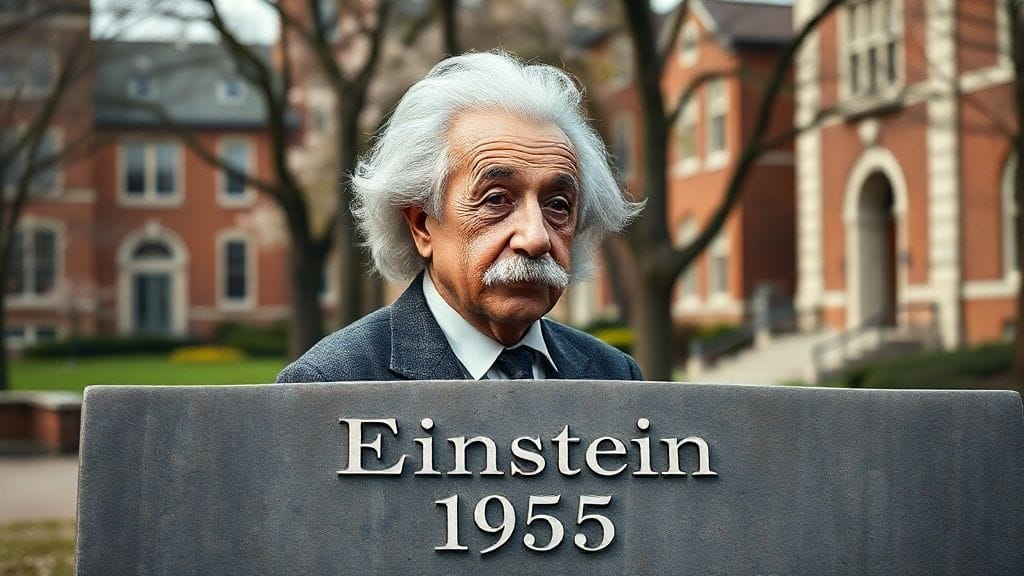
Table of Contents
- The End of an Era: Albert Einstein’s Final Days
- Princeton in the 1950s: A World Rebuilding
- A Mind That Changed the Cosmos: Einstein’s Legacy by 1955
- The Quiet Decline: Einstein’s Health in Early April 1955
- The Morning of April 18: An Ordinary Day, A Fateful Moment
- The Collapse at Princeton Hospital: Final Moments Recounted
- The Last Words Unheard: Mystery and Myth Surrounding Einstein’s Passing
- The Immediate Reaction: A Nation Mourns
- Global Grief: International Tributes to the Scientific Titan
- The Funeral in Tranquility: Private Farewell at Princeton
- Einstein’s Wishes: Cremation and the Scattering of Ashes
- The Scientific Community in Shock: End of an Intellectual Giant
- Einstein’s Death in the Cold War Context
- The Legacy Preserved: How Museums, Universities, and Families Commemorated Einstein
- The Impact on Modern Physics: From Relativity to Quantum Challenges
- Popular Culture and Einstein’s Posthumous Image
- Controversies and Conspiracy Theories after Einstein’s Death
- Reflections by Colleagues: Voices from Oppenheimer to Bohr
- Einstein’s Moral Compass: Pacifism and Humanity Remembered
- Eternal Questions: What Did Einstein’s Death Mean for Science and Society?
The End of an Era: Albert Einstein’s Final Days
On a cool spring morning in April 1955, the world quietly awoke to the death of a man whose name had become synonymous with genius and human curiosity. In a modest hospital room nestled within the serene campus of Princeton, New Jersey, Albert Einstein, aged 76, took his last breath—a gentle severing of life from a mind that had illuminated the secrets of the cosmos for decades. The final moments of the man who reshaped our understanding of time, space, and reality are imbued with a melancholic beauty, a poignant reminder that even the greatest intellects are bound by the fragile laws of mortality.
Around the quiet corridors of the hospital, a hushed reverence prevailed. It was April 18, 1955, but to many, the loss felt as though a star had silently extinguished in the vastness of human thought. The world would forever mark this date, not only as the passing of a scientist but as the closing chapter of one of history’s most luminous souls.
Princeton in the 1950s: A World Rebuilding
The mid-20th century was a time of reconstruction and tension. The fallout from the Second World War still cast its long shadow, and the Cold War brewed ominously on the geopolitical horizon. Princeton University, where Einstein spent his last years, was itself a beacon of intellectual revival amidst a world reshaping itself politically and scientifically.
Postwar America was wresting with newfound global dominance and the nuclear age’s terrifying potential, a reality Einstein himself had helped precipitate but deeply regretted. It was in this crucible of hope and anxiety that Einstein's final days unfolded — a personal twilight reflecting wider global uncertainties.
A Mind That Changed the Cosmos: Einstein’s Legacy by 1955
By the time Albert Einstein entered his final months, his contributions to physics were both foundational and revolutionary. His 1905 annus mirabilis—miracle year—had already transformed physics forever with papers on special relativity, the photoelectric effect (which earned him the Nobel Prize in 1921), and the nature of Brownian motion.
Einstein’s general theory of relativity redefined gravity not as a force but as a curvature of spacetime. Yet, despite decades of fame, he remained a restless mind, wrestling with a quantum world he could never fully embrace. The tension between relativity and quantum mechanics was emblematic of his life—brilliant, sometimes at odds, but always pushing the boundaries of human knowledge.
The Quiet Decline: Einstein’s Health in Early April 1955
Einstein’s health had become precarious by the spring of 1955. Suffering from abdominal aortic aneurysm, a condition he had lived with for years since surgery in 1948, Einstein faced increasing weakness. He had refused further invasive treatment, reportedly telling his doctors, “I want to go when I want. It is tasteless to prolong life artificially.”
True to his nature, Einstein met his decline with dignity, humor, and a clarity of thought that underscored his enduring human spirit.
The Morning of April 18: An Ordinary Day, A Fateful Moment
On April 18, Einstein was admitted to Princeton Hospital after experiencing internal bleeding, a consequence of his weakened aorta. The morning passed with the calm typical of his everyday routine—reading, thinking, and quietly conversing.
But soon, the delicate thread of life began to unravel. His breathing grew labored; the once-commanding mind now slipping gently toward the inevitable silence. Around him, the nurses and doctors maintained a solemn vigil, fully aware that the man lying before them was no ordinary patient.
The Collapse at Princeton Hospital: Final Moments Recounted
Accounts of Einstein’s last moments blend clinical detail with a narrative almost too touching for words. With the ticking clock marked by machines and heartbeats, the great physicist suffered a rupture inside his abdomen around 3:30 pm.
Despite frantic attempts at saving him through surgery, Einstein refused. He expressed to the attending physician his wish against further operations, declaring, “I want to go when I want. It is tasteless to prolong life artificially.”
He passed away shortly afterward, becoming more than a man but a symbol—a beacon fading into history as a transformative figure of the 20th century.
The Last Words Unheard: Mystery and Myth Surrounding Einstein’s Passing
What were Einstein’s final words? The question has become part of his enduring mythos, yet, according to reliable witnesses, Einstein spoke to the hospital staff only in his native German during his last hours—a language many nurses did not understand, and thus the exact last words were never recorded.
Some accounts say his last murmur was quiet and incoherent; others emphasize a silent departure. This mystery has only intensified the legend surrounding his death, feeding the imagination of historians and admirers.
The Immediate Reaction: A Nation Mourns
News of Einstein’s death spread rapidly, first through Princeton and then across the United States. Initially met with somber headlines, reflecting on the man who had come to symbolize the conscience of science in an uncertain world.
President Dwight D. Eisenhower sent a message honoring Einstein’s “deep human sympathy,” his “passion for truth,” and his “quest for peace.” Newspapers detailed his life, not merely as a scientist but as a profound humanitarian whose values challenged the status quo of war and political hypocrisy.
Global Grief: International Tributes to the Scientific Titan
Einstein’s death transcended national borders. In postwar Europe, Germany—his birthplace—expressed deep sorrow, while Israel mourned a national hero whom they had hoped would be their first president. Leaders from Britain to the Soviet Union issued condolences, underscoring his status as a universal figure of intellect and conscience.
In a world cleaved by ideological conflicts, Einstein remained a rare figure united in admiration.
The Funeral in Tranquility: Private Farewell at Princeton
Unlike the grand state funerals other world leaders might have merited, Einstein’s family opted for a quiet ceremony. Held in Princeton, the funeral was attended by close friends, family, and a few members of the scientific community.
There were no grandiose displays—just a simple service reflecting Einstein’s desire for privacy and modesty in death. His ashes were later scattered at an undisclosed location, honoring his wishes and continuing the aura of mystery surrounding him.
Einstein’s Wishes: Cremation and the Scattering of Ashes
Einstein’s instructions for his remains were explicit—he did not want a monument or shrine, nor an elaborate burial that might distract from scientific pursuit and human progress.
His ashes were scattered secretly, reportedly in the Delaware River. This act was symbolic; his legacy was not to be tied to a physical place but embedded in the ever-expanding quest for knowledge.
The Scientific Community in Shock: End of an Intellectual Giant
For physicists and intellectuals worldwide, Einstein’s passing was akin to the closing of a golden age. Colleagues and proteges struggled to come to terms with losing a guiding light whose genius had shaped modern physics.
J. Robert Oppenheimer, who had famously worked on the Manhattan Project, called him “the quintessential physicist, a man whose reach was beyond calculation.” The scientific journals carried tributes that spoke not only of his work but his profound humanity.
Einstein’s Death in the Cold War Context
In 1955, the Cold War was intensifying, with nuclear fears escalating. Einstein had become a public figure opposing nuclear weapons and advocating for peaceful coexistence between East and West.
His death came at a time when his voice was sorely needed, symbolizing a loss not just to science but to an increasingly polarized world searching for moral guidance amid atomic threats.
The Legacy Preserved: How Museums, Universities, and Families Commemorated Einstein
Following his death, institutions worldwide took up the mantle of preserving Einstein’s legacy. The Institute for Advanced Study in Princeton became a living monument, dedicated to the kind of intellectual freedom Einstein epitomized.
Museums showcased his manuscripts, and universities across continents established chairs and fellowships in his name, ensuring future generations would continue to be inspired by his life’s work.
The Impact on Modern Physics: From Relativity to Quantum Challenges
Einstein’s death marked a pivotal moment in physics. While relativity remained undisputed, the subatomic world pressed ahead into mysteries of quantum mechanics and particle physics—fields Einstein had viewed with ambivalence.
His passing symbolized both culmination and new beginnings, leaving successors a monumental foundation on which to build the ever-evolving edifice of science.
Popular Culture and Einstein’s Posthumous Image
In death as in life, Einstein’s visage became iconic, emblematic of the “mad genius” archetype. Photographs of his unruly hair and genial smile circulated widely, appearing on everything from posters to coffee mugs.
His name entered popular parlance as a synonym for intelligence, a cultural touchstone invoking the wonder of discovery and the human capacity for creativity.
Controversies and Conspiracy Theories after Einstein’s Death
Despite the respect earned by Einstein’s name, his death was not without murmurs of controversy. Some conspiracy theories suggested government involvement or secretive motives due to his political stances, though none were substantiated.
More significantly, debates around the handling of his papers and intellectual property sparked disputes among heirs, universities, and collectors, raising questions about ownership and access to knowledge.
Reflections by Colleagues: Voices from Oppenheimer to Bohr
Personal remembrances painted a portrait of a man both brilliant and deeply humane. Niels Bohr lamented, “Einstein’s courage in confronting the unknown was matched only by his warmth and simple humanity.”
Oppenheimer reflected on Einstein’s contradictory personality—sometimes stubborn, sometimes playful—who nonetheless remained an enduring mentor and friend to countless physicists.
Einstein’s Moral Compass: Pacifism and Humanity Remembered
Throughout his life, Einstein spoke openly against war, nationalism, and racial injustice. His death rekindled these ideals in public memory, reminding the world of the scientist as an engaged citizen.
His efforts for civil rights in America, his warnings about nuclear weapons, and his advocacy for peace remain powerful elements of his legacy.
Eternal Questions: What Did Einstein’s Death Mean for Science and Society?
Einstein’s passing leaves us with enduring questions. How do we balance genius with humility? Can science truly serve humanity without ethical guardianship? His death marked not just the loss of an individual but a summons to carry forward the torch of inquiry, tempered by conscience.
The great elder’s departure was less an end and more an invitation—to look beyond the horizon, to dare to understand the universe and ourselves anew.
Conclusion
Albert Einstein’s death on April 18, 1955, was a moment both deeply personal and universally significant. It closed the chapter on a life of unparalleled intellectual courage and human compassion. Yet, as the ashes of his body scattered and his name echoed in lecture halls and popular culture, it became clear that Einstein had transcended mortality.
His legacy is a testament to the power of curiosity, the responsibility of knowledge, and the enduring quest for truth. In mourning his loss, the world also celebrates the indelible footprints he left across science and humanity—footprints that continue to guide and inspire, reminding us that within every question lies the potential for revelation. The story of Albert Einstein is far from over; it remains an open journey into the infinite.
FAQs
Q1: What caused Albert Einstein’s death?
Albert Einstein died from an abdominal aortic aneurysm rupture on April 18, 1955. He refused surgical intervention, preferring to let nature take its course.
Q2: Where did Albert Einstein die?
He died in Princeton Hospital, Princeton, New Jersey, USA.
Q3: How did the world react to Einstein’s death?
The world mourned deeply, with tributes from political leaders, scientists, and the public globally, reflecting on his scientific and humanitarian contributions.
Q4: Were there any memorials or funerals for Einstein?
Einstein’s funeral was a private affair in Princeton without grand ceremonies. His ashes were scattered secretly, according to his wishes.
Q5: What legacy did Einstein leave behind?
Einstein revolutionized physics, especially through the theories of relativity, and he remains a symbol of intellectual bravery and moral conviction.
Q6: Did Einstein’s death affect Cold War politics?
His passing was felt during a tense Cold War era; as a vocal advocate for peace, his absence was a significant loss in the struggle for nuclear disarmament and global dialogue.
Q7: Are there any controversies linked to Einstein’s death?
Some conspiracy theories exist but lack credible evidence. Disputes over his personal papers and intellectual legacy have created legal and ethical debates.
Q8: What personal qualities of Einstein are most remembered?
Beyond genius, Einstein is remembered for his warmth, pacifism, humility, and commitment to social justice.

