Table of Contents
- The Clash at Tolbiac: Prelude to a Turning Point
- Germania in Turmoil: The Alemanni and the Franks
- The Rise of Clovis: Ambition and Destiny
- Political and Religious Landscapes of Late 5th Century Europe
- The Battle Unfolds: Strategies, Stakes, and Soldiers
- The Turning Tide: Alemanni Retreat and Frankish Triumph
- Clovis’s Pivotal Prayer: Faith in the Midst of Battle
- The Aftermath: Establishing Frankish Dominance
- The Conversion of Clovis: From Pagan Warrior to Christian King
- The Frankish Kingdom: Seeds of Medieval Europe
- Alemanni Resilience and Decline
- The Religious Dimension: Catholicism vs. Arianism
- Legacy of the Battle in Historical Memory and Myth
- The Myth and Reality of Tolbiac: Comparing Chronicles
- Tolbiac and the Formation of a European Identity
- Clovis’s Victory in Later Medieval Historiography
- Archaeological Insights into the 496 Battlefield
- The Alemanni in Post-Battle Germania
- Political Ramifications within the Frankish Realm
- Tolbiac’s Echoes in Modern German-French Relations
- Final Reflections on a Battle that Shaped Western Christendom
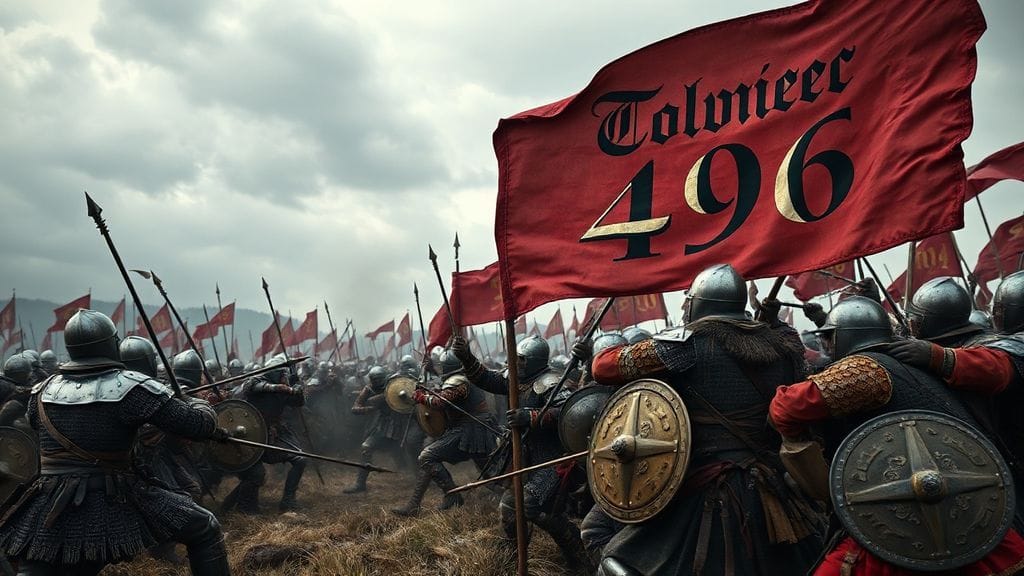
The morning air hung heavy with the mist of uncertainty, thick over the rolling hills near a small settlement called Tolbiac, not far from today’s Zülpich in Germania. Two great peoples, the Alemanni and the Franks, stood face to face, their warriors fatigued from years of migration, territorial disputes, and shifting alliances. The pounding of thousands of feet, the clanking of chainmail, and the muted prayers whispered before the clash fused into a palpable tension. In 496 AD, what seemed at first like just another skirmish between Germanic tribes bore consequences that would echo for centuries—a collision that would shape the destiny of medieval Europe and the religious landscape of the West.
Germania in Turmoil: The Alemanni and the Franks
To fully grasp the significance of the confrontation at Tolbiac, we must zoom out to the fractious world of late 5th-century Germania. The Alemanni, a confederation of Germanic tribes, had established themselves in the southwestern reaches of Germania, often encroaching into Roman Gaul’s northeastern territories. Known for their fierce independence and warrior traditions, they frequently clashed with neighboring peoples for dominance and survival amidst the collapse of Roman authority.
To the west of the Alemanni stood the rising Frankish tribes, under the command of a bold leader named Clovis I. Unlike the loosely affiliated Alemanni, the Franks were rapidly coalescing into a unified kingdom, embodying a new wave of power capable of filling the vacuum left by Rome’s retreat. The competition for land, resources, and prestige was fierce, and in this turbulent era, military strength was the ultimate currency.
The Rise of Clovis: Ambition and Destiny
Clovis, son of Childeric I, was not merely a warrior chieftain but a figure whose ambitions matched the shifting tides of his time. His rulership began in the late 5th century with the goal of consolidating Frankish power, uniting rival clans, and challenging external foes such as the Alemanni. Yet beyond politics, Clovis’s story is interwoven with something far more profound: his eventual conversion to Catholic Christianity, a decision that would pivot on the outcome of the battle near Tolbiac.
Before the fighting erupted, Clovis was a man torn between his traditional pagan roots and the growing influence of Christianity spreading through Roman Gaul. The Franks included many Arian Christians but Clovis remained a pagan — up until the moment that would change everything.
Political and Religious Landscapes of Late 5th Century Europe
The late 5th century was a moment pregnant with upheaval: Rome’s western empire had fallen just two decades earlier, in 476 AD, leaving a fractured patchwork of successor kingdoms. The influence of Christianity was evolving, with Catholicism and Arianism jockeying for dominance among Germanic rulers and their peoples. The Alemanni largely adhered to paganism or Arian Christianity, while the Romanized populations preferred Nicene Catholicism.
Clovis’s embrace of Catholicism would give him an unprecedented political advantage. The Roman Church and the Gallo-Roman aristocracy viewed him as the natural heir to the Roman legacy in Gaul, offering spiritual legitimacy to his military conquests and political maneuvering. The battle at Tolbiac thus held not just territorial consequences but symbolized a quiet revolution of faith and power in early medieval Europe.
The Battle Unfolds: Strategies, Stakes, and Soldiers
Despite the scarcity of detailed military records, it is known that the battle consisted of relentless hand-to-hand combat on a field strewn with mud and broken branches—characteristics commonplace for the forests and marshlands of Germania. Clovis’s Frankish forces were likely better organized and more numerous, yet the Alemanni's ferocity and knowledge of the terrain made victory uncertain.
Contemporary chroniclers like Gregory of Tours attest to the desperation of Clovis's troops, who suffered significant losses under the Alemanni’s assault, described as overwhelming and brutal. It was in this critical moment—when defeat seemed inevitable—that the famed prayer occurred, a turning point etched into historical memory.
The Turning Tide: Alemanni Retreat and Frankish Triumph
According to almost legendary accounts, Clovis prayed to the Christian God to aid him in battle, vowing to convert should he be granted victory. Almost miraculously, the Frankish forces rallied with renewed vigor, turning the tide and forcing the Alemanni into a retreat.
The Alemanni, though formidable, could not withstand the reinvigorated Frankish charge. Their defeat at Tolbiac marked a decisive setback, heralding the rise of Clovis as the dominant power in the region. But the victory was not just a military one; it was spiritual, political, and symbolic.
Clovis’s Pivotal Prayer: Faith in the Midst of Battle
Gregory of Tours, writing roughly a century later, captures the drama and drama of Clovis’s prayer beautifully:
"If you grant me this victory over the Alemanni, I will believe in your holy God."
True to his word, following the battle Clovis was baptized a Catholic Christian, an event that changed the course of Frankish and European history.
This moment gave birth to a new narrative: the Christian king chosen by God to lead the Frankish peoples. The merger of political authority and religious legitimacy under Clovis's leadership set the precedent for medieval Christendom.
The Aftermath: Establishing Frankish Dominance
The victory over the Alemanni did more than halt their advance—it opened the doors for Frankish expansion into former Roman territories. Clovis capitalized on his success by consolidating power, incorporating Alemannic lands, and bolstering support among Gallo-Romans and the Church.
In the decades following Tolbiac, the Frankish kingdom expanded dramatically, laying the groundwork for what would eventually become the Carolingian Empire centuries later. Clovis’s reign thus signaled not just a military triumph but the dawn of a new political order in Europe.
The Conversion of Clovis: From Pagan Warrior to Christian King
While the battle near Tolbiac marks the military turning point, it was Clovis’s conversion to Catholic Christianity that stamped his legacy and inspired generations. Unlike many contemporaries who embraced Arianism—a variant Christianity considered heretical by Rome—Clovis’s alignment with orthodox Catholicism earned him papal favor and the loyalty of powerful Roman elites.
The baptism, traditionally celebrated as taking place in Reims around 496, was more than a personal religious experience; it symbolized the unification of Frankish power with the spiritual authority of the Church, fostering an identity that blended Roman tradition and Germanic strength.
The Frankish Kingdom: Seeds of Medieval Europe
Under Clovis, the Franks united much of Gaul into a stable realm, creating the political and cultural foundations for medieval Europe. His law code, the Salic Law, systematized governance, and established legal precedents that would resonate for centuries.
Moreover, the Frankish adoption of Catholicism set the stage for the Church’s increasing influence in temporal affairs, transforming Europe’s landscape from fragmented tribal territories to theocratic kingdoms under the banner of Christendom.
Alemanni Resilience and Decline
Despite their defeat, the Alemanni were not erased overnight. They retreated into their homelands, resisting Frankish domination intermittently over the next century. However, continued pressure from the expanding Frankish kingdom and internal divisions gradually eroded their independence.
By the 6th and 7th centuries, Alemannic territory was absorbed into Frankish domains, their distinct identity diluted but never entirely extinguished, surviving in regional languages and cultures of southwest Germany.
The Religious Dimension: Catholicism vs. Arianism
The battle and Clovis’s conversion also exemplified the religious tensions between Arianism—which many Germanic tribes, including the Goths and Lombards, endorsed—and Catholic orthodoxy championed by the Church in Rome.
Clovis’s choice to support Catholicism encouraged other Germanic rulers to reconsider their faith, accelerating the Church’s consolidation of power over the “barbarian” kingdoms and shaping the religious map of Europe for centuries.
Legacy of the Battle in Historical Memory and Myth
Tolbiac’s legacy grew beyond its immediate military significance. Chroniclers, monks, and later medieval historians framed the battle as divinely ordained, an event where secular power and sacred will converged.
It became a founding myth for the French monarchy and a symbol of Christian triumph over paganism, inspiring art, literature, and national identity. The prayer of Clovis, in particular, was recounted as a miracle, reinforcing the king’s sanctified role.
The Myth and Reality of Tolbiac: Comparing Chronicles
While Gregory of Tours provides the major narrative, other sources are silent or fragmentary, leaving historians to navigate between embellished myth and sparse fact.
Archaeological findings remain inconclusive in pinpointing the exact location and scale of the battle, and questions linger about the real dynamics of the conflict. Yet, the enduring story reveals how historical memory is crafted as much by faith and politics as by the swords on the field.
Tolbiac and the Formation of a European Identity
The encounter at Tolbiac was more than a single clash; it was the crucible in which the identity of Western Europe began to forge itself—Christian, Latinized, yet rooted in Germanic tradition.
By uniting the Frankish kingdom and linking it with the Church, Tolbiac set the stage for the medieval synthesis of Roman, Christian, and barbarian legacies.
Clovis’s Victory in Later Medieval Historiography
Throughout the Middle Ages, Clovis was lauded as the “Last Roman” and the “First Christian King” of France. His story was invoked to legitimize royal power, to inspire crusades, and to embody the ideals of medieval kingship.
Tolbiac’s narrative was retold in chansons de geste, illuminated manuscripts, and royal propaganda, ensuring its place in Europe’s collective imagination.
Archaeological Insights into the 496 Battlefield
Modern archaeology has sporadically explored the region near Zülpich, attempting to uncover remnants of late 5th-century conflicts. While no definitive evidence confirms battlefield specifics, limited finds such as weapon fragments and settlement layers corroborate the area’s importance as a contested zone.
Continued research promises to shed further light on this shadowy moment in history.
The Alemanni in Post-Battle Germania
Post-Tolbiac, the Alemanni adapted by integrating into the Frankish realm, retaining some cultural distinctiveness but gradually assimilating.
Their linguistic and cultural heritage contributed to regional identities in southwestern Germany, Upper Alsace, and parts of Switzerland, areas that carry traces of their name and presence to this day.
Political Ramifications within the Frankish Realm
Clovis’s victory consolidated his power and facilitated the unification of diverse Frankish tribes under a single crown. This political centralization was a critical step toward the creation of a united medieval France.
Clovis’s reign also established dynastic precedents for the Merovingian dynasty, although it would be centuries later before the full flowering of Frankish power under the Carolingians.
Tolbiac’s Echoes in Modern German-French Relations
Remarkably, the battle that once saw two Germanic peoples clash now symbolizes the intertwined histories of Germany and France. Tolbiac’s legacy survives in cultural memory and scholarship as a reminder of shared origins and conflicts.
In more recent centuries, historians and politicians have looked back to such moments to either cultivate rivalry or promote reconciliation, reflecting the layered meanings historical events acquire over time.
Final Reflections on a Battle that Shaped Western Christendom
The Battle of Tolbiac stands as a defining moment when martial valor, religious faith, and political ambition converged to alter the trajectory of European civilization. It illustrates how a single day’s combat can resonate beyond the battlefield, influencing belief systems, state formation, and identity for generations.
Clovis’s victory was not simply a triumph over the Alemanni, but a victory for a burgeoning medieval Europe—a Europe that would carry the dual legacies of Rome and the Germanic peoples within the shield of Christianity.
Conclusion
The battle near Tolbiac in 496 offers more than a tale of swords clashing; it reveals the fragile, combustible juncture at which history pivots. Here, a leader’s promise amid desperation blossomed into a transformation of kingdom and conscience, nation and faith. Clovis’s victory was not merely strategic but epochal: by choosing Catholicism, he chose the future of Europe. The Alemanni were checked not only on a battlefield but within the currents of time itself, their fate intertwined with the rise of the medieval West.
This moment, shrouded in mist and myth, teaches us how history is a human story of courage and belief, a web of choices and chance that crafts the world we inherit. Tolbiac reminds us that behind every great victory lies an intimate struggle — a prayer, a hope, a turning point that reshapes destinies.
FAQs
Q1: Why was the Battle of Tolbiac so significant in European history?
The battle marked the decisive defeat of the Alemanni by the Franks, enabling Clovis to consolidate power and establish the foundations of the medieval Frankish kingdom. It also precipitated his conversion to Catholicism, influencing the religious future of Europe.
Q2: Who were the Alemanni, and what role did they play in late 5th-century Germania?
The Alemanni were a confederation of Germanic tribes inhabiting southwestern Germania. Known for their military prowess and resistance to Roman and Frankish expansion, they played a central role in regional dynamics until their defeat at Tolbiac.
Q3: What is the historical evidence for Clovis’s prayer and conversion?
The primary source is Gregory of Tours, writing roughly 100 years later. While the prayer’s exact details lack contemporary corroboration, its narrative served as a potent symbol of divine intervention legitimizing Clovis’s rule.
Q4: How did Clovis’s conversion impact the spread of Christianity in Europe?
By embracing Catholicism over Arianism or paganism, Clovis aligned the Frankish realm with the Roman Church, facilitating the spread of orthodox Christianity among Germanic peoples and strengthening the Church’s political influence.
Q5: In what ways did the battle affect the Alemanni?
It was a major military and political setback that led to the gradual incorporation of Alemannic lands into the Frankish kingdom. Although the Alemanni persisted culturally, their political independence waned.
Q6: How is the Battle of Tolbiac remembered in modern times?
Tolbiac remains a symbol of the birth of France and Christian Europe in historiography and cultural memory. It is often referenced in discussions of early medieval history and the formation of European identities.
Q7: Are there any archaeological findings related to the battle?
To date, archaeological evidence is limited and inconclusive, but discoveries around Zülpich suggest the region was contested during this period. Ongoing studies aim to uncover more definitive proof.
Q8: What role did the battle play in shaping medieval European political structures?
The victory helped unify disparate Frankish tribes under Clovis’s rule, setting precedents for centralized monarchies and intertwining royal authority with the Church, cornerstones of medieval European governance.

