Table of Contents
- The Fateful Night: February 10, 1837, in St. Petersburg
- Russia’s Greatest Poet Faces His Mortal Duel
- Early Life of Alexander Pushkin: From Prodigy to National Icon
- The Burden of Genius: Pushkin’s Turbulent Personal Life
- The Rise of Romanticism and Literary Revolution in Imperial Russia
- The Political Climate of Tsarist Russia in the 1830s
- The Scandal that Sparked the Duel: Pushkin and Georges d’Anthès
- The Anatomy of a Duel: Rituals and Deadly Consequences
- From the Duel to the Deathbed: The Final Hours
- Public Mourning in St. Petersburg: A Nation in Grief
- Literary Legacy: How Pushkin Redefined Russian Literature
- The Duel’s Role in Shaping Russian Romanticism
- Tsar Nicholas I’s Complicated Relationship with the Poet
- Pushkin’s Death and the Shadow of Censorship
- Myths and Legends: The Poet’s Death in Popular Imagination
- Pushkin’s Influence Across Borders and Generations
- The Evolution of Pushkin’s Memory in Soviet and Post-Soviet Russia
- The Cultural and Political Symbolism of Pushkin’s Demise
- Enduring Questions: Honor, Freedom, and Artistic Expression
- Conclusion: The Eternal Flame of Russia’s Bard
- FAQs About Alexander Pushkin’s Death and Legacy
- External Resource
- Internal Link
1. The Fateful Night: February 10, 1837, in St. Petersburg
The cold air of that February night in 1837 was sharp, unforgiving—the sort that bites into the bone beneath the delicate waistcoats and velvet cloaks favored by St. Petersburg’s aristocracy. Snow muffled the city’s usual din, and gas lamps cast elongated shadows on cobblestone streets slick with ice. Inside a modest apartment near the Neva River, Alexander Pushkin, Russia’s beloved poet and the fiery soul behind the nation’s literary awakening, lay gravely wounded. His chest bore a bullet wound inflicted just hours earlier, the result of a duel as old as honor itself but as fatal as the rising tide of censorship and intrigue that engulfed the empire.
As his breathing slowed and his vision blurred, Pushkin’s final moments were filled with a profound mixture of pain, regret, and a fierce clinging to the poetic essence that defined him. Friends and family gathered near the bedside of this brilliant man whose voice had forever altered Russian culture—yet now, the vibrancy of life drained away like melting snow. The city would never be the same after that night.
2. Russia’s Greatest Poet Faces His Mortal Duel
Alexander Sergeyevich Pushkin was not merely a writer; he was the soul of Russian literature in its infancy, the fiery precedent for what was to become a national identity forged in words and spirit. Yet on this cold February evening in the imperial capital, it was not a stanza or a novel that commanded attention—it was a pistol, a code of honor, and a threat that came cloaked in passion and jealousy.
His adversary, the French officer Georges-Charles de Heeckeren d’Anthès, a symbol of the foreign influence and court intrigues harbored in Petersburg’s salons, had become the lightning rod for rumors surrounding Pushkin’s wife, Natalya Goncharova. The duel was an inevitable clash—between past and future, between the individual and society, and ultimately between life and death.
3. Early Life of Alexander Pushkin: From Prodigy to National Icon
Born in 1799 into an aristocratic family of minor nobility, Pushkin’s destiny was seeded early. Showing precocious talent, he was immersed in education that ranged from classic literature to languages and history. Moscow’s universities and St. Petersburg’s elite schools polished his literary gifts, but nowhere was his true education more profound than in the unfolding narrative of Russian national consciousness.
His early works, marked by a keen lyricism and a playful wit, positioned Pushkin as a prodigy worthy of imperial patronage. However, his genius was restless, revealing a deep yearning for freedom, both political and artistic—a dangerous cocktail in Tsarist Russia’s tightened grip.
4. The Burden of Genius: Pushkin’s Turbulent Personal Life
Pushkin’s personal life resembled the tempestuous narratives he penned. His passionate nature, combined with intense sensitivity, drew him both admirers and adversaries. His marriage to Natalya Goncharova, celebrated for her unparalleled beauty, was a social triumph but not without strife. Jealousies, rumors, and gossip swirled in the aristocratic circles, with d’Anthès’s attentions to Natalya igniting fires that would consume Pushkin’s final days.
The poet’s letters reveal a man torn between dignity and despair, courage and vulnerability. He feared the damage the scandals might inflict not only on his reputation but on his creative spirit.
5. The Rise of Romanticism and Literary Revolution in Imperial Russia
During Pushkin’s life, Russia was riven between the Enlightenment’s fading shadows and the rising flame of Romanticism, a movement that celebrated the individual, emotion, and nature’s untamed force. Pushkin emerged as a key figure leading this literary transformation—he was a bridge between European currents and an authentically Russian voice.
His works, ranging from “Eugene Onegin” to “The Bronze Horseman,” offered a heartfelt exploration of human passion, social critique, and historical reflection. In doing so, he laid the foundation for the golden age of Russian literature.
6. The Political Climate of Tsarist Russia in the 1830s
The 1830s were a precarious time in the empire. Tsar Nicholas I had consolidated power with an iron fist, wary of liberal ideas spreading from Europe, and particularly sensitive to any hint of unrest at home. Secret police and censorship were omnipresent; intellectual freedom was traded for survival.
Pushkin’s own relationship with the regime was paradoxical: sometimes favored, sometimes watched with suspicion. His works were scrutinized, and his social circle, filled with liberals and conspirators, made his position increasingly precarious.
7. The Scandal that Sparked the Duel: Pushkin and Georges d’Anthès
The origins of the deadly duel lie in jealousy and honor—a volatile mix. Georges d’Anthès, a French émigré officer serving in the Russian cavalry, became enamored with Natalya Goncharova. His overt attentions inflamed rumors so rampant that society whispered of an affair.
Pushkin, insulted and desperate to defend not only his wife's honor but his own, confronted d’Anthès with heated letters and verbal challenges. The tensions escalated quickly until the fateful decision to meet at dawn with pistols.
8. The Anatomy of a Duel: Rituals and Deadly Consequences
The duel was an archaic ritual steeped in notions of chivalry and masculinity. Set under the pallid light of a frozen winter morning on a meadow near Strelna, the men faced each other with loaded pistols.
Shots rang out. Pushkin was hit in the abdomen—an injury that would prove rapidly fatal given the era’s limited medical knowledge. The duel, sanctioned by codes of honor yet utterly senseless in its outcome, sealed the poet’s fate.
9. From the Duel to the Deathbed: The Final Hours
After agonizing over his mortal wound, Pushkin was moved to his home under the care of his family and trusted friends. Doctors attended to him, but the bullet had pierced vital organs, and infection set in quickly.
In these hours, the poet reportedly managed to compose verses, cling to consciousness, and share last words. His presence was a beacon of fading brilliance—friends described the room as heavy with sorrow yet suffused with the dignity of a man confronting death on his own terms.
10. Public Mourning in St. Petersburg: A Nation in Grief
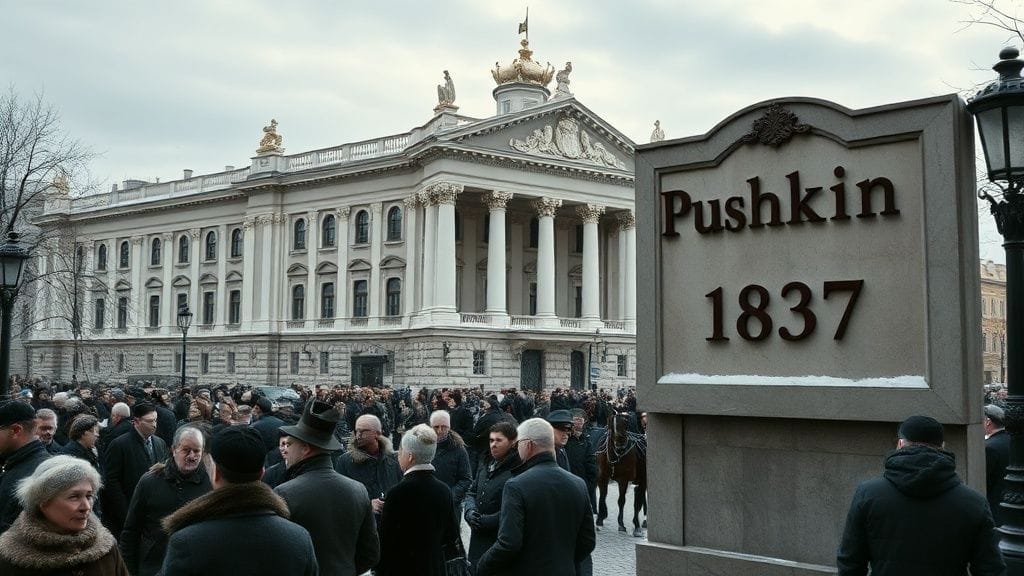
News of Pushkin’s death swept through St. Petersburg and beyond like a somber tide. Citizens from all walks of life observed collective mourning. Public readings of his poetry were organized, candles lit in churches, and newspapers published elegies.
No Russian poet before him had galvanized the emotional consciousness of the nation so profoundly. Even the tsar’s court felt the tremors of loss, though caution dictated a muted response.
11. Literary Legacy: How Pushkin Redefined Russian Literature
Pushkin’s death marked not only the loss of a man but the end of an era and the birth of a legacy. He revolutionized Russian language, lifting it beyond the rigid classical templates into vibrant, expressive forms accessible to the people.
His work opened doors for future titans—Dostoevsky, Tolstoy, Turgenev—and his influence on narrative structure, character psychology, and poetic forms persists today. He was both a democratizer and a visionary of literary art.
12. The Duel’s Role in Shaping Russian Romanticism
The tragedy of Pushkin’s death became emblematic of Romantic ideals: the tortured genius, the conflict between individual passion and societal constraints, the heroic yet doomed figure. His death enshrined the Romantic poet as a cultural martyr.
The duel itself entered literary imagination, symbolizing fatal honor clashes that haunted Russia’s social and political fabric.
13. Tsar Nicholas I’s Complicated Relationship with the Poet
Nicholas I’s reign was marked by authoritarian control, yet he simultaneously admired parts of Pushkin’s genius. Ironically, it was the Tsar who personally supervised the poet’s censorship and even legitimized the duel’s aftermath by condemning d’Anthès to exile rather than harsher penalties.
The Tsar’s patronage underscored the complex interplay of power, creativity, and control in imperial Russia.
14. Pushkin’s Death and the Shadow of Censorship
Pushkin’s legacy was both celebrated and suppressed. Authorities, mindful of the political potential in his writings, limited access to his more subversive works. The poet’s death also silenced a critical voice amid a growing wave of political unrest.
This paradox shaped the literary currents for decades—where freedom struggled against autocracy, much like the poet himself had done.
15. Myths and Legends: The Poet’s Death in Popular Imagination
Over time, Pushkin’s death transcended facts to become legend—stories of ghostly apparitions, prophetic dreams, and secret societies formed around his memory emerged. The duel was mythologized as a symbol of ultimate sacrifice, honor, and the artist’s eternal struggle.
These tales reveal as much about Russian cultural psyche as they do about the historical event.
16. Pushkin’s Influence Across Borders and Generations
Pushkin’s genius was not confined to Russia. His works inspired European Romanticism and became a reference point for writers worldwide who saw in him a beacon of linguistic innovation and humanistic depth.
His influence echoed in poetry, prose, and even music, fostering a cultural dialogue between Russia and the world.
17. The Evolution of Pushkin’s Memory in Soviet and Post-Soviet Russia
In Soviet times, Pushkin was appropriated as a national hero embodying the spirit of the people, though censored and reframed to fit ideological narratives. Statues and commemorations proliferated, turning his image into a symbol of Russian cultural pride.
Post-Soviet Russia has witnessed a more nuanced engagement with his legacy, balancing reverence with critical scholarship.
18. The Cultural and Political Symbolism of Pushkin’s Demise
Pushkin’s death is often interpreted as a microcosm of Russia’s continuing struggles—the conflict between progress and tradition, freedom and repression, individual and state. His demise symbolizes the cost of artistic truth in authoritarian contexts.
To this day, memorials in St. Petersburg echo this symbolism, reminding visitors of the enduring human stakes involved.
19. Enduring Questions: Honor, Freedom, and Artistic Expression
The duel that killed Pushkin poses timeless questions. What price does creativity pay under oppressive regimes? How do notions of honor shape or distort human lives? Can art transcend mortal tragedy?
These inquiries keep Pushkin’s story alive—not as mere history, but as a continuing dialogue.
20. Conclusion: The Eternal Flame of Russia’s Bard
Alexander Pushkin’s death was a tragic rupture in the cultural heart of Russia—yet from this loss emerged an immortal flame. His poetry sings through centuries, his name uttered with reverence and love. The duel on that frozen morning cost the world an incomparable genius, but also bolstered a national identity still deeply connected to his voice.
Even today, as snow falls softly over St. Petersburg, one can almost hear Pushkin’s verses riding the cold winds, an eternal testament to the enduring power of art and humanity.
FAQs About Alexander Pushkin’s Death and Legacy
Q1: What led to the duel between Alexander Pushkin and Georges d’Anthès?
A1: The duel was primarily sparked by rumors and jealousy surrounding Pushkin’s wife, Natalya Goncharova, and d’Anthès’s attentions toward her. Pushkin’s honor compelled him to challenge d’Anthès after escalating social provocations.
Q2: How did the political climate of Russia contribute to Pushkin’s fate?
A2: The repressive atmosphere under Tsar Nicholas I amplified tensions around free expression and personal honor. Pushkin’s critical yet complex relationship with the regime created a perilous backdrop that indirectly influenced his downfall.
Q3: What was the immediate impact of Pushkin’s death on Russian society?
A3: Pushkin’s death triggered widespread mourning across social classes. It was seen as a national tragedy, propelling public reflection on artistic freedom and personal dignity within Russian culture.
Q4: How did Pushkin influence later Russian writers?
A4: Pushkin is often called the father of modern Russian literature. His innovations in language, narrative style, and character development profoundly influenced great writers like Dostoevsky, Tolstoy, and Chekhov.
Q5: Was Pushkin’s duel and death unique in Russian history?
A5: While dueling was not uncommon among the aristocracy, Pushkin’s death was unique due to his towering literary stature and the symbolic significance it gained in Russian cultural memory.
Q6: How is Pushkin remembered in contemporary Russia?
A6: Pushkin remains a towering cultural figure. His works are mandatory in education, and his death is commemorated through museums, monuments, and literary festivals, embodying Russian national identity.
Q7: Did Tsar Nicholas I intervene in the duel or its aftermath?
A7: Nicholas I, who had a personal interest in Pushkin's career, did not prevent the duel but later took steps to exile d’Anthès. The tsar’s actions reflected a desire to maintain order while balancing his patronage of the poet.
Q8: What myths surround Pushkin’s death?
A8: Various legends suggest mystical elements around his death, including ghost sightings and prophetic dreams. These myths have grown over time, embedding the poet deeply in Russian folklore.