Table of Contents
- The Dawn of Desperation: Wessex in the Shadow of Viking Invasion
- Alfred the Great: The Monarch in Exile
- The Vikings in England: From Raids to Conquest
- Strategic Retreats and Critical Alliances
- Rallying the West Saxons: The Making of a Resistance
- The Gathering Storm at Edington: Prelude to Battle
- The Battlefield: Geography and Conditions of Ethandun
- Clash of Titans: The Battle Unfolds
- Tactics and Turning Points: How Alfred Triumphed
- The Aftermath: Viking Surrender and Terms of Peace
- The Treaty of Wedmore: A Fragile Peace
- Alfred’s Vision: Consolidating Wessex and Defending England
- The Danelaw Established: A Divided Kingdom
- Alfred’s Legacy: From Warrior King to Father of England
- The Cultural Renaissance Inspired by Alfred’s Victory
- Reflections in Saga and Song: Vikings and Saxons Remember Edington
- The Long Shadow of 878: How Edington Shaped Britain
- Conclusion: Alfred’s Victory as a Beacon of Hope and Resilience
- FAQs: Insights into Alfred’s Victory at Edington
- External Resource
- Internal Link
In the late spring of 878, as the frost began to relinquish its hold on the English countryside, the air was thick with foreboding. The once-mighty Kingdom of Wessex, the last significant Anglo-Saxon holdout against the relentless Viking onslaught, teetered on the brink of annihilation. King Alfred, a monarch whose name would become legendary, had been forced into hiding, his forces battered and scattered. Yet, from the depths of despair emerged a flame of resistance at Edington — a confrontation that would alter the course of English history forever.
The Dawn of Desperation: Wessex in the Shadow of Viking Invasion
For decades, the relentless tide of Viking activity had turned from hit-and-run raids into calculated campaigns of conquest. Since their first infamous landing in 865, the Great Heathen Army had ravaged the English kingdoms, toppling monarchs and seizing territories with ruthless efficiency. By 878, only Wessex remained a bulwark against full Norse domination. Yet even this bastion had nearly fallen, and the very survival of Anglo-Saxon identity hung by a thread.
Alfred the Great: The Monarch in Exile
King Alfred, son of King Æthelwulf, was no ordinary ruler. Despite being raised for the burden of kingship, he was also a scholar, a poet, and a devout Christian. Yet the military crisis tested not only his strategic acumen but his spirit. The winter of 878 was one of hardship; Alfred was forced into refuge in the marshes of Athelney, an island amid the Fens. Stories tell of him disguised as a humble swineherd, hiding from Viking patrols — a king reduced to a fugitive in his own land. But far from despairing, Alfred used this exile to rally his nobles and warriors, setting the stage for a decisive counterstrike.
The Vikings in England: From Raids to Conquest
The Viking incursions into England had evolved dramatically. Initially opportunistic raids for plunder, these expeditions morphed into a systematic effort to subjugate and settle English territories. The Great Heathen Army, under the command of the Danish warlord Guthrum, wreaked havoc from Northumbria down to Mercia and into the heart of Wessex. Guthrum was no mere pirate; he was a formidable and calculating leader, a symbol of Norse ambition to establish a permanent foothold in England.
Strategic Retreats and Critical Alliances
Alfred’s decision to retreat was not a sign of weakness but of tactical foresight. Understanding the limits of his forces and the strategic landscape, he sought to preserve his core army and rebuild alliances. His continued communication with other Anglo-Saxon nobles, including Mercian leaders, laid the foundations of a broader coalition against the Vikings. This patience and strategic cunning contrast sharply with the popular image of impulsive battle.
Rallying the West Saxons: The Making of a Resistance
From the marshes of Athelney, Alfred summoned his commanders and galvanized the spirit of the West Saxons. His proclamations, brimming with religious conviction and appeals to communal identity, rekindled hope. Alfred’s charismatic leadership was essential; tales tell of how he invoked not just loyalty but a profound sense of destiny, framing the fight as a holy defense of Christian England against pagan invaders.
The Gathering Storm at Edington: Prelude to Battle
By late spring, Alfred’s forces moved from the swamps and woods, converging on Edington (also recorded as Ethandun), a location carefully chosen. The selection was no accident: Edington lay within reach of strategic routes and allowed Alfred to control the battlefield’s flow. Viking detachments, scattered from winter quarters, began to regroup under Guthrum, setting the stage for the inevitable confrontation.
The Battlefield: Geography and Conditions of Ethandun
The terrain at Edington was a decisive factor. Rolling downs meeting open fields gave cavalry and foot soldiers room to maneuver but also made concealment difficult. The battle likely commenced under clear skies, with both armies aware that the future of their peoples rested on this encounter. Contemporary chronicles offer tantalizing glimpses — the clash was fierce, the noise deafening, the stakes monumental.
Clash of Titans: The Battle Unfolds
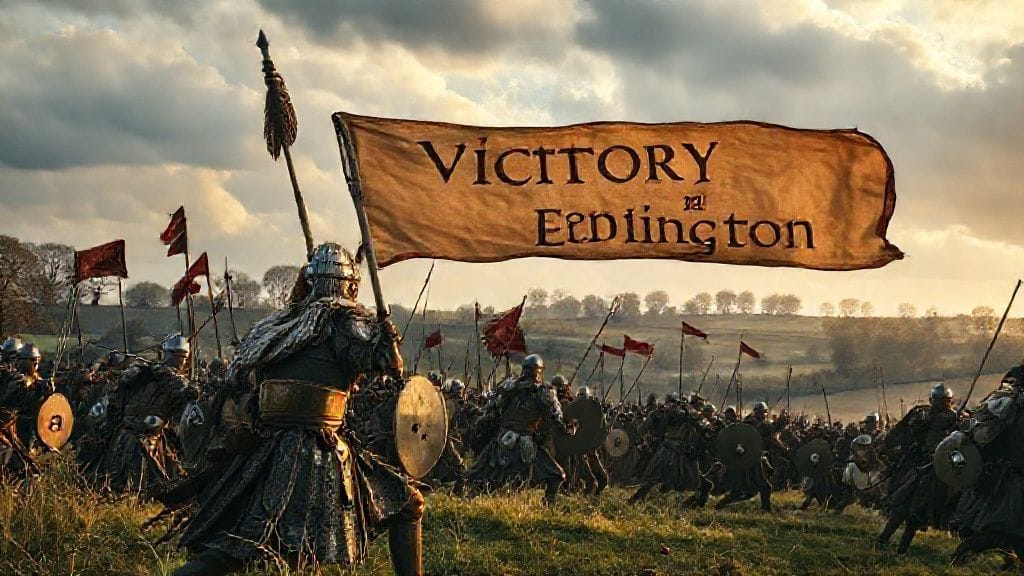
The battle itself remains shrouded in some mystery, given the brevity of contemporary accounts, but the intensity is evident. Alfred’s forces employed disciplined shield-walls, archers, and carefully timed charges, while Guthrum’s Vikings fought with feared berserker ferocity. The Saxons’ morale, buoyed by a unifying cause and Alfred’s leadership, gradually turned the tide against the initially imposing Viking forces.
Tactics and Turning Points: How Alfred Triumphed
One turning point was likely the effective use of archers disrupting Viking formations, combined with coordinated infantry surges breaching the Norse lines. Some historians speculate that Alfred’s familiarity with local terrain allowed him to outmaneuver Guthrum’s army. As Viking cohesion faltered, desertions and breakdowns followed, culminating in Guthrum’s surrender — a psychological and strategic defeat.
The Aftermath: Viking Surrender and Terms of Peace
The Viking defeat was not merely a military loss but a moment of political transformation. Guthrum agreed to be baptized as a Christian under Alfred’s sponsorship, symbolizing not only conversion but submission. This pact reflected a remarkable moment where force gave way to diplomacy, enabling a tenuous peace that allowed Wessex to recover while establishing frameworks for Viking settlement in eastern England.
The Treaty of Wedmore: A Fragile Peace
Though the exact terms of the Treaty of Wedmore are debated by historians, its significance is undisputed. The agreement formalized boundaries between Saxon-controlled lands and the Danelaw, the Viking-controlled territories in the north and east. This partition set the stage for decades of uneasy coexistence, marked by shifting alliances, trade, and occasional conflicts.
Alfred’s Vision: Consolidating Wessex and Defending England
Following his victory, Alfred set about strengthening his kingdom. He reformed the military system, built a network of fortified burhs (fortresses), and reorganized the navy to prevent new Viking raids. Beyond warfare, he promoted education, legal reform, and the revival of learning — a renaissance to match his military achievements. Alfred’s foresight ensured that Wessex was better prepared to face future threats.
The Danelaw Established: A Divided Kingdom
The emergence of the Danelaw entrenched a cultural, political, and legal division in England. Norse customs and English traditions coexisted, sometimes clashing, sometimes blending. Viking settlers integrated into local communities, leaving a lasting linguistic and genetic legacy. This era of division and interaction shaped the evolution of England’s medieval tapestry.
Alfred’s Legacy: From Warrior King to Father of England
Alfred’s victory at Edington earned him the epithet "the Great," a rare honor for an Anglo-Saxon king. He models leadership marked by resilience, strategic brilliance, and cultural patronage. His ability to transform near-defeat into lasting stability laid the foundation for the eventual unification of England under his descendants.
The Cultural Renaissance Inspired by Alfred’s Victory
Alfred’s reign sparked a revival of English literature, law, and learning. His translations of Latin works into Old English made knowledge accessible. Monastic communities flourished, chronicling history and preserving heritage. This cultural flourishing underpinned the recovery of English identity post-Viking invasions and fostered a sense of national unity.
Reflections in Saga and Song: Vikings and Saxons Remember Edington
Both Anglo-Saxon and Norse traditions preserved memories of this epoch-defining battle. In Anglo-Saxon chronicles, Alfred’s heroism is exalted; Norse sagas recount Guthrum’s baptism and the shifting fates of Viking warriors. These narratives offer contrasting perspectives yet affirm Edington’s central place in the collective memory of Britain and Scandinavia.
The Long Shadow of 878: How Edington Shaped Britain
More than a battle, Edington marked a turning point in English history. It prevented the total Norse conquest of England, preserved Anglo-Saxon governance, and paved the way for the medieval English nation. The conflict and its resolution influenced the politics, culture, and identity of Britain long after the last sword was sheathed.
Conclusion
Alfred’s victory at Edington stands as a testament to human resilience, leadership, and the power of hope against overwhelming odds. It was not merely a clash of armies but a struggle for survival, identity, and destiny. Alfred’s journey — from exile in swampy marshes to triumph on the battlefield — inspires across centuries, reminding us that even in darkest hours, vision and courage can forge a path to greatness. This victory was the seed from which the English nation would grow, echoing through time as a beacon of perseverance and strategic wisdom.
FAQs
Q1: What were the main causes of the Battle of Edington?
The battle stemmed from the Vikings’ aggressive expansion in England, threatening Wessex’s sovereignty. Alfred’s earlier defeats forced a strategic regrouping to resist the invaders’ bid for total conquest, culminating in confrontation at Edington.
Q2: Who was Alfred the Great, and why is he significant?
Alfred was the King of Wessex who, through military skill and visionary governance, defended his kingdom against Vikings, promoted cultural revival, and laid foundations for a unified England.
Q3: How did the Vikings impact England before Edington?
Initially through raids for plunder, the Vikings evolved into settlers and conquerors, controlling large parts of northern and eastern England, known as the Danelaw.
Q4: What were the key tactics that led to Alfred's victory?
Alfred effectively used shield walls, archers, and local terrain advantage to break Viking formations and morale, combined with disciplined coordination among his troops.
Q5: What was the Treaty of Wedmore, and why was it important?
The treaty formalized peace between Wessex and the Vikings, delineating territorial boundaries and leading to Guthrum’s baptism, symbolizing Norse submission and Christianity's spread.
Q6: How did Alfred's victory influence English culture?
Beyond military results, Alfred fostered education, legal reform, and literary translation, sparking a renaissance that preserved English heritage and identity.
Q7: Is there archaeological evidence of the Battle of Edington?
While no definitive battlefield archaeology conclusively identifies Edington’s exact site, local landmarks and historical records guide current research and commemorations.
Q8: How is Alfred’s victory remembered today?
Alfred is celebrated as a national hero in England, his victory at Edington seen as foundational in the story of England’s emergence as a unified kingdom, inspiring literature, scholarship, and cultural memory.

