Table of Contents
- The Final Day of a King: Alfred’s Last Breath in Winchester
- The Kingdom of Wessex on the Eve of Transition
- Alfred’s Early Reign: Forging a Kingdom in Crisis
- The Viking Storm: How Alfred Confronted the Norsemen
- The Battle of Edington: Turning the Tide of 878
- Alfred’s Vision: A United England in the Making
- Reforms and Renaissance: Alfred as Lawgiver and Scholar
- The Establishment of Burhs: Defense and Administration
- Alfred's Cultural Revival: Protecting English Identity
- The King's Final Years: Health and Hopes
- Winchester: The Heart of Wessex and the Place of Passing
- The Day Alfred Died: October 26, 899, through Contemporary Eyes
- Succession and Stability: Edward the Elder’s Ascension
- The Legacy of Alfred: Myth, History, and Memory
- Alfred’s Impact on English Monarchy and National Identity
- The Political Consequences: Wessex and the Road to English Unity
- Alfred’s Influence on Later Legal and Military Reforms
- The Cultural Resonance: Alfred in Literature and Legend
- Final Reflections: The Man behind the Monarch
- The End of an Era, the Dawn of a Nation
The Final Day of a King: Alfred’s Last Breath in Winchester
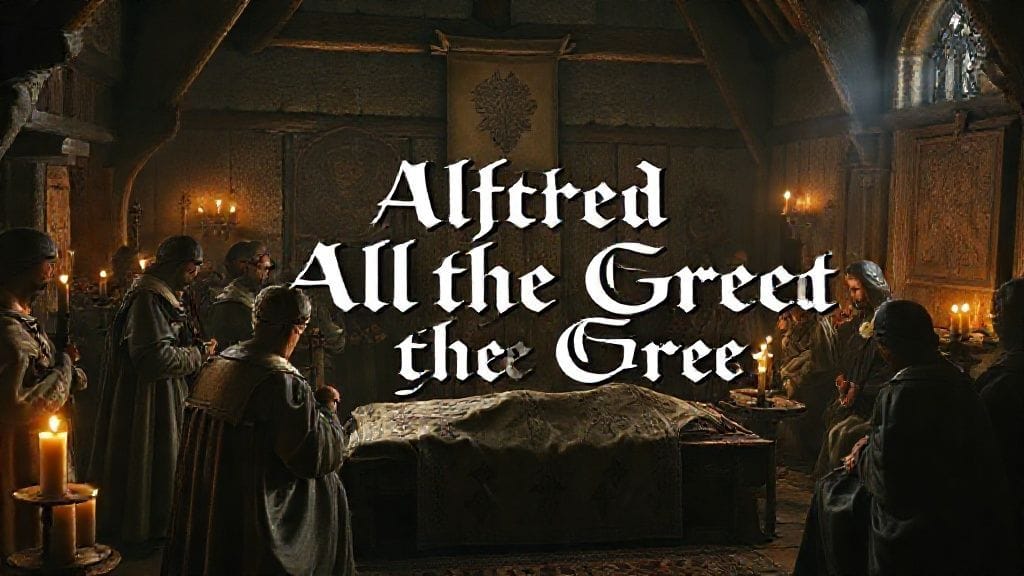
On a crisp October day in 899, the ancient city of Winchester held its breath. Within the dim walls of its royal hall, a monarch who had shaped the destiny of a people was drawing his final breath. Alfred the Great, King of Wessex, lay weakened but resolute, surrounded by the flicker of candlelight and the murmurs of loyal retainers. It was a moment thick with emotion—hope, dread, reverence—all swirling in the gloom. As William of Malmesbury would later recount, even in his mortal frailty, Alfred's mind was fixed on the future of his kingdom, not on his own demise. The death of Alfred was not just the passing of a king—it was the closing of a chapter that had seen England teeter on the brink of conquest and emerge fighting for unity and cultural survival.
The Kingdom of Wessex on the Eve of Transition
By the late 9th century, Wessex was the last bastion of Anglo-Saxon independence amid the relentless expansion of Viking control. Alfred's realm, carved from the southwestern corner of England, was a crucible where survival intertwined with innovation. The political landscape was fraught: Danish incursions threatened every border, nobles jockeyed for influence, and the fragile bond tying disparate localities to the king hung by threads. Yet, no figure loomed larger than Alfred, whose pragmatic yet visionary governance provided a beacon of hope. The atmosphere was heavy with anticipation as the kingdom prepared for the inevitable question—who would succeed the great king now in his twilight?
Alfred’s Early Reign: Forging a Kingdom in Crisis
Ascending the throne in 871, Alfred inherited a realm battered by years of war and near-constant Viking raids. His early years were a relentless struggle to preserve what remained of Anglo-Saxon territories. But Alfred was no ordinary warrior king. Though often underestimated, his intellect and strategic acumen set him apart. His early challenges forced him to innovate—not simply to fight but to build. The foundations he laid in these formative years would prove decisive, giving Wessex a framework to resist and eventually repel the Viking threat.
The Viking Storm: How Alfred Confronted the Norsemen
The 870s were marked by the terrifying advance of the Great Heathen Army, a coalition of Viking forces that ravaged kingdoms across England. Alfred’s early reign was dominated by brutal battles, retreats, and moments of despair. The Vikings were unmatched in their ferocity—burning crops, capturing towns, and carving out footholds. But Alfred's resilience was emblematic of a ruler who would not succumb. Exile in the marshes of Somerset might have signaled defeat for another, but for Alfred, it became a crucible of rebellion and strategy. From these low points, he mounted a comeback that would alter the course of English history.
The Battle of Edington: Turning the Tide of 878
Perhaps no event better encapsulates Alfred's leadership than the Battle of Edington in 878. Against overwhelming odds, Alfred marshaled his forces to deliver a decisive blow to Guthrum and the Viking invaders. The victory was not just military—it demonstrated a shift in the nature of warfare, governance, and diplomacy. After Edington, Guthrum agreed to terms that would lead to the Treaty of Wedmore and usher in a fragile peace—one that recognized Wessex's viability and laid groundwork for coexistence. The triumph at Edington was Alfred’s redemption and a symbol of hope rekindled.
Alfred’s Vision: A United England in the Making
More than a warrior, Alfred was a visionary statesman who dreamed of a unified English identity. Recognizing the importance of cohesion beyond mere arms, he began to weave together legal reforms, cultural revival, and administrative innovations, all designed to forge a resilient kingdom. The concept of England was embryonic but burgeoning under his guidance—a land stitched together by shared law, language, and faith, defended by fortified towns and vigilant troops. This vision would echo through centuries, leaving a blueprint for nationhood.
Reforms and Renaissance: Alfred as Lawgiver and Scholar
Alfred’s intellectual pursuits are as legendary as his military exploits. He was famed for his commitment to education, translation of Latin texts into Old English, and promotion of literacy among clergy and nobility alike. Law codes attributed to him reflected a fusion of Christian ethics and traditional customs. He sought to instill justice and order—pillars without which no polity could stand. The renaissance that bore his name was not an abstract ideal but a concrete effort to ensure the survival and prosperity of his people through knowledge and moral governance.
The Establishment of Burhs: Defense and Administration
A key hallmark of Alfred's reign was the creation of burhs—fortified towns ingeniously designed to counter Viking raids. These strongholds dotted the landscape, acting as both military bastions and commercial hubs. Burhs allowed for the rapid mustering of troops and a secure refuge for rural populations. This system represented an innovative blend of military foresight and administrative efficiency, turning fragmented communities into interconnected bastions of defense. It was Alfred’s answer to a kingdom’s desperate need for security in an age of ceaseless threat.
Alfred's Cultural Revival: Protecting English Identity
Amidst the turmoil, Alfred never lost sight of cultural preservation. He championed the English language at a time when Latin dominated clerical and scholarly circles. By commissioning translations of vital Christian and classical texts, he fostered a resurgence of English learning and literature. The king’s patronage breathed life into a cultural renaissance that bolstered national identity and pride, providing a foundation for future generations to build upon. This cultural awakening was more than symbolic; it was a bulwark against the erasure of the English way of life.
The King's Final Years: Health and Hopes
Despite his monumental achievements, Alfred was plagued by ill health, possibly a severe form of Crohn’s disease, that cast a shadow over his later years. Nonetheless, he governed with unwavering determination, preparing his son Edward to inherit a kingdom reborn. Alfred’s final decade was marked by consolidation and cautious optimism—a time for securing his legacy and ensuring the kingdom’s stability. He continued to legislate, correspond with scholars, and pray for the peace of Wessex and beyond. His fortitude in suffering added a poignant layer to his rulership.
Winchester: The Heart of Wessex and the Place of Passing
Winchester was not merely a capital but the symbolic heart of Wessex’s renaissance under Alfred. The city’s walls bore witness to intense political intrigue, spiritual reflection, and royal ceremony. Here, the king had revitalized the ancient abbey and fostered religious reform. It was fitting that Alfred’s life would end here, encircled by the monuments of his reign. Winchester was a microcosm of his dream—a city where governance, faith, and culture intersected under resolute guidance.
The Day Alfred Died: October 26, 899, through Contemporary Eyes
On October 26, 899, the realm mourned the passing of a monarch whose shadow loomed larger than his mortal frame. Chroniclers described a somber atmosphere in Winchester; sorrow mingled with a stoic acceptance. Alfred’s death was marked by prayer, ritual, and an outpouring of loyalty. His body was laid to rest in the Old Minster, his final resting place among kings and saints. The kingdom felt the tremor of loss but also carried forward his vision, like a flame passed from hand to hand in the dark.
Succession and Stability: Edward the Elder’s Ascension
Alfred’s death posed a critical test for Wessex's future. Fortunately, his son Edward the Elder was ready to assume the throne. Having trained under his father’s tutelage, Edward inherited a kingdom fortified in law, arms, and culture. His accession ensured continuity and stability, allowing the momentum towards English unification to advance. The peaceful transition was a testament to Alfred’s foresight in grooming capable leadership and securing loyalty among the nobility.
The Legacy of Alfred: Myth, History, and Memory
In the centuries that followed, Alfred’s legacy grew into legend and myth—"Alfred the Great" became a figure larger than life, embodying ideals of piety, wisdom, and justice. His deeds were celebrated in chronicles, poetry, and folklore, resonating through England’s collective memory. Yet historians strive to separate fact from hagiography, revealing a complex, sometimes flawed man who nonetheless shaped the destiny of a nation. Alfred’s life remains an enduring narrative of resilience, innovation, and leadership in the face of existential peril.
Alfred’s Impact on English Monarchy and National Identity
Alfred’s reign marked a defining moment in the evolution of the English monarchy. By asserting royal authority through legal reform, military innovation, and cultural patronage, he established a model of kingship that influenced his successors. Moreover, his emphasis on unity and shared identity helped lay the foundations for an English nation, transcending fragmented tribal and regional identities. Alfred’s influence extends beyond his era, echoing in the very concept of what it meant to be English.
The Political Consequences: Wessex and the Road to English Unity
The political landscape post-Alfred was shaped by his achievements and the challenges he left behind. The peace with the Danes, fortified borders, and administrative systems provided a platform for gradual expansion and consolidation. Over the next century, these structures facilitated the gradual emergence of a unified English kingdom, overcoming fragmentation and foreign divisions. Alfred’s vision had set a course that would ultimately culminate in the England we recognize today.
Alfred’s Influence on Later Legal and Military Reforms
The legal codes and military institutions Alfred established became blueprints for centuries. His emphasis on codified law, combined with local enforcement through shires and tithings, presaged more centralized governance. Militarily, the burh system and royal navy initiatives inspired ongoing defensive strategies against external incursion. Alfred’s reforms bridged the ancient and medieval worlds, forging a state apparatus resilient and adaptive in turbulent times.
The Cultural Resonance: Alfred in Literature and Legend
From medieval chroniclers like Asser to Victorian historians, Alfred’s story has been retold and romanticized. He appears in ballads, children's books, and even modern media, embodying the archetype of the wise, just ruler. This cultural resonance reveals how deeply Alfred has permeated the English psyche as both a historical figure and a symbol of good governance. Yet amidst myth lies a genuine legacy deserving scholarly attention and popular appreciation alike.
Final Reflections: The Man behind the Monarch
Behind the regal facade was a man touched by frailty, piety, and profound conviction. Alfred's personal struggles—his illness, the weight of constant threats, the demands of leadership—reveal a deeply human figure. His life reminds us that history’s great actors often triumphed not because of invulnerability but due to relentless courage and vision. Alfred’s story continues to inspire not only because of what he achieved, but because of how he embodied the aspirations of an age seeking survival and meaning.
The End of an Era, the Dawn of a Nation
Alfred’s death marked the end of an era defined by chaos and fragmentation, but it also heralded the dawn of a nation-in-formation. His legacy became the cornerstone upon which future kings built the Kingdom of England. In remembering Alfred the Great’s final day in Winchester, we glimpse the turning point where England took its first steps from a collection of vulnerable territories into a durable kingdom—a journey that would shape the history of an island and beyond.
Conclusion
Alfred the Great’s death in 899 was far more than a simple passing of a king; it was the close of a remarkable chapter in the story of England’s formation. His reign stood at the crossroads of destruction and renewal—transforming a battered, fragmented land into a resilient kingdom with an enduring identity. Alfred’s vision of unity, justice, and cultural preservation forged the soul of Wessex and laid the foundations for a united England. His struggles and triumphs remind us that leadership is shaped by humanity as much as by power. Centuries later, Alfred remains a symbol of hope and a testament to the power of steady resolve in times of crisis. His final breath in Winchester echoed through the ages, defining the destiny of a people yet to come.
FAQs
1. Who was Alfred the Great, and why is he significant?
Alfred the Great was the King of Wessex from 871 to 899, known for defending his kingdom against Viking invasions, implementing extensive military and legal reforms, and fostering a cultural revival. His significance lies in his role as a unifier and state-builder, laying foundations for what would become England.
2. What challenges did Alfred face during his reign?
Alfred’s reign was dominated by relentless Viking attacks, political instability, and internal pressures. He faced the daunting task of defending Wessex while reorganizing its defenses and governance amidst widespread devastation.
3. How did Alfred contribute to English law and culture?
He issued legal codes combining Christian and traditional laws, promoted education by translating important works into Old English, and revived literacy and religion. Alfred’s cultural efforts helped preserve English identity during turbulent times.
4. What was the significance of the Battle of Edington?
Fought in 878, the Battle of Edington was a decisive victory for Alfred against the Vikings, leading to the Treaty of Wedmore and a period of relative peace. It marked a turning point in the struggle for control of England.
5. How did Alfred’s death affect Wessex and England?
Alfred’s death could have destabilized the kingdom, but thanks to his preparations, his son Edward the Elder succeeded him smoothly, continuing the processes of consolidation and expansion.
6. Where was Alfred buried, and why is Winchester important?
Alfred was buried in the Old Minster in Winchester, which was then the political and spiritual heart of Wessex. Winchester symbolized the center of his reign and the renaissance he initiated.
7. Why is Alfred called “the Great”?
This epithet reflects his exceptional leadership in warfare, governance, law, and culture, along with his lasting impact on the English nation, an honor few English kings have received.
8. How is Alfred remembered in modern England?
Alfred remains a cultural icon, celebrated in literature, education, and public memory as the founder of the English nation and a paragon of wise rulership.