Table of Contents
- The Dawn of July 5, 1962: Algiers Awakens to a New Reality
- Seeds of Revolution: The Long Road to Algerian Independence
- France’s Colonial Grip: From Conquest to Conflagration
- The Rise of the FLN: A People’s Voice Turns to Arms
- Toussaint Rouge and the Spark of Armed Struggle
- The Battle for Hearts and Minds: Political and Diplomatic Maneuvering
- War on Two Fronts: Algerian Nationalists and French Settlers
- The Algerian War of Independence: Brutality and Resistance
- International Pressure and the Pathway to Negotiation
- The Evian Accords: A Fragile Peace is Brokered
- The Last Dawn of French Algeria: The Exile of the Pieds-Noirs
- July 5, 1962: A Nation is Born Amidst Celebration and Sorrow
- The New Algerian State: Challenges of Birth and Unity
- Ahmed Ben Bella: The First President and His Vision
- The Legacy of Violence: Memory, Martyrs, and Wounds
- Algeria on the Global Stage: Post-Colonial Diplomacy and Identity
- Economic Hurdles and the Quest for Development
- Cultural Renaissance: Language, Arts, and Identity Reclaimed
- France-Algeria Relations: From Conflict to Cooperation
- Remembering Independence: Commemorations and Controversies
- Conclusion: The Complex Triumph of Freedom
- FAQs: Understanding Algeria’s Road to Independence
- External Resource
- Internal Link
The Dawn of July 5, 1962: Algiers Awakens to a New Reality
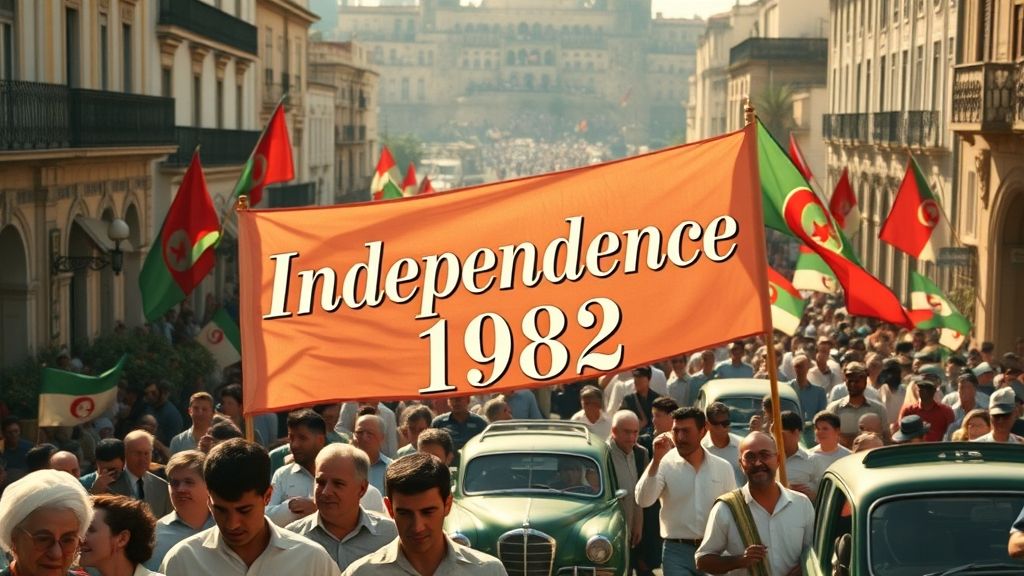
On the morning of July 5, 1962, the streets of Algiers were awash with colors, chants, and a fervent joy that had never before been seen in the city. The sun, piercing the light haze of the Mediterranean dawn, seemed to herald a new era. Algerian flags fluttered proudly from windows, balconies, and the backs of countless citizens spilling into the streets. Behind their smiles and tears, however, lay decades of struggle, violence, heartbreak, and unyielding hope. The air was thick with the scent of jasmine, gunpowder, and revolution. This was more than independence; it was a birth, bloody and triumphant, of a nation long denied its freedom.
But this moment—bathed in euphoria—was the conclusion of a story marked by complexities far greater than the ecstatic cheers suggested. To understand the profound significance of July 5, 1962, we must travel back through the harsh landscape of colonialism, war, political maneuvering, and cultural resilience that shaped this watershed day.
Seeds of Revolution: The Long Road to Algerian Independence
The roots of Algerian independence penetrate deeply into the soil of 19th-century colonial ambition. France’s invasion in 1830 marked the beginning of more than a century of domination, exploitation, and systemic marginalization of the native Algerian population, predominantly Muslim and Berber. The colonial system was harshly segregated, privileging European settlers—the pieds-noirs—while relegating indigenous Algerians to the status of second-class subjects denied political and economic rights.
The nationalist sentiment simmered quietly for decades, fed by the injustices of colonial policies, economic deprivation, and cultural repression. Early reformists such as Messali Hadj planted the ideological seeds of self-determination but faced relentless suppression by the colonial regime. Algeria was legally not a colony but considered an integral part of France — a status that complicated nationalist aspirations.
Still, post-World War II global dynamics, particularly the wave of decolonization sweeping Asia and Africa alongside the ideological contest of the Cold War, emboldened Algerian leaders. The post-war period witnessed growing urban discontent, labor strikes, and political activism clamoring for reform within a colonial framework that refused to evolve.
France’s Colonial Grip: From Conquest to Conflagration
France’s imperial project in Algeria was unlike typical colonial enterprises. Algeria was not merely a foreign territory but a province, administratively divided and represented in the French parliament. However, this pseudo-integration masked brutal repression. Land confiscations systematically dispossessed native farmers, while resources were diverted to support the settler economy.
Settler communities grew powerful, entrenched in their privileges, and feared any concession to Algerian claims. The Sétif massacre in 1945—where French forces killed thousands of Algerians protesting for independence—served as a grim warning that the colonial state would not hesitate to use overwhelming violence to retain control.
Yet, the spark that would ignite a full-scale revolution was yet to come. The illusions of assimilation and cohabitation crumbled swiftly under the weight of mounting inequalities and the fierce determination of Algerian nationalists.
The Rise of the FLN: A People’s Voice Turns to Arms
Against this backdrop, the National Liberation Front (Front de Libération Nationale, FLN) emerged in 1954 as the primary vector of Algerian nationalist aspirations, advocating uncompromising independence through armed struggle. The FLN was not merely a militant organization; it embodied a political platform, linking disparate resistance groups and invoking a pan-Algerian identity that transcended ethnic and religious divides.
Led by charismatic and tactical figures such as Ahmed Ben Bella and Larbi Ben M’Hidi, the FLN sought to project an image of unity and discipline. Their message resonated broadly, particularly among the disenfranchised rural masses and urban youth disillusioned by repeated colonial blunders.
Toussaint Rouge and the Spark of Armed Struggle
On the night of November 1, 1954, an unprecedented series of coordinated attacks struck French military and police targets across Algeria—a moment etched into history as Toussaint Rouge (Red All Saints’ Day). Far from an act of terror in the modern sense, it was a declaration of open war, signaling the end of political dialogue and the beginning of a protracted guerrilla conflict.
The French authorities were taken aback by the scale and coordination of these assaults, but rather than quelling the movement, the violence ignited widespread mobilization within Algeria. The FLN quickly expanded its influence, establishing control over vast rural spaces and asserting itself as the sole representative of the Algerian people.
The Battle for Hearts and Minds: Political and Diplomatic Maneuvering
Beyond the battlefield, the FLN engaged a sophisticated campaign targeting international public opinion and diplomatic forums. Their appeals to the United Nations and emerging African and Arab states invited solidarity and broadened the scope of the conflict beyond Algeria’s borders.
Meanwhile, the French government’s initial approach oscillated between repression and reform. Successive administrations debated how to “solve” the Algerian question—a dilemma that exposed sharp divisions within France itself, including in its military and political elites. The fear of losing Algeria, seen as central to French identity and prestige, made any peaceful settlement politically fraught.
War on Two Fronts: Algerian Nationalists and French Settlers
The conflict was brutal, marked by atrocities committed by all sides. The French military employed tactics of scorched earth, torture, forced relocations, and summary executions, while the FLN conducted guerrilla warfare, bombings, and assassinations.
The pieds-noirs and loyalist Algerians formed paramilitary militias, turning towns and cities into battlefronts. The war fractured communities and families, generating cycles of revenge and fear. Media coverage exposed the world to images of cruelty, further eroding French moral authority internationally.
The Algerian War of Independence: Brutality and Resistance
From 1954 to 1962, the Algerian War of Independence became one of the most bitter and polarizing conflicts of the 20th century. The human cost was staggering: estimates suggest over one million Algerians died, alongside tens of thousands of French soldiers and civilians.
Yet beneath the statistics lay countless personal tragedies—displacement, the devastating loss of cultural heritage, and enduring psychological scars. The war’s ferocity forced both the colonizer and the colonized to confront the limits of their ideals and the brutal reality of colonial domination.
International Pressure and the Pathway to Negotiation
By the early 1960s, the mounting death toll and international condemnation compelled France—and notably President Charles de Gaulle, who had returned to power in 1958—to reconsider the viability of continued colonial rule. De Gaulle’s initial promise to keep Algeria French was gradually eroded by pragmatism and recognition of an un-winnable conflict.
Heavy pressure from the United Nations, the Organization of African Unity, and key geopolitical players, coupled with internal resistance including military insubordination and public demonstration, set the stage for negotiations.
The Evian Accords: A Fragile Peace is Brokered
On March 18, 1962, the Evian Accords were signed between representatives of the French government and the FLN, officially ending the armed conflict. The agreements stipulated a ceasefire, a referendum to determine Algeria’s status, and provisions for the protection of minorities and French property.
However, this peace was uneasy and fragile. Hardline pieds-noirs and some factions within the French military launched the “Organisation Armée Secrète” (OAS), a terrorist group determined to sabotage the accords and maintain French Algeria through violence.
The Last Dawn of French Algeria: The Exile of the Pieds-Noirs
Following the referendum, which overwhelmingly favored independence, massive upheavals swept Algeria. An exodus of nearly a million pieds-noirs, often accompanied by loyalist Algerians fearing reprisals, flooded into France. Their departure marked the end of a prominent and complex community's three-century presence and left scars still palpable today.
The upheaval created demographic shocks and deep wounds on both sides, complicating future Franco-Algerian relations.
July 5, 1962: A Nation is Born Amidst Celebration and Sorrow
When Algeria’s independence was officially proclaimed on July 5, 1962, jubilation erupted throughout the country. But beneath the triumph lay a cautious optimism mixed with grief—for the lives lost, for the divisions still present, and for the monumental task of nation-building ahead.
The day’s celebrations reflected both liberation and a collective reckoning with the past.
The New Algerian State: Challenges of Birth and Unity
The early years of independence were turbulent. The FLN transformed itself from a revolutionary movement into a governing party, centralizing power in the hands of leaders like Ahmed Ben Bella. Economic dislocation, ethnic tensions, and the exodus of skilled Europeans complicated efforts to forge a cohesive state.
Rebuilding infrastructure shattered by war and uniting diverse groups demanded extraordinary leadership and sacrifice.
Ahmed Ben Bella: The First President and His Vision
Ben Bella, Algeria’s first president, envisioned a socialist, non-aligned Algeria that would redefine African post-colonial identity. His charisma, commitment, and populism rallied much support, but his government also faced opposition, internal rivalries, and the daunting reality of Cold War geopolitics.
His eventual overthrow in 1965 by Houari Boumédiène signaled continuing political instability.
The Legacy of Violence: Memory, Martyrs, and Wounds
Algeria’s independence is forever linked to memory—cherished and contested. Martyrs of the revolution enjoy solemn commemoration, yet the lingering trauma of torture, forced displacement, and fractures between communities continue to influence cultural and political narratives both in Algeria and France.
Efforts at reconciliation are ongoing and complex, reflecting the enduring impact of colonial violence.
Algeria on the Global Stage: Post-Colonial Diplomacy and Identity
Emerging from the ashes of war, Algeria positioned itself as a leader in the Non-Aligned Movement and a voice for Third World solidarity. It offered support to liberation movements globally, framing its struggle as part of a universal quest against imperialism.
This internationalist posture contrasted with efforts to consolidate internal governance and sovereignty.
Economic Hurdles and the Quest for Development
Despite abundant natural resources, Algeria faced significant economic challenges. Post-war reconstruction, populist policies, and fluctuating oil prices shaped the nation’s economic trajectory. Nationalization initiatives, notably of hydrocarbons, sought to wrest control from former colonial powers, emphasizing economic sovereignty.
Yet poverty, unemployment, and rural underdevelopment remained persistent challenges.
Cultural Renaissance: Language, Arts, and Identity Reclaimed
Independence brought a cultural resurgence. The revival of the Arabic language, promotion of Berber identity, and flourishing of Algerian literature, cinema, and music expressed newfound pride and self-definition.
However, debates over language policy and identity continue to reflect the nation’s diverse heritage and unresolved colonial legacies.
France-Algeria Relations: From Conflict to Cooperation
The post-independence relationship between Algeria and France has been marked by tension, reconciliation, and pragmatism. Migrant communities, economic ties, and historical debates on memory contribute to a complex bilateral dynamic.
Both nations have, at times, wrestled with the painful colonial past while forging pathways toward cooperation in trade, culture, and diplomacy.
Remembering Independence: Commemorations and Controversies
July 5 remains Algeria’s most significant national holiday—a day of pride and solemn remembrance. Yet, it also invites reflection on the cost of freedom. Museums, memorials, and education initiatives endeavor to preserve historical memory amidst generational shifts and political changes.
The narrative of independence remains central to Algerian identity but is also subject to reinterpretation and debate.
Conclusion: The Complex Triumph of Freedom
The independence of Algeria on July 5, 1962, stands as a testament to the resilience of a colonized people who refused to be silenced or subdued. It was not merely a political event but an epic human drama that reshaped identities, borders, and histories. The path to freedom was forged in sacrifice, blood, and unwavering courage, illuminating the dark corners of colonial violence while offering the possibility of self-determination.
Yet, independence was just the first step in a continuing journey. The Algerian story reminds us that liberation carries with it not only hope but also the immense responsibility of rebuilding, healing, and re-imagining a nation. It challenges us to confront the legacies of the past honestly and to honor the deep humanity of those who dared to dream of freedom.
This narrative continues to resonate today, inspiring reflections on justice, identity, and the meaning of sovereignty in a world still wrestling with the shadows of empire.
FAQs: Understanding Algeria’s Road to Independence
Q1: What were the main causes of the Algerian War of Independence?
A1: The war stemmed primarily from decades of systemic colonial oppression, land dispossession, political disenfranchisement, and cultural repression imposed by French rule. The failure of peaceful reforms and the rise of nationalist movements also contributed.
Q2: Who were the key figures in the Algerian independence movement?
A2: Central figures included Ahmed Ben Bella, Larbi Ben M’Hidi, and Mohamed Boudiaf within the FLN, alongside numerous grassroots fighters and intellectuals advocating both armed struggle and political mobilization.
Q3: What role did the Evian Accords play in ending the conflict?
A3: Signed in March 1962, the Evian Accords established a ceasefire, set the stage for Algeria’s independence referendum, and defined terms for the transition, effectively ending active hostilities.
Q4: How did the Pieds-Noirs react to Algerian independence?
A4: Many pieds-noirs opposed independence vehemently, some engaging in violence through groups like the OAS. Ultimately, nearly one million fled Algeria due to fears of reprisals and loss of status.
Q5: How did Algeria manage the challenges of nation-building post-independence?
A5: The new government faced political factionalism, economic reconstruction, social integration, and defining national identity amid Cold War pressures and the legacies of war.
Q6: What is the lasting impact of Algeria’s independence on Franco-Algerian relations?
A6: The relationship remains complex, marked by shared histories, migration, economic links, cultural exchange, and ongoing dialogues about colonial memory and reconciliation.
Q7: How is Algerian independence commemorated today?
A7: Independence Day on July 5 is a national holiday featuring celebrations, memorial ceremonies, and cultural events that honor the sacrifices and achievements of the independence struggle.
Q8: Why is the Algerian independence struggle considered significant in global history?
A8: It was one of the most intense decolonization conflicts of the 20th century, influencing other liberation movements and reshaping geopolitical alignments during the Cold War era.