Table of Contents
- Dawn Breaks on the Aegean Shore: The Landing at Gallipoli
- The Strategic Gamble: Why Gallipoli?
- The Stakes of the Great War and the Ottoman Front
- The Allies Assemble: British, ANZACs, French, and more
- A Night of Nerves: Preparing for the Assault
- At First Light: The Initial Landings at Cape Helles
- The Geography of Despair: Terrain and Trenches
- Fierce Resistance: Ottoman Defenders and Their Leaders
- Chaos and Confusion: The Fog of Battle
- Heroism and Horror: Personal Stories from the Front
- The Stalemate Takes Hold: Attrition and Supply Struggles
- The Role of Naval Forces and the Failed Dardanelles Campaign
- The Psychological Toll: Morale, Suffering, and Letters Home
- Political Reverberations in London, Paris, and Istanbul
- Gallipoli’s Place in ANZAC and Turkish National Memory
- Lessons Learned and the End of the Campaign
- The Aftermath: Consequences for WWI and Beyond
- The Myth and Reality of Gallipoli
- Conclusion: Gallipoli, a Tragedy That Shaped Nations
- FAQs: Understanding Gallipoli's Legacy
- External Resource
- Internal Link
1. Dawn Breaks on the Aegean Shore: The Landing at Gallipoli
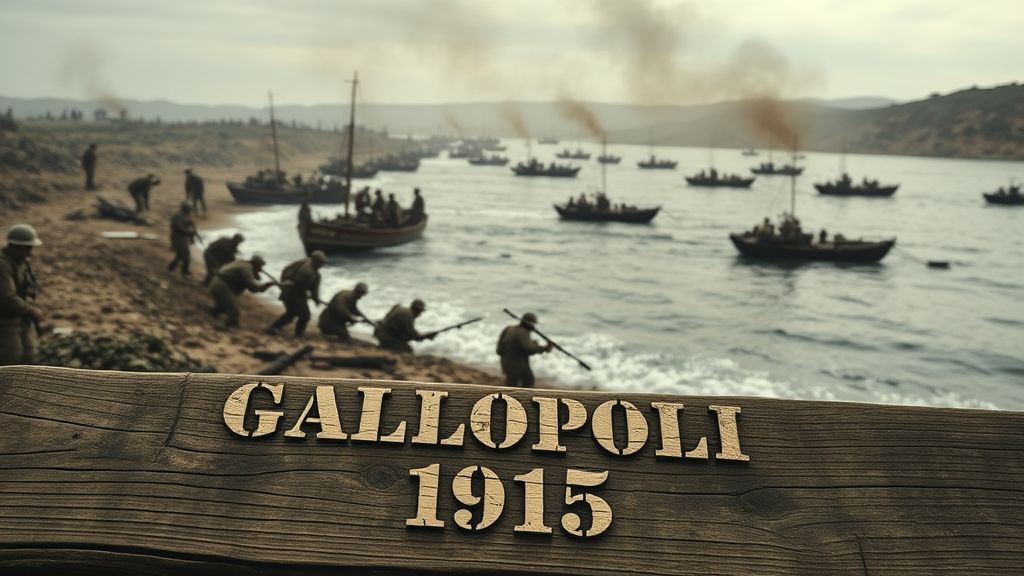
Under the first pale light of April 25, 1915, the beaches of Cape Helles on the Gallipoli Peninsula became the stage for one of the fiercest and most tragic episodes of the First World War. As the sea mist curled off the Aegean waves, thousands of Allied soldiers—British, French, and the Australian and New Zealand Army Corps (ANZAC)—stepped from their landing craft onto rocky, unforgiving shores. They had set out on a bold and perilous mission: to break the stranglehold of the Ottoman Empire, knock open the Dardanelles, and relieve the deadlock in Europe.
But the moment was thick with tension and uncertainty. For the men arriving, it was the brink of a nightmare—chaos, bullets whizzing through the salty air, machine guns staking the cliffs, and an enemy who knew every inch of the terrain. The air was heavy with fear, hope, and the indelible weight of history pressing down on weary shoulders. This was not just a landing; it was a test of endurance, strategy, and human spirit that would echo through decades.
2. The Strategic Gamble: Why Gallipoli?
To understand the landing at Gallipoli, one must first grasp the grand chessboard of the First World War’s early years. The Western Front had frozen into a deadly stalemate of trenches, mud, and bloodshed. The Allies sought another way to break the back of the Central Powers. The Ottoman Empire’s control of the Dardanelles Strait—a narrow channel connecting the Aegean Sea to the Sea of Marmara and eventually to Constantinople—blocked access to Russia via the Black Sea.
By forcing a passage through Gallipoli, the Allies aimed not only to open a supply route to their Russian ally but also potentially topple the Ottoman capital, shaking the empire from within. Winston Churchill, then First Lord of the Admiralty, was one of the chief advocates of this daring strategy, believing that a maritime and amphibious assault could circumvent the horrors of the trench warfare in France.
Yet the gamble was enormous. The Ottomans, newly aligned with Germany, had prepared fiercely, and the peninsula’s rugged coasts favored defenders. The operation called for flawless coordination among naval forces and infantry, precision landings on hostile ground, and rapid advances inland—ambitious plans fraught with risk.
3. The Stakes of the Great War and the Ottoman Front
The Great War was not just a contest between European powers but a global conflagration, pulling empires into a vortex of conflict never seen before. The Ottoman Empire was the last great Muslim empire straddling the crossroads of Europe and Asia, its survival central to Middle Eastern dynamics.
The Allies feared that if the Ottomans held control over the Dardanelles, they could choke off their Russian ally, jeopardize the Eastern Front, and fortify their position in the region. For the Ottomans, defending Gallipoli was existential; losing meant not just strategic defeat but the unraveling of an empire teetering on modernity's edge.
Moreover, success at Gallipoli could ignite nationalist sentiments and shift the momentum in the war, but failure would embolden the Central Powers, drain Allied resources, and leave scars on the soldiers and civilians alike.
4. The Allies Assemble: British, ANZACs, French, and more
The invasion force was an eclectic and multinational assembly. British troops—both seasoned regulars and reservists—formed the backbone, alongside the ANZAC, composed primarily of volunteers from Australia and New Zealand, young countries eager to prove their mettle on the world stage.
French forces also participated, though their numbers were smaller. Each contingent brought its own culture, fighting style, and expectations, but all faced the same daunting challenge. These men had trained hard, but few were truly prepared for the rocky cliffs, stifling heat, and deadly Ottoman fire awaiting them.
Captains, lieutenants, privates—each would carry the weight of the landing, their personal courage set against an unyielding enemy and environment.
5. A Night of Nerves: Preparing for the Assault
In the hours leading to dawn, silence settled uneasily over the invasion fleet. The boats bobbed just off the shore, men gripped weapons and exchanged whispered prayers. Commanders wrestled with last-minute plans; signals flashed; nerves frayed.
The tension was palpable. To many, the landing was the point of no return.
On the Turkish side, defenders were alert, well dug-in, and guided by commanders such as Colonel Mustafa Kemal—a name soon to resonate far beyond the peninsula. The Ottomans had placed machine guns, artillery, and infantry in defensive positions, anticipating the attack.
As darkness gave way to morning, the silence shattered into gunfire and explosions.
6. At First Light: The Initial Landings at Cape Helles
The first squads hit the pebbled beaches amid a hail of bullets and shells. Confusion reigned—many landing craft missed designated zones, and men scrambled up slopes under fire. Supply chains faltered from the start; equipment, rations, and reinforcements struggled to follow.
Despite chaos, soldiers pressed forward, driven by duty and fear. The cliffs and ridges were soon bathed in blood, as Ottoman riflemen picked off waves of attackers, forcing many to seek cover.
Crucially, while Cape Helles was only one of several landing sites, it bore the brunt of the fight, symbolizing the brutal face of the Gallipoli campaign.
7. The Geography of Despair: Terrain and Trenches
Gallipoli’s terrain was cruel. Jagged cliffs, deep ravines, and sparse vegetation gave defenders natural high ground and made supply and communication a nightmare. The rocky soils limited digging; soldiers lived, fought, and died in cramped, precarious trenches under sweltering sun or biting wind.
The peninsula’s landscape cut both ways—making progress agonizingly slow and attrition relentless. The environment was as much an adversary as the Ottoman guns.
8. Fierce Resistance: Ottoman Defenders and Their Leaders
Opposing the Allies stood an Ottoman force imbued with fierce determination and expert leadership. Mustafa Kemal emerged as a pivotal figure, rallying troops and mastering defensive tactics with diminishing resources.
Their victory at Gallipoli became a symbol of Ottoman resilience, shattering myths of inevitable imperial collapse. The defenders’ intimate knowledge of the landscape, combined with strategic use of machine guns and artillery, inflicted heavy casualties on the invaders.
The defenders fought not just for empire, but for homeland and honor—a narrative that would underpin Turkish nationalism for decades.
9. Chaos and Confusion: The Fog of Battle
The Gallipoli landing rapidly descended into a labyrinth of miscommunications, misplaced units, and fragmented objectives. Naval gunfire was often misdirected or ineffective. Many soldiers found themselves isolated, surrounded, and cut off.
Medical evacuation was chaotic; wounded men lay unattended under scorching heat. Night brought an eerie quiet broken only by sporadic sniper fire and whispered orders. The campaign’s early days unveiled the brutal realities of amphibious warfare previously untested on such a scale.
10. Heroism and Horror: Personal Stories from the Front
Behind the grand strategy and grim statistics lay countless human stories—acts of courage and moments of despair etched in memory. Corporals charging enemy positions, medics risking their lives to drag wounded comrades, young men writing letters home with tentative hope.
Private Thomas Kenny of the ANZACs recounted: “When the bullets began, all I could hear was the pounding in my ears. I thought of my mother and how this would end… but there was no time to think, only fight.”
Such testimonies give voice to the courage and tragedy suffusing the sand and stone.
11. The Stalemate Takes Hold: Attrition and Supply Struggles
Despite initial hopes for rapid victory, Gallipoli bogged down into a grinding stalemate. Resupply was fragile; fresh troops struggled against weather and terrain.
Efforts to break out met with stiff Ottoman resistance. The campaign shifted from an invasion to a harrowing war of attrition, exhausting men physically and mentally.
Both sides suffered tens of thousands of casualties with marginal territorial movement.
12. The Role of Naval Forces and the Failed Dardanelles Campaign
Beyond the beaches, the naval dimension was critical. British and French fleets attempted to force the straits but faced heavy mines, shore batteries, and torpedo attacks.
A series of naval disasters—especially the loss of several battleships—shattered morale and reinforced the necessity of the land campaign. However, naval support remained inconsistent, undermining the larger strategy.
By summer, it was clear the amphibious assault had faltered dramatically.
13. The Psychological Toll: Morale, Suffering, and Letters Home
The mental scars of Gallipoli ran deep. Soldiers endured hunger, disease, heat, and relentless danger. Letters reveal homesick men grappling with fear and hope.
One letter from a New Zealand infantryman reads, “I wish I could be back home planting potatoes, but here we are, the world’s edge, fighting for reasons I can barely understand.”
The campaign challenged not just bodies but the spirit, illuminating war’s human cost.
14. Political Reverberations in London, Paris, and Istanbul
News from Gallipoli rippled powerfully through capitals. Allied failures spurred criticism of leadership, especially Churchill, whose career nearly ended.
In Istanbul, Ottoman success was a morale boost, igniting national pride and consolidating authority.
Politicians debated, strategists revised plans, and public opinion swayed—Gallipoli was more than a military episode; it was a political crucible.
15. Gallipoli’s Place in ANZAC and Turkish National Memory
Though a military failure for the Allies, Gallipoli became foundational for Australian and New Zealand national identity. ANZAC Day now commemorates the courage and sacrifice of those young nations on foreign soil.
For Turkey, the victory marked the rise of Mustafa Kemal Atatürk and the eventual birth of a republic, transforming Gallipoli into a symbol of resilience and sovereignty.
Thus, the peninsula lives in collective memory—painful yet proud.
16. Lessons Learned and the End of the Campaign
Repeated offensives failed; by January 1916, the Allies evacuated amid cover and secrecy, bearing heavy losses but avoiding annihilation.
The campaign exposed shortcomings in planning, intelligence, and joint operations, shaping future military doctrines.
It also underscored the limits of imperial ambition and the unforgiving nature of modern war.
17. The Aftermath: Consequences for WWI and Beyond
Gallipoli prolonged the war, diverted resources, and bound nations closer in grief and valor.
The Ottoman Empire lingered but was deeply weakened; new nationalist movements surged.
For the Allies, the campaign was a sobering lesson, heralding the brutal years still to come.
18. The Myth and Reality of Gallipoli
Over time, Gallipoli has been both mythologized and critically assessed. Stories of heroism coexist with accounts of mismanagement and unnecessary suffering.
Historians continue to debate the strategic value and command decisions, preserving Gallipoli as a complex chapter rather than a simple tale of triumph or disaster.
19. Conclusion: Gallipoli, a Tragedy That Shaped Nations
The landing at Gallipoli was not merely a military event but a crucible where empires, nations, and individual destinies collided. It unveiled the courage and cost of war in vivid detail—men facing impossible odds, landscapes both beautiful and brutal, and the shattering consequences of grand ambitions.
Gallipoli still whispers its lessons: about folly and bravery, pride and loss, the fierce will to survive and remember.
As we reflect on those April dawns and the men who fought there, it remains a story of humanity’s staggering resilience and a poignant reminder that history’s echoes shape our present.
Conclusion
Gallipoli was a moment suspended between hope and despair, where the currents of history swept thousands into unknown waters. It was a canvas painted with the blood and valor of countless men who fought far from home, caught in the gears of geopolitical dreams and nightmares. Though the campaign failed in military terms, it succeeded in forging identities, testing courage, and awakening the world to the complex nature of modern warfare.
In remembering Gallipoli, we hold both tragedy and triumph in our hands—the price of war and the enduring strength of the human spirit.
FAQs
1. Why did the Allied forces decide to land at Gallipoli?
The Allies aimed to open a supply route to Russia via the Dardanelles Strait and knock the Ottoman Empire out of the war by capturing Constantinople, hoping to break the stalemate of the Western Front.
2. Which nations participated in the Gallipoli landings?
Mainly British, French, Australian, and New Zealand troops composed the Allied forces, with ANZAC being a particularly celebrated corps.
3. Who were the key leaders on both sides?
On the Allied side, Churchill was a major proponent; commanders on the ground included General Ian Hamilton. The Ottoman side featured Colonel Mustafa Kemal, whose leadership was crucial.
4. What were the main challenges faced during the landing?
Difficult terrain, strong Ottoman defense, logistical difficulties, poor intelligence, and miscommunication plagued the campaign.
5. How did Gallipoli impact ANZAC national identity?
Despite heavy losses, the campaign became a defining moment for Australia and New Zealand, symbolizing national courage and sacrifice celebrated annually on ANZAC Day.
6. What was the outcome of the campaign?
The campaign failed militarily; the Allies evacuated after months of fighting, suffering heavy casualties, but it strengthened Turkish nationalism and reshaped regional politics.
7. How is Gallipoli remembered in Turkey?
As a symbol of resistance and birth of the Turkish Republic under Mustafa Kemal Atatürk, Gallipoli is a source of national pride and commemoration.
8. What lessons did military strategists learn from Gallipoli?
The campaign highlighted the importance of joint coordination, intelligence, logistical planning, and adaptability in amphibious warfare, influencing future military operations.