Table of Contents
- A Tremor in the Tapestry of Time: Introducing the Almaty Earthquake
- The Silent Sleeping Giant: Geological Backdrop of Verny
- Cities on Fault Lines: Verny’s Emergence in a Volatile Landscape
- The Afternoon of June 8, 1887: When the Earth Roared
- The Shaking Ground: Witness Accounts and Immediate Devastation
- Buildings Crumble, Lives Shatter: The Human Toll Unfolds
- A City in Ruins: Verny’s Infrastructure and Architectural Collapse
- Rescue and Relief: Early Response Amidst Chaos
- Imperial Imperatives: The Russian Empire Reacts
- The Scientific Awakening: Seismology’s Nascent Understanding
- Social Fabric Torn: Families, Communities, and Survival
- Economic Shockwaves: The Earthquake’s Ripple Through Kazakh Trade
- The Rebirth of Verny: Reconstruction and Urban Planning
- Cultural Memory: Oral Traditions and the Earthquake’s Legacy
- Lessons in Fragility: How 1887 Shaped Future Kazakh Urban Resilience
- Earthquakes in Central Asia: Contextualizing Verny within Regional Seismicity
- The Role of Verny’s Earthquake in Modern Kazakh Identity
- Voices from the Past: Letters, Reports, and Diaries Revisited
- The 1887 Almaty Earthquake Today: Commemorations and Scholarship
- Conclusion: Earthquakes as Catalysts for Change and Reflection
- FAQs: Unpacking the Almaty Earthquake of 1887
- External Resource
- Internal Link
1. A Tremor in the Tapestry of Time: Introducing the Almaty Earthquake
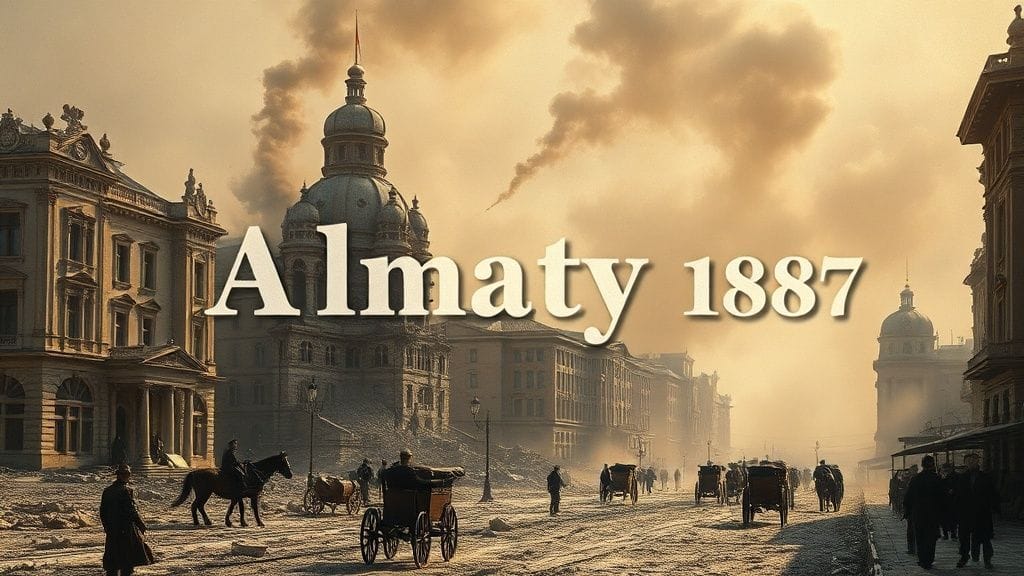
On a seemingly ordinary June afternoon in 1887, the growing city of Verny, nestled in the shadows of the Tian Shan mountain range, was brought to a sudden and terrifying halt. The earth beneath it convulsed with an unexpected fury, shaking homes, markets, places of worship, and the very spirit of its inhabitants. What was to become known as the Almaty—or Verny—earthquake left an indelible scar, not just on the city’s geography, but on its collective memory. This was a rupture not merely in the ground, but in the narrative of a fledgling urban center struggling to forge its identity amid imperial ambitions and natural perils.
Suddenly, the well-ordered life of this Russian imperial outpost was shattered. Dust rose to shroud the sun, voices echoed in shock and pain, and the ground’s desperate roar mingled with the cries of a community thrown into chaos. And yet, from the wreckage, a story of resilience and renewal also began to emerge. This article traces the tremors, both physical and societal, set loose by the June 8, 1887, earthquake and unspools the threads of its complex legacy.
2. The Silent Sleeping Giant: Geological Backdrop of Verny
Long before Verny’s streets were laid with cobblestones and its markets thrived, the ground that cradled it was shaped by one of the most dynamic geological theatres on Earth. The city sat perilously close to the complex fault systems of the Tian Shan mountains, a region where the Eurasian and Indian tectonic plates collide with relentless force. It is a zone marked by deep fractures, trembling fault lines, and occasional, deadly ruptures.
Understanding the 1887 quake requires stepping thousands of years back to when the earth’s crust was molded by the slow but inexorable pressures of continental drift. Verny’s location was no accident; it was a strategic point on trade routes, yet it also inherited a latent violence beneath its soil, a geological tension immeasurable in human terms but utterly real nonetheless.
3. Cities on Fault Lines: Verny’s Emergence in a Volatile Landscape
The city of Verny—later renamed Almaty—emerged rather recently in the late 19th century as a Russian fortress on the fringes of Central Asia. Founded in 1854, its purpose was twofold: to consolidate Russian control over Kazakh territories and to act as a gateway for trade and military influence toward China and beyond. Verny was born into a world of shifting allegiances, steppe nomads, Russian settlers, and imperial strategists.
But beyond politics and economics, Verny was also a human experiment on the border of nature’s unpredictable temperament. The settlers brought bricks and timber, but soon, so did the danger hidden in the fault lines beneath their feet.
4. The Afternoon of June 8, 1887: When the Earth Roared
The day began like many others—sunlight warm, markets bustling, children playing in the courtyards. And then came the first violent tremors, an unbidden roar underfoot. Verny shuddered with increasing intensity; the earth buckled and rippled like a living beast awoken from a long slumber.
Eyewitnesses recalled the ground shooting fissures open, swallowing streets, and tearing foundations apart. The shaking was relentless; houses collapsed into heaps of timber and stone, markets were upended, and the cries of the injured pierced the thick dust clouds.
The clock seemed to freeze in panic. Some people fled in terror, others frantically sought their families amid the ruins. For many, the terror was doubled by confusion—what had sparked this sudden apocalypse? The earth’s fury had exploded without warning.
5. The Shaking Ground: Witness Accounts and Immediate Devastation
Personal testimonies from survivors paint a vivid tableau of chaos and horror. One merchant described how his shop was “shattered as if by a hammer,” his goods crushed beneath rubble. A mother recounted clinging to a tree as her home crumbled around her, feeling “the world itself breathing wildly beneath my feet.”
The tremors lasted for minutes that felt like hours. For some, the shaking stopped finally—only to be replaced by aftershocks that continued to unnerve the remaining populace for days.
The destruction was extensive. Several buildings in Verny, constructed without consideration for seismic risk, transformed into death traps. Official estimates counted hundreds of casualties, but the true toll—erring inevitably on the side of undercounting—was a community forever marked by loss.
6. Buildings Crumble, Lives Shatter: The Human Toll Unfolds
Beyond the physical damage, the earthquake tore into the heart of Verny’s society. Entire families were uprooted; some lost homes, others lost loved ones. Local hospitals and aid centers—already few and ill-equipped—were overwhelmed by the surge of injured needing urgent care.
The social systems that bound the frontier city together faltered under the strain. Many survivors recounted despair intermingled with moments of solidarity: neighbors sheltering one another in mud-brick ruins, citizens sharing the meager resources that had survived.
The fragility of life was laid bare in this cataclysm. The earthquake did not discriminate—it challenged the assumption of order with a brutal reminder of nature’s ultimate authority.
7. A City in Ruins: Verny’s Infrastructure and Architectural Collapse
Verny’s architecture in 1887 was a patchwork of wooden houses, adobe buildings, and stone fortifications, many designed more for convenience or aesthetic heritage than for endurance against seismic threats. The result was catastrophic.
The central market was reduced to rubble, supply routes were blocked by landslides triggered by the quake, and critical infrastructure—bridges, wells, roads—was either destroyed or rendered unsafe. The city’s strategic value instantly diminished as communication faltered and travel became perilous.
The once lively streets of Verny became a haunting mosaic of collapsed buildings and silent debris, littered with remnants that spoke of everyday life frozen mid-motion by the earthquake’s wrath.
8. Rescue and Relief: Early Response Amidst Chaos
In the immediate aftermath, the surviving citizens of Verny faced stark choices. Without modern emergency services, they relied on ad hoc rescue efforts. Men, women, and even children dug by hand through rubble searching for survivors; wounded were carried to whatever shelter remained.
Complicating relief was the isolation Verny experienced—supply chains were broken, and the nearest centers of Russian administration and military power were hundreds of kilometers away. News of the quake traveled slowly, leaving survivors to wrestle with devastation alone for precious days.
Yet from this chaos sprung remarkable stories of resourcefulness and community spirit. Religious figures, local leaders, and even individuals of humble means organized makeshift aid stations and orchestrated the distribution of food and water.
9. Imperial Imperatives: The Russian Empire Reacts
Verny’s status as a frontier outpost of the Russian Empire meant that imperial authorities took keen interest in the catastrophe. Messages were sent to Petrograd; military detachments were dispatched to secure the city and assist in reconstruction.
Yet the empire’s response was complicated by bureaucratic inertia and competing priorities in an era marked by turmoil on multiple fronts. Nonetheless, funds were allocated, engineers were sent, and official reports were compiled interpreting the quake as both a natural disaster and a test of Russian influence over Central Asia.
This disaster also spotlighted the challenges faced by imperial powers in governing diverse, far-flung territories subject to natural hazards they scarcely understood.
10. The Scientific Awakening: Seismology’s Nascent Understanding
The 1887 Verny earthquake came at a moment when modern seismology was just beginning to take form. Groundbreaking seismic instruments were not yet widespread, and understanding of tectonic processes was rudimentary at best.
Nevertheless, the quake attracted the attention of geologists and physicists who sought to explain the sudden convulsions. Early reports published in Russian scientific journals attempted to categorize the earthquake's intensity through observations and damage metrics.
Despite limitations, these studies laid groundwork for future research. Verny’s catastrophe underscored the necessity of developing instruments and techniques to predict, measure, and mitigate seismic risks.
11. Social Fabric Torn: Families, Communities, and Survival
Among the intangible damages wrought by the earthquake was the fracturing of social networks. Many survivors faced homelessness and displacement; children lost parents, elders lost younger generations; friendships were disrupted by forced migrations caused by the city’s destruction.
Yet, human resilience was evident as well. Kazakh nomadic groups and Russian settlers cooperated in emergency response efforts. Religious rites adapted to the calamity, offering solace through prayer and communal mourning.
The disaster highlighted both vulnerability and endurance, compelling communities to reconfigure identities amid shared trauma.
12. Economic Shockwaves: The Earthquake’s Ripple Through Kazakh Trade
Beyond the immediate devastation, the earthquake sent shockwaves through Verny’s economic ecosystem. The city was a commercial crossroads linking Russian and Central Asian trade networks. Markets closed, transport arteries faltered, and confidence in the region’s stability wavered.
Caravans delayed, merchants wary, and local producers confronted scarcity as agricultural zones nearby also suffered damage. Reconstruction efforts consumed capital and labor, delaying economic recovery.
Historians note that while Verny rebounded, the quake destabilized regional trade in the short term, highlighting the precarious balance between nature and human commerce.
13. The Rebirth of Verny: Reconstruction and Urban Planning
Following the disaster, Verny’s leaders and residents embarked on a massive rebuilding campaign. Debates emerged about architectural styles, construction materials, and urban layouts designed to better withstand future tremors.
Russian engineers introduced stricter building codes; hybrid construction methods combining wood flexibility and stone solidity gained favor. Parks and open spaces were planned as buffer zones.
This period was pivotal in shaping the modern city of Almaty, symbolizing a phoenix rising from ruins with lessons etched into its very foundations.
14. Cultural Memory: Oral Traditions and the Earthquake’s Legacy
Though official records provide one perspective, local Kazakh oral traditions preserved the earthquake differently—through stories, songs, and rituals commemorating loss and survival.
Elders recounted the terrifying shaking as a warning from the natural world; some interpreted it through spiritual lenses, incorporating it into cosmologies about balance and retribution.
These narratives persist today in Kazakh culture, binding generations through collective memory and deepening the social significance of the 1887 earthquake.
15. Lessons in Fragility: How 1887 Shaped Future Kazakh Urban Resilience
The Verny earthquake remains a stark reminder of vulnerability in regions perched on restless fault lines. It catalyzed developments in seismic awareness and urban policy not only locally but in the broader Central Asian context.
Modern Almaty still honors those lessons, incorporating advanced building techniques and disaster preparedness programs reflecting a century and more of accumulated knowledge.
The 1887 tremor transformed abstract geological risk into lived experience, serving as a timeless call to respect the earth beneath our feet.
16. Earthquakes in Central Asia: Contextualizing Verny within Regional Seismicity
The 1887 event is one in a lineage of significant quakes across Central Asia, a seismically active zone due to continental collision dynamics. Other notable earthquakes, such as the 1911 Kemin or the 1931 Chilik quakes, echo similar patterns of destruction and recovery.
Studying Verny’s quake alongside these reveals broader themes of human adaptation and risk in a volatile environment, informing current scientific and policy frameworks.
17. The Role of Verny’s Earthquake in Modern Kazakh Identity
In contemporary Kazakhstan, the Verny earthquake has transcended mere history—it is part of the national narrative about resilience, geographical destiny, and the ability to turn trials into opportunities.
Almaty’s commemorations, museums, and educational programs attest to this heritage, linking past calamities to future hope.
18. Voices from the Past: Letters, Reports, and Diaries Revisited
Historical archives provide snapshots of personal experiences: letters from citizens pleading for aid, official reports sketching damage estimates, and travelers’ diaries capturing the atmosphere of shock.
These documents enrich our understanding, allowing us to hear the voices of those whose lives were forever transformed on that fateful June day.
19. The 1887 Almaty Earthquake Today: Commemorations and Scholarship
More than a century later, scholarly research continues to analyze the quake’s geology, urban impact, and social ramifications. Commemorative events reinforce community bonds and raise awareness of seismic dangers.
The earthquake remains a poignant educational and cultural touchstone in Kazakhstan and among Central Asian historians.
20. Conclusion: Earthquakes as Catalysts for Change and Reflection
The 1887 Verny earthquake was a moment when nature shattered a city’s illusion of permanence, revealing the fragile dance between human ambition and geological forces. But within this catastrophe was a narrative of endurance and renewal—of people who rebuilt their lives and city stronger, wiser.
It reminds us that history is often written not merely in battles or politics but in how societies confront adversity. The tremor beneath Verny’s feet echoes today in Almaty’s skyline, in the stories passed down, and in humanity’s enduring hope amid uncertainty.
Conclusion
The earthquake that shook Verny on June 8, 1887, was not just a natural disaster. It was a profound human experience that exposed vulnerability, galvanized resilience, and reshaped an entire city’s trajectory. Through ruins and rubble, the people of Verny confronted not only physical destruction but also the deep uncertainties of life perched on the edge of geological forces beyond their control.
Yet from this very edge, the city that would become Almaty was reborn—a testament to human perseverance and the power of communal effort. It remains a symbol of how fragility can coexist with strength, how tragedy can become a teacher, and how the earth’s rhythms forever mingle with human destiny. The 1887 earthquake, thus, is etched into history not only in stone and soil but in the hearts and minds of generations who learned to live with the tremors beneath their feet.
FAQs
Q1: What caused the Almaty (Verny) earthquake of 1887?
A1: The earthquake was caused by tectonic movements along fault lines in the seismically active Tian Shan mountain region, where the Eurasian and Indian plates interact.
Q2: How severe was the damage in Verny?
A2: The quake caused widespread destruction of buildings and infrastructure, with hundreds of casualties and injuries. The city’s strategic and economic functions were severely disrupted.
Q3: How did people survive the earthquake?
A3: Survival depended on immediate community response, sheltering in open spaces, and makeshift rescue efforts since formal emergency services were not available.
Q4: What was the Russian Empire’s response?
A4: The empire sent support, funding, and engineers to assist in reconstruction, though bureaucratic delays and logistical challenges complicated relief efforts.
Q5: How did the earthquake influence scientific understanding of seismic activity?
A5: It contributed to early seismological studies, highlighting the need for better measurement tools and further research on earthquakes in Central Asia.
Q6: How is the 1887 earthquake remembered today in Kazakhstan?
A6: It is commemorated through cultural memory, education, and urban planning initiatives, symbolizing resilience and respect for the natural environment.
Q7: Did the earthquake affect economic trade in the region?
A7: Yes, disruptions to roads and markets temporarily hindered trade routes, impacting local producers and merchants.
Q8: What lessons were learned for future urban development?
A8: The event prompted the introduction of seismic building codes and strategic urban planning, aiming to improve resilience against future earthquakes.