Table of Contents
- The Fragile Peace After the War of 1812
- Washington, D.C., April 28, 1817: A Quiet Revolution Begins
- The Aftermath of Conflict: Why Disarmament Was Imperative
- The Anglo-American Relationship in the Early 19th Century
- Defining Terms: What Was the Rush–Bagot Agreement?
- The Personalities Behind the Pact: Charles Bagot and Richard Rush
- Negotiation Tensions and Diplomatic Dance
- Naval Rivalry on the Great Lakes: An Arms Race in Miniature
- The Agreement’s Provisions: Limitations on Warships and Armaments
- Implementing the Pact: From Ink to Action on the Water
- Public and Political Reactions on Both Sides of the Border
- The Rush–Bagot Agreement’s Role in Ending Hostilities for Good
- The Treaty’s Legacy in Shaping the Longest Unfortified Border
- Symbolizing Trust: How the Agreement Fostered Bilateral Cooperation
- Challenges and Criticisms: Was the Disarmament Sustainable?
- Echoes Through Time: The Agreement’s Influence on Future Treaties
- The Rush–Bagot Agreement in the Context of Global Naval Disarmament
- Cultural Reflections: How Americans and Canadians Remember the Pact
- The Role of Geography and National Identity in Shaping Peace
- Modern Perspectives: The Agreement’s Relevance in Today’s Diplomacy
- Conclusion: From War's Shadow to Enduring Peace
- FAQs: Common Questions About the Rush–Bagot Agreement
- External Resource
- Internal Link
The Fragile Peace After the War of 1812
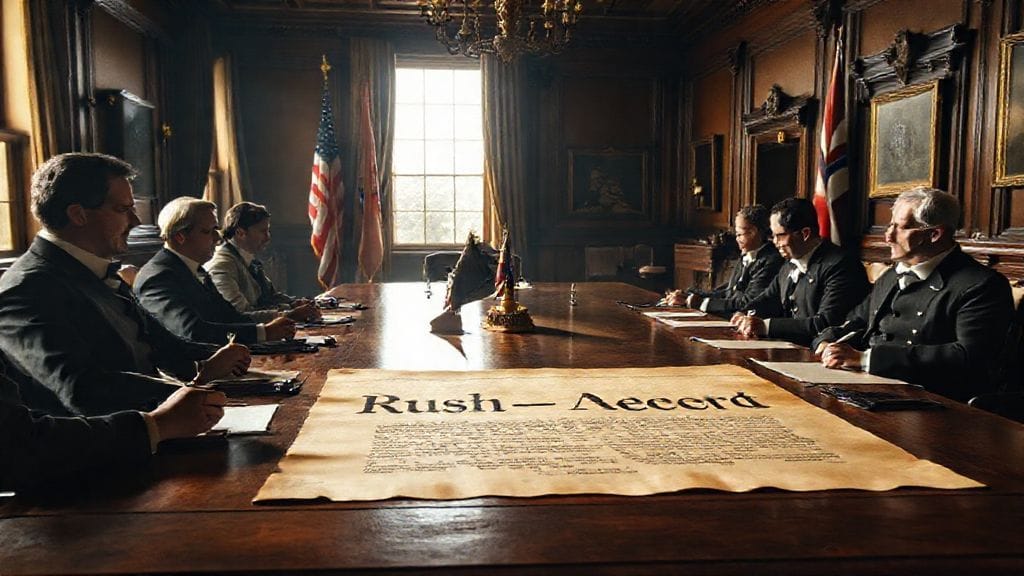
On a chilly spring morning in Washington, D.C., the palpable tension that had long gripped Anglo-American relations began to ebb away—not with the crash of battle, but with the quiet strokes of a pen. The War of 1812, often dubbed America’s "second war of independence," had left a fractured and uneasy peace between the United States and the British Empire. Yet, amid the scars and losses, a unique opportunity for reconciliation and restraint presented itself—one that would soon crystallize into a landmark agreement shaping international diplomacy.
This was no mere ceasefire or a temporary truce sewn with fragile threads. The Rush–Bagot Agreement, signed on April 28, 1817, was a pioneering accord, subtly revolutionary in its ambition and implications. Its impact would ripple far beyond the immediate postwar period, forging a legacy of disarmament and cooperation along one of the world’s most enduring frontiers.
Washington, D.C., April 28, 1817: A Quiet Revolution Begins
The corridors of power in the United States capital buzzed not with the boom of cannon fire but with the crucial negotiations between two emissaries: Richard Rush, representing the young American republic, and Charles Bagot, acting on behalf of Great Britain. Behind closed doors, these diplomats navigated the turbulent aftermath of war, seeking not revenge or dominance, but a practical roadmap toward peace.
The atmosphere was charged yet hopeful. Memories of battles like Lake Erie and Fort McHenry still flickered in national consciousness, even as leaders realized that another military confrontation would be catastrophic. Both sides understood this implicitly. Here, at last, lay a chance to move forward—unarmed but unafraid.
The Aftermath of Conflict: Why Disarmament Was Imperative
The War of 1812 exposed the persistent volatility along the U.S.-Canadian border, particularly on the vast and strategically crucial Great Lakes. These expansive inland seas had witnessed fierce naval skirmishes that underscored the potential for continued bloodshed unless drastic measures were taken.
But beyond the military calculus, economic factors played a decisive role. The cost of maintaining a wartime fleet on the Great Lakes strained resources, while local communities on both sides yearned for peace to restore trade and prosperity. Disarmament promised a reduction in military expenditures and an opportunity to stabilize the region.
Yet, gestures toward peace required more than economics; they demanded trust. After years of hostility and fierce competition, the idea of placing naval power on the lakes under strict limits was bold, almost unprecedented.
The Anglo-American Relationship in the Early 19th Century
To comprehend the significance of the Rush–Bagot Agreement, one must examine the complex relationship between Britain and the United States following independence and the War of 1812. The two nations shared not only geography but also cultural ties, economic interdependence, and ideological differences.
While Britain remained a global imperial power, the U.S. was an emerging republic eager to assert its sovereignty and security. Tensions born from unresolved issues, including trade restrictions and territorial disputes, festered beneath the surface. The war was the explosive outcome of these frustrations.
Yet, the mutual exhaustion post-war set a stage for new diplomacy, one shaped by pragmatism and the shifting global order.
Defining Terms: What Was the Rush–Bagot Agreement?
At its heart, the Rush–Bagot Agreement was a bilateral treaty that aimed to drastically limit naval forces on the Great Lakes and Lake Champlain. It stipulated strict caps on the number, size, and armament of vessels that the U.S. and Britain could maintain in peacetime on these waters.
This delicate balance prevented either side from gaining a significant naval advantage, thereby reducing the likelihood of future conflicts. The pact was modest in length but momentous in effect—a testament to the power of restraint in international relations.
The Personalities Behind the Pact: Charles Bagot and Richard Rush
Behind every historic agreement are the men and women who maneuver the intricate machinery of diplomacy. Charles Bagot, the British ambassador to the United States, was a seasoned diplomat with a reputation for tact and pragmatism. He understood the importance of balancing imperial interests with the realities of a newly assertive neighbor.
Opposite him was Richard Rush, the American minister to Britain and son of a prominent statesman, whose firm yet conciliatory approach helped bridge the chasm of distrust between the two nations. Their correspondence reveals a mutual respect and a shared vision that transcended the scars of war.
Negotiation Tensions and Diplomatic Dance
Negotiations were far from straightforward. Both sides harbored suspicion: the U.S. feared British encroachment, while Britain worried about American ambitions along the northern frontier. Navigating these fears required skillful diplomacy, patient listening, and creative compromise.
At times, talks nearly stalled over details such as the number of warships allowed or the extent of patrols. Yet, amid these moments of tension, the diplomats remained mindful that their mission extended beyond immediate terms—it was about forging a durable peace.
Naval Rivalry on the Great Lakes: An Arms Race in Miniature
Before the agreement, the Great Lakes witnessed a naval arms race unmatched in scale by the modest populations surrounding them. Both the British and American militaries competed to build fleets equipped with powerful schooners and gunboats, each seeking control over these critical waterways.
This competition not only risked escalating hostilities but also drained scarce resources. The Rush–Bagot Agreement froze this naval buildup, mandating that only a limited number of small vessels—armed with minimal cannons—could be retained, effectively neutralizing the lakes as potential battlefronts.
The Agreement’s Provisions: Limitations on Warships and Armaments
The treaty was succinct yet precise. Each side agreed to maintain only one vessel of no more than 100 tons and a single cannon on Lake Ontario and Lake Champlain, and up to two vessels not exceeding 100 tons and armed with only one cannon each on the upper lakes.
This careful calibration ensured parity and prevented surprises. The vessels had to be clearly identified and could only serve defensive purposes. Such unprecedented mutual restraint set a template for peaceful coexistence.
Implementing the Pact: From Ink to Action on the Water
The signature on April 28 was merely the starting point. Implementing the Rush–Bagot provisions required joint surveys, mutual inspections, and ongoing communication to ensure compliance.
Local commanders on both sides were charged with overseeing the removal or destruction of excess vessels and weapons. The lakes gradually quieted, transforming from militarized zones into corridors of commerce and travel.
Public and Political Reactions on Both Sides of the Border
Reactions were mixed but generally positive. In the United States, some military leaders expressed skepticism, wary that disarmament might weaken national security. Meanwhile, citizens and merchants welcomed the prospect of peace and economic revival.
In Britain, especially in Canada, the agreement was viewed cautiously; yet, many saw it as a pragmatic step toward normalizing relations. Newspapers on both sides reported with guarded optimism, highlighting the potential for a new era.
The Rush–Bagot Agreement’s Role in Ending Hostilities for Good
While the Treaty of Ghent had formally ended hostilities in 1814, friction lingered. The Rush–Bagot Agreement was critical in translating peace from paper into practice, marking a tangible reduction in military tensions.
It helped establish a paradigm where military force was not the default tool for conflict resolution in the region. This accord is widely regarded as one of the earliest examples of arms control and conflict de-escalation between great powers.
The Treaty’s Legacy in Shaping the Longest Unfortified Border
Perhaps the greatest testament to the Rush–Bagot Agreement’s success is the present-day U.S.-Canada border, the longest undefended boundary in the world. This demilitarized frontier stands as a living monument to the trust and cooperation fostered by the 1817 treaty.
The lakes and rivers, once potential flashpoints for war, now serve as symbols of peaceful coexistence, commerce, and friendship.
Symbolizing Trust: How the Agreement Fostered Bilateral Cooperation
More than a disarmament pact, the Rush–Bagot Agreement laid the groundwork for broader cooperation. It signaled a willingness to resolve disputes diplomatically and to share oversight peacefully.
This spirit influenced subsequent agreements on boundary commissions, trade, and environmental management, creating a foundation of mutual respect and partnership still evident today.
Challenges and Criticisms: Was the Disarmament Sustainable?
Of course, the agreement was not perfect. Critics questioned whether the restrictions could be enforced effectively, especially given the vast geography involved. Some saw it as a temporary fix rather than a lasting solution.
However, the fact that the basic terms have endured—with only minor adjustments—suggests the wisdom of this approach. The parties proved capable of putting trust over fear, a formidable challenge in international relations.
Echoes Through Time: The Agreement’s Influence on Future Treaties
The Rush–Bagot model foreshadowed 20th-century arms control efforts, from naval treaties post-World War I to Cold War disarmament talks. Its emphasis on parity, verification, and mutual limitation remains relevant.
Historians often cite it as a pioneering step toward international regimes that seek to limit weapons and build confidence between adversaries.
The Rush–Bagot Agreement in the Context of Global Naval Disarmament
At a time when major European powers were building ever-larger navies, Britain and the US chose a path of restraint on a significant frontier. This stance contrasted sharply with global trends, making the agreement noteworthy for its exceptionalism.
It underscored the potential of bilateral cooperation amidst rising nationalism and military rivalry, offering a hopeful lesson for the future.
Cultural Reflections: How Americans and Canadians Remember the Pact
In folklore and official histories alike, the Rush–Bagot Agreement occupies a subtle but important place. Canada views it as part of its path to peaceful status within the British Empire and eventually independent identity.
For Americans, it marks a milestone where republicans and monarchists alike found common ground. Anniversaries are commemorated in both nations, highlighting the enduring value of peaceful diplomacy.
The Role of Geography and National Identity in Shaping Peace
The vast wilderness, lakes, and forests of the borderlands shaped the negotiation’s pragmatic tone. Neither side could easily project overwhelming military power across such an expanse, necessitating cooperation.
Simultaneously, national identity was bound up with the frontier—asserting control without igniting conflict required finesse. The geographical realities nudged politics toward peace.
Modern Perspectives: The Agreement’s Relevance in Today’s Diplomacy
Today, in an era of complex global challenges and renewed border tensions worldwide, the Rush–Bagot Agreement offers timeless insights. It demonstrates how even adversaries can agree to constraints for mutual benefit.
Its principles inspire ongoing dialogues on arms control, border security, and international trust-building, making it more than a historical footnote.
Conclusion
From the ashes of war, the Rush–Bagot Agreement emerged as a quiet testament to human reason and hope. It showed that even after bitter conflict, former enemies could choose cooperation over confrontation, restraint over escalation. The story of this 1817 pact teaches us that peace is not merely the absence of war but the deliberate cultivation of trust, respect, and shared security.
More than two centuries later, the echoes of that spring day in Washington resonate along the shimmering waters of the Great Lakes and beyond. They remind us that the pen—and the vision behind it—can indeed be mightier than the sword.
FAQs
1. What triggered the signing of the Rush–Bagot Agreement in 1817?
The war between the US and Britain had ended in 1814, but tensions, especially naval rivalry on the Great Lakes, remained high. Both sides wanted to prevent future conflicts and reduce military expenses, leading to negotiations for disarmament.
2. Who were the key figures in the Rush–Bagot negotiations?
Richard Rush, the American minister to Britain, and Charles Bagot, the British ambassador to the United States, were the primary diplomats responsible for crafting and signing the agreement.
3. What were the main terms of the Rush–Bagot Agreement?
It limited each side to only a few small armed vessels on the Great Lakes, with restrictions on the number, size, and armament, effectively demilitarizing the waterways.
4. How did the agreement influence the US-Canada border?
It helped establish the foundation for the world’s longest unfortified border, reducing military tensions and fostering a peaceful coexistence that persists today.
5. Was the Rush–Bagot Agreement unique at its time?
Yes. It was one of the earliest arms control treaties, emphasizing mutual limitations and trust between two former adversaries, contrasting with global trends toward militarization.
6. Did the agreement face any challenges in implementation?
While some military officials were skeptical, the geographical expanse and mutual interest in peace helped enforce the pact successfully over time.
7. How is the Rush–Bagot Agreement remembered in the US and Canada?
It is celebrated as a symbol of peaceful diplomacy and cooperation, marking a significant moment in the countries’ shared history.
8. Does the agreement still hold relevance today?
Absolutely. It serves as a model for disarmament and international cooperation, underscoring the enduring value of trust in global diplomacy.