Table of Contents
- The Calm Before the Storm: Europe at the Dawn of the 20th Century
- The Great Game Revisited: Anglo-Russian Rivalry in Central Asia
- Mutual Suspicion and Tangled Interests: The Path to the Convention
- The Meeting in Saint Petersburg: Negotiations Behind Closed Doors
- Triumph of Diplomacy: Signing of the Anglo-Russian Convention, August 31, 1907
- The Art of Compromise: Key Provisions of the Agreement
- Redrawing the Map: Defining Spheres of Influence in Persia, Afghanistan, and Tibet
- Reactions Across the Globe: Allies, Rivals, and the Press
- From Enmity to Entente: Impact on Anglo-Russian Relations
- The Convention and the Emerging Triple Entente
- Afghanistan’s Role: Buffer State and Pawn in Imperial Chess
- Persia and the Contest for Control: From Qajar Decline to Foreign Intrigue
- Tibet: The Forgotten Frontier and British-Russian Maneuvering
- Strategic Alignments and the Diminishing ‘Great Game’
- How the Convention Shifted the Balance of Power in Europe
- The Fallout in Germany and Austro-Hungary: Unease and Calculations
- The Convention’s Influence on the Road to World War I
- A New Era in Anglo-Russian Interaction: Cooperation or Temporary Truce?
- Legacy in International Relations: Lessons and Historical Perspectives
- Remembering the 1907 Convention: Historical Memory and Modern Analysis
The Calm Before the Storm: Europe at the Dawn of the 20th Century
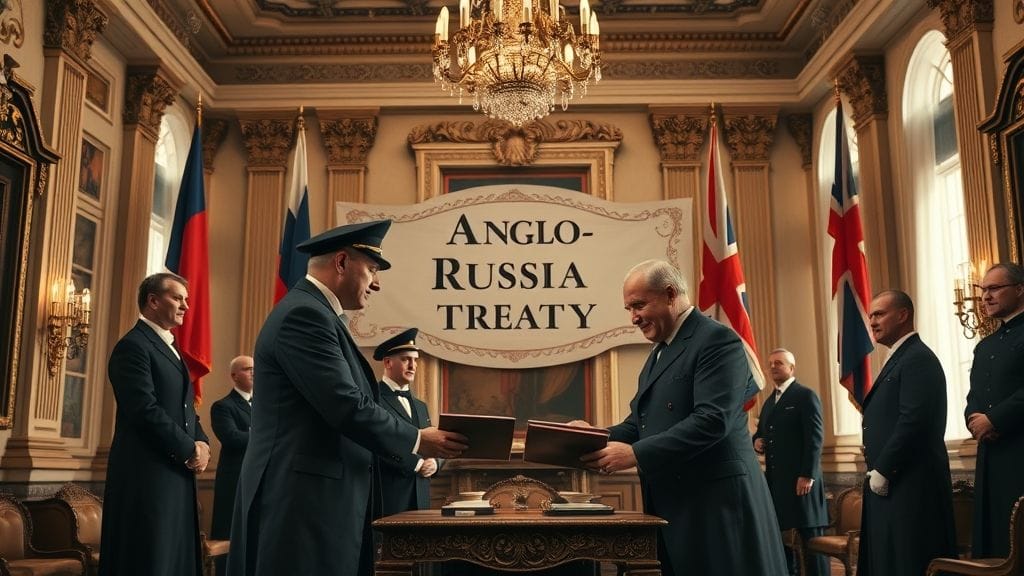
It was a restless epoch, a prelude to chaos. The summer of 1907 had witnessed tremors beneath the polished façade of European diplomacy. Empires vied with anxious hearts and sharpened swords, yet on August 31, amid the grandeur of Saint Petersburg's imperial palaces, envoys of two great rivals sat down to craft a pact that would redefine the chessboard of global power. The signing of the Anglo-Russian Convention was not merely a document on parchment; it was the palpable breath of change, a tentative gesture towards peace in a century destined to be torn apart by war.
The sun glimmered on the Neva River, casting a golden sheen over the city, as diplomats from London and Saint Petersburg engaged in final deliberations. To an outside observer, the scene might have suggested the fragile calm before an inevitable storm, yet inside these chambers, the seeds of a new political landscape were taking root—an alliance born of necessity, pragmatism, and weary resignation.
The Great Game Revisited: Anglo-Russian Rivalry in Central Asia
For much of the 19th century, the vast expanse of Central Asia was a stage for the so-called "Great Game," where the British and Russian Empires played a high-stakes game of espionage, subterfuge, and military posturing. The prize was control over trade routes, buffer zones, and influence stretching from India to the Caucasus and beyond. The British, protectors of the Indian Raj, feared Russian expansion southwards, while the Russians, propelled by imperial ambition, sought to extend their reach towards warm-water ports and strategic depth.
The decade preceding 1907 was fraught with crises reflecting this uneasy rivalry: the Panjdeh Incident of 1885 that brought the two empires to the brink of war, Afghan intrigues, and competing influence in Persia’s weakening Qajar dynasty. Borders were vague, claims were overlapping, and every tribal revolt or shifting alliance in the region could escalate tensions in London or Saint Petersburg.
Mutual Suspicion and Tangled Interests: The Path to the Convention
Yet, by the early 1900s, the world was changing. Both empires faced internal unrest, financial strain, and new external threats. Japan’s surprise victory over Russia in 1905 shattered illusions of invincibility, while Britain contemplated the rising challenge of Germany on the Continent and beyond. These pressures nudged London and Saint Petersburg towards dialogue.
Behind the curtains, informal talks had started to thaw decades of mistrust. The desire to avoid a costly war and to redirect energies elsewhere inspired diplomats to seek common ground. But this was no easy path. Deep-rooted fears, pride, and conflicting imperial ambitions demanded subtle negotiations, balancing acts, and strategic concessions.
The Meeting in Saint Petersburg: Negotiations Behind Closed Doors
In the shadow of the Winter Palace, the British and Russian representatives convened with a mixture of suspicion and resolve. Few details emerged at the time, but what is known highlights the painstaking efforts that went into bridging gaps of distrust.
Discussions extended over multiple days, with each concession hard-won. Britain pushed for recognition of its paramount interests in Afghanistan, while Russia sought acknowledgment of its influence in northern Persia and Central Asia. Tibet, often dismissed by Western observers as a remote frontier, also emerged as a contested sphere.
The theatre of these talks was not merely a diplomatic venue but a reflection of empires grappling with the limits of power and the promise of peace.
Triumph of Diplomacy: Signing of the Anglo-Russian Convention, August 31, 1907
On that late summer day, the ink dried on an agreement that surprised many in international circles. The Anglo-Russian Convention was heralded as a masterstroke of diplomacy—one that reconciled decades of rivalry and opened doors to collaboration.
The document itself was succinct but packed with meaning: mutual recognition of spheres of influence, agreements on non-interference, and an expressed interest in preserving the independence of buffer states. It marked the first time Britain and Russia, two rivals who had eyed each other with suspicion and hostility, publicly aligned their interests.
Yet, beneath the surface, it was understood that this was a truce more than a deep friendship.
The Art of Compromise: Key Provisions of the Agreement
At its core, the convention delineated three primary zones in Persia: the northern region under Russian influence, the southern along the Persian Gulf under British influence, and a neutral central region intended to remain free from foreign control. Afghanistan was formally recognized as outside Russian influence, a British sphere of influence acting as a protective buffer. In Tibet, both powers pledged to respect its territorial integrity, refraining from any territorial claims or interference.
This division was no arbitrary act but an acknowledgment of the limits of imperial reach. It was an attempt to impose order and prevent future conflicts in a volatile region. The convention also implicitly recognized the sovereignty of these regions, though in practice, imperial rivalry would continue to influence their internal affairs.
Redrawing the Map: Defining Spheres of Influence in Persia, Afghanistan, and Tibet
Persia, often called the "land of conflicting ambitions," stood at the heart of the agreement’s most delicate compromises. The Qajar dynasty, weakened by corruption and foreign pressures, offered little resistance to this partitioning from the outside. Britain sought access to Persian Gulf ports and ensured influence over southern Persia, vital for protecting routes to India. Russia secured northern Persia, including access to the Caspian Sea.
Afghanistan’s geopolitical status was clarified with Britain guaranteeing its protection against Russian encroachment—a clear victory for British strategic interests. Tibet, a mysterious and largely unexplored region, was recognized as a sphere both powers would avoid disrupting, partly to calm British anxieties following the 1904 British expedition into Lhasa.
Reactions Across the Globe: Allies, Rivals, and the Press
News of the convention rippled throughout Europe and beyond, eliciting varied reactions. In Britain, many politicians hailed the agreement as a triumph, an end to a costly rivalry and a foundations stone of the emerging Triple Entente that would include France. Russian reaction was more cautious; while the Tsarist government saw the agreement as a practical solution, nationalist factions decried the loss of imperial ambition.
Germany, always wary of Anglo-Russian cooperation, viewed the treaty with suspicion. German newspapers condemned what they saw as an encirclement strategy. Austro-Hungary, France, and even the United States watched with interest, recognizing the shift in power balances this accord represented.
From Enmity to Entente: Impact on Anglo-Russian Relations
This convention effectively ended the "Great Game" rivalry and paved the way for warmer relations between London and Saint Petersburg. The improved diplomatic ties between the two empires facilitated the creation of the Triple Entente in alliance with France, aimed at countering the rising threat of the German Empire.
Though old mistrust lingered, cooperation grew. Intelligence sharing, military coordination, and diplomatic communication increased, setting the stage for a new era in European and world geopolitics.
The Convention and the Emerging Triple Entente
The Anglo-Russian Convention was not an isolated diplomatic move. It was the final piece in a puzzle that included the Entente Cordiale between Britain and France (1904) and the Franco-Russian Alliance. Together, these agreements created a tripartite understanding that shaped alliances heading into the First World War.
This alignment challenged the existing balance of power in Europe, confronting the Central Powers and signaling a shift toward organized opposition, countering decades of fragmented alliances and rivalries.
Afghanistan’s Role: Buffer State and Pawn in Imperial Chess
The convention’s treatment of Afghanistan resonated far beyond diplomatic lines on a map. As a buffer state, Afghanistan's sovereignty was both respected and compromised. Britain’s commitment to defend Afghanistan against Russian influence ensured continued British dominance over Afghan foreign affairs. It was a delicate balance, preserving Afghan autonomy in name while limiting its freedom in practice.
This approach both stabilized the region temporarily and sowed the seeds of future Afghan resentment and conflict, illustrating the complex human cost of imperial diplomacy.
Persia and the Contest for Control: From Qajar Decline to Foreign Intrigue
Persia under the weakening Qajar dynasty was a patchwork of foreign influence and internal struggle. The division imposed by the convention exacerbated these conditions. British and Russian penetration into the economy, politics, and military affairs of Persia intensified, drawing the country into compelling but precarious relationships with the two empires.
This period also saw the rise of nationalist sentiments within Persia, as intellectuals and leaders began to challenge foreign control—a prelude to the Constitutional Revolution and broader movements against imperialism.
Tibet: The Forgotten Frontier and British-Russian Maneuvering
While often overlooked, Tibet represented a critical—and symbolic—area of Anglo-Russian contestation. Following the British expedition to Lhasa in 1904, Russia feared British overreach on its perceived sphere of influence. The convention's provision to respect Tibetan territorial integrity was an attempt to prevent further conflict over this enigmatic region.
For Tibetans themselves, this agreement remained distant diplomacy; nonetheless, it foreshadowed decades of external pressures that would shape Tibetan history profoundly.
Strategic Alignments and the Diminishing ‘Great Game’
The convention marked the twilight of the classic Great Game. The rivalry shifted from direct confrontation to diplomatic accommodation and alliance-building. This transformation reflected broader changes in global politics, including new threats, alliances, and technological advancements in warfare and communications.
What was once a brutal espionage and military contest became a calculated and structured diplomacy—a testament to the evolving nature of imperialism in the century’s first decade.
How the Convention Shifted the Balance of Power in Europe
By resolving key friction points between Britain and Russia, the convention realigned European geopolitics. It strengthened the defensive posture of the Entente Powers, setting clearer divisions against the Central Powers. This created a Europe divided not only by alliances but by deeper ideological and imperial interests, intensifying the rivalries that would erupt a few years later.
The convention’s significance thus transcended Central Asia—it was a step toward the cataclysmic conflicts yet to come.
The Fallout in Germany and Austro-Hungary: Unease and Calculations
Germany perceived the convention as part of a hostile encirclement, intensifying anxiety in Berlin. Austro-Hungary, concerned about the shifting balance, reassessed its diplomatic strategies, especially regarding Serbia and the Balkans.
This unease contributed indirectly to the complex web of tensions that fostered the conditions for World War I, demonstrating how a seemingly remote agreement in Central Asia echoed throughout global capitals.
The Convention’s Influence on the Road to World War I
By creating clearer alliances and resolving certain conflicts, the convention inadvertently set the stage for larger-scale confrontations. The entrenchment of alliance blocs emboldened powers to stand firm in rising conflicts, ultimately limiting diplomatic flexibility in crises.
The treaty underscored the paradox of pre-war diplomacy: agreements intended to prevent war sometimes sharpened divisions, creating a powder keg ready to ignite.
A New Era in Anglo-Russian Interaction: Cooperation or Temporary Truce?
Was the Anglo-Russian Convention the dawn of genuine friendship or a temporary strategic truce? While cooperation increased in the years after, the undercurrents of rivalry persisted beneath the surface. The overthrow of the Romanov dynasty and the Bolshevik Revolution would soon erase the imperial Russian state, replacing it with a radically different government hostile to British imperialism.
Thus, the convention remains a fascinating snapshot—a moment when pragmatism overcame enmity, however briefly.
Legacy in International Relations: Lessons and Historical Perspectives
Historians looking back often emphasize the Anglo-Russian Convention as a landmark in diplomacy, demonstrating how ancient rivals can find common cause. It is a case study in balancing rivalry and cooperation, managing conflicting interests, and recognizing limits.
However, it also illustrates the fragility of such agreements amid shifting political tides and the impossibility of fully erasing deep-seated competition.
Remembering the 1907 Convention: Historical Memory and Modern Analysis
Today, the 1907 Anglo-Russian Convention is a subject of scholarly interest rather than popular memory. It is taught as a turning point in early 20th-century diplomacy, a precursor to the complex alliances that shaped modern history.
Modern geopolitics still echoes the questions raised by this agreement: How do major powers balance cooperation and competition? How are smaller nations and regions affected by distant deals? The convention remains a powerful reminder of the enduring interplay between imperial ambition and realpolitik.
Conclusion
The Anglo-Russian Convention of August 31, 1907, was a momentary beacon amid the gathering clouds of the 20th century’s tumult. It demonstrated the powers of dialogue and compromise, even when weighed down by decades of rivalry and suspicion. Yet, it also foreshadowed the limits of such peace, reminding us that the great empires, their ambitions vast and intertwined, often walk a razor’s edge.
In the grand theater of history, this convention was a chapter where political pragmatism sought to tame imperial rivalry—if only for a time. It reshaped borders, alliances, and perceptions, leaving a legacy both instructive and cautionary. For students of history and the human saga of power, it offers a poignant lesson: peace does not root easily in fields worn by conquest and fear, but it can be born even amid uncertainty—if only for a fleeting moment.
FAQs
Q1: What motivated Britain and Russia to sign the Anglo-Russian Convention in 1907?
A1: Both empires faced external threats, such as rising German power and internal challenges like financial strain and military setbacks (notably Russia’s defeat in the Russo-Japanese War). These pressures encouraged them to resolve their long-standing rivalries in Central Asia to avoid costly conflicts.
Q2: What were the main territorial divisions set by the convention?
A2: The agreement divided Persia into three zones (Russian north, British south, neutral center), recognized Afghanistan as a British sphere (buffer against Russia), and established non-interference in Tibet for both parties.
Q3: How did the convention affect the ‘Great Game’?
A3: It effectively brought an end to the classic Anglo-Russian rivalry over Central Asia by formalizing spheres of influence and promoting cooperation, shifting the Great Game from overt competition to diplomatic engagement.
Q4: Did the convention lead to a long-lasting alliance?
A4: While it improved Anglo-Russian relations and helped form the Triple Entente, the alliance was opportunistic and fragile. The Russian Revolution and other 20th-century upheavals later altered relationships drastically.
Q5: How did other powers react to the convention?
A5: Germany and Austro-Hungary viewed it with suspicion, seeing it as encirclement. France welcomed it as it strengthened the alliance system. The United States and others observed cautiously, recognizing shifts in global power dynamics.
Q6: What was Afghanistan’s status after the convention?
A6: Afghanistan was recognized as a British sphere of influence protected from Russian expansion, affirming its role as a buffer state between the two empires despite limited Afghan input in the agreement.
Q7: Did the convention have any impact on World War I?
A7: Yes. By solidifying alliances and spheres of influence, it helped lay the groundwork for the blocks that fought in World War I, contributing indirectly to the conflict's outbreak through increased polarization.
Q8: Is the Anglo-Russian Convention still relevant today?
A8: While the specific geopolitical context has changed, the treaty is relevant as an example of diplomacy’s potential and limits in resolving imperial rivalries and managing competing national interests.