Table of Contents
- The Dawn of a Frozen Frontier: Setting the Stage for the Antarctic Treaty
- Early Antarctic Exploration and the Claims of Sovereignty
- The Cold War and the Strategic Importance of Antarctica
- Scientific Endeavors Under the Southern Lights: A Prelude to Cooperation
- The International Geophysical Year (1957-1958): Catalyst for Collaboration
- Rising Tensions and the Need for a Neutral Zone
- Diplomatic Maneuvering in Washington, D.C.: The Road to the Treaty
- The Signing Day: December 1, 1959 – A Historic Moment of Peace
- Key Provisions of the Antarctic Treaty: Peace, Science, and Sovereignty
- The Signatory Nations: A Unique Multilateral Pact in a Divided World
- Immediate Reactions and Global Reception of the Treaty
- Enforcing Peace on the Icy Continent: Mechanisms and Challenges
- Scientific Collaboration Flourishes: Post-Treaty Research Initiatives
- Environmental Protection and the Evolution of Antarctic Governance
- The Antarctic Treaty System: Expanding the Framework
- Case Studies: Successes and Conflicts Since the Treaty’s Inception
- Antarctica and International Law: Sovereignty Beyond Borders
- The Treaty’s Role Amidst Modern Geopolitical Shifts
- Cultural and Symbolic Legacy of the Antarctic Treaty
- Antarctica Today: A Testament to Peace and Cooperation
- Conclusion: An Enduring Oath to Peace and Science
- FAQs: Unraveling the Mysteries of the Antarctic Treaty
- External Resource
- Internal Link
On a crisp December morning in 1959, beneath the grand facades of Washington, D.C., a crowd of diplomats, scientists, and policymakers gathered to witness something extraordinary. In an era marked by ideological hostilities, nuclear brinkmanship, and the ever-looming threat of global conflict, twelve nations came together not to compete but to collaborate, forging a pact whose ripples would extend far beyond icy shores. The Antarctic Treaty was signed that day—not just a document, but a beacon of hope, signaling a rare convergence of peace and scientific pursuit on the Earth’s southernmost continent.
The Dawn of a Frozen Frontier: Setting the Stage for the Antarctic Treaty
Antarctica, a land of extremes—unforgiving cold, shifting ice, and an almost otherworldly silence—captured human imagination long before the world saw the first permanent research stations. The continent had been a place of mystery and myth, a white blank on the map beckoning explorers and nations alike. By the mid-20th century, Antarctica was not just a geographic curiosity but a symbol of territorial ambition, scientific promise, and Cold War tension. Conventional diplomacy, military strategy, and scientific curiosity collided, setting the stage for a unique international agreement.
Early Antarctic Exploration and the Claims of Sovereignty
The story of Antarctica’s exploration is fraught with daring expeditions and territorial claims. From the first sightings by explorers like James Cook and Fabian Gottlieb von Bellingshausen in the 18th and 19th centuries, to the heroic age of exploration in the early 1900s with names like Robert Falcon Scott, Ernest Shackleton, and Roald Amundsen, the continent was a theater of human endurance and adventure.
Several countries, notably the United Kingdom, Argentina, Chile, Norway, and later Australia and New Zealand, laid overlapping claims to portions of Antarctica. These claims sparked diplomatic tensions, as multiple nations vied for strategic advantage and national prestige. The lack of clear international legal frameworks only fanned the flames of uncertainty.
The Cold War and the Strategic Importance of Antarctica
The global chessboard of the Cold War cast long shadows even onto Antarctica’s frozen expanses. The continent’s vast mineral resources remained largely theoretical, but its strategic position was real. The United States and the Soviet Union, aware of Antarctica’s potential as a base for scientific research—and possibly military installations—maintained vibrant presences even as they hedged one another’s movements.
The threat of military confrontation permeated discussions, and the continent risked becoming yet another proxy battleground in the ideological conflict. However, paradoxically, the shared challenges of extreme weather and logistical isolation fostered a spirit of cooperation among scientists from opposing blocs.
Scientific Endeavors Under the Southern Lights: A Prelude to Cooperation
Science, as so often, became the currency of peace. Before the treaty, international scientific collaboration was episodic but crucial. Expeditions exchanged meteorological data and shared logistical support during the harsh Antarctic winters. The continent’s unique environment offered unparalleled opportunities to study earth sciences, geophysics, and atmospheric phenomena.
Scientists recognized the importance of transcending political divides for the sake of knowledge. This ethos of cooperation grew stronger during the International Geophysical Year.
The International Geophysical Year (1957-1958): Catalyst for Collaboration
The International Geophysical Year (IGY), spanning from July 1957 to December 1958, served as a defining moment. Fifty-three nations joined forces to conduct simultaneous, coordinated observations of Earth’s physical properties—from the polar regions to the equator. Antarctica was a major focus, with unprecedented international stations established, including the United States’ McMurdo Station and the Soviet Union’s Vostok Station.
The success of the IGY helped dissipate mistrust and illustrated the benefits of peaceful scientific collaboration. It forged networks of coordination and trust among participants, setting a roadmap for post-IGY governance.
Rising Tensions and the Need for a Neutral Zone
Yet, beneath the cooperative veneer, sovereignty claims and militarization concerns simmered. The deployment of military personnel in support of research, and reports of nuclear testing in nearby oceanic regions, stoked suspicions. The risk that Antarctica could become an extension of geopolitical rivalry loomed large.
Diplomatic circles increasingly perceived the continent as a zone that must be neutralized to avoid conflict—an idea gaining traction with growing awareness of Antarctica’s global importance.
Diplomatic Maneuvering in Washington, D.C.: The Road to the Treaty
Against this backdrop, the United States, then under President Dwight D. Eisenhower, took the initiative. Washington became the diplomatic hub where discussions coalesced into formal negotiations. Twelve countries, including Argentina, Australia, Belgium, Chile, France, Japan, New Zealand, Norway, South Africa, the Soviet Union, the United Kingdom, and the United States, convened over successive meetings.
These negotiations delicately balanced national interests with the desire for peaceful coexistence—an effort emblematic of Cold War diplomacy at its most judicious. Each party’s concerns over sovereignty, military use, and scientific freedom were painstakingly debated and refined.
The Signing Day: December 1, 1959 – A Historic Moment of Peace
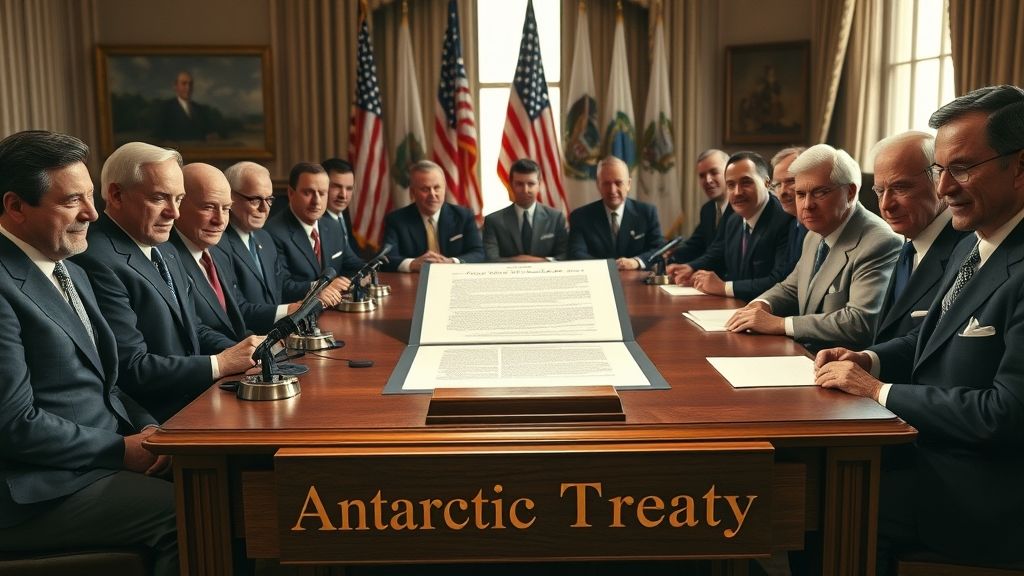
December 1, 1959, remains etched in history as the day twelve signatories affixed their names on a document that transcended political divides. The signing ceremony in Washington was a quiet but momentous occasion, symbolizing a collective pact to dedicate the Antarctic continent exclusively to peaceful activities and scientific research.
The Treaty opened with a powerful declaration, committing to ban any nuclear explosions and halt the disposal of radioactive waste. That twelve bitterly opposed nations could agree on such terms—during one of the tensest periods of the Cold War—remains one of modern diplomacy’s finest achievements.
Key Provisions of the Antarctic Treaty: Peace, Science, and Sovereignty
At the heart of the Treaty were revolutionary principles: Antarctica was to be used exclusively for peaceful purposes—no military activities, no nuclear explosions, no disposal of radioactive waste. The continent was designated a scientific preserve, emphasizing freedom of scientific investigation and cooperation.
The Treaty also froze territorial claims without prejudice—neither recognizing nor disputing them—effectively putting sovereignty disputes on hold. This delicate compromise allowed the Treaty to prevail where previous attempts foundered.
The Signatory Nations: A Unique Multilateral Pact in a Divided World
The original twelve signatory nations represented a diverse tapestry of geopolitical alignment: from Western powers to communist states, from colonial empires to emergent democracies. Their coming together symbolized a pragmatic willingness to look beyond ideological fault lines for the sake of preservation and peace.
Over decades, the Antarctic Treaty membership swelled, embodying the world’s growing commitment to international cooperation and environmental stewardship.
Immediate Reactions and Global Reception of the Treaty
The signing triggered a wave of optimism. Newspapers hailed the Antarctic Treaty as a “Glacier of Peace,” and politicians lauded its promise amid Cold War darkness. Yet, some voices remained skeptical, questioning enforcement and the true intentions behind the agreements.
Nonetheless, the Treaty set a precedent—a rare successful arms control measure embedded within international law, grounded not in power, but in consensus and shared values.
Enforcing Peace on the Icy Continent: Mechanisms and Challenges
Implementing the Treaty posed unique challenges. With no permanent government in Antarctica, enforcement fell to signatory nations through inspections and cooperation. Regular consultative meetings were established to review compliance, and later protocols would strengthen inspections.
Logistical difficulties, vast distances, and harsh conditions complicated monitoring. Yet, the Treaty’s success owes much to transparency and mutual trust fostered among participants.
Scientific Collaboration Flourishes: Post-Treaty Research Initiatives
Freed from military competition, Antarctic research flourished spectacularly. Nations pooled resources and data, unlocking secrets about climate, geology, and the magnetosphere. Breakthrough discoveries, from ice core drilling revealing Earth’s climatic past to insights into the ozone layer’s depletion, would shape environmental science for generations.
The Southern Continent became a laboratory for science diplomacy, where researchers and diplomats worked hand in hand.
Environmental Protection and the Evolution of Antarctic Governance
While the original Treaty focused on peace and science, awareness of Antarctica’s fragile ecosystems grew. Subsequent agreements, like the 1991 Protocol on Environmental Protection, built upon the Treaty to safeguard habitats, regulate waste, and suspend mineral resource exploitation.
Today, Antarctica stands as one of the last great wildernesses on Earth—a testament to evolving international commitment not just to peace, but to planetary stewardship.
The Antarctic Treaty System: Expanding the Framework
The Treaty’s framework extended to encompass additional agreements addressing seals, marine living resources, and environmental impact. Known collectively as the Antarctic Treaty System, these diplomatic layers contributed to comprehensive governance, adapting as new challenges emerged.
This system is a pioneering example of multilateral environmental law and cooperative management of a global commons.
Case Studies: Successes and Conflicts Since the Treaty’s Inception
Despite its strengths, the Antarctic Treaty has faced tests—territorial audits by claimant states, military exercises repurposed under scientific pretenses, and national pride clashing with common interests. For example, the Argentina-Chile disputes around the Antarctic Peninsula still simmer under the Treaty’s careful mediation.
Yet each challenge has reaffirmed the Treaty’s core principle: conflict is avoidable when dialogue and mutual respect prevail.
Antarctica and International Law: Sovereignty Beyond Borders
Legally, Antarctica occupies a unique space. The Treaty freezes claims but does not extinguish sovereignty, creating an intricate legal ambiguity. This “territory without a state” invites ongoing debate about governance, rights, and responsibilities—especially as resources and climate change introduce new complexities.
It is a laboratory not only for science but for international law and diplomacy.
The Treaty’s Role Amidst Modern Geopolitical Shifts
In the post-Cold War era, Antarctica’s geopolitical importance remains, now entwined with global environmental concerns and emerging security interests. China’s expanding presence, increasing tourism, and potential resource pressures test the Treaty’s resilience.
Still, the Antarctic Treaty endures as a framework for negotiation and cooperation, emphasizing cautious optimism amid changing global dynamics.
Cultural and Symbolic Legacy of the Antarctic Treaty
Beyond politics and science, the Treaty has become a symbol of hope—proof that shared values can transcend division. It inspires literature, art, and public imagination as a “continent of peace,” a place where humanity recognizes its common destiny.
In a world marked by fragmentation, the Treaty stands tall as a narrative of unity.
Antarctica Today: A Testament to Peace and Cooperation
Seventy-plus years later, Antarctica remains the only continent devoted exclusively to peace and research. International stations pulse with life in the frozen expanses, while inspectors and diplomats convene regularly, ensuring the Treaty’s spirit endures.
The icy silence is a witness to one of mankind’s finest diplomatic achievements.
Conclusion
The Antarctic Treaty, signed on that December day in 1959, is more than a legal document—it is a monumental affirmation of human possibility. In a time when the world was cleaved by suspicion and fear, twelve nations cast aside differences to protect a fragile continent in the spirit of peace, science, and cooperation. Its legacy is a reminder that even in the most inhospitable corners of the earth, humanity can carve out spaces of hope and mutual respect. Antarctica’s frozen wilderness is thereby not only a tableau of natural wonder but a living testament to diplomacy’s highest aspirations.
FAQs
Q1: What were the main causes that led to the signing of the Antarctic Treaty?
A1: The combination of overlapping territorial claims, Cold War tensions, the strategic importance of Antarctica, and the success of scientific collaboration during the International Geophysical Year created the imperative for a formal treaty to preserve peace and promote research.
Q2: Which countries were the original signatories of the Antarctic Treaty?
A2: The original twelve signed the Treaty on December 1, 1959: Argentina, Australia, Belgium, Chile, France, Japan, New Zealand, Norway, South Africa, Soviet Union, United Kingdom, and the United States.
Q3: How does the Treaty address military activities and nuclear testing?
A3: The Treaty prohibits any military activity, including the establishment of military bases, maneuvers, and nuclear explosions or radioactive waste disposal in Antarctica, ensuring the continent remains demilitarized.
Q4: What is the significance of freezing territorial claims in the Treaty?
A4: Freezing claims meant that countries neither renounced nor recognized sovereignty claims. This compromise avoided conflict while allowing continued peaceful scientific activity without prejudice to claims.
Q5: How has the Antarctic Treaty influenced environmental protection?
A5: Over the decades, the Treaty framework has expanded to include environmental protocols safeguarding ecosystems, regulating waste, and banning mineral resource exploitation to preserve Antarctica’s fragile environment.
Q6: How is the Treaty enforced given Antarctica’s remoteness?
A6: Enforcement relies on inspections by signatory nations, regular consultative meetings, transparency in activities, and mutual cooperation to ensure compliance despite logistical challenges.
Q7: What role does the Treaty play in present-day geopolitics?
A7: It remains crucial in managing scientific cooperation, environmental protection, and conflict prevention, even as emerging powers increase their presence and climate concerns grow.
Q8: Why is the Antarctic Treaty considered a landmark in international diplomacy?
A8: Because it successfully established a long-term framework for peace, science, and cooperation during the Cold War, throughout shifting global tensions, it remains a rare example of consensual multilateral governance.