Table of Contents
- The Dawn of Defeat: France on the Brink, June 1940
- The Fall of France: Prelude to Armistice
- Paris Under Siege: The Psychological Collapse
- The Path to Compiègne: From Battlefield to Negotiation Table
- June 16, 1940: Pétain’s Rise and the Quest for Peace
- The Strategic Context: Hitler’s Calculations and the Wehrmacht’s Advance
- The French Government in Crisis: Division and Desperation
- The Armistice Site: The Forest of Compiègne and Its Symbolism
- June 21, 1940: The Arrival at the Clairière de l’Armistice
- June 22, 1940: Signing the Armistice – Ceremony and Content
- The Terms of Surrender: France Divided and Subjugated
- The Immediate Reactions: French Citizens and International Response
- Vichy France: Collaboration, Resistance, and Ambiguity
- The Psychological Weight: Shame, Survival, and National Trauma
- The Global Impact: Altering the Course of World War II
- The Armistice as a Propaganda Tool: Nazi Germany’s Message of Power
- Resistance Sparks: The Armistice as a Call to Fight
- The Legacy of Compiègne: Memory and Symbolism in Postwar France
- The Compiègne Armistice Carriage: From History to Icon
- Closing Reflections: The Fragility of Peace and Power
- FAQs: Unraveling Myths and Understanding Reality
- External Resource
- Internal Link
1. The Dawn of Defeat: France on the Brink, June 1940
The morning sun filtered weakly through the fog-laden canopy of the Compiègne forest on June 22, 1940. It was an unremarkable day in northern France, save for the profound weight that hung in the damp air—the weight of a nation's surrender. Somewhere deep in the shadows of tall beech trees lay a deserted railway carriage, an artifact of the First World War. Here, in this place thick with historic resonance, the French Third Republic would sign an armistice that would alter the course of the 20th century.
For millions of French citizens, the moment was suffused with an unbearable mixture of disbelief, despair, and weary resignation. Across the country, the front lines had melted away in a matter of weeks; pride and morale had given way to confusion and anxiety as the German war machine advanced with relentless efficiency. This was not just a military defeat—it was a profound national trauma that would echo for decades.
But before the ink dried on the armistice document, the story of how France found itself forced to capitulate unfolds like a riveting, tragic drama, steeped in political intrigue, desperate calculations, and the cruel realities of total war.
2. The Fall of France: Prelude to Armistice
The defeat of France in the spring of 1940 was a shock with reverberations as earth-shaking as the eruption of war itself. In the months prior, Europe had watched with increasing dread as Nazi Germany unleashed a blitzkrieg—a new form of warfare characterized by rapid, mechanized advances—that pulverized the defenses of neighboring countries. Belgium, the Netherlands, and Luxembourg fell rapidly, and on May 10, 1940, German forces launched a surprise offensive through the Ardennes Forest, outflanking the heavily fortified Maginot Line.
French and British forces were caught off guard and soon trapped in a shrinking pocket along the northern coast of France, near Dunkirk. The famous evacuation of over 300,000 Allied troops across the English Channel was underway, but behind this rescue lay the grim reality: the heart of France was vulnerable, the government paralyzed by indecision, and German tanks were rolling toward Paris.
France, once considered the stalwart of European democracy and military might, faced the catastrophic implosion of its defenses. The collective sense of impending doom grew palpable as German forces made steady progress, their mechanized units slicing through the lines with terrifying speed.
3. Paris Under Siege: The Psychological Collapse
On June 14, 1940, German troops marched triumphantly into Paris, unopposed. The fall of the capital, symbolic and crushing, was a psychological blow far beyond military consequence. The City of Light, with its centuries of revolutionary pride and cultural grandeur, now lay under the shadow of the swastika.
The French government, which had fled to Bordeaux, was scrambling to find a path to salvage what remained of national dignity and sovereignty. Hope was in short supply. Streets filled with refugees and displaced civilians painted a portrait of chaos and loss.
Yet the Germans did not bomb Paris into ruins; instead, they seemingly spared the city to underline the political nature of the conquest—France was to remain a grand prize, but only as a subdued and compliant neighbor. This gesture was layered with menace: it was an invitation to capitulation.
4. The Path to Compiègne: From Battlefield to Negotiation Table
With military defeat confirmed and the capital occupied, the French government faced an impossible question: continue a futile fight or seek terms. The dilemma was embodied by Marshal Philippe Pétain, a hero of World War I, who had been summoned to lead the government after the resignation of Paul Reynaud.
Pétain, an emblem of conservatism and national stability, made clear his belief that France needed to stop the bloodshed. Negotiations began in earnest, with the Germans keen to display their power and set conditions favorable to their strategic ambitions. Adolf Hitler chose Compiègne as the meeting place for the armistice to be signed; a deliberate choice, charged with symbolism and revenge against the humiliation Germany had endured in 1918.
5. June 16, 1940: Pétain’s Rise and the Quest for Peace
On June 16, Pétain became Prime Minister, signaling a dramatic shift in French policy. His appeal to the French people was plain and direct: "It is with a heavy heart I tell you today that the war is lost… I enter my duties with the conviction that I am returning to a position of strength where our country can find the rest and the calm necessary for its reconstruction."
His message struck a chord with a nation shattered by rapid defeat. Many longed for peace, for respite from relentless bombing, rationing, and fear. Yet beneath the surface, currents of dissent began to form—figures such as Charles de Gaulle rejected surrender unconditionally, setting themselves on a path of resistance.
6. The Strategic Context: Hitler’s Calculations and the Wehrmacht’s Advance
For Hitler and his generals, the campaign of 1940 was a masterstroke—a demonstration of the new doctrine of warfare that would give Germany unprecedented control over Europe. The speed and decisiveness of the assault transformed the strategic landscape.
But the choice of Compiègne had a deeper meaning. It was at the same site in 1918, in the same railway carriage, that Germany had signed its own surrender, ending World War I. To force France to sign its submission here was a symbolic act of humiliation and retribution. Hitler wanted not just to defeat France militarily, but to impose a psychological and historical wound.
7. The French Government in Crisis: Division and Desperation
France’s political leadership was fractured, caught between a desire to save as much as possible and a belief in continuing the fight from overseas territories or with British help. Debates were fraught and bitter. The army and many public figures called for continued resistance; others, overwhelmed by horrors witnessed and pragmatic about saving civilian lives, pushed for negotiation.
Behind grand speeches lay intense human dramas—ministers hastily signing documents, generals facing the abyss of ruin, millions of civilians facing hunger, dislocation, and fear.
8. The Armistice Site: The Forest of Compiègne and Its Symbolism
The Clairière de l’Armistice, the Clearing of the Armistice, nestled in the dense forest near Compiègne, was chosen as the venue on Hitler’s instructions. The site was deliberately preserved from 1918 as a monument to Germany's earlier defeat.
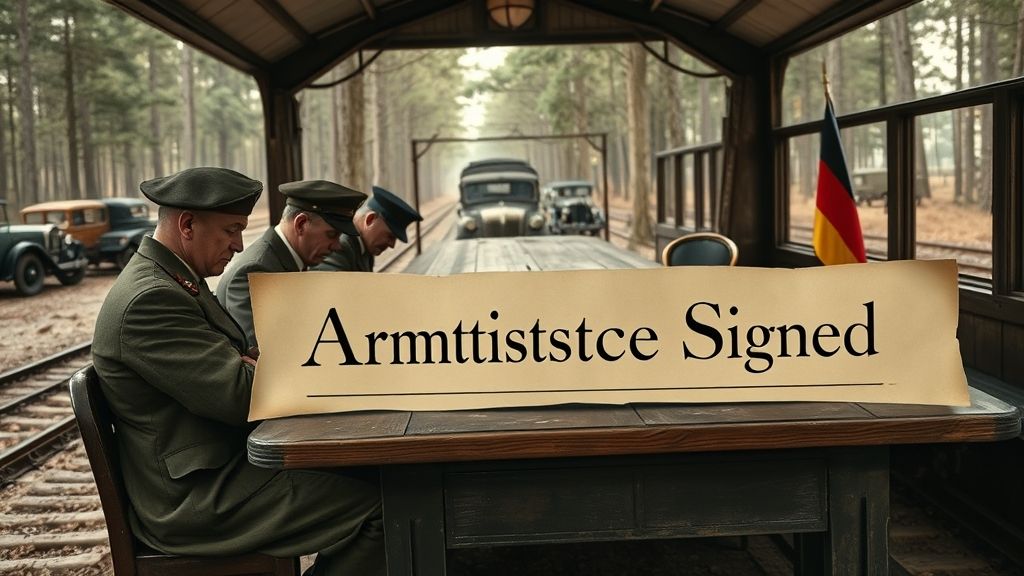
To the German leadership, it represented a stage on which they could literally rewrite history. The static, abandoned railway carriage was placed back on the tracks, setting a theatrical backdrop for the signing ceremony that would reverberate far beyond the French countryside.
9. June 21, 1940: The Arrival at the Clairière de l’Armistice
On the eve of the signing, French representatives arrived under heavy guard, their faces etched with exhaustion and anxiety. The atmosphere was grim; photographers and journalists were barred, the event tightly controlled by the German authorities.
Hitler himself delayed his arrival, emphasizing the humiliation and waiting for maximum psychological effect. The French delegation waited in the cold shadows, aware that they were about to seal not only a document but a fate.
10. June 22, 1940: Signing the Armistice – Ceremony and Content
On the morning of June 22, the armistice was signed inside the railway carriage. The ceremony was terse, cold, and charged with tension. General Charles Huntziger represented France, while German representatives, including General Wilhelm Keitel, signed on behalf of the Reich.
Terms were harsh, outlining the occupation of northern and western France, German control of borders and airspace, and demanding disarmament. France was to be split into occupied and unoccupied zones, with the latter governed by the Vichy regime under Pétain's nominal leadership.
11. The Terms of Surrender: France Divided and Subjugated
The terms resulted in France’s effective division—approximately two-fifths of the country under direct German occupation, including Paris and the industrial north, while the south was administered by the collaborationist government of Vichy.
French armed forces were drastically reduced, and the Treaties imposed reparations and restrictions that stung the national pride and economic vitality. The armistice curtailed France’s sovereignty yet left the illusion of independence, a stratagem that would fuel both collaboration and resistance.
12. The Immediate Reactions: French Citizens and International Response
News of the armistice ignited a storm of despair in France: public morale plummeted, but so too did violent outbreaks and spontaneous acts of defiance. Around the world, allied governments expressed shock and uncertainty. Britain, steadfast but isolated, steeled itself for the long fight. The United States watched with growing concern but remained officially neutral at that stage.
Within France, the population’s response was deeply divided—some accepted the bitter peace in hopes of stability, others saw it as betrayal. The seeds of resistance were quietly sown amid the rubble.
13. Vichy France: Collaboration, Resistance, and Ambiguity
Marshal Pétain’s government, seated in Vichy, quickly became a symbol of both survival and contentious collaboration. It implemented policies of cooperation with Nazi Germany that remain debated to this day—policies that ranged from enforced labor service to the persecution of Jews on French soil.
Yet simultaneously, underground movements began to organize. Charles de Gaulle, in exile, broadcast appeals for continued resistance, framing the armistice as a temporary blow, not an end. The tension between collaboration and resistance would define the French experience throughout the war.
14. The Psychological Weight: Shame, Survival, and National Trauma
For the French people, the armistice was more than a political event—it was a national trauma, a wound to the collective psyche. Pride was crushed as the symbol of freedom—the tricolor flag—was partially supplanted by the Nazi swastika.
Yet survival instincts prevailed in many quarters, as families adjusted to new realities, rationing, curfews, and the relentless presence of occupying forces. Stories of loss, courage, and quiet defiance would fill diaries and forge the mythos of wartime France.
15. The Global Impact: Altering the Course of World War II
The armistice reshaped the global conflict. It left Britain to stand alone against Nazi Germany, hardening Winston Churchill’s resolve, and signaling that the war would continue far beyond the French surrender.
It emboldened Hitler’s ambitions, granting Germany access to French industrial resources and strategic positions. It altered alliances and forced neutral countries to reconsider their positions as the Axis seemed ascendant.
16. The Armistice as a Propaganda Tool: Nazi Germany’s Message of Power
Germany exploited the armistice visually and rhetorically. The deliberate choice of Compiègne, the reproduction of the 1918 humiliation, and the spectacle of the signing were broadcast to project the image of an invincible Reich.
Propaganda films and newspapers emphasized the “miraculous collapse” of France, intending to demoralize other potential opponents and to intimidate occupied populations. The armistice became as much a psychological weapon as a political agreement.
17. Resistance Sparks: The Armistice as a Call to Fight
Yet the armistice also had an unintended effect: it galvanized resistance movements both inside France and abroad. Charles de Gaulle’s Free French Forces formed the nucleus of organized defiance, and underground networks proliferated, committed to undermining Nazi authority.
The cruelties of occupation and the sting of collaboration united disparate groups over time, fanning the flames of liberation that would come years later.
18. The Legacy of Compiègne: Memory and Symbolism in Postwar France
After liberation, the site of Compiègne became a powerful symbol of both humiliation and redemption. The railway carriage was removed by the Nazis during the war, only to be destroyed in an Allied bombing raid, forever sealing the physical reminder.
Memorials now stand in the forest to remember both the armistice and the great war's conclusion, layered with a complex history that evokes remembrance, sorrow, and the lessons of history.
19. The Compiègne Armistice Carriage: From History to Icon
This seemingly mundane railway carriage gained an almost mythic status. It was the site of both Germany's defeat in 1918 and France's subjugation in 1940—a potent emblem of the cyclical nature of fate in history.
Its story has been retold in books, films, and exhibitions, emphasizing the interplay of war, memory, and national identity.
20. Closing Reflections: The Fragility of Peace and Power
The June 22, 1940 armistice was more than a historical footnote. It was a moment that exposed the fragility of power, the volatility of ideals in the storm of war, and the resilience of a nation both broken and unbowed.
France’s ordeal at Compiègne serves as a stark reminder of how quickly fortunes can change, how symbolism and psychology are intertwined with politics, and how even in defeat, the ember of hope can persist.
Conclusion
The armistice signed at Compiègne on June 22, 1940, is a chapter etched with the indelible ink of tragedy, resilience, and transformation. It marked the nadir of French national fortunes in World War II but also the genesis of a profound moral and political reckoning.
In that quiet clearing amidst the ancient forest, history looped back on itself: the carriage that symbolized German surrender in 1918 became the stage for French submission in 1940, underscoring the painful cycles of war and humiliation. Yet, far from signaling the end, the armistice ignited the sparks of resistance and eventual liberation, reminding us that even the darkest moments might kindle the light of renewal.
Through understanding this epochal event—the political upheavals, the human sorrow, and the symbolic theater—we glimpse the complexity of human endurance when faced with the abyss. The legacy of Compiègne compels us to reflect on the costs of conflict, the fragility of peace, and the enduring spirit of a people who refused to be defined solely by defeat.
FAQs
Q1: What led to France signing the armistice in June 1940?
The rapid German blitzkrieg, the collapse of French military defenses, political paralysis, and the fall of Paris forced France into a position where surrender seemed the only option to avoid further bloodshed and chaos.
Q2: Why was Compiègne chosen as the site for the armistice signing?
Hitler chose Compiègne for its symbolic resonance—it was where Germany had signed its own surrender in 1918. Forcing France to capitulate there was a deliberate act to humiliate and reverse the humiliation of World War I.
Q3: What were the main terms of the 1940 armistice?
France was divided into occupied and unoccupied zones; the French military was severely limited; Germany took control of borders and airspace, and the Vichy government administered the unoccupied south under German oversight.
Q4: How did the French public react to the armistice?
Reactions varied: many felt shame, despair, and resignation, while others rejected the surrender and began organizing resistance. It marked a profound psychological crisis for the nation.
Q5: What was the international impact of the armistice?
It left Britain isolated in Europe, solidified Nazi dominance in Western Europe, and shifted the dynamics of the war, leading to intensified Allied resistance and strategic recalculations.
Q6: Who opposed the armistice and sought continued resistance?
Charles de Gaulle was the most vocal opponent, refusing to accept defeat, rallying Free French forces, and calling for ongoing resistance against Nazi occupation.
Q7: How is the Compiègne armistice remembered today?
It is remembered as both a symbol of humiliation and a critical moment that spurred French resistance and eventual liberation. Memorials and museums preserve its legacy, emphasizing lessons on war, memory, and resilience.
Q8: Did the armistice lead to collaboration between Vichy France and Nazi Germany?
Yes, the Vichy government collaborated with Nazi Germany in various ways, including implementing anti-Semitic laws and suppressing resistance. However, this period is marked by complex moral ambiguities and acts of both compliance and defiance.