Table of Contents
- A Gray Afternoon in Washington: The Moment the Shots Rang Out
- From Hollywood to the White House: How Ronald Reagan Arrived at 1600 Pennsylvania Avenue
- A Nation on Edge: America in the Early 1980s
- John Hinckley Jr.: Obsession, Isolation, and a Dangerous Fantasy
- The Walk to the Limo: Minute-by-Minute Before the Attack
- The Assassination Attempt on Ronald Reagan: Six Shots in 1.7 Seconds
- Chaos on the Pavement: Secret Service, Sirens, and Split-Second Decisions
- Racing to George Washington University Hospital: A President on the Brink
- Inside the Operating Room: Blood, Humor, and the Fight for Survival
- Brady, Delahanty, McCarthy: The Other Lives Forever Changed
- Television, Rumor, and the Edge of Panic: How America Learned the News
- Power in the Balance: Haig, the Cabinet, and the Question of Who Was in Charge
- Security Transformed: How the Secret Service Rewrote Its Own Rules
- Law, Madness, and Responsibility: The Hinckley Trial and the Insanity Defense
- From Wound to Weapon: The Brady Bill and the Gun Control Battle
- Reagan’s Political Resurrection: Mythmaking, Image, and the “Teflon President”
- Culture, Celebrity, and Stalking: Jodie Foster and the Dark Side of Fame
- Memory, Legacy, and What Almost Changed in 1981
- Conclusion
- FAQs
- External Resource
- Internal Link
Article Summary: On March 30, 1981, the assassination attempt on Ronald Reagan outside the Washington Hilton jolted a fragile nation that was still adjusting to a new president and a turbulent world. In less than two seconds, six gunshots turned a routine speech into a national emergency, leaving the president, his press secretary James Brady, a police officer, and a Secret Service agent gravely wounded. This article reconstructs the tense hours that followed, from the sidewalk chaos to the frantic ride to George Washington University Hospital, and the life-or-death surgery that unfolded behind closed doors. It also explores how the assassination attempt on Ronald Reagan reshaped presidential security, sparked fierce legal debates over insanity and criminal responsibility, and eventually helped push forward landmark gun control legislation. The narrative follows not only Reagan and his would-be assassin, John Hinckley Jr., but also the families, staff, and bystanders whose lives were permanently altered. At the same time, it examines the era’s political and cultural anxieties—from the Cold War and economic malaise to the allure and menace of celebrity obsession. By blending close-up storytelling with historical analysis, the article shows how the assassination attempt on Ronald Reagan became both a near-tragedy and a defining moment in late twentieth-century American history. Ultimately, it asks what might have happened if a bullet had flown an inch higher or a decision had been delayed by just a few seconds. The story of March 30, 1981, is thus retold not simply as an attack, but as a crossroads where fate, politics, and obsession violently collided.
A Gray Afternoon in Washington: The Moment the Shots Rang Out
It was a mild, gray Monday in Washington, D.C., the kind of undramatic late-March day that seemed to promise little more than drizzle and routine. The capital’s rhythms pulsed as usual: staffers rushing along K Street with briefcases, tourists clustering near the monuments, and motorcades weaving through traffic like familiar, half-noticed spectacles. Outside the Washington Hilton Hotel on Connecticut Avenue, a modest crowd had gathered, pressed behind metal barriers, hoping to catch a glimpse of the new president as he emerged from a speaking engagement with the AFL-CIO’s Building and Construction Trades Department.
Ronald Reagan, barely ten weeks into his presidency, moved with the ease of a man accustomed to cameras and crowds. He wore a dark suit and long overcoat, his hair neatly combed back, his expression relaxed. He had delivered countless speeches throughout his life—on film sets, in union halls, on campaign trails—and Washington that day seemed just another stage. The assassination attempt on Ronald Reagan that would soon unfold did not yet exist, even as possibility, in the minds of the agents scanning windows, the officers watching faces, or the journalists jostling for position.
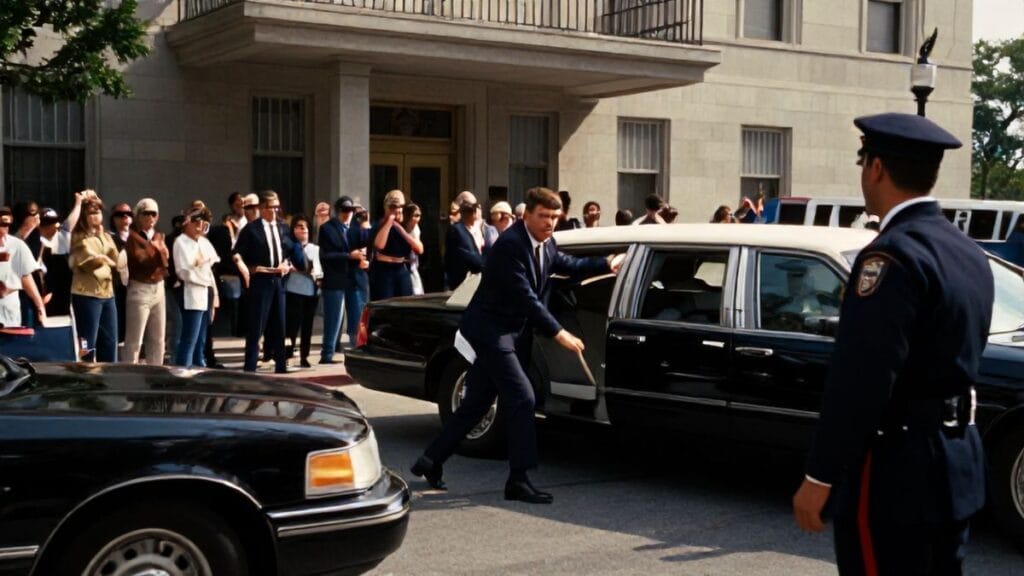
Reagan stepped out of the hotel’s T Street exit, a side entrance often used for secure arrivals and departures. Two lines of men flanked him: Secret Service agents, a D.C. police officer, and his press secretary, James Brady. Microphones bobbed, cameras whirred, and a light drizzle beaded on the dark paint of the presidential limousine—code-named “Stagecoach.” Everything about the scene was practiced choreography: the turn of the president toward the crowd, the flash of a smile, the slight wave of his hand, the pivot toward the open limousine door. He looked, for an instant, less like the most powerful man in the world and more like the actor he had once been, exiting a theater after a matinee.
Then, in the space of less than two heartbeats, the afternoon tore apart. A crackling series of sharp reports—six shots in about 1.7 seconds—slashed through the murmur of the crowd. The president’s smile vanished as agents lunged, hands flew to guns, and onlookers dropped, screamed, or froze. The faint smell of gunpowder drifted through the air, mixing with the wet asphalt. For those who were there, time seemed to split: before the shots, a world of routine; after them, a world in which the president’s life, and perhaps the country’s direction, hung suddenly by a thread.
On the sidewalk, scattered bodies and shattered glass marked the scene of impact. Yet, in the chaos of that first instant, almost no one realized that Ronald Reagan himself had been struck by a bullet. Even he did not know. He was shoved into the limousine by agents trained for the unthinkable, his face initially registering more annoyance than alarm. The man who had fired the shots—pale, slight, almost anonymous-looking—was wrestled to the ground in a tangle of arms and uniforms just a few yards away. Within seconds, it was over. Within seconds, the United States had come perilously close to losing another president.
From Hollywood to the White House: How Ronald Reagan Arrived at 1600 Pennsylvania Avenue
To understand the shock that rippled through the nation when the shots were fired, one must first understand who Ronald Reagan had become by 1981. His journey from Midwestern boyhood to Hollywood stardom, from union leader to conservative icon, formed the backdrop against which the assassination attempt on Ronald Reagan resonated so intensely.
Born in 1911 in Tampico, Illinois, Reagan grew up in the lean years between two world wars. His father struggled with alcoholism and unstable work; his mother offered steadier moral guidance and a devout religious grounding. Reagan’s early life was marked by small-town movement, secondhand clothes, and the quiet determination of a young man who discovered he could transform a room simply by speaking. He found his first real stage as a sports announcer in Iowa, painting vivid pictures of baseball games for radio listeners who could not see what he saw.
Hollywood beckoned in the late 1930s. Reagan’s early films cast him as the affable, decent, slightly idealized American everyman. He never became quite the glittering star some studios imagined, but he became familiar, reliable, and likeable. The former sportscaster understood timing, tone, and audience, skills he would later carry into politics. During his tenure as president of the Screen Actors Guild, he drifted from his earlier New Deal liberalism toward an increasingly conservative worldview, shaped in part by labor disputes, the Red Scare, and his deepening skepticism toward communism.
By the 1960s, Reagan had reinvented himself as a political spokesman, delivering polished, emotionally resonant speeches on behalf of Barry Goldwater and conservative causes. His now-famous 1964 address, “A Time for Choosing,” was less a campaign commercial than a manifesto: a narrative of American decline and potential rebirth. It was here that Reagan honed the persona that would electrify many voters: the optimistic yet hard-edged patriot who believed in small government, individual freedom, and a confident, unapologetic America.
Elected governor of California in 1966, Reagan served two transformative terms. He battled campus unrest, clashed with antiwar protesters, and experimented with conservative fiscal policies that would later form the blueprint for “Reaganomics.” By the time he ran for president in 1980, he was no longer an actor who had wandered into public life. He was a hardened political figure who had spent years shaping a coalition of business interests, religious conservatives, anti-communists, and disaffected Democrats.
The 1980 election unfolded against a backdrop of inflation, gas lines, and the Iran hostage crisis. Reagan’s landslide victory over Jimmy Carter felt, to his supporters, like the promise of a national reset. To his critics, it signaled the return of a hawkish, corporate-driven America that might stoke inequality and international tension. Either way, Reagan’s arrival at the White House in January 1981 was widely understood as a turning point. The new president was 69 years old, the oldest man ever elected to the office at the time, yet he projected a curious mix of grandfatherly warmth and steely resolve.
When the assassination attempt on Ronald Reagan unfolded a few weeks later, it was not just an attack on a man. It was an attack on a presidency that many believed would redefine the late twentieth century. The notion that this story—and possibly the trajectory of the conservative movement itself—could be cut short in a hotel driveway seemed both surreal and eerily familiar in a nation haunted by the ghosts of Dallas, Memphis, and Los Angeles.
A Nation on Edge: America in the Early 1980s
The early 1980s were a season of tension and uncertainty in American life. Inflation had eroded savings and shaken confidence in the economy. Factories in the Rust Belt stood silent or sputtered along at reduced capacity, leaving thousands of workers unemployed or underemployed. Streets in many cities bore the visible residue of the 1970s—crime, drugs, and crumbling infrastructure. Faith in government had been battered by Vietnam, Watergate, and the energy crises. The inauguration of Ronald Reagan was, for many, a wager that a different tone and philosophy might restore a sense of national purpose.
Yet the anxieties of the era extended far beyond domestic affairs. Abroad, the Cold War seemed to be entering a renewed period of danger. The Soviet Union had invaded Afghanistan in 1979. American hostages in Tehran had only just returned home when Reagan took office. Nuclear arsenals stood poised on both sides of the Iron Curtain, and the prospect of miscalculation or escalation hovered like a shadow over policy debates. Reagan’s tough rhetoric toward Moscow—calling the Soviet Union an “evil empire” in speeches—would come slightly later, but even in early 1981, his image as a hard-line anti-communist was well established.
Against this atmosphere of uncertainty, the American presidency carried not only symbolic weight but also existential implications. The memory of John F. Kennedy’s assassination in 1963 remained vivid for millions of Americans who could still recall where they had been when they heard the news from Dallas. Martin Luther King Jr. and Robert F. Kennedy’s killings in 1968 had deepened the sense that gunfire could suddenly, violently reroute the nation’s path. Attempts on Gerald Ford’s life in 1975, though unsuccessful, had reminded Americans that the presidency remained vulnerable.
It is therefore not surprising that the assassination attempt on Ronald Reagan struck such a raw nerve. The 1980s had not yet become the era of “Morning in America” campaign ads and booming stock markets. In March 1981, the country was still finding its footing. A sudden power vacuum at the top—a transition from Reagan to his relatively unknown vice president, George H. W. Bush, in the worst possible circumstances—would have deepened the sense of fragility. That this crisis was averted owed much to seconds of human reaction, layers of medical skill, and a measure of sheer luck.
Technology and media also played crucial roles in how the event unfolded in the public’s consciousness. Cable news was in its infancy. Most Americans still relied on the big three networks—ABC, CBS, and NBC—for breaking coverage. Radio, too, would carry tense bulletins into cars, kitchens, and office spaces. The assassination attempt on Ronald Reagan arrived in living rooms not as a blurred rumor hours later, but as a rapidly updated drama, with anchor voices wavering between caution and urgency.
The mood of the early 1980s—cautiously hopeful yet deeply anxious—meant that the attack did not occur in a vacuum. It touched live wires of fear and memory. It raised immediate questions about national security, succession, and the stability of a new administration. And it did something else, too: it momentarily united a divided country in a single, almost desperate wish—that the president, whatever one’s political belief, would survive.
John Hinckley Jr.: Obsession, Isolation, and a Dangerous Fantasy
The man who fired the shots that afternoon did not look like the archetype of a political assassin. John Warnock Hinckley Jr. was 25 years old, soft-spoken, with an almost boyish face framed by tousled hair. He came not from a revolutionary cell or a foreign conspiracy but from the comfortable, if emotionally fractured, world of an upper-middle-class American family.
Born in 1955 in Oklahoma and raised in Texas, Hinckley was the son of a wealthy oil executive. Outwardly, his childhood resembled the American suburban ideal: sports, school, family trips, church on Sundays. Inwardly, cracks began to show as he reached adolescence. He struggled to form close relationships, drifted through failed college attempts, and wrestled with depression and feelings of worthlessness. Friends and acquaintances would later describe him as shy, introverted, sometimes oddly detached. The seeds of the assassination attempt on Ronald Reagan were not political but psychological, rooted in isolation and fantasy.
Hinckley’s descent into obsession began in the darkened theaters of the 1970s. In 1976, he watched Martin Scorsese’s film “Taxi Driver,” the haunting story of Travis Bickle, a lonely, unstable man who plots to assassinate a presidential candidate and ultimately turns his violence against a pimp to “save” a young prostitute. Bickle, portrayed by Robert De Niro, was never meant to be a heroic figure. Yet for Hinckley, the character’s alienation and violent longing for significance resonated with dangerous intensity. He began to identify with Bickle, adopting his mannerisms, clothing style, and worldview.
Above all, the film introduced Hinckley to a young actress who would come to dominate his thoughts: Jodie Foster, who played the teenage prostitute Iris. Hinckley’s infatuation with Foster soon escalated into fixation. He followed her career, collected clippings, and imagined a connection that did not exist. When Foster enrolled at Yale University, Hinckley traveled to New Haven, leaving notes under her door, making phone calls, and stalking her with increasing persistence. His letters moved, in chilling fashion, from awkward admiration to grandiose fantasy.
At the same time, Hinckley’s life was unraveling. He failed at attempts to become a songwriter, drifted between cities, and cut off from stable employment, became financially dependent on his parents. They, in turn, struggled to grasp the depth of his mental illness. Psychiatric evaluations suggested depression and possible psychosis. Medications were prescribed but not consistently followed. Hinckley oscillated between half-hearted self-improvement plans and increasingly violent fantasies of making himself “famous” through a dramatic act.
By 1980, his obsession with Jodie Foster and his emulation of Travis Bickle had merged into a single, delusional script. He became convinced that only an extraordinary deed—an attempt on the life of a president—would impress her. He toyed with targeting Jimmy Carter but never followed through. Reagan, elected in November 1980, became the new focal point. In Hinckley’s distorted logic, assassinating Ronald Reagan would make him, in his own words, “the most famous man in the world” and, somehow, force Foster to recognize his worth.
There was no coherent political motive, no manifesto, no group affiliation. The assassination attempt on Ronald Reagan would emerge from the private hell of an unbalanced mind, from the misreading of a film, and from the lethal combination of emotional illness and easy access to a handgun. If anything, Hinckley’s story underscored the uncomfortable truth that the line between delusion and catastrophe can be terrifyingly thin.
The Walk to the Limo: Minute-by-Minute Before the Attack
Inside the Washington Hilton, the atmosphere before the speech had been unremarkable. Reagan, genial as ever, mingled with union leaders and joked with staff. He delivered his remarks without incident, reinforcing themes that had shaped his campaign: economic revival, national pride, the need to curb government spending and regulation. Reporters took notes; television crews captured sound bites. It was precisely the sort of event that fills the presidential schedule—important yet largely predictable.
Outside, however, a quieter drama was brewing. John Hinckley Jr. had arrived hours earlier, blending into the loose crowd near the hotel entrance. He carried a Röhm RG-14 revolver, a small, inexpensive .22 caliber handgun, concealed in his coat. The gun was loaded with six “Devastator” bullets, designed to explode on impact, though in practice they were unreliable. Hinckley had already shadowed the president on several occasions, including in Nashville and Washington, but this was the first time he would actually pull the trigger.
The Secret Service considered the Washington Hilton site relatively secure. The T Street exit was favored because it allowed the presidential motorcade to pull close to the building and reduced exposure to long-range sniper fire from distant rooftops. Still, the path from the hotel door to the limousine required a brief, unavoidable walk in the open. Agents formed a protective ring: some scanning the crowd, others monitoring the president’s immediate perimeter. D.C. Police Officer Thomas Delahanty stood near the security line, prepared to respond to any disturbance.
At approximately 2:27 p.m., Reagan concluded his speech. Minutes later, he appeared at the T Street exit. Television cameras were rolling; reporters shouted questions. Reagan stopped for a moment, raising his hand in a small wave to the cluster of onlookers. Among them, almost unremarked, stood Hinckley, his hand wrapped around the grip of the revolver in his pocket.
The president turned toward the limousine. The door stood open, held by Secret Service Agent Jerry Parr, who had been with Reagan since the campaign. Another agent, Timothy McCarthy, positioned himself to the president’s side. James Brady, the press secretary, stepped slightly ahead, his portfolio clutched against his chest. The choreography of protection had been rehearsed hundreds of times, but no rehearsal is ever quite the same as the performance.
In those last seconds, Hinckley drew his weapon. To many witnesses, the movement was invisible, lost in the blur of bodies and light rain. He raised the revolver, aimed in the general direction of the president—not with the practiced precision of a trained assassin, but with the desperate, jittery motion of a man driven by compulsion. The distance between Hinckley and Reagan was roughly 15 feet. There were no shouted warnings, no cinematic pause. There was only the crack of the first shot.
The Assassination Attempt on Ronald Reagan: Six Shots in 1.7 Seconds
The first bullet broke the air at 2:27 p.m. It struck James Brady in the head, collapsing him instantly onto the pavement. Witnesses later recalled a dull, sickening sound—a thud more than a crack—as his body hit the ground. Brady’s glasses flew from his face; his notes scattered. In that instant, the assassination attempt on Ronald Reagan had already claimed a life-altering victim, though the full extent of Brady’s injuries would only become clear later.
The second shot hit Officer Thomas Delahanty in the back of the neck as he turned toward the sound of gunfire. The impact knocked him forward, his legs buckling beneath him. Years of training and routine policing had not prepared him for this moment; yet, in his fall, he was part of the living shield that began, almost instinctively, to form around the president.
Secret Service Agent Jerry Parr reacted almost before the echo of the first shot had died. He grabbed Reagan by the shoulders and shoved him toward the open door of the limousine. Agents shouted and cursed; the crowd screamed. Hinckley fired again and again, his hand jerking under the recoil of the small weapon. The third and fourth bullets went wild, striking the limousine and a nearby building. The fifth bullet hit Agent Timothy McCarthy, who had turned and spread his body to cover the president, absorbing the shot in his chest.
The sixth and final bullet would be the most consequential. It struck the armored body of the limousine, flattened, and ricocheted toward the president. As Reagan was being pushed into the car, the bullet entered his body under his left arm, traversing his lung and stopping less than an inch from his heart. The president felt something—“like I’d been hit by a truck,” he would later say—but in the blur of motion, he believed at first that his ribs had been broken when Parr forced him into the car.
On the sidewalk, pandemonium reigned. Hinckley was tackled to the ground, his gun wrested from his hand by agents and police officers who punched and kicked in a frantic effort to ensure he posed no further threat. Spectators dropped to the ground or ran for cover. Cameras, still rolling, captured staggering images: Brady’s limp form, Delahanty’s grimace of pain, McCarthy lying wounded, and the twisting knot of bodies where Hinckley had been swallowed by security personnel.
Within less than two seconds, the attack was over. Yet the meaning of those seconds would unspool over hours, days, years. The assassination attempt on Ronald Reagan had not succeeded in killing the president, but it had pierced his body, threatened his life, and seared itself into the national memory. In that short span of time, four men were seriously injured, one gunman was captured, and the course of a presidency was nearly, irrevocably altered.
Chaos on the Pavement: Secret Service, Sirens, and Split-Second Decisions
As the gunfire ceased, the sidewalk outside the Washington Hilton became a scene of frenzied triage and controlled panic. Secret Service agents shouted overlapping commands: “Go, go, go!” “Get him out of here!” “Secure the perimeter!” Someone screamed for ambulances. A woman cried uncontrollably. Press microphones and camera equipment lay scattered across the wet pavement, some still recording, their lenses inadvertently capturing angles of raw, unscripted terror.
Agents quickly established layers of security. One group formed a rough defensive perimeter around the fallen, scanning windows and rooftops for a possible second shooter. Another cluster focused on the wounded: Brady, Delahanty, and McCarthy. Blood pooled and mingled on the concrete, staining suits and uniforms. Some attempted makeshift first aid, pressing jackets or hands to wounds to stem the bleeding. Others tried to keep the victims conscious, talking to them in urgent, soothing tones.
In the midst of this, a critical misunderstanding took hold: initially, most of the protective detail, and even Reagan himself, believed that the president had escaped uninjured. As the limousine sped away, agents radioed that the president was secure and apparently unharmed. Inside the car, Reagan felt a growing tightness in his chest and shortness of breath, but he attributed it to the shock of the attack and the rough shove into the vehicle. He remained upright, pale but conscious, attempting to maintain composure.
Back at the Hilton, the suspect was dragged to his feet, handcuffed, and hustled into a nearby building before being transported to the Metropolitan Police Department. Even in those first disorienting minutes, some officers sensed that this was not a conventional assassin. Hinckley seemed detached, almost eerily calm. He asked no questions about his victims. He did not shout slogans or make demands. He simply stared, his expression vacant.
News began to leak out through hurried phone calls and radio dispatches. Reporters at the scene relayed sketchy details to their editors: gunshots, wounded staff, an ambulance, sirens screaming down Connecticut Avenue. Television networks scrambled to interrupt regular programming. In New York, anchors were told to prepare for special reports. Yet even as the story began to spread, there remained a fog of confusion about who had been hit and how badly.
The Secret Service’s training emphasized rapid evacuation of the president above all else. The sidewalk could be secured later. The gunman’s motives could be investigated later. What mattered in those first moments was distance—putting miles, then blocks, then seconds between Reagan and his attacker. As the limousine pulled away, its siren wailing, agents inside wrestled with a dawning fear: something was very wrong with the man they were sworn to protect.
Racing to George Washington University Hospital: A President on the Brink
Inside the limousine, Ronald Reagan tried to crack a joke. It was his instinct, his armor against fear. But as he attempted to speak, a wave of pain surged through his chest. He began to cough, and with each cough came a small, terrifying spurt of frothy, bright red blood. Agent Jerry Parr, seated beside him, watched in alarm. Broken ribs, Parr knew, did not produce this kind of bleeding. Something else was happening.
“I think you’ve broken one of my ribs,” Reagan reportedly said, wincing and clutching his side. Parr looked down at the president’s suit and saw the first bloom of red. Training, experience, and instinct merged in an instant. The original plan had been to take the president directly back to the White House, where the secure medical facility in the basement could provide immediate care. But the White House was still several minutes away, and Reagan’s condition was deteriorating fast.
Parr made a fateful decision. Grabbing the radio, he instructed the driver to divert to George Washington University Hospital, just a few blocks away. It was a split-second call that would later be credited with saving the president’s life. The driver swerved through traffic, the siren clearing a path as pedestrians and cars scrambled out of the way. Inside the car, Reagan struggled to breathe, each inhalation a knife of pain.
As they approached the hospital, Reagan’s world narrowed to the simple act of staying conscious. At the emergency entrance, medical staff, already alerted by the Secret Service, rushed out with a gurney. Reagan, ever concerned about appearances, insisted on walking inside. Supported by agents, he stepped from the car, took a few shaky steps, and then collapsed as the pain overwhelmed him. Later, he would famously quip to his wife, Nancy, “Honey, I forgot to duck,” borrowing a line from boxer Jack Dempsey. But in that moment outside George Washington University Hospital, there was nothing humorous about his condition.
Doctors quickly realized the gravity of the situation. The president’s blood pressure was dropping; his lips had a bluish tinge. X-rays and rapid assessment revealed a collapsed lung and substantial internal bleeding. The bullet had entered under his left arm, ricocheted off a rib, and lodged near his heart. He had lost significant blood—some estimates suggested more than a liter by the time he reached the operating table.
Parr, shaken but focused, stayed nearby as the medical team went to work. He later reflected that his decision to divert to the hospital, made in the blur of adrenaline and worry, had been influenced by his study of earlier presidential attacks, particularly the tragedy of John F. Kennedy in Dallas. In a sense, the memory of one assassination guided the response to another assassination attempt on Ronald Reagan, altering the trajectory of history by a matter of minutes.
Inside the Operating Room: Blood, Humor, and the Fight for Survival
George Washington University Hospital was suddenly, jarringly at the center of world attention. In the emergency department, a team of physicians and nurses raced to stabilize the president. Among them was Dr. Joseph Giordano, the head of trauma, who quickly recognized that Reagan was in more danger than his initial composure had suggested. They inserted chest tubes, administered fluids and blood, monitored vital signs, and prepared for surgery.
Despite the urgency, Reagan clung to humor as a lifeline. As he was wheeled into the operating room, surrounded by masked figures and harsh lights, he looked up at the surgeons and said, “I hope you’re all Republicans.” The line drew laughter, even as hands moved swiftly to connect IV lines and monitors. One of the doctors, breaking the tension, replied, “Today, Mr. President, we’re all Republicans.” The exchange became part of the legend of the day, cited frequently in later accounts as evidence of Reagan’s resilience and wit even at death’s door.
The surgery was complex but methodical. The bullet had lodged perilously close to the president’s heart, but it had not penetrated the organ itself. Surgeons opened his chest, carefully navigating through tissue slick with blood. They removed the bullet, repaired the damaged lung, and worked to control the bleeding. Outside the operating room, Nancy Reagan waited in a state of anguished suspense, supported by staff and friends. The first lady, normally composed and elegant, was visibly shaken; she had already lost one husband to divorce and now faced the horrifying possibility of losing another to violence.
In the West Wing and around the world, leaders and citizens awaited updates that came in careful, controlled bursts. Early reports that Reagan was “stable” did not fully convey how close he had come to dying. At one point, his blood pressure dropped so low that the medical team feared cardiac arrest. The combination of rapid transport, skilled care, and the president’s own underlying health made the difference. He was, by all accounts, remarkably fit for his age—a factor that allowed him to endure extensive surgery and significant blood loss.
The operation lasted several hours. When it was finally over, surgeons emerged to brief White House officials and the press. The bullet had been removed, they reported, and the president’s prognosis was cautiously optimistic. He would require days of intensive care and weeks of recovery, but his life was no longer in immediate danger. The assassination attempt on Ronald Reagan had failed not by lack of intent, but by the narrow margin of a ricochet and the swift architecture of medical intervention.
As Reagan regained consciousness in the recovery room, his first thoughts were of Nancy and of reassuring the nation. He asked about the others who had been shot, learning with sadness and concern of James Brady’s critical condition and the serious injuries to Delahanty and McCarthy. For a moment, the political theater of the presidency receded, replaced by the raw human reality of shared suffering. Four men had been caught in the path of one man’s obsession; all of them, in different ways, would carry the consequences for the rest of their lives.
Brady, Delahanty, McCarthy: The Other Lives Forever Changed
In the public imagination, the assassination attempt on Ronald Reagan often centers on the president himself. But three other men bore direct physical witness to the violence of that day on their own bodies: James Brady, Thomas Delahanty, and Timothy McCarthy. Their stories, each distinct, form a somber counterpoint to the narrative of a president’s survival.
James Brady, the 40-year-old press secretary, had been at Reagan’s side not merely as a spokesman but as a key architect of the administration’s communication strategy. The bullet that struck him entered above his left eye, shattering his skull and causing massive brain damage. Rushed to the hospital, Brady underwent extensive surgery. He survived, but the injury left him partially paralyzed, with slurred speech and cognitive impairments. His career as a daily presence in the briefing room was effectively over.
In the months and years that followed, Brady’s name would become synonymous with the fight for gun control in the United States. Along with his wife, Sarah, he became a powerful advocate for stronger background checks and firearm regulations. Their activism led, after a long and bitter political battle, to the Brady Handgun Violence Prevention Act of 1993, which mandated federal background checks for gun purchases from licensed dealers. The law’s passage was a direct, delayed consequence of what happened outside the Washington Hilton in 1981.
Officer Thomas Delahanty, a veteran of the D.C. Metropolitan Police Department, was shot in the back of the neck as he moved toward the source of the gunfire. The bullet caused nerve damage, leaving him with ongoing pain and disability. Though he survived, his law enforcement career was cut short. Delahanty later filed a lawsuit against the manufacturer of the handgun used by Hinckley, arguing that the company had been negligent in marketing a cheap, easily concealable weapon that served little purpose beyond criminal use. The case was ultimately dismissed, but it helped spark broader discussions about the ethics of gun design and distribution.
Secret Service Agent Timothy McCarthy became, in many ways, the embodiment of professional sacrifice. When the shots rang out, he turned his body deliberately toward the gunman, spreading his arms to present a larger target and shield the president. The bullet that struck him entered his chest, puncturing his lung, diaphragm, and liver. He required intensive surgery and a long recovery but eventually returned to duty. McCarthy’s action was cited as a textbook example of the Secret Service’s core mission: to take a bullet for the president if necessary.
These three men illustrate the human cost that radiated outward from the assassination attempt on Ronald Reagan. Their injuries did not end with their hospital discharge. They encompassed years of pain, therapy, life adjustment, and, in Brady’s case, a transformation into a national symbol. Their families, too, bore the weight—dealing with financial strain, emotional upheaval, and the daily reality of care. If Reagan’s survival seemed to some like a miracle, the lives of Brady, Delahanty, and McCarthy were a reminder that miracles often come paired with quiet tragedies.
Television, Rumor, and the Edge of Panic: How America Learned the News
For millions of Americans, the first hint that something was wrong came not from sirens on Connecticut Avenue but from abrupt interruptions to afternoon television programming. Soap operas and game shows vanished mid-scene, replaced by news anchors in serious tones announcing that shots had been fired at the president. Details were scant, and early reports were riddled with errors. At one point, a reporter erroneously stated that Press Secretary James Brady had died. Another suggested that Reagan had escaped uninjured, only to be contradicted minutes later by updates from the hospital.
In living rooms, offices, and school hallways, people clustered around televisions and radios, straining to catch each new scrap of information. The memory of John F. Kennedy’s assassination twenty years earlier loomed large. Many older Americans remembered the long, anguished hours in November 1963, when rumors and false reports spread almost as quickly as verified news. Now, in 1981, they watched with a familiar sense of dread as anchors shuffled papers and correspondents breathlessly relayed fragmentary updates from outside George Washington University Hospital and the White House.
Telephone lines jammed as families checked on one another, and office conversations fell silent. In bars and diners, patrons leaned toward the television, the clatter of dishes and casual talk replaced by murmurs of disbelief. Children, sensing adult fear, asked anxious questions their parents struggled to answer. “Is the president going to die?” “Is there going to be a war?” The assassination attempt on Ronald Reagan felt, for a few suspended hours, like the opening move in a larger, unknown catastrophe.
Journalists, for their part, faced the dual pressure of speed and accuracy. Network executives weighed when to broadcast the most alarming details. White House spokespeople, operating with incomplete information, attempted to balance transparency with the need to project calm. As one historian later noted, “The nation sat in front of the television, waiting for the face that would tell them whether history had changed.” That face, when it finally appeared, was usually that of a press secretary or surgeon rather than the president himself.
By early evening, more reliable information began to solidify. Reagan was out of surgery and in stable condition, though still in serious shape. Brady was alive but gravely wounded. The identities of the other victims became clearer. The gunman had been apprehended and identified as John Hinckley Jr., an apparently disturbed young man with no known ties to political organizations. That last detail, while not comforting, at least dispelled the fear that the attack was part of a coordinated plot or coup.
Television, which had brought the nation together in shared horror after Kennedy’s death, now served a different function: it allowed Americans to exhale collectively as it became clear that their president would live. Yet the grainy replay footage of the attack—run again and again on the evening news—ensured that the trauma of that day would not fade quickly. Each replay etched the assassination attempt on Ronald Reagan more deeply into the country’s memory.
Power in the Balance: Haig, the Cabinet, and the Question of Who Was in Charge
While doctors worked to save Reagan’s life, another drama unfolded in the corridors of power. The United States, a nuclear-armed superpower locked in a tense Cold War standoff, suddenly faced an uncertain chain of command. The Constitution provided a framework for presidential succession, but the practical application of that framework in the chaotic hours after the shooting was anything but straightforward.
Vice President George H. W. Bush was not in Washington when the shots were fired. He was in Texas, aboard Air Force Two, returning from a speech in Fort Worth. Upon learning of the attack, his plane was ordered to return immediately to the capital. In the meantime, top officials gathered at the White House: Secretary of State Alexander Haig, Secretary of Defense Caspar Weinberger, and other members of the national security team. They faced pressing questions: Was the attack part of a larger conspiracy? Were foreign adversaries poised to exploit the moment? Who had the authority to order military responses if needed?
In the Situation Room, tempers and anxieties ran high. Some argued for immediately invoking the 25th Amendment, which provides a mechanism for transferring presidential power if the president is incapacitated. Others urged caution, noting that Reagan was undergoing surgery and might soon be able to resume his duties. The absence of the vice president complicated matters. So did the fog of incomplete information about the president’s condition.
Alexander Haig, a former general and experienced bureaucratic infighter, stepped before the cameras for a White House press briefing that would become infamous. “As of now, I am in control here, in the White House,” he declared, attempting to reassure the public that there was no leadership vacuum. He went on to outline a succession order that placed himself directly after the vice president—an assertion that was constitutionally incorrect. In fact, after the vice president, the Speaker of the House and the president pro tempore of the Senate were next in line, not the secretary of state.
Haig’s statement drew immediate criticism and fueled speculation that he was attempting to aggrandize his own authority. It was, in many ways, a communications failure, born of anxiety and the pressure to project stability. Yet it highlighted a real concern: the mechanisms of continuity of government, though defined in law, were not always clearly understood by the very people tasked with executing them. The assassination attempt on Ronald Reagan thus revealed not only the physical vulnerability of the president but also institutional vulnerabilities in crisis management.
When Bush finally arrived in Washington, he took pains to project both deference and calm. He rejected suggestions that he land his plane on the South Lawn—an image that could have implied he was seizing power—and instead returned through more conventional means. His public statements emphasized loyalty to Reagan and confidence in his recovery. Behind the scenes, contingency plans were discussed, but the moment for invoking the 25th Amendment never came. Reagan’s condition improved steadily enough that, within days, he was signing documents and making calls from his hospital bed.
The near-crisis of authority that followed the attack spurred later efforts to clarify procedures for presidential disability and succession. Experts revisited the language and implementation of the 25th Amendment. Military and intelligence agencies refined protocols for handling sudden leadership disruptions. The day’s events, as one scholar later observed, served as “a stress test for the constitutional system—a reminder that the letter of the law must be paired with readiness and understanding among those sworn to uphold it.”
Security Transformed: How the Secret Service Rewrote Its Own Rules
For the United States Secret Service, the events of March 30, 1981, were both a failure and a vindication. A gunman had come within fifteen feet of the president and fired six shots, hitting four people, including the president himself. Yet the protective detail had also reacted with extraordinary speed and courage, evacuating the president and neutralizing the attacker in under two seconds. The service’s mission—to protect the president at any cost—had been both compromised and, in a grim sense, fulfilled.
In the months after the assassination attempt on Ronald Reagan, the Secret Service conducted a thorough internal review. Every moment of that day—every angle, every pause, every positioning decision—was analyzed. Why had Hinckley been able to get so close? Were metal detectors used effectively? How had the crowd been screened? What could be done differently to reduce a president’s exposure to such threats?
One of the core lessons was the danger posed by the “walk”—the brief but unavoidable movement of a president from building to vehicle or from stage to backstage. Such moments had long been a staple of modern political theater, allowing presidents to be seen, photographed, and cheered in semi-controlled environments. But they were also opportunities for attackers armed with small, easily concealed weapons. In the wake of the attack, the Secret Service became more reluctant to allow open-air walks, especially at unsecured or semi-secured sites.
Advance teams also changed their approach to venues like the Washington Hilton. More stringent checks of surrounding buildings, additional barriers, and revised crowd positioning reduced the number of people who could get within handgun range of the president’s route. Coordination with local law enforcement was tightened. The service expanded its use of intelligence gathering to identify individuals who might pose a threat, particularly those with histories of mental illness or fixation on public figures.
Agents’ training, already intense, incorporated new scenarios based on what had happened that day. The actions of men like Jerry Parr and Timothy McCarthy were studied and used as models. McCarthy’s decision to spread his body and take a bullet for the president was held up as a stark illustration of the service’s ethos. At the same time, there was recognition that relying solely on bravery was not enough; structural changes were needed to reduce the likelihood that such bravery would be tested.
The evolution of presidential security after 1981 occurred in stages, influenced by other incidents and broader changes in terrorism and political violence. But the assassination attempt on Ronald Reagan served as a catalyst, pushing the Secret Service toward tighter, more layered protection. In an ironic twist, the man who had once been celebrated for his ease with crowds and informal style—the “Great Communicator” who loved to press the flesh—became, in some ways, more distant from the public he inspired. The cost of a near-tragedy was a further step away from the notion of an accessible presidency.
Law, Madness, and Responsibility: The Hinckley Trial and the Insanity Defense
While Ronald Reagan recovered and the political world recalibrated, another, slower drama unfolded in the courtroom. John Hinckley Jr. was charged with attempted assassination and a host of related offenses. Yet from the outset, it was clear that his trial would hinge not on whether he had pulled the trigger—there was overwhelming evidence that he had—but on the state of his mind when he did so.
Hinckley’s defense team pursued an insanity defense, arguing that he suffered from severe mental illness that rendered him incapable of understanding the wrongfulness of his actions. Psychiatrists evaluated him extensively, noting his long history of depression, delusion, and obsessive fixation on Jodie Foster. They detailed his identification with Travis Bickle from “Taxi Driver,” his stalking behavior at Yale, and his grandiose, irrational belief that killing the president would win him Foster’s affection.
The prosecution, by contrast, sought to portray Hinckley as a calculating, if deeply disturbed, individual who knew what he was doing was wrong but chose to proceed anyway. They pointed to his planning: the purchase of the weapon, the selection of opportunities to get close to the president, and his previous, aborted attempts to attack other leaders. They argued that mental illness did not absolve Hinckley of responsibility for the assassination attempt on Ronald Reagan and the injuries to Brady, Delahanty, and McCarthy.
The trial, which began in 1982, became a national spectacle. Legal experts debated the meaning and application of the insanity defense. News outlets published competing psychiatric interpretations. Public opinion, already shaken by the attack, was often unforgiving. Many Americans believed that Hinckley should be punished as a criminal, not treated as a patient. The memory of the attack, replayed in endless footage, made detachment difficult.
In June 1982, the jury returned its verdict: not guilty by reason of insanity on all counts. Hinckley was committed to St. Elizabeths Hospital, a psychiatric facility in Washington, D.C., for indefinite treatment. The public reaction was swift and intense. Many saw the verdict as a miscarriage of justice, a loophole through which a would-be assassin had escaped punishment. Lawmakers across the political spectrum expressed outrage and moved to tighten the standards for insanity defenses in federal and state courts.
The Hinckley verdict led directly to the Insanity Defense Reform Act of 1984, which significantly narrowed the definition of legal insanity in federal cases and shifted the burden of proof to the defendant. Several states enacted similar reforms or abolished the insanity defense altogether. As legal scholar Richard Bonnie later observed, “The case of John Hinckley became a touchstone for public anger at a system that seemed to privilege psychiatric complexity over moral accountability.”
Hinckley himself remained in psychiatric custody for decades, though his conditions gradually loosened. Beginning in the early 2000s, he was allowed supervised visits outside the hospital. In 2016, a federal judge ordered his release to live under strict conditions with his mother in Virginia, ruling that he no longer posed a danger. This decision again stirred controversy and reopened debates about forgiveness, risk, and the long shadow cast by a single, violent act.
From Wound to Weapon: The Brady Bill and the Gun Control Battle
The bullet that tore through James Brady’s brain did more than change a man’s life; it ignited a movement. In the years after the attack, as Brady and his wife Sarah adjusted to the realities of disability—the wheelchairs, the therapy, the daily challenges—they also found a new purpose. They became outspoken advocates for gun control, arguing that the ease with which John Hinckley Jr. had obtained his weapon was not merely tragic but intolerable.
In the 1980s, the political climate around gun regulation was fiercely contested. The National Rifle Association (NRA) had emerged as a powerful lobbying force, framing firearms ownership as a core constitutional right and cultural marker. Efforts to tighten gun laws often ran into a wall of organized opposition. Yet the image of Brady, the former press secretary, struggling to speak and move, proved to be a potent symbol for those advocating reform.
The proposed Brady Handgun Violence Prevention Act sought to introduce federal background checks and waiting periods for handgun purchases from licensed dealers. Supporters argued that such measures would make it harder for individuals with criminal records or serious mental illness to obtain firearms. Opponents claimed that the law would burden law-abiding citizens and do little to stop determined criminals. The debate stretched across years, administrations, and election cycles.
Ronald Reagan’s own position on the Brady Bill evolved. A lifelong supporter of gun rights, he had, as governor of California, signed one of the nation’s first significant gun control laws in response to public armed demonstrations by the Black Panther Party. After leaving office, he lent his voice, somewhat unexpectedly, to the cause of the Brady Bill. In a 1991 New York Times op-ed, Reagan wrote in favor of background checks, calling them “just plain common sense” and noting that if such a system had been in place in 1981, it might have prevented the assassination attempt on Ronald Reagan.
After a prolonged legislative struggle, the Brady Bill was finally signed into law by President Bill Clinton in November 1993. It mandated a five-day waiting period for handgun purchases, later replaced by an instant background check system under the National Instant Criminal Background Check System (NICS). The law did not end gun violence in America; far from it. But it represented a significant shift—a recognition that the story of March 30, 1981, carried policy implications as well as personal trauma.
The Brady Bill’s passage underscored an often-overlooked dimension of the assassination attempt on Ronald Reagan: its long-term influence on American law and politics. The bullet intended for a president became, in effect, a wedge in a decades-long battle over the meaning of the Second Amendment, the responsibilities of government, and the balance between individual liberty and collective safety.
Reagan’s Political Resurrection: Mythmaking, Image, and the “Teflon President”
When Ronald Reagan left George Washington University Hospital on April 11, 1981, walking slowly but determinedly toward the cameras, his return was framed as a triumph. Dressed in a blazer and tie, his hair neatly combed, the president raised his hand in a modest wave. The image was carefully managed but genuinely powerful. The assassination attempt on Ronald Reagan, which might have ended his presidency before it truly began, instead became a crucible from which his political image emerged stronger.
Poll numbers told the story. Reagan’s approval ratings surged after the attack, as Americans rallied around their wounded leader. The near-death experience seemed to humanize him in the eyes of some skeptics, softening portrayals of him as merely an ideologue or an actor reading lines. His humor during recovery—joking with doctors, reassuring staff, and sending light-hearted messages to the public—fit neatly into the narrative of a resilient, optimistic American hero.
The White House, keenly aware of the power of symbolism, wove the event into a broader story about Reagan’s purpose and destiny. Some supporters spoke of divine intervention, suggesting that God had spared him for a reason. Reagan himself, a man of personal but not ostentatious faith, hinted at this interpretation, saying that he believed his life had been spared to accomplish important work. In a private diary entry, he described the shooting as a moment in which he felt “a special closeness to God.”
Political opponents, while not sharing such metaphysical views, recognized the practical effect: it became harder to attack a man who had just survived an assassination attempt with grace and humor. Congressional allies, particularly conservative Democrats, were more inclined to support his economic agenda, including tax cuts and budget reductions. The president’s team, emboldened, pressed forward with plans to reshape federal spending, challenge Soviet power, and redefine the terms of the Cold War.
The label “Teflon president,” popularized later in the decade, captured the sense that scandals, missteps, and criticisms seemed not to stick to Reagan as they might to other politicians. While the reasons for this were complex—encompassing media strategy, charisma, and the broader political environment—the events of March 30 played a role. Surviving an assassination attempt conferred a kind of narrative armor, a sense that Reagan was, in some essential way, chosen or protected.
Yet behind the mythmaking lay human frailty. The president’s recovery was not instantaneous. He tired easily, struggled with pain, and had to adjust his schedule. Nancy Reagan, deeply shaken, became even more vigilant about his health and security, sometimes clashing with staff over his workload and travel. The brush with death left scars, physical and emotional, that did not appear on television.
Still, in the broader sweep of history, the assassination attempt on Ronald Reagan served to cement, rather than weaken, his place in the American imagination. It became part of the legend told in biographies, documentaries, and museum exhibits: the president who smiled through pain, who joked with surgeons, who walked out of the hospital into a second chance at leadership.
Culture, Celebrity, and Stalking: Jodie Foster and the Dark Side of Fame
Amid the political and legal reverberations of the attack, another figure found herself pulled unwillingly into the spotlight: Jodie Foster. At the time of the shooting, Foster was a 18-year-old student at Yale University, balancing a highly public acting career with the desire for a relatively normal college experience. The revelation that John Hinckley Jr. had been obsessed with her, and that the assassination attempt on Ronald Reagan had been in part an attempt to impress her, thrust her into a strange and disturbing role.
In the media frenzy that followed, Foster was portrayed in conflicting ways: as a victim, an unwilling muse to madness, a symbol of the risks faced by young women in the public eye. Some coverage veered into sensationalism, treating her as a character in a lurid psychological drama rather than a real person grappling with fear and guilt. She received waves of letters, some supportive, others invasive or threatening. The line between concern and curiosity often blurred.
Foster herself responded with restraint and a determination to maintain privacy. She cooperated with investigators but declined to turn her life into a spectacle. In a rare public statement, she expressed sympathy for the victims and frustration at being linked to the crime. Her experience presaged later debates about the responsibilities of media in covering celebrity stalking and the psychological impact on those who become fixation objects for disturbed individuals.
The Hinckley-Foster connection also contributed to broader cultural conversations about the influence of film and media on behavior. Some commentators blamed “Taxi Driver” for inspiring Hinckley, arguing that violent cinema could glamorize alienation and assassination. Others, including director Martin Scorsese, rejected this view, insisting that art reflects dysfunction but does not create it. As one critic remarked, “To say that ‘Taxi Driver’ caused the attack is to ignore the complex, painful reality of mental illness and personal history.”
In subsequent decades, as stalking laws were strengthened and public awareness of such crimes grew, the Reagan-Hinckley-Foster triangle was often cited as a case study. It underscored the vulnerability of public figures, particularly women, to unwanted attention that can escalate into danger. It also exposed gaps in how law enforcement and institutions responded to warning signs—a lesson that would be revisited in later incidents involving celebrities, politicians, and ordinary individuals.
For Jodie Foster, the events of March 30, 1981, became a shadow she could not entirely escape but learned to live with. She continued her acting career, winning Oscars and directing films, carefully managing her public presence. The assassination attempt on Ronald Reagan remained a grim footnote in her biography, a reminder that fame can attract not only admiration but also the darkest forms of obsession.
Memory, Legacy, and What Almost Changed in 1981
History often turns on moments that almost went another way, and the assassination attempt on Ronald Reagan is one of those moments. Had the ricocheted bullet flown an inch higher, had Jerry Parr decided to return to the White House rather than divert to the hospital, had the surgeons been slightly less skilled or the president’s health slightly worse, the story of the 1980s might have unfolded very differently.
A successful assassination would have elevated Vice President George H. W. Bush to the presidency in 1981, years before he actually took office in 1989. Bush, a cautious pragmatist with deep foreign policy experience, might have pursued similar broad goals—containing the Soviet Union, promoting market economics—but with a different tone and coalition. The symbolic power of Reagan’s rhetoric, his role in reshaping the Republican Party, and his cultural imprint as the “Great Communicator” might have been muted or redirected.
It’s astonishing, isn’t it, how much hung on those 1.7 seconds of gunfire? One historian, reflecting on the event, wrote that “the bullet that nearly killed Reagan also nearly killed an era.” That era, as it actually unfolded, saw massive tax cuts, a military buildup, the intensification and eventual easing of the Cold War, the rise of conservative social movements, and significant shifts in the American judiciary and regulatory landscape. The assassination attempt on Ronald Reagan did not create these developments, but it intersected with them in ways that shaped public perception, political capital, and the aura of inevitability around Reagan’s leadership.
The event also left a durable imprint on the American psyche. It reinforced the sense that the presidency is both powerful and vulnerable, that a single individual’s grievances or delusions can aim directly at the heart of the state. It contributed to the gradual distancing of presidents from ordinary citizens, as security concerns made rope lines shorter and motorcades more insulated. It underscored the fragility of human life even at the pinnacle of power—a fragility that, paradoxically, can inspire both fear and empathy.
Over time, public memory of the attack has softened at the edges, receding behind other traumas and crises: the Challenger explosion, the fall of the Berlin Wall, the attacks of September 11, 2001. Younger generations may know of it primarily through brief textbook mentions or archival footage. Yet for those who lived through that day in 1981, the sound of the shots, the image of the collapsing press secretary, and the sight of a wounded president waving from a hospital window remain intensely vivid.
As with many historical events, the assassination attempt on Ronald Reagan is best understood not as an isolated incident but as a node in a web of causes and consequences: the pathologies of a disturbed young man; the availability of a small revolver and explosive bullets; the vulnerabilities of public security; the legal system’s treatment of insanity; the politics of guns; the narratives of resilience and destiny that politicians and citizens craft around survival. It is a story of what happened and of what nearly happened—and in that gap between actuality and possibility lies much of its enduring fascination.
Conclusion
On a gray March afternoon in 1981, six bullets in less than two seconds brought the United States face-to-face with the precariousness of its leadership and the unpredictable violence that can erupt from a single troubled mind. The assassination attempt on Ronald Reagan did not end a presidency or plunge the nation into constitutional chaos, but it came close enough to reveal the fault lines beneath the surface of American power. From the sidewalk outside the Washington Hilton to the bright lights of the George Washington University Hospital operating room, human decisions—Jerry Parr’s diversion to the hospital, surgeons’ steady hands, agents’ split-second reactions—made the difference between tragic possibility and historical reality.
In the aftermath, the country grappled not only with the physical wounds inflicted on Reagan, James Brady, Thomas Delahanty, and Timothy McCarthy, but also with deeper questions: How should the legal system handle mental illness and criminal responsibility? What balance should be struck between public access to leaders and the imperative of security? How do we reconcile individual gun rights with the collective desire to prevent such attacks? The Hinckley trial, the Brady Bill, and reforms to the Secret Service all emerged from these questions, demonstrating how a moment of violence can echo through law, policy, and culture.
The event also became part of Ronald Reagan’s personal and political mythology—a story of near-martyrdom and recovery that enhanced his standing and lent a sense of providential purpose to his administration. For supporters, his survival symbolized resilience and divine favor; for critics, it was a sobering reminder of how narratives of heroism can amplify political agendas. Yet beyond politics, the attack exposed very human vulnerabilities: Nancy Reagan’s terror, Brady’s long struggle with disability, the lingering trauma faced by all those on the scene.
In the broader sweep of history, the assassination attempt on Ronald Reagan stands as a hinge moment that almost, but not quite, turned the nation in a different direction. It underscores how contingent history can be—how the path of a single bullet, the angle of a limousine door, or the timing of an ambulance ride can shape decades of domestic and foreign policy. It reminds us that presidents, for all their ceremony and security, are mortal, subject to the same frailties as any citizen.
To revisit that day is not only to relive a crisis but to confront the intertwining of fate and choice, obsession and opportunity, courage and luck. The sounds of those six shots have long since faded from Connecticut Avenue, but their reverberations—legal, political, cultural, and personal—still hum beneath the surface of American life.
FAQs
- When and where did the assassination attempt on Ronald Reagan occur?
The assassination attempt on Ronald Reagan took place on March 30, 1981, outside the Washington Hilton Hotel in Washington, D.C., shortly after the president had delivered a speech to a labor union gathering. - Who carried out the attack and why?
The attack was carried out by John Hinckley Jr., a 25-year-old man from a wealthy Texas family. His motive was not political; he was driven by severe mental illness and an obsessive fixation on actress Jodie Foster. Hinckley believed, in a delusional way, that assassinating the president would impress her and win her affection. - How seriously was Ronald Reagan injured?
Reagan was struck by a single .22 caliber bullet that ricocheted off the presidential limousine, entered under his left arm, and lodged near his heart after passing through his lung. He suffered significant internal bleeding and a collapsed lung and required emergency surgery at George Washington University Hospital, but he ultimately made a strong recovery. - Who else was wounded in the attack?
Three other men were seriously wounded: White House Press Secretary James Brady, who suffered a devastating brain injury and was left partially paralyzed; D.C. Police Officer Thomas Delahanty, who was shot in the neck; and Secret Service Agent Timothy McCarthy, who was shot in the chest after moving to shield the president with his body. - What happened to John Hinckley Jr. after the shooting?
Hinckley was arrested at the scene and later tried in federal court. In 1982, he was found not guilty by reason of insanity and committed to St. Elizabeths Hospital in Washington, D.C. Over the years, his confinement conditions gradually eased. In 2016, a federal judge permitted him to live under strict conditions with his mother, concluding that he no longer posed a danger. - How did the attack affect gun control laws in the United States?
The attack, especially the severe wounding of James Brady, eventually helped spur the passage of the Brady Handgun Violence Prevention Act in 1993. The law mandated federal background checks for handgun purchases from licensed dealers and instituted a waiting period that was later replaced by an instant check system. - Did the assassination attempt change presidential security practices?
Yes. The Secret Service conducted an extensive review that led to tighter control over public appearances, greater scrutiny of venues, more rigorous crowd screening, and revised protocols for “walks” between secure locations and vehicles. The attack underscored the vulnerability created by even brief exposures in semi-public spaces. - How did the public and media react on the day of the shooting?
Television networks interrupted regular programming with breaking news bulletins, and early reports were often confused and sometimes inaccurate. The public reacted with shock and fear, haunted by memories of earlier assassinations in the 1960s. As reliable updates emerged that Reagan had survived surgery, the mood shifted toward relief and support for the president. - What was the impact of the attack on Reagan’s presidency?
The attack initially boosted Reagan’s approval ratings, as many Americans rallied around him. His survival and his use of humor during recovery contributed to an image of resilience and helped solidify his political authority in the early months of his administration, strengthening his hand in pushing key parts of his domestic agenda. - Why is this event still historically significant today?
The assassination attempt on Ronald Reagan remains significant because it nearly changed the course of U.S. history, led to major legal and policy reforms—especially in areas of insanity defenses and gun control—and reshaped how Americans think about presidential security, mental illness, and the intersection of fame and obsession.
External Resource
Internal Link
Other Resources
- Encyclopaedia Britannica – general search for the exact subject
- Google Scholar – academic search for the exact subject
- Internet Archive – digital library search for the exact subject