Table of Contents
- Rome on the Edge: The Blood-Soaked Year of the Four Emperors
- From Obscurity to the Purple: The Rise of Aulus Vitellius
- Rome Between Tyrants: The Shadow of Nero and the Brief Rule of Galba and Otho
- The March of the Legions: Vitellius Seizes the Empire
- A Court of Excess: Feasts, Favourites, and the Image of a Glutton Emperor
- In the East, Another Challenger: Vespasian Steps onto the Stage
- Civil War Renewed: Bedriacum, Blood, and the Crumbling Authority of Vitellius
- The Final Days in the Palatine: Fear, Bargains, and Betrayals
- December 20, 69 CE: The Last Morning of Emperor Vitellius
- Fire in the Forum: Street Battles and the Fall of the Palatine
- Dragged through His Own City: The Assassination of Emperor Vitellius
- A Corpse on the Gemonian Stairs: Rituals of Humiliation and Memory
- Voices from the Past: How Tacitus, Suetonius, and Cassius Dio Shaped the Story
- Rome After Vitellius: The Flavian Restoration and the Quest for Stability
- Politics Written in Blood: What Vitellius’s Death Reveals about Imperial Power
- The People, the Soldiers, and the Senate: Society Caught in a Civil War
- Myth, Caricature, and the Man Himself: Rethinking Vitellius
- Echoes through the Centuries: The Assassination of Emperor Vitellius in Culture and Memory
- Conclusion
- FAQs
- External Resource
- Internal Link
Article Summary: In the depths of winter on December 20, 69 CE, Rome watched in horror as its reigning monarch was hunted through his own palace, dragged through the streets, and slaughtered on the Gemonian stairs: the assassination of emperor Vitellius. This article traces the road that led from the collapse of Nero’s dynasty into the chaos of the Year of the Four Emperors, and how a seemingly unremarkable aristocrat became the figurehead of a western army desperate for power and recognition. It follows Vitellius from his rise to the imperial throne through months of feasting, political missteps, and mounting tensions with the eastern legions loyal to Vespasian. Step by step, it reconstructs the frantic days of civil war in Rome, the street fighting, and the brutal final hours that culminated in the assassination of emperor Vitellius in the heart of the capital. Along the way, it examines how ancient historians like Tacitus and Suetonius turned his death into a moral lesson about gluttony, weakness, and the dangers of civil war. Beyond the gore, the article explores the political, social, and emotional consequences of his fall: for soldiers, senators, ordinary Romans, and the new Flavian dynasty that emerged from the carnage. It also interrogates how the assassination of emperor Vitellius became a symbol of Rome devouring its own rulers in times of crisis. In doing so, it reveals the assassination of emperor Vitellius not merely as a grisly episode, but as a turning point that reshaped imperial power and left deep scars on the Roman psyche.
Rome on the Edge: The Blood-Soaked Year of the Four Emperors
In the second half of the first century CE, the city of Rome, capital of the most powerful empire on earth, discovered how fragile its glory could be. Statues gleamed in marble, aqueducts arched across the landscape, and legions stood guard from Britain to Syria, yet at the centre of it all, political authority was dissolving under the weight of suspicion, hunger for power, and the bitter memory of a dead tyrant. The assassination of emperor Vitellius at the end of 69 CE would be the final act of a year that began with hope for renewal but instead turned into a lesson in how quickly an empire could turn its violence inward.
The crisis began with Nero. His suicide in June 68 CE did not simply end the Julio-Claudian line; it shattered the illusion that the principate—the system of one-man rule disguised as republican tradition—was secure. Without an agreed heir, generals suddenly realized that legions were votes, and that the Praetorian Guard, the Senate, and the urban crowd could be courted like competing electorates. The empire had no written constitution to guide succession. What it had instead was fear, memory, and the raw arithmetic of military loyalty.
The result is what later historians would call the Year of the Four Emperors: Galba, Otho, Vitellius, and Vespasian, four names bound together by the shared thread of civil war. Rome had seen bloodshed before, from Sulla and Marius to Julius Caesar and Mark Antony, but 69 CE felt different. The wars were no longer fought at the distant edges of the empire; they spilled into Italy and, eventually, the streets of Rome itself. For the first time since Augustus had claimed victory at Actium, multiple sets of legions marched under rival emperors simultaneously, turning colleagues into enemies overnight.
Within this collapsing order, the ordinary Roman citizen tried to live. Bakers opened their stalls, senators walked to the Curia in nervous clusters, and women lit household lamps to the Lares and Penates, praying for stability. But rumours moved faster than official proclamations: stories of mutinies along the Rhine and Danube, whispered news of palace plots, tales of grain ships delayed by war. Every new emperor promised an end to chaos. Each was instead swallowed by it. When Aulus Vitellius finally seized power in April 69 CE, some Romans hoped they had reached a kind of grim equilibrium. They were wrong. The assassination of emperor Vitellius in December would show just how far the city still had to fall.
From Obscurity to the Purple: The Rise of Aulus Vitellius
Aulus Vitellius was not a man one would have instinctively picked for a decisive role in history. Born around 15 CE into a respectable but not dazzling senatorial family, he occupied that grey middle ground of Roman aristocracy: close enough to power to taste it, but rarely at its centre. His father, Lucius Vitellius, had achieved the consulship three times and governed Syria, mingling with the great and the feared. That legacy granted Aulus access to courtly circles long before he ever dreamed of a throne.
In the social world of the early empire, this meant dinners, patronage networks, and an education in how to survive under volatile rulers. Vitellius served in lesser offices, including the prestigious position of curator of public works and later as proconsul of Africa. These were not glamorous posts, but they were essential training grounds in governing an unruly mosaic of cities, tribal lands, and military outposts. Yet nothing in his early career suggested that he would one day be emperor, much less the doomed protagonist of one of Rome’s bloodiest episodes.
Ancient writers—especially Suetonius—would later emphasize his vices: gluttony, laziness, and a pathetic need for flattery. “He so abandoned himself to luxury and cruelty,” Suetonius claimed, painting him as a man who measured days by banquets and pleasures. But these portraits were written under the later Flavian dynasty, whose legitimacy rested in part on the vilification of the man they had overthrown. Behind the caricature, we can glimpse a more complicated figure: a court insider who learned to keep his head down under Nero, a man liked by some for his affability, feared by few.
His unexpected promotion came from Nero himself. In early 69 CE, just before Nero’s downfall, Vitellius was appointed to command the legions in Germania Inferior, the lower Rhine frontier. On paper, this might have looked like a comfortable semi-exile, a way of removing him from Rome’s intrigues while rewarding him with military prestige. Yet it was a frontier seething with frustration. Soldiers on the Rhine felt neglected and underpaid. They had seen emperors rise and fall without their interests being truly considered. They were ripe for rebellion.
When Galba replaced Nero, bringing promises of a moral restoration, he did so with a cold, parsimonious style that alienated both the Praetorian Guard and the frontier legions. Vitellius reached the Rhine in this tense atmosphere, not as a battle-hardened general but as a new face potentially untainted by Galba’s unpopularity. That made him a convenient figurehead, a vessel into which discontented soldiers could pour their ambitions. The assassination of emperor Vitellius months later would be unthinkable without understanding this crucial twist of fate: that his road to power began not in a calculated coup, but in the grievances of an angry army and the vacuum left by Nero’s fall.
Rome Between Tyrants: The Shadow of Nero and the Brief Rule of Galba and Otho
To grasp why Vitellius’s rise was both possible and perilous, one must step back into the atmosphere of Rome after Nero’s death. Nero’s reign, with its flamboyant performances, purges, and the catastrophic Great Fire of 64 CE, had left a city both traumatized and exhausted. Many elites rejoiced at his fall; yet others, particularly among the lower classes who enjoyed his public shows and largesse, mourned him. Whatever people thought of him, Nero had been a known quantity. What came after felt like a void.
Galba, the first emperor of 69 CE, came to power on the shoulders of the Spanish legions, an austere, elderly senator promising a return to discipline. But discipline, in his lexicon, meant refusing donatives—cash rewards—to the troops that had made him emperor and ignoring the expectations of the Praetorian Guard. In Rome, his attempts at restoring senatorial dignity appeared to many officers and soldiers as ingratitude. In barely seven months, he alienated nearly every constituency that mattered.
Enter Otho, a man once a close friend of Nero and briefly husband to Poppaea Sabina, Nero’s most famous consort before she became the emperor’s lover. Otho had expected to be named Galba’s heir. When passed over, he courted the Praetorians with promises of gold and turned Rome’s own guardians into assassins. Galba was murdered in the Forum in January 69 CE, his head paraded on a pike. The lesson was clear: emperors lived or died by the will of armed men.
Otho’s moment in the sun was shorter still. While he attempted to present himself as a moderate, conciliatory ruler, the Rhine legions had already acted. Before Otho’s coup, they had proclaimed Vitellius emperor in January 69 CE. By spring, two emperors confronted each other, each claiming legitimacy, each backed by battle-hardened troops. Otho’s forces and Vitellius’s legions would clash at the First Battle of Bedriacum in northern Italy. Otho lost. Rather than prolong civil war, he committed suicide in April 69 CE. His death made Vitellius, briefly, the uncontested ruler of the Roman world.
But Otho’s end did not bring peace. The assassination of emperor Vitellius at the year’s close was already foreshadowed in the manner of his accession. Emperors now fell not after long reigns but after mere months—killed by guards, defeated by rival armies, pushed aside like pieces on a board that no one controlled. For the Roman public, the message was devastating. If emperors could appear and vanish this quickly, then what, if anything, was stable? The stage on which Vitellius would play his short, tragic role was already soaked in blood and uncertainty.
The March of the Legions: Vitellius Seizes the Empire
Vitellius’s path from acclaimed general to emperor was paved by the boots of his soldiers. In January 69 CE, the legions of Germania Inferior, and soon those of Germania Superior, proclaimed him imperator. They were not primarily moved by personal devotion to Vitellius; many barely knew him. Instead, they were driven by resentment toward Galba and a sense that their frontier sacrifices earned them the right to decide Rome’s ruler. Vitellius became the vessel for their fury and ambition.
As winter turned to spring, his western armies began their march toward Italy. Two columns advanced: one under Fabius Valens, the other under Aulus Caecina Alienus. Their route was a ribbon of tension through Gaul and the Alpine passes, as local communities were forced to provision these massive forces and guess which name they should engrave on their altars. Each province faced the same question: Galba? Otho? Vitellius? Backing the wrong emperor could mean ruin.
When Galba fell and Otho rose in Rome, the calculus shifted. Otho attempted to shore up loyalty among the Praetorians and the urban cohorts, but the Rhine legions continued their advance undeterred. The First Battle of Bedriacum in April 69 CE decided the matter. Otho’s forces, though initially well positioned, were ultimately overrun by Vitellian troops. According to Tacitus, Otho, learning of the defeat, chose suicide over the spectacle of Rome torn apart further on his account. With Otho dead, Vitellius’s victory appeared complete.
Entering Italy, Vitellius did not rush. His pace was almost leisurely, punctuated by banquets and ceremonies, a style that would soon cement his reputation for indulgence. By the time he approached Rome, some in the city had already begun to dread what sort of man would now take control. Yet others, especially among the populace weary of moralistic austerity, welcomed the prospect of an emperor who seemed to relish life. When Vitellius finally entered the capital in July 69 CE, he did so not as a conquering tyrant issuing threats, but as a ruler who promised games, distributions, and an easing of the rigid discipline of the previous months.
For the moment, the civil wars seemed over. Vitellius disbanded Otho’s Praetorian Guard and replaced them with his own German bodyguard, a move that hinted at future tensions between “foreign” troops and the Roman populace. He also showered favours on the legions that had elevated him, granting donatives and privileges. The treasury, already strained by Nero’s prodigality and the costs of war, buckled under the weight of these promises. The seeds of future crisis were being sown. Yet in the summer of 69 CE, as garlands hung in the streets and sacrifices smoked on the altars, few could have predicted that the same emperor, cheered now by the crowd, would be beaten, dragged, and butchered in those very streets less than six months later.
A Court of Excess: Feasts, Favourites, and the Image of a Glutton Emperor
If later ages remember Vitellius at all, it is often as a caricature: the obese, wine-flushed tyrant whose reign was a single long banquet. Suetonius, in particular, delights in describing his legendary meals, speaking of dishes that combined “the livers of pike, the brains of pheasants and peacocks, the tongues of flamingos” brought from the farthest corners of the empire. Whether these details are strictly true matters less than the image they create: a ruler so consumed by appetite that the state itself seems to melt into his belly.
In reality, every Roman emperor maintained a court around which luxury clustered. Nero had his golden house; Caligula his extravagant games; Claudius his freedmen ministers. Vitellius, however, ascended the throne in a moment of economic strain. His attempts to win the loyalty of his soldiers through lavish donatives and his desire to present himself as a generous provider to the Roman crowd translated into staggering public expenses. Banquets were not just personal indulgence; they were political theatre, staged confirmations that the emperor could still feed the city and pay its armies.
Within the palace, favourites and companions thrived. Freedmen, entertainers, and opportunistic senators gathered around Vitellius, promising support while extracting gifts, offices, and exemptions. His attempts to root out elements loyal to Otho and Galba further polarized the elite. Some careers ended abruptly; others were resurrected if their holders could prove convenient to the new regime. For many senators, survival meant learning to flatter Vitellius without binding themselves too tightly to him in case he fell.
Outside the palace walls, Rome’s ordinary citizens measured the new regime in more concrete terms. Were there games? Were there grain distributions? Was the city calm? Early in his rule, Vitellius satisfied some of these expectations. Yet rumours spread that he had executed rivals without trial, indulged in sadistic pastimes, and allowed his officers to plunder Italy on their way to the capital. Whether exaggerated or not, these stories chipped away at his legitimacy, transforming him in the public imagination from a genial bon vivant to a cruel, indifferent glutton.
The assassination of emperor Vitellius would later be framed by his enemies as poetic justice, the violent purging of a bloated, corrupt ruler whose excess symbolized Rome’s moral decay. But at the time, his position looked less like decadent omnipotence than precarious juggling: balancing the demands of an overmighty army, a resentful aristocracy, and a restless populace. While he feasted in Rome, a new storm was already gathering in the East.
In the East, Another Challenger: Vespasian Steps onto the Stage
While Vitellius basked in the early months of his reign, the empire’s eastern provinces watched and waited. Judaea, Egypt, and Syria were not only strategic military frontiers; they were the breadbasket and financial engine of Rome, funneling grain, taxes, and prestige into the capital. Control of these regions meant control of the empire’s future. And in Judaea, a seasoned general named Titus Flavius Vespasianus—Vespasian—was waging a brutal war to crush a major Jewish revolt.
Vespasian was almost the opposite of Vitellius in public image. Where Vitellius was portrayed as soft and indulgent, Vespasian was the tough veteran, a man of modest tastes and wry humour, more comfortable in a soldier’s cloak than in embroidered silk. He had served under Claudius in Britain and earned a reputation for competence if not brilliance. By 69 CE, he commanded powerful legions in the East, legions that had remained on the sidelines while the West tore itself apart.
How, exactly, Vespasian’s candidacy crystallized is still debated by historians. Tacitus credits a convergence of elite encouragement, military discontent with Vitellius, and a sense that the empire needed a steadier hand. The governor of Syria, Mucianus, played a decisive role, persuading Vespasian that the moment was ripe. On July 1, 69 CE, the legions of Egypt proclaimed Vespasian emperor. Soon, the forces in Judaea and Syria followed. Once again, Rome faced the prospect of rival emperors—Vitellius in the capital, Vespasian in the East.
Vespasian himself did not immediately march west. Instead, he delegated. Danubian legions, already restless under Vitellius, shifted their loyalty and began the advance into Italy under capable generals like Antonius Primus. While they moved, Vespasian secured control of Egypt, whose grain supply was Rome’s lifeblood. In a subtle but deadly move, he leveraged economic power: by threatening Rome’s food supply, he placed immense pressure on Vitellius’s rule.
The news of Vespasian’s acclamation reached Rome like a distant rumble of thunder. For Vitellius, it was a devastating blow. He had not yet consolidated his rule, and now another general, commanding fresh legions and far-flung provinces, laid claim to the same purple. The assassination of emperor Vitellius would ultimately be carried out by men loyal to Vespasian, but the conflict was not simply between two individuals. It was a struggle between competing coalitions of provinces and armies, each claiming to be the true voice of the Roman state.
Civil War Renewed: Bedriacum, Blood, and the Crumbling Authority of Vitellius
The final phase of Vitellius’s reign unfolded like a tragedy with an inexorable second act. Having already won a civil war against Otho at the First Battle of Bedriacum, Vitellius now faced a second confrontation near the same region—this time against Vespasian’s forces. Danubian legions, having defected from Vitellius’s cause, marched into northern Italy under the command of Antonius Primus. Their goal was simple: break the Vitellian armies, open the road to Rome, and install Vespasian as emperor.
Vitellius’s confidence wavered. He attempted negotiations, dispatching envoys to test whether compromise was possible. Could he share power? Could he step down in exchange for safety? Each attempt faltered amid mutual suspicion and the speed of military events. His own generals, including Caecina, grew restless, weighing their odds in case of defeat. Some defected outright. Others hesitated until it was too late. Authority, once perceived as unshakeable, began to fracture openly.
In October 69 CE, the Second Battle of Bedriacum sealed Vitellius’s fate. Vitellian forces fought bravely but were ultimately scattered. The victors, emboldened and hardened by success, pushed south. Cities along their path, forced to choose sides, often surrendered quickly to avoid destruction. The Rhine legions that had once seemed unstoppable now retreated in disarray, their aura of invincibility shattered. With every mile lost, Vitellius’s standing in Rome diminished.
Reports of the defeat reached the capital in fragmented bursts: rumours of mutiny, whispers of massacre, then finally the undeniable truth of catastrophe. For the Senate, the writing was on the wall. Some began to quietly correspond with Vespasian’s camp, hoping to secure favourable treatment in the new order. Others clung to Vitellius, either out of loyalty or sheer terror of what a victorious rival might do to those deemed “Vitellian.”
It is in this context of military collapse and political panic that the assassination of emperor Vitellius must be placed. By late autumn, he was a ruler whose armies had been destroyed, whose governors were deserting him, whose authority in the city was contested by whispers if not yet by open revolt. Yet the decisive blow would not come in a grand battle near Rome’s walls, but in the claustrophobic corridors of the Palatine and the riotous streets that sprawled beneath it.
The Final Days in the Palatine: Fear, Bargains, and Betrayals
As winter drew near, Rome braced itself. The city had seen emperors come and go before, but never with battles raging so close and provinces so openly divided. For Vitellius, the last weeks of his life were a downward spiral of desperate negotiations and swiftly shrinking options. His palace on the Palatine, once a symbol of supreme authority, began to feel like a gilded trap.
According to Tacitus in his Histories, Vitellius at first tried to muster courage. He addressed the Senate, pleading for unity and claiming that reports of defeat were exaggerated. But senators could read the tension in his voice, the emptiness behind his assurances. More telling were the movements of the Praetorian Guard and the urban cohorts, whose loyalties were increasingly uncertain. The German bodyguard on which Vitellius had relied could not, alone, hold the entire city.
Behind closed doors, he explored the impossible: abdication. Envoys passed between Vitellius and Flavian supporters, including the future emperor’s brother Titus and the strategist Mucianus. At one point, Vitellius is said to have agreed to relinquish power in exchange for his life and a generous pension, reportedly describing himself as willing to return to private life like any other citizen. It was a moment of astonishing vulnerability, an emperor contemplating survival at the cost of honour. But events outpaced agreements. Soldiers in both camps distrusted any settlement that denied them the triumphant overthrow of a rival.
Betrayals proliferated. Some of Vitellius’s commanders, sensing the wind’s direction, defected. Others fled the city entirely. Even within his household, fear eroded loyalty. Servants made secret plans; freedmen concealed valuables; family members looked for safe houses beyond the palace. Tacitus describes Vitellius wandering the Palatine, torn between flight and fatalism. Was there still a ship in Ostia that could carry him away? Was there a legion that might rally at the last moment?
In those final days, the assassination of emperor Vitellius became less a question of “if” than “how” and “when.” Would he be killed in battle, die by his own hand like Otho, or fall victim to a palace coup? His indecision contrasted sharply with the grim resolve of the advancing Flavian forces. In the end, his inability to choose a decisive course—abdication, resistance, or suicide—left events to be decided by others, violently, in the roaring chaos of a city at war with itself.
December 20, 69 CE: The Last Morning of Emperor Vitellius
The morning of December 20, 69 CE, must have dawned grey and ominous over Rome. Winter rains slicked the cobblestones, and breath steamed in the cold air as citizens emerged from their homes to scan the streets for soldiers, fires, and rumours. By then, Flavian forces were already in the city, having clashed with Vitellian loyalists in the preceding days. The battle for Rome—once unthinkable—was now an ugly reality.
Vitellius, trapped on the Palatine, awoke to a world closing in on him. Overnight, messengers had brought conflicting news: some segments of the army still held out; others had surrendered or switched allegiance. His negotiations to abdicate, which had briefly offered hope of a quiet exile, lay in tatters. Vespasian’s supporters in the city no longer wanted compromise. They wanted a clear, symbolic end to Vitellius’s rule—an end written in blood.
Tacitus preserves a haunting tableau of this final morning. Vitellius, we are told, tried to send away his few remaining supporters, urging them not to throw their lives away for his sake. Some refused to leave. Others, in tears, agreed, torn between loyalty and survival. Somewhere within the palace, his mother—whom some sources say died in these days, perhaps from shock or despair—cast a final, agonizing look at the son whose rise and fall she had witnessed in a single year.
There are stories, almost certainly embellished, that Vitellius disguised himself, exchanging imperial robes for humble clothing, and attempted to hide in a doorkeeper’s lodge, cowering in fear behind layers of anonymity. The image is powerful: an emperor who had once processed through cheering streets now huddling in a servant’s quarters, listening for the sound of marching feet. Whether literally true or not, it captures the psychological truth of the moment. The assassination of emperor Vitellius would not be a clean, distant execution; it would be a hunt.
Outside, the city was turning into a battlefield. Flavian troops fought Vitellian loyalists around key points: the Forum, the Capitoline Hill, and the approaches to the Palatine. Temple roofs, colonnades, and even sacred spaces became vantage points for archers and skirmishers. For ordinary Romans, the day brought terror: shutters were slammed, doors barred, and families gathered in inner rooms, listening to the clash of steel and the screams of the wounded echoing up the narrow streets.
Fire in the Forum: Street Battles and the Fall of the Palatine
As the hours of December 20 advanced, Rome turned into a labyrinth of violence. Flavian forces, bolstered by units from the Danube and the East, pushed systematically through the city. They met fierce resistance from Vitellian troops, many of them Germans and loyal Praetorians who understood that defeat meant death. The fighting was not some distant clash on a field; it unfolded amid temples, markets, and monuments that had stood for centuries.
The Capitoline Hill, with its great Temple of Jupiter Optimus Maximus, became a focal point. Tacitus reports that Vitellian and Flavian factions fought savagely over this sacred ground, even setting fire to parts of the temple complex in the mêlée. To Romans, this was more than tactical collateral damage; it was a sign that the gods themselves were being dragged into civil strife, that Rome’s heavenly protectors could no longer shield the city from its own madness.
In the Forum below, corpses piled up among toppled statues and overturned market stalls. Horses screamed, chariots careened driverless, and crowds scattered in panic whenever a cohort rounded a corner. Flames licked at porticoes, sending showers of sparks into the winter sky. For those who had lived through Nero’s Great Fire only a few years earlier, the sight of smoke rising once again from Rome’s heart must have awakened terrifying memories.
Bit by bit, the defenders of Vitellius were pushed back toward the Palatine. The imperial palace, with its sprawling courtyards and guarded gates, became a final redoubt. Inside, the emperor’s remaining loyalists scrambled to barricade entrances, position archers, and ready themselves for the ultimate siege. They were not just defending a building; they were defending the symbolic centre of imperial authority—the place where letters were signed, decrees issued, and embassies received. If the Palatine fell, Vitellius’s rule would be over not just politically, but ritually.
The assassination of emperor Vitellius was approaching not as a swift, surgical strike, but as the culmination of a citywide convulsion. At each step, the Flavian victors made clear that they would not be content with forcing Vitellius into exile. To secure Vespasian’s rule, they needed a spectacle, a public unmasking and destruction of the old regime. That meant finding Vitellius, dragging him out of whatever corner he hid in, and making his death a warning inscribed upon the very stones of Rome.
Dragged through His Own City: The Assassination of Emperor Vitellius
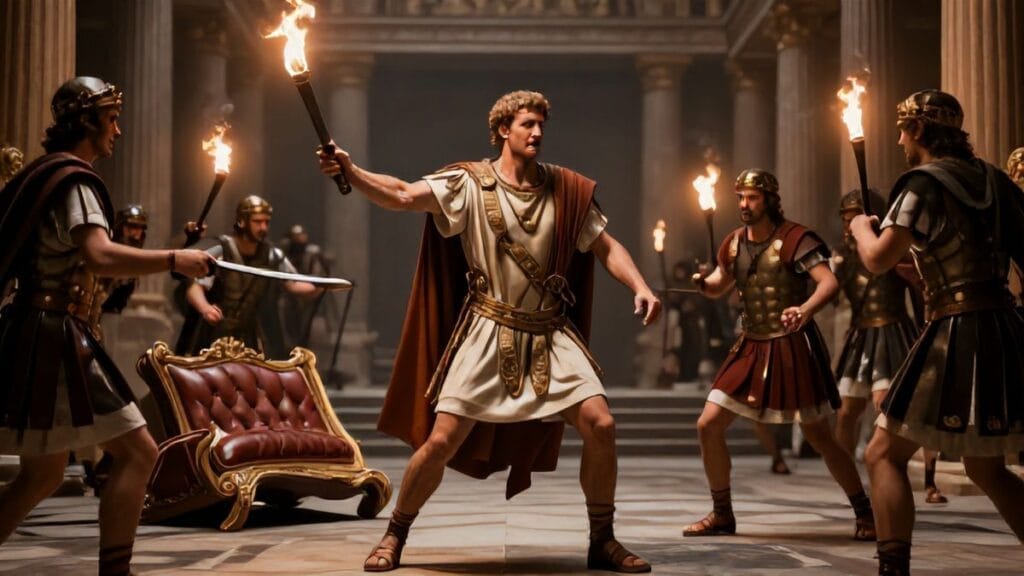
At some point in the chaos of that day—sources differ on the exact hour—Flavian soldiers breached the Palatine. They swarmed through halls once reserved for ambassadors and honoured guests, smashing doors, overturning tables, and cutting down any who stood in their way. Servants fled or begged for mercy. Statues were toppled; imperial portraits shredded. The hunt now narrowed to a single man: Aulus Vitellius, emperor of Rome.
Vitellius was found, according to most accounts, hiding in an obscure corner of the palace complex, perhaps the doorkeeper’s lodge or a similarly lowly station. Tacitus and Suetonius both emphasize the pathos of his discovery: an emperor dragged out of hiding like a common criminal, dishevelled, terrified, still clinging to tatters of dignity. Pleas for his life, if he uttered them, found no sympathy. To the soldiers, he was the obstacle to Vespasian’s triumph, the symbol of a hated regime whose fall they had bled to achieve.
What followed was not an orderly execution but a prolonged public torture. The assassination of emperor Vitellius unfolded in stages as he was paraded through the city he had once ruled. His hands were bound. A rope may have been passed around his neck. Soldiers beat him, mocked him, and forced him along streets still echoing with the sounds of recent battle. Some inhabitants slammed shutters or hid behind columns to avoid being associated with his fate. Others emerged to jeer, throw refuse, or spit. It was not just a killing; it was a ritual of humiliation designed to erase any residual aura of majesty.
As Suetonius relates, the soldiers thrust the tip of a sword under his chin, forcing him to keep his head raised and look upon the crowd. They shouted insulting epithets, calling him glutton, coward, arsonist, and worse. He was dragged past places heavy with symbolism: perhaps the Forum, the rostra where emperors had addressed the people, and ultimately the Gemonian stairs, the notorious execution site where the bodies of criminals were displayed. It was here, on those steps of infamy, that the assassination of emperor Vitellius reached its brutal climax.
There, they killed him. Accounts describe multiple wounds, a flurry of blows rather than a single clean stroke. His body was mutilated, his head cut off and paraded, his corpse eventually cast into the Tiber. The message could not have been clearer. Vitellius was not to be granted the dignity of a proper burial, nor the ambiguous legacy that might have come with quiet exile. He was to be obliterated—physically, symbolically, and historically.
In that moment, Rome devoured its own emperor before the eyes of its citizens. The assassination of emperor Vitellius was less a private act of vengeance than a collective exorcism of a year’s worth of fear, hunger, and rage. But the cost was immense. The city’s moral and political fabric, already frayed, was torn further by the spectacle of such naked brutality. A question lingered in the cold winter air: if this was how Rome treated its rulers, what kind of empire had it become?
A Corpse on the Gemonian Stairs: Rituals of Humiliation and Memory
To understand the full significance of Vitellius’s end, one must look closely at the setting of his death: the Gemonian stairs. These were not just any steps in Rome; they were a place of infamy, a flight of stone near the Forum where the bodies of executed criminals and traitors were exposed to public view. Dogs and birds picked at the remains, and crowds sometimes gathered to hurl curses or stones at the lifeless forms. To die there was to be branded forever as an enemy of the state.
By dragging Vitellius to the Gemonian stairs, his killers were making a statement that reached beyond the moment’s fury. They were rewriting his status from emperor to criminal, from ruler to outcast. The assassination of emperor Vitellius thus became a carefully staged ritual of degradation. His corpse, thrown to the dogs of the city and cast into the Tiber, was denied the ancestral rites that Romans believed vital for a peaceful afterlife. In a culture where the treatment of the dead profoundly shaped memory, this was an erasure as much as a punishment.
The symbolism did not end there. The Tiber, into which Vitellius’s body was reportedly dumped, was both lifeline and sewer for Rome—a sacred river that carried away refuse and corpses alike. To consign an emperor to its waters was to blur the line between ruler and waste, between human and discard. It is astonishing, isn’t it, how the most powerful man in the world could, within hours, become an anonymous cadaver swept downstream, unmarked, unmourned by the new regime.
Yet memory is stubborn. While the Flavian propaganda machine would work hard to present Vitellius as an unworthy emperor, the manner of his death generated complex reactions. Some in Rome, especially those who had benefitted from his generosity or simply seen him as a harmless, if weak, man, felt pity. Others, hardened by war, saw in his mutilation the necessary purging of a failed leader. In whispered conversations, away from soldiers’ ears, people debated whether he had truly deserved such an end.
Over time, the image of Vitellius on the Gemonian stairs would be folded into a broader pattern of Roman memory, alongside the heads displayed after Sulla’s proscriptions and the body of Sejanus torn apart under Tiberius. The assassination of emperor Vitellius thus became part of a grim gallery of examples, invoked whenever Romans spoke of the dangers of civil war and the fickleness of imperial fortune. The stairs themselves, worn soft by centuries of feet and blood, bore silent witness to an empire that so often resolved its crises through spectacle and violence.
Voices from the Past: How Tacitus, Suetonius, and Cassius Dio Shaped the Story
Our knowledge of Vitellius’s brief reign and brutal death comes primarily from three ancient historians: Tacitus, Suetonius, and Cassius Dio. Each wrote with different aims, audiences, and biases, and together they transformed the assassination of emperor Vitellius from a raw event into a moral and political narrative that would echo through the centuries.
Tacitus, writing in the early second century in his Histories, offers perhaps the most detailed account of 69 CE. A senator himself, he was deeply concerned with the erosion of senatorial authority and the corrosive effects of military power on Roman politics. For Tacitus, the Year of the Four Emperors is a case study in what happens when discipline collapses and the principate loses its balance. He portrays Vitellius as weak and pleasure-loving, but not purely monstrous. There are moments of pathos in his description of the emperor’s final days, as if Tacitus cannot help but feel some sympathy for a man destroyed by forces larger than himself.
Suetonius, in contrast, writes imperial biographies designed as collections of anecdotes and character sketches. His Life of Vitellius revels in details of excess: the gargantuan banquets, the supposed cruelty, the humiliations of his death. Suetonius famously claims that Vitellius could consume enormous quantities of food and wine, turning his body into a symbol of insatiable appetite. In this framing, the assassination of emperor Vitellius reads almost like a moral fable: the glutton who devours the empire is in turn devoured by it. Modern historians treat some of these stories with caution, recognizing their rhetorical flourish.
Cassius Dio, writing in Greek in the third century, offers a more distant and concise treatment. He weaves Vitellius’s story into a larger tapestry of Roman history, emphasizing the instability of the imperial office during this period. Dio, like Tacitus, underscores the role of the armies and the opportunism of commanders who saw emperorship as a prize to be won rather than an office to be earned. In his narrative, Vitellius becomes one more example of how the imperial system, left unchecked, could lurch from one disaster to another.
Modern scholars, reading these accounts, must navigate between bias and fact. As the historian Ronald Syme once observed about Tacitus, history can become “politics projected into the past.” The Flavian dynasty that followed Vitellius had every incentive to blacken his reputation; their legitimacy was built on the promise that they had rescued Rome from chaos. Thus, the assassination of emperor Vitellius serves not only as a historical incident but as a canvas onto which later writers projected their anxieties and moral judgments about power, decadence, and the price of civil war.
Rome After Vitellius: The Flavian Restoration and the Quest for Stability
With Vitellius dead and his body consigned to oblivion, Rome stood once more at a crossroads. On one level, the situation was clear: Vespasian was now emperor, his claim validated by victory in civil war and the elimination of his rival. Yet beneath the surface, wounds festered. The city had been fought over, its sacred sites desecrated, its people terrorized. Provinces had taken opposing sides. The legions had tasted the forbidden fruit of king-making twice in one year.
Vespasian’s immediate priority was to restore order—and to legitimize his reign. He did so through a combination of practical reforms, propaganda, and careful patronage. He reasserted control over the army, demobilizing or relocating legions that had proved unreliable and rewarding those that had backed him. He repaired damaged temples and public spaces, including beginning the construction of the Flavian Amphitheatre, later known as the Colosseum, on the site of Nero’s former palace gardens. It was a powerful symbol: where a tyrant had raised a private pleasure palace, a new dynasty would raise a monument for the people.
Politically, Vespasian cultivated the Senate, restoring its dignity—at least in appearance—while making clear that ultimate power still lay with the emperor. He regularized provincial taxation, tackled corruption, and pursued policies aimed at long-term stability rather than short-term spectacle. In comparison to Nero’s extravagance and Vitellius’s reputed feasting, Vespasian presented himself as frugal, earthy, almost austere. The contrast served him well.
Yet the memory of 69 CE could not be erased so easily. The assassination of emperor Vitellius lingered as a cautionary tale in elite and popular consciousness alike. For some, it justified Vespasian’s rule: the man who had defeated an unworthy glutton and restored discipline deserved to govern. For others, it raised troubling questions about the nature of imperial power. If emperors could still be butchered on public steps, how different was this new order from the chaos it claimed to have ended?
Over the next decade, the Flavian dynasty—Vespasian and his sons Titus and Domitian—would consolidate their authority, strengthen the imperial cult, and present themselves as guardians of Roman tradition. But the system remained what it had become in 69 CE: one in which the loyalty of the armies, the mood of the capital, and the will of ambitious generals could at any moment combine to unseat a ruler. The assassination of emperor Vitellius had demonstrated that fact with excruciating clarity, and no amount of stone and ceremony could fully bury that lesson.
Politics Written in Blood: What Vitellius’s Death Reveals about Imperial Power
Strip away the lurid details of banquets and brutality, and the death of Vitellius reveals a fundamental truth about the Roman Empire: political legitimacy rested ultimately on violence. Law, tradition, and ritual mattered, but when push came to shove, emperors lived or died by their ability to command soldiers’ loyalty. The assassination of emperor Vitellius thus becomes a case study in the mechanics of power when institutions fail.
Vitellius’s rise had been made possible by the Rhine legions’ dissatisfaction with Galba. His fall was precipitated when other legions, particularly those of the Danube and the East, rallied to Vespasian. At no point was there a constitutional process to arbitrate between them. The Senate, theoretically the guardian of Rome’s political order, largely followed whichever general controlled the city. The people of Rome, though capable of rioting and influencing events at the margins, ultimately watched as decisions were made by men in armour, often far from their sight.
The manner of Vitellius’s death—public, degrading, spectacular—underlined another aspect of imperial politics: the need to choreograph transitions in a way that communicated clear messages about the old and new regimes. By killing him on the Gemonian stairs, Vespasian’s supporters effectively staged a ritual of damnatio memoriae, an unofficial condemnation of his memory. Yet this did not erase him entirely; instead, it froze him in history as the embodiment of a failed emperor, a foil against which later rulers could define themselves.
There is also the human dimension. The assassination of emperor Vitellius reminds us that behind the abstractions of “regime change” and “civil war” lies the terror of individuals suddenly exposed to overwhelming force. Senators had to decide whether to endorse Vitellius or Vespasian, knowing that the wrong choice might mean exile or execution. Soldiers had to choose between old oaths and new opportunities. Ordinary citizens had to guess which name to shout when a cohort marched past. Political violence seeped into every alley and atrium.
In that sense, Vitellius’s end is not simply a story about a single emperor, but about a system that increasingly normalized murder as a means of resolving succession. Each violent transfer of power made the next one easier to contemplate. Each assassination left scars on Rome’s collective psyche, teaching generations to see the purple not as a sacred mantle but as a target. The Year of the Four Emperors, culminating in Vitellius’s death, exposed this brutal logic in its starkest form.
The People, the Soldiers, and the Senate: Society Caught in a Civil War
While elite narratives tend to focus on emperors and generals, the consequences of Vitellius’s assassination rippled through every layer of Roman society. The Senate, already humiliated under Nero, found itself once again in a reactive role, endorsing emperors after the fact rather than choosing them. Senators who had publicly supported Vitellius now scrambled to distance themselves, commissioning statues and inscriptions to Vespasian, offering vows for his health, and denouncing their former patron as a tyrant. Others, who had bet on Vespasian early, rose swiftly in influence, their loyalty rewarded with offices and governorships.
The army, for its part, emerged from 69 CE with a dangerous sense of its own power. Legions stationed far from Rome had discovered that they could make and unmake emperors. This realization would haunt the empire for centuries, contributing to later military crises and civil wars. In the short term, soldiers who had backed the victor enjoyed donatives and honours, while those associated with Vitellius faced discharge, reassignment to remote frontiers, or worse. Unit cohesion frayed as mutual suspicion seeped into barracks that had once prided themselves on shared identity.
For the urban populace, the experience of seeing their city turned into a battlefield and their emperor dragged through the streets left deep emotional scars. Some had cheered Vitellius’s entry only months earlier; now they watched him beaten and humiliated. The message was confusing and brutal. If the same crowds that had once shouted “Hail, Caesar!” could so swiftly turn to curses—or simply abandon a fallen ruler to his fate—what did loyalty mean? Many Romans learned to read the wind more carefully, holding back their enthusiasm until a new regime proved durable.
Economically, the year’s chaos disrupted trade, damaged infrastructure, and strained the grain supply. Workshops destroyed in the fighting had to be rebuilt; families who lost their breadwinners in the battles around the city faced poverty. The emotional toll was harder to measure but no less real. Children who saw soldiers storm their neighbourhoods, who woke to find corpses in the Forum or blood on the steps of temples, grew up with a very different understanding of imperial might than the triumphant narrative Augustus had once promoted.
Through all this, the assassination of emperor Vitellius became a reference point in conversations and memories. People would say, “We have seen an emperor dragged through these streets,” when rumours of new plots surfaced. Grandparents would tell grandchildren about the winter when Rome devoured one of its own. In this way, Vitellius’s fate became woven into the city’s identity, a grim reminder that its grandeur rested on foundations that could, in moments of crisis, crack wide open.
Myth, Caricature, and the Man Himself: Rethinking Vitellius
Given the hostile sources and spectacular nature of his demise, is it possible to see beyond the myth of Vitellius and find the man? The assassination of emperor Vitellius has so often been told as a story of well-deserved punishment that it can be difficult to question the verdict. Yet modern historians increasingly urge caution, arguing that his image has been distorted by the needs of his enemies and successors.
Consider first the charges of extreme gluttony and laziness. While there is little reason to doubt that Vitellius enjoyed food and feasting—traits not uncommon among the Roman elite—Suetonius’s more extravagant tales may owe as much to literary tradition as to fact. Gluttony was a stock vice in Roman moralizing literature, a convenient metaphor for political excess. By portraying Vitellius’s appetite as monstrous, writers could suggest that his entire reign was a species of uncontrolled consumption.
Similarly, the depiction of Vitellius as a coward in his final days must be weighed against the reality of his situation. Faced with overwhelming military defeat, abandoned by many allies, and aware of how Otho’s suicide had been received, he hesitated between competing models of imperial behaviour. Was he to die by his own hand, fight to the bitter end, or attempt abdication in the hope of sparing Rome further bloodshed? His indecision may reveal not pure weakness, but a man caught between conflicting ideals of masculinity, honour, and responsibility.
There are hints, even in hostile accounts, of a more nuanced figure. Tacitus acknowledges that Vitellius could be generous and amiable, winning affection easily. Some provinces reportedly welcomed his rule, seeing in him a respite from the harsher austerity of Galba. His failure lay less in monstrous cruelty than in an inability to control the forces—military, economic, political—that swirled around him in 69 CE.
To rethink Vitellius is not to rehabilitate him as a great statesman. His reign was short, his policies inconsistent, his reliance on favourites and overindulgence real problems. But it is to recognize that the assassination of emperor Vitellius has been used as a narrative tool, a climactic moment that justifies a particular interpretation of the Year of the Four Emperors. By peeling back the layers of rhetoric and propaganda, we can see him instead as a tragic, if flawed, human being: elevated beyond his capacities, crushed by circumstances, and transformed in death into a cautionary symbol.
Echoes through the Centuries: The Assassination of Emperor Vitellius in Culture and Memory
In the centuries after his death, Vitellius lived on not in marble triumphs or inscriptions of honour, but in texts, images, and moral tales. The assassination of emperor Vitellius became a rich subject for later writers and artists who sought to explore themes of decadence, downfall, and the volatility of political power. Medieval chroniclers, drawing on Suetonius and Tacitus, treated him as a textbook example of how God or fate humbles the proud. Renaissance humanists, rediscovering the Latin historians, wove his story into broader reflections on tyranny and fortune.
Visual artists were particularly drawn to the dramatic possibilities of his end. Baroque painters, fascinated by the interplay of light, shadow, and emotion, sometimes depicted Vitellius’s final procession, the crowd’s jeers, the soldiers’ brutality. Sculptors and medal-makers used his heavy features—known from surviving busts—as a template for the “type” of the corrupt ruler. In these works, the assassination of emperor Vitellius stands alongside other famous deaths—Caesar’s stabbing, Nero’s suicide—as emblematic of Rome’s dark brilliance.
Modern popular culture has largely overlooked Vitellius compared to more famous figures like Caesar, Nero, or Caligula. Yet echoes of his story appear whenever narratives depict a ruler overthrown by their own people in sensational fashion. The image of a fallen leader dragged through streets once swept for his processions resonates strongly in a world that has witnessed televised revolutions and the toppling of dictators’ statues. Vitellius’s fate anticipates these scenes, reminding us that political theatre and violence have long been intertwined.
In academic circles, his assassination continues to serve as a key case study in discussions of regime change, propaganda, and the sociology of imperial power. Scholars analyze how the Flavian regime constructed its legitimacy partly through vilifying Vitellius, and how ancient authors, writing under later emperors, navigated the dangerous task of criticizing past rulers without challenging the institution itself. As one modern historian has noted, civil war narratives in Rome often worked as “mirrors for princes,” warning current emperors what might happen if they lost the support of army and people alike.
Ultimately, the assassination of emperor Vitellius endures less as a story about one man’s vices than as a stark reminder of the precariousness of autocratic rule. It asks enduring questions: How do societies justify violence against their own leaders? How do victors shape the memory of the vanquished? And how many truths are sacrificed when a new order demands a villain to bury with the old? In the cold Roman winter of 69 CE, as Vitellius’s body disappeared into the Tiber, those questions found no immediate answers. They still challenge us today.
Conclusion
On a single December day in 69 CE, the long, violent arc of the Year of the Four Emperors reached its brutal climax on the stones of Rome. The assassination of emperor Vitellius was not an isolated act of vengeance but the visible tip of an iceberg composed of mutinous legions, rival generals, terrified senators, and a populace caught in the crossfire of imperial ambition. His rise from relative obscurity, propelled by the discontent of the Rhine legions, and his fall under the onslaught of Vespasian’s supporters encapsulate the terrifying speed with which fortune could elevate and destroy in the Roman world.
Vitellius’s death on the Gemonian stairs, his body abused and denied burial, crystallized the message that the new Flavian regime wished to send: that his rule had been illegitimate, decadent, and disastrous. Yet, as the sources themselves reveal, the reality was more complex. He was neither a monstrous aberration nor an innocent victim, but a flawed man overwhelmed by a system that had lost its balance. The institutions that might have mediated succession—the Senate, traditional law, civic ritual—proved powerless in the face of armed force and provincial rivalries.
In examining his assassination, we see the costs of a political order that relies on violence to resolve crises. Rome survived 69 CE; indeed, under Vespasian and his successors it entered a period of renewed stability and monumental building. But the scars of that year, and of Vitellius’s especially gruesome end, remained etched into Roman memory as a warning of what lay beneath the empire’s polished surface. Power, in the final calculation, still flowed from the swords of soldiers and the shifting loyalties of distant armies.
Today, the story of Vitellius invites reflection not only on ancient Rome, but on the broader dynamics of regime change, propaganda, and historical memory. The assassination of emperor Vitellius forces us to ask how we judge leaders in times of crisis, how victors shape the narratives we inherit, and how easily a human life can be turned into a symbol or a cautionary tale. Rome’s winter of 69 CE is long past, the Gemonian stairs worn away, but the questions raised by that day’s violence still echo in any society where power is contested and history is written by those who survive.
FAQs
- Who was Emperor Vitellius before he came to power?
Vitellius was a Roman senator from a distinguished but not preeminent family. He held several important offices, including proconsul of Africa, and moved in imperial circles under earlier emperors. His appointment as commander of the Rhine legions in 68 CE unexpectedly placed him in a position where discontented troops could elevate him to the purple. - Why did Vitellius become emperor during the Year of the Four Emperors?
Vitellius was proclaimed emperor by the Rhine legions in early 69 CE, largely because they resented Emperor Galba and felt ignored in the distribution of rewards and honours. They saw in Vitellius a malleable and acceptable figurehead for their rebellion. After defeating Otho at the First Battle of Bedriacum, Vitellius entered Rome as the third emperor of that turbulent year. - What led directly to the assassination of emperor Vitellius?
His assassination resulted from military defeat and political collapse. When powerful eastern and Danubian legions declared for Vespasian, Vitellius’s authority crumbled. After losing the Second Battle of Bedriacum, his forces retreated, allies defected, and Flavian troops marched on Rome. Negotiations for his abdication collapsed amid mutual distrust, and when Vespasian’s supporters seized the city, they hunted, humiliated, and killed him as a public act of regime change. - How did Vitellius die, according to ancient sources?
Ancient historians such as Tacitus and Suetonius report that Vitellius was discovered hiding in the imperial palace, dragged out by Flavian soldiers, beaten, and paraded through Rome. He was insulted and abused along the way, then killed on the Gemonian stairs and his body thrown into the Tiber. The details may be embellished, but they agree on the essential points: a public, degrading death that marked the definitive end of his regime. - Was Vitellius really as gluttonous and decadent as later writers claim?
While he likely enjoyed lavish banquets and was more indulgent than some predecessors, his reputation for extraordinary gluttony comes largely from hostile sources writing under the Flavian dynasty. These authors had strong incentives to portray him negatively to justify Vespasian’s seizure of power. Modern historians are cautious about accepting the most extreme anecdotes at face value, seeing them as part of a broader propaganda effort. - What was the political impact of Vitellius’s assassination on the Roman Empire?
His death cleared the way for Vespasian to become uncontested emperor and inaugurate the Flavian dynasty, which brought relative stability after a year of chaos. However, it also confirmed that emperors could be violently overthrown by rival generals and their armies. This realization emboldened legions in later crises and entrenched the precedent that military might, rather than legal procedure, ultimately decided succession. - How do historians today view Vitellius’s reign?
Modern scholars generally see Vitellius as a weak and ill-fated ruler rather than a uniquely monstrous one. His short reign—only about eight months in Rome—left little room for coherent policy. He was overwhelmed by structural problems: competing armies, financial strain, and the absence of a stable succession mechanism. While acknowledging his failings, historians emphasize that later vilification reflects Flavian propaganda as much as his actual conduct. - What sources describe the assassination of emperor Vitellius?
The main ancient sources are Tacitus’s Histories, Suetonius’s Life of Vitellius, and the Roman History of Cassius Dio. Tacitus offers a detailed, often dramatic narrative; Suetonius focuses on character and scandalous details; Dio provides a more concise overview. These accounts must be read critically, as all were written under later regimes that benefitted from discrediting Vitellius. - How did ordinary Romans experience the events of 69 CE?
For common citizens, the year brought fear, scarcity, and confusion. They witnessed battles in and around the city, fires and destruction, shifting proclamations of new emperors, and finally the sight of Vitellius dragged to his death. Many tried simply to survive, adjusting quickly to each new regime while coping with disrupted trade, damaged property, and the psychological shock of seeing their capital turned into a civil war battlefield. - Why is Vitellius less famous today than emperors like Nero or Caligula?
Vitellius reigned briefly and left few lasting monuments or major policy changes. His story is also overshadowed by more flamboyant figures whose reigns generated more extensive literary and archaeological evidence. Nonetheless, among historians, the assassination of emperor Vitellius is recognized as a pivotal moment in the development of the imperial system and a powerful example of the dangers of militarized politics.
External Resource
Internal Link
Other Resources
- Encyclopaedia Britannica – general search for the exact subject
- Google Scholar – academic search for the exact subject
- Internet Archive – digital library search for the exact subject