Table of Contents
- The Final Days of a Theological Titan
- Alexandria in the 4th Century: A City on the Edge
- The Rise of Athanasius: Defender of Orthodoxy
- The Pressure Building: Religious and Political Tensions
- February 2, 373: The Day the City Stood Still
- Inside the Walls: Athanasius’s Last Moments
- The Mourning of a Bishop: Public Outcry and Grief
- Power Struggles After Death: A City Divided
- The Legacy of Athanasius: From Controversy to Canonization
- Athanasius’s Writings: Enduring Theological Influence
- Alexandria’s Christian Identity Hardened
- The Impact on the Arian Controversy and Church Politics
- The Reign of Theodosius and the Rise of Nicene Christianity
- How Athanasius’s Death Resonated Through the Empire
- Remembering a Saint: Pilgrimage, Veneration, and Memory
- The Archaeological Trace of Athanasius in Alexandria
- Modern Perspectives on Athanasius and His Era
- Conclusion: A Life That Shaped Christian History
- FAQs
- External Resource
- Internal Link
1. The Final Days of a Theological Titan
It was early February in the year 373, and the sun cast a pale light over the bustling streets of Alexandria. The city, a melting pot of ideas, religions, and political ambitions, was no stranger to turmoil. Yet, in the midst of this restless atmosphere, one figure—venerated and reviled in equal measure—was drawing his final breath. Athanasius of Alexandria, bishop, theologian, and formidable defender of Christian orthodoxy, lay on his deathbed. His passing did not simply mark the end of a life, but a turning point for a city, a church, and an empire. The air was thick with anticipation and apprehension as citizens gathered, some in mourning, others scheming in the shadows. The death of Athanasius was not just the death of a man; it was the closing of a volatile chapter in the history of Christianity itself.
2. Alexandria in the 4th Century: A City on the Edge
Alexandria, with its legendary library and crossroads location at the Mediterranean’s edge, was among the ancient world’s most diverse and fractious cities. By the fourth century, it had become a seething cauldron of culture and conflict—Jews, pagans, and Christians jostled for influence, while imperial power tried uneasily to maintain order. The city's complex social fabric was riven by political rivalries, economic stresses, and religious dissent. This was a place where words could ignite riots and where religious debate was often a prelude to violence. Into this volatile environment stepped Athanasius, whose life’s work would become inseparable from Alexandria’s tumultuous fate.
3. The Rise of Athanasius: Defender of Orthodoxy
Born around 296, Athanasius rose from relative obscurity to become the bishop of Alexandria in 328 AD. The early fourth century was a formative time for Christianity, still emerging from persecution and wrestling with internal theological disputes. Athanasius’s defining struggle was against Arianism—a theological doctrine that denied the full divinity of Jesus Christ—which threatened the unity of the Church. His adamant defense of the Nicene Creed, affirmed at the Council of Nicaea in 325, earned him enemies across both ecclesiastical and imperial circles. Exiled multiple times and subject to political machinations, his resilience made him a symbol of orthodox steadfastness. Throughout these decades, his life became a story of dogged persistence in the face of relentless opposition.
4. The Pressure Building: Religious and Political Tensions
As Athanasius grew older, Alexandria’s internal tensions did not abate—they intensified. Pagan intellectuals who clung to the city’s Hellenistic traditions, Jewish communities wary of Christian expansion, and factions within the Christian spectrum itself all viewed Athanasius with suspicion or hostility. Furthermore, the broader Christian Church was transitioning from a persecuted sect into a dominant imperial religion. This transformation brought its own dangers—compromise, infighting, and power struggles. Athanasius’s confrontational style and uncompromising theology made him a polarizing figure. Political leaders, including Roman Emperor Valens and his successors, navigated these choppy waters with varying degrees of support or disdain toward him and his followers.
5. February 2, 373: The Day the City Stood Still
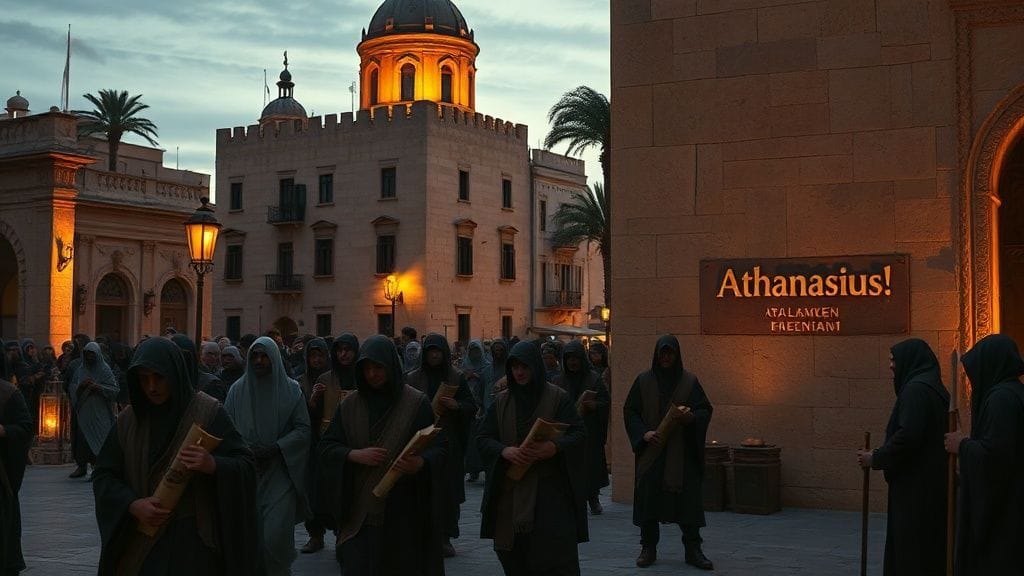
When the news spread that Athanasius was gravely ill, Alexandria was transformed. Shops closed, the harbor fell silent, and an unprecedented outpouring of emotion overtook the city. Athanasius was not merely a churchman; he was a gladiator in the arena of spiritual battles, and his death was felt as a seismic event. Crowds padded through the narrow streets toward the episcopal residence, some intent on witnessing his final moments, others looking to assert their own claims in the vacuum his death would soon create. It was on this day that Alexandria held its breath, knowing that the end of Athanasius would signal profound changes.
6. Inside the Walls: Athanasius’s Last Moments
Accounts from contemporaries and later chroniclers paint a poignant picture of Athanasius in his final hours. Despite the weakness due to age and illness, the bishop remained mentally sharp and spiritually resolute. Surrounded by clergy and devout followers, he delivered final teachings, urging unity and faithfulness to the Nicene doctrine he championed. “I die in the true faith,” he declared. His voice, though faint, carried the weight of decades of struggle. In those solemn hours, the weary yet unwavering bishop embodied the very essence of the Alexandrian Church’s identity.
7. The Mourning of a Bishop: Public Outcry and Grief
The death of Athanasius unleashed waves of grief and chaos. Thousands flooded the streets in mourning, their grief interlaced with fear over what the future might hold. Some pagans and Arians, who considered him an adversary, withheld public sorrow but watched anxiously from the sidelines. The grief was not only spiritual but intensely civic: Athanasius had been a figure of authority and stability amid Alexandria’s abrasive social climate. His funeral procession was grand and somber, weaving through streets lined with weeping citizens. Stories circulated of miracles attributed to his intercession even as he lay lifeless—a testament to the deep faith he inspired.
8. Power Struggles After Death: A City Divided
Athanasius’s death did not result in peace but only sharpened Alexandria’s divisions. Competing factions within the church each sought to install a successor aligned with their theological vision or political interests. The pagans and Jews of Alexandria, sensing a moment of vulnerability, eyed opportunities to reclaim lost influence. The imperial administration, keen to maintain order, found itself an uneasy arbiter in the increasingly fractious landscape. This volatile aftermath underscored how Athanasius’s presence had been a crucial stabilizing force. His departure left Alexandria on a knife’s edge.
9. The Legacy of Athanasius: From Controversy to Canonization
Though contentious in life, Athanasius’s reputation grew steadily after his death. His rigorous defense of the Nicene Creed placed him firmly on the side of what would become orthodox Christian doctrine. Over time, ecclesiastical authorities canonized him as a saint and Doctor of the Church, lauding his theological writings and authoritative testimony. His feast day became a point of spiritual remembrance throughout Christendom. Yet, this legacy was not merely religious; it symbolized the consolidation of Christian orthodoxy against heresy and pagan resistance, with Alexandria as a crucible of transformation.
10. Athanasius’s Writings: Enduring Theological Influence
Beyond politics and ceremony, Athanasius’s most lasting contribution remains his rich body of theological works. His “On the Incarnation,” written early in his career, articulated a profound doctrine of Christ’s divine nature and the redemptive purpose of the incarnation. His letters and treatises challenged contemporary heresies and provided a model of theological rigor and pastoral care. Centuries later, these works continue to inform Christian thought and remain studied for their blend of philosophical insight and spiritual passion. They reveal a man who was not only embroiled in worldly struggles but deeply committed to explaining the mysteries of faith.
11. Alexandria’s Christian Identity Hardened
In the wake of Athanasius’s death, Alexandria emerged ever more decisively as a Christian city. Pagan temples were closed or repurposed, and Christian institutions flourished. The bishop’s leadership had helped forge a communal identity that intertwined faith and civic life. While this fostered unity among Christians, it also exacerbated the marginalization of other groups, reflecting a broader trend in late antiquity where religious homogeneity became an imperial imperative. Alexandria was a microcosm of this complex transformation, and Athanasius’s role was central.
12. The Impact on the Arian Controversy and Church Politics
Athanasius’s death marked a significant milestone in the protracted struggle over Arianism. Though the heresy did not vanish immediately, his defense of Nicene orthodoxy paved the way for its eventual dominance within the empire. Subsequent councils and imperial edicts reinforced the theological frameworks he championed. This consolidation of doctrinal authority had profound consequences for church structure, imperial religious policy, and theological education. It was a turning point from religious plurality toward an increasingly centralized orthodoxy.
13. The Reign of Theodosius and the Rise of Nicene Christianity
Shortly after Athanasius’s death, under Emperor Theodosius I, Nicene Christianity attained unprecedented supremacy as the state religion. Theodosius’s decrees outlawed pagan worship and heretical sects, accelerating Alexandria's Christian transformation. Athanasius’s triumph in defining orthodoxy provided the theological backbone for this imperial shift. The city’s future bishops would invoke his legacy to justify their authority and policies, entrenching his influence deep into the fabric of empire.
14. How Athanasius’s Death Resonated Through the Empire
News of Athanasius’s death traveled far beyond Alexandria. Christian communities across the Roman Empire mourned the loss of a defender of the faith. His theological battles had influenced doctrine in the East and West, crafting a Christian identity that transcended provinces. His death symbolized both an end and a beginning—the passing of a generation marked by conflict and the dawn of a new era of Christian dominance. Yet, the tensions he engaged with persisted, evolving into conflicts that would shape medieval Christendom.
15. Remembering a Saint: Pilgrimage, Veneration, and Memory
In centuries after his death, Athanasius became a figure of veneration. Pilgrims journeyed to Alexandria to visit his tomb, seeking spiritual solace and grace. His feast day inspired liturgical celebrations, art, and devotional literature. Stories of his miracles and steadfast faith circulated widely, embedding him in Christian collective memory. His life was studied not only by theologians but by ordinary believers seeking a model of courage and conviction. His memory helped define the identity of the Alexandrian church and beyond.
16. The Archaeological Trace of Athanasius in Alexandria
While much of ancient Alexandria lies buried beneath modern city layers and the Mediterranean’s shifting sands, archaeological efforts have illuminated aspects of its Christian past. Early churches, inscriptions, and relics provide tangible links to the era of Athanasius. Though his exact tomb has never been conclusively identified, these traces allow historians to reconstruct the cultural context in which he lived and ministered. The physical remains remind us that history is both a story and a landscape, where memory and materiality intertwine.
17. Modern Perspectives on Athanasius and His Era
Today, Athanasius is studied not only as a saint and theologian but as a figure whose life reflects the complexities of late antique religious and political life. Scholars analyze his writings to understand the formation of early Christian doctrine and the dynamics of power in Roman society. Modern interpretations increasingly situate him within the broader Mediterranean world, understanding Alexandria’s multicultural tensions and the competing narratives of its communities. His life challenges simplistic views of religious history, revealing the messiness of faith and politics intertwined.
Conclusion
Athanasius of Alexandria’s death on that cold day in early February 373 was much more than the passing of a man—it was the closing of an epoch defined by fierce ideological battles, relentless persecution, and the forging of a new religious order. His unwavering commitment to the Nicene faith, his endurance through exile and opposition, and his theological brilliance cast a long shadow over not only Alexandria but the entire Christian world. His final breaths in a city teetering between chaos and transformation encapsulate the profound human drama beneath the grand narratives of history. Today, as we reflect on his life and legacy, we see in Athanasius a testament to faith’s power to shape identity, to challenge empires, and to inspire generations. His story is a reminder that history is lived by souls who dare to stand firm amid the storms of change.
FAQs
Q1: Who was Athanasius of Alexandria and why is he significant?
Athanasius was a 4th-century bishop of Alexandria, a key figure in early Christian history known for defending the Nicene Creed against Arianism. His theological work and leadership significantly shaped Christian orthodoxy.
Q2: What caused the religious conflicts in Alexandria during Athanasius’s lifetime?
Alexandria was home to diverse religious communities—pagans, Jews, Christians—with competing interests. The rise of Christianity as an imperial religion, doctrinal disputes, and political rivalries fueled frequent tensions and violence.
Q3: How did Athanasius die, and what was the immediate reaction?
Athanasius died on February 2, 373, likely from natural causes given his advanced age and illness. His death provoked widespread mourning among Christians and heightened factional struggles over his succession.
Q4: What was the impact of Athanasius’s death on Alexandria?
His death intensified rivalries within the church and among the city’s religious groups. Alexandria’s Christian identity, however, grew stronger, and his legacy helped guide its future leadership.
Q5: How did Athanasius influence later Christian doctrine and politics?
His staunch defense of Nicene orthodoxy positioned him as a foundational figure whose works influenced subsequent church councils, imperial religious policy, and theological education.
Q6: Are there any surviving writings by Athanasius?
Yes. His most famous work is On the Incarnation. He also wrote letters, theological treatises, and defenses of orthodoxy that remain influential in Christian thought.
Q7: How is Athanasius remembered today?
He is venerated as a saint and Doctor of the Church, celebrated for his theological contributions and resolute faith amid adversity. His life is commemorated in liturgical calendars and scholarly studies.
Q8: What does Athanasius’s story tell us about late antiquity?
His life exemplifies the complex intersections of religion, politics, culture, and identity during a pivotal era when Christianity transitioned from persecuted sect to imperial power.