Table of Contents
- The Quiet Dawn at Argentia: August 14, 1941
- The World on the Brink: Context of the Atlantic Charter
- Churchill and Roosevelt: Two Leaders, One Destiny
- Newfoundland’s Argentia Bay: The Unlikely Stage
- Secret Meeting, Global Ambitions
- The Drafting of the Charter: Words with Weight
- The Eight Principal Points: A Vision for a New World
- The Shadow of War: Why the Charter Mattered Then
- The U.S. and Britain: A Fragile Alliance Strengthened
- Reactions Across the Globe: Allies, Enemies, and Neutrals
- The Promise of Self-Determination and Free Trade
- The Impact on Colonial Empires: Hope and Ambiguity
- The Charter’s Influence on the Atlantic War Strategy
- Seeds of the United Nations: The Charter’s Legacy
- The Charter in the Eyes of History: Myths and Realities
- Personal Accounts: Voices from Argentia
- The Aftermath: From Words to Action
- The Atlantic Charter and Postwar Reconstruction
- The Charter and Human Rights: A New Moral Compass
- Controversies and Criticisms: What Was Left Unsaid
- Remembering the Atlantic Charter Today
- Conclusion: The Charter’s Enduring Flame
- Frequently Asked Questions
- External Resource
- Internal Link
The Quiet Dawn at Argentia: August 14, 1941
On an overcast August morning, mist shrouded the rugged coastline of Argentia, Newfoundland, as two of the most powerful men in the world landed quietly to meet under historic and hazardous circumstances. Across the gray waters of the North Atlantic, the fate of an embattled planet seemed to hang delicately in the balance. Winston Churchill and Franklin D. Roosevelt, each burdened with the weight of their nations' survival, came together in profound secrecy to forge a vision—one that transcended war and reached boldly toward the hope of peace.
This, at least in their minds, was no ordinary diplomatic encounter. They met not as mere politicians, but as architects steering the course of global destiny. The air was thick with anticipation, and beneath their calm exteriors stirred an urgency born of a world piecing itself together amidst chaos. The resulting Atlantic Charter—announced on that day in 1941—would become a beacon of allied resilience and principle, illuminating the dark skies of war with a promise of freedom, security, and cooperation.
Yet this historic event was far more than a statement of ideals. Behind the ceremonial speeches and idealistic prose lay complex political calculations, strategic imperatives, and the raw human desire for a world better than the one they inherited. In exploring the Atlantic Charter, we unravel not just the document itself, but the story of a pivotal moment when hope emerged amid devastation, opening the door to a postwar world order still felt today.
The World on the Brink: Context of the Atlantic Charter
The summer of 1941 found the world engulfed in turmoil. Europe had fallen largely under the shadow of Nazi domination, with France crushed and Britain standing precariously amid relentless aerial bombardments. The Soviet Union braced under the initial ferocity of Operation Barbarossa. Across the Atlantic, the United States remained officially neutral, its isolationist policy challenged from within and without, yet its involvement inevitable.
Against this grim backdrop, the Atlantic Charter emerged as a strategic and moral response—a declaration of shared purpose and future planning between two allies separated by ocean but bound by common peril. Both Churchill and Roosevelt faced mounting pressure: the former to preserve an empire under siege, the latter to prepare a reluctant nation for the storms ahead.
This unique geopolitical moment witnessed an unprecedented Anglo-American cooperation before the United States had fully entered the war. The Atlantic Charter thus embodied not only political idealism but also a practical blueprint for unified action, intended to reassure the world—and rally support—for the fight against tyranny.
Churchill and Roosevelt: Two Leaders, One Destiny
Winston Churchill arrived at Argentia a man forged in the furnaces of British imperial tradition and wartime leadership, renowned for his indomitable spirit and eloquence. Franklin D. Roosevelt represented a new America—steady, pragmatic, yet visionary—undergoing its own internal debates over intervention and isolation.
Their personal rapport, built over prior correspondence and meetings, was marked by mutual respect and a shared understanding of the stakes. Roosevelt, mindful of American public opinion’s caution, sought to balance idealism with realism. Churchill, fighting for Britain’s survival, sought not only military assistance but also moral validation.
Together, these leaders wielded their combined influence to craft a set of principles aimed not just at winning war, but at constructing a durable peace. Their exchange in Argentia was infused with candidness, humor, and moments of stark realism, revealing the weight of leadership in a world crashing toward catastrophe.
Newfoundland’s Argentia Bay: The Unlikely Stage
Argentia, a quiet naval base nestled along Newfoundland’s eastern shores, was an unlikely theater for such a world-shaping encounter. Yet its remoteness and security made it the perfect venue for a meeting shrouded in secrecy.
At the time, Newfoundland was a British dominion, strategically critical as a foothold in the North Atlantic. Its rugged landscapes and unpredictable weather mirrored the uncertainty that lay before the world’s leaders. The choice of Argentia symbolized both strategic necessity and the clandestine nature of the budding alliance.
The isolation of this setting perhaps also allowed the two men to shed public facades, engaging in candid discussions that transcended mere protocol. The environment lent an almost cinematic quality to the meeting, a small harbor sheltering the ambitions of nations.
Secret Meeting, Global Ambitions
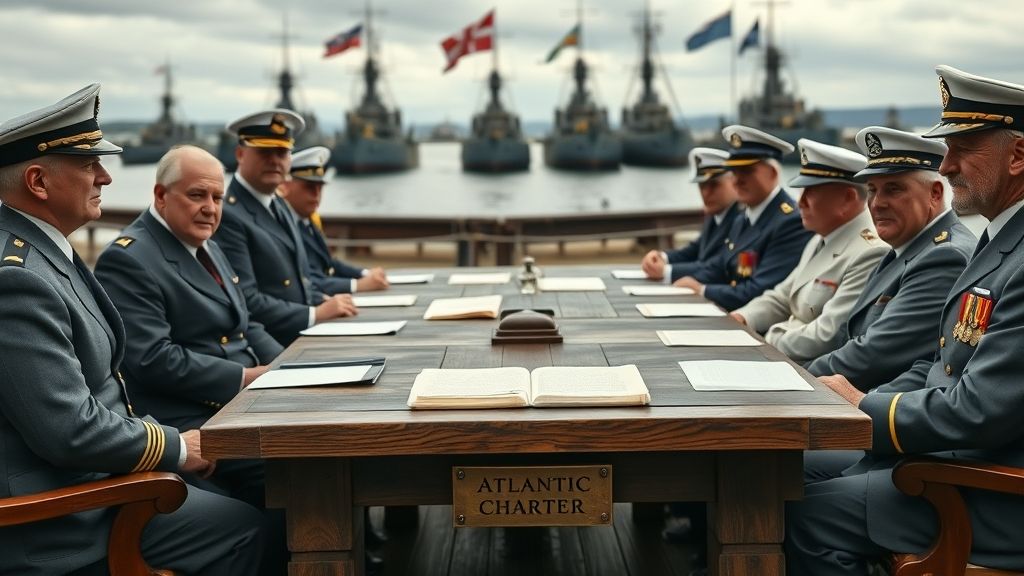
The leaders met aboard the battleship HMS Prince of Wales, anchored off the coast of Argentia, away from prying eyes and ears. The secrecy was paramount, both to shield the discussions from Axis intelligence and from domestic political pressures wary of premature commitments.
Despite wartime exhaustion, the two statesmen devoted nearly a week to intensive talks, exchanging visions for a postwar world that would reject militarism and imperial conquest. The atmosphere was charged, balanced between cautious optimism and the grave reality of ongoing conflict.
The Atlantic Charter thus emerged as more than a statement—it became a foundational text encapsulating two nations’ resolve to fight not just to survive, but to reimagine global order.
The Drafting of the Charter: Words with Weight
The Charter, in its essence, was crafted with acute awareness that words would carry far beyond the immediate moment. Composed in collaboration between Churchill and Roosevelt with the advice of their closest aides, every phrase was charged with diplomatic nuance.
The Charter articulated fundamental principles: no territorial aggrandizement, self-determination, economic collaboration, disarmament, and freedom of the seas. It was a manifesto of hope, yet grounded in the pragmatic acknowledgment of the painstaking process ahead.
The drafting process itself was a delicate balancing act—between accommodating British imperial interests and American democratic ideals, between rallying occupied peoples and managing colonial sensitivities. Despite imperfections, these words planted seeds for international cooperation that decades later would bear significant fruit.
The Eight Principal Points: A Vision for a New World
The Atlantic Charter outlined eight key points that together formed a vision for a better world:
- No territorial gains sought by the United States or the United Kingdom.
- The right of all peoples to choose their form of government.
- Respect for the right of all peoples to economic trade and equal access to raw materials.
- Freedom of the seas.
- Disarmament of aggressor nations and postwar disarmament.
- Global collaboration to secure improved labor standards, economic advancement, and social security.
- The desire to abandon the use of force, except in common harm defense.
- The establishment of a wider and permanent system of general security.
Each point was revolutionary, offering a blueprint for peace that challenged old imperial doctrines and set new standards for international relations.
The Shadow of War: Why the Charter Mattered Then
In the middle of 1941, the war’s outcome remained uncertain. Britain was battered; the Soviet Union was embroiled in desperate defense; the American public’s mood was mixed.
The Atlantic Charter emerged as a symbolic and strategic beacon. It signaled to occupied nations that liberation was not only a military objective but a moral imperative. It reassured the British that American support was firm—despite official neutrality, Roosevelt was inching closer to active engagement.
The Charter was both a declaration of intent and a diplomatic tool, rallying allies and undermining Axis propaganda. Its timing—months before Pearl Harbor—ensured that when the U.S. entered the war, it did so with a clear set of principles already articulated.
The U.S. and Britain: A Fragile Alliance Strengthened
The Charter crystallized an alliance that was still tentative. Though sharing language, history, and strategic interests, Britain and the U.S. had at times divergent worldviews and domestic constraints.
For Roosevelt, it was also a careful message to the American Congress and populace—a reassurance that involvement would be grounded in noble aims. For Churchill, it was a lifeline, binding the “special relationship” into a coalition capable of eventual victory.
Their alliance, solidified at Argentia, would become one of the defining features of 20th-century geopolitics. The Charter’s ideals provided a diplomatic framework for that alliance’s growth, enabling cooperation that shaped the military and political path forward.
Reactions Across the Globe: Allies, Enemies, and Neutrals
News of the Charter, once publicized, rippled worldwide—eliciting hopes, skepticism, and resistance.
Occupied Europeans saw a moral commitment to liberation. Colonized peoples interpreted the promises of self-government as a beacon, planting future seeds of decolonization. However, colonial powers shuddered at the implication of territorial self-rule.
Axis powers dismissed the Charter as Allied propaganda, yet it complicated their efforts to justify conquest and oppression.
Neutral countries watched closely, understanding that a postwar order would likely emerge with or without their input—forcing recalculations in diplomacy.
The Promise of Self-Determination and Free Trade
Perhaps most potent among the Charter’s promises was the commitment to self-determination—a clear rebuke to imperial conquest and forced subjugation.
This point, however, remained deliberately vague. It sowed tensions between promises of freedom and the realities of empire, raising questions about who would control postwar transitions.
Similarly, the call for free trade and equal access to raw materials challenged economic monopolies, yet confronted entrenched colonial economic interests.
These contradictions framed much of the postwar political debate, both within the Allied camp and beyond.
The Impact on Colonial Empires: Hope and Ambiguity
The Charter’s guiding principles inadvertently ignited debates about the future of colonial empires.
For colonial subjects, it was a rallying cry. The document asserted rights that challenged imperial hierarchy, inspiring independence movements in Asia, Africa, and beyond.
For imperial powers, it posed a dilemma: either reform or risk losing legitimacy. Churchill himself was ambivalent, emphasizing survival of the empire while recognizing change was inevitable.
The Charter thus marked the beginning of what historian Margaret MacMillan called “the unravelling of empire,” a process accelerating in the decades that followed.
The Charter’s Influence on the Atlantic War Strategy
Beyond its moral and political significance, the Charter shaped strategic wartime planning.
It affirmed commitments to fight until victory and to rebuild a world order based on cooperation rather than unilateral conquest.
By setting these principles early, the Charter aligned military objectives with political goals, helping to galvanize effort among disparate Allied nations.
It influenced subsequent conferences—Tehran, Yalta, and Potsdam—where details of the postwar world were hammered out.
Seeds of the United Nations: The Charter’s Legacy
The Atlantic Charter laid the groundwork for the creation of the United Nations. Its emphasis on collective security, disarmament, and international cooperation foreshadowed the UN Charter.
Many of its principles were later enshrined in the UN’s founding documents, including respect for sovereignty and promotion of human rights.
In this way, the August 1941 meeting at Argentia became a turning point, transitioning from a world fractured by war to one aspiring toward a new global framework for peace.
The Charter in the Eyes of History: Myths and Realities
History has often mythologized the Atlantic Charter as a perfect, selfless declaration of democracy and freedom.
Yet, a closer examination reveals complexities: political expediency, imperial interests, and compromises.
Some scholars critique the Charter for its imperialist blind spots and the exclusion of certain voices.
Nonetheless, its symbolic power and practical consequences remain undeniable—a testament to diplomacy’s potential to shape world history.
Personal Accounts: Voices from Argentia
The few witnesses to the private meetings recall an atmosphere charged with solemnity and camaraderie.
One naval officer described Churchill’s “gruff humor” easing tense discussions, while Roosevelt’s calm demeanor helped soften difficult negotiations.
These human moments remind us that history’s great events are shaped not only by ideas but by personalities and relationships forged in fleeting encounters.
The Aftermath: From Words to Action
Following the Charter, coordination between the Allies intensified, leading to Lend-Lease aid, joint military planning, and eventual U.S. entry into war.
The Declaration became a rallying point in Allied propaganda and diplomacy.
However, its realization proved arduous, requiring decades of conflict, negotiation, and reform before ideals of self-determination and security could be broadly realized.
The Atlantic Charter and Postwar Reconstruction
After the war, the Charter’s vision guided efforts to rebuild war-torn economies, establish international institutions, and promote peace.
The rise of Bretton Woods institutions and human rights frameworks echoed its core ideals.
Still, Cold War tensions and decolonization struggles complicated this process, revealing the limits of the Charter’s reach.
The Charter and Human Rights: A New Moral Compass
Perhaps one of the most enduring legacies of the Atlantic Charter is its role in launching a postwar human rights movement.
By affirming the rights of individuals and peoples, it prefigured instruments like the Universal Declaration of Human Rights.
It helped shift global dialogue from power politics to principles grounded in dignity and justice.
Controversies and Criticisms: What Was Left Unsaid
Despite its noble principles, the Charter left critical issues ambiguous.
It did not explicitly address racial equality or colonial governance specifics.
Critics argue that the document served as a veneer for continued imperial dominance, particularly by Britain.
These silences illustrate the tensions between idealism and geopolitical realities that persist in international relations.
Remembering the Atlantic Charter Today
The August 1941 meeting remains a symbol of hope and cooperation in history curricula and commemorations.
It serves as a reminder of diplomacy’s power to shape futures and a warning of the challenges in translating ideals into reality.
Anniversaries and museums commemorate the charter’s enduring message in a world still wrestling with conflict and inequality.
Conclusion: The Charter’s Enduring Flame
The Atlantic Charter, born in the foggy harbor of Argentia, was far more than a wartime communiqué. It was a statement of hope, a promise etched in words that transcended borders, ideologies, and generations.
Through war’s darkest hours, it illuminated a vision of freedom, justice, and collaboration upon which the modern world order partly rests. Of course, its promises went unfulfilled for many at the time, and its idealism confronted harsh realties—empire, inequality, and political calculation.
Yet it sparked a profound transformation—a commitment to collective security, human rights, and peaceful coexistence—ideas that continue to inspire and challenge us.
Standing at the crossroads of history, Roosevelt and Churchill not only shaped the course of World War II; they laid down the first stone of a global architecture that strives still toward the “better days” they envisioned.
FAQs
1. What prompted the meeting between Churchill and Roosevelt in August 1941 at Argentia?
The meeting was driven by the urgent need to solidify Anglo-American cooperation in the face of escalating global conflict, with Roosevelt seeking to prepare the U.S. for potential entry into the war and Churchill desperate for support for Britain struggling against Nazi Germany.
2. Why was Newfoundland chosen as the meeting location?
Newfoundland’s Argentia was a secure, isolated location suited for secret discussions away from Axis intelligence and political scrutiny, while serving as a strategic naval base bridging North America and Europe.
3. What were the main principles outlined in the Atlantic Charter?
The Charter contained eight key points, including no territorial expansion, self-determination, free trade, disarmament, freedom of the seas, and the establishment of collective security systems.
4. How did the Atlantic Charter influence the future United Nations?
Many of the Charter’s ideals—such as collective security, respect for sovereignty, and international cooperation—were foundational to the creation of the UN and embedded in its founding documents.
5. Did the Atlantic Charter lead to immediate changes for colonial empires?
No, the Charter's promise of self-determination raised hopes but did not immediately alter colonial realities. It did, however, inspire independence movements that gained momentum in the following decades.
6. How was the Charter received by Axis powers and neutral countries?
Axis powers dismissed it as propaganda, while neutral countries regarded it warily, understanding that a new global order was being shaped that might not include them equally.
7. What criticisms have historians made about the Atlantic Charter?
Critics point out its ambiguities around colonial governance, racial equality, and the continuation of imperial interests, arguing it was as much a strategic document as an idealistic one.
8. What is the Atlantic Charter’s significance today?
The Charter remains a symbol of allied cooperation and a foundational moment for international norms on peace, security, and human rights, continuing to inspire diplomatic efforts worldwide.