Table of Contents
- The Sudden Awakening: August 2006 and the Unexpected Fury of Augustine Volcano
- A Sleeping Giant in the Aleutian Arc: Geological Background of Augustine
- The Aleutian Ring of Fire: A Volcanic Playground of Tectonic Drama
- Early Signs and Subtle Whispers: Prelude to the 2006 Eruption
- First Explosions: The Dramatic Rebirth of Augustine in Late January
- Ash and Fire: The Spectacle of Explosive Eruptions Captivates Witnesses
- Communities on Edge: The Human Story Amid Volcanic Roars
- Aviation in Peril: The Ash Clouds’ Threat to North Pacific Air Traffic
- Scientific Vigilance: Monitoring Augustine’s Every Roar
- The Role of the Alaska Volcano Observatory: Guardians of the Skies and Earth
- Fauna and Flora under Siege: Environmental Impacts on the Pristine Wilderness
- Cultural Reverberations: Augustine in Aleut Oral Traditions and Modern Media
- The Economic Toll: Disruptions in Fishing, Tourism, and Local Commerce
- Global Ripples: Comparing Augustine’s 2006 Eruption to Other Volcanic Events
- Recovery and Reflection: When the Volcano Quieted Down
- Augustine’s Legacy: Lessons Learned and Preparedness for Future Eruptions
- Conclusion: The Enduring Dialogue Between Humans and Fire
- FAQs: Clarifying the Mysteries of Augustine’s 2006 Awakening
- External Resource: Wikipedia’s Comprehensive Overview of Augustine Volcano
- Internal Link: Visit History Sphere → https://historysphere.com/
The Sudden Awakening: August 2006 and the Unexpected Fury of Augustine Volcano
January 11, 2006. The quiet dawn broke over Cook Inlet, Alaska, blanketing the frigid waters with a soft, pastel light. Fishermen prepared their boats for the day’s catch, unaware that beneath the tranquil waves, a colossal force was rumbling back to life. Suddenly, the Earth trembled. A black plume exploded from the summit of Augustine Volcano — a chilling harbinger unleashing decades of pent-up volcanic fury. The once-slumbering giant had awakened, sending ash clouds high into the sky, disrupting lives hundreds of miles away, painting the frozen landscape with a thin, dark veil, and reminding all who witnessed it of nature's raw and unpredictable power.
This was not just a geological event but a deeply human crisis, merging science with survival, tradition with technology, and fear with resilience. The 2006 eruption of Augustine Volcano remains a powerful episode in Alaskan history, imprinted in the memories of local communities, scientists, and — thanks to its disruption of air travel — the global public.
A Sleeping Giant in the Aleutian Arc: Geological Background of Augustine
Augustine Volcano rises starkly from the waters of Cook Inlet, about 280 kilometers southwest of Anchorage. A majestic yet menacing stratovolcano, it is part of the Aleutian volcanic arc — a chain stretching some 3,000 kilometers along the Pacific 'Ring of Fire'. Formed by the subduction of the Pacific Plate beneath the North American Plate, this geological setting fuels some of the world’s most volcanic activity.
Augustine itself is a relatively young volcano by geological standards, constituting layers of hardened lava and ash from numerous eruptions over the millennia. Despite its beauty, it possesses a violent temperament, with eruptions recorded in historical times, including notable ones in 1883, 1935, and 1986.
Understanding Augustine’s structure reveals why it is so dangerous. The volcano’s summit is capped by a dome of viscous lava prone to sudden collapse, feeding pyroclastic flows — deadly avalanches of hot gas, ash, and volcanic rock that race down its slopes. This behavior would play a crucial role in 2006’s fiery spectacle.
The Aleutian Ring of Fire: A Volcanic Playground of Tectonic Drama
The Alaska Peninsula and Aleutian Islands represent one of Earth’s most volatile regions. The incessant tectonic collisions beneath provide a sort of planetary forge, where magma bursts forth as towering volcanoes. Augustine occupies a pivotal position—not just geographically but also culturally and scientifically—in this fiery theater.
This ‘Ring of Fire’ produces approximately 10% of the world’s volcanic activity, igniting eruptions that influence global climate, ecosystems, and human lives profoundly. For Alaska and the nearby Native communities—mainly the indigenous Aleut people—these volcanoes are both sacred entities and dangerous neighbors.
The 2006 Augustine eruption reminds us how the restless planet beneath continues to sculpt the surface and the human experience.
Early Signs and Subtle Whispers: Prelude to the 2006 Eruption
Before calamity strikes, nature often sends subtle signals. For Augustine, these early warnings came weeks ahead of the explosive events. On January 11, minor earthquakes shook the region, and ground deformation hinted that magma was moving beneath the volcano.
Local inhabitants reported mild rumblings and occasional sulfurous smells—omens that scientific equipment would soon confirm. Seismographs detected increasing tremors beneath Augustine, and gas emissions spiked. The Alaska Volcano Observatory (AVO) raised the alert level cautiously, monitoring every detail as the pressure built.
Though the volcano’s quiet dormancy had lulled many into complacency, this crescendo was an urgent reminder: Augustine was stirring, and a dramatic climax loomed.
First Explosions: The Dramatic Rebirth of Augustine in Late January
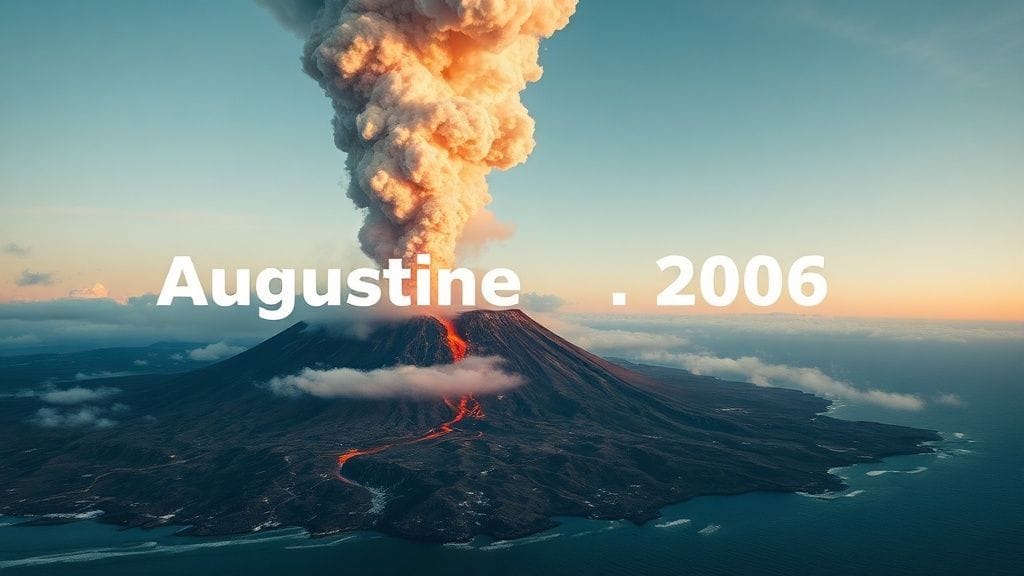
On January 27, 2006, the volcano’s pent-up pressure erupted violently. Towering columns of dark ash and steam shot tens of thousands of feet into the sky, darkening the horizon. The blasts shook the ground, rumbling like distant thunder.
The eruption was not a single outburst but a series of violent explosions, with intermittent quiet in between. Ash fallout blanketed nearby communities and even drifted far beyond Cook Inlet. The sun was momentarily obscured by a veil of volcanic smoke—a surreal scene that locals described as otherworldly.
Volcanic bombs—incandescent fragments ejected from the volcano—and pyroclastic flows spilled over the flanks, reshaping the landscape. Augustine’s indomitable power announced itself uncompromisingly.
Ash and Fire: The Spectacle of Explosive Eruptions Captivates Witnesses
Witnesses described the 2006 eruptions as both terrifying and awe-inspiring. The ash plumes resembled monstrous smoke columns, roaring like beasts as they tore through the morning sky. The eerie orange glow of incandescent lava dome fragments contrasted starkly with the cold Alaskan winter.
Photographers and pilots documented these phenomena, capturing haunting images now etched in volcanic history. The eruption’s intensity waxed and waned over weeks, punctuated by explosive pulses that sent ash many miles downwind.
Yet amid the destructive spectacle, the eruption revealed profound natural rhythms—a dialogue between Earth’s inner heat and surface fragility.
Communities on Edge: The Human Story Amid Volcanic Roars
For residents of nearby communities like Homer, Seldovia, and the Native village of Old Harbor, Augustine’s awakening was not just a geological event but a deeply personal upheaval.
Communities scrambled to prepare evacuation protocols, protect critical infrastructure, and safeguard themselves against ash inhalation and structural damage. Schools closed, fisheries halted, and emergency services mobilized. Anxiety was high, yet local resilience was palpable.
Oral histories later recounted the nights spent watching the glowing plume, holding onto traditions of respect for the volcano’s might, while confronting the reality of modern hazards.
Aviation in Peril: The Ash Clouds’ Threat to North Pacific Air Traffic
One of the most immediate and wide-reaching impacts of the 2006 eruption was the peril posed to aviation. Volcanic ash is notoriously destructive to aircraft engines, capable of causing engine failure and instrument malfunction.
Given Cook Inlet’s position beneath busy trans-Pacific flight routes, the expansion of ash clouds prompted widespread flight cancellations and rerouting. Airlines had to monitor ash dispersion meticulously, balancing safety and operational demands.
This disruption extended well beyond Alaska’s borders, reminding the world how localized natural events can ripple through global transport networks.
Scientific Vigilance: Monitoring Augustine’s Every Roar
The 2006 eruption also highlighted the vital role played by volcanologists and monitoring agencies. The Alaska Volcano Observatory ramped up seismic, deformation, gas, and visual monitoring, providing real-time updates to local authorities and international aviation agencies.
Deployments of ground sensors, satellite imaging, and pilot reports formed a comprehensive web of data, enabling warnings and forecasts that saved lives. The event advanced the science of volcanic prediction, refining models and emergency response strategies.
Behind the scenes, scientists worked tirelessly, sometimes under hazardous conditions, to decode the volcano’s signals.
The Role of the Alaska Volcano Observatory: Guardians of the Skies and Earth
Founded in 1988, the Alaska Volcano Observatory had already amassed considerable expertise by 2006. The Augustine eruption tested their preparedness and response capabilities as never before.
Their careful coordination with the Federal Aviation Administration, local governments, and Native communities exemplified the synthesis of science and public safety. The AVO’s efforts ensured early warnings, timely evacuations, and mitigation of airspace hazards—a life-saving service amidst the chaos.
Their work embodies a modern commitment to coexistence with Earth’s volatile temperament.
Fauna and Flora under Siege: Environmental Impacts on the Pristine Wilderness
The eruption’s environmental toll extended beyond human concerns. Ash blanketed forests, tundras, and waterways, affecting plant life by obscuring sunlight and altering soil chemistry. Wildlife, including migratory birds and marine mammals, faced habitat disruption.
Studies following the eruption documented how ecosystems coped with and eventually adapted to these volcanic disturbances. Some species displayed remarkable resilience, while others experienced stress and dislocation.
Augustine’s echo, thus, reached deep into Alaska’s rich natural tapestry.
Cultural Reverberations: Augustine in Aleut Oral Traditions and Modern Media
Volcanoes like Augustine have long held spiritual and cultural significance for the Aleut people. Stories of fire mountain spirits and ancestral wisdom about living alongside volcanoes permeate oral traditions. The 2006 eruption reignited these narratives, merging ancient respect with contemporary challenges.
Media coverage—from local newspapers to global news agencies—captured this duality, framing Augustine both as a natural threat and a powerful cultural symbol. Documentaries, photographs, and personal interviews have kept the memory alive, bridging nature, history, and humanity.
The Economic Toll: Disruptions in Fishing, Tourism, and Local Commerce
Alaska’s economy, deeply reliant on fishing and seasonal tourism, felt Augustine’s blast keenly. Ash contamination delayed fishing seasons, freight deliveries, and even recreational activities.
Tourism declined temporarily as visibility dropped and access roads were threatened. Local businesses faced uncertainty, loss of income, and extra costs for cleanup and protective measures.
Yet communities demonstrated remarkable adaptability, employing creative solutions and federal assistance programs to weather the economic storm.
Global Ripples: Comparing Augustine’s 2006 Eruption to Other Volcanic Events
While Augustine’s 2006 eruption was relatively moderate by volcanic standards, its impact resonates globally. Compared to catastrophic eruptions like Mount St. Helens (1980) or Eyjafjallajökull (2010), Augustine’s ash clouds were smaller but significant, particularly for aviation safety.
The event reaffirmed lessons learned about monitoring volcanoes on active flight paths. It also stimulated international cooperation in volcanic risk assessment and emergency response protocols.
Studying Augustine offers insights into managing moderate yet disruptive eruptions worldwide.
Recovery and Reflection: When the Volcano Quieted Down
By March 2006, Augustine’s explosive fury subsided. Ash clouds thinned, seismic activity calmed, and communities cautiously resumed normal life. Cleanup operations removed ash deposits, repaired infrastructure, and restored fisheries.
Scientists continued monitoring, documenting volcanic deposits and landscape changes. Recovery was gradual but resolute—a testament to human determination.
Reflection on this episode inspired discussions on disaster preparedness, resilience, and the enduring dialogue with natural forces.
Augustine’s Legacy: Lessons Learned and Preparedness for Future Eruptions
The 2006 eruption left a lasting legacy for Alaskans and volcanologists alike. It underscored the need for robust monitoring, community education, and infrastructure designed to withstand eruptions.
Technological advances since then allow even greater precision in forecasting and response. Local communities, through experience, have developed deepened awareness and protocols to live safely within a volcanic landscape.
Augustine continues to shape policies and perceptions, standing as both a challenge and a teacher.
Conclusion
The 2006 eruption of Augustine Volcano stands as a dramatic chapter in the story of human resilience confronting nature’s unpredictability. It was a moment when the Earth reminded its inhabitants of fragile existence beneath a restless crust—a stark but vital lesson.
Yet, beyond destruction, Augustine revealed the power of science, community, and culture to adapt, endure, and find meaning in such trials. It invites us to appreciate the delicate dance between human aspiration and natural forces, a ceaseless dialogue written in ash and fire.
Remembering Augustine is remembering not just a mountain’s anger, but the indomitable spirit of those who live in its shadow.
FAQs
1. What caused the 2006 eruption of Augustine Volcano?
The eruption was triggered by the movement of magma from deep within the Earth’s mantle into the volcano’s magma chamber, increasing pressure until a violent release occurred. This process is linked to subduction of the Pacific Plate beneath the North American Plate, fueling regional volcanism.
2. How long did the 2006 eruption last?
The most intense eruptive activity occurred from late January to early March 2006, with fluctuating explosive events and ash emissions, before the volcano’s activity significantly decreased.
3. Were there any casualties or injuries?
Thanks to timely warnings and evacuations, no fatalities or severe injuries were reported during the 2006 eruption. However, some residents experienced respiratory issues due to ash exposure.
4. How did the eruption affect air travel?
Ash clouds disrupted commercial and cargo flights over the North Pacific, causing delays, cancellations, and rerouting to avoid engine damage from airborne ash particles.
5. What role did the Alaska Volcano Observatory play?
The AVO monitored volcano activity continuously, issuing alerts and forecasts that informed emergency response, aviation authorities, and the public, helping to mitigate risks effectively.
6. How are local communities culturally connected to Augustine Volcano?
For indigenous Aleut people, Augustine holds spiritual significance, featuring in oral traditions that respect the volcano’s power and teach coexistence with this natural force.
7. What environmental impacts resulted from the eruption?
Ash fallout affected vegetation, wildlife habitats, and water quality, although ecological systems displayed significant resilience over time, with gradual recovery documented.
8. What lessons were learned for future volcanic hazards?
The eruption emphasized the importance of early detection, interdisciplinary collaboration, community readiness, and continuous improvement of volcanic monitoring technologies.

