Table of Contents
- The Twilight of an Emperor: The Last Days of Aurelian
- The Roman Empire at a Crossroads: Context and Crisis in the Third Century
- Aurelian’s Rise: From Soldier to Supreme Commander
- The Restorer of the Roman World: Triumphs and Transformations
- The Perilous Road to the East: Campaigns Against the Palmyrene Empire
- A Glimmer of Stability: Economic and Military Reforms
- The Road to Thrace: Setting the Stage for Tragedy
- A Fateful Conspiracy: Seeds of Betrayal in the Imperial Court
- The Assassination: Chaos and Shock in the Imperial Camp
- The Aftermath: Roman Empire’s Future in the Shadow of Aurelian
- Personalities Behind the Plot: Who Betrayed the Restorer?
- The Role of the Praetorian Guard: Protector or Peril?
- The Impact of Aurelian’s Death on Roman Military Doctrine
- Political Fragmentation: Successors and Instability
- Historians’ Perspectives: The Myth and Reality of Aurelian’s Assassination
- The Legacy of Aurelian: Restorer, Martyr, or Tragic Hero?
- Echoes Through Time: How Aurelian Influenced Later Roman Emperors
- Artistic and Cultural Memory: Aurelian in Renaissance and Modern Historiography
- Lessons from the Fall: Leadership, Loyalty, and the Fragility of Power
- Conclusion: The Assassination That Shaped an Empire’s Fate
- FAQs: Understanding Aurelian’s Life, Death, and Legacy
- External Resource: Further Reading on Aurelian (Wikipedia)
- Internal Link: Visit History Sphere
The Twilight of an Emperor: The Last Days of Aurelian
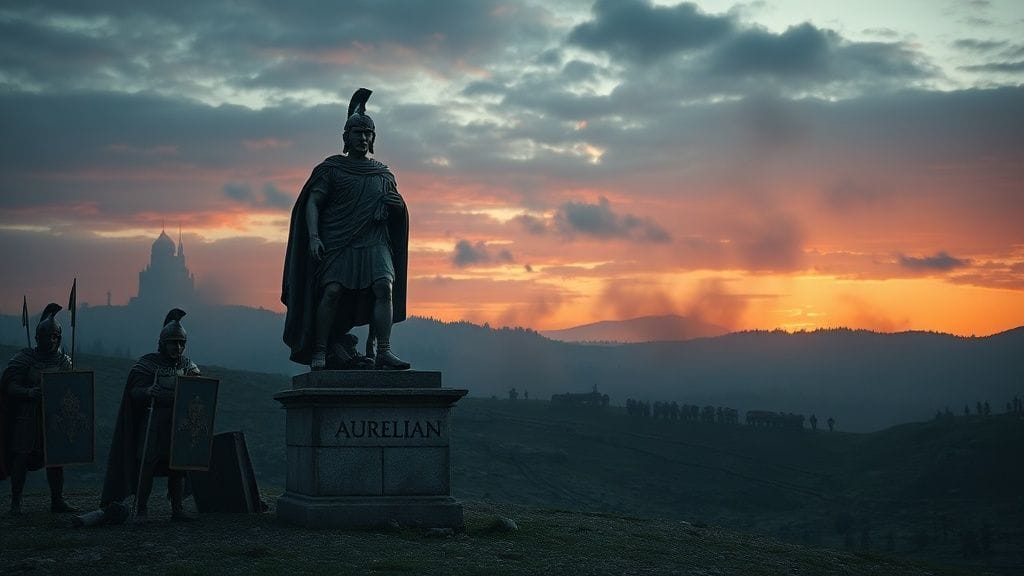
On a brooding autumn morning in 275 AD, the air around the imperial camp in Thrace was thick with tension and dread. Aurelian, the formidable Roman emperor often hailed as Restitutor Orbis—the Restorer of the World—was about to face the sudden unraveling of fate's delicate thread. The sun had risen on a man who had done the unprecedented: reunifying an empire torn apart by decades of chaos, civil war, and insurrection. But power, as history warns, is a double-edged sword. Within the enigmatic folds of the imperial court, shadows of jealousy and fear crept silently toward Aurelian, culminating in a deed as swift as it was catastrophic—a brutal assassination by those once sworn to serve him. The world he had fought tirelessly to restore was about to be thrown once again into uncertainty.
This moment, caustic and raw, marks not only the violent end of one of Rome’s most vigorous emperors but also a pivotal turning point for an empire at its most vulnerable. It is a story of loyalty shattered, of ambition unleashed, and of the perilous dance between power and survival. To understand the gravity of Aurelian’s death, we must delve deep into the gritty realities of the third-century Roman world—a world where the sword decided the fate of empires, and trust was often as fragile as the bodies of those who wielded power.
The Roman Empire at a Crossroads: Context and Crisis in the Third Century
The third century AD had been a time of unparalleled turmoil for Rome. Known by historians as the “Crisis of the Third Century,” the Roman Empire was fracturing under relentless pressure: barbarian incursions on its borders, economic collapse, plagues, and ceaseless internal struggles for power. The Pax Romana, the long-standing peace and prosperity initiated under Augustus centuries earlier, had long since dissipated. In its place arose a precarious, fragmented world where emperors were made and unmade overnight.
Amidst this chaos emerged a series of military leaders who attempted to rescue the empire from disintegration. Yet success was often fleeting. The secession of the Gallic Empire in the west and the Palmyrene Empire in the east reflected the fracturing spirit of the age. The once-unified empire resembled a cracked mosaic, with Rome’s own provinces asserting independence or falling under the sway of ambitious warlords and client kings.
It was into this environment, desperate and volatile, that Aurelian rose—a man of humble origins, a soldier whose pragmatic vision and iron will would briefly restore the empire’s unity and honor. But such heights inevitably attracted enemies both seen and unseen.
Aurelian’s Rise: From Soldier to Supreme Commander
Born around 214 AD in the province of Illyricum, Marcus Aurelius Valerius Aurelianus—and known simply as Aurelian—was a man forged in the crucible of Rome’s relentless military conflicts. His early career is largely veiled in obscurity, but it is clear he earned a reputation for exceptional bravery and tactical acuity during campaigns against Gothic tribes, Alemanni, and other external threats.
What set Aurelian apart was not only his battlefield prowess but a remarkable ability to inspire and unify his troops in an era when allegiance often hinged on personal loyalty rather than state ideology. Rising through the ranks to become commander of the cavalry, he was recognized by the Senate and the emperor Gallienus and soon became a favorite for high command.
Following Gallienus’s assassination in 268 AD, Aurelian was proclaimed emperor by his troops—a testament to their faith in his ability to steady the empire’s faltering ship. From this moment, his trajectory was inexorably toward sweeping reform and conquests that would reunite the fractured Roman world.
The Restorer of the Roman World: Triumphs and Transformations
Aurelian’s epithet “Restorer of the World” was no empty title. His reign, though brief—from 270 to 275 AD—was marked by a series of military and administrative successes that stemmed the empire’s hemorrhaging.
First, he decisively defeated the Gallic Empire in the west. The breakaway regime in Gaul had been a grave wound to Roman unity, but Aurelian’s swift campaigns reasserted defiant imperial authority from the Rhine down to the Pyrenees. The recapture of the strategically crucial city of Cologne signalled the collapse of Gallic separatism.
To the east, another separatist regime—centered on the shrewd and charismatic Queen Zenobia of Palmyra—held sway over Egypt, Syria, and large swaths of Asia Minor. In a campaign marked by bold strategy and unforgiving force, Aurelian crushed the Palmyrene forces and captured Zenobia herself. Her dramatic downfall symbolized the end of secessionist ambitions on Rome’s eastern front.
Beyond military achievements, Aurelian initiated crucial reforms. Recognizing the empire’s economic fragility, he sought to stabilize the currency, reform administrative corruptions, and bolster Rome’s defenses. One of his notable acts was the construction of the Aurelian Walls, fortifications that would shield Rome itself from future barbarian sieges.
Yet, these triumphs stirred admiration and envy alike. Aurelian, for all his tactical genius, was often seen as an aloof figure—sometimes feared by subordinates wary of his uncompromising discipline.
The Perilous Road to the East: Campaigns Against the Palmyrene Empire
The campaign against Palmyra was a defining chapter in Aurelian’s military career. Zenobia had styled herself as the “Queen of the East” and effectively challenged Roman supremacy, establishing a sophisticated and culturally vibrant kingdom stretching from the Levant to Egypt. Her control over key trade routes made her both a political and economic threat.
In 272 AD, Aurelian embarked on a brilliant military operation, advancing rapidly through Asia Minor, defeating Palmyrene armies in a series of decisive engagements that demonstrated his tactical adaptability and relentless pressure. His forces moved with speed, often engaging in battle under difficult terrain and climates, yet maintaining cohesion.
The capture of Palmyra in 273 was a symbolic and strategic victory. The city, rich and culturally diverse, was brought back under the Roman fold, and Zenobia was taken captive—later paraded in Aurelian’s Triumph in Rome, a spectacle of imperial authority.
This conquest was much more than a territorial reclamation—it represented the laying to rest of a dangerous paradigm of insurgent provincial power that threatened to unravel the Roman identity.
A Glimmer of Stability: Economic and Military Reforms
Despite his frontline focus, Aurelian understood the necessity of systemic reform. The empire’s economy had been ravaged by inflation, debased currency, and disorganized taxation. To arrest this decline, he issued a new coinage system, aimed at restoring confidence in the denarius, Rome’s silver currency.
He revamped the military system as well—improving troop discipline, reorganizing defense structures on the frontiers, and implementing training regimes designed to produce more agile and loyal forces. His personal history as a soldier lent him credibility with the legions.
One of his more symbolic acts was establishing the cult of Sol Invictus, the Unconquered Sun, which served as a unifying religious icon intended to transcend local cults and foster imperial cohesion.
Yet, these reforms required centralized power and strict enforcement—a fact that alienated some powerful factions within the empire.
The Road to Thrace: Setting the Stage for Tragedy
In late 275 AD, Aurelian found himself traveling through Thrace, a turbulent province rife with factions and parliamentary intrigue. Perhaps aware of enemies both within and without, his presence in the region was meant to consolidate imperial authority and oversee military operations against the increasingly aggressive Gothic tribes beyond the Danube.
However, the imperial court in Thrace was a hotbed of tension. The Praetorian Guard, Rome’s elite imperial protectors, were traditionally a double-edged sword—guardians of the emperor’s life, yet often pivotal in palace conspiracies.
Rumors of plots and disloyalty swirled. It is believed that false accusations were levied against Aurelian, sowing distrust between the emperor and his inner circle. The trigger for what would soon become a fatal conspiracy was set.
A Fateful Conspiracy: Seeds of Betrayal in the Imperial Court
Conspirators within the Praetorian Guard and possibly other officers orchestrated a dangerous plot. Perhaps fearing Aurelian’s ever-tightening grip—or convinced by malicious whispers that he intended to execute certain commanders—the circle around the emperor turned deadly.
The exact motivations remain shrouded in mystery, but envy, fear, and political self-preservation seem to have intertwined to birth the deadly plan. The men who had pledged allegiance to the Restorer of the World now drew daggers behind his back.
It is rumored that a forged letter, purportedly penned by the emperor ordering the execution of loyal officers, was circulated to justify their action—an act of cold deception that would seal Aurelian’s fate.
The Assassination: Chaos and Shock in the Imperial Camp
The assassination itself was swift and brutal. On a cold afternoon, as Aurelian walked unarmed within the confines of the imperial enclosure, he was ambushed by his own guards. Overpowered and stabbed multiple times, the emperor fell a victim to the very machinery of power he had maintained.
His death sent shockwaves through the imperial court and across the empire. The serene vision of restoration seemed shattered in an instant by the cold, cruel hand of betrayal.
Historians recount a poignant detail: a soldier loyal to Aurelian reportedly cried out in despair, mourning the tragic fall of the man who had so often led them to victory and stability.
The Aftermath: Roman Empire’s Future in the Shadow of Aurelian
The immediate aftermath was chaos. The Praetorian Guard’s leaders, believing the emperor dead, quickly attempted to install a new ruler, but the senate and provincial commanders swiftly intervened. Marcus Claudius Tacitus eventually became emperor, but the death of Aurelian marked a return to a time of fragility and uncertainty.
Without the guiding force of the Restorer, the empire again wavered on the edge of fracture and war. External threats loomed large: Gothic incursions grew more daring, internal dissent festered, and economic issues remained unresolved.
Aurelian’s death was not just the fall of a man but a critical inflection point signaling the fragility of imperial reunification—a precarious flame soon to flicker again in the gathering storm.
Personalities Behind the Plot: Who Betrayed the Restorer?
The conspirators included members of the Praetorian Guard and imperial staff—men accustomed to power but unprepared for Aurelian’s stern leadership. Though precise names remain difficult to establish with certainty, sources hint toward figures such as the Praetorian prefect Mamertinus and other officers disgruntled by the emperor’s reforms and militarization policies.
Their motivation, complex and intertwined with personal ambition and fear, reflected the volatile spirit of an age when the distance between loyalty and treason was perilously thin.
The Role of the Praetorian Guard: Protector or Peril?
One cannot fully grasp the assassination without addressing the paradoxical role of the Praetorian Guard. Established as personal protectors of the emperor, they often became kingmakers or executioners in their own right.
In Aurelian’s case, their betrayal underscored the dangers of concentrated power in the hands of elite military bodies with divided loyalties. The Guard’s discontent with Aurelian’s centralization and stern discipline paved the way for treachery.
This event would resonate throughout Roman history, serving as a grim reminder of the precarious relationship between rulers and their closest protectors.
The Impact of Aurelian’s Death on Roman Military Doctrine
Aurelian was a reformer who believed deeply in a strong, centralized and professional military command—a legacy cut short by his murder. After his death, the military found itself vulnerable to divided command, inconsistent strategy, and political meddling.
His assassination exposed the risks inherent in leadership heavily reliant on military loyalty without robust institutional safeguards. Later emperors would struggle to balance the demands of military power and political stability—a tension that ultimately contributed to Rome’s gradual transformation and eventual decline.
Political Fragmentation: Successors and Instability
The vacuum left by Aurelian quickly led to renewed political instability. His successors lacked his military genius and resolute will. The empire, though briefly reunited, soon found itself wrestling again with border pressures and internal revolts.
The fragile unity Aurelian had achieved appeared tenuous, highlighting how dependent the Roman world remained on individual leadership in an era not yet embraced by institutional continuity.
Historians’ Perspectives: The Myth and Reality of Aurelian’s Assassination
Ancient historians such as Zosimus and Zonaras provide divergent accounts of the assassination—some emphasizing betrayal within the army, others hinting at broader political conspiracies. Modern scholarship tends to view the murder as a tragic intersection of personal ambition and systemic fragility.
Some have framed Aurelian’s death as a symbolic end to the “Restoration” era, a moment when the fragile balance between military power and imperial legitimacy irrevocably shifted.
The Legacy of Aurelian: Restorer, Martyr, or Tragic Hero?
In the centuries since, Aurelian’s name has inspired admiration and debate. He is remembered as a heroic restorer and visionary reformer who briefly arrested Rome’s decline. Yet his violent end paints a picture of impermanence and vulnerability—a poignant reminder that even the strongest leaders must navigate treacherous currents of power.
He remains a tragic figure—a man who saved the empire only to be undone by its very guardians.
Echoes Through Time: How Aurelian Influenced Later Roman Emperors
Aurelian’s military methods, administrative reforms, and the institution of the Sol Invictus cult influenced subsequent emperors, including Diocletian and Constantine, whose reigns shaped the late Roman Empire.
His brief resurgence of centralized power revealed both the possibilities and limits of imperial authority—a lesson etched into the DNA of Rome’s later history.
Artistic and Cultural Memory: Aurelian in Renaissance and Modern Historiography
Though overshadowed in popular imagination by emperors like Augustus or Constantine, Aurelian has experienced resurgences in historical interest, especially during the Renaissance revival of classical studies.
Modern portrayals often emphasize his role as a soldier-emperor caught in the unyielding machinery of imperial politics. His life has inspired novels, films, and scholarly debates on leadership and empire.
Lessons from the Fall: Leadership, Loyalty, and the Fragility of Power
Aurelian’s assassination teaches timeless lessons about the delicate nature of leadership, especially in volatile political environments. It highlights the peril when loyalty fractures and when power is concentrated without accountability.
More than a historical footnote, his death is a mirror reflecting the eternal challenges of power: suspicion, ambition, and the vulnerability inherent in human institutions.
Conclusion
Aurelian’s assassination in Thrace was not merely the violent death of a single man; it was an epochal moment that encapsulated the vulnerabilities and contradictions of an empire struggling to survive. His life’s work—the reunification of the Roman world—was heroic, yet fragile, a fleeting light before a long night.
Through vivid triumphs and tragic betrayal, Aurelian emerges as a symbol of both hope and caution. He reminds us that the fate of nations often hinges on the precarious balance between strength and vulnerability, vision and suspicion, loyalty and treachery. His story beckons us to remember the human heart beneath imperial grandeur—the dreams, fears, and frailties that shape history’s course.
FAQs
1. Who was Aurelian, and why is he called the “Restorer of the World”?
Aurelian was a Roman emperor from 270 to 275 AD who successfully reunified the eastern and western parts of the fragmented Roman Empire, defeating separatist regimes such as the Gallic and Palmyrene Empires. His reforms and military victories earned him the title “Restorer of the World” (Restitutor Orbis).
2. What circumstances led to Aurelian’s assassination?
Aurelian was traveling through Thrace when members of his own Praetorian Guard, possibly motivated by jealousy, fear of his strict reforms, and political intrigue, conspired against him. A forged letter suggesting the emperor intended to execute officers helped spark the fatal betrayal.
3. How did Aurelian’s death affect the Roman Empire?
His assassination precipitated a renewed period of instability and fragmentation. Without his strong leadership and reforms, the empire struggled against internal dissent and external threats, illustrating the fragility of imperial unity.
4. Who were the main conspirators in the assassination?
Though exact names are uncertain, key figures included officers within the Praetorian Guard and imperial staff discontented with Aurelian’s policies. The Praetorian prefect Mamertinus is often mentioned among the conspirators.
5. What military reforms did Aurelian implement?
Aurelian reorganized the Roman army to improve discipline and efficiency, established new defensive structures such as the Aurelian Walls around Rome, and promoted loyalty through rigorous training and leadership.
6. Did Aurelian’s assassination influence future emperors?
Yes, his death highlighted the dangers of military revolts and internal court conspiracies. Later emperors like Diocletian and Constantine drew lessons from his reign, balancing centralized power with institutional reforms.
7. How has Aurelian been remembered historically?
Aurelian is remembered as a dynamic, formidable emperor who briefly reversed Rome’s decline. However, his tragic assassination marks him as a symbol of the precariousness of power during Rome’s Crisis of the Third Century.
8. Where can I learn more about Aurelian?
A comprehensive overview of Aurelian’s life and reign can be found on his Wikipedia page.