Table of Contents
- A Silent Storm: The Quiet Annexation that Shook Europe
- Vienna’s Bold Move: Austria-Hungary’s Ambitions Revealed
- The Shadow over the Balkans: Bosnia and Herzegovina in Context
- The Ottoman Aftermath: A Declining Empire’s Silent Surrender
- Serbian Aspirations: A Nation Held Back but Burning
- The Great Powers on Edge: Europe’s Delicate Balance
- The July Crisis Foreshadowed: Seeds of Conflict Sown
- Inside the Habsburg Court: Political Intrigues and Decisions
- The Balkan Nationalisms: A Powder Keg Ready to Explode
- Public Outrage and Support: Voices from Vienna to Sarajevo
- Diplomatic Maneuvers: Alliances Tested and Strained
- The Role of Russia: Protector of Slavs or Cautious Observer?
- Germany’s Calculated Backing: A Pillar of Austro-Hungarian Resolve
- The Ottoman Empire’s Diminishing Influence
- World Reactions: From London to Paris, Alarm and Acceptance
- Bosnia and Herzegovina under New Rule: Immediate Changes and Challenges
- The Annexation’s Impact on the Local Population
- The Rise of Resistance Movements: From Grievance to Action
- Economic Ambitions and Infrastructure Developments Post-Annexation
- The Long Shadow: How 1908 Paved the Road to Sarajevo 1914
- Reflections from Historians: Understanding the Annexation’s Place in History
- Lessons Learned: Nationalism, Empire, and the Fragility of Peace
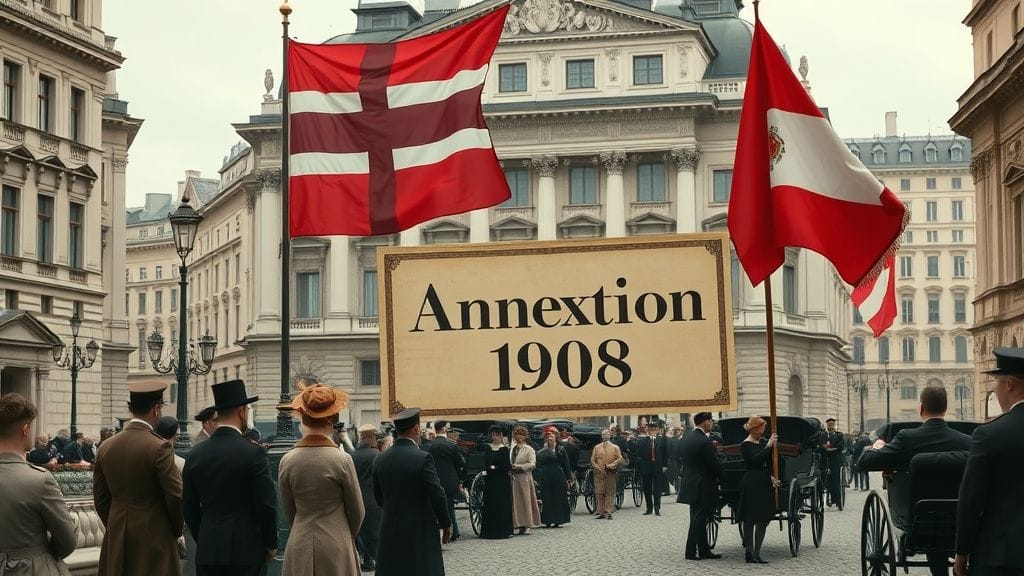
On the crisp autumn morning of October 6th, 1908, a dramatic proclamation echoed through the opulent halls of the Hofburg Palace in Vienna. The Austro-Hungarian Empire had officially annexed the territories of Bosnia and Herzegovina — a move cloaked in ambition, audacity, and fraught with peril. For many outside the empire, the news was a jolt: a quiet land on the fringes of Europe was suddenly the epicenter of a storm that would convulse the continent in the years to come.
The annexation was more than a political act; it was the unmistakable reverberation of an empire trying to assert itself amid the fractures of a changing world. Within the sprawling bounds of Austria-Hungary, the signing echoed as triumph, yet beyond, it sparked outrage, fear, and a cascade of destabilizing effects. It was a moment pregnant with promise — and profound peril.
To step into this pivotal episode is to traverse a landscape thick with history, ambition, nationalism, and the fragile strands that held Europe together on the eve of catastrophe. It demands a journey through the tangled politics of Vienna’s corridors, the oppressed heartlands of the Balkans, and the towering ambitions of empires teetering on the brink of modernity and collapse.
Vienna’s Bold Move: Austria-Hungary’s Ambitions Revealed
The annexation of Bosnia and Herzegovina was not a spontaneous act. For decades, the Austro-Hungarian Empire had cast covetous eyes on these rugged lands. Strategically perched in the Balkans, Bosnia and Herzegovina had long served as a crossroad for cultures, empires, and conflict. Following the Congress of Berlin in 1878, Austria-Hungary had exercised administrative control over the provinces but without formal sovereignty.
The decision to formally annex these territories was propelled by multiple layers of incentive. First, Vienna sought to consolidate its authority over the Balkans against rising Slavic nationalism, particularly Serb expansionism that threatened the delicate ethnic patchwork within the empire’s borders. Moreover, the annexation was a strategic assertion against the waning Ottoman Empire—a declaration that the era of imperial decline had its share of new players ready to carve up the spoils.
Yet this move was also driven by internal politics. Emperor Franz Joseph I, aging and resolute, wished to demonstrate that the empire retained its power amidst creeping doubts. The ministers in Vienna debated fervently — fears that annexation could ignite regional war wrestled with the desire for imperial prestige. Despite international warnings, the decision was made: Austria-Hungary would claim Bosnia and Herzegovina outright.
The Shadow over the Balkans: Bosnia and Herzegovina in Context
At the turn of the 20th century, Bosnia and Herzegovina occupied a unique and volatile position. Though still nominally part of the decaying Ottoman Empire, they had been governed by Austro-Hungarian forces for thirty years. The region was a mosaic of ethnicities: Bosniaks, Serbs, Croats, and others, each with complex loyalties and growing nationalist movements fueled by ideas of self-determination and ethnic identity.
The local population’s relationship with Austria-Hungary was ambivalent at best. While some sought modernization under Habsburg governance, others saw the empire as an oppressive force. Here, religious tensions—Orthodox Christian Serbs, Catholic Croats, and Muslim Bosniaks—further complicated the social fabric, weaving a fragile tapestry of coexistence and conflict.
The annexation crystallized long-standing anxieties. It was seen as a betrayal by many Slavs, particularly Serbia, who viewed Bosnia and Herzegovina as part of the greater Serbian national aspiration. The region was more than just land; it was a symbol, a prize, and a flashpoint—a tinderbox waiting for a match.
The Ottoman Aftermath: A Declining Empire’s Silent Surrender
The Ottoman Empire, once the dominating power in the Balkans, was now a shadow of its former self. With military defeats and internal decay, it had little means to resist Austria-Hungary’s ambitions. The 1878 Congress of Berlin had already stripped it of administrative control over Bosnia and Herzegovina, leaving the empire a faint nominal suzerainty.
By 1908, the Ottomans, weakened and distracted by internal turmoil and nationalist uprisings, found themselves powerless but unwilling to officially accept the loss without protest. Yet the imperial retreating footprint was clear, marking the continued dissolution of centuries-old rule.
The annexation further cemented this global decline, symbolizing the shift of power in Southeastern Europe from the Turks to the Central European empires, intensifying the volatile vacuum that new nationalisms sought to fill.
Serbian Aspirations: A Nation Held Back but Burning
Serbia, small yet spirited, was the primary beneficiary and the greatest loser of this annexation. For Belgrade, Bosnia and Herzegovina were a natural extension of the Serbian nation, brimming with ethnic kin and cultural ties.
The annexation was perceived as a direct provocation—a bold assertion of Austro-Hungarian might over what Serbians considered their rightful territory. Public reactions in Serbia were electrifying, marked by outrage, nationalist fervor, and growing resolve to challenge imperial dominance.
This moment fueled the flames of Serb nationalist organizations, including the infamous Black Hand, whose secretive ambitions and violent tactics would eventually culminate in the assassination of Archduke Franz Ferdinand in 1914. The annexation’s reverberations thus went beyond diplomacy—it was a catalyst for revolution and tragedy.
The Great Powers on Edge: Europe’s Delicate Balance
Austria-Hungary’s unilateral action sent shockwaves across Europe, unsettling the fragile web of alliances that defined early 20th-century geopolitics. Britain, France, Russia, and Germany—all major players—watched with concern and calculation.
Russia, the self-styled protector of Slavic peoples, was humiliated and constrained by its recent defeats in the Russo-Japanese War and internal unrest. It protested vocally but lacked the strength to confront Vienna militarily. Britain and France prioritized broader stability, wary of any conflict that might disrupt peace.
Germany stood firmly behind Austria-Hungary, its pivotal ally, seeing the annexation as a means of cementing Central European dominance. Germany’s “blank check” of support emboldened Vienna, reducing the possibility of diplomatic rollback.
The July Crisis Foreshadowed: Seeds of Conflict Sown
Though the annexation occurred in October 1908, its consequences rippled through the years, directly setting the stage for the catastrophic July Crisis of 1914. The unresolved tensions over Bosnia and Herzegovina became the flashpoint in which simmering rivalries exploded into the First World War.
The clause “powder keg of Europe”—so often repeated—gains its full meaning in this context. Austria-Hungary’s bold move fractured Europe’s already fragile peace, creating a collision course with Serbia, Russia, and ultimately the Great War.
Inside the Habsburg Court: Political Intrigues and Decisions
Behind the public proclamation lay intense political intrigue. Emperor Franz Joseph’s decision to announce the annexation without prior international agreement reflected both boldness and miscalculation.
The imperial bureaucracy, military leaders, and diplomatic corps debated fiercely. The annexation was drafted and timed during the turmoil of Ottoman constitutional unrest, exploiting a moment of weakness.
Yet, despite internal dissent, the move signaled a crucial moment of assertion for a multinational empire grappling with ethnic diversity and external challenges. It was a gamble that reflected desperation as much as pride.
The Balkan Nationalisms: A Powder Keg Ready to Explode
The annexation awoke long-dormant nationalist desires throughout the Balkans. Whether Serbs, Croats, Bulgarians, or Albanians, each group saw the event as a challenge or an opportunity.
Nationalist movements, often clandestine and radical, used the annexation to rally supporters, fuel resentment, and plan resistance. This period became fertile ground for ideological ferment that mixed patriotism with violence and revolution.
Public Outrage and Support: Voices from Vienna to Sarajevo
Reactions were as diverse as the populations involved. In Vienna, many celebrated the annexation as a triumph strengthening the empire’s borders. Newspapers lauded the move as proof of imperial resilience.
Conversely, in Sarajevo’s streets and the countryside of Bosnia-Herzegovina, the mood was heavy with foreboding. Protests and riots erupted, and fears of forced assimilation or cultural erasure grew.
These polarized sentiments foreshadowed the unpredictable and tragic consequences that the annexation unleashed on everyday lives.
Diplomatic Maneuvers: Alliances Tested and Strained
The diplomatic fallout was nearly immediate. Austria-Hungary’s move violated the delicate understandings laid out at previous congresses and drew protests from neighbors.
Though no immediate military resolution occurred, alliances trembled. Russia’s inability to support Serbia decisively emboldened Vienna, while other powers carefully recalibrated their positions.
The annexation exposed the fragility of European diplomacy and the complexity of maintaining peace amid competing nationalisms.
The Role of Russia: Protector of Slavs or Cautious Observer?
Russia’s dilemma was acute. Bound by pan-Slavic sentiments to support Serbia, the Tsarist government was hampered by military weakness and domestic upheaval.
The annexation placed Russia in a diplomatic bind—forced to protest but unable to act directly. This inaction sowed seeds of frustration within Serbia and influenced future Russian policy.
Russia’s cautious approach illustrated the limits of power and foreshadowed the later, more decisive involvement in Balkan affairs.
Germany’s Calculated Backing: A Pillar of Austro-Hungarian Resolve
Germany’s unwavering backing was the linchpin of the annexation’s survival. Chancellor Bethmann-Hollweg and Kaiser Wilhelm II endorsed Vienna, sending a clear message that Austria-Hungary could count on Berlin’s support.
This alliance reinforced Austria-Hungary’s confidence but polarized international relations, pushing Europe into the alliance system that polarized the continent and created conditions for global war.
The Ottoman Empire’s Diminishing Influence
The annexation was one more nail in the coffin of Ottoman influence in Europe. Reduced to a bystander, the empire’s diplomatic protests carried little weight.
This loss symbolized the end of Ottoman ambitions in the Balkans, accelerating political shifts and regional realignments that reshaped Southeastern Europe.
World Reactions: From London to Paris, Alarm and Acceptance
Western powers voiced “regret” and “concern,” but prioritized maintaining the broader status quo. The prospect of a direct military confrontation was widely avoided, though the annexation disrupted the diplomatic calm.
Press in London and Paris debated the implications for balance of power, dynasty, and the international order, marking the event as a central moment in the decline of peace.
Bosnia and Herzegovina under New Rule: Immediate Changes and Challenges
The annexation brought administrative reforms. Austria-Hungary invested in infrastructure and governance, integrating the provinces economically and politically.
Yet these changes faced obstacles from local resistance, ethnic divisions, and the challenge of imposing imperial authority over a region long accustomed to shifting rulers.
The Annexation’s Impact on the Local Population
For ordinary people, the annexation was a moment of upheaval. Families navigated identity, loyalty, and survival amid growing nationalist pressures and imperial expectations.
Stories abound of both collaboration and resistance, illustrating the human dimension behind grand political moves.
The Rise of Resistance Movements: From Grievance to Action
The annexation galvanized revolutionary groups. Secret societies, intellectuals, and youth movements channeled anger into organization.
This period saw the sharpening of nationalist militancy in the Balkans, setting the stage for future violent confrontations.
Economic Ambitions and Infrastructure Developments Post-Annexation
Austria-Hungary sought to modernize Bosnia and Herzegovina. Railroads, roads, and communication networks expanded, seeking to bind the provinces closer to the imperial center.
Economic integration was both a tool of control and a vision of progress, though benefits were uneven and unevenly felt.
The Long Shadow: How 1908 Paved the Road to Sarajevo 1914
The annexation is inseparable from the tragic events of 1914 in Sarajevo, where the assassination of Archduke Franz Ferdinand ignited the First World War.
It exemplifies how imperial ambitions and nationalist resentments can collide with catastrophic consequences, underscoring the fragility of peace in a world of competing identities and empires.
Reflections from Historians: Understanding the Annexation’s Place in History
Scholars continue to debate the annexation’s motivations, risks, and effects. Was it a blunder or necessity? A power grab or desperation?
Understanding this event deepens our comprehension of early 20th-century geopolitics, nationalism, and the road toward global conflict.
Lessons Learned: Nationalism, Empire, and the Fragility of Peace
The annexation reveals enduring truths about the dangers of overlapping identities within imperials borders, the volatility of nationalist aspirations, and the delicate balance of international diplomacy.
It serves as a poignant reminder of how seemingly calculated political maneuvers can spiral beyond control, reshaping history in unforeseeable ways.
Conclusion
The annexation of Bosnia and Herzegovina by Austria-Hungary in 1908 was far more than a bureaucratic decision or a territorial adjustment. It was the flashpoint where imperial ambition clashed with nationalist dreams, where old empires creaked under the pressure of modern identities, and where the fragile peace of Europe was rent. What seemed a calculated assertion by Vienna echoed across capitals and Balkans alike, inflaming passions and reshaping alliances.
Looking back, we see a moment charged with human hopes, fears, and contradictions—a moment that illuminates the complexities of empire and nationhood. The story of the annexation is a vivid chapter in the prelude to one of history’s darkest conflicts, reminding us that history is not merely dates and declarations, but the sum of human lives caught in the relentless tide of change.
FAQs
Q1: Why did Austria-Hungary annex Bosnia and Herzegovina in 1908?
Austria-Hungary aimed to solidify control over a strategically vital region, curb rising Serbian nationalism, and assert imperial strength amid Ottoman decline. The annexation was a strategic move to secure influence in the Balkans.
Q2: How did Serbia react to the annexation?
Serbia reacted with outrage and increased nationalist fervor, viewing the annexation as a direct challenge to Serbian national aspirations and territorial claims. This contributed to rising tensions that culminated in the events of 1914.
Q3: What was the international reaction to the annexation?
Reactions ranged from alarm to reluctant acceptance. Russia protested but was weakened. Germany backed Austria-Hungary firmly. Britain and France voiced concerns but prioritized maintaining peace.
Q4: What role did the annexation play in leading to World War I?
The annexation exacerbated Balkan tensions, intensified rivalry between Austria-Hungary and Serbia, and created alliances and resentments that played a crucial role in the July Crisis and the outbreak of World War I.
Q5: How did the annexation affect the people of Bosnia and Herzegovina?
The local population experienced political upheaval, increased ethnic tension, and resistance, but also infrastructural development. Identity struggles and loyalties were deeply tested.
Q6: Was the Ottoman Empire able to respond effectively to the annexation?
No, the Ottoman Empire was in decline and unable to militarily or diplomatically resist Austria-Hungary’s actions, marking a further erosion of its Balkan influence.
Q7: What was Germany’s position on the annexation?
Germany supported Austria-Hungary unequivocally, providing political and diplomatic backing, which emboldened Vienna and influenced the dynamics of alliance politics in Europe.
Q8: Could the annexation have been handled differently to avoid conflict?
Some historians argue that greater international negotiation and compromise might have mitigated tensions, but entrenched nationalism and imperial ambitions made conflict difficult to avoid.