Table of Contents
- The Winter Winds of Change: Vienna on the Brink
- Metternich’s Empire: Architect of Stability or Symbol of Repression?
- The Tremors of Revolution: Europe in 1848
- Vienna, March 1848: The Spark Ignites
- The Gathering Storm: Citizens and Soldiers Face Off
- The Moment of Truth: Metternich's Resignation Announcement
- A Fading Titan: The Fall of a Statesman
- The Immediate Aftermath: Turmoil and Transition in Vienna
- The Spread of Revolutions: Austria’s Empire in Flames
- Metternich’s Legacy: Reaction, Repression, or Reform?
- The Personal Side: Metternich in Exile and Reflection
- Austria Transforming: The Road to Constitutionalism
- The Habsburg Monarchy’s Battle to Survive
- Cultural Reverberations: Vienna’s Intellectual and Artistic Awakening
- Lessons from 1848: Revolution in the Age of Nationalism
- Echoes in Modern Europe: The Enduring Impact of Metternich’s Fall
- Conclusion: The End of an Era, The Dawn of Change
- FAQs about Metternich’s Resignation and the 1848 Revolutions
- External Resource
- Internal Link
The chill of March in Vienna was biting that afternoon of 1848, but the cold gripping the imperial capital was less about the weather and more about the fierce storm brewing in the hearts of its citizens. In the grand halls where decisions about the fate of an empire were once unchallengeable, an unprecedented tide of unrest now surged, fracturing decades of brittle order. At the eye of this storm stood Prince Klemens Wenzel von Metternich, the masterful Austrian chancellor whose resignation on March 13 symbolized the shattering of an old world — an empire on the verge of transformation and chaos.
The fall of Metternich was not merely the stepping down of one man but the collapse of a political system that had, for decades, tried to suppress the radical forces of change swelling beneath Europe’s surface. This article embarks on an immersive journey through one of the pivotal moments in 19th-century European history: the resignation of Metternich, set against the backdrop of the 1848 Revolutionary wave that shook Vienna and the continental order alike.
The Winter Winds of Change: Vienna on the Brink
Vienna in early 1848 was a microcosm of Europe’s restless discontent. The city, gleaming with imperial grandeur and strict social hierarchies, masked deep societal cracks. Factory workers toiling under grim conditions, students inspired by liberal and nationalist ideals, and a press increasingly clamoring for freedom fed a swelling hunger for reform. The Habsburg Empire’s multinational structure, stitched together forcibly through dynastic marriages and political arrangements, was straining under ethnic tensions and conflicting national aspirations.
Prince Metternich, long the symbol of conservative diplomacy and reactionary policies, had spent more than three decades stabilizing Europe after the Napoleonic Wars through the Congress of Vienna system. His doctrine was clear: suppress revolutionary fervor, maintain monarchical legitimacy, and uphold the old order. Yet Vienna had become a powder keg, and by the end of winter, the flames of popular discontent were impossible to contain.
Metternich’s Empire: Architect of Stability or Symbol of Repression?
To understand why Metternich’s resignation mattered so deeply, one must appreciate his role in shaping post-Napoleonic Europe. Often dubbed the “Age of Metternich,” the period was defined by diplomacy aimed at balance—not freedom. He masterminded a network of alliances designed to prevent revolutions and maintain the status quo but also became the embodiment of aristocratic control and resistance against the tide of liberalism.
Metternich was no mere reactionary; he was a complex figure, balancing pragmatism with paternalism. While his suppression of nationalist movements and censorship were infamous, some historians note his occasional cautious openness to gradual reform. Yet by 1848, his cautious hand had tightened into a fist, and his unwillingness to adapt sowed the seeds of his downfall.
The Tremors of Revolution: Europe in 1848
The Austrian Empire did not fall in isolation. By early 1848, Europe was aflame with revolutionary aspirations. From Paris to Berlin, Budapest to Milan, demands for constitutionality, national self-determination, and social justice challenged monarchies and empires. The underlying causes were complex but centered on rapid urbanization, economic hardship, class tensions, and the rise of a politically conscious middle class.
Vienna’s unrest was part of this continental symphony of uprisings, but its particular ethnic mosaic—Germans, Hungarians, Italians, Slavs—meant that revolutions here threatened to unravel an empire whose unity was fragile, and whose cohesion depended on Metternich’s diplomatic finesse.
Vienna, March 1848: The Spark Ignites
On March 13, 1848, the city was tense, alive with rumors and charged conversations. Students and workers had taken to the streets, demanding press freedom, political representation, and the dismissal of Metternich. What had started as petitions and protests quickly morphed into street clashes with imperial troops — a classic scenario of escalating confrontation.
The authorities’ responses, marked by both hesitation and repression, only inflamed passions further. Crowds swelled around the Hofburg Palace, symbol of imperial power and Metternich’s bastion, as the tumult reached a fever pitch. The old diplomatic giant faced not just political adversaries but the collective will of a restless people.
The Gathering Storm: Citizens and Soldiers Face Off
Eyewitness accounts describe the city as a chaotic maze of barricades, chants, and shouts echoing through narrow alleys. The military under Marshal Radetzky was called in, but many soldiers sympathized with protesters, reflecting deep fractures within the empire’s power structures. The uncertainty within the ranks showed the erosion of the Habsburg’s absolute authority.
The storming of government buildings and the sacking of newspaper offices revealed a pent-up fury aimed precisely at the institutions Metternich had long defended. The chancellor’s position, once unassailable, was now a lightning rod for change.
The Moment of Truth: Metternich's Resignation Announcement
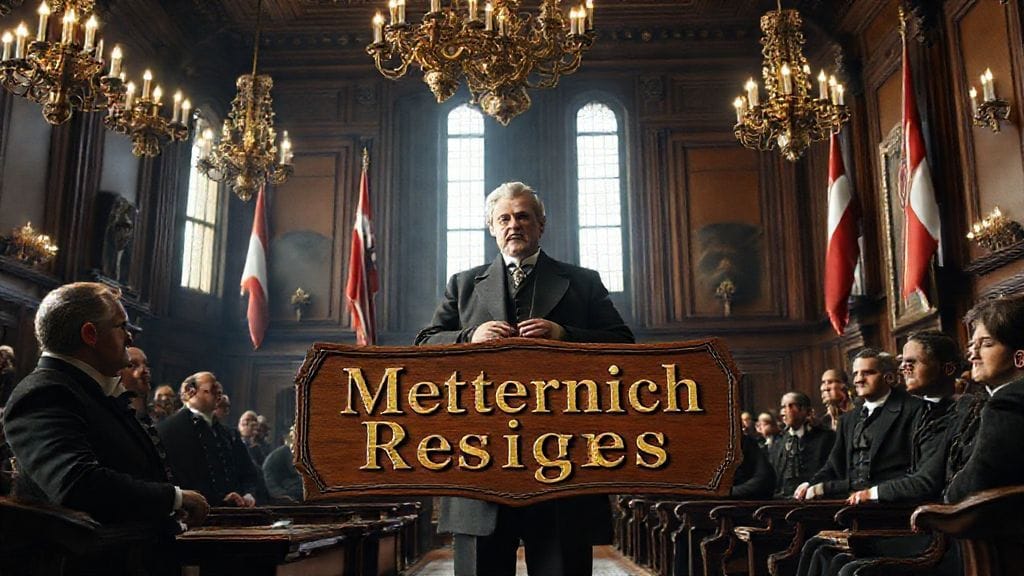
On the evening of March 13, under immense pressure and with Vienna teetering on the edge of revolt, Metternich submitted his resignation. His decision was a dramatic farewell to a career that had defined European diplomacy for decades. Reports from the time paint a scene mixing relief, incredulity, and sorrow among the populace and aristocracy alike.
Metternich boarded a carriage that would take him away from the capital—a symbol of old order retreating as a new era dawned. His words were sparse but meaningful; he acknowledged the impossibility of maintaining the old guard in the face of relentless popular demand.
A Fading Titan: The Fall of a Statesman
His resignation marked not just the exit of a man, but the collapse of his vision: a Europe held together by elite consensus and diplomatic checks. For the first time since 1815, the Habsburg Empire seemed vulnerable, exposed to the forces of nationalism and liberalism it had long suppressed.
Metternich’s retreat signaled a crucial turning point. The Viennese revolutionaries felt empowered, while European capitals braced for the contagion of rebellion to spread.
The Immediate Aftermath: Turmoil and Transition in Vienna
Following Metternich’s fall, Vienna plunged into a chaotic mix of hope and anxiety. The imperial government scrambled to contain the unrest, soon making concessions including the promise of a constitution and the abolition of censorship. Yet beneath the surface, ethnic tensions flared and radical factions vied for influence.
The social fabric of Vienna, always delicate, strained under quick twists of political fortune. The city would become both a laboratory and a battleground for revolutionary ideals and reactionary backlash.
The Spread of Revolutions: Austria’s Empire in Flames
What happened in Vienna rippled quickly across the Empire. In Hungary, the push for independence intensified; in Prague and Milan, nationalist uprisings erupted. Metternich’s resignation was a clarion call to those long denied political voice.
The Emperor Ferdinand I, often overshadowed by his chancellor, faced his own crisis as he tried to hold together a fracturing realm. The year 1848 would become a calendar of conflict, negotiation, and, ultimately, suppression.
Metternich’s Legacy: Reaction, Repression, or Reform?
Historians remain divided over Metternich’s legacy. To some, he was the last guardian of a Europe torn between revolution and order. To others, his policies delayed inevitable reforms, at a huge human cost.
His diplomatic mastery preserved peace for decades but at the price of freedoms that new generations were determined to claim. His resignation symbolizes the twilight of European aristocratic dominance.
The Personal Side: Metternich in Exile and Reflection
After fleeing Vienna, Metternich lived in exile, most notably in England and later the Rhineland. This period was one of reflection and quiet observation as the old world he had shaped crumbled. Letters and memoirs reveal a man both proud of his achievements and aware of his limitations.
Yet even in retirement, Metternich remained a symbol of resistance to change and the complexities of political power.
Austria Transforming: The Road to Constitutionalism
The revolution catalyzed Austria’s slow and painful transition from absolutism toward constitutional monarchy. Though 1848 ended with many revolutionary setbacks, seeds of parliamentary governance were planted.
The Empire’s political landscape began to shift, forcing rulers to adapt or risk continued instability amid growing nationalist demands.
The Habsburg Monarchy’s Battle to Survive
The decades following 1848 were marked by efforts to reconcile competing demands—ethnic, social, political—within the Habsburg domains. The monarchy oscillated between repression and reform, seeking to maintain cohesion.
Metternich’s departure had exposed vulnerabilities, yet the House of Habsburg would endure, navigating crises until the 20th century’s upheavals.
Cultural Reverberations: Vienna’s Intellectual and Artistic Awakening
The revolutionary period inspired an outpouring of cultural activity. Vienna became a crucible where political thought, literature, and music reflected the tensions of an empire in flux. Figures like Johann Strauss began to compose the soundtrack of a city redefining itself.
The arts carried the emotional hue of 1848—hope, loss, and relentless desire for change.
Lessons from 1848: Revolution in the Age of Nationalism
The events surrounding Metternich’s resignation exemplify the clash between old hierarchical empires and emerging forces of nationalism and liberal democracy. These struggles would shape Europe’s political trajectory deep into the 20th century.
Understanding 1848 gives insight into the cyclical nature of revolution and reform across history.
Echoes in Modern Europe: The Enduring Impact of Metternich’s Fall
Today, the reverberations of 1848 remain palpable. The challenges of multiethnic states, the tensions between liberalism and conservatism, and the demands for democratic representation all find early expression in that tumultuous time.
Metternich’s fall marks a moment when the certainties of the past were irrevocably challenged, ushering in a modern age.
Conclusion
Prince Metternich’s resignation on a cold day in March 1848 was far more than a political maneuver. It was the sound of a world shifting beneath the feet of an empire long accustomed to control through diplomacy and power. The chancellor’s fall was a deeply human moment of reckoning—the embodiment of old Europe’s struggle to confront new realities.
From the stormy streets of Vienna to the far corners of the Austrian Empire, the tremors of that day revealed the inexorable force of popular will, nationalism, and the hunger for representation. Yet, it also reminded us of history’s complexity: how the efforts to preserve stability can sow the seeds of upheaval, and how leaders, however formidable, remain subject to the currents of change.
The legacy of Metternich’s resignation teaches us about resilience and adaptation, warning that resting on old certainties in a changing world can only delay—but never prevent—transformation.
FAQs about Metternich’s Resignation and the 1848 Revolutions
Q1: Why did Metternich resign in March 1848?
A1: Metternich resigned due to growing revolutionary pressure in Vienna, widespread public unrest, and loss of support among elites and the military. The city was on the brink of chaos, and he saw resignation as the only way to prevent further bloodshed.
Q2: What was Metternich’s role in European politics before 1848?
A2: He was the Austrian Empire’s chief diplomat and architect of the post-Napoleonic order, focusing on maintaining the balance of power and suppressing revolutionary movements to ensure conservative stability.
Q3: How did Metternich’s policies contribute to the 1848 revolutions?
A3: His strict censorship, political repression, and opposition to nationalist demands created resentment and stifled reform, which fueled revolutionary sentiments instead of quelling them.
Q4: What happened in Vienna immediately after Metternich’s resignation?
A4: Vienna experienced a brief period of excitement and political experimentation, followed by instability as various groups vied for influence. The government promised reforms, but ethnic and political conflicts soon resurfaced.
Q5: Did Metternich return to power after 1848?
A5: No, he never returned to power. He lived in exile for several years and eventually retired, watching from the sidelines as the empire and Europe evolved.
Q6: How did the 1848 revolutions impact the Austrian Empire's future?
A6: The revolutions exposed deep weaknesses in the empire’s structure, leading to political reforms, including constitutional changes, but also harsher repression. They set the stage for the empire’s long-term struggle to balance nationalism and imperial authority.
Q7: How is Metternich viewed by modern historians?
A7: Opinions vary; some see him as a master diplomat who maintained peace, others as a reactionary figure who delayed necessary reforms. His legacy is complex, reflecting both skill and rigidity.
Q8: Why are the 1848 revolutions often called the “Springtime of Nations”?
A8: Because they represented a widespread awakening of nationalist, liberal, and democratic movements across multiple European nations demanding political and social reforms.