Table of Contents
- A Summer Day in Arles: The Moment an Emperor Was Made
- The Crumbling West: Rome before Avitus
- From Auvergne to the Imperial Court: The Making of Avitus
- Vandals at the Gates: The Crisis after Valentinian III
- The Journey to Gaul: Diplomacy among Ruins
- Avitus and Theodoric II: Friendship, Alliance, and Ambition
- July 9, 455: Avitus Proclaimed Western Roman Emperor in Arles
- Voices in the Forum: How Arles Received Its New Augustus
- Senators, Soldiers, and Bishops: Reactions across the Western Empire
- The Gallo-Roman Vision: A New Center for a Fading Empire
- From Hope to Anxiety: The Short Reign of Avitus
- Ricimer, the Army, and the Shadow of Revolt
- Downfall at Placentia: The Fall of an Unwanted Emperor
- After Avitus: What His Brief Empire Revealed
- Memory, Myth, and Silence: How History Judged Avitus
- The Human Face of Collapse: Everyday Life in Avitus’s West
- Why the Arles Proclamation Still Matters Today
- Conclusion
- FAQs
- External Resource
- Internal Link
Article Summary: On a hot July day in 455, in the ancient city of Arles in Gaul, the aging aristocrat Avitus was lifted from provincial statesman to emperor, in a desperate attempt to rescue an empire on the brink of disintegration. This article follows the drama of that moment—when Avitus proclaimed Western Roman Emperor with Gothic support—and traces the political earthquakes it unleashed across a fractured West. We travel back through the collapsing institutions of late Roman government, the Vandal sack of Rome, and the bitter rivalries between Roman generals and barbarian kings. The narrative moves from the personal biography of Avitus to the grand stage of imperial politics, examining how one proclamation in Arles both symbolized hope and exposed fatal weaknesses. Through cinematic storytelling and careful historical analysis, we see how his Gallo-Roman regime tried to reshape the West, and why it failed so quickly. Along the way, we listen to contemporary voices such as Sidonius Apollinaris, who praised and later maneuvered around his father‑in‑law’s reputation. In the end, the proclamation in Arles appears not as a mere footnote, but as a poignant emblem of a world collapsing in slow motion. This study shows why the moment when avitus proclaimed western roman emperor remains central for understanding the twilight of the Western Roman Empire.
A Summer Day in Arles: The Moment an Emperor Was Made
The air over Arles shimmered in the July heat. Dust rose in thin, restless spirals from the streets where the Rhône’s breeze had no strength left to cool the city. In the forum, beneath statues whose bronze torsos recalled a power that the empire no longer fully possessed, men in worn but carefully arranged togas clustered in tight knots of conversation. Somewhere between apprehension and ceremony, they were waiting for an announcement that would try to turn back the tide of history.
This was Gaul, not Italy; Arles, not Rome. Yet on that day—9 July 455—here, at the edge of the Mediterranean, amid crumbling marble and half‑empty warehouses, a decision would be made that dared to speak in the name of the entire Western Roman Empire. Surrounded by Gothic horsemen and Gallo‑Roman aristocrats, a man from the Auvergne, Eparchius Avitus, prepared to step forward. In a few short moments, avitus proclaimed Western Roman Emperor, and an empire that no longer knew how to save itself tried once more to clothe its despair in the purple of tradition.
It is worth imagining the soundscape of that hour. Latin murmurs, a few harsh Gothic consonants, the ringing of iron on stone as soldiers shifted their weight. The banners of Theodoric II’s Visigoths stirred lazily in the sun, their presence a reminder that Roman authority was now inseparable from the power of former enemies. Bishops of Gaul stood not far from Gothic nobles, living proof of an age when alliances no longer followed easy lines of language or faith. Roman officers, uncertain where their loyalties should rest now that Italy had seen emperors rise and fall within months, watched from the edges.
The proclamation itself has not survived in any full text. No scribe carefully copied its phrases into a codex that would endure the centuries. Instead, the moment echoes dimly through later letters and chronicles—Sidonius Apollinaris, Hydatius in distant Hispania, and others whose words have come down to us in fragments. Yet even from those shards, we can reconstruct the emotional charge of that instant: hope, calculation, fear, and above all, exhaustion. The West was tired—tired of civil wars, of usurpers, of barbarian incursions, of watching its own institutions hollow out while pretenses remained.
But this was only the beginning. The act by which avitus proclaimed Western Roman Emperor in Arles was not a triumphant founding moment like Augustus’s rise half a millennium earlier. It was the late, faltering breath of a political order trying, again, to improvise its own survival. To understand why this provincial ceremony mattered, and why it ultimately failed, we have to step back into the decades that preceded it—into a West that was no longer simply Roman, but something more ambiguous and fragile.
The Crumbling West: Rome before Avitus
By the time Avitus stood before the crowd in Arles, the Western Roman Empire was already a shattered mosaic. The familiar map of a unified Mediterranean world, painted in the red of Roman authority, had begun to break into strange shapes. In Britain, Roman rule had long since faded into memory and legend. In Hispania and Gaul, Visigoths and Sueves carved out semi‑independent kingdoms. In North Africa, the Vandals under Geiseric had created a maritime power that threatened Rome’s grain supply and its pride alike.
The political center in Ravenna—then in Rome, then back again—had struggled for decades to hold together a state that no longer had the tax base or military discipline of earlier centuries. The imperial court had become the stage for a revolving cast of emperors whose power rarely extended much beyond Italy, and generals whose private armies and barbarian alliances made or unmade regimes. The great Theodosius had died in 395; what followed was an accelerating fragmentation that outpaced every attempt at reform.
The Western Empire’s weakness was not immediately obvious to contemporaries. Laws were still issued in the name of emperors, coins still stamped with imperial images circulated from Gaul to Africa, bishops still met in synods and wrote deferentially to the palace. The machinery of late Roman administration—the bureaucracy, the tax system, the complex hierarchy of civil officials—still functioned, though often creakily. But the crucial link between those institutions and effective military power had frayed.
In the early 5th century, men like Stilicho and Aetius had tried to manage this crisis by harnessing barbarian forces—Visigoths, Huns, Burgundians—into the Roman military structure. For a time, the strategy worked. Rome could still mobilize formidable armies, still repel invasions, still project imperial authority. Yet each victory deepened the dependency. Generals became kingmakers; barbarian federate groups settled permanently on Roman soil; the very idea of a clear line between “Roman” and “barbarian” lost sharpness.
By 455, this delicate equilibrium had broken down. Aetius, last of the great Western generals, had been murdered at court in 454 by the emperor Valentinian III—who in turn was assassinated in 455 by men loyal to Aetius. As one chronicler would later summarize with bitter economy: “Aetius was cut down by the sword he had long wielded; soon after, the hand that struck him fell too.” In that lethal chain of revenge, the West lost not only a general but the thin layer of stability that still covered its structural weaknesses.
It is against this backdrop of assassination and fear that the story of Avitus must be told. When avitus proclaimed Western Roman Emperor in Arles, he was not stepping into the shoes of a secure and broadly accepted office. He was climbing atop a crumbling pedestal, supported by factions whose interests rarely coincided. The empire he inherited was less a coherent state than a tired habit of obedience, one that could still rally sentiment but no longer dictate events.
From Auvergne to the Imperial Court: The Making of Avitus
Avitus did not emerge from nowhere. He was born into the senatorial aristocracy of Gaul, in the region of the Auvergne—central, landlocked, and far from the marble facades of Rome or the lagoon marshes of Ravenna. His family was old, with deep roots in provincial administration and landholding, part of that Gallo‑Roman elite that had long played a double role: loyal to the distant emperor, yet intensely local in their wealth and networks.
As a young man, Avitus received the education appropriate to his class. He was steeped in rhetoric and law, trained to quote Virgil and Cicero with ease, to deploy classical allusions as currency in conversation and politics alike. We glimpse the contours of this education through the letters of his future son‑in‑law, Sidonius Apollinaris, a poet and aristocrat who would later become bishop of Clermont. Sidonius praised Avitus as a man of both arms and letters—a rare combination in an age when many aristocrats preferred villa life to the uncertainties of public service.
Avitus entered imperial service, as so many of his peers did, and rose through administrative posts. At some point, he became associated with Flavius Aetius, the powerful magister militum who dominated Western politics for over two decades. Their relationship was not one of equals—Aetius commanded armies; Avitus managed provinces and diplomacy—but it embedded Avitus in the heart of Western power. He learned, close up, how fragile that power had become.
One of Avitus’s most important roles was as a diplomatic bridge between the imperial court and the Visigoths settled around Toulouse. He served as comes and later as praetorian prefect of Gaul, effectively the highest civilian authority in the region. In these roles, he had to negotiate not only imperial edicts and tax demands, but also Gothic expectations and grievances. From these experiences emerged a man uniquely comfortable in the borderland between Roman and barbarian, Latin and Gothic, tradition and necessity.
It is telling that the Visigothic king Theodoric I—and later his son Theodoric II—trusted Avitus. They saw in him not a distant Roman bureaucrat but a neighbor, a man of Gaul whose fortunes were tied to the same soil as theirs. When Hunnic pressure threatened Gaul, Avitus was among those who helped broker alliances that would culminate at the Battle of the Catalaunian Plains in 451, where Roman and Gothic forces fought side by side against Attila. In that contest, Aetius gained the glory, but Avitus gained something subtler: deep credit among the Gallo‑Roman elite and the Visigothic leadership alike.
By the early 450s, Avitus had also embraced the Christian cultural leadership of his class. Bishops and aristocrats met at councils, exchanged letters, built churches, and patronized monasteries. Avitus moved comfortably in those circuits, his household a node in a network that combined spiritual authority and landed power. When avitus proclaimed Western Roman Emperor years later, that network would be both his support and his vulnerability. To Italy, he would appear not as “Roman” in the old sense, but as the candidate of Gaulish aristocrats and Gothic kings—a provincial emperor for a fragmented world.
Vandals at the Gates: The Crisis after Valentinian III
The last years of Valentinian III’s reign were haunted by the specter of the Vandals. From their base in Carthage, Geiseric’s warriors had perfected a new form of warfare: fast, seaborne raids that could slash at the heart of imperial prestige. Coastal cities, once seen as the gateways of Roman civilization, became anxious thresholds between safety and sudden devastation. Africa’s loss in 439 had already dealt a crippling blow to the Western economy, severing the vital grain lifeline to Italy.
When Valentinian ordered the murder of Aetius in 454, he removed the one man who had shown the ability to balance barbarian alliances, court intrigues, and military campaigns. Less than a year later, Valentinian himself was dead, cut down in the Campus Martius. The succession vacuum was immediate and terrifying. Petronius Maximus, a senator of immense wealth but little true authority, seized the throne in a palace coup. His brief reign lasted barely two months.
Worse still, Petronius made an enemy of Geiseric by breaking off the betrothal between Valentinian’s daughter Eudocia and Geiseric’s son Huneric. The Vandal king construed it as a grave insult and an opportunity. In June 455, his fleet appeared at the mouth of the Tiber. Rome, which had withstood the Gothic sack of 410, now faced a foe unconcerned with old Roman sensibilities. Pope Leo I rode out to negotiate, likely persuading Geiseric to avoid wholesale slaughter. But the city was nonetheless subjected to a methodical, humiliating sack that lasted fourteen days.
The news of that catastrophe traveled quickly along roads and rivers. To the inhabitants of Gaul, already accustomed to instability, it was like hearing that the sun itself had flickered. Rome sacked again, this time by Vandals from Africa—what remained of Western prestige? The imperial court, such as it was, had collapsed. Petronius was dead, stoned by a mob as he tried to flee. Italian magnates scattered; some looked to the Eastern emperor in Constantinople for guidance, others to powerful generals like Ricimer.
In this vacuum, different regions of the West began to imagine different futures. In Italy, the generals and what remained of the senatorial class weighed their options, acutely aware of Vandal naval power. In Gaul, however, there was a sense that events in Rome, while shocking, were also distant. The administrative center of the Gallic prefecture at Arles remained intact. The Visigothic kingdom around Toulouse remained strong. The local aristocracy, though shaken, had the means to act.
It is astonishing, isn’t it, that less than a month after Rome’s second sack, a new emperor would be proclaimed not on the banks of the Tiber, but on the Rhône? Yet that is precisely what happened when avitus proclaimed Western Roman Emperor in Arles. The ruins of Rome did not halt the machinery of imperial imagination; instead, they pushed it into new geographic and political configurations. The empire would continue, but now from its fringes—and under the shadow of Gothic swords.
The Journey to Gaul: Diplomacy among Ruins
In the chaos after Petronius Maximus’s death and Rome’s sack, various figures attempted to shape the succession. Among them was the powerful Italian general Ricimer, a man of Suevic‑Gothic ancestry whose military prowess and command of barbarian troops made him a crucial kingmaker. But in the very first weeks after the sack, Ricimer’s position was not yet fully consolidated. Other actors, far from Italy, moved swiftly.
One of these actors was the Eastern Roman court in Constantinople, which watched events in the West with a mixture of fear and condescension. The Eastern emperor Marcian had his own problems, including the Huns and internal doctrinal disputes, but he could not ignore the implosion of his western counterpart. The distance between Constantinople and Arles was not only geographical; it was also emotional and political. The East had grown used to the West’s weakness and was reluctant to commit resources to salvage it.
In Gaul, Avitus had temporarily retired to his estates in the Auvergne following the upheavals in Italy. But he did not entirely withdraw from public life. His connections to the Visigothic court remained strong. The Visigothic king Theodoric II, more polished and Romanized than many of his predecessors, cultivated Latin culture and Roman aristocratic friendships. For him, the collapse of effective central authority in the West was both a danger and an opportunity.
Sometime in early summer 455, Avitus traveled to the Visigothic court, reportedly at the urging of Aetius’s former supporters and Gallic aristocrats anxious to secure a stable political framework. In the royal halls near Toulouse, amid Gothic guards and Latin‑speaking counselors, a plan began to take shape. The West needed an emperor, someone who could speak in the language of Roman legitimacy but who also understood the realities of Gothic military power.
Avitus fit the role almost too perfectly. He was a Roman senator, a former praetorian prefect, a man known at the Eastern court, and already respected by Theodoric II as a friend and ally. When he arrived, Theodoric reportedly welcomed him with honors and urged him to accept a higher destiny. According to later accounts, Avitus initially hesitated. He was not a young man; he knew the dangers. But the combination of Roman desperation and Gothic encouragement proved decisive.
Before long, Avitus was escorted toward Arles by Visigothic troops, a living embodiment of the new political equation. It was a journey both literal and symbolic: from the upland estates of the Auvergne to the administrative heart of Gaul, from provincial notable to imperial candidate, from the memory of a unified empire to the reality of a patchwork of powers. Each milestone on the road carried the weight of that transition.
By the time Avitus reached Arles, the stage was set. The Gallic aristocracy, anxious for a protector sympathetic to their interests, was ready to acclaim him. Theodoric II, keen to secure Roman recognition for his own position and to stabilize his northern frontier, lent Gothic cavalry as both bodyguard and implicit threat. And out of this convergence—diplomacy among ruins, friendships forged in earlier crises—would emerge the moment when avitus proclaimed Western Roman Emperor and tried to knit these worlds together under one fragile purple mantle.
Avitus and Theodoric II: Friendship, Alliance, and Ambition
The alliance between Avitus and Theodoric II was not merely tactical; it rested on years of cultivated trust. Theodoric, son of Theodoric I, had come to the throne of the Visigoths in circumstances as violent as any Roman civil war, and he knew that his legitimacy, too, rested on delicate foundations. To be recognized as a rex within the Roman order still carried immense prestige. His kingdom lay within former Roman territory; his nobles owned villas that looked indistinguishable from those of their Gallo‑Roman neighbors. For him, an emperor who owed him his throne would be the perfect partner.
Avitus, for his part, understood that without Gothic support, any imperial title in the West was a hollow shell. The days when Italian‑based forces could impose their will across Gaul and Hispania were gone. To ensure that the title “Augustus” meant more than a line on law codes, an emperor now needed the backing of powerful federate armies. Aetius had once played Huns, Goths, and Burgundians against one another; Avitus had no similar military base. Instead, he had his reputation and his friendships.
Their alliance thus was a marriage of necessity and mutual admiration. Theodoric II likely saw in Avitus a mentor, an older Roman statesman whose counsel could help steer his still‑young rule. Avitus saw in Theodoric the only available sword with which to secure the imperial diadem. That such a bond could form at all reveals how far the Roman world had changed in the half‑century since the crossing of the Rhine in 406. What had begun as a massive barbarian incursion had, by 455, evolved into a hybrid political system in which Roman senatorial families and Gothic dynasties shared the stage.
Theodoric’s troops, riding with Avitus toward Arles, were a visible reminder of that reality. To the inhabitants of the city, they must have been both reassuring and ominous. Reassuring, because they embodied military strength in a time of chaos; ominous, because they underscored that the new emperor’s authority was inseparable from Gothic arms. As one later historian, Edward Gibbon, would summarize the age (with some rhetorical flourish), emperors were “created, deposed, and murdered” by the nations they had once hired as auxiliaries.
Yet behind the celebrations that would soon unfold in Arles, there lay quieter calculations. Theodoric II expected territorial concessions, influence over imperial policy in Gaul and Hispania, and recognition of his kingdom’s autonomy. Avitus, if he were honest with himself, knew he could not say no. The very act by which avitus proclaimed Western Roman Emperor would bind him to a trajectory in which he might appear in Italy as a Gothic candidate, a man whose Roman dignity masked dependence on foreign kings.
Still, in those early weeks, the alliance must have felt like a genuine renewal. Both men shared the memory of fighting side by side against Attila. Both desired a stable western order in which their respective communities—Gallo‑Romans and Visigoths—could coexist without endless raiding and counter‑raiding. For a brief moment, on the roads leading to Arles, it was possible to imagine a Western Empire re‑founded on a new partnership, less Roman in the old sense, but still faithful to the idea of a shared civilization.
July 9, 455: Avitus Proclaimed Western Roman Emperor in Arles
And then the day came. The city of Arles, long a strategic jewel in Roman Gaul, became the unlikely stage for an imperial drama. Its amphitheater and circus, its warehouses along the Rhône, its elegant houses decorated with mosaics depicting mythological scenes—all bore witness as history tilted on its axis. The date, 9 July 455, is preserved in the terse entries of chroniclers who could hardly have grasped how emblematic the moment would appear in retrospect.
Gathered in the city were the key actors of this provincial coronation: Gallo‑Roman senators and landowners from surrounding territories, military officers from the local garrisons, representatives of the Gallic church, envoys from the Visigothic court, and the Gothic troops themselves. The absence was as significant as the presence: there were no Italian senators, no Eastern envoys, no representatives of a unified Roman Senate. The West had chosen—or been forced—to act on its own, from its outer provinces inward.
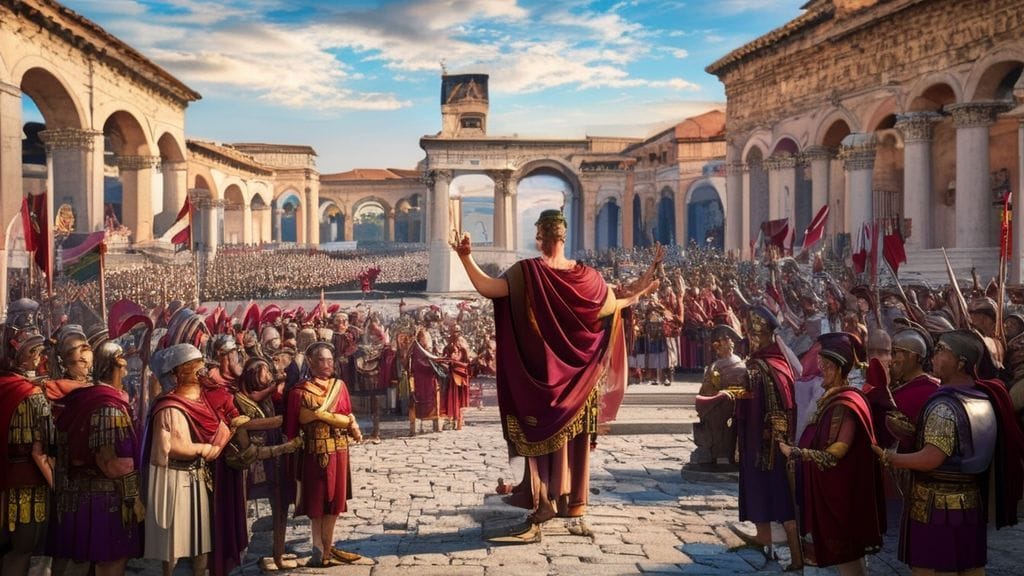
The formal act by which avitus proclaimed Western Roman Emperor was, in theory, simple. The assembled dignitaries acclaimed him as Augustus, invoking the language and rituals that had been honed over centuries. Purple robes were draped across his shoulders; perhaps a diadem or jeweled wreath was placed upon his head. Acclamations—Augustus, Augustus!—rose from official mouths and echoed, more uncertainly, among the wider crowd. Somewhere, a notary recorded the proceedings for dispatch to other cities.
Yet beneath this carefully choreographed revival of Roman forms lay new meanings. The shouts in the forum were punctuated by the glint of Gothic spears; the “will of the people” was heavily curated by those who stood closest to Avitus. What made an emperor in 455 was no longer the Senate in Rome, nor the hereditary principle, nor the favor of the army alone, but a precarious convergence of regional elites and federate kings. Avitus’s proclamation in Arles was an experiment in this new arithmetic of power.
As he addressed the assembled notables—if, as seems likely, he did—Avitus would have had to balance multiple audiences. To the Gallo‑Roman aristocracy, he had to promise protection of their lands, their tax privileges, and their cultural identity. To the churchmen, he had to present himself as a defender of Catholic orthodoxy in a landscape increasingly dotted with Arian Gothic and Vandal rulers. To the Gothic envoys and soldiers, he had to confirm the alliance with Theodoric II and hint at rewards yet to come.
The chronicler Hydatius, writing in distant Gallaecia (northwestern Hispania), noted with a mixture of fact and judgment that Avitus owed his elevation to the Goths. The phrase haunted his reign: the “Gothic emperor.” But on that July day, in the flush of ceremony, such criticisms might have felt abstract. Arles had an emperor again, one of its own, proclaimed not in the decaying palaces of Italy, but in the heart of Gaul. For the men and women in the crowd, the scene must have carried both strangeness and familiarity: traditional forms draped over a radically altered reality.
In that moment, avitus proclaimed Western Roman Emperor not only in a legal sense, but in an emotional one. He claimed continuity with the centuries‑long story of Rome, even as the script had been radically rewritten. His voice, carrying across the forum, tried to make that continuity believable. For a short while, it worked. Dispatches were sent; coins would later be minted in his name; bishops wrote letters acknowledging him as Augustus. The West, on paper at least, had a ruler again.
Voices in the Forum: How Arles Received Its New Augustus
To grasp the human texture of that day, we must look beyond the elites who orchestrated it. Arles was a living city, its streets crowded with laborers, artisans, dockworkers, small traders, slaves, and freedmen. For many of them, imperial politics were something that happened at a distance—far away in Ravenna or Rome. Now, power had arrived at their doorstep, draped in purple and accompanied by foreign warriors.
Imagine a dockworker down by the river, pausing from unloading barrels of wine to listen to rumors carried by fellow laborers: “They say a new emperor has been made. Not in Rome—in our own city!” Or a shopkeeper selling oil and garum in the market, wondering what imperial proclamations would mean for prices and taxes. The presence of Gothic troops meant increased demand for food and lodging, but also the risk of brawls, of misunderstandings in crowded taverns.
Among the city’s literate classes, reactions were more articulated but no less ambivalent. Some local aristocrats likely felt exhilaration: at last, a man from their world, not some distant Italian courtier, was wearing the purple. Others harbored quiet doubts, fearing that close association with the Goths would provoke resentment from Italy or even intervention from Constantinople. The bishops, guardians not only of souls but of urban cohesion, saw both opportunity and risk in an emperor whose power base lay in their own region.
Sidonius Apollinaris, though not in Arles that day, would later compose a panegyric for his father‑in‑law Avitus at Rome. In it, he painted the emperor’s elevation in glowing terms, describing how Gaul had given a savior to the world, and how even the barbarians acknowledged his greatness. Poetic license colored every line, but behind the rhetoric lay a genuine pride in the fact that the imperial office had, for once, flowed from the provinces to the center, and not the other way around. “Gaul,” he implied, “has not deserted Rome; she has rescued her.”
Yet behind the celebrations, there were whispers. Some Italian observers, upon hearing of the event, muttered that Arles had crowned a provincial usurper. Others resented the obvious role of Theodoric’s Goths. The title remained the same—Augustus, emperor of the Romans—but the path by which Avitus had reached it felt unorthodox. This tension between form and perception would haunt his short reign. His proclamation in Arles was a triumph in Gaul, but in Italy, it would be received with folded arms and guarded eyes.
Still, for the people of Arles in those first days, the future seemed open. Orders would now go out from their city stamped with imperial authority. The presence of the emperor and his court meant jobs, contracts, the possibility of pleading cases in person. In taverns in the shadow of the amphitheater, men argued fiercely about what this would mean; in the basilicas, priests led prayers for the new ruler. Life went on: ships still docked, markets still bustled. But above all the noise hung a new name, repeated in public readings and private conversations: Avitus, emperor.
Senators, Soldiers, and Bishops: Reactions across the Western Empire
News of the Arles proclamation traveled slowly but inexorably. Couriers rode south into Hispania, north toward the Rhine frontier, and east toward Italy. Each region, each power center, filtered the information through its own anxieties and aspirations. The figure who had stood beneath the sun in Arles as avitus proclaimed Western Roman Emperor now appeared as a rumor, then a fact, in places he had never yet set foot.
In Hispania, where Roman administration coexisted uneasily with Suevic and Visigothic ambitions, many local aristocrats saw advantage in an emperor with Visigothic backing. If Avitus could stabilize relations with Theodoric II, perhaps the endless violence on the frontiers would diminish. The chronicler Hydatius, though, was skeptical. Writing from Gallaecia, he recorded Avitus’s elevation in clipped terms, stressing the Gothic role and hinting that this was yet another sign of Roman weakness rather than renewal.
Along the Rhine, where Roman control had long been perforated by Frankish and Alamannic groups, the news mattered less. Local commanders were more concerned with provisioning their troops and negotiating with nearby kings than with who wore the purple in some distant city. Still, formal recognition of Avitus would have filtered through the chain of command, accompanied by orders to continue defending the frontiers in his name. For soldiers facing the raw winter winds of the Rhine, the emperor’s identity was secondary to whether their pay arrived on time.
In Italy, reactions were far more charged. The Senate, still clinging to its ancestral prestige, had not been consulted in the choice of Avitus. Many senators had never met him; to them, he was a provincial aristocrat, elevated by barbarians and provincial bishops. The great families of Rome and Ravenna—Anicii, Symmachi, and others—had seen too many emperors come and go to welcome another outsider lightly. Some counseled cautious acceptance; others waited, sensing that power might soon shift again.
Ricimer and Majorian, the leading military figures in Italy, watched with particular care. Both were veterans of Aetius’s campaigns; both commanded loyalty among Roman and barbarian troops. For them, Avitus was a potential rival and, at best, a temporary convenience. They would not move rashly. Let the new emperor come to Italy, they thought. Let him demonstrate whether he could feed the people, satisfy the Senate, and reconcile himself with the Eastern court. Only then would they decide to support or oppose him.
The bishops of the West, increasingly important arbiters of local legitimacy, mostly followed the formal line. They wrote letters acknowledging Avitus, prayed for him in the liturgy, and included his name in their appeals for justice. Yet some also quietly sought assurances. Would he defend Catholic orthodoxy against Arian rulers like Geiseric and Theodoric II? Would he protect church property in an era when bishops often acted as de facto city leaders? The intersection of imperial politics and ecclesiastical authority grew tighter with each passing year.
Thus, as summer deepened in 455, the name of Avitus spread across a broken empire like a ripple across a shattered mirror. In some shards, it was welcomed; in others, it distorted uncomfortably. The proclamation in Arles had succeeded in re‑establishing the formal structure of a Western emperorship. But the deeper question—whether it could command broad emotional and material loyalty—remained unresolved.
The Gallo-Roman Vision: A New Center for a Fading Empire
What did Avitus himself imagine as he left Arles, preparing to assume the broader duties of emperor? His actions suggest that he envisioned something like a Gallo‑Roman revival of the West, with Gaul as the beating heart of a reconfigured empire. For centuries, decisions affecting Gaul had been taken in distant Italy; now, for a moment, the direction seemed reversed. It was Gaul that had given an emperor to Rome, Gaul whose networks bound together bishops, landowners, and federate kings.
The Gallo‑Roman vision was not separatist. Avitus did not seek to break the empire into pieces; he sought to hold it together through a different center of gravity. Gaul’s cities, from Arles to Lyon to Clermont, still bore the physical imprint of Roman urbanism. Its aristocracy was no less cultured than that of Italy. Its churches and monasteries buzzed with theological and literary activity. From Avitus’s vantage point, the notion that Gaul could anchor a renewed imperial project was not absurd—it was the last plausible hope.
Coins minted in his name, though rare, symbolize this project. On one side, the emperor’s image, diademed and draped, looked out with the traditional stern serenity. On the other, familiar personifications of Victory or Roma signaled continuity. But their circulation in Gaul, Hispania, and northern Italy hinted at a different story: this was a regime whose legitimacy emanated as much from the Rhône and Garonne as from the Tiber.
Avitus also tried to use his connections with Theodoric II to secure the western provinces. In Hispania, Visigothic forces could be deployed against the Sueves; in Gaul, Gothic arms could help stabilize troubled areas. In return, Avitus granted Theodoric expanded influence, perhaps even territorial concessions in Hispania. It was a trade‑off that made sense on parchment but risked alienating other Roman elites, who saw in each concession a further nibbling away of imperial integrity.
The Gallo‑Roman vision extended into culture as well. Sidonius Apollinaris and others crafted a narrative in which Gaul was not a periphery but a co‑heir of Roman civilization. In his panegyric to Avitus, Sidonius portrayed the emperor’s elevation as an almost providential balancing of the imperial scales: after centuries in which Italy had monopolized the purple, it was just that Gaul, loyal and productive, should now be honored. The rhetorical flourish masked a sharper claim—that the West could only be saved if it stopped treating Gaul as a subordinate province and acknowledged it as a partner.
But such a reimagining of the imperial geography could not be achieved by words alone. It required administrative reforms, redistribution of military resources, and above all, time. Avitus had none of these in abundance. Every decision he made had to confront the hard realities of famine in Italy, Vandal raids in the Mediterranean, and the simmering ambitions of generals like Ricimer. The vision remained compelling but fragile, like a mosaic missing too many of its tesserae.
From Hope to Anxiety: The Short Reign of Avitus
The months following the proclamation in Arles traced a trajectory from cautious optimism to deepening anxiety. Avitus traveled to Italy, as he had to, in order to present himself in Rome and affirm the traditional bond between emperor and the old capital. On 1 January 456, Sidonius recited his panegyric in Rome in the presence of the Senate, clothing the emperor’s Gaulish origins in classically ornate Latin praise. The event, later described by Sidonius himself, was a consciously theatrical reaffirmation of unity between Italy and Gaul.
Yet by the time those verses rang in the basilica, the economic and political cracks beneath Avitus’s regime had widened. Italy was suffering food shortages, exacerbated by Vandal control of African grain. Financing the presence of a large Gothic contingent in Italy—part of Avitus’s security apparatus—strained the already weakened treasury. To many Romans, it felt as though they were paying for their own subordination, funding foreign troops whose loyalties lay not with the Senate but with Theodoric II.
In the countryside, banditry and local conflicts persisted. Imperial edicts, though still drafted in elaborate legal language, struggled to have real effect. Tax collection grew harsher as revenues shrank, further alienating landowners and peasants alike. The memory of Arles—of that moment when avitus proclaimed Western Roman Emperor with promise—must have seemed increasingly distant to those now grappling with the day‑to‑day consequences of his policies.
Avitus attempted to demonstrate energy and competence. He appointed officials from among his Gallic circle, trusting those whose loyalty had already been tested. He tried to negotiate with Geiseric, seeking either a modus vivendi or at least a temporary easing of Vandal pressure. He maintained close contact with Theodoric II, whose support remained essential. But each move he made risked aggravating some other constituency. Italian senators complained about the influx of Gauls into high office; military commanders grumbled that the emperor favored Gothic auxiliaries over traditional Roman troops.
By mid‑456, the balance of power had begun to tilt against him. Ricimer had scored a notable victory against the Vandals in a naval engagement near Corsica, enhancing his prestige among both troops and populace. Majorian, a brilliant general with impeccable Roman credentials, also rose in influence. Both men sensed that Avitus’s base of support was narrow and that resentment against him was growing. They began to plot, cautiously at first, then more openly, to unseat him.
In this climate, the Arles proclamation took on an ironic hue. The very fact that avitus proclaimed Western Roman Emperor with Gothic backing now served as a weapon in the hands of his enemies. Pamphlets, speeches, and whispered conversations framed him as the puppet of Theodoric II, an emperor whose first loyalty lay with Gaulish aristocrats and Gothic kings rather than with the Roman people. Whether fair or not, the perception hardened. And in late Roman politics, perception could be as lethal as steel.
Ricimer, the Army, and the Shadow of Revolt
Ricimer’s rise is one of the starkest indicators of the transformation of the Western Empire’s power structure. Of mixed Suevic and Gothic descent, he could never himself be emperor according to the still‑powerful prejudices of the Roman senatorial class. But he could make emperors—and unmake them. As magister militum, he commanded significant forces and enjoyed the loyalty of troops weary of distant provincial experiments.
Ricimer’s victory over the Vandals in 456 gave him the aura of a savior in Italy, just as Avitus’s regime seemed to falter. Crowds in Rome and other Italian cities praised the general whose ships had battled the feared Vandal fleets. In contrast, Avitus was increasingly associated with shortages, foreign troops, and unpopular officials from Gaul. The political wind shifted. Senators who had reluctantly accommodated themselves to the new emperor now glanced toward Ricimer and Majorian as alternative sources of stability.
The two generals began to maneuver. They could not simply declare Avitus deposed; the forms of imperial legitimacy still had to be observed. Instead, they encouraged discontent within the army, highlighting the costs of maintaining Gothic contingents and the perceived favoritism toward Gaulish elites. They stressed that the Eastern court had not clearly endorsed Avitus and that a change of regime might secure badly needed support from Constantinople.
In the late summer or early autumn of 456, the simmering tensions boiled over into open revolt. Italian troops, rallied by Ricimer and Majorian, refused to obey Avitus’s commands. The emperor, now isolated, sought to marshal what forces he could. Some of his Gallic supporters and remaining Gothic allies stood by him, but their numbers were limited, and distance from Gaul weakened their ability to act swiftly. Theodoric II, preoccupied with his own campaigns in Hispania, could offer only indirect help.
The stage was set for a confrontation that would decide not only Avitus’s fate but the viability of his Gallo‑Roman vision. The proclamation in Arles had been a high point; now, on the plains of northern Italy, the emperor would have to fight for the purple he had accepted in that sun‑drenched forum. The shadow of civil war, long familiar in Roman history, once again darkened the landscape—this time in a West whose resources to sustain such conflicts were dangerously depleted.
Downfall at Placentia: The Fall of an Unwanted Emperor
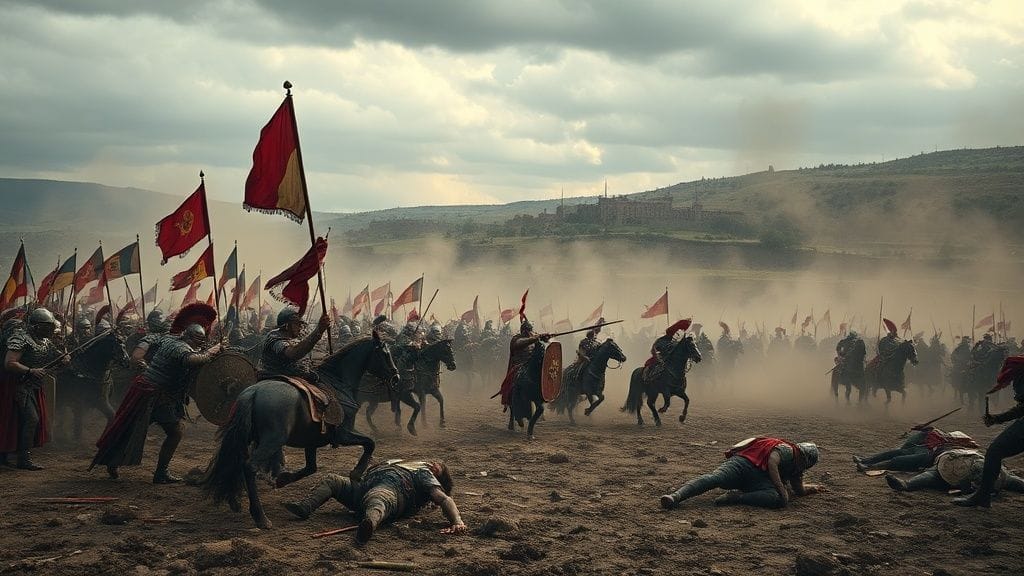
The final act of Avitus’s reign unfolded near Placentia (modern Piacenza), a city strategically situated on the Po River. There, in late 456, his forces clashed with those loyal to Ricimer and Majorian. The details of the battle are poorly preserved; no historian has left us the kind of vivid narrative that Ammianus once provided for earlier conflicts. What we know comes from brief, almost reluctant notices: there was a battle; Avitus’s army was defeated; the emperor fell into his enemies’ hands.
Some accounts suggest that Avitus attempted to flee, hoping perhaps to retreat toward Gaul and regroup among his original supporters. Others hint that he sought to negotiate, offering to step down in exchange for safety. Whatever the precise sequence, the outcome was clear: the man who had, with such ceremony, avitus proclaimed Western Roman Emperor in Arles now found himself stripped of his title, his purple, and his power. The empire he had tried to salvage receded from his grasp like a dream upon waking.
Ricimer and Majorian faced a choice. They could have executed Avitus outright, as past emperors had been executed in moments of crisis. Instead, perhaps mindful of public opinion and ecclesiastical sensibilities, they opted for a more ambiguous humiliation: they forced him to become bishop of Placentia. It was not entirely without precedent for an ex‑official to enter the clergy, but in this context, it was a clear demotion—a way of neutralizing a rival while cloaking the act in Christian respectability.
For Avitus, the transformation from emperor to bishop must have been both bitter and strangely familiar. He had moved for decades in circles where senatorial power and episcopal authority overlapped. Now he inhabited that world from a different angle. The imperial palace was exchanged for an episcopal residence; edicts for sermons; military dispatches for pastoral letters. We do not know what he thought, whether he raged inwardly, accepted his fate with resignation, or interpreted it through a theological lens as divine chastisement.
His time as bishop was short. Within months—by 457 at the latest—Avitus was dead. Sources differ on the cause; some suggest he was killed while trying to return to Gaul, others that he died peacefully. But his death sealed the fate of his brief experiment. Ricimer would soon elevate Majorian as the new Western emperor, one more acceptable to Italian elites and more fully under his military sway. The regime that had begun in Arles, amid Gothic lances and Gallic acclamations, ended in a small northern Italian city, almost as a footnote.
And yet, to treat it as a mere footnote is to miss the deeper resonance. The arc from Arles to Placentia encapsulates the tragedy of the late Western Empire: regional initiatives doomed by structural weakness, emperors dependent on barbarian allies and distrusted by their own elites, the growing power of generals whose vision rarely extended beyond the next campaign. Avitus’s fall was personal, but it was also emblematic. As he disappeared from the stage, the West slipped one step closer to the abyss.
After Avitus: What His Brief Empire Revealed
The fall of Avitus did not, in itself, cause the collapse of the Western Roman Empire. That process was already well underway, driven by demographic shifts, economic contraction, military dependence on federate troops, and the emergence of durable non‑Roman kingdoms. But his rise and fall cast a stark light on how far the imperial structure had eroded—and how narrow the options had become for those who still tried to preserve it.
One lesson is the increasing regionalization of power. The fact that an emperor could be proclaimed in Arles, with primarily Gallic and Gothic backing, reveals that the old Italian‑centric model was no longer mandatory. Gaul had the resources and networks to attempt an imperial project of its own. At the same time, the swift collapse of that project in the face of Italian military opposition shows that no single region could yet dictate terms to the rest. The empire was too fragmented to be unified, yet too intertwined to be neatly divided.
Another lesson lies in the role of barbarian allies. Avitus’s reliance on Theodoric II was not unusual; it was simply more visible. Other emperors before and after him leaned heavily on barbarian generals and troops. But the symbolism of Gothic lances in Arles, of a Gallic emperor so clearly tied to a Visigothic king, made the arrangement impossible to ignore. It forced contemporaries to confront what had long been true: the Western Empire’s survival depended on the cooperation of groups once branded as enemies.
Avitus’s reign also illustrates the growing power of the church as both a stabilizing and complicating factor. Bishops had helped legitimate his rule; bishops, too, had helped smooth his demotion into ecclesiastical office. The church’s involvement in imperial politics was no longer marginal. It shaped perceptions of emperors, mediated conflicts, and offered alternative career paths for disgraced aristocrats. The shifting balance between secular and ecclesiastical authority would continue to define Western politics long after the last emperor was deposed in 476.
Finally, his story lays bare the emotional dimension of imperial decline. It is easy, from a distance of fifteen centuries, to reduce these events to structural forces and institutional changes. But in the letters of Sidonius, in the terse entries of Hydatius, in the later reflections of historians like Gibbon, one feels a different register: sorrow, frustration, nostalgia, sometimes even shame. The moment when avitus proclaimed Western Roman Emperor in Arles can be read as a last act of faith in the imperial ideal from a class that sensed its world slipping away.
That is why his short reign matters. It is a lens, not a center. Through it, we see the interplay of regional identities, barbarian integration, senatorial resentment, military independence, and ecclesiastical influence. Through it, we feel the weight of decisions made under pressure, of hopes raised and dashed within a single year. And through it, we are reminded that decline is rarely a straight line; it is a series of attempts, reversals, and gambles—like the gamble of Arles in 455.
Memory, Myth, and Silence: How History Judged Avitus
History has not been kind to Avitus, but it has also been strangely quiet. Unlike figures such as Honorius, Aetius, or even Ricimer, he does not loom large in the standard narratives of Rome’s fall. Many modern readers encounter his name only in passing, a minor emperor sandwiched between more famous catastrophes. In a sense, his fate in memory mirrors his fate in life: overshadowed, abbreviated, and often misunderstood.
Contemporary and near‑contemporary sources offer contrasting portraits. Sidonius Apollinaris, bound by family ties and initial enthusiasm, painted him in golden colors, emphasizing his virtues, his military service, his diplomatic skill, and his cultured mind. Reading Sidonius alone, one could believe that Avitus was a nearly ideal emperor tragically undone by circumstance. Hydatius, in contrast, saw in him a symptom of decay, a man whose dependence on the Goths epitomized Rome’s loss of autonomy.
Later chroniclers, writing from the vantage point of a post‑imperial West, had little incentive to rehabilitate him. Their interest lay in explaining the great turning points—the sack of Rome, the deposition of Romulus Augustulus, the establishment of new kingdoms. Avitus’s experiment did not fit easily into such stark narratives. It was neither a dramatic beginning nor an unequivocal end. It was, rather, one of those in‑between moments when history hesitates, tries one path, then abandons it.
Modern historians have, in recent decades, paid more attention to figures like Avitus, precisely because they complicate simplistic stories of “fall” or “transformation.” They see in his regime evidence of a Gallo‑Roman identity that was strong and confident enough to attempt leadership of the wider West. They note the sophistication of his networks, the cultural vibrancy of the circles around him, and the genuine possibility—however slim—that his reign could have lasted longer if circumstances had been slightly different.
Yet even in these reassessments, Avitus remains elusive. We have no autobiography, no detailed contemporary biography, no long narrative account of his decisions. We reconstruct him from coins, inscriptions, scattered legal texts, and the partial testimonies of others. The silence around him is, in itself, a historical fact. It tells us that his regime did not generate the kind of enduring institutional memory that more stable governments leave behind. It also reminds us how much of late Roman history is built on fragments.
In that sense, the moment when avitus proclaimed Western Roman Emperor in Arles is like a flare in the night: bright, quickly fading, remembered mainly for the brief illumination it cast on surrounding shapes. It allows us to glimpse the anxieties of Gallo‑Roman aristocrats, the confidence of Visigothic kings, the resentment of Italian generals, the ambivalence of Christian bishops. After the flare dies, much returns to shadow. But our eyes, having seen more, cannot entirely forget.
The Human Face of Collapse: Everyday Life in Avitus’s West
To understand fully the significance of Avitus’s proclamation and reign, we must descend from courts and battlefields into the everyday lives of those who inhabited his world. For most people in 455—peasants in Gaul, townsfolk in Hispania, sailors in the western Mediterranean—the identity of the emperor mattered less than the stability of harvests, the safety of roads, and the fairness of local officials. Yet imperial politics continually intruded, shaping their fortunes in indirect but powerful ways.
In rural Gaul, large estates dominated the landscape. Peasants worked the lands of senatorial families and bishops, paying rents in kind and labor. The rise of Avitus, himself a great landowner, might initially have seemed like a sign that their patrons’ influence was rising; perhaps disputes could be resolved more favorably, taxes moderated, or protection against raids strengthened. Over time, however, the disruptions caused by shifting allegiances, troop movements, and fiscal pressures likely outweighed any such hopes.
In the cities, where trade and crafts still persisted despite contraction, the proclamation in Arles would have been felt more immediately. Merchants dealing in cloth, oil, wine, and ceramics found their networks stretched and twisted by changing political borders. Gothic and Roman markets intersected in complex ways. A potter near Toulouse might sell to both Visigothic nobles and Roman citizens; a ship captain from Arles might carry goods to Italian ports under the watchful eye of Vandal raiders. Stability was always provisional.
The Christian church provided one of the few institutions that seemed to grow stronger amid the turmoil. Bishops like those who supported Avitus often acted as local judges, diplomats, and welfare administrators. They mediated between imperial officials and their congregations, negotiated ransoms for captives, and built basilicas that functioned as both spiritual centers and emergency shelters. For many ordinary people, the bishop, not the emperor, was the face of authority they actually encountered.
Yet even here, imperial decisions rippled through daily life. Tax exemptions for church property, grants of land to federate groups, the redirection of military resources—all of these, decided in places like Arles or Ravenna, could alter the balance of power on the ground. When avitus proclaimed Western Roman Emperor, he implicitly promised to maintain a certain level of order, to keep the roads open, to protect communities from the worst depredations. His failure to secure a lasting regime meant that insecurity continued, if not intensified.
It is tempting to imagine a family in a small Gallic town hearing of his fall months after the fact. Perhaps they had cheered his rise from a distance, proud that a man of their region now wore the purple. Now they learn, via a traveling merchant or a priest, that he has been defeated, reduced to a bishop, and then died. A new emperor rules in Italy; Ricimer pulls strings behind the throne. For them, the names change, but the pattern remains: taxes are hard, bandits threaten the roads, and hopes for a decisive restoration of peace recede further into the realm of rumor and prayer.
Why the Arles Proclamation Still Matters Today
Why should we, in a world so far removed from togas and Gothic cavalry, care that avitus proclaimed Western Roman Emperor in a provincial city on 9 July 455? The answer lies not in nostalgia for Rome’s grandeur, but in what this episode reveals about the dynamics of political fragmentation, cultural hybridity, and attempts at renewal under extreme pressure.
The Arles proclamation shows us a society trying to reinvent central authority without the material base that had once sustained it. The Western Empire of Avitus’s time was a shrinking, overextended state, reliant on allies whose interests only partially overlapped with its own. Forced to operate with reduced tax revenues, contested borders, and multiple centers of power, it struggled to maintain the fiction of a single, unified sovereignty. Avitus’s rise captures a moment when that fiction was still believed enough to inspire action, but doubted enough to inspire resistance.
In an age when modern states, too, face challenges from regionalism, shifting alliances, and the erosion of traditional economic foundations, there is something eerily familiar in this story. The Gallo‑Roman elite’s attempt to anchor the empire in a new center, the reliance on former enemies as indispensable partners, the contest between civilian institutions and military power—these are not issues confined to late antiquity. They reappear, in different guises, across history.
The episode also invites reflection on how identities are negotiated in times of crisis. Avitus was Roman, but also profoundly Gallic; his principal allies were Goths who had adopted many Roman customs but maintained their own traditions. The proclamation in Arles was not simply the continuation of a Roman story; it was the performance of a new, composite identity in which Roman, Gallic, and Gothic elements intertwined. The fact that many contemporaries experienced this as both promising and threatening speaks to the deep ambivalence that accompanies cultural blending in any age.
Finally, the fate of Avitus reminds us of the limits of individual agency. He was not an incompetent mediocrity; he was, by the standards of his class, capable, experienced, and well connected. Yet the forces arrayed against him—economic contraction, military decentralization, entrenched regional interests—were more than any one person could master. To focus too much on his personal failures or virtues is to miss the structural currents that made his project so fraught from the outset.
In the end, the story of the man who, for a brief year, avitus proclaimed Western Roman Emperor in Arles is a story about how worlds end—not with a single dramatic catastrophe, but with a succession of fragile experiments that almost, but not quite, manage to hold the pieces together. It is about the courage of those who try, the ambiguities of their alliances, and the silences that memory leaves behind. That, perhaps, is why his forgotten coronation still deserves our attention.
Conclusion
On that July day in 455, as the sun blazed over Arles and the Rhône flowed indifferently past the city’s piers, a tired empire tried once more to reinvent itself. In the forum, amid the clatter of arms and the murmur of acclamations, avitus proclaimed Western Roman Emperor with all the ceremonial weight four centuries of tradition could muster. Around him stood Gallo‑Roman aristocrats, Gothic envoys, bishops in their vestments, soldiers with dust on their boots—an entire world compressed into one crowded square.
His reign was brief, his achievements modest, his downfall swift. Yet within that compressed span lies a concentrated image of the Western Empire’s final century: regional elites stepping into vacuums left by collapsing centers, federate kings transforming from clients into kingmakers, emperors balancing between senatorial suspicion and military necessity, and the church weaving itself ever deeper into the fabric of power. The road from Arles to Placentia, from proclamation to deposition, charts not just one man’s misfortune but the structural inability of the late Roman West to reconcile its competing forces.
Avitus’s story forces us to abandon simple narratives of Rome’s “fall” in favor of a more intricate tapestry of attempts, adaptations, and partial successes. His Gallo‑Roman vision, though ultimately thwarted by Italian resistance and material scarcity, hints at paths not taken—an empire led from its provinces, anchored in new centers of gravity, and openly partnered with its barbarian neighbors. That it failed does not mean it was doomed from the start; it means it was born in a world already stretched beyond its limits.
Today, when we look back at the fading light of the Western Roman Empire, Avitus’s figure stands in the penumbra: not as a great conqueror or a notorious tyrant, but as an earnest, imperfect, and historically revealing attempt to hold together a crumbling order. His proclamation in Arles is worth remembering precisely because it did not succeed. It reminds us that between flourishing and collapse lies a long, humanly inhabited terrain of improvisation, compromise, and fragile hope—an in‑between space where, for one hot summer in Gaul, an aging aristocrat dared to call himself emperor.
FAQs
- Who was Avitus before he became emperor?
Avitus, full name Eparchius Avitus, was a Gallo‑Roman aristocrat from the Auvergne, a high‑ranking official who served as praetorian prefect of Gaul and a close associate of the powerful general Aetius. He was also a respected diplomat, especially in dealings with the Visigothic kings around Toulouse, and moved comfortably in both senatorial and ecclesiastical circles. - Why was Avitus proclaimed Western Roman Emperor in Arles instead of Rome?
Arles was the administrative center of the Gallic prefecture and a stronghold of Gallo‑Roman power, relatively intact after the turmoil in Italy and the Vandal sack of Rome in 455. With the Italian court in disarray and the Visigothic king Theodoric II backing Avitus, Gaul became the most viable launching point for a new regime, leading to his proclamation as Western emperor there on 9 July 455. - What role did the Visigoths play in Avitus’s rise to power?
The Visigoths, under King Theodoric II, were crucial to Avitus’s elevation. Avitus had long‑standing ties to the Visigothic court and was trusted as a friend and intermediary. Theodoric supplied military support and political endorsement, and Gothic troops accompanied Avitus to Arles, where his presence underlined that his authority rested heavily on Visigothic backing. - Why did Avitus’s reign end so quickly?
Avitus’s reign, lasting roughly one year, ended because he failed to build broad support beyond his Gallic and Gothic base. Italian senators resented his provincial origins and his reliance on foreign troops, while generals like Ricimer and Majorian gained prestige through military victories and capitalized on economic hardship in Italy. In 456, their forces rebelled, defeated Avitus near Placentia, and forced him to step down. - What happened to Avitus after his deposition?
After his defeat near Placentia, Avitus was compelled to enter the clergy and became bishop of Placentia, a move that both neutralized him politically and allowed his enemies to claim a measure of Christian clemency. His episcopal tenure was short; he died soon afterward, likely in 457, either while still in office or while attempting to return to Gaul. - How did Avitus’s rule affect relations between Romans and Goths?
Avitus’s rule symbolized and deepened the interdependence between Romans and Goths. By openly relying on Theodoric II and Visigothic troops, he acknowledged that imperial power in the West depended on federate allies. This alarmed some Roman elites but also formalized Gothic influence in Gaul and Hispania, anticipating the more permanent Roman‑Gothic political arrangements that would follow in the post‑imperial kingdoms. - Did Avitus’s reign contribute directly to the fall of the Western Roman Empire?
Avitus’s brief reign did not directly cause the empire’s fall, but it highlighted underlying problems—regional fragmentation, fiscal weakness, and dependence on barbarian allies—that would continue to plague his successors. His failure showed how difficult it had become to maintain a cohesive imperial authority, and in that sense, his story is one more step along the path that ended with the deposition of Romulus Augustulus in 476. - Why do historians today study Avitus’s proclamation in Arles?
Historians study the Arles proclamation because it illuminates a pivotal phase in late Roman history, when provincial elites and federate kings attempted to reshape imperial authority. The event reveals the growing importance of Gaul, the integration of barbarian powers into Roman politics, and the ways in which traditional institutions were adapted in a time of crisis. It offers a nuanced snapshot of transition rather than a simple picture of decline.
External Resource
Internal Link
Other Resources
- Encyclopaedia Britannica – general search for the exact subject
- Google Scholar – academic search for the exact subject
- Internet Archive – digital library search for the exact subject