Table of Contents
- The Cold War Chessboard: Setting the Scene in 1955
- A City at the Crossroads: Baghdad in the Mid-20th Century
- From Colonial Shadows to New Alliances: The Birth of the Baghdad Pact
- The Architects of Alliance: Britain, Iraq, Turkey, Iran, and Pakistan
- February 24, 1955: An Afternoon in Baghdad That Changed the Middle East
- The Pact’s Promise: Collective Security Against Soviet Expansion
- The United States: A Shadow Player with Growing Interest
- Regional Reactions: Support, Skepticism, and Outrage
- The Arab World’s View: Nationalism and Anti-Imperial Sentiments
- Britain’s Calculated Gamble: Holding Grip on Influence
- Turkey and Iran’s Strategic Calculations
- Pakistan’s Role: Beyond South Asia’s Borders
- Iraq’s Ambivalence and Political Complexity
- Soviet Alarm Bells and Propaganda Responses
- The Pact in Action: Early Challenges and Missed Opportunities
- The Suez Crisis of 1956: The Baghdad Pact Tested
- The Rise of Pan-Arabism: Nasser’s Challenge to the Pact
- Lebanon and Jordan: Peripheral Players under Pressure
- The Pact’s Fracture: Iraq’s Withdrawal in 1959
- Legacy of the Baghdad Pact: From Alliance to Near-Obsolescence
- Lessons Learned: Cold War Alliances and Middle Eastern Realities
- How the Baghdad Pact Shaped Modern Geopolitics
- Reflections in Contemporary Politics: Echoes of 1955
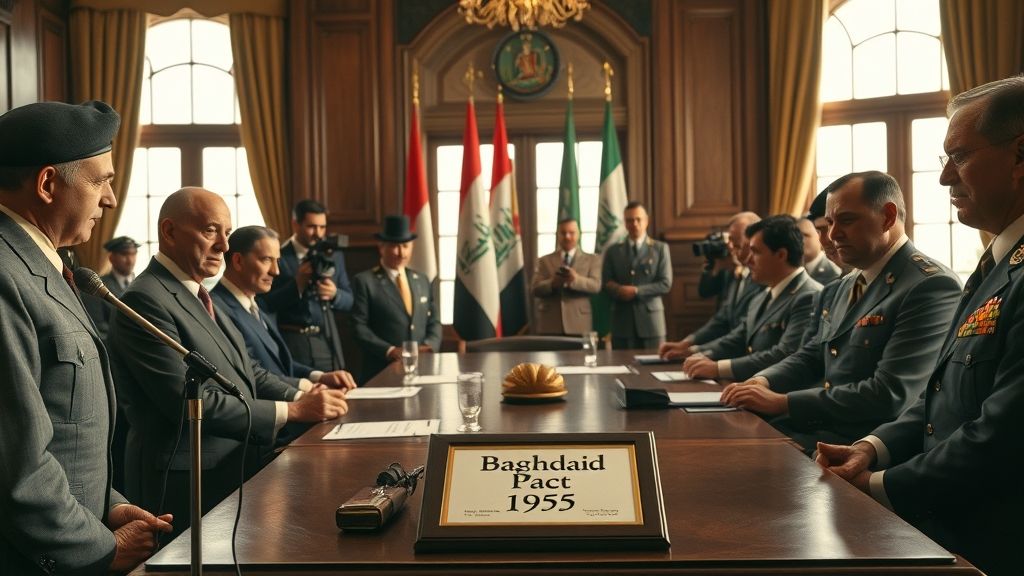
On a late winter’s day in 1955, beneath the blue sky of a restless Baghdad, a gathering of diplomats, military officials, and political leaders signed what was to become one of the Cold War’s lesser-known yet profoundly impactful agreements: the Baghdad Pact. This alliance, formed among Middle Eastern and South Asian nations under the watchful influence of Britain, promised collective security “for the defense of the region” against the looming threat of Soviet communism. But in the warmly lit halls of Iraq’s capital, beneath the veneer of unity, simmered doubts, divisions, and visions that would soon unravel this precarious coalition.
In the heart of Baghdad, a city rich with history yet trembling with the tremors of post-colonial change, the signing of the pact was anything but a simple political act. It encapsulated aspirations to protect sovereignty, fears of external domination, and the complex dance of global superpowers attempting to carve strategic footholds. The pact was a microcosm of Cold War tensions, an emblem of Western attempts to contain communism, and a catalyst in the evolving Middle Eastern struggle for identity and influence.
Yet, the pact’s historical arc stretched far beyond a mere treaty. It would intertwine with the rise of Arab nationalism, the shifting allegiances of regional powers, and the deepening of Cold War rivalries. From its promising beginnings to its eventual dilution, the Baghdad Pact remains a compelling chapter in understanding how alliance-building shaped—and was shaped by—the turbulent politics of the Middle East.
The Cold War Chessboard: Setting the Scene in 1955
The mid-1950s were dominated by the escalating rivalry between the United States and the Soviet Union, each seeking spheres of influence across a world scarred by World War II and the demise of old empires. The Middle East, with its vast oil reserves and strategic position between Europe, Asia, and Africa, became an unavoidable arena in this contest.
Western powers viewed the Soviet Union’s expanding reach with increasing alarm. The fear was not only about ideology but about tangible territorial and resource control. In this fraught climate, the creation of alliances was paramount. NATO served as the bulwark in Europe; in Asia, SEATO was born. It was only natural, from the Western perspective, to extend similar protective frameworks to the Middle East.
But the region’s political landscape was anything but simple. The old colonial order was fading, yet new nationalist and revolutionary movements emerged vigorously, particularly against foreign interference. The Baghdad Pact was both a reaction to external communist threat and an expression of internal regional dynamics.
A City at the Crossroads: Baghdad in the Mid-20th Century
Once the jewel of the ancient Mesopotamian civilization, Baghdad struggled in the mid-20th century to redefine itself. Under the Hashemite monarchy, it was a capital striving for modernization while preserving tradition. The legacy of British colonial influence was still palpable, but new local aspirations—sometimes conflicting—were becoming more vocal.
The city’s streets were filled with a mixture of excitement and anxiety. Young officers in the Iraqi army mingled with political elites who knew that the future of Iraq hinged on the ability to navigate between Cold War powers, internal nationalist sentiments, and regional rivalries. The decision to host and sign the Baghdad Pact gathered all these undercurrents in one place, capturing a moment freighted with expectation and risk.
From Colonial Shadows to New Alliances: The Birth of the Baghdad Pact
The pact’s origins lie in the complex aftermath of British withdrawal from India and the rising Soviet influence in neighboring territories like Iran and Afghanistan. Britain sought new regional partnerships to maintain influence while ceding direct control.
The alliance was thus born from a confluence of British strategic interests and the desires of regional powers wanting security guarantees without becoming outright Soviet clients. Unlike NATO, the pact distinctly combined Middle Eastern and South Asian nations, reflecting the geopolitics of the “near East” and South Asia’s interconnected security concerns.
The Architects of Alliance: Britain, Iraq, Turkey, Iran, and Pakistan
The pact was essentially sponsored and orchestrated by Britain, whose declining empire demanded new tools of influence. The British Foreign Office and military advisors crafted an alliance including Turkey, a pivotal NATO member and bulwark against the USSR; Iran, under Shah Mohammad Reza Pahlavi, seeking Western patronage; Pakistan, eager to expand its global role; and Iraq, whose monarchy was willing but internally divided.
Each partner brought different ambitions and fears to the table. For Britain, the pact was a lifeline to uphold its strategic routes, especially towards the oil fields of the Gulf. For Iraq, it was a double-edged sword: a security option but one fraught with nationalist criticism. Turkey remained loyal to the West, seeing the USSR as its primary enemy. Iran aimed to secure its shaky monarchy. Pakistan hoped to balance its rivalry with India with Western support.
February 24, 1955: An Afternoon in Baghdad That Changed the Middle East
On a day marked by official pomp and the clatter of inks signing formal documents, the Baghdad Pact was sealed. The event was covered cautiously by Western press but met with popular protests and suspicion in many Arab capitals.
The treaty announced a promise of mutual defense, intelligence sharing, and coordinated military planning—language laden with Cold War urgency. Beyond the signing, however, the political symbolism was profound: the establishment of a bloc that divided the Middle East into spheres vulnerable to superpower manipulation.
The words penned that day created ripples felt far beyond the ornate halls of Baghdad: in Cairo’s crowded streets, in Moscow’s Kremlin chambers, and along the oil-rich coasts of the Persian Gulf.
The Pact’s Promise: Collective Security Against Soviet Expansion
The formal purpose of the Baghdad Pact was to stand as a united front against Soviet expansionism—a threat perceived differently by each member state. In speeches and communiqués, the pact’s leaders emphasized cooperation, collective defense, and the importance of preserving sovereignty against ideology-driven encroachment.
Yet the “Soviet threat” was a flexible concept, often mixed with deeper regional anxieties: border disputes, ethnic tensions, and ideological battles between monarchists, communists, and nationalists.
The United States: A Shadow Player with Growing Interest
Curiously, the United States initially refrained from joining the pact officially, citing the coalition’s regional nature and hesitation about entanglements in the Middle East. However, American support was emphatic behind the scenes, with logistical aid and political backing.
This ambivalence reflected a cautious U.S. approach—keen on supplanting British influence but wary of alienating Arab nationalism. Over time, the U.S. would become a primary interlocutor and beneficiary of these arrangements.
Regional Reactions: Support, Skepticism, and Outrage
While Turkey and Iran officially welcomed the pact, wider regional responses were more fractured. Arab nationalist leaders, primarily in Egypt, Lebanon, and Syria, condemned the Baghdad Pact as a new form of imperialist encirclement.
Popular uprisings and intellectual critiques depicted the alliance as a betrayal—especially by Iraq’s neighbors who saw it as ceding sovereignty to Western powers. Anti-British sentiment surged, coalescing with calls for Arab unity under Nasser’s charismatic leadership.
The Arab World’s View: Nationalism and Anti-Imperial Sentiments
President Gamal Abdel Nasser of Egypt emerged as the most vocal opponent, casting the pact as a tool for Western dominance rather than genuine regional security. His rhetoric galvanized a rising tide of pan-Arab nationalism, shifting the Middle East’s ideological battle lines.
The Baghdad Pact thus inadvertently strengthened forces it sought to contain—nationalist movements that rejected Cold War binaries and foreign interference.
Britain’s Calculated Gamble: Holding Grip on Influence
For Britain, the pact was a measured bet to maintain geopolitical leverage. The decline of its empire required creative diplomacy, and alliance-building was a means to project power without costly colonization.
Yet this gamble entangled Britain in Middle Eastern politics at a time of increasing anti-Western sentiment. The alliance’s fragility mirrored Britain’s own waning global dominance.
Turkey and Iran’s Strategic Calculations
Turkey’s position as a NATO member meant it viewed the Baghdad Pact as a logical extension of its East-West defenses, providing a southern buffer against Soviet ambitions.
Iran, meanwhile, relied heavily on Western support for the survival of the Shah’s regime. The pact was a way to secure military aid and assert itself domestically, but also risked further antagonizing Soviet fears along its northern frontier.
Pakistan’s Role: Beyond South Asia’s Borders
Pakistan’s involvement reflected its growing foreign policy assertiveness vis-à-vis India and the Cold War context. The pact promised Pakistan access to Western military aid and regional alliances, projecting influence beyond its immediate neighborhood.
Nevertheless, Pakistan’s embedded insecurities about India sometimes took precedence over the alliance’s broader Middle Eastern focus.
Iraq’s Ambivalence and Political Complexity
Iraq’s monarchy was caught between internal forces. While the ruling elites saw the pact as necessary for security and Western alignment, anti-monarchists and communists within Iraq opposed what they perceived as neo-colonial submission.
This tension would ultimately contribute to the monarchy’s downfall in 1958, challenging the pact’s cohesion.
Soviet Alarm Bells and Propaganda Responses
The Soviet Union saw the Baghdad Pact as a direct threat to its security interests and responded with sharp condemnations and increased support for sympathetic Arab and leftist movements.
Moscow’s counter-propaganda framed the pact as an imperialist plot, deepening Cold War polarization in the region.
The Pact in Action: Early Challenges and Missed Opportunities
Despite promises, the pact soon revealed its weaknesses. Coordination difficulties, mutual distrust among members, and the absence of U.S. formal membership limited its effectiveness.
The regional and global contexts were changing rapidly, demanding flexibility that the pact often lacked.
The Suez Crisis of 1956: The Baghdad Pact Tested
The 1956 Suez Crisis dramatically exposed the alliance’s fragility. Britain and France’s military intervention in Egypt, in response to Nasser’s nationalization of the Suez Canal, shocked allies and enemies alike.
Iraq and other pact members were reluctant to fully endorse the invasion, fearing backlash from Arab public opinion.
The crisis accelerated the shift away from colonial entanglements and highlighted the divergent interests within the pact.
The Rise of Pan-Arabism: Nasser’s Challenge to the Pact
Nasser’s vision of Arab unity and socialism gained momentum after Suez, directly opposing the Baghdad Pact’s Western orientation.
Pan-Arabism resonated with millions who saw the pact as a Western wedge against Arab independence and dignity.
This ideological battle would sweep the region, undermining traditional alliances and fostering new political alignments.
Lebanon and Jordan: Peripheral Players under Pressure
While not signatories, Lebanon and Jordan found themselves navigating pressures from both the pact and nationalist forces, revealing the broader regional tensions engendered by the treaty.
Both kingdoms sought to balance survival amid instability, often adjusting policies to external and domestic winds.
The Pact’s Fracture: Iraq’s Withdrawal in 1959
The watershed moment came with the 1958 Iraqi revolution, which overthrew the monarchy and replaced it with a republic hostile to the pact and Western influence.
Iraq’s exit in 1959 undercut the alliance’s credibility and territorial coherence, signaling the start of the pact’s decline.
Legacy of the Baghdad Pact: From Alliance to Near-Obsolescence
Over the subsequent years, the pact’s relevance faded, replaced by new alliances and Cold War dynamics. It was renamed CENTO (Central Treaty Organization) but never gained the cohesion of NATO or SEATO.
Its legacy remains as a cautionary tale of Cold War alliance-building, Middle Eastern nationalism, and the limits of external influence.
Lessons Learned: Cold War Alliances and Middle Eastern Realities
The Baghdad Pact demonstrated how international military alliances often clashed with local political realities and historical grievances.
It highlighted the complex interplay between global strategies and regional identities—lessons vital for future diplomatic efforts.
How the Baghdad Pact Shaped Modern Geopolitics
Though short-lived, the Baghdad Pact influenced the geopolitical structure of the Middle East, shaping U.S. policy, Arab nationalist movements, and the region’s Cold War posture.
Its echoes can be traced in later alliances, conflicts, and diplomatic strategies into the 21st century.
Reflections in Contemporary Politics: Echoes of 1955
Today, amid renewed great power competition in the Middle East, the Baghdad Pact’s story offers insights into the possibilities and pitfalls of alliance-building in a region defined by complex loyalties and enduring resilience.
Its history invites reflection on sovereignty, security, and the intricate dance between global powers and local actors.
Conclusion
The Baghdad Pact, signed on a chilly February day in 1955, was more than a military alliance: it was a vivid illustration of the Cold War’s entanglement with a region yearning for autonomy yet ensnared in global rivalries. From the ornate halls of Baghdad to the bustling streets where hopes and fears mingled, this pact spoke to the ambitions—and anxieties—of nations at a historic crossroads.
Though the alliance ultimately unraveled, its story remains a compelling testament to the complexity of Middle Eastern politics, the relentless currents of nationalism, and the far-reaching shadows cast by superpowers. In understanding the Baghdad Pact, we touch on a crucial chapter of modern history—one reminding us that alliances, however forged, must reckon deeply with the human and political realities that shape their fate.
FAQs
Q1: What was the primary purpose of the Baghdad Pact?
The Baghdad Pact was designed as a mutual defense alliance to prevent Soviet expansion into the Middle East and South Asia during the Cold War.
Q2: Why did the United States not officially join the Baghdad Pact at first?
The U.S. initially refrained due to concerns about entangling itself too deeply in Middle Eastern politics and sought a more cautious approach while offering political and logistical support.
Q3: Who were the main members of the Baghdad Pact?
The founding members were Iraq, Turkey, Iran, Pakistan, and the United Kingdom.
Q4: How did Arab nationalist movements view the pact?
Most Arab nationalist leaders and populations opposed the pact, seeing it as an instrument of Western imperialism and a threat to Arab unity.
Q5: What led to the decline and eventual collapse of the Baghdad Pact?
Internal divisions, the 1958 Iraqi revolution, regional opposition to Western influence, and the rise of pan-Arabism contributed to its decline.
Q6: How did the Baghdad Pact influence the Cold War in the Middle East?
It intensified polarization, aligned certain states with the West, provoked Soviet counteractions, and affected regional dynamics for decades.
Q7: What was CENTO and how is it related to the Baghdad Pact?
CENTO (Central Treaty Organization) was the later name of the Baghdad Pact after Iraq’s departure, reflecting attempts to maintain the alliance with fewer members.
Q8: Does the legacy of the Baghdad Pact still matter today?
Yes, it offers lessons about alliance-building, regional politics, and the persistent challenges of balancing great power interests with local sovereignty.