Table of Contents
- The Final Breath of a Radical Mind: Spinoza’s Last Day in The Hague
- The Intellectual Landscape of the Dutch Republic in the 17th Century
- Origins of a Philosopher: From Amsterdam’s Jewish Quarter to The Hague
- The Duel Between Faith and Reason: Spinoza’s Radical Philosophy
- Spinoza’s Uncompromising Vision of God and Nature
- Excommunication and Isolation: The Price of Dissent
- The Quiet Life of a Lens Grinder: Survival on the Margins
- The Last Journey: Why Spinoza Left Amsterdam for The Hague
- The February of 1677: The Hour of Death and Reflection
- Witnesses and Friends: Reactions to Spinoza’s Passing
- Burial and Memorial: A Philosopher’s Place in the Dutch Republic
- The Quiet Aftermath: Spinoza’s Legacy in the Enlightenment to Come
- From Obscurity to Reverence: How Spinoza’s Ideas Ignited Future Revolutions
- The Political and Religious Repercussions in the Dutch Context
- Echoes Through Time: Spinoza’s Influence on Modern Secular Thought
- The Myth and the Man: Separating Spinoza’s Life from Legend
- Renewed Interest in Spinoza in the 19th and 20th Centuries
- The Human Cost: Spinoza’s Personal Struggles and Triumphs
- The Philosophical Battlefield: Responses and Critiques After His Death
- Final Reflections: Why Spinoza’s Death Marked a Turning Point in Western Thought
The Final Breath of a Radical Mind: Spinoza’s Last Day in The Hague
On a cold winter morning, February 21, 1677, the Dutch city of The Hague held its breath as Baruch Spinoza exhaled his last. The philosopher, then in his mid-forties, lay quietly in a modest house far from the bustling intellectual circles he once frequented in Amsterdam. His death was not marked by grand ceremonies or widespread mourning. Instead, it was a quiet exit for a man whose ideas had already begun penetrating the hearts of Europe’s most daring thinkers.
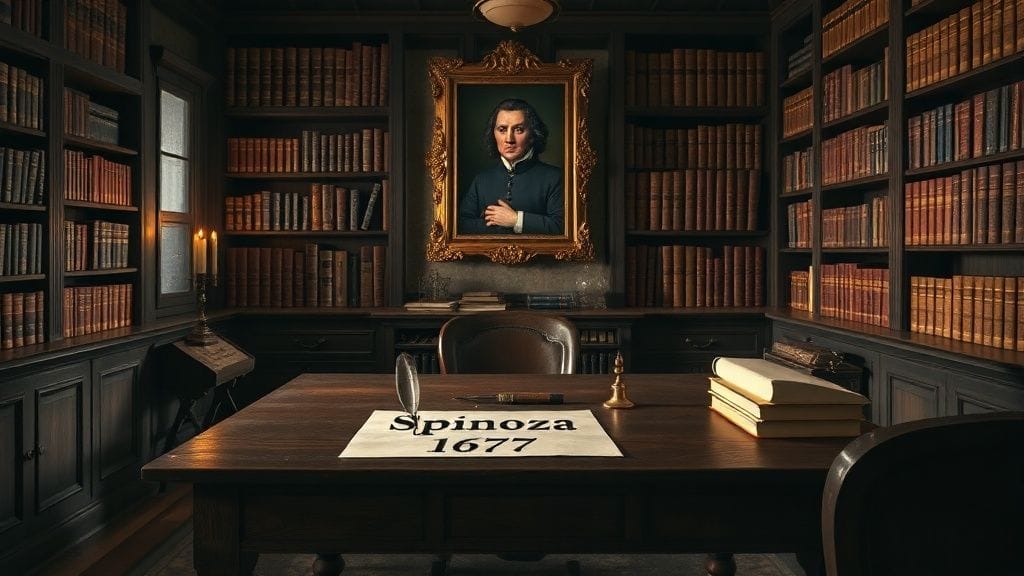
The air was crisp, harboring the frozen scent of a Dutch winter. Inside, the flicker of candlelight danced on walls lined with books and lenses, testaments to a life devoted to thought and craftsmanship. Spinoza’s last moments were the product of years of solitude, intellectual strife, and societal alienation—an existence marked by sharp edges, where belief was relentlessly questioned and the dogmas of religion were torn asunder by reason.
It was the death of a man, but also a threshold, the closing of a chapter that would soon be the prelude to a philosophical awakening stretching far into the future.
The Intellectual Landscape of the Dutch Republic in the 17th Century
The 17th century Dutch Republic was no ordinary backdrop for Spinoza’s life and death. Bursting as a cultural and commercial hub, it was also a crucible of ideological experimentation. Although proud of its relative religious tolerance, Dutch society oscillated between openness and deep sectarian fractures. Calvinism reigned as the official creed, yet Jewish, Catholic, Protestant dissenters, and secular thinkers lived in a careful balance.
Amsterdam itself was a melting pot where exiles from Spain and Portugal, among others, sought refuge. This dynamic created fertile ground for the cross-pollination of ideas but also led to considerable tension. Into this volatile mix stepped Baruch Spinoza—born into a Portuguese-Jewish family, but increasingly at odds with orthodox beliefs on every front.
Spinoza’s death in The Hague, a stronghold of Dutch political power, symbolically separated him physically and ideologically from his birthplace. The Hague, a city associated with governance and law, would witness the life’s end of a thinker who had relentlessly sought to redefine the very foundations of both.
Origins of a Philosopher: From Amsterdam’s Jewish Quarter to The Hague
Baruch Spinoza was born in 1632 in Amsterdam's vibrant yet restrictive Portuguese-Jewish community. His family descended from Sephardic Jews who had fled the Inquisition. Raised in a tradition steeped in scripture and Talmudic study, Spinoza displayed early a profound hunger for knowledge.
Yet, even as a young man, his intellectual curiosity could not be contained by orthodox teachings. He began questioning the literal interpretations of scripture and the concept of divine providence. These radical inquiries did not go unnoticed. In 1656, he was excommunicated—cherem—from the Jewish community. The edict was severe: he was cut off from community, family ties, and spiritual life.
Banished in his own city, yet free to pursue his thoughts unfettered, Spinoza became a wanderer both physically and intellectually. His exile laid the foundation for a philosophy that challenged not only religious dogma but also political authority.
This stark break between community and individual would define both his life and eventually the place he would die.
The Duel Between Faith and Reason: Spinoza’s Radical Philosophy
Spinoza’s exile did not silence him. Instead, it marked the beginning of a relentless quest to chart a new understanding of existence. His philosophy was nothing less than a revolution against the accepted Christian and Jewish dogmas of his time.
Rejecting the notion of a personal God who intervenes in human affairs, Spinoza proposed a model where God and Nature are one and the same—Deus sive Natura. This monist view eliminated the traditional divide between creator and creation, attributing to the universe an immanent, eternal substance.
This perspective was radical, dangerous even. It called into question the authority of scripture, the legitimacy of the clergy, and the foundations of the state. To many contemporaries, Spinoza’s God was a heresy so profound it threatened the social order.
Yet Spinoza’s writings were not mere rebellion; they were a visionary attempt to ground ethics, politics, and knowledge in reason. His Ethics, published posthumously, laid out a system where freedom was found not in blind faith but in understanding the necessary laws of nature and our place within them.
Spinoza’s Uncompromising Vision of God and Nature
At the heart of Spinoza’s philosophy lies an uncompromising vision: God is not an anthropomorphic being but an infinite substance expressing itself through nature and its laws. This startling idea dismantled illusions of divine intervention and providence, presenting a universe governed by necessity and cause.
For Spinoza, this meant a profound ethical shift. Human freedom was redefined as the power to act according to reason, aligning one’s desires with the deterministic order of the cosmos. Emotions, passions, and superstitions clouded this path, binding individuals to misery.
His vision was austere but hopeful. By understanding the true nature of things, humans could achieve a form of blessedness—intellectual love of God (amor Dei intellectualis). It was a philosophy deeply humanist, seeking liberation from fear and ignorance.
However, such a vision was a direct affront to established religion, which relied on divine mystery and authoritative interpretation. The hostility against Spinoza’s thought was thus inevitable.
Excommunication and Isolation: The Price of Dissent
Spinoza’s 1656 cherem was more than a condemnation—it was a sentence of social and spiritual death. He became a pariah, completely severed from his Jewish community and condemned by Christian authorities as well.
Yet, paradoxically, this isolation fueled a prolific intellectual life. Spinoza retreated into a self-imposed solitude, engaging only sparingly with a small circle of like-minded friends and correspondents. His modest earnings came from grinding lenses, a craft demanding patience and precision.
But isolation bore weight. Friends came and went, distrust lingered in the air, and the ever-present threat of persecution shadowed his work. His manuscript circulated in secret, and he himself knew his ideas would only be fully appreciated long after his death.
This loneliness, however, was a crucible for original thought, a testament to the cost of uncompromising honesty in an age of dogma.
The Quiet Life of a Lens Grinder: Survival on the Margins
To understand Spinoza at the end of his life is to visualize not just a philosopher but a craftsman shaping lenses in dimly lit workshops. Grinding lenses was not merely a trade; it was a form of meditation, an exercise in the same careful scrutiny he applied to ideas.
Despite his modest lifestyle, Spinoza’s technical skill was renowned, contributing to the scientific efforts of his time, including improvements to telescopes. He was connected to figures such as Christiaan Huygens, yet these ties never pulled him back into the intellectual salons formally.
This physical work grounded Spinoza’s abstract thinking in the tangible world. His understanding of optics even complemented his metaphysical inquiries into perception and reality.
His death in The Hague found him still immersed in this quiet craft, embodying the intersection between theory and praxis.
The Last Journey: Why Spinoza Left Amsterdam for The Hague
By the mid-1670s, Spinoza’s health was failing, likely due to tuberculosis exacerbated by long hours spent inhaling fine glass dust. The move to The Hague was partly medicinal—seeking cleaner air—and partly strategic.
Unlike Amsterdam, The Hague was less saturated with the tensions of religious factions and offered a degree of discretion. Spinoza rented a modest room, away from prying eyes, where he could continue his work, both philosophical and optical.
This departure symbolized the final chapter of a life always on the margins—physically distanced from his origins and intellectually from the accepted norms of society.
The February of 1677: The Hour of Death and Reflection
On that cold February day, friends gathered quietly to tend Spinoza in his final hours. Though small in number, this circle represented the transmission of his ideas—men who would preserve and disseminate his legacy.
Accounts recall his serene acceptance of death, consistent with his belief in the eternal nature of the soul as an expression of the intellect, freed from bodily passions.
His last words, though unrecorded precisely, reportedly echoed his lifelong commitment to reason and truth. A man scorned by dogma, Spinoza passed with a dignity anchored in clarity and peace.
Witnesses and Friends: Reactions to Spinoza’s Passing
News of Spinoza’s death did not spread widely at first. To many, he was an obscure figure, a troublemaker best forgotten. Yet among intellectual circles—small, secretive, but influential—his passing was mourned with respect.
Friends like Willem van Blijenbergh and Henry Oldenburg, who corresponded with Spinoza, recognized the loss of a rare mind. Their letters convey a mix of sorrow and awe for the man who had dared to challenge the pillars of thought.
To orthodoxy, however, Spinoza remained a dangerous heretic. His death did not mark the end of controversy but the beginning of a slow, persistent grappling with his ideas.
Burial and Memorial: A Philosopher’s Place in the Dutch Republic
Spinoza was buried modestly in The Hague. Unlike the elaborate tombs of the wealthy or noble, his grave remained simple—no monument, no grand epitaph.
This lack of fanfare reflected both his marginal status and the still-fragile acceptance of his philosophy. It was only centuries later that his burial site would become a place of homage.
Yet, even in death, Spinoza’s influence was anchored in the Dutch soil, an enduring witness to the birth of modern secular thought.
The Quiet Aftermath: Spinoza’s Legacy in the Enlightenment to Come
Though largely unpublished during his lifetime, Spinoza’s works circulated clandestinely, sowing seeds of enlightenment. His Ethics and political treatises challenged absolutism, dogmatic religion, and superstition.
In the decades following his death, figures like Locke, Voltaire, and Diderot engaged with, adapted, or reacted against his thought. Spinoza became a symbol for liberty of thought and reason—an icon of the intellectual revolution sweeping Europe.
His impact on biblical criticism, modern philosophy, and political theory is incalculable, even if his name remained whispered at first.
From Obscurity to Reverence: How Spinoza’s Ideas Ignited Future Revolutions
The 18th and 19th centuries saw a rediscovery of Spinoza as an intellectual forefather to secularism, democracy, and the scientific worldview. German idealists like Hegel, and later Nietzsche, grappled with his ideas.
For many, Spinoza’s vision of a rational, necessary universe was a rallying cry against dogmatic oppression. His death, once overlooked, became the symbolic martyrdom of free thought.
Today, his name resonates in philosophy, politics, and the fight for intellectual freedom across the globe.
The Political and Religious Repercussions in the Dutch Context
In the immediate decades after his death, Spinoza’s ideas were a bitter pill in the largely Calvinist Dutch Republic. Many regarded him as a dangerous radical undermining faith and order.
Yet the Dutch state pragmatically balanced tolerance with control, allowing intellectual ferment while limiting its social repercussions. Spinoza’s marginal status and posthumous fame reflect this tension between innovation and tradition.
His death thus illustrates a society wrestling with modernity’s dawn: caught between the old world and the new.
Echoes Through Time: Spinoza’s Influence on Modern Secular Thought
Spinoza’s demise in a quiet room belies the thunderous intellectual storm his philosophy unleashed long after. He paved the way for modern pantheism, atheism, and secular humanism.
The idea that God is inseparable from nature challenged not only theology but also offered a new metaphysical foundation for science and ethics. His insistence on reason as the path to freedom remains a cornerstone of modern secularism.
Every step toward liberal democracy and freedom of conscience carries traces of Spinoza’s daring legacy.
The Myth and the Man: Separating Spinoza’s Life from Legend
Over centuries, Spinoza’s biography has been embellished and mythologized. Some portray him as a solitary genius, others as a tormented exile, even a mystic.
Yet archival evidence paints him as also pragmatic, disciplined, and deeply human—a man balancing an intense intellectual life with modest daily routines.
Understanding the real Spinoza enriches appreciation for his courage and the enduring relevance of his thought.
Renewed Interest in Spinoza in the 19th and 20th Centuries
Philosophers, scientists, and theologians revisited Spinoza as modernity matured. The 19th century especially saw a resurgence of interest with German philosophers elevating him to canonical status.
In the 20th century, with the rise of secular and scientific paradigms, Spinoza’s ideas gained new life. Contemporary thinkers continue to engage with his work in philosophy, environmental ethics, political theory, and beyond.
Spinoza’s death long ago marked an end, but his intellectual journey is very much alive.
The Human Cost: Spinoza’s Personal Struggles and Triumphs
Behind the abstract thought was a man who faced profound personal challenges—excommunication, alienation, illness, and poverty. His death at a relatively young age reminds us of the physical and emotional toll of dissent.
Yet within this hardship, Spinoza found meaning and purpose. His ability to transform suffering into philosophical insight offers a deeply human lesson on courage and resilience.
The Philosophical Battlefield: Responses and Critiques After His Death
Spinoza’s ideas unleashed fierce debates. Some rejected them as atheism, others hailed them as enlightened reason. The battlefield of philosophy in subsequent centuries bore the marks of these disputes.
Critiques ranged from religious denunciations to intellectual appropriations, showing how Spinoza’s thought challenged fundamental assumptions.
His death did not end the conflict—it intensified it by leaving his work as a provocative legacy to be wrestled with.
Final Reflections: Why Spinoza’s Death Marked a Turning Point in Western Thought
The modest death of Baruch Spinoza in The Hague belies a profound historical moment. It marked not just the passing of a man but the gradual unfolding of a new era—where faith bowed, reason rose, and the modern worldview was born.
Spinoza’s final moments encapsulate the tension between isolation and influence, between marginality and legacy. His life and death remind us that revolutionary ideas often begin in silence and solitude but can resonate across centuries.
In remembering Spinoza, we consider the enduring power of courage to challenge orthodoxy and illuminate new paths for humanity.
Conclusion
Baruch Spinoza’s death in 1677 was less an ending than a passage—of a radical thinker from the shadows of obscurity into the light of history. His life story is a narrative of exile and intellectual bravery, a testament to the human spirit’s capacity to question, endure, and transform.
Though his contemporaries viewed him with suspicion and hostility, the ripples of his thought would swell into waves that reshaped philosophy, politics, and science. Spinoza’s philosophy invites us to embrace reason, seek understanding, and find freedom not in dogma but in the clarity of thought.
He died alone in The Hague, a modest lens grinder banished from the community that birthed him. Yet, the world he helped imagine beckons us still—towards a horizon where knowledge and freedom walk hand in hand.
FAQs
Q1: Why was Spinoza excommunicated from the Jewish community?
A1: Spinoza was excommunicated in 1656 due to his radical critiques of religious dogma, including rejection of the divine authorship of scripture and the anthropomorphic conception of God. His ideas were deemed heretical and dangerous, leading to his ostracism.
Q2: What was revolutionary about Spinoza’s philosophy of God?
A2: Spinoza proposed that God and Nature are a single substance (Deus sive Natura), rejecting the idea of a personal God who intervenes in human affairs. This pantheism laid the groundwork for secular and naturalistic worldviews.
Q3: How did Spinoza sustain himself while developing his philosophy?
A3: Spinoza earned his living as a lens grinder, a meticulous craft that also connected him socially to scientific circles but kept him largely outside formal academic institutions.
Q4: What caused Spinoza’s death at a relatively young age?
A4: Spinoza suffered from tuberculosis, likely worsened by inhaling glass dust during lens grinding—a common occupational hazard.
Q5: How was Spinoza’s death received by his contemporaries?
A5: His death was mourned in small intellectual circles but largely overlooked or ignored by mainstream society and religious authorities, who continued to view his ideas with suspicion.
Q6: What is the legacy of Spinoza’s death in philosophical history?
A6: Spinoza’s death marked the transition from a period dominated by religious dogmatism to the rise of Enlightenment thinking. His philosophy has influenced countless thinkers and remains foundational for secular, scientific, and ethical discourse.
Q7: Why did Spinoza move to The Hague before his death?
A7: Seeking better health conditions and a quieter environment away from Amsterdam’s religious tensions, Spinoza moved to The Hague, where he spent his final months.
Q8: How has Spinoza’s burial been commemorated?
A8: Initially modest and unmarked, Spinoza’s grave later became a site of homage, reflecting the posthumous recognition of his profound intellectual contributions.