Table of Contents
- The Dawn of December 2, 1805: A Cold Morning in Moravia
- The Stakes at Austerlitz: A Gathering Storm in Europe
- Napoleon’s Grande Armée vs. The Allied Forces: Forces and Leaders
- The Prelude: Maneuvers and Deceptions Before Battle
- The Battlefield: Geography, Strategy, and Surprise
- The Opening Salvos: The Allies’ First Moves
- Napoleon’s Masterstroke: Feigning Weakness to Lure the Enemy
- The Crushing Counterattack: The Collapse of the Allied Center
- The Role of the Imperial Guard: Steely Resolve in Chaos
- The Allied Retreat: Confusion and Catastrophe Unfold
- The Aftermath on the Field: Casualties, Captures, and Chaos
- Austerlitz in the Eyes of Contemporaries: Letters and Eyewitness Accounts
- Strategic Triumph: What Austerlitz Meant for Napoleon’s Empire
- The Repercussions for Austria and Russia: A Shift in Power
- Austerlitz and the European Balance of Power in 1806
- The Legend Grows: How Austerlitz Became a Symbol of Military Genius
- The Battle’s Impact on Military Doctrine and Tactics
- Remembering Austerlitz: Monuments, Museums, and Memory
- The Psychological Legacy: Napoleon’s Confidence and Hubris
- The Battle’s Place in World History: From 1805 to Modern Times
- Conclusion: Lessons and Legacies Carved in the Moravian Frost
- FAQs: Untangling the Myths and Facts of Austerlitz
- External Resource
- Internal Link
The Dawn of December 2, 1805: A Cold Morning in Moravia
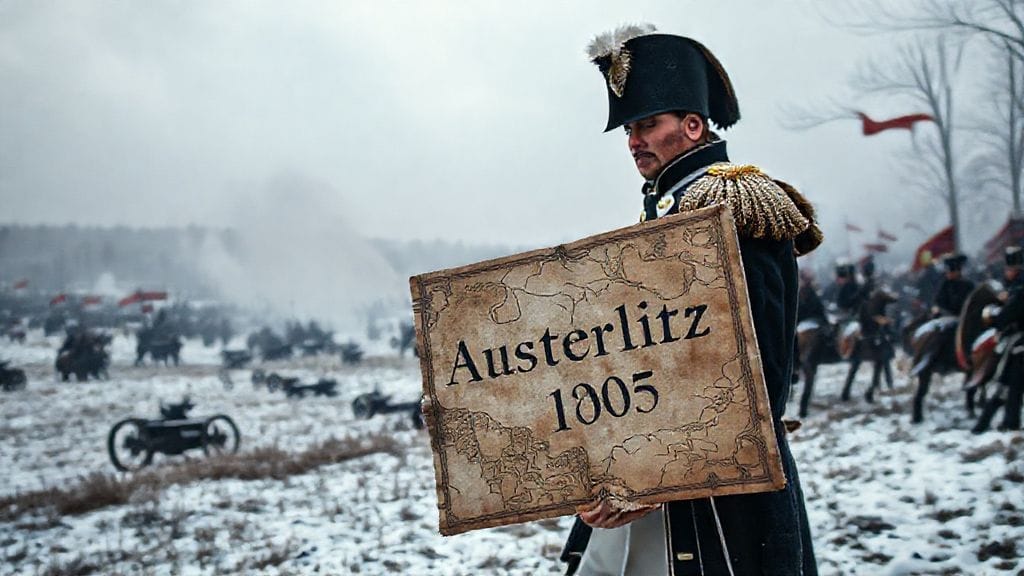
The brittle frost of early December crackled beneath the feet of tens of thousands of soldiers camped amid the snow-dusted fields of Moravia – near the small town of Austerlitz, known today as Slavkov u Brna. The sky was pale, smeared with the orange light of dawn, stretching over a landscape stiff with winter’s hold and heavy with the deep breaths of men poised for war. The air was sharp, almost biting, as if the very atmosphere sensed the storm about to break. It was December 2, 1805. An epic confrontation was about to unfold — one that would etch itself into the annals of military history and elevate Napoleon Bonaparte to almost mythical status.
But this was far more than just a battle — it was a decisive moment in the Napoleonic Wars, where empires clashed, destinies would alter, and the fragile balance of Europe would tilt on a knife’s edge.
The Stakes at Austerlitz: A Gathering Storm in Europe
Europe stood at a crossroads. The old order, represented largely by the Austrian Habsburg monarchy and the tsarist regime of Russia, was struggling to contain the chaotic rise of Napoleon’s France. The French Revolution had upended centuries-old traditions; Napoleon, an extraordinary military and political tactician, had crowned himself Emperor of the French in 1804. His aggressive campaigns had redrawn borders, toppled monarchies, and sent ripples of fear into the courts of Vienna, St. Petersburg, and London.
By late 1805, the Third Coalition against France had crystallized — Britain, Austria, Russia, Sweden, and Naples united in opposition. After Napoleon’s overwhelming success in Ulm, where the Austrian army was captured or dispersed, the Allied forces hurried to regroup near Moravia, determined to challenge the French and halt their expansion eastwards.
The tension was palpable: on one side, Napoleon, commanding approximately 73,000 men; on the other, the combined Russian and Austrian forces under Tsar Alexander I and Emperor Francis II, numbering around 85,000. This was to be a showdown not only of armies but of ideologies and visions for Europe’s future.
Napoleon’s Grande Armée vs. The Allied Forces: Forces and Leaders
The motley alliance of the Third Coalition was a fragile one, held together more by shared anxiety than genuine camaraderie. The Allied command structure was as fractured as the landscapes they marched upon. The Russian Tsar Alexander I, young and somewhat inexperienced in warfare, relied heavily on his trusted general, Prince Mikhail Kutuzov, a veteran commander with a cautious approach. The Austrians brought their own proud but beleaguered tradition, under the command of Emperor Francis II and his chief of staff, Karl Mack (who had suffered disgrace previously at Ulm).
Napoleon, in contrast, was more of a singular force. At 36, he was a general who combined ruthless pragmatism with a charismatic zeal. His Grande Armée was more than a military machine — it was a living organism, forged by experience, well-drilled to operate with precision, and infused with the belief in their leader’s genius.
The Prelude: Maneuvers and Deceptions Before Battle
The weeks preceding the battle witnessed a tense chess game of strategic positioning across the ridges, valleys, and frozen lakes around Austerlitz. Napoleon’s forces took up positions that appeared vulnerable, deliberately exposing the right flank near the Pratzen Heights—a commanding ridge that both armies sought to control.
Napoleon’s deception was masterful. Through false retreats and controlled withdrawals, he lulled the Allied commanders into overconfidence, convincing them that their enemies were weak, even on the verge of collapse. The Allies, craving a decisive victory, sought to exploit this supposed vulnerability.
Yet behind the scenes, Napoleon’s plan was to attack precisely the part of the Allied line that extended too far and was too thinly held — the heart of the allied army straddling the Pratzen Heights.
The Battlefield: Geography, Strategy, and Surprise
The terrain itself shaped the battle. The Pratzen Heights stood as a natural fortress dominating the surrounding plains. The villages of Austerlitz and Telnitz nestled around these strategic points with the frozen ponds and the Goldbach stream complicating troop movements.
Napoleon’s genius lay in seeing through the geography what others could not—recognizing the strategic importance of holding the heights and luring the Allies into attacking a seemingly weak right flank. The fog and early morning mist further cloaked the battle’s first moves, contributing to confusion and surprise.
The Opening Salvos: The Allies’ First Moves
At dawn, the Allies launched their assault. The Russian and Austrian troops moved in earnest to outflank the French right, their columns advancing through the mist, confident that the French center was vulnerable on the Pratzen Heights. Slow and methodical, their attack was hampered by fragmented command and the clinging cold.
Meanwhile, French forces held quietly, conserving strength in the center while resisting the initial Allied probes on their flanks. For several hours, a brutal artillery duel and skirmishing traded space and fire.
Napoleon’s Masterstroke: Feigning Weakness to Lure the Enemy
The heart of Napoleon’s plan was now in motion. Just as the Allied forces committed more troops to the right flank and descended from the Pratzen Heights, French columns surged upwards from the center with lethal precision.
Marshal Soult's IV Corps led the counterattack, seizing the unguarded heights. The sudden ascent and the fierce French assault split the Allied forces. The Russian and Austrian center was ruptured; chains of command faltered. As panic set in, French artillery laid devastating crossfires.
It was a stunning reversal — what seemed like a French weakness turned into their greatest strength. The moment became a military masterclass in timing, deception, and the exploitation of enemy error.
The Crushing Counterattack: The Collapse of the Allied Center
As the French surged up the heights, the Allied center began to crumble. Communications broke down; units became isolated. Confusion and fear spread quickly.
Battered by concentrated fire and overwhelmed by the rapid French advance, the Allied troops faltered. Attempts to regain the heights failed. The battle plan the Allies had so carefully prepared now lay in ruins.
Napoleon’s forces pressed their advantage ruthlessly, turning chaos into decisive victory.
The Role of the Imperial Guard: Steely Resolve in Chaos
Amid the unfolding carnage, the Imperial Guard—Napoleon’s elite troops—stood as a symbol of discipline and order. Holding key positions and reinforcing where the battle was most acute, they provided the backbone of the French advance.
Their presence inspired the rank and file, showcased Napoleon’s mastery not just of tactics but of morale. In many accounts, they were described as immovable “walls,” impenetrable and resolute.
The Allied Retreat: Confusion and Catastrophe Unfold
The collapse of the center triggered a massive withdrawal. Allied forces, caught between French pincers and imploding command structures, fled south and east in desperate disorder.
Thousands were captured, and many drowned attempting to cross the frozen lakes that littered the terrain. Horses, artillery, and supplies were abandoned or destroyed to prevent capture.
By afternoon, the battle was effectively over — a stunning French victory.
The Aftermath on the Field: Casualties, Captures, and Chaos
The cost was enormous. Around 36,000 Allied soldiers were lost — either killed, wounded, or captured — compared to approximately 9,000 French casualties. Entire units ceased to exist.
Napoleon himself toured the battlefield, composed yet visibly satisfied. His ability to turn the tide of a seemingly precarious situation into an overwhelming triumph was undisputed.
But beneath the military success lay the human cost — shattered families, orphaned children, and devastated homelands.
Austerlitz in the Eyes of Contemporaries: Letters and Eyewitness Accounts
Soldiers, officers, and even neutral observers penned letters and memoirs recounting the battle’s intensity. Many remarked on the eerie morning fog and the deadly lull before the storm.
Tsar Alexander reportedly said, “I have seen my army defeated, but never by such a masterful opponent.” Napoleon's marshal Masséna called it "the finest battlefield victory in history."
These voices bring flesh and blood to the cold accounts, revealing fear, admiration, and heartbreak intertwined.
Strategic Triumph: What Austerlitz Meant for Napoleon’s Empire
In the wake of Austerlitz, Napoleon’s position as Europe’s preeminent military genius was cemented. The Holy Roman Empire was effectively dissolved; Austria sued for peace, signing the Treaty of Pressburg.
This victory allowed Napoleon to redraw the map of Europe, creating client states and extending French influence deep into Central Europe. His aura of invincibility spread, emboldening his campaigns and intimidating rivals.
The Repercussions for Austria and Russia: A Shift in Power
For Austria, the defeat was a humiliating blow that triggered political upheaval and military reform. The Habsburgs lost territory, prestige, and influence.
Russia retreated to recalibrate. Despite the loss, Tsar Alexander I did not give up resistance, setting a stage for future confrontations, most notably the 1812 invasion of Russia.
The old coalition was shattered, but the animosities and ambitions that fueled it lingered.
Austerlitz and the European Balance of Power in 1806
With the Third Coalition disintegrated, the European balance of power shifted decisively toward France. Napoleon’s dominance over continental Europe was near absolute.
The victory at Austerlitz influenced the creation of the Confederation of the Rhine, aligned German states under French hegemony, and forced Britain to rethink its continental strategy, further reinforcing its naval supremacy.
The Legend Grows: How Austerlitz Became a Symbol of Military Genius
Napoleon’s victory transcended its immediate military consequences to become a symbol of supreme command.
Books, paintings, and poems celebrated his brilliance. “The Battle of the Three Emperors,” as it was sometimes called due to the attendance of Napoleon, Francis II, and Alexander I, grew in legend — a prototype of the perfect battle.
Generations of military strategists have studied Austerlitz for its lessons on deception, timing, and decisive action.
The Battle’s Impact on Military Doctrine and Tactics
Austerlitz introduced new standards in the conduct of battle—centralized command balanced by delegated initiative, flexible troop movements, and careful orchestration of deception.
Napoleon’s methods demonstrated how smaller forces could rout numerically superior enemies through superior strategy and morale.
Its study remains a cornerstone in military academies worldwide.
Remembering Austerlitz: Monuments, Museums, and Memory
Centuries later, the fields around Slavkov are dotted with monuments, memorials, and museums dedicated to the battle.
The Austerlitz battlefield, preserved and studied, draws historians, tourists, and reenactors alike. These commemorations remind us of the cost and glory of battle and the enduring human spirit behind historical events.
The Psychological Legacy: Napoleon’s Confidence and Hubris
Austerlitz bolstered Napoleon’s confidence undeniably but also sowed seeds of hubris.
The sense of invincibility after such a victory colored his future decisions and arguably contributed to mistakes seen in later campaigns like the disastrous invasion of Russia.
The battle thus serves as a lesson in both brilliance and the perils of overconfidence.
The Battle’s Place in World History: From 1805 to Modern Times
More than two centuries later, the Battle of Austerlitz stands as a defining moment in world military history.
It shaped the 19th-century European order, influenced nationalism and military innovation, and provided case studies on leadership and strategy that transcend time and geography.
An event frozen in the frosty fields of Moravia, yet burning brightly in the human story.
Conclusion
The Battle of Austerlitz was more than a clash of swords and guns; it was a drama of human wills, vision, and courage tested under the harshest conditions. On that cold December day, amidst the snow and fog, Napoleon Bonaparte did not just win a battle — he created a legend.
Yet, amid the glory lay the whispers of loss, sacrifice, and the transformative tides of history. Austerlitz teaches us about the power of ingenuity, the cost of ambition, and the fragile balance of forces that shape human destiny.
It remains a timeless chapter in the story of humankind — a reminder that history is not merely about the names and dates but about the flesh-and-blood people who lived, dreamed, and fought to forge their place in time.
FAQs
Q1: What were the main causes that led to the Battle of Austerlitz?
The battle arose from the formation of the Third Coalition against Napoleon’s expanding French Empire, primarily motivated by Austria and Russia’s desire to check French power after years of revolutionary wars and Napoleon’s crowning as Emperor.
Q2: Who were the key commanders at Austerlitz?
Napoleon Bonaparte led the French forces. The Allied forces were commanded by Russian Tsar Alexander I and Austrian Emperor Francis II, with generals like Prince Kutuzov on the Russian side involved.
Q3: How did Napoleon’s tactics influence the outcome?
Napoleon deliberately feigned weakness, luring the Allies into a vulnerable position. His timely and coordinated attack on the Pratzen Heights split the Allied center, turning their strength into a fatal weakness.
Q4: What were the immediate consequences of the battle?
Austerlitz destroyed the Third Coalition, led to the Treaty of Pressburg, the collapse of the Holy Roman Empire, and significant territorial gains for France. It established French dominance over much of continental Europe.
Q5: How did the battle affect Austria and Russia politically and militarily?
Both nations suffered humiliations that forced military reforms. Austria lost territory and influence, while Russia withdrew to rebuild, eventually contributing to future conflicts with France.
Q6: Why is the Battle of Austerlitz considered a masterpiece of military strategy?
Because it showcased masterful use of deception, terrain, timing, and morale, enabling a smaller, well-coordinated force to overwhelmingly defeat a larger coalition army.
Q7: How is the battle remembered today?
Through preserved battlefields, monuments, museums, and historical studies, Austerlitz remains a symbol of Napoleonic warfare and a subject of fascination for scholars and enthusiasts alike.
Q8: What lessons does Austerlitz offer to modern military strategists?
It underlines the importance of adaptability, intelligence, timing, psychological warfare, and exploiting enemy mistakes — principles still foundational in military theory worldwide.