Table of Contents
- The Dawn of Balaclava: A Chilling October Morning
- The Crimean War in Context: Great Powers Collide
- Strategic Stakes: Why Balaclava Mattered
- The British Army Arrives: Anxiety and Preparation
- The Artillery Duel: Opening Salvos Over the Ridge
- The Thin Red Line: A Stand Against the Thunderstorm of Cossacks
- The Charge of the Heavy Brigade: A Bold Counterblast
- The Light Brigade’s Tragic Ride: Courage Meets Chaos
- Voices from the Front: Eyewitness Accounts and Letters
- Command and Communication: Leadership in Turmoil
- The Russian Perspective: Ambitions and Miscalculations
- Balaclava’s Aftermath: Battlefield Chaos and Human Cost
- Media and Memory: How the Battle Captivated Victorian England
- The Legacy of the Thin Red Line in Military Lore
- Balaclava in Art and Literature: From Tennyson to Modern Media
- Lessons in Warfare: Balaclava’s Impact on Tactics and Strategy
- Remembrance and Monuments: Honoring the Fallen
- The Crimean Campaign’s Broader Impact on Europe
- Political Reverberations in London and St. Petersburg
- Modern Perspectives: Revisiting Balaclava’s Myths and Realities
The Dawn of Balaclava: A Chilling October Morning
October 25, 1854, broke over the windswept heights near Balaclava, Crimea, with a cold bite in the air and a sky mottled with heavy clouds. The early light revealed a landscape scarred by artillery fire, trenches half-dug, and soldiers huddled around meager fires, their breath visible in the frost. Tension hung thick among the troops—a forboding calm before a tempest. Far from home, thousands of British, French, and Ottoman soldiers found themselves part of a larger, brutal chess match against Russian forces, each seeking dominion over the strategically vital port city of Sevastopol.
Amid this chilling tableau, a slender line of British infantry prepared to repel what seemed an overwhelming cavalry charge. Across the valley, Russian horsemen thundered forward, a black tide of sabers glinting in the morning mist. It was in this fraught moment that the myth of the “Thin Red Line” was born—a testament to steadfast discipline and extraordinary courage in the face of implacable odds.
The Crimean War in Context: Great Powers Collide
The Battle of Balaclava was not an isolated spark but a flare in a broader conflagration—The Crimean War (1853–1856). This conflict, rooted in the decline of the Ottoman Empire and tangled alliances, pitted Russia against an uneasy coalition of Britain, France, the Ottoman Empire, and Sardinia. The immediate cause was Russia’s ambition to expand southwards and protect Orthodox Christian interests in Ottoman lands, particularly concerning control over the Holy Places in Jerusalem.
European powers watched anxiously; Britain and France feared Russian expansion threatened the balance of power, particularly the control of Mediterranean trade routes. This geopolitical turmoil created a volatile backdrop: armies clashed over faraway steppes and shores, military innovation met outdated tactics, and soldiers struggled through the harshest conditions of trench and siege warfare the modern era had yet known.
Strategic Stakes: Why Balaclava Mattered
Balaclava was a critical supply depot, just south of Sevastopol—the focal point of the allied siege. The winter months approached, and holding the port open was essential for the continuation of siege operations, bringing in food, ammunition, and reinforcements. Losing Balaclava would isolate the siege forces and possibly turn the campaign’s tide in favor of the Russians.
The ridge overlooking Balaclava offered commanding views and control of key roads. Whichever side held the high ground could dominate movements in the valley below. Both British and Russian commanders understood the dangers and possibilities this terrain held.
The British Army Arrives: Anxiety and Preparation
By October 1854, the British army, a mix of seasoned regulars, green recruits, and officers from aristocratic backgrounds, found themselves entrenched along the ridge near Balaclava. Morale was fragile; disease and supply shortages took their toll, and the harsh Crimean climate tested even the most hardened among them.
Lieutenant Colonel James Thomas Brudenell, the 7th Earl of Cardigan, commanded the famed Light Brigade. Nearby, the 93rd Highlanders, led by Sir Colin Campbell, prepared their defensive stand—the "Thin Red Line." Officers paced nervously; scouts reported Russian cavalry movements. Everyday soldiers wrapped in greatcoats looked eastward, awaiting the coming storm.
The Artillery Duel: Opening Salvos Over the Ridge
As dawn turned to morning, a long-range artillery duel erupted. British and French cannons exchanged thunderous volleys with Russian batteries positioned beyond the valley. Shells screamed overhead, exploding with deadly precision. The ground shook as men scrambled for cover behind earthworks and rock.
This exchange was not just a prelude but a deadly contest of attrition. The Russians sought to probe defenses and soften British lines before committing to their larger cavalry assault. British gunners, though outnumbered in some sectors, fought with determination, underscoring the importance of maintaining control of the ridge.
The Thin Red Line: A Stand Against the Thunderstorm of Cossacks
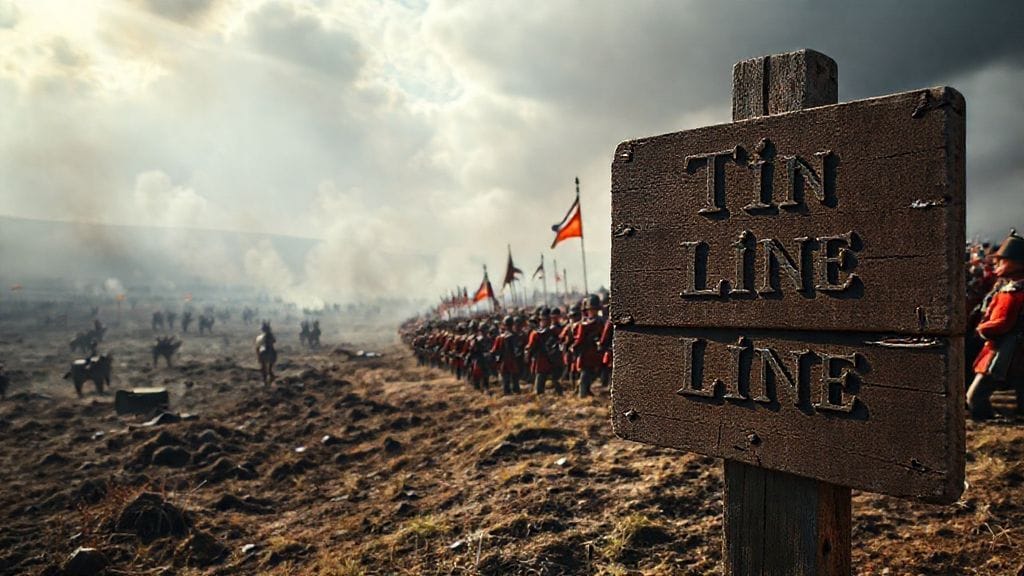
The moment that immortalized the Battle of Balaclava came when the 93rd Highlanders, forming just two ranks across the road—an epitome of discipline and resolve—stood firm against a massive charge of Russian cavalry.
Witnesses described the scene with a mix of awe and disbelief. As the Cossack horsemen surged forward, the lightly armed Highlanders held their fire until the last possible moment, then unleashed a devastating volley. The onslaught broke, faltering against the savage determination of men who refused to yield.
The poet Alfred, Lord Tennyson would later capture that moment in verse, coining the phrase that would echo for generations—the "Thin Red Line." This small but unyielding band of soldiers symbolized the very essence of military grit and the human will to stand unbroken before the storm.
The Charge of the Heavy Brigade: A Bold Counterblast
Not far away, another cavalry engagement unfolded. The Heavy Brigade, under General James Scarlett, faced a sizable force of Russian cavalry attempting to seize control of critical ground over the causeway. Against the odds, Scarlett ordered a charge uphill—an audacious maneuver challenging conventional military wisdom.
Their thunderous assault caught the Russians by surprise. The Heavy Brigade penetrated enemy lines, scattering the attackers and reclaiming lost ground. It was the only successful cavalry charge of the day and a beacon of hope amidst chaos.
This action demonstrated the importance of leadership decisiveness and the power of shock cavalry in mid-19th-century warfare, though it remained overshadowed by the later catastrophe of the Light Brigade.
The Light Brigade’s Tragic Ride: Courage Meets Chaos
But the heart of Balaclava’s drama—and tragedy—was the Charge of the Light Brigade. Ordered by the Earl of Cardigan, amid a fog of miscommunication, the lightly armed cavalry unit was sent galloping into a deadly valley surrounded by Russian artillery on three sides.
What followed is one of military history’s most poignant episodes: the Light Brigade’s desperate dash into near-certain slaughter. Despite the familiar shouting of officers and the rattle of sabers, the men confronted a hellstorm of cannonballs, grapeshot, and rifle fire.
The charge inflicted losses of nearly half the brigade’s men and horses. Tales of individual bravery abound—of troopers who fought to the last breath, of officers who died leading charges far beyond the line of retreat. Yet, behind the heroism lay a somber narrative of confusion, flawed orders, and the futility of valor when strategy fails.
Voices from the Front: Eyewitness Accounts and Letters
Soldiers and officers wrote home that day and afterwards, their letters painting vivid, often harrowing pictures of the battle. Captain Louis Nolan, who famously communicated the muddled order, died during the charge. Private accounts spoke of fear, camaraderie, and sheer astonishment at surviving the inferno.
One letter from a Highlander recalled, “We stood firm, the Cossacks like wolves upon us, but we fired as one man… it was as if the world held its breath.” Another from a Light Brigade survivor noted the “thunder of death” and the “wheels of hell” rolling ever closer.
These personal narratives transformed the battle from statistics into human experience, anchoring the event in the collective memory of a nation.
Command and Communication: Leadership in Turmoil
Behind the scenes, command and communication woes played as decisive a role as individual valor. Ambiguous orders, misinterpretations, and the fog of war collided disastrously.
Lord Raglan’s intentions, transmitted through Captain Nolan and an unclear chain of command, became distorted by intermediary officers. The final disastrous order sent the Light Brigade into a valley ill-suited for cavalry attack and overlooked the tactical realities on the ground.
This failure highlighted systemic issues in 19th-century military command structures and the lethal consequences of poor communication—lessons bitterly learned amid the carnage.
The Russian Perspective: Ambitions and Miscalculations
From the Russian side, commanders sought to exploit weaknesses in the allied positions at Balaclava. Cavalry charges aimed to disrupt supply lines and force a retreat from critical infrastructure. Yet despite the numerical advantage in horsemen, Russian forces often poorly coordinated their attacks or failed to apply overwhelming pressure.
Some historians argue that the Russian command underestimated the resilience and firepower of British infantry and cavalry, leading to missed opportunities to penetrate enemy defenses more decisively.
Their perspective adds nuance—Balaclava was not just a British tale of triumph and tragedy but a clash of strategic intent and human limitation on both sides.
Balaclava’s Aftermath: Battlefield Chaos and Human Cost
As the smoke cleared, Balaclava lay blighted by death and confusion. Casualties were staggering—hundreds dead, wounded, or missing amidst shattered artillery, tangled horses, and abandoned weapons.
The battlefield itself became a scene of grim excavation, medical triage, and sobering realization. The Light Brigade, decimated but unbroken in spirit, withdrew. The Highlanders tended their wounded and took stock of a victory marred by the cost.
For many soldiers, the horrors witnessed left indelible psychological scars. For the British public, the raw reports sparked a mixture of pride and outrage at the needless loss of life.
Media and Memory: How the Battle Captivated Victorian England
News of Balaclava ignited a media frenzy. Newspapers, journals, and poems carried the tales of heroic stands, reckless charges, and the steadfast "Thin Red Line" into drawing rooms across Britain.
Alfred, Lord Tennyson’s poem, commissioned by Queen Victoria herself, immortalized the Light Brigade’s charge in verse that blended admiration with sorrow. Headlines celebrated the courage but also questioned the leadership.
This burgeoning war journalism marked a pivotal moment—the public became more directly engaged with the brutal realities of warfare, shaping how Balaclava and the Crimean War were remembered for generations.
The Legacy of the Thin Red Line in Military Lore
The image of the Thin Red Line transcended the battle. It became shorthand for unyielding courage and disciplined resolve in infantry warfare. Military academies studied it as a model of defensive stance under fire; popular culture embraced it as the symbol of British stubbornness and professionalism.
Yet, the phrase also encapsulated British ambivalence—a pride in steadfastness but an acknowledgement of strategic vulnerability amid modernizing warfare.
Balaclava in Art and Literature: From Tennyson to Modern Media
The Battle of Balaclava inspired artists beyond the battlefield. Iconic paintings by Robert Gibb and other Victorian artists dramatized the Thin Red Line and the Light Brigade charge in vivid color and emotion.
Literary and musical works echoed the themes of valor and tragedy. The battle has appeared in cinema, television, and video games, each retelling layering new interpretations onto the original events—sometimes heroic, sometimes critical.
This artistic legacy ensured that Balaclava remained not only a historic event but a cultural touchstone.
Lessons in Warfare: Balaclava’s Impact on Tactics and Strategy
Military analysts dissected Balaclava extensively. The battle underscored the perils of outdated Napoleonic tactics when confronted with emerging artillery firepower and the necessity for clear communication.
It accelerated reforms in British military logistics, command structure, and battlefield medicine. The need for coordinated cavalry roles and combined arms operations became painfully evident.
Balaclava thus served as a grim classroom, its lessons influencing military thought well into the 20th century.
Remembrance and Monuments: Honoring the Fallen
Across Britain and Crimea, numerous monuments commemorate the battle and its fallen heroes. In London, the Crimean War Memorials honor the soldiers whose courage and sacrifice have become integral to national memory.
In Crimea, the battlefield is now a place of pilgrimage—a tangible link to the past that invites reflection on the human cost of empire and war.
Ceremonies and commemorations continue to recall the bravery and tragedy witnessed in autumn 1854.
The Crimean Campaign’s Broader Impact on Europe
Balaclava was a single but decisive episode within a campaign that reshaped European geopolitics. The Crimean War exposed the weaknesses of the Russian Empire, contributed to the end of the Concert of Europe, and foreshadowed shifting alliances.
It accelerated modernization within armies and navies, influenced the unification of Italy and Germany, and highlighted the growing importance of international media in warfare.
Its reverberations extended far beyond the dusty valleys of Balaclava.
Political Reverberations in London and St. Petersburg
Back in capitals, news of Balaclava fueled political debate. British Parliamentarians criticized military leadership and called for reforms; Russian officials grappled with the consequences of the defeat and the limits of their imperial ambitions.
The war strained diplomatic relations and domestic stability in both empires, eventually contributing to a cautious peace but leaving unresolved tensions.
Modern Perspectives: Revisiting Balaclava’s Myths and Realities
Today, historians revisit Balaclava armed with new archives, archaeological evidence, and critical analysis. The romanticized accounts are balanced by sober assessments of mistakes, mismanagement, and the brutal realities faced by common soldiers.
Reevaluating Balaclava informs broader discussions about heroism, military ethics, and the costs of empire. It remains a potent symbol—a story of courage enveloped in complexity.
Conclusion
The Battle of Balaclava—famed for the Thin Red Line and the Charge of the Light Brigade—remains an enduring chapter in the grand narrative of warfare and human resilience. It captures the paradox of heroism: extraordinary courage unfolding amidst chaos, confusion, and tragedy. Beyond its tactical details and political ramifications, Balaclava invites us to reflect on the costs of conflict and the limits of valor without clarity.
In its echoes through poetry, art, and memory, the battle resonates across time as a testament to discipline, sacrifice, and the frailty of even the most heroic endeavors. The thin red line reminds us that history is not merely dates and facts but stories of men and women facing their most harrowing moments, striving to hold firm as the world shifts around them.
FAQs
Q1: What was the primary cause of the Battle of Balaclava during the Crimean War?
The battle was fought primarily over control of the crucial supply port of Balaclava, which supported the allied siege of Sevastopol. The Russian forces aimed to disrupt these lines to relieve pressure on their defenses.
Q2: Who were the main combatants involved in the Battle of Balaclava?
The primary combatants were British and Russian forces, with British allies including French and Ottoman troops nearby. Key British units included the 93rd Highlanders, the Heavy Brigade, and the Light Brigade.
Q3: Why is the “Thin Red Line” significant?
The “Thin Red Line” refers to the disciplined stand of the 93rd Highlanders against a Russian cavalry charge. Their steadfast defense under heavy pressure became a symbol of courage and military discipline.
Q4: What caused the disastrous Charge of the Light Brigade?
A combination of unclear orders, poor communication, and misunderstandings among British commanders led the Light Brigade to charge directly into a heavily fortified Russian artillery position, resulting in heavy casualties.
Q5: How did the Battle of Balaclava affect military tactics and leadership?
The battle exposed weaknesses in communication and command structures, emphasizing the need for clearer orders and better coordination in modern warfare. It also highlighted the evolving role of cavalry in the face of artillery.
Q6: How was Balaclava remembered and commemorated in Britain?
Victorian media lionized the bravery displayed, especially through Tennyson’s poetry. Monuments and memorials were erected, and the battle became a defining story in British military history and culture.
Q7: What lessons does Balaclava offer to modern military history?
Balaclava underscores the importance of leadership clarity, the realities of technological change in warfare, and the human dimension of combat, balancing valor with strategic prudence.
Q8: What was the broader impact of the Crimean War, including Balaclava, on Europe?
The war weakened the Russian Empire, reshaped European alliances, and accelerated military and political reforms, contributing to shifts that would eventually lead to new power configurations in the late 19th century.