Table of Contents
- The Roar Before the Storm: A Prelude to Bannockburn
- Scotland in Flames: The Context of Early 14th Century Conflict
- The Claimants and the Crown: The Struggle for the English Throne and Scottish Independence
- Edward II: A King Unready for War
- Robert the Bruce: The Heartbeat of Scottish Resistance
- Stirling Castle: The Prize that Stirred Nations
- The March to Bannockburn: Forces Gather at the Edge of Destiny
- Day One – June 23, 1314: Skirmishes and Strategic Maneuvers
- The Terrain of Fate: How Bannockburn’s Landscape Became a Silent Ally
- Day Two – June 24, 1314: The Decisive Clash That Shattered An Empire’s Ambition
- The Scottish Schiltrons: Spearmen on a Mission
- The English Cavalry and Their Downfall: From Confidence to Collapse
- The Deaths and Heroics: Tales of Blood and Valor
- The Aftermath: A King Fled, A Nation Roared
- The Battle's Political Tremors Across Britain and Beyond
- Scotland’s Renewal: Identity, Independence, and Myth-Making
- Edward II’s Reign After Bannockburn: Decline and Defeat
- The Battle in Memory: Legends, Songs, and National Consciousness
- Bannockburn on the Global Stage: A Precursor to Revolutionary Nationalism?
- Archaeology and Bannockburn: Unearthing the Battlefield’s Secrets
- Modern Commemorations: Bannockburn in Culture and Politics
- Lessons from Bannockburn: Leadership, Terrain, and National Spirit
- Conclusion: The Eternal Flame of Bannockburn
- FAQs
- External Resource
- Internal Link
1. The Roar Before the Storm: A Prelude to Bannockburn
June 23, 1314, dawned over the green fields near Stirling, Scotland, under a sky heavy with the anticipation of war. The morning air carried the murmurs of thousands of soldiers—men hardened by years of conflict, their breath visible in the chill, their weapons glistening with the cold fire of steel sharpened for battle. The atmosphere was electric: on one side, the aging King Edward II of England, anxious yet determined to crush the rebellious Scots once and for all; on the other, Robert the Bruce, the King of Scots whose fierce hope and tenacity burned brighter than the rising sun.
The land between Bannockburn and St. Ninian’s was set to become a cauldron of blood and history. It was not just a clash of armies—it was a collision of wills, a decisive moment in Scotland’s turbulent fight for survival and sovereignty. As the flags unfurled and the war horns echoed, time seemed to hold its breath.
2. Scotland in Flames: The Context of Early 14th Century Conflict
The early 1300s were a maelstrom of political upheaval. Scotland had declared its independence under the Declaration of Arbroath, while England sought to reassert control following the First War of Scottish Independence. After the death of William Wallace and the capture of Scottish nobles, the English crown's grip troubled Scotland’s freedom fiercely yet unevenly.
Edinburgh, Berwick, and the rolling hills of the Scottish Highlands were not just landscapes; they were battlegrounds of identity, loyalty, and survival. The English wanted to extinguish the flickering Scottish rebellion, while the Scots saw every battle as a desperate plea against subjugation.
3. The Claimants and the Crown: The Struggle for the English Throne and Scottish Independence
At the heart of the turmoil was the tangled web of claims on the Scottish and English thrones. Edward I, the “Hammer of the Scots,” had died two years before, but his son, Edward II, inherited not only the crown but an impossible task: to secure what his father had waged brutal wars to attain.
Meanwhile, Robert the Bruce, crowned King of Scots in 1306 in a bold bid for sovereignty, was fighting not only English occupation but the fractured loyalties within his own country. His reign was marred by betrayal, exile, and relentless warfare. Yet, standing firm was central to his vision—a vision that found its crucible at Bannockburn.
4. Edward II: A King Unready for War
Edward II’s reign was marked by internal dissent and questionable leadership. Unlike his father, he lacked military prowess and charisma. His reliance on favorites like Piers Gaveston alienated many nobles, and his capacity to inspire his troops was limited.
As the English army crossed the Scottish border with the intent to relieve the siege of Stirling Castle, whispers of doubts and fears rippled through the ranks. This was a king strained beyond his limits, embattled not only by foreign foes but by the corpses of his own authority crumbling.
5. Robert the Bruce: The Heartbeat of Scottish Resistance
Robert the Bruce was a man forged in the crucible of hardship. Once a noble with divided loyalties, he had transformed into the embodiment of Scottish determination. His strategic genius was matched by a deep resolve to unite a fractured kingdom.
The King’s knowledge of his homeland’s rugged terrain became an invaluable asset. More importantly, Bruce understood the soul of his people: fierce independence, a willingness to endure hardship, and an unshakable loyalty to their homeland.
6. Stirling Castle: The Prize that Stirred Nations
Stirling Castle, perched on a rocky outcrop, was more than a fortress; it was a symbol. Control over Stirling meant control over the Northern Highlands and the gateway to the rest of Scotland. Its possession was pivotal, making it a strategic and psychological prize for both sides.
By June 1314, the castle was under siege by Robert the Bruce's forces—a direct challenge that compelled Edward II to march north with an army sufficient to break the siege and crush the Scottish rebellion outright.
7. The March to Bannockburn: Forces Gather at the Edge of Destiny
Edward II's forces numbered between 15,000 and 20,000—a formidable force consisting of English knights, archers, and mercenaries. Robert the Bruce led roughly 5,000 to 6,000 Scots, but their numbers obscured something deeper: unity of purpose, intimate knowledge of the land, and an unbreakable will to fight for their homeland.
The armies converged near Bannockburn, and the surrounding countryside buzzed with tension and whispered prayers. Both leaders understood that this battle would tilt the scales of history.
8. Day One – June 23, 1314: Skirmishes and Strategic Maneuvers
The first day of battle was a dance of probing attacks and cautious advances. English knights sought to test Scottish defenses, but Bruce’s forces, utilizing schiltrons—dense formations of spearmen—held their lines with a discipline that surprised many.
Sentries reported on the enemy formations; scouts measured terrain and morale. Though inconclusive, the first skirmishes foreshadowed the ferocity of what lay ahead.
9. The Terrain of Fate: How Bannockburn’s Landscape Became a Silent Ally
Bannockburn's rolling fields, interspersed with marshes and woods, were more than mere background; they were weapons in the hands of a shrewd commander. Bruce chose the battleground with care—narrow approaches hindered the English cavalry's famous charges, and uneven terrain blunted heavy horsemen's momentum.
Nature itself seemed to whisper its assent, positioning the English forces into vulnerabilities that would soon be mercilessly exploited.
10. Day Two – June 24, 1314: The Decisive Clash That Shattered An Empire’s Ambition
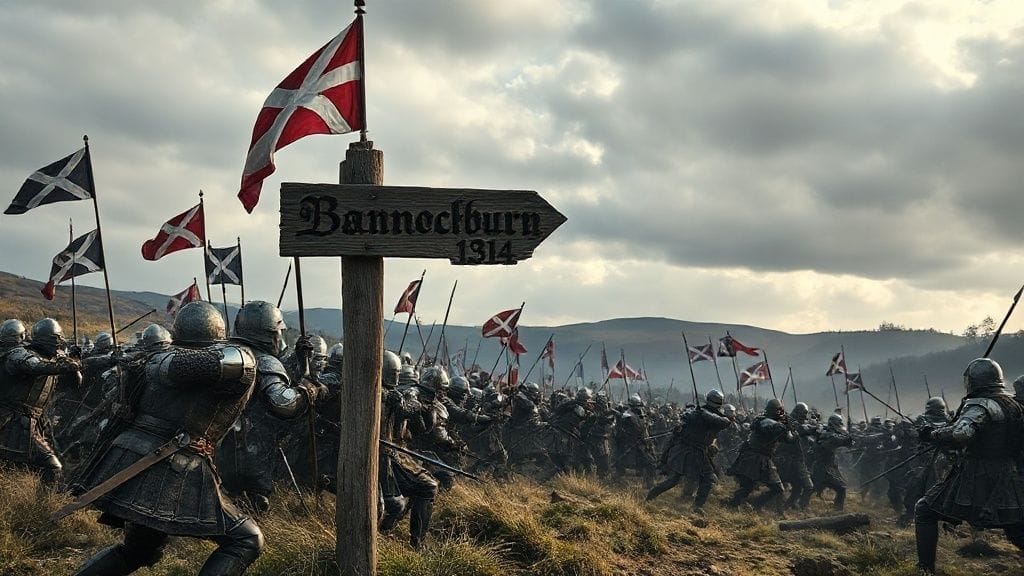
On June 24, the battle reached its fiery crescendo. The two armies met in earnest—steel clanged, arrows blotted the sun, and the cries of the wounded painted a grim symphony. English knights galloped forward with confidence, expecting to crush the Scots with heavy charges.
But the Scots stood firm. The schiltrons’ compact formations of spears, like impenetrable hedgehogs, rebuffed cavalry assaults. The weight of Scottish resolve grew heavier as the day pressed on. Gradually, cracks appeared in the English lines—their formations fragmented, morale wavered, and panic began to stir.
11. The Scottish Schiltrons: Spearmen on a Mission
The schiltron was a revelation—a defensive tactic that turned spearmen into moving walls. Somewhat immobile but devastatingly effective, these formations neutralized the advantage of England’s mounted knights and archers.
Bruce's commitment to training and discipline transformed these masses into a formidable bulwark. The warriors knew that their lives and liberty depended on holding the line, and they did so with grim determination.
12. The English Cavalry and Their Downfall: From Confidence to Collapse
The English cavalry had been the pride of Edward I’s previous campaigns. Yet at Bannockburn, their heavy armor and charges found no purchase in the muddy, constricted field. Repeated assaults against the schiltrons drained their strength.
Fatigue set in. Command faltered. Confusion spread. Some knights were swallowed by the chaos, others surrendered, and key leaders, including the Earl of Gloucester, fell wounded or captured.
13. The Deaths and Heroics: Tales of Blood and Valor
Among the carnage, moments of individual bravery shine through. Sir Simon Fraser, “the Patriot,” fought fiercely for Scotland’s cause, meeting his end with honor. English nobles fought desperately to rally their men, but fate was unkind.
On the Scottish side, Robert the Bruce was reportedly seen rallying his troops, standing steadfast amidst arrows and melee. Such stories would echo through the centuries, forging a narrative of resilience and heroism.
14. The Aftermath: A King Fled, A Nation Roared
By evening, it was clear: the English army was battered and broken. Edward II fled, his regal ambitions shattered. Stirling Castle’s siege was lifted, and Scotland rejoiced with a fervor that had not been kindled in decades.
This was more than a military victory—it was a vindication of Scottish identity and a decisive blow to English claims over Scotland.
15. The Battle's Political Tremors Across Britain and Beyond
Bannockburn sent shockwaves through the British Isles and Europe. For England, it was a humiliation that undermined Edward II’s authority and emboldened rivals. For Scotland, it was a diplomatic lever; though independence was not yet fully secured, the victory forced England to the negotiating table again.
Across the continent, monarchs watched with interest, noting that a smaller, united force could defy a larger, established kingdom.
16. Scotland’s Renewal: Identity, Independence, and Myth-Making
The victory birthed a renaissance of Scottish nationalism. The battle, its heroes, and its myths wove into the tapestry of Scottish culture and folklore. It nurtured poets like Blind Harry, whose The Wallace and later histories stoked the fires of pride.
Bannockburn became a symbol not merely of battle but of enduring independence and spirit.
17. Edward II’s Reign After Bannockburn: Decline and Defeat
The defeat at Bannockburn gravely damaged Edward II’s reign. Weak and embattled, he faced rebellion at home and the court’s Machiavellian intrigues. He was eventually deposed in 1327, his reign regarded by many historians as one of failure and misfortune.
His legacy, forever tied to Bannockburn, serves as a cautionary tale about the pitfalls of poor leadership.
18. The Battle in Memory: Legends, Songs, and National Consciousness
Centuries later, Bannockburn remains alive in Scottish narratives: re-enacted in pageants, commemorated in songs, and present in the collective consciousness. It is a cornerstone in the story told about what it means to be Scottish.
This battle bridges past and present, inspiring debates about sovereignty, identity, and the power of unity.
19. Bannockburn on the Global Stage: A Precursor to Revolutionary Nationalism?
Some historians argue that Bannockburn foreshadowed later nationalist movements worldwide—how underdog nations or peoples, against imperial forces, claimed their voice through unity and symbolic victories.
Whether seen as a military milestone or an early spark of self-determination, its global echoes cannot be ignored.
20. Archaeology and Bannockburn: Unearthing the Battlefield’s Secrets
Modern archaeology has sought to clarify details long obscured by time. Excavations have uncovered weapon fragments, skeletal remains, and fortifications, shedding new light on the battle’s scale and ferocity.
Each artifact connects us more intimately to the men who fought and died on that fateful field.
21. Modern Commemorations: Bannockburn in Culture and Politics
Today, Bannockburn’s legacy serves both celebration and reflection. Annual events attract visitors from across the globe, while political movements in Scotland tap into the battle’s symbolism when debating independence and identity.
The battlefield itself has become a site of pilgrimage, storytelling, and education.
22. Lessons from Bannockburn: Leadership, Terrain, and National Spirit
What does Bannockburn teach us? Leadership, exemplified by Robert the Bruce’s mix of courage and strategy; the importance of terrain mastery; and most profoundly, the power of a united people fighting for their homeland.
Bannockburn is a masterclass in how psychological and geographical factors can eclipse sheer numbers.
23. Conclusion: The Eternal Flame of Bannockburn
The Battle of Bannockburn was far more than a military engagement—it was an awakening, a story of resilience that resonates through Scotland’s history. Amidst the blood and chaos, it forged a nation’s soul, igniting a flame that still burns in the hearts of Scots and all who champion the ideals of freedom and identity.
In the dusty fields near Stirling, history was made, and with it, a reminder that even the mightiest empires can falter when faced with courage and unyielding spirit.
FAQs
Q1: What were the main causes of the Battle of Bannockburn?
The battle stemmed from the ongoing Wars of Scottish Independence, primarily over English attempts to assert control over Scotland and Scottish efforts to maintain sovereignty. The siege of Stirling Castle by Scottish forces in 1314 compelled Edward II to respond militarily.
Q2: Who were the leading figures at Bannockburn?
King Robert the Bruce of Scotland and King Edward II of England were the central commanders. Other notable figures included Scottish nobles like Sir James Douglas and Thomas Randolph, and English leaders such as the Earl of Gloucester.
Q3: What was the significance of the schiltron formation?
The schiltron was a dense infantry formation of spearmen, crucial for countering English cavalry charges. Its effective use by the Scots neutralized the English knights’ advantages in heavy cavalry.
Q4: How did the terrain affect the outcome of the battle?
The marshy, uneven ground around Bannockburn limited the mobility of the English cavalry, playing to Scottish strengths and contributing significantly to their victory.
Q5: What were the immediate consequences of the battle?
The English army was defeated, Stirling Castle remained under Scottish control, and the defeat weakened Edward II’s authority. It bolstered Scottish morale and legitimacy, although full independence would come only later.
Q6: How is Bannockburn remembered today?
It is commemorated as a symbol of Scottish national pride and resistance. Modern reenactments, monuments, and cultural celebrations keep the memory alive.
Q7: Did Bannockburn end the Wars of Scottish Independence?
No, the war continued intermittently for several more years, but Bannockburn was a decisive turning point that greatly improved Scotland’s position in negotiations.
Q8: How reliable are the historical sources on Bannockburn?
Sources vary; contemporary chronicles, later poems, and archaeological evidence all contribute but sometimes offer conflicting details. Modern historians balance these to reconstruct the most plausible account.

