Table of Contents
- A Spring Evening in Anjou: Setting the Stage for Disaster
- England’s Triumphant Decade and the Shadow Over France
- Scotland’s Vengeful March South
- Baugé and the Landscape of Ambush
- Princes and Captains: The Cast of 1421
- The Rash Advance of Clarence
- Easter Saturday: Crossing the Bridge into Legend
- Steel in the Fields: How the Battle Unfolded
- The Death of a Prince and the Collapse of an Army
- Echoes in England: Grief, Fury, and the Weight on Henry V
- Consequences in France: A Kingdom Still Fighting
- Scotland’s Hour of Glory and the Price Paid
- Tactics, Terrain, and Miscalculation: Why the English Lost
- Voices from the Past: Chronicles and Memory
- From Baugé to Patay: A Chain of Unexpected Reversals
- The Long Memory of a Short Battle
- Reconstructing 1421: What We Know and What We Guess
- Conclusion
- FAQs
- External Resource
- Internal Link
Article Summary: On 22 March 1421, amid the grinding chaos of the Hundred Years’ War, the battle of baugé unfolded in the soft river valleys of Anjou and shattered the illusion of English invincibility forged by Agincourt. This article traces the political, social, and emotional landscape that led to that fateful Easter Saturday, when an overconfident English force under Thomas, Duke of Clarence, hurled itself against a coalition of French and Scottish troops. It follows the decisions, missteps, and acts of courage that turned a raid into a catastrophe and left a prince of the blood dead in a farmer’s field. Through reconstructed scenes, historical analysis, and testimonies drawn from contemporary chroniclers, the narrative explores how the battle of baugé altered morale, alliances, and strategy across three kingdoms. It also examines the Scottish quest for revenge, the French struggle for survival, and the English court’s stunned reaction to this sudden reversal. Yet behind the clash of arms, the article highlights the ordinary soldiers — archers, men-at-arms, Scottish spearmen — whose lives and deaths rarely appear in official records. In the end, the battle of baugé emerges not as an isolated encounter, but as a hinge in the wider story of the Hundred Years’ War, shaping what came after in ways contemporaries could barely grasp.
A Spring Evening in Anjou: Setting the Stage for Disaster
Twilight came late in Anjou on 22 March 1421. The fields around the small town of Baugé, still damp from winter rains, glimmered with patches of standing water that mirrored a sky streaked in grey and pale rose. The air carried the familiar smells of rural France — turned earth, woodsmoke, the faint sourness of wet straw — but on that day there was something else as well: the metallic tang of anticipation, the quiet terror that comes when armed men move through the countryside.
To most of Europe, this was simply one more day in the long torment later called the Hundred Years’ War. Yet for those walking the lanes and watching from shuttered windows, it was the day when the calm, winding River Couasnon — and the modest bridge at Baugé — would become the axis around which lives, dynasties, and reputations turned. The battle of baugé would be short, brutal, and decisive, but in that final quiet hour before steel met flesh, nothing was yet certain.
The English column under Thomas of Lancaster, Duke of Clarence, had been moving hard. Reports placed them scattered across the nearby villages, some billeted in barns, others in makeshift camps. Horses steamed in the cold, knights grumbled at the lack of plunder, and men-at-arms cursed the wet ground that pulled at their boots. They believed they were predators stalking a wounded enemy: a Franco-Scottish army thought exhausted, divided, and ripe for surprise. Clarence, brother to King Henry V, nursed his own impatience. His king was in England, and glory in France was his to seize.
Across the same landscape, out of sight but never far, the Scots and French were also on the move. They had crossed the Loire, marched through late-winter mud, and now gathered near Baugé with a resolve hardened by years of humiliation and by one battle in particular: Agincourt, fought in 1415, a name that burned in Scottish memory almost as fiercely as it did in French. That English victory had carved a legend; the coalition facing Clarence nursed a different sort of legend in the making, one fueled by grief and vengeance.
It is astonishing, isn’t it, how thin the line is between routine patrol and historic catastrophe? On this evening, no trumpets announced the coming clash to the villagers sheltering inside. Chickens clucked in the dirt yards, dogs barked at strange scents, and abbey bells tolled the approach of Easter — a time of resurrection, of peace. But this was only the beginning of a night that would end with fields strewn with English dead and a dead prince lying in blood-darkened grass. The battle of baugé would be over within hours. Its consequences would linger for generations.
England’s Triumphant Decade and the Shadow Over France
To understand why Clarence rode so recklessly into Anjou in March 1421, we must step back to the broader arc of the war that brought him there. By the second decade of the fifteenth century, England, under the iron will of Henry V, seemed to have history on its side. The kingdom that had once staggered under internal rebellion and financial strain now looked outward with renewed energy and ruthless purpose.
In 1415, Henry V had crossed the Channel with an army that contemporary observers estimated at around 12,000 men. His siege of Harfleur, though grueling and disease-ridden, succeeded. The march that followed, across northern France toward Calais, culminated in the legendary battle of Agincourt. English longbowmen, planted behind stakes on a waterlogged field, cut down French knights in their hundreds. The French nobility, already fractured by internal factionalism, saw some of its greatest names die in the mud: the constable of France, the admiral, dukes, counts, banners trampled underfoot.
Agincourt did more than win Henry a battlefield victory; it resurrected the very idea of English conquest in France. In parliament and pulpit, the campaign was painted as proof of divine favor. Henry’s propagandists wove the story into a tapestry of destiny: the rightful Plantagenet claim to the French crown, the punishment of French arrogance, the restoration of a lost empire. Over the next few years, one success followed another. By 1420, Henry forced the Treaty of Troyes upon a broken French court.
That treaty was astonishing in its audacity. Charles VI of France, mentally unstable and politically weak, recognized Henry V as his heir and regent, disinheriting his own son, the dauphin Charles. The English king married Charles VI’s daughter, Catherine of Valois, sealing a union that promised a dual monarchy. English officials walked through French towns as new masters; English garrisons sleepily watched over gates that had once barred them. It seemed the war might end not with piecemeal territorial concessions, but with the complete overturning of the French royal line.
But even at the height of this apparent triumph, the edifice was fragile. Large regions of France still resisted. The dauphin held court in Bourges and drew to him loyalists opposed to Troyes. Peasants in many districts treated English troops not as legitimate rulers but as occupiers. Wolves prowled in depopulated fields; in some places, the dead outnumbered the living. As the French chronicler Enguerrand de Monstrelet observed in another context, “War ate the kingdom like a disease of the blood.” The appearance of English invincibility hid deep cracks.
And there was another destabilizing force that English confidence never fully reckoned with: Scotland. The Auld Alliance between Scotland and France, sealed in blood and law over generations, remained one of the most enduring diplomatic realities of medieval Europe. When English banners advanced too confidently on the continent, Scottish lords took note — and some prepared to cross seas not merely to help an ally, but to settle old scores.
Scotland’s Vengeful March South
For Scotland, the early fifteenth century was a time of both captivity and opportunity. King James I had been a prisoner in England since 1406, taken at sea while a teenager. In his absence, regents and great magnates jockeyed for power at home, but one policy endured: the enduring hostility toward England and the commitment to France.
The Auld Alliance, first formalized in the late thirteenth century, was born out of shared fear and shared enmity. Whenever England pressed hard on one frontier, it risked a counterblow from the other. Scottish soldiers fought in French service at many points during the Hundred Years’ War, but in the years after Agincourt, that flow became a determined stream. Young lords, landless knights, and hardened retainers rode to the ports, boarded ships, and took service under French banners. Some sought pay; others, glory; all carried memories of English raids, burned crops, and slain kin.
By 1419–1420, a substantial Scottish expeditionary force had formed in France. Estimates vary, as they almost always do in medieval warfare, but a figure of several thousand Scots seems plausible. They were seasoned fighters, schooled in the bitter Border wars. The names of their leaders would surface dramatically at Baugé: John Stewart, Earl of Buchan, and Archibald Douglas, the fearsome Earl of Wigtown and son of the great Douglas house, among others.
For the French dauphin Charles, these Scots were more than mercenaries; they were a lifeline. As he watched his father disinherit him under the Treaty of Troyes, stripped in law of his birthright, Charles needed troops willing to fight on even the bleakest days. The Scots answered that call. Chroniclers on both sides noted their ferocity in battle. Some complained they were unruly, hard to control, and quick to plunder. But on the field, they were steadfast.
Their motivations were layered. Agincourt had crippled much of the traditional French chivalry, but for the Scots it had also been a moral wound. Many of them saw the English victory as an insult to the very ideal of knighthood, won through what they perceived as treacherous killing of prisoners and reliance on archers rather than “honorable” mounted combat. True or not, this perception sharpened their hatred. In taverns from Edinburgh to Perth, stories of English cruelty and French suffering intertwined, feeding the resolve of those who would sail south.
By early 1421, these Scottish forces were deeply embedded in the dauphinist war effort. When word came that an English force under Clarence was active in Anjou, raiding and seeking to force battle, the Scots were among the first to move. There, they saw a chance not just to defend an ally’s territory but to strike at the beating heart of the enemy’s confidence. To kill an English prince in the field would be to write a new kind of story — one that could travel back across the Channel like a cold wind and remind England that its victories were not permanent.
Baugé and the Landscape of Ambush
The town of Baugé itself was no great fortress, no towering citadel looming over a plain. It was a modest settlement in Anjou, nestled in a landscape of low hills, streams, and small bridges. The River Couasnon bent and twisted here, forming natural obstacles to large-scale movement. In the fifteenth century, travel and war alike were funneled by such features. Bridges, fords, and causeways were as strategically important as castles.
On maps reconstructed by modern historians, Baugé emerges as a point in a web of rural roads connecting larger centers: Angers, Tours, and the Loire valley beyond. Control of this region mattered less for its own sake than for what it allowed armies to do. For Clarence, moving through Anjou meant probing the fragile shell of dauphinist resistance, threatening deeper incursions, and perhaps forcing the coalition forces to fight on ground not of their choosing. For the Franco-Scottish commanders, Baugé was a place to contain, delay, and, if possible, ensnare their enemy.
The terrain favored the defenders. Though not mountainous, Anjou’s patchwork of fields, hedges, small woods, and marshy patches could break up a charging force and disrupt tight formations. The Couasnon near Baugé was neither wide nor dramatic, but it was enough of a barrier to complicate rapid crossings, especially under pressure. Wooden bridges — sturdy but limited in width — turned any attempt at pursuit or surprise into a gamble with time and sequence.
Villages clustered along these routes, their thatched roofs and stone churches offering potential strongpoints or traps. A hundred men behind rough walls and in narrow lanes could delay a far larger host. Streams and minor watercourses, swollen by spring, created unseen pockets of mud, the kind that wrenched hooves and toppled riders at crucial moments. It is in these details, more than in sweeping abstractions, that the outcome of the battle of baugé was decided.
Local people had lived with war for so long that they read the land in a different way. A farmer guiding his oxen might glance at a low ridge and imagine skirmishers there; a miller watching the river’s flow would know instinctively where it could be forded in a dry month and where it would swell to dangerous width after rain. For foreign commanders, even skilled ones, this intimate geography had to be pieced together quickly through scouts, rumor, and sheer guesswork.
On the eve of battle, Franco-Scottish forces were reported to be spread along the area around La Lande-Chasles and Vieil-Baugé, within striking distance but not apparently in a single, centralized camp. Clarence appears to have believed they were retreating or disorganized. He saw in this landscape not the teeth of a trap but the tail of a wounded animal — worth chasing, worth the risk. He would pay for that misreading in blood.
Princes and Captains: The Cast of 1421
At the heart of the drama at Baugé stood several men whose lives, ambitions, and failings intersected in a fatal instant. First among them was Thomas of Lancaster, Duke of Clarence. Born in 1387, Thomas was the second son of Henry IV and thus brother to Henry V. Where his elder brother had carefully honed an image of pious kingship and military competence, Clarence moved in a different shadow. He was brave, undoubtedly, and had seen service in Ireland and France, but he did not enjoy the unshakeable aura that clung to Henry V.
Clarence had commanded forces in France before, but often under the king’s watchful presence. In early 1421, however, he found himself effectively in charge of English operations in the region while Henry was in England, dealing with domestic matters and the politics of his new Franco-English kingdom. This was Clarence’s moment to prove himself as more than a royal appendage. His army, though not vast by the standards of the age, was composed of experienced men-at-arms and the lethal English archers who had made the king’s name across the Channel.
Opposite Clarence were the Franco-Scottish leaders whose cooperation, born of necessity and alliance, would shape the battle of baugé. John Stewart, Earl of Buchan, commanded the Scottish contingent. Fierce, resilient, and deeply invested in both the fortunes of France and the honor of his homeland, Buchan was no mere foreign mercenary. His own father, the Duke of Albany, had long ruled Scotland as regent in the king’s absence. Buchan’s presence in France combined personal ambition with the strategic logic of a kingdom that found in French fields an outlet for military energies that might otherwise tear Scotland apart.
Alongside him stood Archibald Douglas, Earl of Wigtown, scion of the powerful Douglas family. The Douglases’ long rivalry with English power along the Borders had written whole chapters of blood-soaked history. Their banners were feared in Northumberland and beyond. To ride now under French skies, spear in hand, was to continue a feud written not only in charters but in memory.
The French leadership, though sometimes overshadowed in later accounts by the dramatic Scottish presence, was equally significant. Men like the sire de Lafayette and the count of Aumale provided the local knowledge and political anchoring that knitted the army together. For them, the battle of baugé offered not an exotic foreign vendetta, but the desperate defense of their own soil, their own peasants, their own churches and fields.
It is tempting to imagine these captains as marble-faced heroes or villains, but they were human, with fears and misjudgments of their own. Clarence, sources suggest, had a temper and a streak of bravado. Buchan and Douglas had to balance loyalty to the dauphin with their own men’s needs and expectations — after months of campaigning, the promise of plunder was always in the air. Each leader saw in the coming days either a chance to secure their king’s favor or a risk that could end their career in disaster. None, on that March morning, could know that they were walking toward one of the most unexpectedly decisive engagements of the war.
The Rash Advance of Clarence
The immediate lead-up to the battle of baugé is a case study in how overconfidence and impatience can destroy even a well-equipped force. Clarence, with perhaps around 3,000–4,000 men under his command, had originally hoped to coordinate with another English army led by the veteran Earl of Salisbury. Together, these forces might have been able to pin down and crush the dauphinist troops operating in and around the Loire valley.
Yet communications in 1421 were slow and uncertain. Reports arrived late or garbled. Scouts misread the movement of enemy detachments. A sense grew in Clarence’s camp that the coalition army — especially the Scots — was spreading out, vulnerable. Some chroniclers later suggested that Clarence feared the Scots would escape without a fight, denying him the chance to humble them and claim glory for himself. Whether this was truly his motivation or an ex post facto explanation offered by critics, what matters is that he decided not to wait for Salisbury.
In a move that stunned later observers, Clarence chose to advance with a comparatively small mounted force, leaving behind much of his archery support. The English longbow, that fearsome weapon of Crécy and Agincourt, would play almost no role in the coming clash. Instead, Clarence was effectively choosing a knightly charge over a disciplined combined-arms tactic. It was a decision steeped in the romanticized ideals of chivalry and the desire for an aggressive, decisive strike — but it ran counter to the very lessons that had given England its previous victories.
Contemporary English sources were sometimes reluctant to dwell on this error, but later chroniclers admitted that Clarence’s forces went into the encounter dispersed and improperly coordinated. As they approached the area around Baugé on Easter Saturday, they were operating under the belief that the enemy was unprepared. This misperception was fatal. Instead of catching scattered foragers and disordered camps, Clarence rode into a foe who had already begun to form for battle, using the terrain to their advantage.
One can imagine the conversations in those final hours: captains voicing half-hearted concerns about numbers; a few urging caution, others pointing to the lateness of the day. Behind them, squires tightened girths, strapped on armor, made the small preparations that, in their routine familiarity, hid the possibility that they were, in fact, dressing for death. If any man that morning sensed the coming disaster in his bones, history has not preserved his name.
Easter Saturday: Crossing the Bridge into Legend
The date of the battle of baugé — 22 March 1421 — fell on Easter Saturday, a day that in the Christian calendar stands between death and resurrection, between Good Friday’s darkness and Easter Sunday’s light. It is a liminal time, charged with expectation. For those who believe heavily in medieval symbolism, this timing seems almost too perfect: an English prince marching toward his own passion, a coalition of underdogs preparing to rise.
As Clarence’s leading elements approached Baugé, they were confronted with the Couasnon and its bridges. Accounts differ in detail, but a consistent theme emerges: the crossing was contested or, at the very least, constrained. Some sources suggest that a small French or Scottish detachment initially held the bridge at Baugé, skirmishing with English advance troops. In the rush to secure passage, the English may have driven them back, but at a cost in time and order.
The bridge itself, narrow and hemmed in by water and muddy banks, could not accommodate a full, cohesive charge by all of Clarence’s men. Instead, his troops had to cross in stages, strung out and vulnerable. Across the far bank, Franco-Scottish forces were already coalescing, forming lines in fields and along slight rises that gave them a vantage point. Those who crossed first would face the brunt of the opposition before their comrades could properly deploy.
We can picture Clarence, banners snapping, urging speed. He had not come this far to baulk at a river. The temptation to seize the initiative — to crash into the enemy before they were fully arrayed — must have burned in his chest. Perhaps some of his knights shared his eagerness, urging him forward. Others might have glanced back at the bowmen and infantry still trailing behind and wished, quietly, that the duke would wait. But he did not.
Through the cold air, across the rippling water, the sounds of the opposing camp carried: the clink of armor, shouted orders in French and Scots-inflected speech, the distant whinny of horses. For the Scots, the sight of the English crossing must have stirred something deeper than routine battlefield nerves. They knew the stories of English triumphs; they had seen the arrogance of enemy knights who believed themselves anointed by God. Here, at this humble crossing in Anjou, they had the chance to stand and say: Not this time.
Once the first English contingents were across, there was no turning back. The bridge had done its work, converting what might have been a balanced engagement into a piecemeal confrontation. Clarence had crossed a physical barrier but also an invisible line in history: from prudence to rashness, from potential victory to impending ruin.
Steel in the Fields: How the Battle Unfolded
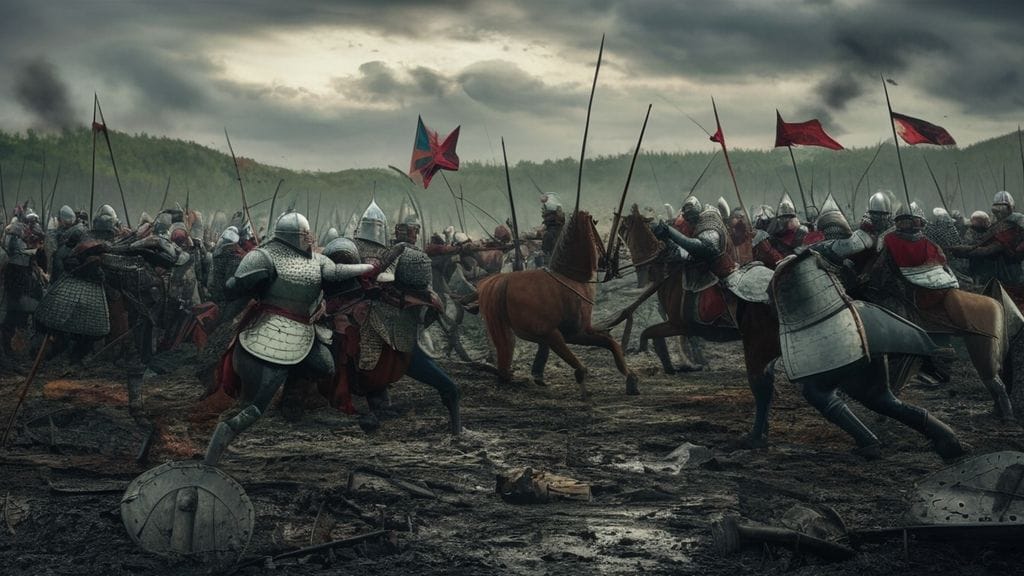
What followed on the far side of the Couasnon was not a set-piece battle in the sense of Crécy or Agincourt, but a swirling, close-quarters melee that unfolded rapidly across fields, hedges, and gently rising ground. Without significant archery support, the English who had crossed first were effectively fighting on terms chosen by their opponents.
The Scots, deployed in compact formations, presented dense thickets of spears and axes. Their style of fighting, familiar from the wars of the Scottish Borders, emphasized resilience on foot, a brutal close-in struggle in which heavy armor and raw courage counted for more than complex maneuver. French men-at-arms supported them, some mounted, others dismounted to hold ground better in the damp soil.
Clarence appears to have led from the front, as befitted a prince of his house. Mounted and armored, he cut into the enemy lines with his household troops. For a brief, intense moment, English momentum may have seemed unstoppable. Horses crashed into shields, swords flashed, and banners dipped and rose as men died beneath them. To one side, a Scottish standard bearing the familiar saltire of St. Andrew might have swayed dangerously, then steadied as more men pushed forward.
Yet the numbers and the terrain were against Clarence. The Franco-Scottish army was likely significantly larger than the force he had brought across the river. As more coalition troops entered the fray, the English spearhead began to feel the pressure. The narrowness of the crossing behind them meant reinforcement came slowly; those still waiting to cross could only watch as the tumult grew hotter. In such conditions, even a minor disruption — a fallen horse, a wounded leader, a flare of panic at one point in the line — could ripple catastrophically outward.
One famous anecdote, repeated in various chronicles, has Clarence’s horse being killed under him, perhaps hampered by the wet, uneven ground. Forced to fight on foot amid the heaving press of bodies, the duke would have found his advantage sharply reduced. Surrounded by Scots eager to strike at so grand a prize, he became both symbol and target. According to some accounts, it was a Scottish knight, Sir John Swinton or Sir Alexander Buchanan, who delivered the fatal blow. The precise identity remains debated, but the essence is clear: a French ally from the north felled the brother of the English king in a foreign field.
All around him, English men-at-arms died in ones and tens, dragged down by weight of numbers. Without archers to thin the ranks of the enemy before contact, they found their vaunted discipline less decisive. Franco-Scottish cohesion, bolstered by the certainty that this was their stand, held firm. Some English tried to break out, to regroup, but every attempt to retreat toward the bridge meant pushing back through their own comrades still arriving, choking the route with confusion.
The battle itself probably lasted no more than a few hours, perhaps significantly less. Medieval combat was an intense, physically exhausting clash, not the prolonged ordeal sometimes imagined. Men in heavy armor, swinging weapons and grappling at close quarters, soon became drenched in sweat despite the spring chill. Some killed; others simply collapsed and were finished on the ground. Through it all, the Franco-Scottish banners stayed upright. The English standard of Clarence, once a proud marker of royal presence, eventually fell.
The Death of a Prince and the Collapse of an Army
When word spread through the melee that Clarence was down, wounded or dead, the psychological effect on the English was immediate and devastating. Medieval armies did not possess the rigid, anonymous command structures of later centuries; leadership was intensely personal. A prince’s presence bound together the efforts of his captains, lent moral weight to their actions, and anchored morale amid chaos. His loss cut those invisible cords in an instant.
Some English knights may have fought with redoubled fury, forming a desperate knot of resistance around their fallen leader’s body. Others, realizing that the day was lost, began to look for routes of escape. Panic, always hovering at the edges of any battle, started to seep inward. The road back to the bridge, already crowded, now filled with men in retreat. The wooden structure that had carried them so confidently forward became a bottleneck of fear.
Franco-Scottish fighters pressed their advantage. Capturing or killing as many high-ranking opponents as possible was not simply a matter of vengeance but of economics; ransoms for noble prisoners could fund campaigns and enrich families. Even amid the adrenaline and the blood, some measured their blows, seeking to disable rather than slay, to take prisoners who could later be exchanged for gold. Yet in the case of Clarence himself, the killing seems to have been decisive and final. Perhaps there was no opportunity for capture; perhaps the fury of combat overwhelmed calculation.
Later reports spoke of a field strewn with English corpses, of knights and men-at-arms lying where they had been cut down. Exact numbers are hard to pin down — chroniclers disagreed, some inflating or minimizing losses to serve political narratives — but it is clear that the English suffered a stinging defeat out of all proportion to the scale of the engagement. Dozens of high-ranking individuals died or were captured. The Franco-Scottish casualties were far lighter, though they too paid in blood for their victory.
When the fighting subsided, the air must have carried that distinctive, sickly-sweet smell of death that haunts every battlefield. Surviving Scots and French moved among the fallen, stripping armor, identifying the dead, finishing off the mortally wounded. Somewhere in that grim harvest, they found the body of Thomas, Duke of Clarence. A prince of England, brother to a king, lay in a French field far from Westminster’s stone halls and the soft green of English winters.
For the victors, there was no doubt: this was a triumph. The battle of baugé, though small on the grand scale of medieval warfare, had yielded a prize that would echo through courts and councils. For the English survivors, it was a humiliation and a trauma, burned into memory. Some would later recount the chaos with bitterness, blaming Clarence’s rashness. Others would keep their grief quieter, perhaps haunted for years by flashes of that Easter Saturday — the bridge, the shouting, the prince falling under foreign spears.
Echoes in England: Grief, Fury, and the Weight on Henry V
News in the fifteenth century traveled at the pace of horses and ships, but it traveled nonetheless. Couriers rode hard across Normandy and through Picardy, bearing the story: Clarence was dead; an English army had been broken at Baugé by Scots and French. When these tidings finally reached Henry V, the shock must have been immense.
Henry was not a man inclined to public displays of emotion, at least as portrayed in contemporary records. Yet this was his own brother, the nearest male branch of his blood, fallen in battle at the hands of enemies he had grown accustomed to defeating. The king had staked his reign on the French war, on the assertion that God favored his cause. What did it mean that God had allowed this? No chronicler can truly capture the private storm such a question might have stirred in him.
Politically, the impact was immediate. The English crown suddenly had to navigate the loss of a key royal commander and the demoralizing narrative that accompanied it. Opponents of the war effort might quietly point to Baugé as a sign that the French adventure was more costly and uncertain than Henry’s propagandists claimed. Supporters, on the other hand, would double down, arguing that this reverse only proved the need for renewed, more vigorous campaigning to avenge Clarence and reassert English dominance.
The king chose the latter path. Henry returned swiftly to France, determined to show that the death at Baugé had not shaken his resolve. In subsequent campaigns, he recaptured several towns and won further victories, attempting to drown the memory of Baugé in new streams of triumph. But the stain remained; the aura of invincibility created at Agincourt had been pierced. Enemies across Europe noted this with keen interest.
Within the English aristocracy, Clarence’s death also had ripple effects. The redistribution of his estates and titles stirred new rounds of political calculation. Some families saw opportunity; others feared the shifting balance of power. At a more intimate level, there were widows to mourn, children to be raised in the shadow of absent fathers, retainers suddenly without their patron. War’s cost is never borne only on the battlefield.
One can imagine, too, the quieter grief of those who had known Thomas as more than a commander — household knights who had eaten at his table, jesters and chaplains who had seen him in moments of unguarded humanity. Their memories of Baugé would have been layered with earlier recollections: a boy-prince practicing arms in the tiltyard, a laughing companion in a royal hunt, a lord whose flaws they knew as intimately as his virtues. In this way, the battle of baugé inscribed itself not only in chronicles but in the hearts of individuals whose names we will never know.
Consequences in France: A Kingdom Still Fighting
If the shock of Baugé reverberated in England, its impact in France was no less profound — though colored with a very different emotional palette. For the followers of the dauphin Charles, still reeling from the humiliation of the Treaty of Troyes, the victory was a rare and precious gift: a proof that resistance was not futile, that angels did not automatically stand behind the banners of the English lion.
Politically, the battle of baugé stiffened the spine of the dauphinist faction. Towns wavering between submission to the Anglo-Burgundian alliance and loyalty to the disinherited prince could now point to Baugé as evidence that the English could be beaten in the field. It was no longer a story of a doomed, honorable struggle against overwhelming odds; it was a fight in which, given good leadership and favorable conditions, the French side could actually win.
For the French peasantry and urban poor, the news came in rumors and fragments. Few would ever see an official proclamation about the engagement; instead, the story traveled by word of mouth. In village squares, at market stalls, and along dusty roads, people whispered that an English king’s brother had been killed by “our men” in Anjou. Exaggerations blossomed — some probably imagined Clarence falling in single combat against a humble French squire, others saw in the Scots a near-mythic force, avenging every outrage committed by foreign soldiers in the countryside.
Morale matters in war, especially a war as protracted and draining as the Hundred Years’ War. After years of defeat and occupation, the French cause needed legends of its own. Baugé became one such tale — not as famous as later battles like Orléans or Patay, but a quiet, solid example that the tide could turn. It also reinforced the value of the Scottish alliance. Far from being a mere diplomatic gesture, the Auld Alliance had once again proved its military teeth.
Strategically, however, Baugé did not end the English threat. Henry V’s subsequent campaigns rolled back some of the gains in morale the dauphinist side enjoyed. Yet those campaigns were now contested in a landscape where English supremacy was no longer unquestioned. Every English captain planning a raid or a forced march through hostile territory had to reckon with the possibility of another Baugé — another instance where an apparently weak enemy, well-positioned, could deal a shocking blow.
For the dauphin himself, Baugé was both a relief and a challenge. He could claim the victory as a sign that God had not entirely abandoned his line, but he also had to navigate the pride and expectations of the Scottish captains who had delivered it. Political skill would be required to keep this potent but independent-minded ally integrated into his cause without letting them overshadow his own authority.
Scotland’s Hour of Glory and the Price Paid
For Scotland, the battle of baugé entered a different kind of memory: that of vindication and martial honor. At home, when word reached the courts and castles, the names of Buchan, Douglas, and their companions were spoken with pride. They had gone to France as exiles in spirit and returned, if not in person, then in reputation, as heroes who had struck down an English prince.
Scottish chronicles emphasize the valor of their countrymen, sometimes casting the French role into the background. Writers like Walter Bower, in his continuation of John of Fordun’s Scotichronicon, portrayed the victory as a direct consequence of Scottish courage and steadfastness under fire. In such retellings, Baugé became almost a purely Scottish triumph on foreign soil, a counterweight to earlier defeats such as Halidon Hill and Homildon.
This elevation of Baugé in Scottish memory served social and political purposes. Noble families involved in the campaign could leverage their association with the victory to bolster their status at home. The Douglas and Stewart names, already powerful, acquired an additional luster. Lesser knights who had fought in the battle might find patronage easier to secure, their tales of that Easter Saturday retold in great halls lit by smoky torches.
Yet glory had its cost. The Scots who served in France were far from home, operating in a land wracked by its own civil conflicts and economic devastation. Many would never see their families again, dying later in the war or succumbing to disease and hardship. The very success at Baugé bound Scotland more tightly to the French conflict, encouraging further expeditions and deeper involvement in a continental struggle that drained men and resources.
Moreover, victory could breed overconfidence. In later engagements, including the catastrophic battle of Verneuil in 1424, Scottish forces serving France would suffer grievous losses. Historians often juxtapose Baugé and Verneuil as twin poles of Scottish experience in the Hundred Years’ War: one a triumphant ascent, the other a bloody fall. Baugé raised expectations that Scottish steel could always tip the balance; Verneuil revealed the brutal limits of that assumption.
Still, in the collective imagination, Baugé retained its shine. At a time when their own king remained a prisoner in England, Scottish nobles could point to the battle as proof that the kingdom was anything but passive. They were not merely victims of English aggression; they were active agents on a wider European stage, carving their story into the flesh of an English dynasty on a field in Anjou.
Tactics, Terrain, and Miscalculation: Why the English Lost
Looking back with the benefit of centuries, historians have sifted through the fragments of evidence to understand why the battle of baugé ended as it did. No single factor explains the English defeat; rather, it was a convergence of tactical errors, terrain features, and broader strategic misjudgments.
Foremost among these was Clarence’s decision to attack without his full force, particularly his archers. The English longbow, deployed en masse, was a terror on open ground. At Baugé, however, the combination of rushed movement, the bridge crossing, and Clarence’s eagerness to strike appears to have left this key asset underutilized or entirely absent from the decisive phase of the fighting. By choosing to lead a mounted vanguard into contact, Clarence effectively fought on terms suited to his enemies, who excelled in close-quarters infantry combat.
The terrain amplified this mistake. The Couasnon and its bridges constrained movement, breaking the English advance into fragments. Once across, the fields and slight rises favored defenders who had time to take position. The Scots and French, fighting largely on foot, could hold ground more effectively in such conditions than a cavalry charge could exploit it. Mud and water, as at so many medieval battles, became silent allies to the side better integrated with the landscape.
Another critical factor was intelligence — or rather, the lack of it. Clarence’s understanding of the enemy’s disposition was flawed. Either his scouts failed to detect the full strength and readiness of the Franco-Scottish forces, or their warnings were disregarded in the rush to engage. In his authoritative study of the period, historian A. J. Pollard notes that “Clarence moved as though chasing a broken enemy, not as a commander approaching a concentrated and prepared host.” That misreading proved fatal.
Command and control also played a role. Once the fighting began in earnest, the English attack seems to have lacked the coordinated, phased structure that had made Henry V’s operations so effective. Instead of a carefully planned combination of arrow storms, defensive stakes, and controlled advances, Baugé devolved into a more traditional knightly melee — thrilling in its raw courage, perhaps, but dangerously dependent on individual prowess and luck.
On the Franco-Scottish side, by contrast, there appears to have been a clearer sense of defensive purpose. They did not need to annihilate the entire English army to win a significant victory; breaking the leading elements, killing or capturing high-value targets, and forcing a retreat would suffice. Their formations held, their commanders stayed engaged, and they exploited every opportunity the terrain and English mistakes offered.
In sum, the battle of baugé was not an inevitable outcome ordained by some overarching balance of power. It was a contingent event, shaped by choices made in the days and hours before steel met steel. Had Clarence waited for Salisbury, had he used his archers more effectively, had he respected the terrain’s constraining power, the story might have ended very differently. Instead, his fall at Baugé became a cautionary tale about the perils of overreach and the importance of learning from one’s own past victories rather than being blinded by them.
Voices from the Past: Chronicles and Memory
Our knowledge of the battle of baugé comes to us refracted through the pens of chroniclers, many of them writing years after the fact, influenced by their own loyalties and agendas. They give us not a single, clear image but a mosaic of perspectives in which some tiles shine brighter than others.
English chroniclers, often writing in the service of a monarchy eager to preserve its dignity, tended to downplay the scale of the defeat while emphasizing Clarence’s personal valor. The duke becomes a tragic figure, brave to the point of recklessness, undone by fortune and the treachery of lesser foes. In such accounts, the Scots are sometimes portrayed as brutal or uncivilized, their victory over a prince depicted more as a shocking irregularity than a legitimate feat of arms.
French and Scottish sources tell a different story. For them, Baugé is a moment of justified reversal, a divine correction to English arrogance. A Burgundian chronicler like Monstrelet, while not a dauphinist propagandist, nonetheless records the event with a certain grim satisfaction, noting the strategic significance of Clarence’s death. Scottish writers, as noted earlier, place their countrymen at the center of the narrative. According to one tradition, Archibald Douglas or Sir Alexander Buchanan personally struck down Clarence; some tales even claim that Buchanan raised the duke’s helm on his spear as a grisly trophy, a gesture both triumphant and symbolic.
Modern historians approach these sources with caution. As the medievalist Jonathan Sumption has observed, “Baugé lies in that hazy zone where firm facts end and national legend begins.” By comparing different accounts, weighing their biases, and situating them in the broader context of the war, scholars attempt to reconstruct a plausible core narrative while recognizing that some details — who struck the final blow, the exact sequence of tactical moves — may never be fully resolved.
The very uncertainty speaks to how battles become stories. Each retelling emphasizes what matters most to the teller: valor, treachery, divine favor, the folly of the mighty. Over time, these narratives influence not only academic debate but popular memory. In Scotland, Baugé is still occasionally invoked as an example of the nation’s martial prowess abroad. In France, it sits in the shadow of more famous engagements but remains an important footnote in the slow process of pushing back English power. In England, it is often remembered — when it is remembered at all — as a sobering counterpoint to the glories of Agincourt.
Behind all the rhetoric and myth-making, however, lie the unrecorded voices: the archers, spearmen, camp followers, and villagers whose lives brushed against that Easter Saturday in ways never written down. Their silence is perhaps the most profound chronicle of all.
From Baugé to Patay: A Chain of Unexpected Reversals
In the grand sweep of the Hundred Years’ War, the battle of baugé stands not as an isolated spark but as one link in a chain of reversals that would ultimately reshape the conflict. It did not by itself turn the tide against England, but it foreshadowed a pattern: the erosion of English aura, the growing competence and confidence of French-led forces, and the increasing importance of allied contingents like the Scots.
After Baugé, Henry V’s renewed campaigns temporarily restored English momentum, but his early death in 1422 changed everything. The infant Henry VI inherited two crowns he could not yet wear in person, leaving regents and councils to manage a sprawling, fragile empire. Internal English politics grew more complex and contentious. Resources, always strained by continental warfare, became harder to mobilize in a united fashion.
On the French side, the dauphin’s cause continued to wobble, but not collapse. Into this tense landscape, a peasant girl from Domrémy would step — Joan of Arc, whose arrival in 1429 galvanized French morale in ways few could have predicted. At Orléans, French troops under her inspirational leadership lifted a siege that had threatened to choke the last major bastion on the Loire. A few months later, at Patay, French forces decisively defeated an English army whose longbowmen, caught before they could properly deploy, were ridden down in a rout that reversed the logic of Agincourt.
The echoes of Baugé sound dimly but distinctly in these later events. At Baugé, an English force, overconfident and inadequately supported by archers, was cut apart by determined infantry on ground that favored the defenders. At Patay, English misjudgment and poor positioning once again exposed them to a different form of disaster. Though the circumstances and scale differed, both battles signaled that the English war machine was not infallible, that in the right conditions, with the right leadership, its seeming advantages could be neutralized or even turned against it.
As the 1430s and 1440s unfolded, English holdings in France progressively shrank. Normandy was lost, then Gascony. By the end of the war in 1453, nearly all English possessions on the continent had vanished, save for Calais. The dream of a dual monarchy, enshrined so confidently in the Treaty of Troyes, lay in ruins. In hindsight, historians see Baugé as one of the early cracks in that dream — small but telling, a reminder that no conquest is ever permanent, no victory beyond question.
Each generation that looked back could find in Baugé a different lesson: a warning against hubris, a testament to the value of alliances, a demonstration of the decisive role of terrain and tactics. For those caught up in the shifting fortunes of the war, it was one more turning in a long, exhausting road that would leave France devastated but ultimately intact, and England introspective and inward-looking for a century to come.
The Long Memory of a Short Battle
The battle of baugé itself lasted only a brief span of hours, yet its memory stretched across centuries in poems, chronicles, and oral traditions. This is one of the paradoxes of military history: small, localized events can cast shadows disproportionate to their size when they intersect with powerful symbols — a prince, an alliance, the reversal of a narrative of invincibility.
In the borderlands between England and Scotland, Baugé sometimes surfaced in song and story as proof that English power could be checked not only at home but abroad. For French local memory in Anjou, the battle contributed to a more diffuse sense that their region had not been a passive victim of foreign occupation, but an active theatre in which fortune could turn. In English histories, especially earlier ones focused heavily on kings and great battles, Baugé tended to be tucked in between larger set pieces, acknowledged but not dwelt upon, a discomforting reminder that even Henry V’s campaigns were vulnerable where his direct authority was absent.
Over time, as nation-states solidified and later wars claimed the attention of patriotic historians, Baugé risked slipping into obscurity outside specialist circles. The Napoleonic era, with its vast armies and sweeping campaigns, dwarfed the muddy fields of Anjou in popular imagination. Yet among scholars of the Hundred Years’ War, the battle never entirely disappeared. Each new generation returned to the sources with fresh questions: How did allied forces cooperate across language and cultural barriers? What role did local French communities play in supporting or resisting foreign armies? How did news of defeats like Baugé shape political decision-making back in Westminster or Bourges?
Archaeology, too, has sought the faint traces of that Easter Saturday. While no grand mass graves or spectacular relics have been definitively tied to the battle, the careful study of landscape, field boundaries, and settlement patterns can hint at where men once fought and fell. A fragment of a spur, a rusted blade, an anomalous scatter of bone — each may whisper that here, in this quiet field where tractors now pass, knights once shouted and banners dipped.
The long memory of Baugé is also a reminder of how history is made and remade. What we choose to remember — and how — says as much about us as it does about the events themselves. In an age still wrestling with the legacies of war, empire, and national identity, the battle of baugé offers a compact case study in the complexities of victory and defeat, of courage and error, of how quickly fortunes can shift when certainty hardens into arrogance.
Reconstructing 1421: What We Know and What We Guess
Despite all we have said, it is important to acknowledge that the battle of baugé remains, in many respects, an event glimpsed through fog. Medieval documentation was uneven, and the survival of sources has been haphazard. Some charters that might have referenced the battle are lost; some letters describing it may yet lie miscataloged in distant archives. What we possess is a partial mosaic, its missing pieces filled in by inference.
We know, with reasonable confidence, the key facts: the date, the place, the main commanders, the outcome, the death of Thomas, Duke of Clarence. We have enough independent attestations to be certain that a substantial English force was defeated by a Franco-Scottish army and that this defeat had significant political consequences. Beyond that, much involves weighing probabilities.
For instance, estimates of force sizes vary. Some chronicles inflate numbers to magnify the glory of victory or the shame of defeat; others minimize them to serve opposite ends. Modern historians cross-check these claims with logistical realities — the capacity of ports, the known size of garrisons, the availability of pay and supplies — to arrive at plausible ranges rather than precise figures.
The exact topography of the battlefield has also been debated. Rivers shift course over centuries; bridges are rebuilt or vanish; fields change use. By correlating medieval place names with modern maps and cadastral records, researchers propose likely sites for the main action, but absolute certainty remains elusive. A ditch that turned a horse, a hedge that provided cover, a slight rise that gave one side a vantage — all may now lie erased or transformed.
Even the famous anecdote of who struck down Clarence is contested. The name of Sir Alexander Buchanan looms large in Scottish tradition, while some French sources emphasize their own nobles. It is entirely possible that in the swirl of hand-to-hand fighting, several men struck near-simultaneous blows. The desire to pin the act on a single hero reflects the human need to personalize and simplify events that were, in reality, chaotic and collective.
Yet this uncertainty does not reduce the battle of baugé to mere myth. Instead, it challenges us to approach it with humility, recognizing both the limits of our knowledge and the value of critical analysis. By comparing sources, situating them in context, and being honest about what is conjecture, historians keep alive an event that might otherwise fade completely. In doing so, they honor not only the princes and captains whose names survive, but also the anonymous many whose lives, and deaths, made those names matter.
Conclusion
On a damp Easter Saturday in 1421, in the modest landscape of Anjou, the battle of baugé unfolded with a ferocity that belied its scale. An English prince, fired by ambition and shaped by a decade of seemingly irresistible victories, rode too far and too fast into the arms of an enemy who had learned from past defeats. Scots driven by vengeance and loyalty, French nobles defending their ravaged homeland, and English knights accustomed to winning all collided on ground that favored caution over bravado.
In the end, the bridge at Baugé and the fields beyond became the stage for a critical reversal. Clarence’s death shattered the illusion that English arms were blessed with automatic success. For France, it was proof that resistance could prevail; for Scotland, an enduring symbol of martial honor; for England, a bitter lesson in the costs of miscalculation. The battle did not decide the Hundred Years’ War, but it altered its trajectory, loosening the English grip just enough that later reversals could pry it open altogether.
Today, when one walks the quiet roads near Baugé, the sounds of that day are gone: no clash of steel, no shouted commands, no cries of triumph or despair. Yet in the historical record and the imagination, the battle persists — a knot of human choices and consequences, courage and error, ambition and mortality. To study it is to be reminded that history often turns not on grand designs alone, but on the actions of men facing urgent decisions in muddy fields, with imperfect knowledge and everything to lose.
FAQs
- What was the Battle of Baugé?
The Battle of Baugé was a clash on 22 March 1421, during the Hundred Years’ War, in which a Franco-Scottish army defeated an English force near the town of Baugé in Anjou, France. The engagement is most famous for the death of Thomas, Duke of Clarence, brother of King Henry V of England. - Why is the Battle of Baugé historically important?
Although not large in scale, the battle was significant because it shattered the aura of English invincibility created by earlier victories like Agincourt. It boosted French and Scottish morale, strengthened the dauphinist cause, and forced England to confront the limits of its military power in France. - Who commanded the armies at Baugé?
The English force was led by Thomas, Duke of Clarence. The opposing Franco-Scottish army was commanded by John Stewart, Earl of Buchan, and Archibald Douglas, Earl of Wigtown, alongside French nobles such as the sire de Lafayette and the count of Aumale. - How did Thomas, Duke of Clarence, die?
Clarence was killed in the thick of close combat after his horse was reportedly brought down, forcing him to fight on foot. He was then overwhelmed and slain by Franco-Scottish troops. Later tradition often credits a Scottish knight, such as Sir Alexander Buchanan, with delivering the fatal blow, though the exact details remain uncertain. - What role did the Scots play in the battle?
Scottish troops formed a core part of the dauphinist army and fought largely on foot in dense formations. Their determination, shaped by longstanding hostility to England and desire to support their French allies, was crucial in withstanding and then breaking the English attack. - How did the terrain influence the outcome?
The River Couasnon and its narrow bridges forced the English to cross in stages, preventing a unified attack and slowing reinforcement. The surrounding fields, hedges, and wet ground favored defensive infantry over mounted charges, playing into Franco-Scottish strengths. - Were English longbowmen present at Baugé?
While Clarence’s wider army included archers, he advanced into battle with a smaller, largely mounted vanguard that appears to have lacked strong longbow support. This decision deprived the English of their most effective battlefield asset and contributed to their defeat. - Did the Battle of Baugé end the Hundred Years’ War?
No. The war continued for more than three decades after Baugé. However, the battle was an early sign that English dominance was not absolute and that determined resistance, supported by skilled allies, could inflict serious setbacks. - How reliable are the sources about the battle?
The main accounts come from English, French, and Scottish chroniclers, each with their own biases and gaps. Modern historians cross-reference these narratives and consider logistical and political context to reconstruct a plausible picture, but some details remain uncertain or disputed. - Can the battlefield still be visited today?
The exact locations of specific phases of the fighting are not marked with absolute certainty, as the landscape has changed over six centuries. However, the general area around Baugé in Anjou can be visited, and local traditions and historical studies help approximate where the battle likely took place.
External Resource
Internal Link
Other Resources
- Encyclopaedia Britannica – general search for the exact subject
- Google Scholar – academic search for the exact subject
- Internet Archive – digital library search for the exact subject

