Table of Contents
- On the Road to Boroughbridge: England on the Brink
- A Kingdom Fractured: Edward II, Gaveston, and the Lords Ordainers
- Rise of the Rebel Lord: Thomas of Lancaster’s Long War with the Crown
- The Shadow of Bannockburn and the Scottish Threat
- From Tense Peace to Open Revolt: The March Toward 1322
- The King Strikes Back: Boroughbridge Chosen as a Trap
- The Lay of the Land: River, Bridge, and the Men Who Would Decide a Realm
- Dawn at Boroughbridge: The Rebel Column Arrives
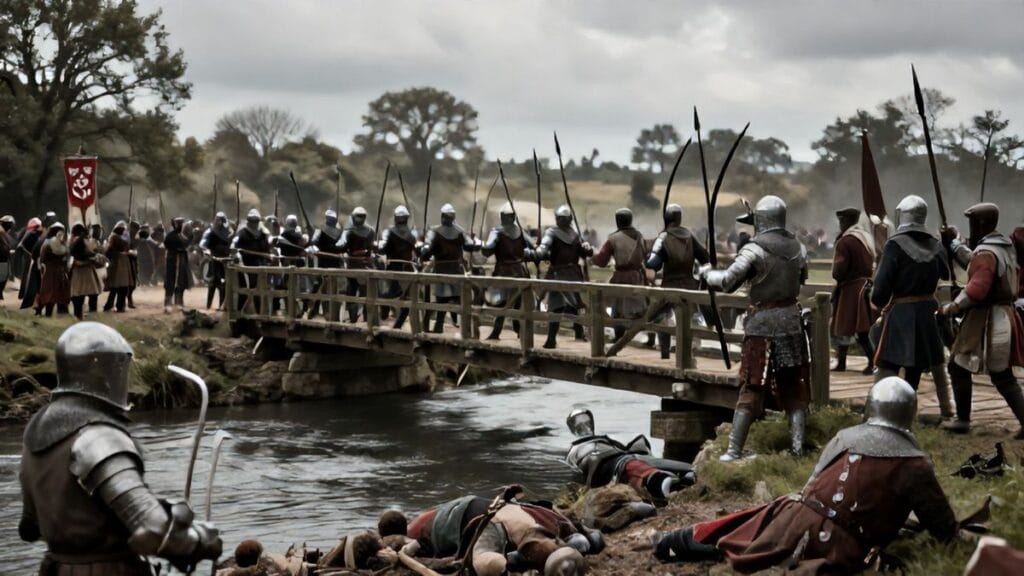
- Arrows over the Ure: The First Clash on the Bridge
- Spears in the Water: Sir Andrew Harclay’s Tactical Masterstroke
- Collapse of a Cause: Rout, Surrender, and the Capture of Lancaster
- Vengeance in Velvet and Steel: Trials, Executions, and Confiscations
- Winners in Chains: The Rise and Fall of Andrew Harclay
- Echoes in Parliament: Boroughbridge and the Fate of the Ordinances
- Fear, Memory, and Myth: How Chroniclers Remembered Boroughbridge
- From Boroughbridge to Mortimer: The Slow Unraveling of Edward II
- The Bridge That Broke a Generation: Social and Local Consequences
- Lessons from a Narrow Crossing: Strategy, Loyalty, and Miscalculation
- Conclusion
- FAQs
- External Resource
- Internal Link
Article Summary: On 16 March 1322, at a modest crossing of the River Ure in Yorkshire, the battle of boroughbridge became the brutal fulcrum on which the reign of Edward II turned. What began as a simmering constitutional conflict between an embattled king and a coalition of magnates led by Thomas of Lancaster ended in a short, vicious clash on a narrow bridge and in a ford choked with spearmen. This article traces the decades of tension that culminated in the battle, from the rise of royal favorites like Piers Gaveston to the Ordinances that tried to bind the king. It then reconstructs the battle of boroughbridge itself in detail: the terrain, the tactics of Sir Andrew Harclay, the rain of arrows, and the final unraveling of the rebel army. Yet the story does not end with the rebel defeat; it follows the trials, executions, and political reversals that reshaped English governance in the 1320s. The battle of boroughbridge also left deep marks on local communities, church lands, and the mental world of contemporaries who saw in it a warning about overmighty subjects and vengeful kings. Across these sections, the narrative returns again and again to how the battle of boroughbridge, brief though it was, became a turning point that seemed to secure Edward II’s power—only to sow the seeds of his own downfall. Ultimately, this crossing of the Ure is revealed not as a footnote, but as a small stage on which the grand drama of medieval English politics played out with unforgettable intensity.
On the Road to Boroughbridge: England on the Brink
On a raw March day in 1322, the wind coming off the Yorkshire moors carried more than the smell of wet earth and river water. It carried rumors—of a king finally marching to crush his enemies, of a rebel lord haunted by the ghosts of lost opportunities, of a narrow bridge where fate itself would seem to pause. The battle of Boroughbridge, fought on 16 March beside and upon the crossing of the River Ure, was no great clash of thousands spread across rolling fields. It was, instead, a brutal encounter compressed into a strip of wood and stone, a ford, and the muddy banks on either side. Yet in that confined space, the political life of a kingdom convulsed.
England in the early fourteenth century was not at peace with itself. The wounds of the disastrous defeat at Bannockburn in 1314 were still open, and the authority of King Edward II had long been under question. Noble houses that once spoke of the “community of the realm” now muttered of betrayal, favoritism, and tyranny. Behind the immediate violence of the battle of Boroughbridge lay years of simmering anger: a king who seemed to prefer the company of a few favorites to the counsel of his barons; a cousin, Thomas of Lancaster, who believed himself the true guardian of England’s laws; and a country where the line between rebellion and reform could be perilously thin.
By the time the opposing forces converged at Boroughbridge, choices had largely been made. There would be no neat negotiation, no grand assembly to draft charters of compromise. There would be steel, river water, and the terrible arithmetic of arrows and spears. In the chronicles, the battle of Boroughbridge sometimes occupies only a few lines, a brief note between longer tales of councils and campaigns. But if one listens closely to those terse medieval voices—and to the silence of those who died nameless on the bridge—a richer story emerges, one in which personalities, politics, and geography collide at a single, fragile choke point.
A Kingdom Fractured: Edward II, Gaveston, and the Lords Ordainers
To understand why men were willing to kill and die at Boroughbridge, one must step back more than a decade, to the early years of Edward II’s troubled reign. When Edward inherited the throne in 1307, he also inherited the formidable legacy of his father, Edward I, a king who had bent Wales to his rule and brought Scotland close to submission. The son, however, seemed cut from different cloth. He was known to enjoy music, pageantry, the company of favorites, and the physical labor of thatching roofs and rowing boats—pastimes many magnates viewed as unbecoming, even shameful, in a king who was expected to be stern, warlike, and unbending.
At the center of noble resentment stood one man: Piers Gaveston. A Gascon knight of modest birth but immense charm, Gaveston became the king’s intimate companion, and almost immediately a lightning rod for discontent. Edward showered him with titles, lands, and public displays of affection that were difficult for his contemporaries to ignore. Chroniclers describe the nobility gritting their teeth as they watched Gaveston ride in splendid finery, mock them with nicknames, and stand beside the king in roles they believed belonged to them by right of birth.
The baronial elite—earls and major lords—began to fear that their place in the realm’s hierarchy was being eroded. Among them, Thomas of Lancaster, a grandson of Henry III and first cousin to Edward II, felt this insult particularly keenly. Through inheritance and marriage, Lancaster had accumulated a vast constellation of lands and titles: Earl of Lancaster, Leicester, Derby, Lincoln, and Salisbury. His estates stretched across much of the Midlands and the North, and his income may have surpassed that of the king himself. Such a man could not tolerate being sidelined by a foreign-born favorite.
The conflict over Gaveston was not merely personal; it cut to the heart of medieval concepts of kingship and counsel. Lords believed the king should govern through the “community of the realm,” which, in their eyes, meant through them. When Edward refused to dismiss Gaveston, the nobles turned to a more formal instrument: the Ordinances of 1311, a set of restrictions drafted by a group known as the Lords Ordainers. These powerful magnates sought to bind the king’s hands, curbing his right to appoint officials, manage finances, and wage war without their consent.
The Ordinances declared Piers Gaveston banished and made his return a capital crime. Edward yielded on parchment but not in his heart. Gaveston returned, was seized by the king’s enemies, and, in 1312, was executed without royal consent. His death, however, did not restore harmony. Instead, it transformed an angry king into a man consumed by bitterness and set Thomas of Lancaster ever more firmly in opposition, convinced that only stern oversight could prevent the crown from falling into ruin.
Rise of the Rebel Lord: Thomas of Lancaster’s Long War with the Crown
Thomas of Lancaster is often remembered as the doomed rebel who met his end after the battle of Boroughbridge, but for many years he was something closer to a second king in England. As political winds shifted, Lancaster emerged as the uneasy leader of a diverse coalition of nobles, clerics, and knights who shared different grievances but a common unease with Edward II’s governance.
Physically, Lancaster was not a charismatic figure; chroniclers paint him as gloomy and often sullen. Yet he possessed what mattered in this age—land, men, and leverage. His vast retinues of retainers, drawn from his widespread estates, gave him the power to project force across much of the country. His castles formed a chain of strongpoints that could resist royal pressure. It is telling that, as the Ordinances were enforced, Edward’s court drew ever smaller while Lancaster’s following seemed to swell.
Still, Lancaster was no flawless constitutional hero. He could be vindictive, slow to act, and more interested in weakening his royal cousin than in constructing a stable alternative government. He was the kind of lord who believed he was protecting the realm, even as his own rivalries helped fracture it. In the tense years after Gaveston’s death, Lancaster avoided a direct showdown, preferring to let Edward’s missteps erode royal authority. But his stance hardened as new favorites, particularly Hugh Despenser the Younger and his father, rose to positions once held by Gaveston.
The Despensers, shrewd and unapologetically ambitious, soon became as deeply detested as Gaveston had ever been, especially in the Welsh Marches where their land-grabbing sharpened noble resentments. Lancaster saw in their ascendancy confirmation of his old fears: that Edward’s personal loyalties would always override the common good. He became, in effect, a prince of the opposition, a lord who could claim to represent the grievances of many counties, towns, and knightly families.
Yet Lancaster’s leadership had limits. He was cautious where boldness might have served him better and occasionally disdainful of allies he considered his social inferiors. This mixture of immense resources and hesitant command would have dire consequences when the kingdom lurched toward open conflict and the road led, almost inexorably, to Boroughbridge.
The Shadow of Bannockburn and the Scottish Threat
Hovering over all of Edward II’s domestic struggles was the dark silhouette of an enemy to the north: Robert the Bruce and the resurgent kingdom of Scotland. The catastrophe at Bannockburn in June 1314, where Edward’s army was routed by Bruce’s smaller but better-led forces, was more than a military defeat. It was a wound to royal prestige so deep that it colored every political conversation in England for years afterward.
Thomas of Lancaster and other critics did not hesitate to use Bannockburn as a weapon. If a king could not win wars, they argued, what claim did he have to the obedience of his nobility? England’s northern shires bore the brunt of the failure. Scottish raiding parties slipped across the border, burning farms, seizing livestock, and kidnapping villagers for ransom. In such places, loyalty to the king became fragile. Men asked whether their suffering was the price of royal incompetence.
The battle of Boroughbridge unfolded against this unsettled backdrop. Many of the soldiers who would fight there had already seen flames on the horizon and heard the terrifying clatter of Scottish horsemen in previous years. Robert the Bruce, confident and calculating, used England’s internal turmoil to strengthen his own position, knowing that a divided kingdom was less likely to mount a serious campaign against him.
Edward II’s failures in Scotland gave his domestic enemies a convenient narrative: not only was the king ruled by favorites, they claimed, he was also unable to protect the realm. This accusation mattered. Protection—of church, land, and livelihood—was a fundamental expectation of kingship. Thus, every cross-border raid was not just a military event but a political indictment, an unspoken vote of no confidence in Edward’s rule.
In a cruel twist of history, the man who would defeat Thomas of Lancaster at Boroughbridge, Sir Andrew Harclay, earned his reputation in this same northern war. Harclay had fought the Scots with determination, defending Carlisle and other northern strongholds. He, perhaps more than any other commander at the battle of Boroughbridge, understood how geography, discipline, and fortified positions could decide a fight. He carried those lessons from the Scottish borderlands to the quiet banks of the Ure in March 1322.
From Tense Peace to Open Revolt: The March Toward 1322
By the late 1310s, the uneasy equilibrium between king and barons was coming apart. Famine stalked the land in the years 1315–1317, a crisis known to historians as the Great Famine, which devastated harvests and deepened social unrest. It was all too easy for hungry peasants and anxious townspeople to associate their misery with the perceived failings of the crown. Meanwhile, the Despenser family rose ever higher, monopolizing royal patronage and using their influence to expand their estates, especially in the Welsh Marches.
Powerful marcher lords such as Roger Mortimer, Humphrey de Bohun, Earl of Hereford, and others found themselves squeezed. They watched as the Despensers secured royal charters, manipulated legal processes, and leveraged their closeness to the king to unpick traditional balances of power on the frontier. Marcher society, rough and prone to feuding, now buzzed with talk of open resistance. When law seemed rigged, rebellion began to appear not as crime but as a form of justice.
In 1321, this simmering anger erupted. A coalition of marchers, with Thomas of Lancaster in the background as a moral and political anchor, rose in revolt against the Despensers. They attacked Despenser lands, sacked properties, and used the language of reform to justify their actions. Under mounting pressure, a parliament was convened at Westminster. Edward, cornered, appeared to give way: the Despensers were formally exiled, banished from England and its dominions.
Yet behind these gestures of capitulation, the king nursed his grievances. He had acquiesced to Gaveston’s exile, only to see him killed. He had endured the Ordinances, only to watch them used as chains upon his will. He had allowed the Despensers to be sent away, but he had no intention of making that humiliation permanent. Over the winter of 1321–1322, Edward gathered allies: loyal earls, royal sheriffs, and household knights whose fortunes depended on his favor.
In this crucial period, Thomas of Lancaster made a fateful miscalculation. He underestimated the king’s capacity to reorganize and strike back; accustomed to royal hesitation, he did not imagine that Edward, now steeled by a decade of humiliation, would move with real speed. Nor did Lancaster succeed in building a coherent military coalition. The marcher barons were powerful but fractious, and when the king campaigned methodically against them—taking one lord, one castle, one shire at a time—the alliance began to crack.
By early 1322, the balance had tipped. The Despensers returned from exile. Royal forces subdued key marcher rebels. Lancaster, who had hesitated to stand firmly with them in arms, now found himself increasingly isolated. When the king called for his submission, he refused. The quarrel that had been simmering for more than a decade erupted fully into civil war. Lancaster mustered his forces and began a desperate march northwards, hoping to link up with Scottish allies or at least find safety behind the walls of northern strongholds. Instead, he found Boroughbridge waiting for him.
The King Strikes Back: Boroughbridge Chosen as a Trap
It is tempting to imagine the road to Boroughbridge as a straight line, but in reality it was a frantic, twisting path. Thomas of Lancaster, seeing royal armies closing in from the south, tried to move northwards along the great road systems of England, seeking to outpace the king and reach his power base. He could still rely on substantial support from parts of the North, and there were rumors—never fully realized—of coordination with Robert the Bruce. If Lancaster could escape Edward’s tightening net, the war might drag on, or even turn in his favor.
But Edward II had at last learned the value of speed and coordination. He and his advisers recognized that Lancaster’s route north would likely press toward the crossings of the River Ure, a critical barrier between the heart of England and the far North. Among those who understood the importance of these chokepoints was Sir Andrew Harclay, sheriff of Cumberland and a seasoned commander in the war against Scotland. Harclay knew the terrain; he knew, too, that a smaller disciplined force, properly arrayed, could block a larger column at a narrow crossing.
Edward moved to outmaneuver his cousin. While the main royal army pursued Lancaster, Harclay was dispatched—or perhaps took it upon himself—to secure Boroughbridge, a modest but strategically vital town on the river. The bridge there carried the Great North Road, one of the main arteries of England. A ford nearby allowed, in normal conditions, an alternative passage across the current. Whoever held Boroughbridge could open or close the door to escape and reinforcement.
The king’s strategy was simple and ruthless. Drive Lancaster north, harry his rearguard, and ensure that when he reached the Ure he would find it barred. There would be no opportunity for a grand siege, no protracted stand-off. The rebel column, tired and disorganized by days of marching and skirmishing, would be confronted with a stark choice: force the crossing under fire or surrender. The battle of Boroughbridge, in other words, was less an accident of campaign movement than the intended climax of a royal counteroffensive years in the making.
By mid-March 1322, the trap was nearly sprung. Harclay’s men were in position; Lancaster’s scouts had yet to grasp the full extent of the danger. Somewhere to the south, Edward’s main army closed the distance. The long, bitter rivalry between king and cousin was about to be compressed into a contest over a narrow strip of bridge planks and a cold, swirling river.
The Lay of the Land: River, Bridge, and the Men Who Would Decide a Realm
The battle of Boroughbridge was shaped as much by geography as by human will. The River Ure, flowing eastward toward the Ouse, was not a mighty torrent, but in March its waters ran cold and strong. At Boroughbridge itself, the crossing point was a relatively narrow bridge on the main road, with a nearby ford that could sometimes be used by infantry and cavalry willing to brave the current. On one bank lay the town and its approaches; on the other, the roads to the north and the open countryside.
Sir Andrew Harclay understood that in such a landscape, defense possessed inherent advantages. He placed his men so as to turn the river into a lethal barrier rather than a mere obstacle. Contemporary sources suggest that Harclay’s force was smaller than Lancaster’s—perhaps a few thousand men at most—but it was carefully selected and well led. He had archers, hardened in the northern wars, and infantry drilled to fight in dense formations. He also had time. While Lancaster’s exhausted contingents trudged toward the crossing, Harclay’s forces could prepare positions, perhaps strengthening the approaches, certainly establishing lines of fire for their archers.
On the rebel side, the army was a patchwork. It included Thomas of Lancaster’s household knights and retainers, men from his estates, and the followers of key allies, notably Humphrey de Bohun, Earl of Hereford. There were likely disaffected marchers, local levies, and men of fortune drawn to the banner of a great earl in revolt. But these troops had been marching hard, their morale sapped by previous setbacks and the knowledge that royal forces still threatened from the rear.
In Lancaster’s ranks, there was also confusion. Rumors multiplied along the column: that the king’s main army was only hours away; that Boroughbridge was lightly held; that Scottish help might yet appear from the north. The reality—that a capable royal commander already controlled the crossing—would have struck his officers like a cold shock. Some may have urged a cautious reconnaissance, others a rapid assault before Harclay could fully settle in. A decisive leader might have made a bold, unified choice. But Lancaster, for all his power, was not that leader.
Chroniclers seldom pause to name the ordinary men on either side of the river, but they were there in their thousands: archers with ash-wood bows, men-at-arms gripping spears and swords, squires tending horses, and camp followers trailing the column in hope of pay or plunder. For them, the battle of Boroughbridge would not be a game of grand politics. It would be a question of whether the bridge could be taken, whether the arrow would find them or fly past, whether today would be their last day in a cold northern March.
Dawn at Boroughbridge: The Rebel Column Arrives
On the morning of 16 March 1322, the rebel army approached Boroughbridge, its banners caught in the gusting wind, its ranks stretched out along the road. The hours before sighting the river must have been filled with nervous speculation. Some knights may have reassured their companions that the crossing would be clear, that a northern safe haven was within reach. Others, more seasoned or more cynical, likely suspected that the king would not have allowed such an escape route to remain undefended.
As the head of the column neared the town, scouts rode ahead and returned with unwelcome news: royal troops held the bridge. The standard of Sir Andrew Harclay stood on the far bank, fluttering defiantly. Along the approaches, lines of archers and infantry could be glimpsed forming ranks. The river, that ordinary feature of the landscape, had become a drawn sword held across Lancaster’s path.
Lancaster and his captains convened a hurried council. Among those whose voices mattered most was Humphrey de Bohun, the Earl of Hereford, a marcher lord of stern reputation and a man not inclined to surrender. It seems that, in this moment of crisis, two primary options were considered: negotiate a passage, or attempt to force the crossing. With the king’s main army already closing from the south, delay meant entrapment. Negotiation might buy time, but it would almost certainly require humiliating concessions, perhaps even immediate submission.
Lancaster’s long rivalry with Edward II made such a course almost unthinkable. For more than a decade he had positioned himself as the conscience of the realm, a leader of baronial reform. To yield now, without a fight, would be to admit that the revolution of the Ordinances, the execution of Gaveston, the marches against the Despensers, had all ended in failure. Pride, principle, and perhaps desperation pushed the rebels toward battle.
Men were ordered into position. The column began to contract into tighter formations, readying for an assault on the bridge. Horses were drawn up, infantry assembled, and pennons aligned. Across the river, Harclay completed his own preparations, watching the rebel dispositions with a practiced eye. The scene had an eerie symmetry: two English forces, under English lords, face to face over a river. No foreign invader, no banner of Scotland or France—only the divided realm confronting itself in steel.
For the ordinary soldiers, this must have been a moment of pure dread and adrenaline. They could see the long planks of the bridge, the swift water at the ford, the bristling lines of their enemies. Some may have prayed; others gripped their weapons with sweating hands and tried not to think about what an arrow could do to the human body. The trumpeters took their positions. Orders were shouted down the lines. The battle of Boroughbridge was about to begin in earnest.
Arrows over the Ure: The First Clash on the Bridge
The opening phase of the battle of Boroughbridge centered on the bridge itself. Humphrey de Bohun, Earl of Hereford, volunteered—or perhaps insisted—on leading the assault. It was a mark of his sense of honor, and also a recognition that, if the rebels were to break through, they needed decisive leadership at the point of contact. Under his command, a vanguard of knights and men-at-arms advanced toward the bridge, their armor glinting dully in the pale light.
As they approached, Harclay’s archers loosed their first volleys. The hiss and snap of English arrows—ironically, the terror of so many Scottish campaigns—now fell upon Englishmen themselves. The bridge, narrow and exposed, became a killing ground. Without sufficient space to fan out or maneuver, Hereford’s men presented an all too perfect target. Some attempted to raise shields overhead, forming a semblance of a makeshift roof, but the tight confines and the press of bodies made such tactics clumsy.
Despite the rain of arrows, the rebels pushed onto the bridge. The fighting quickly degenerated into a brutal hand-to-hand struggle. At the far end, Harclay’s infantry, armed with spears and polearms, stood ready to meet them, using the slight elevation and the bottleneck to their advantage. Every foot gained by the rebels had to be paid for twice over in blood and breath. Men slipped on blood-slicked planks, stumbled against each other, and fell into the river screaming, dragged down by the weight of their armor.
It was in this chaos that tragedy struck the rebel cause. Hereford himself, pressing forward at the head of his men, attempted to cross the bridge or perhaps move through a small breach or opening. According to one account, he was thrust upward from beneath by a spearman concealed in the structure, pierced through the anus and belly—a ghastly and ignoble wound for a great earl. He fell, mortally injured, and his death sent a visible shudder through the attacking ranks.
The loss of Hereford at this early stage was more than symbolic. It ripped a hole in the rebel command structure at the very moment when cohesion was most essential. Some of his followers, horrified, began to fall back. Others, enraged, threw themselves forward with reckless bravery. But courage alone could not overcome the tactical reality. Harclay’s men held the far end of the bridge like a wall of flesh and steel, and the archers continued their deadly work.
Slowly, inexorably, the first assault faltered. The cries on the bridge—orders, pleas, curses, death groans—must have been deafening. When the vanguard finally recoiled, dragging wounded and shattered morale with it, the rebels realized that the bridge would not easily be taken. The river, once merely a line on a map, had become their jailer.
Spears in the Water: Sir Andrew Harclay’s Tactical Masterstroke
With the bridge proving a deadly choke point, Thomas of Lancaster sought another way across. The existence of a ford near Boroughbridge offered a slender hope. If a substantial force could cross there and fall upon Harclay’s flank, the defenders at the bridge might be pressed so hard that the whole royal position would give way. It was a classic tactical idea: fix the enemy in front, strike where they are weak.
But Harclay had anticipated this move. Drawing on his experience fighting the Scots, he deployed a formation that would soon become famous in English warfare, though at Boroughbridge it was turned inward, against compatriots. He ordered infantry armed with long spears or pikes to stand in dense ranks at or near the ford, forming a kind of living barricade. Behind or among them, archers could fire at any force attempting to wade across.
When the rebels pressed toward the ford, they encountered this forest of spears. Horses balked at the gleaming points; riders who urged their mounts forward found themselves impaled or forced to retreat. Infantry, attempting to wade through the current, struggled to keep footing while also fending off missile fire. The moving water turned every misstep into potential disaster. A man who slipped could drown beneath the press of comrades and the drag of armor.
It is here that one can appreciate the cold brilliance of Harclay’s disposition. By anchoring his line on the river and using the ford as a deliberate killing ground, he transformed what might have been a vulnerability into a strength. The rebels were denied the chance to use their numbers to outflank him. Instead, they were compelled to attack piecemeal, channelled into narrow approaches where discipline and preparation counted more than raw courage.
Repeated attempts to force the ford failed. Each time, the rebels met the same grim combination of arrows and spears. Men fell into the water, their bodies caught and spun by the current. Some may have tried to swim with armor partially stripped, but the cold would have stolen their strength in minutes. Others retreated in confusion to the banks, blood freezing on their clothes, resolve slipping away.
The longer the fight dragged on, the clearer it became that Harclay’s position was nearly impregnable with the forces at his disposal. The rebel army, caught between an unyielding river defense and the looming threat of the king’s main forces arriving from the south, began to lose the will to continue. What had started as a daring crossing attempt was devolving into a series of costly, incoherent assaults. At Boroughbridge, Harclay had demonstrated what one chronicler would later summarize—“good order upon a narrow way may undo a multitude” (a sentiment echoed in the Vita Edwardi Secundi).
Collapse of a Cause: Rout, Surrender, and the Capture of Lancaster
As the afternoon wore on, the outcome of the battle of Boroughbridge grew ever clearer. The rebels had failed to force the bridge; their attacks at the ford had been bloodily repulsed. The body of Humphrey de Bohun lay among the dead, a stark emblem of noble defeat. Wounded men groaned along the banks, arrows bristling from their limbs. Smoke from campfires and burning equipment mingled with the damp air, obscuring sightlines and deepening the sense of disorientation.
Thomas of Lancaster, whose banners had once seemed to represent a movement for reform, now found himself in a trap with no easy exit. Some reports suggest that his men began to melt away, slipping into the countryside or seeking quarter from Harclay’s officers. Others do not dwell on the details, preferring simply to note that resistance ebbed. Lancaster had to choose: fight on to the point of total destruction, or seek terms from the man who had outmaneuvered him.
At some point—medieval sources are frustratingly vague about the exact hour—Lancaster’s army effectively disintegrated as a fighting force. Harclay’s disciplined defense had inflicted enough casualties and sown enough despair that organized assaults ceased. Surrounded by a tightening cordon of royalist troops and with no prospect of relief, Lancaster and several of his leading followers surrendered. It is likely that Harclay, keenly aware of the propaganda value of capturing the king’s greatest domestic enemy alive, offered or accepted their submission on the understanding that their lives would at least be spared on the field.
The image of Lancaster coming into custody is a powerful one, even if its exact details are lost. This was a man who had once defied kings, who had spoken in the name of the baronial community, who had stood behind the Ordinances as a bulwark against royal excess. Now he was a prisoner, his fine clothes spattered with mud, his authority stripped away in a single day. Around him, his household knights and companions faced the same bleak future. The rebel camp, once lively with talk of reform and resistance, was now little more than a charnel ground.
For Harclay, the moment was a personal triumph. He had not only held the crossing; he had delivered the king the prize he most desired. News of the victory and the capture of Lancaster sped southward, carried by swift riders. As Edward II advanced, he did so no longer as a harried ruler chasing a dangerous enemy, but as a conquering king whose greatest internal foe had already been broken on the river Ure.
Yet behind the royalistic rejoicing, a darker truth lingered. The battle of Boroughbridge had not reconciled the kingdom; it had severed one head of resistance at the cost of deepening fears among those who had doubted the king. The manner in which Edward would treat his vanquished cousin would either heal or poison the political culture of England for years to come.
Vengeance in Velvet and Steel: Trials, Executions, and Confiscations
Edward II arrived in the aftermath of the battle of Boroughbridge in a mood not of magnanimity but of vengeance. For years he had endured baronial lectures, forced ordinances, and, most painfully, the execution of his beloved Piers Gaveston. Now, with Thomas of Lancaster in chains, the king had the opportunity to repay the insults that had defined his reign. What followed was less the measured justice of a reconciled realm than the ritual humiliation of a defeated faction.
Lancaster was taken to his own castle at Pontefract for what was called a “trial,” though the outcome was never in doubt. Royal judges, magnates loyal to the crown, and the king’s own presence ensured that the proceedings were a formality. Lancaster was accused not only of rebellion but of treason, of rising against his rightful lord and conspiring with the Scots. He attempted no dramatic defense. Perhaps he knew that words could not save him; perhaps he was simply exhausted, the will to argue drained on the banks of the Ure.
The sentence was death. In a grim parody of the fate inflicted on Gaveston, the king’s cousin would now himself suffer public execution. Chroniclers record that Lancaster was led outside Pontefract’s walls, dressed in mockery with the emblems of betrayal, and beheaded before a gathering of onlookers. Some later writers would speak of him as a kind of martyr to the cause of the community of the realm, a role that would grow in the telling long after the reign of Edward II had ended.
Lancaster was not alone in his fate. Many of those who had stood with him at Boroughbridge met similar ends—executed, imprisoned, or forced into ruinous fines and forfeitures. Lands were confiscated and redistributed, often to the Despensers and their allies. This was punishment, but it was also consolidation. With each estate transferred, the king and his favorites wove a tighter web of patronage, binding new men to their cause through the lure of wealth.
The spectacle of Lancaster’s fall sent a chill through the aristocracy. If a man of such lineage and resources could be destroyed, who was safe? The message from the crown was unmistakable: opposition would no longer be tolerated as a legitimate expression of baronial “counsel.” It would be treated as treason, pure and simple. As one near-contemporary chronicle, the Annales Paulini, observed in somber tones, “From that day many lords held their tongues, fearing more the king’s wrath than loving his peace.”
But fear is a brittle foundation for rule. The post-Boroughbridge purges may have solidified Edward’s authority in the short term, but they also deepened resentments that would find new expression in the years to come, particularly as the Despensers’ influence grew ever more oppressive.
Winners in Chains: The Rise and Fall of Andrew Harclay
In the immediate aftermath of the battle of Boroughbridge, Sir Andrew Harclay stood as one of Edward II’s most successful commanders. He had defeated a major rebellion, captured the king’s foremost opponent, and demonstrated tactical skill on par with the best English captains of his generation. The king rewarded him accordingly, elevating him to the earldom of Carlisle—a remarkable ascent for a man who was not, by birth, among the great magnates of the realm.
Yet the favor of Edward II was a dangerous gift. Harclay’s power was rooted in the turbulent North, where the ongoing conflict with Scotland continued to ravage communities. Desperate to bring some measure of stability to his region, Harclay began to contemplate negotiations that reached beyond the strict boundaries of royal policy. In 1323, he entered into unauthorized talks with Robert the Bruce, the very Scottish king whom Edward had so often failed to defeat.
The deal Harclay is believed to have explored or even agreed upon was, from a practical standpoint, not irrational. It would have recognized Bruce’s kingship in Scotland and established a truce, relieving pressure on the northern shires. For Harclay, who had seen firsthand the devastation of Scottish raids and the inability of the central government to provide lasting security, such an arrangement must have seemed like common sense. But for Edward, and especially for the Despensers, it was an almost unthinkable betrayal.
When news of Harclay’s negotiations reached the royal court, the reaction was swift and merciless. The very man who had won the battle of Boroughbridge for the crown was now condemned as a traitor. Arrested and brought to trial, Harclay found that recent precedents—those set at Pontefract for Lancaster and others—now worked ruthlessly against him. He was stripped of his titles and, in a bitter twist of irony, condemned to a traitor’s death.
In March 1323, almost exactly one year after Boroughbridge, Andrew Harclay was executed. His body was quartered, the pieces sent to different towns as a warning. The man who had once seemed the embodiment of royal loyalty had discovered how quickly fortune could turn under a suspicious and vengeful regime. His fate underscores one of the more unsettling lessons of this period: victory in battle did not guarantee safety in politics. In the treacherous currents of Edward II’s England, even the winners of one year could be the condemned of the next.
Harclay’s downfall also deprived the North of one of its most competent defenders. In sacrificing him to royal anger, Edward and the Despensers signaled that unilateral initiative, however well-intentioned, would not be tolerated. The same impulse that had crushed Lancaster now consumed one of the king’s own champions, further narrowing the field of those who dared to act boldly in the realm’s service.
Echoes in Parliament: Boroughbridge and the Fate of the Ordinances
The political consequences of the battle of Boroughbridge were not confined to battlefields and executions. They reverberated in the halls of parliament and in the evolving constitutional language of the realm. Before 1322, the Ordinances of 1311 had stood as a symbol of baronial victory: a set of restrictions that curbed the king’s powers in finance, appointments, and war-making. Lancaster and his allies had used them as both shield and sword—as a justification for resisting royal policies and as a legal framework for reshaping governance.
With Lancaster dead and his rebellion crushed, Edward II moved to dismantle this constitutional edifice. In a parliament held at York later in 1322, the king took advantage of his strengthened position to have the Ordinances formally revoked. They were denounced as an overreach by subjects against their sovereign, an affront to the proper order of the realm. In their place, Edward affirmed more traditional expressions of royal prerogative, insisting that while he would rule with “good counsel,” that counsel would not bind his hands.
The York parliament can be read as the political twin of the battle of Boroughbridge: where the battle shattered the rebel army, the parliamentary reversals shattered the legal and ideological basis of their reform program. Those who had once imagined a realm in which the king was constitutionally constrained by a standing set of ordinances returned to a harsher reality. The crown, backed by military victory, reasserted its claim to supreme authority.
Yet the ideas embodied in the Ordinances did not entirely disappear. They lingered in the memories and arguments of jurists, clerics, and lords who had seen, albeit briefly, what a more formally limited monarchy might look like. The story of English constitutional development would, in later centuries, celebrate documents like Magna Carta and the 1689 Bill of Rights. The Ordinances and the events around the battle of Boroughbridge form a less famous but still essential chapter in that longer struggle over how kings and subjects should share power.
For contemporaries, the immediate effect was clear: resistance had been criminalized, and the vocabulary of constitutional protest weaponized against those who dared to speak it. The next generation of reformers would remember the fate of Lancaster and his companions. Some would be cowed; others would learn from their mistakes, adapting their strategies to press for change in ways less vulnerable to the king’s sword.
Fear, Memory, and Myth: How Chroniclers Remembered Boroughbridge
Medieval England did not possess modern newspapers or mass media, but it did have its chroniclers—monks, clerics, and lay writers who recorded the events of their time in Latin or French, shaping how future generations would understand moments like the battle of Boroughbridge. Their accounts are rarely neutral. They are colored by regional loyalties, moral judgments, and the ever-present desire to extract a lesson from history.
Some chroniclers, writing from institutions that had suffered under baronial unrest, framed Boroughbridge as a providential victory for rightful monarchy. They emphasized Lancaster’s disobedience, his alliances with the king’s enemies, and the chaos that baronial overreach could inflict on the kingdom. To them, the battle was a stern warning: God does not favor those who raise their hands against their anointed lord.
Others, however, were more sympathetic to the rebel cause or, at least, to its stated objectives. They lamented the hardening of royal power after the battle, the harsh punishments, and the enrichment of the Despensers. In some texts, Lancaster’s execution takes on almost hagiographic tones. He is portrayed as a sufferer for the cause of the community, a flawed but sincere defender of the realm’s customs against an ill-advised king. Over time, local cults of remembrance sprang up around his memory, particularly on lands once under his control.
The physical site of Boroughbridge also entered the mental map of English political memory. For those living in Yorkshire and the northern shires, it became one of several places—alongside Bannockburn or the fields around Carlisle—where the realm’s fate had been contested. Stories would have circulated of the deadly bridge, the drowning men, the fall of Hereford. Each retelling, passed from parent to child or monk to novice, added a layer of drama or moralization.
Modern historians, looking back, have tried to sift through these layered narratives. They ask not only what happened, but how and why contemporaries chose to remember it in particular ways. As one twentieth-century scholar observed when reflecting on these sources, “Boroughbridge was less a pitched battle than a crystallization of anxieties” (a paraphrase drawn from J.R. Maddicott’s work on Thomas of Lancaster). It concentrated fears about tyranny, disorder, and divine judgment into a single, bloody episode.
In this sense, the battle of Boroughbridge lives on not just in dates and details, but in the shifting stories told about it. Each chronicler, each later historian, has found in that narrow bridge and cold river a mirror for their own concerns about power, justice, and the fragile balance between ruler and ruled.
From Boroughbridge to Mortimer: The Slow Unraveling of Edward II
For a moment after the battle of Boroughbridge, it might have seemed that Edward II had finally secured his throne. His greatest domestic enemy lay dead, his reassertion of authority in parliament was complete, and his favorites, the Despensers, stood unchallenged at his side. Yet this apparent triumph masked deep structural weaknesses in his rule. Boroughbridge had eliminated one faction, but it had not healed the underlying fractures of the realm.
In the years that followed, the Despensers continued to accumulate power and property with a zeal that stirred up new rounds of resentment. Families who had lost lands through confiscations after the rebellion watched in fury as these estates were parcelled out to royal favorites. Merchants and lesser knights, meanwhile, felt the sting of arbitrary governance, heavy taxation, and the continuing insecurity caused by Scottish raids and continental tensions.
Into this brewing discontent stepped another figure who would reshape Edward’s fate: Roger Mortimer of Wigmore, a marcher lord who had once been part of the coalition that rose against the Despensers. Imprisoned in the Tower of London after the king’s victories, Mortimer escaped in a daring flight to France. There, he joined forces with the most unexpected of Edward’s future enemies—his own queen, Isabella of France.
Isabella, long humiliated by the Despensers’ dominance and by her husband’s neglect, transformed from a sidelined consort into the figurehead of a new resistance. Together with Mortimer, she fashioned a narrative in which England needed rescue from tyranny and misgovernment. When they invaded England in 1326, landing in the east with a relatively small force, the response was startling. Towns opened their gates; nobles rallied to their banners; even men who had once fought for Edward now turned against him.
The fear that had gripped the nobility after Boroughbridge now worked in reverse. Many lords calculated that a king who had treated Lancaster and Harclay so harshly might not hesitate to strike at them if they fell from grace. Aligning with Isabella and Mortimer seemed, to some, the safer long-term bet. Edward II and the Despensers fled, but could not outrun the tide. Hugh Despenser the Younger met a gruesome end, executed with barbaric ceremony, while Edward was forced to abdicate in favor of his young son, Edward III.
In this broader arc, Boroughbridge appears as an inflection point rather than an endpoint. The battle cleared the field of one set of opponents, only to encourage, by its brutality and the absolutism that followed, a different and ultimately more successful rebellion. The very instruments of royal vengeance honed after the defeat of Lancaster—the swift trials, the confiscations, the lethal punishments—would be turned against the king’s own household within a few years. Edward II’s reign, momentarily buoyed by victory at Boroughbridge, was in fact already drifting toward its terminal crisis.
The Bridge That Broke a Generation: Social and Local Consequences
Beyond kings and earls, the battle of Boroughbridge left quieter but no less lasting marks on ordinary people and local landscapes. Wars of this period were not fought on empty stages. The fields around Boroughbridge were tilled by peasants, the town housed traders and artisans, the church bells rang for baptisms, marriages, and funerals. When an army arrived—let alone two—these rhythms were abruptly and often violently disrupted.
In the days leading up to and following the battle, local stores of grain, livestock, and fodder would have been requisitioned or seized. Horses were taken for war; carts were pressed into service. Townspeople and villagers saw their bridges and fords transformed into militarized zones. Some found employment as guides, laborers, or suppliers; others simply hid what they could and prayed the storm would pass quickly.
The dead left behind their own grim burdens. Bodies had to be buried, sometimes in hastily dug mass graves. Armor and weapons were stripped; valuables looted. The nearby churchyards might have received some of the fallen of higher status, but most of the nameless dead were consigned to the soil with little ceremony. For years afterward, ploughmen may have turned up rusted arrowheads or fragments of mail in their fields, concrete reminders that their land had once been an arena of history.
Socially, the defeat of Lancaster’s faction reshaped local hierarchies. Families aligned with the losing side could see their fortunes destroyed overnight. A manor held for generations might suddenly be in the hands of a royal favorite or a royal sheriff. Tenants found themselves answering to new lords whose priorities and methods might be radically different. The legal disputes over property and rights that followed the redistributions after Boroughbridge likely lingered in local courts and memories for decades.
In religious life, too, the shock of the battle could be felt. Monasteries and parish churches interpreted such events through the lens of divine providence. Sermons might connect the outcome at Boroughbridge to God’s judgment on pride, rebellion, or injustice—depending on the preacher’s loyalties. Some communities quietly commemorated the fallen, especially Lancaster, whom they regarded as a victim of royal excess. Others used the memory of the battle as a cautionary tale against those who would disturb the peace of the realm.
Boroughbridge itself, the modest town on the Ure, carried its association with the battle into the later Middle Ages and beyond. Though the bridge has changed and the river’s course has subtly shifted, the idea of that place as a turning point in English history endured. For local people, it became part of the landscape’s identity, a story layered onto the everyday business of markets and harvests.
Lessons from a Narrow Crossing: Strategy, Loyalty, and Miscalculation
Looking back across the centuries, the battle of Boroughbridge offers a compact but revealing study in strategy, loyalty, and political miscalculation. From a purely military perspective, it underscores the enduring importance of terrain and preparation. Harclay’s defensive arrangement at the bridge and ford transformed what might have been a disadvantageous numerical position into a commanding tactical one. His use of archers and spear-armed infantry to block narrow crossings anticipated later English battlefield successes, where disciplined formations and controlled use of missile troops would devastate more numerous foes.
For Thomas of Lancaster, the lessons are more tragic. His long rivalry with Edward II and his status as a leader of opposition had given him immense political capital, but he failed to convert that into effective military and logistical planning when crisis came. He underestimated the king’s capacity to act decisively, overestimated the cohesion of his own coalition, and perhaps allowed pride to override prudence in choosing to force the crossing rather than seek other options—however unpalatable. A leader who had preached restraint and reform found himself finally forced into a desperate gamble on a narrow bridge.
On the level of loyalty, Boroughbridge reveals the fragility of personal and factional bonds. Men fought and died for Lancaster and Hereford, but when the cause collapsed, many survivors adapted quickly to new realities, seeking royal favor or at least royal forgiveness. Harclay’s own trajectory, from loyal royalist victor to executed traitor, shows how quickly allegiances could be reevaluated and punished in an environment saturated with fear and suspicion.
Politically, the battle illuminates the paradox of short-term victory and long-term instability. Edward II emerged from Boroughbridge seemingly secure, his enemies crushed and his authority vindicated. Yet by answering rebellion with harsh, exemplary violence and by concentrating power ever more tightly in the hands of the Despensers, he sowed the seeds of his own downfall. The very ruthlessness that silenced one generation of opponents convinced another that only his removal could restore equilibrium.
Finally, there is a more subtle, almost psychological lesson. Boroughbridge reminds us that history often turns not on grand set-piece battles but on small, constrained encounters in unlikely places. A modest bridge over a northern river; a ford in cold March water; a dispute over who should cross first and under what terms—these are not the materials of epic poetry, and yet they reshaped the trajectory of a kingdom. It is astonishing, isn’t it, how much can depend on such a narrow crossing?
Conclusion
The battle of Boroughbridge, fought on 16 March 1322, was in many ways a modest affair by the standards of medieval warfare: a brief, intense struggle over a bridge and a ford on a quiet northern river. Yet its consequences rippled outward through England’s political, social, and constitutional life. In the clash between Thomas of Lancaster’s rebel host and Sir Andrew Harclay’s disciplined royalist force, years of tension between king and magnates reached a brutal resolution. The deaths of Humphrey de Bohun on the bridge and Lancaster on the scaffold symbolized the eclipse of a particular vision of baronial oversight and reform.
For Edward II, victory at Boroughbridge provided a fleeting sense of triumph. He broke the most powerful of his internal enemies, revoked the Ordinances that had constrained him, and, for a time, ruled with an authority he had long been denied. Yet the harshness with which he and the Despensers treated the defeated rebels—executions, confiscations, and unyielding vengeance—ultimately undermined the stability that the battle had won. Within a few years, a new coalition led by Isabella and Mortimer would turn the instruments of royal justice against the king himself.
At the local level, the battle scarred landscapes and communities, embedding itself in the memory of Boroughbridge and its surrounding countryside. Chroniclers, each with their own biases, transformed the crossing of the Ure into a site of moral and political reflection. Some saw divine judgment on overmighty subjects; others, the tragic fall of a flawed defender of the common good. Modern historians continue to debate Lancaster’s legacy and the constitutional significance of the Ordinances, but all recognize that Boroughbridge marks a decisive hinge in that larger story.
In the end, the battle of Boroughbridge teaches that the great questions of power, loyalty, and law are often decided not only in grand councils or towering cathedrals, but in muddy fields and on narrow bridges where ordinary men fight at the command of their superiors. It was there, on the River Ure, that a generation’s experiment in limiting royal authority met a bloody end—and there, too, that the contradictions of Edward II’s kingship were laid bare, setting the stage for the further convulsions that would soon follow.
FAQs
- What was the Battle of Boroughbridge?
The Battle of Boroughbridge was a civil conflict fought on 16 March 1322 near the town of Boroughbridge in Yorkshire, England. It pitted the forces of King Edward II, commanded locally by Sir Andrew Harclay, against a rebel army led by Thomas of Lancaster and his allies. The fighting centered on a bridge and nearby ford over the River Ure, where Harclay’s defensive tactics decisively repelled the rebels. - Why did the battle of Boroughbridge take place?
The battle occurred as the climax of a long power struggle between Edward II and a faction of nobles led by Thomas of Lancaster. After years of conflict over royal favorites, the Ordinances of 1311, and the influence of the Despenser family, open rebellion broke out in 1321–1322. When Lancaster attempted to retreat north to safety and potential Scottish support, Edward’s forces blocked his path at Boroughbridge, forcing a confrontation. - Who were the main leaders on each side?
On the rebel side, the key leader was Thomas of Lancaster, cousin to Edward II and one of the greatest magnates in England, supported by figures like Humphrey de Bohun, Earl of Hereford. On the royalist side, while Edward II was the ultimate commander, the immediate leadership at Boroughbridge fell to Sir Andrew Harclay, an experienced northern soldier who orchestrated the defense of the bridge and ford. - What were the key tactics used in the battle?
Sir Andrew Harclay used the terrain to his advantage, stationing archers and infantry to defend the narrow bridge and deploying spear-armed troops in dense formations to block the nearby ford. This forced the rebels to attack in confined spaces under heavy arrow fire, neutralizing their numerical advantages. Repeated assaults on both the bridge and ford failed, leading to heavy rebel casualties and the eventual collapse of their resistance. - What happened to Thomas of Lancaster after the battle?
Thomas of Lancaster was captured following the defeat of his army at Boroughbridge and taken to Pontefract Castle. There he was subjected to a perfunctory trial dominated by royal loyalists and found guilty of treason. He was executed by beheading outside the castle walls, an event that many contemporaries and later writers came to view as the martyr-like end of a leading critic of Edward II. - How did the battle of Boroughbridge affect Edward II’s reign?
In the short term, the battle greatly strengthened Edward II’s position. It crushed the main baronial opposition, allowed him to revoke the Ordinances that had limited his authority, and solidified the dominance of his favorites, the Despensers. However, the harsh reprisals against defeated nobles and the concentration of power in the hands of a few favorites deepened resentment, contributing to the later invasion by Queen Isabella and Roger Mortimer and to Edward’s eventual deposition. - What was the fate of Sir Andrew Harclay, the royalist commander?
Despite his victory at Boroughbridge and subsequent reward with the earldom of Carlisle, Sir Andrew Harclay later fell from grace. In 1323, he was accused of treason for entering into unauthorized negotiations with Robert the Bruce of Scotland, seeking a regional peace. He was arrested, condemned, and executed, his body quartered and displayed as a warning—an ironic fate for the man who had delivered the king’s great victory just a year earlier. - Is the site of the battle still visible today?
The exact medieval landscape has changed over the centuries, with alterations to the bridge, roads, and riverbanks, but the general area of Boroughbridge and the River Ure can still be visited. While few, if any, clear battlefield features remain, local tradition and historical studies identify the vicinity of the town and its crossing as the scene of the fighting. Visitors today stand near where this pivotal encounter once unfolded, though the modern setting is far more peaceful. - How does the battle of Boroughbridge fit into England’s constitutional history?
The battle and its aftermath mark the violent end of one phase of attempts to impose formal constitutional limits on the king through the Ordinances of 1311. The defeat and execution of Thomas of Lancaster allowed Edward II to revoke those measures and reassert traditional royal prerogatives. Although the specific framework of the Ordinances collapsed, the ideas behind them—about baronial counsel and limitations on royal power—would re-emerge in later struggles, making Boroughbridge an important, if often overlooked, episode in the long evolution of English constitutionalism. - Why is the battle of Boroughbridge less famous than battles like Bannockburn or Agincourt?
The battle of Boroughbridge was relatively small in scale, involved only English factions rather than foreign enemies, and produced no sweeping territorial changes. Its significance lies more in its political and constitutional consequences than in its immediate military drama. As a result, it has tended to receive less attention in popular memory than large, externally focused battles like Bannockburn or Agincourt, even though its impact on Edward II’s reign and on internal English politics was profound.
External Resource
Internal Link
Other Resources
- Encyclopaedia Britannica – general search for the exact subject
- Google Scholar – academic search for the exact subject
- Internet Archive – digital library search for the exact subject

