Table of Contents
- Dawn Over the Fields of Bouvines: The Calm Before the Storm
- Europe in Turmoil: The Geopolitical Chessboard of 1214
- Philip II Augustus: The Architect of French Centralization
- The Coalition Against France: Alliances Forged in Ambition
- The Prelude to Battle: Maneuvers, Espionage, and Final Preparations
- July 27, 1214: The Battlefield Awakens at Bouvines
- Clash of Titans: Infantry, Cavalry, and the Symphony of Steel
- The Turning Point: Courage, Chaos, and Command Decisions
- The Fall of Key Leaders: A Day Written in Blood and Glory
- Victory for Philip II: Testimonials and Tales from the Field
- The Immediate Aftermath: Celebrations and Strategems
- Impact on the English Crown: John Lackland’s Lost Hopes
- The Holy Roman Emperor Otto IV: Defeat and Decline
- The Remaking of French Monarchy: From Feudal Lords to Royal Authority
- The Battle’s Influence on Medieval Warfare and Tactics
- Cultural Reflections: Bouvines in Chronicles, Ballads, and Legend
- The Legacy of Bouvines: Foundations for Nationhood in France
- Echoes Through Time: Bouvines and European Political Stability
- Conclusion: The Moment That Shaped Medieval Europe’s Destiny
- FAQs: Unraveling the Many Facets of the Battle of Bouvines
- External Resource: Dive Deeper into Bouvines on Wikipedia
- Internal Link: Explore More with History Sphere
On a shimmering July morning in 1214, as the sun rose over the emerald fields near the northern French town of Bouvines, an event of staggering consequence was about to unfold. The air, thick with anticipation and the iron scent of prepared weapons, held the collective breath of empires. Knights donned their gleaming armor, banners proudly emblazoned, fluttered in the breeze. In the distance, the thunderous footsteps of thousands of soldiers echoed across the strategic plain—poised on the knife's edge between triumph and catastrophe. This was no mere clash of tempers or territories; it was a decisive episode that would redefine power, politics, and identity across medieval Europe.
It was here, in the soft fields of Bouvines, that Philip II Augustus of France faced a coalition of monarchs and nobles united by a singular aim: to curtail the growing strength of the French crown. Their combined forces, a tapestry of alliances and rivalries knit across the continent, converged with the hope of breaking Philip’s unyielding grip on his expanding realm. Yet the day’s unfolding would irrevocably change the trajectory of nations.
Europe was a volatile mosaic in 1214. The High Middle Ages pulsed with the ambitions of kings, the tension of feudal rivalries, and the restless stirrings of nascent nation-states. The Holy Roman Empire, under Emperor Otto IV, vied for supremacy against a France continually assertive in its quest to consolidate power. Meanwhile, England, ruled by King John—often remembered as “Lackland” for his losses—nursed its wounded pride and sought to reclaim lost territories in Normandy and beyond.
The stage was set against a backdrop of competing claims, broken treaties, and personal vendettas. Philip II Augustus, one of France’s most formidable and strategic monarchs, had spent decades strengthening royal authority and reclaiming lands once fragmented among feudal lords. His success had made him a magnet for opposition, and so a coalition formed, blending ambition and desperation.
The alliance drew together Emperor Otto IV, King John of England, and rebellious French barons, among others—a motley coalition united by the desire to check Philip’s power. Theirs was a plan forged in secrecy and signed in urgency. Yet the challenge was daunting: would their combined strength overcome the tactical brilliance and battlefield valor of the French king?
In the days before the confrontation, tension filled the air with an electric charge. Scouts moved in shadows, spies whispered secrets in court halls, and armies maneuvered stealthily over country lanes and through forests. Philip’s preparations were meticulous; he knew that victory here would ensure the future of the Capetian dynasty for generations.
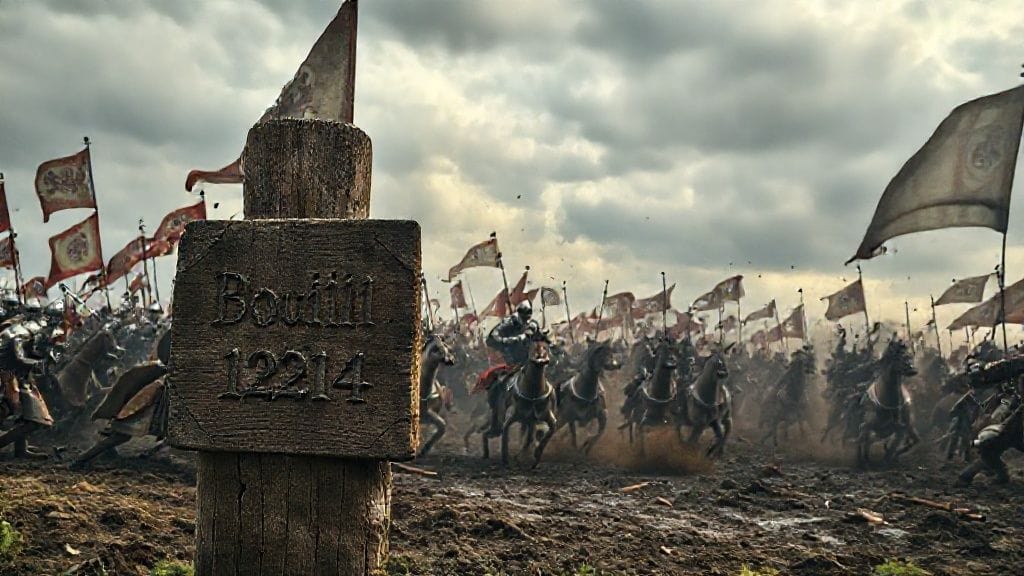
At dawn on July 27, the two forces arrayed on the plain near Bouvines, around 40 kilometers northeast of Lille. The French army, smaller but disciplined and unified under a single command, awaited the larger, yet disparate coalition force. The morning was calm—almost deceptively so—as soldiers polished their weapons, knights adjusted their stirrups, and priests administered last rites and blessings.
As sun climbed higher, the battle erupted in a cacophony of clangs, shouts, cries, and thunderous hooves. The French infantry, cavalry, and archers engaged with fierce coordination. Philip was in the thick of it, rallying his troops, directing charges, and personally confronting enemy leaders.
The clash of titans—knights resplendent in shining armor charging headlong into squadrons wielding pikes and bows—was brutal and unrelenting. The ground quickly soaked in the blood of bravely fallen men. At critical moments, boldness and quick decisions tipped the scales. Philip’s command and the steadfast morale of his troops turned back repeated coalition assaults.
Notably, the capture of significant leaders, including Count Ferdinand of Flanders and William Longsword, was a symbolic and material blow to the coalition, further underscoring the French king’s dominance on the field.
As dusk approached, the battlefield quieted, giving way to the heralds of a decisive victory. The coalition was shattered, its ambitions dashed amid the trampled fields. For Philip II Augustus, the triumph at Bouvines was more than a military success—it was the confirmation of the legitimacy and power of the French throne.
Celebrations in Paris and throughout France soon erupted, as the victory secured Philip’s reign and dampened English hopes of regaining Normandy. The aftermath rippled through the complex feudal system: noble insurrections were quashed, the authority of the monarchy strengthened, and a new political order began to crystallize.
For King John of England, the loss spelled ever-deepening troubles that would culminate in domestic revolt and the sealing of the Magna Carta in 1215. For Emperor Otto IV, Bouvines began a rapid decline from imperial zenith to political irrelevance.
The battle also marked a shift in medieval warfare tactics, emphasizing disciplined infantry and command coherence over sheer numbers—a precedent that reverberated in later centuries.
Beyond politics and strategy, the Battle of Bouvines inspired generations of chroniclers, poets, and artists. It became a symbol of national pride and a foundation myth for France’s identity, echoed in literary works for centuries.
The victory also contributed to the gradual emergence of Europe’s modern nations. In stabilizing France’s borders and monarchy, Bouvines provided a stepping stone toward centralized states that would dominate the continent’s future.
More than 800 years later, the fields of Bouvines stand silent but proud—testimony to a day when valor, leadership, and fate intertwined to shape history itself.
Conclusion
The Battle of Bouvines remains a defining chapter in European history, not merely as a military encounter but as a moment that crystallized power, ambition, and identity. Philip II Augustus’s victory was a beacon of royal authority that cast long shadows into the medieval future, influencing the political, social, and cultural milieu of a continent in flux.
Its legacy is human and heroic: it tells the story of kings and knights, allies and enemies, of blood spilled and glory won, but also of the fragile, complex dance of power that shapes the course of nations. In Bouvines, we find not only the echoes of clashing swords but the whispered beginnings of modern Europe.
FAQs
What caused the Battle of Bouvines?
The battle arose from competing territorial claims and political tensions in medieval Europe, especially Philip II Augustus's efforts to consolidate French royal power, which alarmed neighboring rulers like Emperor Otto IV and King John of England.
Who were the main figures involved in the battle?
Key figures include Philip II Augustus of France, Emperor Otto IV of the Holy Roman Empire, King John of England, Count Ferdinand of Flanders, and various French barons.
Why was the Battle of Bouvines so significant?
It was a decisive turning point affirming French royal authority, weakening opposing coalitions, influencing medieval warfare, and shaping the political future of France and Europe.
What were the consequences for England after the battle?
England’s defeat intensified King John’s domestic struggles, directly contributing to the rebellion of the barons and the drafting of the Magna Carta.
How did the battle affect the Holy Roman Empire?
Emperor Otto IV’s defeat at Bouvines severely undermined his reign and accelerated his political decline.
What innovations in warfare were demonstrated at Bouvines?
The battle highlighted the importance of disciplined infantry, coordination, and command structure over numerical superiority.
How has Bouvines been remembered culturally?
It inspired numerous chronicles, poems, and national legends, contributing to a foundational French national identity.
Is the battlefield preserved today?
Yes, the site near Bouvines is marked and commemorated as a significant historical landmark in France.

