Table of Contents
- On the Banks of the Euphrates: Setting the Stage for Callinicum
- Empires in Tension: Rome and Persia Before the Storm
- Justinian’s Ambitions and the Burden on the Eastern Frontier
- Kavadh I, Khosrow I, and the Sasanian Quest for Supremacy
- Belisarius and Azarethes: Commanders on a Collision Course
- Road to the Euphrates: Campaigns and Skirmishes Before Callinicum
- Holy Week on the March: The Army Approaches Callinicum
- The Morning of Battle: Terrain, Formations, and First Blows
- Cavalry, Arrows, and Dust: The Battle of Callinicum Unfolds
- Collapse on the Roman Right: Panic, Heroism, and Retreat
- Blood on the Riverbank: Casualties, Survivors, and the Night After
- Blame and Justification: Belisarius on Trial in the Court of Opinion
- Diplomacy After Defeat: From Callinicum to the “Eternal Peace”
- Life on the Edge: Cities, Soldiers, and Civilians Along the Frontier
- Faith and War: Religion, Holy Days, and Moral Dilemmas at Callinicum
- Memory and Legend: How Chroniclers Told the Story of Callinicum
- From Euphrates to Italy: What Callinicum Meant for Belisarius’s Career
- Echoes Through Time: Strategic Lessons of Callinicum
- Conclusion
- FAQs
- External Resource
- Internal Link
Article Summary: On a windswept bend of the Euphrates in 531, Roman and Persian armies met in the fateful battle of callinicum, a clash that would scar both empires and yet be overshadowed by later, larger catastrophes. This article follows the story from the mounting tension between Justinian’s Eastern Roman Empire and the Sasanian monarchy, through the personal dramas of generals, soldiers, and civilians dragged into a frontier war. It reconstructs the days and hours leading to the battle of callinicum, explores the tactics and terrain that shaped its outcome, and lingers over the chaos when the Roman line finally broke beside the river. We then trace the political fallout: Belisarius’s contested reputation, the negotiations that led toward the so‑called “Eternal Peace,” and the ways this defeat paradoxically cleared the way for later campaigns in Africa and Italy. Social and religious undercurrents—Holy Week on campaign, the fears of border towns, and the moral strain on Christian soldiers—run through the narrative. Drawing on ancient historians and modern interpretations, the article also examines how chroniclers remembered or distorted the battle of callinicum and what that tells us about power and storytelling. In conclusion, it argues that the battle of callinicum was less an isolated defeat than a revealing snapshot of an imperial system under relentless pressure, on the cusp of both triumph and eventual collapse.
On the Banks of the Euphrates: Setting the Stage for Callinicum
The wind along the Euphrates had a way of carrying rumors. It moved over the water, brushed the reed thickets, slid across the dusty streets of Callinicum—modern Raqqa—and climbed the low ramparts where sentries peered eastward toward Persia. In early 531, the town’s inhabitants woke each morning to the uneasy knowledge that they lived on a frontier, where empires did not merely watch one another but tested, probed, and bled each other dry. Here, in this liminal space between the Roman world and the Sasanian realm, the stage was slowly being arranged for the battle of Callinicum, a clash that would become a grim lesson in the perils of overconfidence and the unforgiving logic of strategy.
Callinicum itself was not a great capital, but it was a node: a crossing point, a way-station for caravans, a bridge between the Mediterranean world and the Iranian plateau. Merchants knew its markets; priests knew its churches and synagogues; soldiers knew its walls and its river. For decades, this frontier zone had been dotted with garrisons, patrol routes, and fortified cities, each silently acknowledging that the peace between Constantinople and Ctesiphon could never be assumed, only managed. When word came that Sasanian forces had crossed into Roman territory with unusual boldness, no one in Callinicum was truly surprised. Alarmed, yes—but surprised, no.
In distant Constantinople, Emperor Justinian was only at the beginning of his long reign, but he already dreamed in imperial superlatives. He inherited a war with Persia and saw in it not merely danger but opportunity: a chance to assert strength, to redefine boundaries, perhaps even to reshape the map of the East. To realize such ambitions, he relied on men like Belisarius, a general still young by the standards of the day, recently bloodied at Dara and entrusted once more with the fragile defense of Rome’s eastern flank. As winter yielded to spring along the Euphrates, Belisarius’s army moved like a shadow through the countryside—dust in its wake, prayers on its lips—toward an encounter no one yet fully understood.
But this was only the beginning. On the other side of the frontier, Persian commanders weighed their own calculations. They knew that the Roman military, though formidable, was stretched across vast distances from the Balkans to Egypt. They could feel that the balance of power along the Euphrates might be tipped, at least for a moment, by speed and audacity. It was in this swirling mixture of ambition, fear, and calculation that the battle of Callinicum would erupt, like a storm long in the making finally breaking open over an unlucky town on the river’s edge.
Empires in Tension: Rome and Persia Before the Storm
To understand how swords came to be drawn at Callinicum in 531, it is necessary to step back and consider the broader dance of rivalry that had long bound Rome and Persia together. For generations, these two superpowers of Late Antiquity—Eastern Rome, often still called “Byzantine” by modern historians, and the Sasanian Empire—had engaged in an uneasy duet of war and diplomacy. Neither could obliterate the other; neither could safely ignore the other. The frontier between them, running roughly from the Caucasus southward along the Euphrates and into the Arabian deserts, was less a line than a living organism, constantly shifting, always under strain.
By the early sixth century, the Sasanian Empire was a formidable state, heir to the Achaemenid and Parthian traditions but defined by its own rigid aristocracy and powerful Zoroastrian priesthood. Its shahanshah—“King of Kings”—commanded a sophisticated bureaucracy and an army famed for its elite armored cavalry, the savārān, and for heavily armored horsemen known in earlier centuries as cataphracts. The Romans, for their part, had gradually reshaped their own military machine, emphasizing mobile field armies, fortified frontiers (the limes), and strategic cities like Dara and Nisibis.
Conflict between the two had flared repeatedly in the fifth century, leaving scars visible in ruined cities, disrupted trade routes, and resentful subject peoples. Treaties had been signed and broken, hostages exchanged and ransomed, tributary payments negotiated with gritted teeth. Petra in Arabia, Lazica in the Caucasus, and the great Mesopotamian plains were not just geography—they were bargaining chips. The citizens of Callinicum lived at one such bargaining point, acutely aware that they were the buffer between two restless giants.
In this long rivalry, religious factors added a new intensity. While Rome, under Justinian and his predecessors, had increasingly defined itself as a Christian empire, the Sasanians were guardians of Zoroastrian tradition, though they ruled over diverse Christian and Jewish communities as well. The frontier thus became not only a political boundary but a religious and cultural frontier. This did not make war constant—it often made accommodation necessary—but when war did come, it could be framed, by propagandists on both sides, as a contest not just of kings but of gods.
Into this combustible environment came the wars of the late 520s and early 530s, a period when the old tension suddenly flared incandescent. The campaigns of those years, including the lead-up to the battle of Callinicum, were not random. They were the product of accumulated grievances, ambitions, and fears, stretching back decades, perhaps centuries, into the shared—and contested—memory of two empires that knew each other all too well.
Justinian’s Ambitions and the Burden on the Eastern Frontier
When Justinian ascended to the imperial throne in 527, he took command of a state that appeared powerful yet was in many ways fragile. The Western Roman Empire had fallen nearly half a century before, leaving barbarian kingdoms in its wake. In the East, Constantinople had preserved the traditions, administration, and military heritage of Rome, but it did so under constant pressure: Slavs and Huns along the Danube, rebellious factions within the capital, and, most dangerous of all, the Persian Empire to the east. Justinian, however, did not see himself as a caretaker of a diminished realm. He dreamed of restoration, reconquest, and the glory of a reunited Roman world.
To realize these dreams, Justinian needed peace—or at least manageable conflict—on the eastern frontier. Initially, war with Persia was not part of his grand design. He inherited ongoing hostilities from his uncle and predecessor, Justin I. The frontier fighting of the early 520s and 530s drained funds, consumed soldiers, and threatened the stability of the very regions that supplied the empire’s wealth. Yet Justinian was no pacifist. He understood, perhaps instinctively, that imperial prestige required not only victory but visible strength. A humiliating peace could undermine his authority at home and abroad, especially as he embarked on expensive projects like the reconstruction of the Hagia Sophia and future western campaigns.
It was within this strategic calculus that he dispatched Belisarius to the East. The young general’s victory at Dara in 530 had been a rare moment of clarity amid the fog of war—a triumph that suggested Rome could still outmaneuver and outfight its ancient rival when led with skill. Justinian seized avidly on the propaganda value of Dara, circulating accounts of the Roman triumph and using the fame of Belisarius to bolster the image of his regime. Yet a single victory could not end a deeply rooted conflict, and in some ways it raised expectations that the following campaigns struggled to meet.
The soldiers who marched toward the Euphrates in 531 carried with them the weight of this imperial ambition. They came from Anatolia, Thrace, Armenia, Syria, and beyond; some were Roman citizens, others federate allies or mercenaries. They had heard of Dara, of Belisarius’s cunning earthworks and the disciplined maneuvering that had stymied the Persians. Many hoped that their own encounter with the enemy would end similarly, in glory and plunder. But the campaign that culminated in the battle of Callinicum would prove less accommodating. Justinian’s grand vision demanded results that the realities of terrain, logistics, and human frailty could not always supply.
Back in Constantinople, the emperor watched the eastern reports with a mixture of impatience and calculation. Every setback risked weakening his hand in negotiations, while every success tempted him to push further. In such a climate, the difference between a “strategic setback” and a “disaster” was not merely military; it was political theater, shaped by how events were narrated and judged after the fact. The story of Callinicum would be one of those contested narratives, hovering between honorable resistance and costly blunder, its meaning still debated long after the blood had dried on the riverbank.
Kavadh I, Khosrow I, and the Sasanian Quest for Supremacy
While Justinian schemed in Constantinople, the Persian court along the Tigris and at Ctesiphon was undergoing its own transition. Shah Kavadh I, who had reigned—intermittently—since the late fifth century, had steered the Sasanian state through internal upheavals and external challenges. In his final years, he was obsessed not only with maintaining Sasanian power but with ensuring a stable succession. Among his sons, one stood out: Khosrow, later known as Khosrow I Anushirvan, “of the Immortal Soul,” who would become one of the most formidable and admired rulers in Persian history.
In 531, the same year as the battle of Callinicum, this transition was very near. Kavadh’s death was imminent, and Khosrow’s rise to power would soon reshape Persian policy. But even before his formal accession, the faction around Khosrow pushed for an assertive stance toward Rome. Persia’s aristocracy and military elite saw in the simmering frontier war a chance to extract concessions—gold, fortresses, prestige—that could strengthen the new regime. Victory against Rome would not only enrich Persia; it would also help legitimize Khosrow’s rule in the eyes of nobles and clergy alike.
The Persian commanders operating along the frontier, including the general often named as Azarethes (or Azarethes the Persian), were more than mere soldiers. They were representatives of powerful families bound by ties of land, privilege, and royal favor. A bold incursion into Roman Syria could shift the balance of negotiations, reinforce the authority of the new king, and remind restless border regions where true power lay. It is within this context that the cavalry-heavy Sasanian army moved westward, probing Roman defenses and looking for an opportunity to strike a telling blow.
The Sasanians were keenly aware of Roman strengths. They knew that fortresses like Dara could turn into deadly traps for invading forces, and that Roman infantry, when well led and properly positioned, could hold a line with terrifying stubbornness. Thus the Persian strategy often sought to avoid being pinned down in unfavorable sieges, instead seeking open ground where their cavalry could dominate. The plains and riverbanks near Callinicum offered precisely such an environment—a place where speed, encirclement, and missile fire could be brought to bear against a Roman army forced to defend both its front and its flanks.
For Persia, the campaign that climaxed at Callinicum was not an isolated raid but part of a broader statement of intent. With a new shah poised to take the throne, the empire intended to negotiate from a position of strength. Every movement of cavalry, every burned village, every skirmish along the frontier was a word in a larger diplomatic sentence, spelling out the terms under which Persia would accept, or reject, peace. As the Sasanian banners fluttered toward the Euphrates, they carried with them the weight of a dynasty’s ambition and of a coming ruler determined to rival, and perhaps overshadow, Rome’s most celebrated emperors.
Belisarius and Azarethes: Commanders on a Collision Course
Two men, in many ways emblematic of their respective empires, would shape the events at Callinicum: Flavius Belisarius, the Roman general from Thrace or Illyria whose exact origins remain partially veiled, and Azarethes, the Persian commander whose lineage bore the marks of Sasanian aristocracy. Though they likely never exchanged words, their decisions, anxieties, and instincts collided on that dusty battlefield beside the Euphrates.
Belisarius had already emerged as a rising star by 531. His defense of Dara the previous year, described in vivid detail by his secretary Procopius, showcased an exceptional grasp of terrain and timing. He was not yet the legendary figure who would later reconquer Italy, but he was known in the army as calm under pressure, inventive in fortification, and unusually willing to listen to his subordinates. However, he was also young for the responsibilities thrust upon him. The weight of Justinian’s expectations and the scrutiny of jealous rivals at court pressed on his shoulders nearly as heavily as his armor.
Azarethes, by contrast, was the product of a Persian military tradition that prized shock cavalry and noble leadership. His forces leaned heavily on armored horsemen and mounted archers, accustomed to speed, feints, and encirclement. Whereas Belisarius had to manage a complex army of infantry, cavalry, and allied contingents—Arabs, Armenians, and others—Azarethes could draw on a more homogeneous elite core, drilled in the tactics that had long troubled Roman commanders. The two men approached warfare from different assumptions, yet each understood the other’s strengths well enough to fear them.
As the Persian army moved westward, Azarethes had a clear objective: to bring the Romans to battle under conditions that favored his cavalry, away from strong fortifications and onto ground where maneuver could be decisive. He hoped to outflank the Roman frontier forces, threaten major cities, and either break Roman resistance or force them into a defensive posture. Belisarius, receiving reports of these movements, faced a dilemma. Pursue too aggressively, and he risked being drawn into a trap; retreat too far, and he would appear weak, inviting further incursions and risking the loss of key territories.
The convergence of their armies near Callinicum was not the result of blind chance but of these intertwined calculations. Each commander sought advantage; each misread, to some extent, the resolve and disposition of the other. As the armies closed in, the battle of Callinicum became the inevitable outcome of paths that neither commander, once committed, could easily abandon. They were, in a sense, already locked in combat long before the first arrows darkened the sky over the Euphrates.
Road to the Euphrates: Campaigns and Skirmishes Before Callinicum
The weeks leading up to the battle of Callinicum were marked by movement, rumor, and the constant friction of minor engagements. Persian forces, operating with deliberate speed, slipped past some Roman positions, raiding and intimidating as they advanced. Their aim was to disrupt, to unsettle, to make it clear that no town along the frontier could consider itself entirely safe. For inhabitants of villages and smaller settlements, the first sign of war was often a cloud of dust in the distance and the sudden, terrifying arrival of horsemen whose language and banners they did not share.
Belisarius, gathering his forces, attempted to anticipate the Persian routes. His army was a mosaic: regular Roman troops, elite bucellarii cavalry loyal personally to him, Isaurian infantry, and allied Arab contingents under their own leaders. Coordinating such a diverse collection of men and traditions was not easy. Arguments over pay, rations, and the risks of deep pursuit into territory exposed to Persian attack flared within the campfires at night. Still, the Roman command tried to maintain discipline, aware that any sign of internal fracture could be fatal.
Skirmishes erupted as scouting parties clashed. These were not full-scale battles, but they mattered. A lost patrol could mean a lost sense of where the enemy truly was; a victorious cavalry engagement could reveal Persian tactics and temper. During these days, the Euphrates loomed as both boundary and beacon. Roman strategists knew that the river could serve as a defensive anchor, preventing Persian forces from fully enveloping them. Yet they also knew that being pressed against the river, with no easy line of retreat, could turn that same waterway into a trap.
As the Persian army under Azarethes moved toward the river, reports filtered into Belisarius’s camp that the enemy had achieved a series of successes against local forces and that the morale of the frontier garrisons was waning. To allow the Persians to leave Roman territory unchallenged, especially after such a raid, would be politically damaging and strategically dangerous. And so, pushed by honor, imperial expectation, and the desperate need to show resistance, Belisarius began to angle his forces toward a confrontation near Callinicum. The river would be his shield—but if misused, it could become his undoing.
Holy Week on the March: The Army Approaches Callinicum
The date of the battle—19 April 531—fell within the Christian Holy Week, a fact that later chroniclers could not ignore. For soldiers in Belisarius’s army who were devout, it was a time usually reserved for reflection, fasting, and preparation for Easter. Instead, they found themselves tightening straps, checking spearheads, watering horses, and marching toward the sound of war. The contradiction was sharp: prayers for peace mingled uneasily with the practical preparations for killing.
Contemporary writers suggest that some Roman officers, and perhaps some of the clergy accompanying the army, urged caution on Belisarius. To fight a major battle on such a sacred day seemed to many a bad omen—a provocation of divine disfavor. Others, however, argued that the defense of Christian lands and Christian subjects justified any departure from normal observance. God, they insisted, would understand. Yet behind the pious arguments lay more worldly concerns: the political cost of appearing timid, the fear that retreat would embolden both the Persian enemy and internal critics in Constantinople.
As the army approached Callinicum, the in-between nature of the frontier landscape became painfully clear. Some local populations were Chalcedonian Christians loyal to Constantinople; others were Monophysites with more strained relations to the imperial church; still others were Jews or followers of local sects. The arrival of the imperial army was both reassurance and burden: reassurance that Rome cared enough to defend them, burden in the form of requisitioned supplies, quartered troops, and the lurking fear that battle might spill into their streets.
On the Persian side, the religious calendar was different, the symbolism less immediate. But Sasanian officers and soldiers were not blind to the significance of forcing the Romans into a struggle when their minds and rituals were supposed to be directed elsewhere. The approaching clash near the Euphrates would not only test Roman arms; it would test their confidence that providence was on their side. As the sun set over the river on the eve of the battle, campfires dotted both banks, and prayers—uttered in Greek, Latin, Syriac, Arabic, Middle Persian—rose into the same darkening sky, each side asking its god or gods for victory.
The Morning of Battle: Terrain, Formations, and First Blows
Dawn on 19 April 531 broke over a tense and watchful landscape. The Euphrates glinted dully in the early light, its surface disrupted only occasionally by the passage of small boats and drifting debris. On the western bank stood the Roman army, its back effectively to the river, anchored by the town of Callinicum upriver. On the eastern side—or facing eastward across the open ground—were the Persians, their cavalry massed and restless, aware that time and space worked to their advantage.
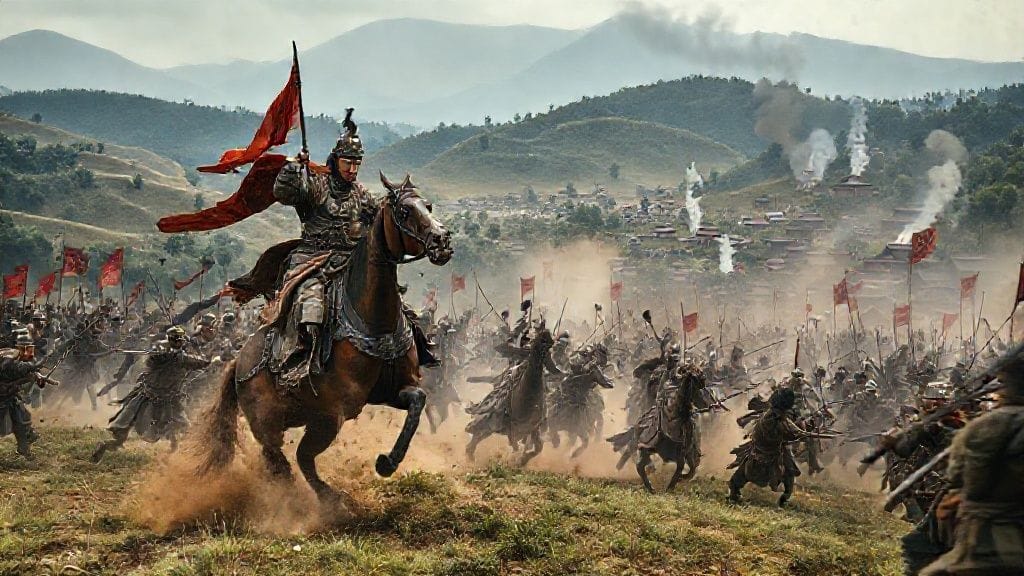
Belisarius chose his deployment with characteristic care, but his options were constrained. The river limited his room to maneuver; he could not easily refuse a flank or execute a large-scale retreat without risking chaos and drowning. He placed his infantry in the center, anchoring the line and providing a solid core of resistance. His cavalry, including his own bucellarii and allied Arab horsemen, took the wings, tasked with countering Persian mounted charges and archery. The town of Callinicum lay to one side, offering at least the psychological comfort of nearby walls, but the battlefield itself was open, flat enough to favor cavalry operations.
Azarethes, by contrast, saw in this terrain an invitation. His plan, as reconstructed by modern historians from the terse accounts of Procopius and others, appears to have aimed at enveloping the Roman line, pressing hard on the wings, and using concentrated missile fire to sap their cohesion. The Persian army relied heavily on mounted archers who could canter in, loose volleys, and withdraw before the heavily armored Roman infantry could close. Over time, such tactics could erode discipline, provoking impulsive charges or panicked retreats.
As the two armies settled into their positions, the air filled with the sounds of last preparations: the clatter of shields and spears, the snorting of horses, the shouted commands of officers trying to impose order on thousands of individual fears. A Roman standard-bearer, gripping the heavy pole of his vexillum, muttered a quick prayer to saints and martyrs. Across the field, a Persian noble checked the edges of his lamellar armor and tightened his grip on the reins of his warhorse, decorated with colored leather and bits of metal that would glint to intimidate. They were separated by language, empire, and belief, but in that moment, as they waited for the signal to advance, their hearts likely beat with the same sharp awareness that some of them would not see another sunrise.
The initial exchanges were cautious. Skirmishers and archers crept forward, loosing tentative arrows to test range and response. The battle of Callinicum had begun not with a thunderous clash but with the hiss of missiles slicing the air and the dull thuds of impacts on shields, flesh, and earth. Both sides watched, measured, and adjusted. The storm was gathering, but its full force was yet to break.
Cavalry, Arrows, and Dust: The Battle of Callinicum Unfolds
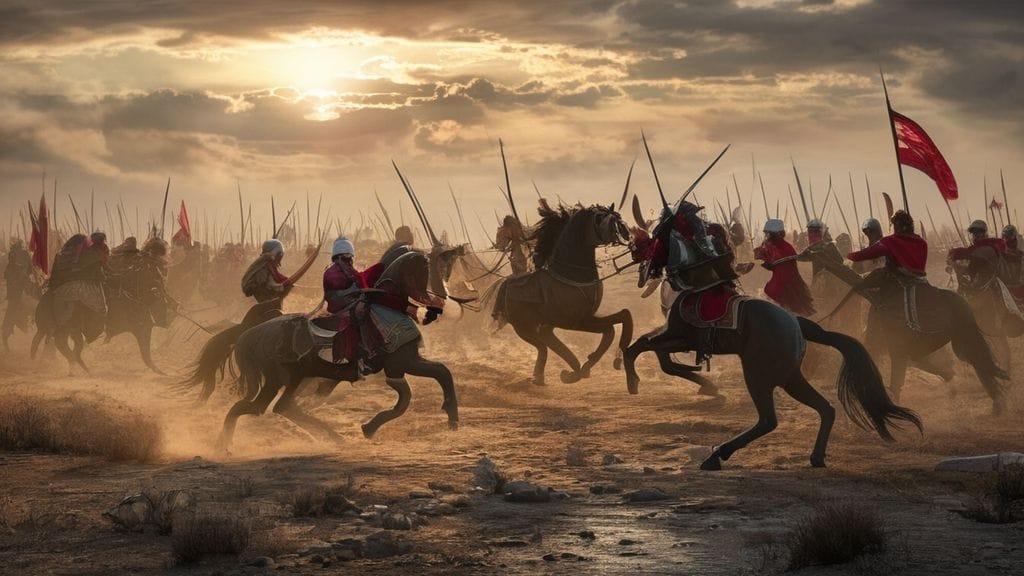
As the sun climbed higher, the battle of Callinicum shifted from probing to serious engagement. Persian mounted archers, operating in loose formations, advanced at a canter, loosed volleys, and wheeled away in clouds of dust. The Romans responded with their own archers and slingers, but the comparative mobility of the Persian forces gave them an edge in this opening phase. Gradually, the dust hung over the battlefield like a low fog, obscuring lines of sight and adding confusion to shouted commands.
Belisarius tried to keep his cavalry from overcommitting. He understood that a reckless charge into a storm of arrows could shatter his wings and expose the infantry. Yet the constant harassing fire and the sting of losses made restraint difficult. On the Roman left, some of the allied Arab contingents, less accustomed to the tightly controlled discipline that Belisarius favored, allegedly pressed forward more aggressively than planned. Whether out of eagerness for glory or simple miscommunication, they soon found themselves in deadly proximity to the Persian horse archers.
Azarethes seized the moment. Seeing elements of the Roman line pushing forward unevenly, he signaled a more concentrated assault on the exposed wing. Persian cavalry surged toward the thinning line, their ornate armor clattering, their lances leveled. The impact, when it came, was brutal. Horses slammed into horses, men were thrown from saddles, and for a moment the battlefield narrowed to personal struggles: a Roman cavalryman trying to wrench a Sasanian rider from his mount; a Persian noble driving his spear past a shield rim; bodies tumbling in knots to the trampled earth.
In the center, the Roman infantry held for the time being, raising shields to intercept arrows and bracing for any attempt by the Persians to break through. But the pressure on the wings was unrelenting. The Persians understood that, pinned against the Euphrates, the Romans could not easily afford a collapse on either flank. If one wing gave way, the entire army could be rolled up and driven into the river. Azarethes’s strategy increasingly focused on this grim arithmetic, testing the resilience of the Roman cavalry, looking for cracks to widen into a rout.
The screams of wounded men and animals, the shouted commands half-heard over the din, the oppressive heat—these formed the sensory tapestry of the battle of Callinicum as it raged through the late morning and into the afternoon. For those in the thick of it, the grand strategies of emperors and shahs shrank to immediate concerns: shield raised or lowered, strike now or feint, flee a step or hold the line. Somewhere amid the turmoil, messengers rode to and from Belisarius, carrying fragments of news from different parts of the field. Piece by piece, the general began to understand that the day was slipping away from him.
Collapse on the Roman Right: Panic, Heroism, and Retreat
The turning point of the battle came on the Roman right wing. Sources differ in their precise details—somehip emphasize the role of allied Arab troops under their own chieftains, others the exhaustion and overextension of Roman cavalry—but the essence is clear: under sustained Persian pressure, the Roman right began to buckle. Men who had held formation for hours started to edge backward, then turn, then run.
It is astonishing, isn’t it, how quickly order can dissolve? One moment, a line of riders sits shoulder to shoulder, presenting a united front; the next, one or two peel away, perhaps to seek water for a dying horse or to escort a wounded officer to safety. In the confusion of battle, these individual choices ripple outward. Seeing comrades move back, others assume that a general retreat has been ordered. Fear, already taut as a bowstring, snaps. The formation’s cohesion fractures, and the disciplined wall of spears and shields becomes, in a heartbeat, a scatter of individuals seeking survival.
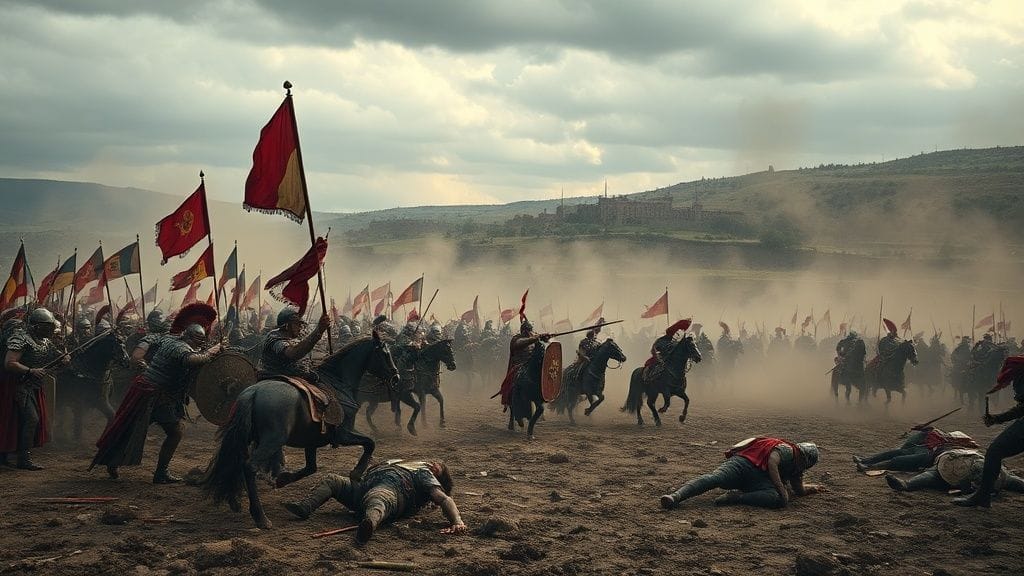
Azarethes and his officers were quick to exploit the shift. Persian cavalry plunged into the gap, their momentum now carrying them into the fragile zone where command structures disintegrated. The Roman right wing, suddenly exposed to encirclement, lost its capacity to resist in an organized way. Some units fought desperately to form a new line closer to the river; others were simply swept up in the chaos, their riders cut down as they tried to flee along the bank or toward the town of Callinicum.
In the center and on the left, Belisarius struggled to salvage the situation. He dispatched reserves where he could, tightening the infantry formation and trying to prevent the Persian assault from breaking through. There are hints in the sources—particularly in Procopius, who was keen to defend his patron’s reputation—that Belisarius considered, and then rejected, a more complete withdrawal. To attempt an orderly retreat under such conditions, with the Euphrates at his back and the enemy pressing hard, risked turning a defeat into an outright massacre.
Within this maelstrom, acts of personal heroism flickered like brief lamps in the dark. A centurion rallying a handful of infantry to hold a narrow stretch of ground; an Arab ally refusing to abandon Roman comrades, cutting down pursuers to buy time; officers sacrificing their own escape to cover the movement of wounded men toward the safety of the town. Yet such gestures, however noble, could not reverse the tide. The battle of Callinicum had reached the point where the best Belisarius could hope for was not victory, but survival.
Gradually, with great effort and at terrible cost, the Romans managed to stabilize a defensive line closer to the river and in the vicinity of Callinicum’s walls. Persian forces, though bloodied, had the advantage, and they pressed it, but their own casualties and the onset of exhaustion limited their ability to finish the Romans off. Night, as so often in premodern warfare, became the ally of the defeated. Under cover of darkness and the protective presence of the town, Belisarius began the grim process of counting his losses and preparing for a withdrawal he had desperately hoped to avoid.
Blood on the Riverbank: Casualties, Survivors, and the Night After
When the sun finally dipped below the horizon, leaving the battlefield in a reddish haze, the full horror of the day’s fighting came into view. The ground near the Euphrates was littered with bodies—Roman and Persian, human and animal, friend and foe. The dust kicked up by thousands of hooves settled slowly onto still faces and broken spears. For those who had survived, the first task was both practical and emotional: to find the living among the dead, to bind wounds, to carry comrades to shelter, and to whisper final prayers over those who would never rise again.
Exact casualty figures, as with many battles of antiquity, are impossible to ascertain with confidence. Ancient writers tended to exaggerate; modern scholars, working backwards from hints and logistics, suggest heavy losses on both sides, with the Romans suffering particularly on their right wing. The battle of Callinicum did not annihilate the Roman field army in the East, but it inflicted enough damage to force a rethinking of immediate operations. Units had to be recombined, replacements summoned, officers reassigned. For the ordinary soldier, this meant the shattering of familiar bonds and the gnawing awareness that his own chance of survival in future campaigns had just grown slimmer.
Inside Callinicum, the atmosphere that night was tense and haunted. The town had not fallen, but its people had witnessed the imperial army—supposed bulwark of their security—driven back and bloodied at their gates. Makeshift infirmaries filled with groaning men. Local clerics moved among them, offering water, blessings, and what spiritual comfort they could muster. Outside, along the riverbank, work details dug shallow graves. Some bodies were claimed by relatives or comrades; others, especially among the Persian fallen, lay unburied or were cast into the Euphrates, to be carried far downstream as mute, tragic messengers of the day’s violence.
The Persians, too, had their mourning to do. Victory had come at a price. Armored cavalrymen who had ridden into the fray with glittering helmets and proud banners now lay broken under the hooves of riderless horses. Azarethes, though he had achieved a clear tactical advantage, had to report to his superiors that the enemy had escaped annihilation. In a world where court politics were as dangerous as the battlefield, an incomplete victory could be interpreted as a kind of failure.
Night across the Euphrates often brought a deceptive silence. Frogs croaked in the reeds; the river flowed steadily outward as if uninterested in the affairs of men. But in 531, after the battle of Callinicum, that silence was thick with unspoken questions. What had gone wrong? Could the outcome have been different? And, most pressingly for commanders and rulers on both sides: what would happen next?
Blame and Justification: Belisarius on Trial in the Court of Opinion
In the weeks and months that followed, as news of the battle of Callinicum traveled along the dusty roads to Antioch, Edessa, and ultimately Constantinople, the human tendency to seek culprits asserted itself. Defeats, far more than victories, demand explanations. Who had miscalculated? Who had disobeyed orders? Who could be sacrificed to preserve the reputations of those in power?
Belisarius, despite his earlier triumph at Dara, did not escape criticism. Some accused him of rashly engaging the Persians with his back to the river, of failing to enforce discipline among allied contingents, of not committing reserves at the right moment. Others argued the opposite—that he had been too cautious, too reluctant to press opportunities, allowing the Persians to dictate the tempo. In Constantinople, where information was fragmentary and heavily filtered, court factions seized on the news to support their own agendas. To undercut Belisarius was, in some cases, to undercut Justinian’s reliance on military strongmen; in others, it was simply to remove a rival from the emperor’s favor.
One of the most important sources for our understanding of the battle, the historian Procopius, served as Belisarius’s secretary and was personally present for many of his campaigns. In his work History of the Wars, Procopius presents the outcome of Callinicum as something less than a disaster, emphasizing the resilience of the army and the strategic context that limited what Belisarius could do. Modern historians, reading between the lines, detect a subtle defensive tone, as if the author is pushing back against accusations that circulated among contemporaries. It is a vivid reminder that our knowledge of the battle of Callinicum is filtered through the pens of men who had their own loyalties and fears.
There is some evidence that Belisarius was recalled from the eastern front not long after, at least in part because of the controversy surrounding Callinicum. Yet this recall was not a strict condemnation. Justinian would soon entrust him with the daring expedition against the Vandal Kingdom in North Africa, a signal that, whatever the murmurs at court, the emperor still saw in him the qualities of a great commander. Belisarius’s career, in other words, bent but did not break under the weight of this defeat. It remains a testament to his skill and personal charisma that he weathered a setback which, for many lesser generals, would have been politically fatal.
Blame, justification, and revision would continue to swirl around the memory of Callinicum for centuries. Was it a minor reverse, quickly compensated by later successes, or a warning sign that the empire was overextending itself on too many fronts? Even today, scholars debate the wisdom of Belisarius’s tactical choices on that April day. Such debates are not mere academic quibbles; they reveal how deeply we yearn to understand the fine line between prudence and recklessness, between necessary risk and needless sacrifice.
Diplomacy After Defeat: From Callinicum to the “Eternal Peace”
The battle of Callinicum, for all its bloodshed, did not end the war between Rome and Persia. But it did help shape the diplomatic landscape that followed. Both empires, exhausted by years of conflict and distracted by internal concerns, had reasons to seek a more stable arrangement. In Persia, the death of Kavadh I and the accession of Khosrow I brought new priorities. The young shah needed time to consolidate power, reform aspects of administration, and manage restive noble families. A prolonged, inconclusive war with Rome was an expensive distraction.
On the Roman side, Justinian’s gaze was turning increasingly westward. He had begun to consider seriously the prospect of reconquering the former Roman provinces held by the Vandals in North Africa and, eventually, by the Ostrogoths in Italy. To do so, he needed troops and funds that were currently tied down in the East. An armistice or, better yet, a long-term peace with Persia would free resources and legitimize the shift in strategic focus. The costly and ambiguous outcome of the battle of Callinicum underscored the dangers of continued large-scale campaigning in Mesopotamia.
Negotiations between the two empires were complex, involving not only diplomats but also ecclesiastical figures, frontier governors, and intermediaries from client kingdoms that straddled the border. The eventual agreement, often referred to as the “Eternal Peace” of 532, was anything but eternal; it would be broken within a decade. Yet at the time, it seemed a remarkable achievement. Rome agreed to pay a substantial sum of gold—interpreted by some observers as tribute, by others as a just contribution to shared frontier defense. In return, Persia accepted a stable boundary and pledged to respect Roman territories.
The shadow of Callinicum lingered in these talks, even if not always explicitly invoked. Persia could negotiate from a position of relative strength, pointing to its recent battlefield success as evidence of its capacity to inflict damage. Rome, however, could stress that its army, though beaten, had not been destroyed. The frontier towns, including Callinicum, had not fallen. Both sides could claim, with some plausibility, that they were yielding peace out of magnanimity rather than desperation.
For the people living along the Euphrates, the “Eternal Peace” meant a reprieve: fewer raids, more predictable tax collection instead of emergency levies, and the hope that their sons might not be marched quite so often to distant, deadly fields. But they also understood, perhaps better than the politicians in their distant capitals, that peace on such a frontier was always provisional. The river flowed on, indifferent; walls could be repaired, but memories of siege and battle did not so easily fade.
Life on the Edge: Cities, Soldiers, and Civilians Along the Frontier
The battle of Callinicum, when viewed in isolation, can appear as a strictly military episode—lines of troops, cavalry charges, the familiar choreography of ancient warfare. Yet to the people who lived near the battlefield, it was part of the larger fabric of frontier life. Towns like Callinicum, Edessa, and Dara were not merely strategic points on a map; they were communities whose daily rhythms were regularly interrupted by the rumblings of imperial rivalry.
In Callinicum itself, the population was a mix of Greek- and Syriac-speaking Christians, Jews engaged in trade and crafts, and others who moved along the caravan routes. Merchants sold grain, textiles, and luxury items imported from further east; artisans worked leather, metal, and stone. Market days were noisy, filled with haggling and gossip about prices, distant wars, and the mood of tax officials. Soldiers on leave wandered through the stalls, searching for cheap wine, better boots, or a simple distraction from the ever-present possibility of sudden orders to march.
When news of troop movements reached town, life could change overnight. Workshops were requisitioned to produce or repair equipment; storehouses were opened to provide grain and fodder; inns filled with officers and couriers. Civilians found themselves sharing streets and wells with men in armor whose priorities and anxieties did not always align with their own. In some cases, local resentment flared against the demands of garrisons that seemed to consume more than they protected. Yet in times of acute danger, the sight of a disciplined Roman force, under a commander like Belisarius, could still inspire relief. Better an imposing imperial army than marauding enemy horsemen whose arrival might mean fire and enslavement.
On the Persian side of the frontier, life in cities like Nisibis and Ctesiphon had parallel dynamics. Traders moved goods along the Silk Road and its branches; Zoroastrian fire temples and Christian churches coexisted, sometimes uneasily. The Sasanian authorities, like their Roman counterparts, depended on frontier communities to supply both revenue and manpower. For peasants and smallholders, whether under Roman or Persian rule, imperial slogans about victory and divine favor often translated into higher taxes, recruitment of sons into military units, and the ever-present threat that their farms could become battlefields.
The battle of Callinicum thus stands not only as a clash between empires but as a window into the precariousness of life on the margins of great powers. Soldiers and civilians lived intertwined lives, sharing food, water, and occasional laughter, yet separated by their roles in a system that could at any moment demand from one group the ultimate sacrifice and from the other the ultimate endurance.
Faith and War: Religion, Holy Days, and Moral Dilemmas at Callinicum
The coincidence of the battle of Callinicum with the Christian Holy Week invited theological reflection almost immediately. How could a devout Christian soldier reconcile the call to arms with the call to repentance and contemplation? Was it right to shed blood on the very days that commemorated Christ’s Passion? Clergy, theologians, and lay believers grappled with these questions, and their answers were anything but unanimous.
Some saw in the timing a sign of divine displeasure. They argued that the defeat, or at least the lack of a resounding victory, was a chastisement for impiety—for the sins of the empire, for the brutality of its tax collectors, for the theological divisions that plagued the church. Others took a more pragmatic stance, insisting that defense of the faithful and the empire’s lands was itself a holy duty, one that could not always be neatly scheduled around liturgical calendars. The moral universe of a frontier soldier was rarely tidy.
Primary sources hint at episodes of intense piety amid the violence. Before the battle, some units may have received blessings from priests; relics of saints might have been carried as talismans and sources of courage. After the battle, priests and monks were among the first to minister to the wounded, Roman and perhaps even Persian, driven by a belief that charity did not stop at the frontier. Such actions complicate any simple narrative of “Christian Rome” versus “Zoroastrian Persia.” The battlefield was, in practice, a place where doctrinal lines blurred in the face of human suffering.
A later chronicler, pondering the events near Callinicum, put the dilemma succinctly: “Men prayed for peace while sharpening their swords.” The line, though perhaps apocryphal, captures the paradox. The imperial ideology of both Rome and Persia linked earthly success to divine favor, yet the mechanisms for securing that favor—prayer, sacrifice, almsgiving—coexisted uneasily with the practical demands of war. The battle of Callinicum, fought under the shadow of the cross and the fire altar, illustrates how deeply religion permeated the logic of conflict, without ever fully controlling it.
Memory and Legend: How Chroniclers Told the Story of Callinicum
In the centuries after 531, the battle of Callinicum appeared in the works of chroniclers and historians, each reshaping it to fit broader narratives. Some, writing from a Roman or Byzantine perspective, minimized the scale of the defeat, presenting it as a hard-fought engagement that, while costly, did not fundamentally alter the balance of power. Others, especially those concerned with the later triumphs of Belisarius in Africa and Italy, treated Callinicum as a sort of testing ground—a difficult lesson that helped forge the general’s later brilliance.
One of our chief testimonies, Procopius, deserves special attention. His History of the Wars is both a goldmine and a puzzle, rich in detail yet shaped by loyalties and grudges. In his account, the Roman army at Callinicum is depicted as hampered by allies who failed to hold their ground and by circumstances beyond Belisarius’s control. The Persian victory is acknowledged but framed in such a way as to preserve the essential competence and honor of the Roman command. Later, in his much more bitter and secretive Anecdota (or Secret History), Procopius would turn a more critical eye on Justinian and Theodora, yet he still tends to protect Belisarius’s military reputation.
Persian sources are less explicit about Callinicum, often focusing instead on Khosrow I’s later campaigns and achievements. Yet the tradition of Sasanian martial pride undoubtedly absorbed the victory into its repertoire of proof that Persian arms could humble even the heirs of Rome. In Armenian and Syriac chronicles, where the frontier wars were felt directly, references to battles like Callinicum are woven into larger stories of suffering, resilience, and the uneasy coexistence of empires.
Over time, as the great catastrophe of the early seventh century—the final, devastating Roman-Persian war of Heraclius and Khosrow II—came to dominate historical memory, the battle of Callinicum faded somewhat into the background. Compared to the sieges of Constantinople, the capture of Jerusalem, and the near collapse of both empires, a regional defeat in 531 seemed almost minor. Yet for those who study the slow unraveling of Late Antiquity, Callinicum remains a telling episode, a signpost on the long road that led from relative stability to apocalyptic conflict.
Modern historians, drawing on archaeology, textual criticism, and comparative analysis, continue to revisit the battle. Some emphasize tactical details; others see it as a moment when the limits of Justinian’s eastern policy became starkly visible. In any case, the way Callinicum has been remembered—and sometimes forgotten—reveals as much about the preoccupations of later ages as it does about the day when arrows darkened the sky over the Euphrates.
From Euphrates to Italy: What Callinicum Meant for Belisarius’s Career
In retrospect, one of the most intriguing aspects of the battle of Callinicum is how little it damaged Belisarius’s long-term career. In many other empires, a general associated with a costly defeat might have been quietly sidelined, exiled, or worse. That Belisarius instead went on to lead the spectacular reconquest of the Vandal Kingdom in North Africa in 533–534, and later to campaign in Italy, suggests that Justinian saw in him qualities that outweighed the blemish of Callinicum.
The recall of Belisarius from the East after the battle can be read in several ways. Perhaps it was a subtle rebuke, a way of signaling imperial displeasure while stopping short of outright disgrace. Perhaps it was a pragmatic recognition that his talents were needed elsewhere and that the eastern front, now moving toward the “Eternal Peace,” could be managed by others. Either way, the episode underscores the delicate dance between military reality and political perception in Justinian’s court.
Belisarius himself, if we can trust the hints in Procopius, may have drawn important lessons from Callinicum. In later campaigns, he showed an acute awareness of the dangers of overextension, of engaging strong enemies without secure lines of retreat, and of relying too heavily on allied contingents whose loyalty might be conditional. At Dara, he had already demonstrated a genius for using terrain to offset enemy strengths. After Callinicum, he seems even more committed to avoiding situations where his army could be maneuvered into a corner, as it had been against the Euphrates.
For Justinian, the very fact that a general who had lost at Callinicum could nonetheless deliver glittering victories elsewhere was politically useful. It allowed the emperor to present setbacks as temporary and localized, while showcasing the empire’s capacity for renewal. When Belisarius entered Constantinople in triumph after his African campaign, leading captive Vandals and displaying captured treasures, the ghosts of Callinicum were, for a moment, pushed firmly into the shadows.
Yet those ghosts never entirely vanished. In quiet conversations among veteran officers, in the memories of families along the Euphrates who had buried sons and husbands after the battle, Callinicum remained a reference point—a reminder that even Rome’s best generals were fallible, that imperial glory was always purchased at a cost measured in blood and tears.
Echoes Through Time: Strategic Lessons of Callinicum
Looking back across nearly fifteen centuries, the battle of Callinicum still offers lessons that resonate beyond its immediate historical context. Strategists and military historians, analyzing the accounts, see in it a case study in risk management, coalition warfare, and the perils of letting political imperatives dictate operational decisions. Belisarius’s decision to engage near the Euphrates, with limited room for maneuver, was shaped as much by the need to demonstrate resistance to Persian incursions as by pure tactical logic. The result was a battle fought under conditions more favorable to the enemy.
The reliance on allied and federate troops—Arab cavalry in particular—highlights the complexity of imperial armies in Late Antiquity. Rome could no longer wage war solely with its own citizen soldiers; it depended on partnerships, subsidies, and negotiated loyalties. When those allies fought well, as many did, they could tip the balance. When misunderstandings or morale issues disrupted coordination, as appears to have happened on the Roman right at Callinicum, the consequences could be catastrophic. Modern coalitions, too, wrestle with similar questions of interoperability, shared objectives, and trust.
Another enduring lesson lies in the relationship between tactical outcomes and strategic trajectories. The Persians won the day at Callinicum, dealing a painful blow to Roman arms, yet the broader war soon moved toward negotiation and the “Eternal Peace.” Rome, for its part, absorbed the defeat, shifted its focus westward, and embarked on campaigns that would temporarily expand its reach across the Mediterranean. Meanwhile, Persia, despite its victory, did not exploit Callinicum to launch a decisive campaign deeper into Roman territory. The battle thus illustrates how individual engagements, even significant ones, can be subordinated to wider calculations that transcend immediate victory or defeat.
Finally, Callinicum offers a sobering reflection on the limits of even the most talented commanders. Belisarius was not a fool; he understood the risks he faced. Yet he operated within constraints—political directives, logistical shortages, the pressures of alliance management—that left him with no perfect choices. In this sense, the battle of Callinicum stands as a reminder that history is often driven not by flawless plans executed by omniscient leaders, but by imperfect humans making hard decisions amid uncertainty, fear, and competing responsibilities.
Conclusion
On that April day in 531, along a bend of the Euphrates near the town of Callinicum, the great abstractions of history—empire, strategy, faith, rivalry—became immediate and painfully concrete. Men in armor felt their throats parch with dust and fear; civilians huddled behind walls, listening to the distant roar of battle; rulers far away awaited reports that would shape their next moves in the intricate game of power. The battle of Callinicum was, in one sense, a relatively contained episode in the long saga of Roman-Persian conflict, overshadowed by later cataclysms. Yet in another sense, it encapsulated the fragile balance on which Late Antique civilization rested.
We have traced its story from the broad tensions between Justinian’s Rome and the Sasanian monarchy, through the personal trajectories of Belisarius and Azarethes, to the dust-choked chaos of the battlefield and the somber night that followed. We have watched as blame was assigned and deflected, as diplomats turned defeat into the prelude to an “Eternal Peace,” and as life on the frontier resumed its precarious rhythm under the watchful gaze of distant capitals. In the process, the battle of Callinicum emerges not merely as a clash of swords, but as a lens onto the political, social, and spiritual anxieties of an age.
Like many defeats, it taught harsher lessons than victory might have done. It revealed the dangers of overconfidence, the complexity of coalition warfare, and the tragic speed with which order can dissolve when fear takes hold. It underscored the dependency of even mighty empires on the loyalty of allies, the steadiness of mid-level officers, and the endurance of ordinary soldiers. And it prefigured, in miniature, the larger strains that would, in time, pull both Rome and Persia toward the brink of mutual exhaustion.
Yet behind the strategic narratives and imperial calculations, it is worth remembering the human scale. Each nameless grave along the Euphrates, each family that waited in vain for a son’s return, each veteran who carried the memory of that day into old age—these lives are the true substance of what we call the battle of Callinicum. The river still flows, the town has changed names and rulers many times, and the empires that clashed there have long since vanished. But the echoes of their struggle, and the lessons embedded within it, continue to speak to anyone willing to listen across the centuries.
FAQs
- What was the Battle of Callinicum?
The Battle of Callinicum was a major engagement fought on 19 April 531 between the Eastern Roman (Byzantine) Empire and the Sasanian Persian Empire near the town of Callinicum on the Euphrates River, in what is now northern Syria. Commanded by Belisarius on the Roman side and Azarethes for the Persians, it ended in a tactical Persian victory that forced the Roman army to retreat with significant losses. - Why did the Battle of Callinicum take place?
The battle occurred during a broader Roman-Persian war driven by long-standing rivalry, border disputes, and changing leadership in both empires. The Persians had launched a bold campaign into Roman territory, and Belisarius moved to challenge them near Callinicum to prevent further incursions and to demonstrate that the empire would not allow such raids to go unanswered. - Who commanded the armies at Callinicum?
The Roman army was commanded by the general Belisarius, already known for his earlier victory at Dara. The Sasanian forces were led by the general Azarethes, an experienced commander of Persia’s elite cavalry. Their decisions on deployment, use of cavalry, and timing of attacks largely shaped the outcome of the battle. - What was the outcome of the battle?
The Persians achieved a tactical victory, inflicting heavy casualties on the Roman army, particularly on its right wing and among allied Arab cavalry. However, the Romans were not annihilated; they managed to retreat toward Callinicum and preserve a significant part of their force. Strategically, the battle contributed to both sides seeking negotiations that culminated in the “Eternal Peace” of 532. - How did the Battle of Callinicum affect Belisarius’s career?
Although the defeat generated criticism and likely prompted his recall from the eastern front, Belisarius’s overall reputation survived. Emperor Justinian soon entrusted him with the high-profile campaign against the Vandals in North Africa, where he won a stunning victory. Thus, Callinicum marked a setback but not a ruinous one, and it may have influenced his cautious, terrain-conscious approach in later wars. - What role did religion play in the battle?
The battle took place during Christian Holy Week, raising moral questions for many Roman soldiers and clergy about fighting on such sacred days. Some interpreted the defeat as divine chastisement, while others argued that defending Christian lands was itself a religious duty. On the Persian side, Zoroastrian and other religious traditions framed the conflict differently, but both empires linked military success to divine favor in their propaganda. - Did the Battle of Callinicum change the course of Roman-Persian relations?
It did not radically redefine the relationship, but it helped shape the immediate diplomatic outcome. The Persian victory strengthened their bargaining position, while Roman resilience and the desire of both Justinian and Khosrow I to focus on internal reforms and other campaigns encouraged compromise. Together with earlier and later engagements, Callinicum formed part of the backdrop to the 532 “Eternal Peace.” - How do historians know about the Battle of Callinicum?
Our main information comes from contemporary or near-contemporary historians such as Procopius, who wrote about the Roman-Persian wars in his work History of the Wars. These narratives are supplemented by later chronicles in Greek, Syriac, and other languages, as well as by modern historical analysis that compares accounts, examines broader military patterns, and, where possible, integrates archaeological evidence from the region.
External Resource
Internal Link
Other Resources
- Encyclopaedia Britannica – general search for the exact subject
- Google Scholar – academic search for the exact subject
- Internet Archive – digital library search for the exact subject