Table of Contents
- Dawn over Dublin: The Calm Before the Storm
- Ireland at the Turn of the First Millennium: A Land Divided
- The Rise of Brian Boru: From King of Munster to High King of Ireland
- The Viking Legacy in Ireland: Raiders, Settlers, and Kings
- The Road to Clontarf: Brewing Tensions and Fragile Alliances
- The Gathering Storm: The Viking and Irish Forces Assemble
- April 23, 1014: The Battle Unfolds on the Plains of Clontarf
- Chaos and Heroism in the Fog of War: Key Moments of the Battle
- Death of a King: Brian Boru’s Final Hours and Legacy
- The Aftermath: Casualties, Captives, and the Future of Ireland
- The Decisive Impact on Viking Influence in Ireland and Beyond
- Clontarf and the Consolidation of Irish Sovereignty
- The Mythology of Clontarf: How History Became Legend
- Political Reverberations: The High Kingship after Brian Boru
- Cultural Ripples: Clontarf in Irish Memory and Identity
- Archaeological Perspectives: Uncovering the Battlefield
- Clontarf in Literature and Art: The Birth of a National Icon
- The Battle’s Place in European Medieval Warfare History
- Lessons from Clontarf: Leadership, Unity, and Resistance
- Modern Reflections: Commemorations and Historical Debates
- Conclusion: Clontarf—A Pivotal Moment in Irish Destiny
- FAQs: Understanding the Battle, Its Context, and Legacy
- External Resource
- Internal Link
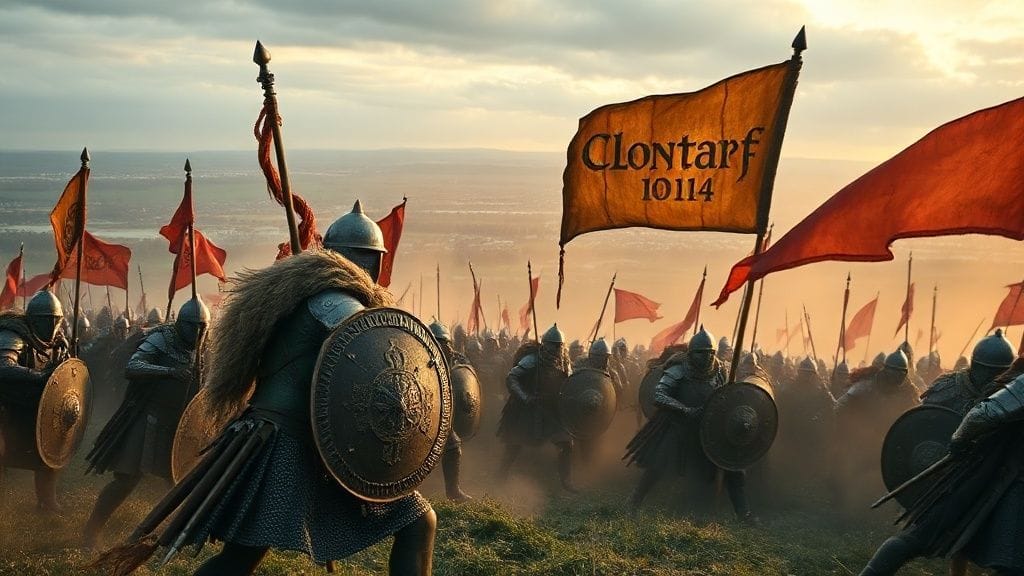
The mist hung low over the River Liffey on that cold spring morning of April 23, 1014. The air, thick with anticipation and the scent of damp earth, crackled with a tension older than the hills that cradled Dublin. Men armed with swords, axes, and shields clattered into position, their faces set in grim determination. This was more than a clash of armies—it was a decisive moment that would reshape the course of Irish history forever. The Battle of Clontarf was about to unfold, pitting not only man against man but visions of power, identity, and survival against one another in a violent crescendo that would echo through the centuries.
Dawn over Dublin: The Calm Before the Storm
As dawn broke, the city of Dublin lay wrapped in its Viking roots—the trading posts, the stone walls, and the bustling docks. Yet, this Norse stronghold stood precariously between two worlds: the native Irish clans, rallying under one banner, and the remnants of Viking power determined to retain their hold over the land. To an outsider, it might have seemed like a routine confrontation among warring factions, but for the Irish people, it was a crucible of hope and liberation.
Before the battle lines hardened, whispers raced through the camps—the strategy, the alliances, the betrayals. Birds scattered from the branches, disturbed by the restless feet of warriors awaiting the signal to charge. A quiet settled—heavy and telling—before the first blow would be struck.
Ireland at the Turn of the First Millennium: A Land Divided
To understand Clontarf is to traverse the fragmented political landscape of early 11th-century Ireland. The island was far from a unified kingdom; it was instead a quilt of rival provinces—Leinster, Munster, Ulster, Connacht—each with its own king, chieftains, and ambitions. Amid this fracturing stood the concept of the High King of Ireland, an often symbolic, sometimes hegemonic role held by the most powerful monarch, but lacking absolute control.
This era was marked by constant rivalry: alliances forged as quickly as they broke, and a precarious balance of power that could tip at any moment. In the background loomed the Viking settlements—Dublin being the most influential—exerting economic and military strength but longing for acceptance and dominance beyond coastal enclaves.
The Rise of Brian Boru: From King of Munster to High King of Ireland
Into this volatile climate stepped Brian Boru, a man whose ambition and charisma would rewrite Irish history. Hailing from the Dál gCais dynasty in Munster, Brian’s rise was neither swift nor uncontested. His early victories against neighboring rulers and Viking raiders built his reputation, but his true genius lay in his vision: to unify Ireland under a single, powerful sovereign free from Viking domination.
By the turn of the millennium, Brian had solidified his hold over much of southern Ireland and, in 1002, was acknowledged as High King—though critics argued the title was more aspirational than factual. Still, he pressed forward, extending his influence and stifling dissent across provinces and Viking enclaves alike.
The Viking Legacy in Ireland: Raiders, Settlers, and Kings
The Vikings’ story in Ireland was complex—a saga of alternating violence and coexistence. Arriving in the late 8th century as raiders, these Norsemen established settlements and evolved into traders, farmers, and rulers. Dublin became a hub of commerce and Norse culture, but their presence was never uncontested.
Despite initial conflicts, intermarriage and alliances shaped a hybrid society in parts of Ireland, blending Gaelic and Norse traditions. Yet, the Vikings remained outsiders in the eyes of many Irish clans, a foreign yoke to be cast off. The battle lines of Clontarf, in a way, represented a final reckoning of this uneasy integration.
The Road to Clontarf: Brewing Tensions and Fragile Alliances
The years leading up to 1014 were a chessboard of shifting alliances. The Kingdom of Leinster, traditionally rival to Brian Boru, joined with Viking forces from Dublin and Norwegian contingents from the Irish Sea to challenge the High King's rising dominance. The impetus was clear: the Norse and their allies sought to preserve their power; Brian, to cement his sovereignty.
One pivotal alliance was between Máel Mórda of Leinster and Sigtrygg Silkbeard, King of Dublin. Their united front was a deliberate counterweight to Brian’s encroaching reach. Both sides marshaled their forces with care, knowing that failure would mean obliteration—not only of armies but of centuries-old power structures.
The Gathering Storm: The Viking and Irish Forces Assemble
As spring warmed the lands, the battle lines hardened. Brian Boru led a formidable force, estimated at tens of thousands, drawn from Munster and allied provinces. Opposing him was a coalition of Vikings and Leinster men, including seasoned mercenaries and the famed Viking warrior armies, some from as far as Orkney and the Isle of Man.
The troops gathered near Clontarf, then a coastal village outside Dublin’s walls. Encampments filled the fields, banners fluttered, and the thrum of war drums echoed. Both sides understood that this was a contest for Ireland itself—victory would seal a new era of rule, defeat would plunge the island into chaos and perhaps renewed Viking domination.
April 23, 1014: The Battle Unfolds on the Plains of Clontarf
When the sun finally rose on April 23, the clash was brutal from the start. Traditional sources, such as the Annals of Ulster, describe a ferocious melee that lasted from dawn until dusk—a contest of endurance and grit. Warriors fought with a desperate valor, the clangor of blades intertwining with the war cries.
Not merely a straightforward fight, the battle had layers of strategic depth. Brian’s forces sought to pin the Vikings while fending off inland Leinster troops. The Vikings, expert in shield-wall tactics, aimed to break the Irish lines with a ferocity born of centuries of combat experience.
Chaos and Heroism in the Fog of War: Key Moments of the Battle
Amid the carnage, stories emerged that became legendary. Brian Boru, though aged and suffering ill health, reportedly fought with steadfast bravery. According to tradition, he met his death not amidst the open field but inside his tent, slain by a Norseman who slipped past the frontlines—a poignant end to a warrior king on the cusp of triumph.
The death of Brian caused confusion among his troops, but the momentum had shifted. The Viking-Leinster coalition, despite their formidable numbers, began to falter under the relentless Irish assault. Tales of individual heroism abound: of Irish nobles holding the line, of Viking leaders falling in battle, and of common soldiers whose fates would be lost to history save for the echoes in ancient chronicles.
Death of a King: Brian Boru’s Final Hours and Legacy
Brian’s death did not extinguish his vision. It was paradoxical—the collapse of the king who sought to unify Ireland also became the catalyst for that unification. His legacy endured in the collective memory as a symbol of resistance against foreign domination and of Irish sovereignty.
Chroniclers paint Brian as a larger-than-life figure, melding historical fact with legend. His demise was both tragic and heroic, embodying the complex realities of medieval warfare and kingship. The battle’s conclusion, while bloodied, marked the beginning of the end for Viking power in Ireland.
The Aftermath: Casualties, Captives, and the Future of Ireland
Casualties were immense. Estimates suggest thousands perished on both sides, including many high-ranking nobles and commanders. The Viking fleets were scattered, and their grip on Ireland weakened dramatically. Dublin, while surviving as a city, lost much of its political independence.
Yet, Ireland would not immediately become a unified kingdom. The ensuing years saw continued power struggles, but Clontarf shifted the balance irrevocably toward native Irish rule. The tide had turned, and the Norse presence was relegated to secondary status—more merchants than rulers.
The Decisive Impact on Viking Influence in Ireland and Beyond
Beyond Ireland’s shores, Clontarf resonated across the Norse world. The battle marked a critical point in the decline of Viking power in the Irish Sea region. It served as a warning to other Norse settlements and diminished the prospect of further large-scale Norse invasions.
For the Irish, it was a reclaiming of their homeland from centuries of violent incursion—a narrative of resilience that would inspire later generations facing new foreign threats.
Clontarf and the Consolidation of Irish Sovereignty
Though political fragmentation persisted, the symbolic weight of Clontarf allowed subsequent rulers to claim a higher authority grounded in the legacy of Brian Boru. The notion of a unified Ireland, while delayed, gained renewed vigor. Clontarf became more than a battle; it became the foundational myth for Irish sovereignty.
The Mythology of Clontarf: How History Became Legend
Over time, Clontarf’s story grew in the telling. Chronicles, bardic poetry, and oral tradition wove fact with fiction. The battle transformed into a tale of national salvation, of a king who embodied the spirit of the Irish people, and of a triumph of native warriors over invaders.
This mythology sometimes obscures the complexities of the event but also keeps its memory alive and resonant in the Irish psyche.
Political Reverberations: The High Kingship after Brian Boru
Brian’s successors never fully matched his power or unifying vision. The High Kingship reverted to a more ceremonial role, and regional kings reclaimed influence. Nevertheless, the battle’s outcome curtailed external Viking interference in Irish politics and shifted the focus inward.
This political aftershock influenced centuries of Irish medieval history, setting the stage for future struggles both internal and foreign.
Cultural Ripples: Clontarf in Irish Memory and Identity
Clontarf has been celebrated in Irish culture as a symbol of national pride and resistance. From 19th-century nationalist writers to modern commemorations, it represents the enduring spirit of Ireland—resilient, defiant, and rooted in a rich past.
Songs, stories, and public monuments all attest to its continued relevance. It is a prism through which Ireland reflects on identity and destiny.
Archaeological Perspectives: Uncovering the Battlefield
In recent decades, archaeology has sought to unearth clues beneath the fields of Clontarf. Finds of weaponry, skeletal remains, and artifacts add material evidence to legendary accounts. These discoveries enrich our understanding of the battle’s scale and the lived experiences of those who fought.
However, much remains buried and elusive, keeping the mystery and romance of Clontarf alive.
Clontarf in Literature and Art: The Birth of a National Icon
The battle has inspired countless works—from historical epics to paintings and poems. Its dramatis personae, from Brian himself to fierce Viking warriors, populate the cultural imagination. These creative interpretations bridge past and present, inviting audiences to engage with history emotionally and intellectually.
The Battle’s Place in European Medieval Warfare History
While often viewed through an Irish lens, Clontarf also holds significance in the broader medieval context. It illustrates the intersection of Viking and Gaelic warfare styles, the shifting power dynamics of the British Isles, and the rise of nascent national identities.
Comparisons to other medieval conflicts highlight its role in the transition from Viking expeditions to settled kingdoms.
Lessons from Clontarf: Leadership, Unity, and Resistance
Clontarf teaches enduring lessons on the importance of vision and leadership in times of division. Brian Boru’s ability to unite disparate factions, confront a common enemy, and inspire sacrifice resonates beyond medieval Ireland.
The battle echoes through history as a testament to the power of unity against fragmentation and external threat.
Modern Reflections: Commemorations and Historical Debates
Each year, the anniversary of Clontarf invites reflection. Debates continue among historians regarding troop numbers, the battle’s precise course, and its long-term effects. Contemporary commemorations blend scholarship with cultural expression, highlighting the living relevance of this ancient clash.
Conclusion: Clontarf—A Pivotal Moment in Irish Destiny
The Battle of Clontarf remains one of the most pivotal and evocative moments in Irish history. It was a defining clash between cultures and kingdoms, where the struggle for identity, sovereignty, and survival played out with fearless intensity. Though Brian Boru’s life ended on that battlefield, his vision for a unified Ireland ignited a flame that would burn through history’s darkest nights.
Clontarf teaches that history is not merely a sequence of dates and events but a living tapestry of human courage, ambition, and resilience. It reminds us that the past shapes who we are, and in the echoes of old battles, we find the voice of a people forever striving for freedom and unity.
FAQs
Q1: What were the main causes of the Battle of Clontarf?
The battle was rooted in ongoing power struggles between Irish kingdoms and Viking settlers, with King Brian Boru aiming to end Viking influence and unify Ireland under native rule. Tensions escalated due to alliances between Leinster and Dublin Vikings opposing Brian’s ascendancy.
Q2: Who were the key figures in the battle?
Brian Boru, High King of Ireland, led the Irish side. Opposing him were Sigtrygg Silkbeard, King of Dublin, and Máel Mórda of Leinster. Various Viking mercenaries from the Irish Sea region also took part.
Q3: What was the outcome of the battle?
The Irish forces won a strategic victory that ended much of Viking political power in Ireland. However, Brian Boru died in the battle, leading to continued regional turmoil despite the diminished Viking threat.
Q4: How did the battle affect Viking influence in Ireland?
It marked the decline of Viking dominance in Ireland. After Clontarf, Viking settlements became less politically independent and more integrated into Irish culture and economy.
Q5: Is the battle remembered as a moment of Irish national unity?
Yes, Clontarf became a potent symbol of Irish resistance to foreign domination and the aspiration for unity, inspiring national identity narratives in later centuries.
Q6: What sources describe the battle?
Primary sources include the Annals of Ulster, various Irish chronicles, and Norse sagas, though these often blend fact and legend.
Q7: Has the battlefield been archaeologically studied?
Yes, some excavations have revealed artifacts and remains, though much is still undiscovered, and debate continues about the exact locations of key fighting points.
Q8: How is the battle commemorated today?
Clontarf is remembered through cultural events, historical reenactments, academic study, and public monuments, especially in Dublin and Munster.

