Table of Contents
- A City on the Brink: Delhi Before the Tempest of 1737
- The Waning Mughal Sun: Empire in Decline
- The Rise of the Marathas: From Deccan Upstarts to Imperial Challengers
- Peshwa Baji Rao I: The Man Who Dreamed of Delhi
- The Road to Confrontation: Raids, Revenues, and Imperial Pride
- On the March to the North: The Maratha Cavalry Sweeps Hindustan
- Inside the Red Fort: Panic, Politics, and Paralysis in the Mughal Court
- The Battle of Delhi 1737 Begins: A City Confronts Its New Masters
- Fire, Dust, and Hooves: How the Fighting Unfolded Around the Capital
- The People of Delhi: Fear, Rumor, and Survival Amid the Clash
- From Victory to Message: Baji Rao’s Political Theatre at Delhi’s Gates
- Retreat or Triumph? The Maratha Withdrawal and Its Hidden Calculations
- Echoes in the Court: How the Mughal Elite Processed Humiliation
- Reshaping the Subcontinent: Political Consequences of the 1737 Campaign
- Delhi After the Storm: Memory, Trauma, and the Stories People Told
- From Delhi 1737 to Panipat 1761: A Long Shadow Over Maratha Ambitions
- Sources, Silences, and Myths: How Historians Reconstruct the Battle
- Conclusion
- FAQs
- External Resource
- Internal Link
Article Summary: In the spring of 1737, the Mughal capital of Delhi—once the glittering heart of an empire—confronted a new power from the south in what is now remembered as the battle of delhi 1737. This article traces the slow unravelling of Mughal authority and the bold rise of the Maratha Confederacy that made such an audacious march on Delhi possible. Moving from court intrigues in the Red Fort to the thunder of cavalry outside the city’s walls, it reconstructs how a campaign that was militarily limited became politically seismic. We follow Peshwa Baji Rao I’s daring strategies, the Mughal court’s hesitation, and the terror and confusion felt by ordinary residents of Delhi. The narrative explores how this episode signaled a transfer of initiative in India—from a fading dynasty to ambitious regional powers. Yet behind every maneuver lay human stories of fear, pride, ambition, and loss. By the end, the article shows how the battle of delhi 1737 foreshadowed later catastrophes, including the Third Battle of Panipat, and helped shape the fractured political landscape into which colonial forces would later step. In doing so, it invites us to listen closely to both the loud clash of armies and the quieter echoes of a city discovering it was no longer invincible.
A City on the Brink: Delhi Before the Tempest of 1737
On a late March morning in 1737, the air over Delhi shimmered with a deceptive calm. From the sandstone ramparts of the Red Fort, the city stretched outward in a patchwork of domes, bazaars, gardens, and dusty lanes. To an untrained eye, the Mughal capital still appeared eternal: the Yamuna glided past the palace walls, the call to prayer rose above Chandi Chowk, and the imperial banners fluttered lazily over the fort’s towers. Yet beneath this veneer of continuity, Delhi was a city on the brink, the stage upon which the drama of the battle of delhi 1737 would soon unfold.
Delhi had long lived on a careful balance of fear and awe. For more than a century and a half, its emperors had commanded distant provinces with the stroke of a pen and the march of their armies. In the days of Akbar, Jahangir, and Shah Jahan, the mere mention of the Mughal name had carried a weight that few dared challenge. But by the 1730s, the city’s grandeur concealed crippling decay: the treasury strained to meet expenses, governors in far-flung regions withheld revenues, and rival powers chipped away at the empire’s authority.
Walk through a Delhi lane in that era and you might see the contradictions etched into daily life. A nobleman’s palanquin squeezed past a line of unpaid soldiers demanding their arrears. Jewelers still sold fine emeralds and pearls, yet many aristocratic families were secretly pawning heirlooms to maintain appearances. The emperor, Muhammad Shah—later remembered with a mixture of affection and disdain as Muhammad Shah Rangila, the “Colorful” or “Merry”—devoted himself to music, painting, and dancing girls, while frontier reports of rebellion and defiance piled up unread or unheeded.
Rumors rode swifter than couriers. Whispers of Maratha raids to the south, of Sikhs stirring in the Punjab, of Nizam-ul-Mulk in the Deccan behaving more like an independent prince than an obedient vizier—these stories circulated in the markets and tea stalls, sometimes dismissed with a shrug, sometimes retold with dread. Perhaps, some old men muttered, the days of Aurangzeb’s iron rule had not been as bad as people claimed; at least then, the empire’s enemies trembled at its might.
Yet life went on. Weddings were celebrated, petitions filed, poems written. Nobody in Delhi, not even the most anxious courtier, fully grasped that within months the city would stand exposed—its weakness made visible not by a massive siege but by a swift and cunning cavalry raid that arrived before the empire could even properly respond. It is this moment of deceptive calm, the fragile normalcy before the storm, that gives the battle of delhi 1737 its haunting power. The city felt old, permanent, anchored. The men riding toward it from the south thought otherwise.
The Waning Mughal Sun: Empire in Decline
To understand what happened in 1737, one must first understand how the Mughal Empire came to such a state that an upstart power could dare to threaten its capital. Half a century earlier, the idea of anyone challenging Delhi directly would have seemed almost absurd. In the late seventeenth century, under Emperor Aurangzeb, the empire stretched from Kabul to the Deccan, from Gujarat’s coastline to the borders of Bengal. But Aurangzeb’s later years were spent not in stable governance but in unending warfare, particularly in the Deccan, where he tried to crush the Marathas and other local powers through relentless campaigns.
Aurangzeb died in 1707, leaving an empire exhausted in treasure and willpower. His successors inherited both a vast domain and a set of structural problems he had never resolved. The nobility was divided into factions; revenue systems were under strain; and resentment simmered in many regions that had been drawn into Mughal rule through force rather than loyalty. The following decades saw emperors rise and fall in quick succession, some assassinated, others manipulated by powerful courtiers, all increasingly dependent on military elites whose loyalties were negotiable.
Muhammad Shah ascended the throne in 1719, after a dizzying period of instability that had seen puppet emperors rise and fall within months. Charismatic, charming, and artistically inclined, he tried to restore some dignity to the crown. He encouraged music, painting, and cultural refinement at court. Delhi’s ateliers came alive with new styles of miniature painting; poets found patronage; festivals resumed with old splendor. For a moment, it seemed as if the Mughals might reclaim not their former territorial reach but at least their cultural centrality.
Yet governance demanded more than taste. While Muhammad Shah reveled in courtly pleasures, powerful statesmen like Nizam-ul-Mulk carved out personal fiefdoms in the Deccan, maintaining nominal loyalty while pursuing their own interests. Afghan chieftains along the northwestern frontier tested the empire’s defenses. The imperial army, once the terror of the subcontinent, suffered from poor discipline, delayed pay, and outmoded tactics. Heavy artillery and ponderous infantry still formed the core of their doctrine, even as nimble cavalry forces began to define the new age of warfare in India.
This was the backdrop against which the Marathas rose: not against the unstoppable force of early Mughal might, but against a tired, faction-ridden, and increasingly defensive empire. The battle of delhi 1737 was not just an isolated clash; it was a symptom of a wider imbalance that had been building over decades. In the language of one later Persian chronicler, the Mughal sun had not yet set completely, but “its disc had grown pale, and its rays no longer scorched the earth as before.”
Inside the Red Fort, the imperial court rarely acknowledged the depth of the crisis. A few ministers and generals warned of the danger, urging military reforms, more disciplined revenue collection, and a firmer hand over fractious governors. Their voices were often drowned out by factional rivalries. Prestige mattered as much as practicality. The idea that the emperor of Hindustan might have to make concessions to provincial powers was an affront to centuries of imperial ideology. And so, decisions were delayed, reassurances were offered, and warnings were shelved. In that slow paralysis, the Marathas found their opportunity.
The Rise of the Marathas: From Deccan Upstarts to Imperial Challengers
The story on the other side of the subcontinent was dramatically different. In the rugged hill forts and valleys of the western Deccan, a new power was testing its wings. The Marathas had emerged in the late seventeenth century under the leadership of Shivaji, who built a guerrilla-style kingdom that defied Mughal attempts at subjugation. Shivaji’s legacy was not just territory, but an idea: that regional powers could contest Mughal supremacy, using speed, mobility, and local support to offset imperial strength.
After Shivaji’s death and a period of internal conflict, the Maratha state reorganized under a new structure: the Chhatrapati (sovereign king) as the symbolic head and the Peshwa (chief minister) as the real architect of power. By the early eighteenth century, the Peshwas in Pune had begun to transform this once-fragmented resistance movement into a coordinated confederacy. They did so through a shrewd blend of military pressure and financial negotiation—demanding chauth (a quarter of revenue) and sardeshmukhi (an additional levy) from Mughal provinces in exchange for peace.
Maratha armies differed fundamentally from their Mughal counterparts. Their core strength lay in light cavalry: horsemen who could cover astonishing distances in short spans of time, carrying minimal baggage, living off the land and local supplies. They preferred harassment to head-on confrontation, attrition to grand set-piece battles. Where Mughals lumbered, they darted; where Mughals entrenched, they flowed around obstacles. Their commanders, forged in the harsh terrain of the Deccan, had learned to treat mobility itself as a weapon.
By the 1720s and 1730s, the Marathas were no longer merely defending their homeland; they were pushing outward. Malwa and Bundelkhand, central Indian regions that linked the north to the Deccan, became contested spaces. Governors alternately fought and negotiated, paying chauth to avoid devastation, then appealing to Delhi when the burden grew too heavy. Each such treaty—each payment accepted in exchange for peace—was also a recognition, however grudging, that the Marathas had become a force that could not be ignored.
It is important to see the battle of delhi 1737 in this arc of Maratha expansion. The raid on Delhi was not an isolated adventure but the logical extension of a strategy developed in central India: demonstrate force, exact payment, secure recognition, and retreat before a decisive counterstroke could be organized. What made 1737 extraordinary was not that the Marathas raided north, but that they dared to approach the Mughal capital itself, aiming not merely for wealth but for symbolic dominance.
Within Maratha ranks, this shift in ambition created both excitement and unease. Traditional leaders from the Deccan still saw their struggle as one anchored in that region. But a new generation of commanders—restless, confident, and conditioned by a series of hard-won successes—looked toward Hindustan, the northern heartland of the Mughal realm, as their rightful arena. Among these men, one figure towered above the rest: Peshwa Baji Rao I.
Peshwa Baji Rao I: The Man Who Dreamed of Delhi
“Let us strike at the trunk of the withering tree, not merely at its branches.” With words like these—recorded in later Maratha traditions, though filtered through memory and myth—Peshwa Baji Rao I is said to have articulated his vision of confronting Mughal power at its core. Whether he uttered those exact phrases or not, there is no doubt that his strategic mind worked along such lines. He understood that as long as Delhi remained an unquestioned symbol of sovereignty, the Marathas would remain supplicants and raiders, not true contenders for imperial authority.
Baji Rao did not look like the stereotypical conqueror of popular imagination. Rather than towering physical presence, he projected intensity and focus. Contemporary descriptions from both Maratha and Persianate sources emphasize his restless energy, his almost uncanny sense of timing in war, and his willingness to ride with his men across punishing distances. A later British observer, writing after the Marathas had become a known quantity to European powers, would call him “a master of the rapid stroke, whose cavalry seemed to devour the ground beneath them.” That assessment, though retrospective, captures something essential about his style.
In Pune, the young Peshwa pushed for an expansionist agenda. He argued that the Maratha state could not remain confined to the Deccan if it wished to command the tributary revenues on which its growing ambitions depended. The rich lands of Malwa, the Gangetic plain, and eventually the environs of Delhi beckoned. Each successful campaign emboldened him. Victories in Malwa showed that Mughal garrisons could be outmaneuvered, their supply lines cut, and their commanders forced to accept Maratha terms.
Baji Rao also understood the importance of theatre. Warfare in eighteenth-century India was not just about killing enemies; it was about sending messages—to rival courts, to local elites whose loyalty was always negotiable, and to the ordinary people whose cooperation or resistance could make or break campaigns. A raid near a major city, a demonstration of strength, a magnanimous pardon or a calculated act of terror: all could alter the political weather. The raid that culminated in the battle of delhi 1737 must be seen through this lens. It was not a bid for occupation, but for shock and awe.
Yet Baji Rao was no mere gambler. He knew the limits of his forces and the risks inherent in pushing too far, too fast. Delhi was not just any city; it was the Mughal capital, with symbolic allies across the subcontinent. A serious attempt to seize it might provoke coalitions from Afghans, Rajputs, and other powers, all anxious about Maratha overreach. So he calibrated his objective carefully: ride fast, strike hard, induce panic, then withdraw on terms that implicitly recognized Maratha ascendancy.
In the months leading up to 1737, correspondence between Maratha commanders and allies in central India shows a growing confidence. Reports reaching Pune suggested that the Mughal court was distracted, its generals divided, its frontier forces stretched thin. Payments due from several regions had been delayed or withheld. For a strategist like Baji Rao, these were temptations too great to ignore. The map of Hindustan lay before him; his finger traced a path north. If he could reach Delhi’s environs and leave before the empire fully awoke, he would change the political conversation for years to come.
The Road to Confrontation: Raids, Revenues, and Imperial Pride
The immediate triggers that led to the Maratha thrust toward Delhi in 1737 lay in a complex web of unpaid tributes, broken promises, and wounded pride. Throughout the early 1730s, Mughal governors in Malwa, Bundelkhand, and adjacent regions had been playing a difficult game. On one side stood the emperor in Delhi, demanding revenues to sustain an overextended empire; on the other, the Marathas, demanding chauth as the price of peace. Provincial administrators tried to appease both, often failing both.
Resentment built on all sides. From Delhi’s perspective, the governors seemed weak, complicit in the erosion of imperial authority. From Pune’s point of view, the governors’ efforts to delay or dilute payments looked like betrayal of solemn agreements. Caught between the two, the countryside suffered. Maratha raiding parties descended on villages and market towns, seizing crops, cattle, and cash when the promised sums were not forthcoming. Locals cursed both the distant emperor and the mounted raiders, but they paid whoever stood at their door with armed men.
In this atmosphere of chronic instability, small incidents could have large consequences. A particular caravan plundered, a fort commander dishonored, an envoy insulted at court—each became a spark in the tinder of fragile arrangements. In one widely cited Persian chronicle, the chronicler laments that “petty revenue disputes, which might have been settled by ink and counsel, were left to be decided by the sword.” It is precisely this failure of timely negotiation that set the stage for the campaign culminating in the battle of delhi 1737.
From the Mughal side, there were also attempts at counter-pressure. Ahmad Khan Bangash, an Afghan chief who commanded respect in the region of Farrukhabad, and other regional warriors were encouraged to resist Maratha incursions. But such commanders were semi-autonomous, their own interests only partly aligned with Delhi’s. Sometimes they fought bravely; sometimes they bargained. The empire had become a patchwork of overlapping authorities, with loyalty as fluid as the money that sustained it.
By 1736, negotiations between the Mughals and Marathas had grown increasingly strained. The Marathas pressed for formal recognition of their right to collect chauth from vast swathes of Malwa and beyond. The Mughal court vacillated, its ministers torn between the practical need to buy peace and the ideological horror of validating what they still called “rebellious zamindars.” Muhammad Shah, sensitive to perceptions of his honor, wavered. Every concession looked like an admission of weakness.
In Pune, this hesitation was read not as principled resistance but as an invitation. If Delhi would not acknowledge Maratha rights through treaties, perhaps it could be made to do so through fear. Around late 1736 and early 1737, Baji Rao made his decision. He would ride north with a strong cavalry force, carve a path through central India, and present himself, not within the walls of Delhi—that was neither desirable nor feasible—but within striking distance of its gates. Only then, he gambled, would the emperor truly understand the new balance of power.
On the March to the North: The Maratha Cavalry Sweeps Hindustan
The Maratha advance toward Delhi in early 1737 is one of the most striking examples of operational mobility in eighteenth-century Indian warfare. Leaving the Deccan, Baji Rao led a force composed largely of light cavalry—estimates vary, but many historians place it between 20,000 and 30,000 horsemen, supplemented by some infantry and artillery. What made this army formidable was not its size alone, but its speed. They carried minimal baggage, relied on local forage, and were prepared to move as much as fifty to sixty kilometers in a day, an extraordinary pace for the time.
As the Marathas moved through Malwa, they encountered pockets of resistance but no coordinated imperial defense. Many local commanders chose to negotiate rather than risk annihilation. Forts that might have held out for weeks against a formal siege were bypassed if they posed no immediate threat to Maratha lines of movement. Bridges were seized, ferries commandeered, and grain stocks appropriated. Villages along their path watched with a mixture of awe and terror as waves of horsemen passed, pennants snapping in the wind, riders sometimes singing battle songs in Marathi, sometimes ominously silent.
In such campaigns, information was as important as steel. Scouts and spies went ahead, probing for enemy forces, mapping water sources, and gauging local sentiment. The Marathas were adept at blending intelligence with speed. If a Mughal detachment was reported nearby, they might appear at its flank or rear before it had fully formed into battle lines. Conversely, when a strong force threatened to block their path, they diverted swiftly, leaving confusion in their wake. To many central Indian observers, it seemed as if the very geography of Hindustan had changed—roads and distances compressed under the pounding hooves of Maratha horses.
Delhi, at first, did not quite believe the reports. News of Maratha incursions was familiar; what made 1737 different was the direction and speed of their movement. Messengers arrived breathless at the imperial court, describing how Baji Rao’s army had crossed one river after another, how once-secure towns had either paid or fled, how Mughal detachments sent to contain them had been brushed aside. Still, some courtiers argued that this was an exaggeration, the usual panic of provincial officials seeking attention and funds.
But as the weeks passed and the news grew more alarming—Maratha banners sighted near Gwalior, columns spotted north of the Chambal—the denial grew harder to maintain. For those who today reconstruct the battle of delhi 1737, these days of advance are crucial. They represent the empire’s last realistic chance to halt Baji Rao far from the capital. Instead, indecision reigned. Orders were issued and countermanded, generals argued over strategy, and time slipped away, measured in miles covered by Maratha cavalry.
If one imagines a map of northern India in early 1737, it would be crisscrossed with lines of movement—couriers racing to Delhi, merchants diverting caravans, villagers fleeing anticipated plunder, Maratha scouts fanning out ahead of the main force. Among these lines, one arrow grew steadily longer, pointing toward Delhi. It did not yet mean the city’s fall; Baji Rao did not aim to occupy the capital. But the arrow’s very direction challenged centuries of political geography. Delhi was no longer a distant, invulnerable center. It could be approached—and, if need be, threatened.
Inside the Red Fort: Panic, Politics, and Paralysis in the Mughal Court
While the Maratha cavalry closed in, drama of a different kind unfolded inside the thick walls of the Red Fort. The Mughal court, once the supreme command center of an empire, was now a theater of anxieties, factions, and half-measures. When credible reports finally convinced Muhammad Shah and his ministers that Baji Rao was heading toward Delhi, the initial reaction was disbelief tinged with anger. How dare these “country chiefs,” as some still called the Marathas, presume to bring their raiding so close to the imperial seat?
Yet rhetoric could not hide the problem of means. The imperial army on paper remained formidable: thousands of cavalry and infantry, artillery pieces, seasoned nobles with long service. In practice, many units were understrength, their horses in poor condition, their officers more accustomed to ceremonial duties than hard campaigning. The treasury struggled to pay arrears. Some regiments, owed months of wages, were on the verge of mutiny. To send such an army swiftly against a fast-moving foe required decisive leadership—and that was precisely what the court lacked.
Councils were convened, plans debated. One faction argued that a strong force should be dispatched under a trusted general to block Baji Rao’s advance and drive him back to central India. Another urged caution: perhaps the reports were exaggerated; perhaps a show of force nearer Delhi would suffice. Some suggested negotiation, others scoffed at any talk of compromise. Every option seemed fraught with risk; doing nothing, however, was the one option that guaranteed further emboldenment of the Marathas.
At the center of this storm of counsel sat Muhammad Shah. Chroniclers sympathetic to him depict a ruler torn between competing advice, striving to balance honor with prudence. Less charitable accounts portray him as vacillating, more concerned with preserving his dignity at court than with forging a coherent response. Whichever portrait one accepts, the outcome was clear: the empire’s reaction lagged behind the pace of events. By the time a significant imperial force under the experienced commander Khan Dauran and others began to move, the Marathas were already uncomfortably close.
Outside the immediate circle of power, anxiety spread among Delhi’s residents. Merchants worried about their stocks and caravans; artisans wondered whether orders would dry up if chaos reigned; common laborers feared conscription or plunder. Yet rumor also bred bravado. Some declared that no outsider could possibly threaten Delhi, protected as it was by both walls and divine favor. Others whispered older stories—of Timur’s sack of the city in 1398, of earlier invasions that had turned its streets into charnel houses. The memory of those catastrophes, passed down through generations, gave their fears a grim vocabulary.
It was in these charged days, as the court oscillated and the populace wavered between fear and denial, that the approach to the battle of delhi 1737 truly began. The clash itself would be sharp and localized; the real struggle was psychological and political. Would Delhi admit, even to itself, that its age of unquestioned preeminence was over?
The Battle of Delhi 1737 Begins: A City Confronts Its New Masters
The phrase “battle of delhi 1737” can be misleading if one imagines a single, massive engagement beneath the city’s walls. In reality, the conflict unfolded as a series of rapid maneuvers and confrontations around the broader Delhi region, culminating in a dramatic demonstration of Maratha power within striking distance of the capital. It was less a siege and more a daring thrust—a saber slash that did not quite pierce the heart, but left a deep and lasting scar.
By late March 1737, Baji Rao’s forces had reached the vicinity of Delhi. Their arrival sent a jolt through the countryside. Villages watched with dread as columns of horsemen appeared on the horizon, dust plumes marking their path long before they themselves were visible. Some local landholders chose to submit, offering supplies and pledges of neutrality; others fled behind the relative safety of town walls. The Marathas, for their part, aimed to avoid getting bogged down in prolonged sieges. Their eyes were fixed on the psychological prize: to show that they could operate freely in the shadow of Delhi itself.
The Mughal forces in the field, under generals such as Khan Dauran and others, attempted to interpose themselves between the Maratha army and the capital. Yet coordination proved difficult. The Mughals were constrained by heavier equipment, slower infantry, and more cumbersome supply lines. Moreover, they needed to defend multiple possible approaches to the city. Baji Rao exploited this dilemma ruthlessly, feinting in one direction, concentrating in another, and forcing his enemies to scramble in response.
Near the outskirts of the capital’s sphere of control, skirmishes escalated. Maratha vanguards clashed with Mughal cavalry patrols; musket fire cracked across fields where, only weeks earlier, farmers had plowed in relative peace. Several sources describe sudden engagements in which Mughal detachments, expecting to face modest raiding parties, found themselves outmaneuvered by larger and more agile Maratha units. Once pushed back, imperial forces found it hard to reassert control, as Baji Rao kept the initiative, dictating when and where serious fighting would occur.
The psychological impact on Delhi was disproportionate to the actual casualties. The very idea that hostile troops were operating so close to the capital sent waves of panic through the city. Every rumor grew in the telling. Some claimed that Maratha flags could already be seen from the city walls; others insisted that traitors inside Delhi were ready to open the gates. Chroniclers report shops closing early, hoarding of food, and a marked drop in evening gatherings in markets that had once been noisy well into the night.
For Baji Rao, these days represented the culmination of his gamble. He did not need to storm Delhi to achieve his goals; he needed to make it abundantly clear that he could, in theory, pose such a threat. The battle of delhi 1737 thus became a performance of power as much as a military operation—a point that modern historians, such as Stewart Gordon and Jadunath Sarkar in their respective studies of Maratha warfare, have emphasized. The real audience was not just the Mughal court, but every regional ruler and landholder watching to see who now held the upper hand in Hindustan.
Fire, Dust, and Hooves: How the Fighting Unfolded Around the Capital
The engagements around Delhi in 1737 did not coalesce into a single, well-documented pitched battle in the modern sense, yet several confrontations stand out in the surviving accounts. One of the decisive clashes occurred as Mughal forces attempted to check the Maratha advance near key crossing points and approaches to the city. Imperial commanders, seeking to exploit their numerical and artillery advantages, tried to fix Baji Rao’s cavalry in a position where they could be bombarded and overwhelmed.
Baji Rao refused to cooperate. Instead, he used his cavalry’s speed to avoid being pinned down. When Mughal horsemen pursued aggressively, he lured them away from their supporting infantry and guns, then counterattacked with superior numbers in localized sectors. Maratha riders, seasoned by years of Deccan warfare, excelled at hit-and-run tactics—closing swiftly, unleashing volleys of arrows or musket fire, then wheeling away before the enemy could respond in coordinated fashion.
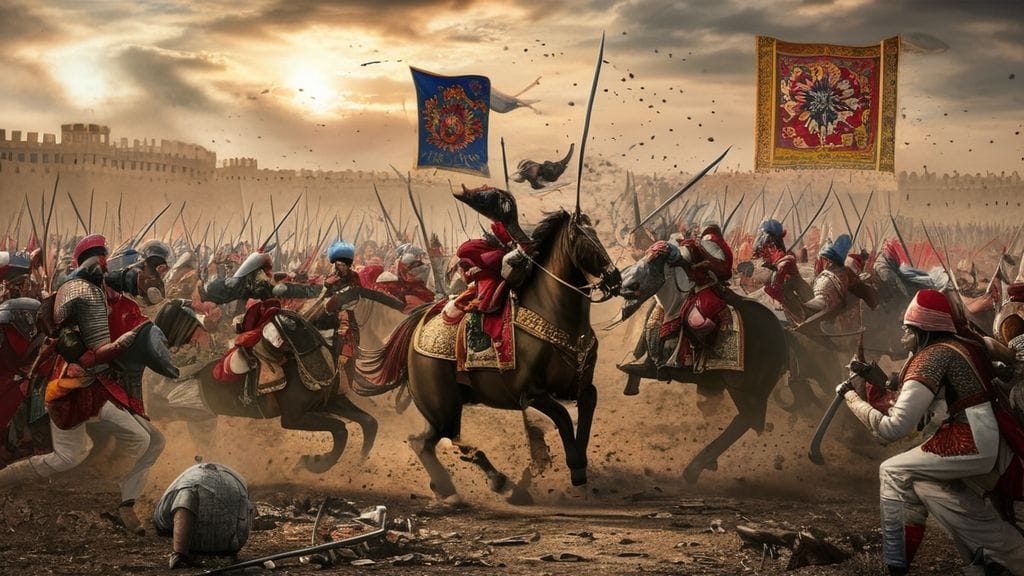
Eyewitness descriptions evoke a landscape transformed by the chaos of war. Fields were churned into mud by pounding hooves; smoke from scattered fires blurred the horizon; the shouts of commanders trying to impose order competed with the panicked cries of camp followers and noncombatants caught too close to the lines. In some places, Mughal gunners did manage to bring their artillery to bear, their cannon shots sending up plumes of earth and scattering groups of Maratha riders. But the very act of preparing for a set-piece engagement played into Baji Rao’s hands. While the imperial army labored to form and protect its gun lines, the Marathas simply slipped away to strike elsewhere.
The result was a series of Mughal frustrations rather than a clear victory. Each day’s fighting seemed to end with the Marathas still in control of the initiative, still prowling too close to Delhi for comfort. Even when imperial forces held the field at sundown, the knowledge that the enemy could reappear elsewhere the next morning eroded their sense of accomplishment. Baji Rao’s aim in the battle of delhi 1737 was not to annihilate the Mughal army but to demonstrate its impotence in defending the capital from swift, harrying attacks.
Anecdotes from the period highlight these dynamics. One tale recounts a Mughal officer, proud of his heavy armored cavalry, vowing to crush the “thin horses” of the Marathas. After a day of fruitless pursuit, his men exhausted and their mounts lathered, he reportedly muttered that he had been chasing ghosts. Whether or not the story is literally true, it captures a very real sentiment: the imperial war machine felt clumsy and outdated in the face of Maratha mobility.
By the end of these engagements, the message was unmistakable. The Mughals could not prevent a determined, fast-moving enemy from approaching their capital, skirmishing near its approaches, and then retiring at a time of their own choosing. In military manuals and chronicles written decades later, this campaign would be cited as a textbook example of how not to fight a more agile foe. For Delhi’s people, however, no such abstraction was available. They understood only that danger had come near and that their defenders, however brave as individuals, had not been able to decisively drive it away.
The People of Delhi: Fear, Rumor, and Survival Amid the Clash
Amid the maneuvers of generals and the clash of cavalry, the everyday residents of Delhi struggled simply to endure. While the main fighting of the battle of delhi 1737 took place outside the city’s walls, its emotional and economic shockwaves rippled through every quarter. Shopkeepers in Chandi Chowk debated whether to keep their stalls open; some did so in the mornings, closing early as rumors of approaching danger circulated every afternoon. Grain prices spiked, driven as much by fear and hoarding as by actual shortages.
In the cramped houses of artisans and laborers, families held anxious conversations by lamplight. Mothers told their children not to stray too far, fathers wondered whether they should send relatives to safer villages farther up the Yamuna. Those with memories of older invasions—or elders who had heard such stories from their own grandparents—spoke in hushed tones about massacres, looting, and the burning of entire neighborhoods. The specter of Timur’s sack in the fourteenth century still haunted the city’s collective psyche, resurfacing whenever a serious external threat appeared.
Yet life had to go on. The call to prayer still echoed from mosques; Hindu shrines in and around the city remained sites of daily worship; Sikh travelers stopped at sarais, sharing news from the Punjab and beyond. What changed was the tone of those conversations. “Have you heard? They say the Marathas are just days away.” “No, no, I hear the emperor has already crushed them.” “My cousin’s husband saw their flags—why would he lie?” Rumor became both a coping mechanism and a source of further anxiety.
Some tried to profit from the turmoil. Moneylenders tightened the terms of credit, citing the risk of upheaval. Hoarders bought up staple goods, confident they could sell later at high prices. Enterprising guides offered their services to families who wished to move valuables to safer locations—sometimes they delivered them safely, sometimes they disappeared with the treasure. As in most crises, human behavior in Delhi spanned the range from solidarity to opportunism.
There were also quieter acts of courage and kindness. Neighbors pooled food; religious communities organized simple shelters for those displaced from nearby villages; some merchants distributed bread at city gates to those arriving with tales of burned crops and stolen livestock. These stories rarely appear in the grand narratives of empire and war, but they are integral to understanding the full impact of the battle of delhi 1737. The city was not just a political symbol; it was a dense web of human lives, bound together by necessity, habit, and fragile hope.
From the vantage point of ordinary Delhiites, the Maratha commanders were distant figures, their names less important than the fact that war was once again stalking the outskirts. When, finally, news began to spread that the Marathas were withdrawing, the emotional response was one of exhausted relief rather than triumph. The empire had survived another scare—but the sense of invulnerability that had once cloaked Delhi was gone, replaced by an uneasy awareness that further storms might follow.
From Victory to Message: Baji Rao’s Political Theatre at Delhi’s Gates
When historians speak of the battle of delhi 1737 as a Maratha victory, they are not referring to the capture of the city or the annihilation of Mughal forces—neither of which occurred. They mean that Baji Rao achieved his strategic goals: he reached the environs of Delhi, exposed the empire’s inability to prevent his approach, and then withdrew before the Mughals could organize a decisive counterattack. This combination of audacity and restraint was itself a kind of theatre, staged for a vast audience across the subcontinent.
Baji Rao’s communications during and after the campaign emphasized not just military success but political intent. He presented the raid as a response to Delhi’s failure to honor agreements, a forced reminder that the Marathas could not be ignored. Maratha chroniclers later embellished the story, portraying the Peshwa as standing metaphorically at the gates of Delhi and challenging the emperor’s authority without needing to topple him. In their telling, the very act of coming so close, extracting informal concessions, and then riding away on their own terms was a claim to parity, if not superiority.
The Mughal court, of course, saw matters differently. Official bulletins, when they mentioned the events at all, stressed imperial resistance and portrayed the Marathas as repelled raiders. Yet the gap between rhetoric and reality was visible to anyone with access to more than one source of information. Provincial governors, Rajput princes, Afghan chiefs, and other regional powers read between the lines. They saw that an enemy had operated near Delhi and left uncrushed. The emperor’s seal continued to adorn farmans, but the awe it once commanded had dimmed.
This is where the “message” of the battle of delhi 1737 becomes especially clear. Consider a hypothetical Rajput ruler, weighing whether to obey a new imperial order or negotiate separate terms with the Marathas. Before 1737, the calculus might have leaned toward obedience, out of fear of Mughal reprisal. After 1737, that fear was tempered by new doubts: if the emperor could not protect his own capital from swift raids, could he truly enforce obedience hundreds of miles away?
Baji Rao’s restraint in not attempting to seize Delhi outright was part tactical prudence, part political sophistication. Occupying the city would have required a much larger force, sustained supplies, and willingness to face not just Mughal armies but possible coalitions of other powers alarmed at such a bold move. By contrast, a sharp raid that left the city traumatized but intact achieved nearly the same psychological effect at far lower cost. It allowed the Marathas to pose as powerful but not yet imperial overlords, challengers rather than outright usurpers.
In this sense, the battle of delhi 1737 occupies a distinctive place in eighteenth-century Indian history: it is a case study in how limited military actions, skillfully designed and executed, can yield outsized political dividends. The Peshwa returned to the Deccan not with wagonloads of loot from Delhi itself, but with something more subtle and perhaps more valuable—a transformed reputation.
Retreat or Triumph? The Maratha Withdrawal and Its Hidden Calculations
After demonstrating their reach around Delhi, the Marathas began to withdraw southward. To some observers, especially within the Mughal camp, this retreat was initially interpreted as a sign that imperial resistance had forced Baji Rao to reconsider. But a closer examination of the timing and circumstances suggests that the withdrawal was planned, not panicked. The Marathas had always intended their presence near Delhi to be a swift, intensive demonstration rather than a protracted occupation.
Logistics played a crucial role. The further a cavalry-heavy force operated from its home base, the more vulnerable it became to supply problems, fatigue, and attrition. While the Marathas were masters of living off the land, the environs of Delhi could not sustain a large surplus of horses indefinitely without causing severe local shortages—something likely to turn the population even more hostile. Moreover, each day spent near the capital increased the risk that distant Mughal forces, or even other regional powers, might converge on them.
By withdrawing at a moment of perceived strength—still mobile, still unencumbered by heavy losses—Baji Rao reinforced the impression that he was leaving by choice, not compulsion. He could claim, with some justification, that he had made his point. The Peshwa’s letters sent after the campaign, and the way his exploits were celebrated in Pune, framed the event as a triumph. The Marathas had “touched” Delhi, in the metaphorical sense, and returned unscathed.
Within Delhi, the withdrawal provoked a complex mix of relief and resentment. People were glad that the threat had passed, that no storming of the walls or sack of the city had occurred. But those close to the centers of power understood the cost in prestige. The emperor had not ridden forth personally to chase away the invaders, as earlier great Mughals might have done. His generals had fought, certainly, but they had not delivered a resounding victory. A sense of unfinished business lingered in the air, like smoke after a fire that had burned itself out but left blackened walls.
For the Marathas, the road home was also a road forward. News of their campaign, magnified in the telling, raced ahead of them. In towns and courts stretching from Malwa to the Deccan, they were greeted not simply as local chieftains but as a force to be reckoned with across Hindustan. What had been tested in 1737 could be repeated—or so it seemed. The success of their Delhi raid would, in time, embolden them to take even greater risks further north, with fateful consequences at Panipat a generation later.
It is tempting to see the battle of delhi 1737 purely as the prelude to later dramas, but for those who lived through it, the event was complete in itself. To them, the sight of smoke on the horizon, the rumors of Maratha forces near the capital, and the eventual, almost anticlimactic withdrawal left an imprint that no historian’s summary can fully recapture. The city had stared into the face of vulnerability—and though the moment passed, its memory endured.
Echoes in the Court: How the Mughal Elite Processed Humiliation
In the weeks and months after the Maratha withdrawal, the Mughal court set about the delicate task of explaining what had happened—both to itself and to the wider world. Official chronicles, always inclined to protect the image of the throne, emphasized the bravery of imperial troops and the firm resolve of Muhammad Shah. They suggested that the Marathas had been driven back, their nerve broken by imperial resistance. Yet private letters and less guarded accounts tell a different story: one of wounded pride, finger-pointing, and growing despair about the empire’s direction.
Courtiers sought scapegoats. Some blamed the generals in the field, accusing them of timidity or incompetence. Others faulted the emperor’s advisers for failing to mobilize sufficient resources quickly enough. Still others pointed back further, to the long-term neglect of the army, the decay of discipline, and the indulgent atmosphere at court. In these more candid moments, the battle of delhi 1737 became a shorthand for a broader malaise—the point at which the empire’s illusions about its own invincibility became impossible to sustain.
The emperor himself, according to several sources, oscillated between anger and melancholy. A patron of the arts and a lover of refinement, Muhammad Shah had never been a warrior in the mold of Akbar or Aurangzeb. He valued stability and dignity, but the world around him had grown too turbulent for such priorities to suffice. The Maratha incursion, however temporary, was a direct affront to his authority. Publicly, he maintained composure; privately, he must have known that his reign would forever be shadowed by the realization that his capital had come close to serious danger.
Some members of the elite proposed reforms: modernization of the army, tighter control over provincial governors, more serious attempts to negotiate a lasting arrangement with the Marathas that acknowledged new realities while preserving some core of imperial prestige. A few of these ideas were even partially implemented. But the momentum of decline proved hard to reverse. Each year brought new crises—internal revolts, external threats, fiscal difficulties—that sapped the court’s capacity for sustained, coherent reform.
The memory of the battle of delhi 1737 also shaped the court’s external diplomacy. Negotiations with provincial chiefs and foreign envoys alike now took place under the shadow of that event. When Nadir Shah of Iran later advanced toward Delhi in 1739, some at court remembered how slowly and ineffectively they had responded to the Maratha threat. This time, too, their efforts would prove tragically insufficient, culminating in a catastrophe vastly greater than anything Baji Rao had attempted.
In this sense, 1737 functioned as both warning and rehearsal: a smaller crisis that revealed vulnerabilities the empire refused, or was unable, to fully address. The Mughal elite processed the humiliation in ways typical of proud but beleaguered institutions everywhere—by minimizing its significance in public discourse while privately acknowledging its gravity. The dissonance between these two narratives further eroded the capacity for decisive action.
Reshaping the Subcontinent: Political Consequences of the 1737 Campaign
The aftermath of the battle of delhi 1737 rippled far beyond the walls of the Mughal capital. In political terms, the campaign marked a crucial step in the redistribution of power across the Indian subcontinent. While the Mughals had been declining for decades, 1737 offered stark, visible proof that their decline was not just a matter of lost provinces at the periphery, but a loss of control at the very center.
Regional rulers took note. In Awadh, in Hyderabad, in Bengal, and among the Rajput states, elites recalibrated their strategies. If the emperor could no longer guarantee protection, then political survival demanded new calculations. Some deepened their own autonomy, acting ever more like independent monarchs while still paying lip service to the Mughal crown. Others quietly opened channels to the Marathas, exploring alliances or at least understandings that might shield them from future raids.
For the Marathas, the campaign was both validation and temptation. They had shown that they could challenge the Mughals near their capital and survive unscathed. This success encouraged further expansion into northern and central India in subsequent years. Maratha influence spread through a combination of direct rule, tributary arrangements, and the strategic placing of garrisons in key towns. The dream of a Maratha-dominated subcontinent, with Delhi as at least a symbolic prize, grew more imaginable.
At the same time, the very boldness that fueled Maratha ambitions also sowed the seeds of future overreach. As they extended their reach into regions like the Punjab and beyond, they encountered new adversaries—Afghan forces under Ahmad Shah Durrani, entrenched local elites, and eventually European trading companies with their own military capabilities. The confidence they had gained in 1737 would contribute, in part, to the miscalculations that led to the disaster at the Third Battle of Panipat in 1761.
In the broader arc of Indian history, the battle of delhi 1737 illustrates a transitional moment: the shift from a relatively centralized imperial structure to a fragmented mosaic of competing powers. This fragmentation, in turn, created openings for the British East India Company and other European actors to move from trade to territorial control. While 1737 was not about Europeans, its consequences set the stage for a landscape in which no single Indian power could easily dominate the whole, making external intervention more feasible.
Historians, looking back, often draw a line from Aurangzeb’s endless wars to the empire’s fiscal exhaustion, from fiscal exhaustion to military weakness, from military weakness to vulnerabilities like those exposed in 1737, and from those vulnerabilities to the eventual colonization of India. That line is not straight or inevitable, but the campaign around Delhi is undeniably one of its major inflection points. It announced to all of Hindustan that the old order was crumbling—and that whoever dared, and moved fastest, might shape what came next.
Delhi After the Storm: Memory, Trauma, and the Stories People Told
When the dust settled and the Maratha horsemen were once more distant riders on the horizon, Delhi began the slow, subtle work of absorbing what had happened. The city had not been sacked, its great monuments still stood, and daily life resumed with a semblance of normalcy. Yet beneath the surface, something had shifted. The experience of vulnerability left a residue in the stories people told and the ways they imagined their city’s place in the world.
In tea stalls and marketplaces, older men recalled how, in their youth, Delhi had seemed unreachable, a fortress of imperial power surrounded by obedient provinces. Now, they said, the city had felt the breath of danger on its neck. Younger listeners, who had grown up hearing of Mughal glory in the abstract, encountered a different reality: an empire that could be challenged, even mocked, by upstart rivals. The aura of the Red Fort, whose gates had once seemed to open only outward—to send armies forth—was subtly altered. People began to imagine those gates as potential points of entry for invaders, not just exits for conquerors.
Memory is selective, and over time, the details of the battle of delhi 1737 blurred, especially among those who had not directly witnessed the skirmishes. Numbers of troops grew or shrank depending on the storyteller; the proximity of Maratha forces to the city walls became a matter of heated debate. But the emotional truth remained stable: there had been a moment when Delhi’s safety was in question, when the emperor’s ability to protect his own capital was doubted by his subjects.
Religious interpretations also emerged. Some preachers, drawing on older traditions, framed the Maratha incursion as a divine warning—a sign that moral decay at court and in society at large was inviting calamity. If the emperor and his nobles did not mend their ways, worse would follow. Others emphasized the resilience of the city, arguing that the fact Delhi had survived without a full-scale disaster proved God’s continuing favor. Between these poles of warning and reassurance, ordinary believers searched for meaning.
In families that had suffered directly—those who had lost relatives in the fighting, or whose property had been plundered by roaming troops of either side—the memory was more concrete and painful. Children who had huddled in fear at the sound of distant gunfire carried those impressions into adulthood. For them, the battle of delhi 1737 was not a line in a chronicle but the crack of a musket, the smell of smoke, the sudden decision to flee or to hide.
As decades passed and even greater catastrophes befell the city—notably Nadir Shah’s sack in 1739—the events of 1737 risked being overshadowed. Yet, in a way, they survived as a prelude, the first act in a tragic sequence. Older residents, reminiscing after 1739, might say, “We should have known when the Marathas came. That was the warning.” In such statements lies a recognition of 1737’s role not only as an event in itself, but as a signpost on the road to deeper crises.
From Delhi 1737 to Panipat 1761: A Long Shadow Over Maratha Ambitions
The Maratha victory around Delhi in 1737 cast a long and complicated shadow over their subsequent history. On one hand, it confirmed the viability of their strategic model: rapid, mobile operations that targeted the political nerve centers of rivals without necessarily seeking outright occupation. On the other, it may have fostered a degree of overconfidence that proved costly in later decades, particularly when they faced opponents who had studied and adapted to their methods.
In the years following 1737, Maratha influence surged. They played kingmakers in several North Indian affairs, forged alliances with some regional powers, and coerced others into paying chauth. The idea that they could one day effectively dominate Hindustan took firmer root in Pune’s political imagination. Delhi remained symbolically important. Although they did not seek to permanently seize the city at that time, their proximity in 1737 had familiarized them with the terrain—strategic, political, and psychological—around the Mughal capital.
By the mid-eighteenth century, the Mughal emperors had become increasingly dependent on external powers, including the Marathas themselves, for their survival. At times, Maratha armies entered Delhi not as raiders but as “protectors” or even as de facto arbiters of court politics. The line between challenge and guardianship blurred. It is in this context that the disastrous clash at the Third Battle of Panipat in 1761 occurred, when the Marathas confronted Ahmad Shah Durrani’s Afghan forces in a bid to consolidate their northern dominance.
Many historians draw a line from the heady confidence generated by operations such as the battle of delhi 1737 to the strategic miscalculations at Panipat. Accustomed to cowing their opponents through speed and aggressive maneuvering, the Marathas underestimated the logistical challenges of fighting far from home against a determined and well-led enemy who understood their methods. At Panipat, they chose a positional battle—almost the opposite of Baji Rao’s mobile campaign near Delhi—and suffered catastrophic losses.
This is not to say that 1737 “caused” 1761, but rather that it shaped a generation of Maratha leaders’ sense of what was possible. Baji Rao’s success became a benchmark, a story of boldness rewarded. Later commanders, aiming to match or surpass his achievements, operated within a mental world in which Delhi and the broader north were legitimate arenas of Maratha ambition. The tragic irony is that this same expansionist impulse, once a source of strength, ultimately stretched their resources and exposed them to risks they could not fully manage.
For the Mughal Empire, the arc from 1737 to Panipat marked a slow fading into political irrelevance. The emperor’s authority became increasingly ceremonial, overshadowed by whichever power—Maratha, Afghan, or later British—happened at any given moment to control the capital’s environs. The battle of delhi 1737 was one of the early moments in this long twilight, a scene in which the future shape of power in India briefly came into focus.
Sources, Silences, and Myths: How Historians Reconstruct the Battle
Reconstructing the battle of delhi 1737 presents historians with both rich materials and stubborn gaps. Unlike some earlier or later conflicts, it did not produce a single, canonical account. Instead, we have to piece together the story from Persian court chronicles, Marathi bakhar narratives, letters, later histories, and even European observers’ scattered comments. Each source brings its own biases and blind spots, forcing careful readers to move between them with a critical eye.
Persian chronicles produced at or near the Mughal court tend to downplay the scale of the Maratha success, emphasizing imperial resistance and framing the outcome as at worst a temporary setback. Their authors wrote under patronage and censorship constraints; their careers depended on not embarrassing the throne too blatantly. Yet, in the margins and between the lines, they sometimes reveal more than they intend—acknowledging, for example, that Maratha cavalry operated freely near the capital for longer than was comfortable.
Marathi sources, by contrast, often amplify Baji Rao’s triumph, presenting the campaign in heroic hues. In some bakhar texts, his ride toward Delhi is cast almost as destiny fulfilled, Shivaji’s dream carried northward by his political heirs. These accounts occasionally exaggerate numbers or dramatize encounters, a common feature of courtly or epic-style historiography. Still, they preserve valuable details about the planning, routes, and internal debates among Maratha leaders.
Modern historians, such as Jadunath Sarkar in his work on the later Mughals and Stewart Gordon in his studies of the Marathas, have tried to synthesize these perspectives, cross-checking claims against one another and against external data like revenue records and diplomatic correspondence. They often confront silences—moments where crucial details, such as exact troop strengths or precise battlefield locations, are missing or contradictory. In such cases, careful inference and comparison with analogous campaigns become essential tools.
Myth-making further complicates the picture. Over time, the battle of delhi 1737 has been invoked in various nationalist contexts, sometimes as a symbol of Hindu assertion against a Muslim empire, sometimes as an example of regional resistance to centralized authority. These readings often flatten the complex realities of eighteenth-century India, where alliances and conflicts frequently cut across religious lines and were driven as much by revenue and power as by ideology. Historians must therefore disentangle later agendas from the evidence, striving to restore the messier, more ambiguous truth.
Yet even with all these challenges, a coherent narrative emerges: a declining empire caught off guard by a nimble adversary; a daring Peshwa exploiting structural weaknesses; a capital city confronting its own vulnerability. The exact contours of particular skirmishes may remain debated, but the campaign’s broad outline and significance are now widely recognized. In a way, the very act of reconstruction mirrors the original event: scattered, fast-moving, and shaped by perception as much as by hard data.
Conclusion
In the long, intricate story of the Indian subcontinent, the battle of delhi 1737 stands as a vivid moment when the old order and the new brushed against one another at the gates of an imperial capital. It did not topple thrones or redraw borders overnight, yet its psychological and political impact far exceeded the localized nature of its skirmishes. Baji Rao’s swift advance and calculated withdrawal exposed the Mughal Empire’s dwindling capacity to command respect through fear and force, while announcing the Marathas as serious claimants to regional supremacy.
For Delhi’s residents, the episode was a jarring encounter with vulnerability. The city that had once projected power outward found itself anxiously watching the horizon, its faith in imperial protection shaken. For the Mughal court, 1737 was a humiliation awkwardly papered over in official records but unmistakable in its implications. For the Marathas, it was both a triumph and a temptation, a demonstration that success could indeed be won far from their Deccan heartland—and a step down a path that would eventually lead to overextension and catastrophe.
Looking back from the vantage point of later events—the sack of Delhi by Nadir Shah in 1739, the rise of regional successor states, the Third Battle of Panipat, and ultimately the expansion of British rule—we can see 1737 as part of a chain of crises that unmade the centralized Mughal order. Yet to reduce it to a mere prelude would be to overlook its own dramatic power. In those weeks when Maratha horsemen roamed near Delhi and imperial generals struggled to respond, the subcontinent’s political imagination shifted. It became possible, at last, to think of Hindustan without unquestioned Mughal dominance at its core.
The story of the battle of delhi 1737 is thus not only about cavalry charges and court intrigues, but about how perceptions change—how a single audacious campaign can upend assumptions built over generations. It invites us to listen to the anxious whispers in Delhi’s bazaars, to feel the restless energy in Baji Rao’s camp, and to witness an empire discovering, perhaps too late, that its aura of invincibility had already begun to fade. In doing so, it reminds us that history often turns not on the largest battles alone, but on those moments when confidence falters, ambitions swell, and the balance between them briefly and decisively shifts.
FAQs
- What was the Battle of Delhi 1737?
The battle of delhi 1737 was a campaign led by Maratha Peshwa Baji Rao I, in which a fast-moving Maratha cavalry force advanced to the environs of the Mughal capital, clashed with imperial troops, and then withdrew. It was less a single pitched battle and more a series of engagements and maneuvers around Delhi, designed to demonstrate Mughal weakness and Maratha reach. - Who were the main leaders involved in the 1737 campaign?
The primary Maratha leader was Peshwa Baji Rao I, architect of the raid and commander of the cavalry force. On the Mughal side, Emperor Muhammad Shah remained in Delhi while generals such as Khan Dauran and other regional commanders attempted to block the Maratha advance and defend the approaches to the capital. - Did the Marathas actually capture Delhi in 1737?
No, the Marathas did not capture or occupy Delhi during the 1737 campaign. Their goal was not to seize the city outright but to approach it closely, engage Mughal forces in its vicinity, and thereby expose the empire’s inability to prevent such a challenge. After achieving this demonstration effect, they withdrew to the Deccan. - Why is the battle of delhi 1737 considered important?
It is considered important because it starkly revealed the Mughal Empire’s decline and showcased the Marathas as a major power capable of threatening the imperial capital. The campaign influenced how regional rulers viewed both powers, accelerated the fragmentation of Mughal authority, and helped set the stage for later conflicts, including Nadir Shah’s invasion and the Third Battle of Panipat. - How did the people of Delhi experience the 1737 events?
Most residents of Delhi experienced the 1737 campaign as a time of intense anxiety rather than direct destruction. Rumors of Maratha proximity, skirmishes near the city, rising prices, and the visible unease of the court created a pervasive sense of insecurity. While the city escaped a full-scale sack, the realization that it could be threatened at all left a lasting psychological impact. - What were the long-term consequences for the Marathas?
For the Marathas, the campaign was a major boost to their prestige and confidence, confirming the effectiveness of their mobile warfare and encouraging further expansion into northern India. However, the sense of invincibility it fostered also contributed to later overreach, most notably in the ill-fated campaign against Ahmad Shah Durrani that ended in defeat at the Third Battle of Panipat in 1761. - What sources do historians use to study the battle of delhi 1737?
Historians rely on a mix of Persian court chronicles, Marathi bakhar narratives, contemporary letters, later regional histories, and occasional European accounts. Scholars like Jadunath Sarkar and Stewart Gordon have analyzed these sources critically, comparing their claims and filling gaps through contextual inference to reconstruct the campaign’s course and significance.
External Resource
Internal Link
Other Resources
- Encyclopaedia Britannica – general search for the exact subject
- Google Scholar – academic search for the exact subject
- Internet Archive – digital library search for the exact subject

