Table of Contents
- The Dawn of July 1, 1097: A Morning Shrouded in Tension
- The Great Crusade’s Journey Into Anatolia: Context and Stakes
- The Seljuk Turks: Masters of the Steppes and the Mountain Passes
- The Crusaders’ Leadership: Unity in a Divided Coalition
- The March Towards Dorylaeum: Expectations and Unease
- The Terrain of Anatolia: Geography as a Silent Commander
- The First Contact: Seljuk Ambush and the Shock of Battle
- Holding the Line: The Crusader Rearguard’s Courage Under Fire
- The Siege Mentality: Clinging to Hope Amidst Desperation
- Bohemond’s Bold Counterattack: Turning the Tide
- The Arrival of Godfrey’s Vanguard: Reinforcement and Relief
- The Clash of Titans: Heavy Cavalry vs. Light Horse Archers
- Blood and Dust: The Human Cost of Dorylaeum
- Seljuk Defeat and Retreat: The Crumbling of a Perfect Ambush
- The Aftermath: Momentum for the Crusaders Toward Antioch
- Political Reverberations in Anatolia and the Byzantine Empire
- The Battle’s Role in Shaping the Crusader States
- Religious Fervor and Propaganda: Narratives Forged in Fire
- Lessons in Medieval Warfare: Adaptation and Tactics
- Personal Stories: Voices from the Battlefield
- Echoes Through Time: How Dorylaeum Resonates in History
- Conclusion: Triumph, Tragedy, and the Making of Myth
- FAQs: Understanding the Battle of Dorylaeum
- External Resource: Wikipedia on the Battle of Dorylaeum
- Internal Link: Visit History Sphere
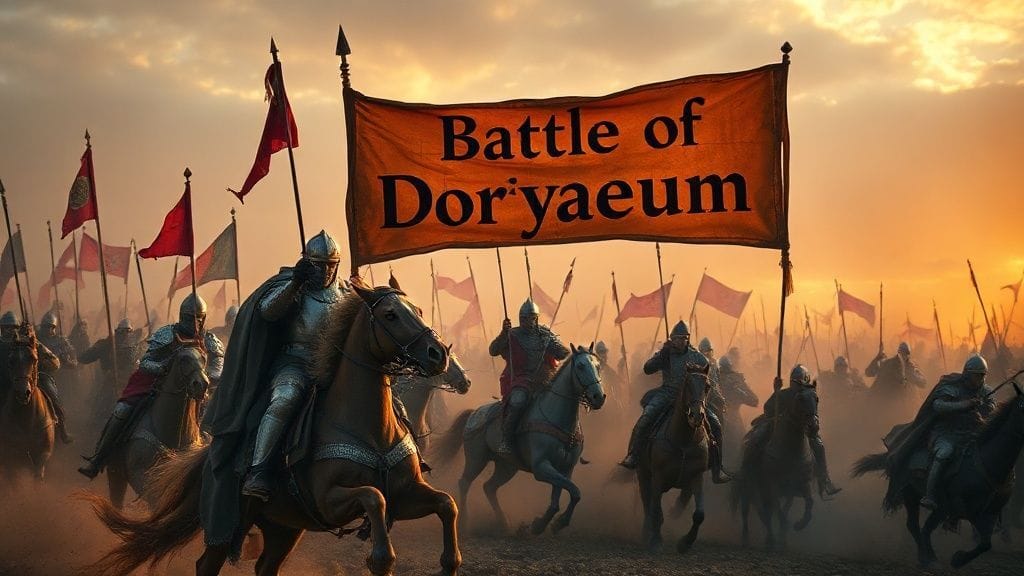
On a sweltering summer morning, under the unforgiving Anatolian sun, the shifting dust of thousands of armored riders bore witness to a confrontation that would resonate through the annals of medieval history—the Battle of Dorylaeum. It was July 1, 1097, and the armored legions of the First Crusade were marching deep into the heart of Seljuk-controlled Anatolia, a land of vast steppes, treacherous mountains, and ancient trade routes. As dawn broke, the Crusaders found themselves suddenly beset by the swift and elusive Seljuk horse archers, masters of ambush and harbingers of annihilation. What followed was a tale of desperation, courage, and unexpected reinforcements—an episode that would cement the Crusaders' foothold in Anatolia and signal a turning point in their perilous quest for Jerusalem.
The Battle of Dorylaeum is often remembered as a classic clash between two starkly different martial cultures: the heavy armored knights of Western Europe and the mobile, composite-bow-wielding horse archers of the Seljuk Sultanate. But beneath the dust and clangor of steel, this engagement reveals deeper narratives of religious zeal, political ambition, cultural collision, and survival against overwhelming odds—an episode that shaped not only the course of the Crusades but also the medieval world’s understanding of warfare and diplomacy.
The Great Crusade’s Journey Into Anatolia: Context and Stakes
To understand the significance of Dorylaeum, we must first traverse back to the turbulent conditions of late 11th-century Europe and the Near East. The First Crusade was launched in 1095 by Pope Urban II at Clermont, an impassioned call for Christian knights to reclaim Jerusalem from Muslim control. While the spiritual motivation was paramount, the motives were complicated: entangled with personal ambitions, feudal rivalries, and the lure of land and wealth.
By mid-1097, thousands of crusaders from diverse territories had crossed into Byzantine territory, under uncertain alliances with Emperor Alexios I Komnenos, who himself eyed the return of lost Anatolian lands once ruled by Byzantium before Seljuk conquests. Anatolia was a landscape fraught with political intrigue and military peril, dominated by the formidable presence of the Seljuk Turks, a force that had steadily eroded Byzantine power over recent decades.
The Seljuks, under leaders such as Sultan Kilij Arslan, had established a strong dominion characterized by fast-moving cavalry tactics and intimate knowledge of the rugged terrain. For the Crusaders, Anatolia was not just a province to cross—it was an ominous gauntlet, a testing ground for their resolve and discipline.
The Seljuk Turks: Masters of the Steppes and the Mountain Passes
The Seljuks were the heirs to a long lineage of Central Asian nomadic horsemen, renowned for their superior horse archery and hit-and-run tactics that exploited mobility over brute strength. Their empire stretched from the Caspian Sea to Anatolia, and their military doctrine emphasized ambushes, feigned retreats, and rapid encirclements.
Their armies were composed primarily of mounted archers clad lightly for speed, capable of firing volleys of arrows while retreating, and drawing enemies into traps. Against the heavily armored, slower knights of the West, this posed a deadly problem. Previous encounters had already revealed the Crusaders' vulnerability in Anatolia, and Sultan Kilij Arslan himself was determined to halt their advance.
The Crusaders’ Leadership: Unity in a Divided Coalition
The Crusader forces were a mosaic of European nobility—Normans, French, Germans, Italians—each leader commanding his own retinue with varying degrees of cooperation and rivalry. Bohemond of Taranto, the astute Norman prince, was a charismatic and battle-hardened commander who sought glory and territory in the East.
Godfrey of Bouillon, a pious and resolute nobleman, was the spiritual heart of the army, while Raymond IV of Toulouse embodied the idealistic fervor of the pilgrimage and conquest. Despite underlying tensions, they were united by religious zeal and the pressing need for survival as they ventured into hostile territory.
The March Towards Dorylaeum: Expectations and Unease
By late June 1097, after months of arduous travel, disease, and cautious advance, the Crusaders had reached the outskirts of Dorylaeum—a strategic city located along the key route from Constantinople toward Antioch. The city was under Seljuk control, but the Crusaders hoped to bypass or besiege it quickly.
However, Kilij Arslan’s forces lurked nearby, keenly aware of their enemy’s movements. The Seljuks had already regrouped after initial setbacks and prepared to trap the Crusaders in a calculated ambush. The Crusader army, divided into two groups due to its size, would become victim to an intricate Seljuk stratagem.
The Terrain of Anatolia: Geography as a Silent Commander
Anatolia’s landscape was a complicated mosaic of rocky hills, deep gullies, and narrow passes—terrain that favored light cavalry and archers who could outmaneuver the slow-moving knights choking on rough routes. The Crusader army had to maintain tight formation and cautious scouting.
At Dorylaeum, the surrounding hills provided ideal vantage points for an ambush. The narrow valley near the city would funnel the Crusader columns, preventing them from deploying fully and leaving their rear vulnerable.
The First Contact: Seljuk Ambush and the Shock of Battle
On the morning of July 1, as the vanguard of Bohemond’s force advanced, the Seljuks struck with lethal precision. From elevated positions, they unleashed a deadly rain of arrows, harassing the Crusaders and sowing panic.
The initial shock fractured the Crusader formation, and the rear contingent, led by Raymond but separate from Bohemond’s front line, was soon cut off and surrounded. The Seljuks pressed their advantage, darting in and out of range, inflicting casualties while avoiding prolonged hand-to-hand combat.
Holding the Line: The Crusader Rearguard’s Courage Under Fire
Despite being heavily outnumbered and overwhelmed by the relentless Seljuk archery, the Crusader rearguard fought with desperate bravery. Knights formed tight defensive formations, using their shield walls and heavy armor to withstand the storm of arrows.
Leaders rallied their tired troops, and even common foot soldiers displayed remarkable resilience. Accounts describe instances of knights and footmen fighting side by side to stave off annihilation, a testament to the discipline borne from months of strife and hardship.
The Siege Mentality: Clinging to Hope Amidst Desperation
For hours, the Crusader rear guard found themselves trapped in a brutal siege-like scenario, hemmed in by mobile enemies and the crushing landscape. Morale waned, fatigue set in, and the specter of defeat loomed large.
Outside eyes watch the unfolding battle with bated breath, while within the lines, prayers were whispered fervently, swords were gripped tighter, and the thought of home and holy salvation fueled determination.
Bohemond’s Bold Counterattack: Turning the Tide
As the midday sun reached its peak, the desperate situation inspired boldness. Bohemond, leading the vanguard, rallied his knights and prepared an aggressive countercharge. With a thunderous charge of heavy cavalry, he broke through the Seljuk encirclement, disrupting their lines.
This audacious move relieved pressure on the rear and marked the beginning of the Crusader recovery in the battle.
The Arrival of Godfrey’s Vanguard: Reinforcement and Relief
Almost simultaneously, Godfrey of Bouillon’s contingent arrived after a forced march, bringing fresh troops and renewed hope. Their sudden appearance engulfed the Seljuk forces in a pincer attack that shattered the ambush.
The combined impact of Bohemond’s counterattack and Godfrey’s arrival forced Kilij Arslan to order a retreat, unable to sustain losses against increasingly coordinated Crusader resistance.
The Clash of Titans: Heavy Cavalry vs. Light Horse Archers
The Battle of Dorylaeum exposed the contrasts between medieval Western and Eastern warfare. The Crusaders’ heavy knights, armored from head to toe, relied on shock tactics and steadfastness, while the Seljuks’ swift horse archers excelled in mobility and distance combat.
The Seljuks’ initial success showed the lethality of their tactics, but the Crusaders’ ability to hold formation and execute a decisive charge underscored the enduring value of heavy cavalry in open combat.
Blood and Dust: The Human Cost of Dorylaeum
Though the Crusaders emerged victorious, the toll was immense. Contemporary chroniclers speak of thousands wounded and hundreds slain. The Seljuks suffered even heavier losses in retreat and subsequent pursuits.
Stories of individual heroism and sacrifice fill the accounts: knights who fought till the last breath, infantrymen who stood their ground against overwhelming odds, and commanders who inspired men not through rank alone but through sheer resolve.
Seljuk Defeat and Retreat: The Crumbling of a Perfect Ambush
Kilij Arslan’s carefully prepared ambush, which had promised a decisive blow against the Crusader incursion, ended in disarray. The Seljuk forces withdrew, conceding the strategic pass. Though far from broken, this loss impaired their immediate ability to halt the Crusader advance.
It was a humbling lesson in underestimating the cohesion and tenacity of the Western knights.
The Aftermath: Momentum for the Crusaders Toward Antioch
The victory at Dorylaeum opened the gates to further advances toward Antioch, a major objective in the Crusade. The morale boost was palpable after weeks of hardship, and the unity of the Crusader forces was reinforced by shared hardship and triumph.
This battle marked a turning point—no longer were they a scattered collection of armies vulnerable to Seljuk raids. They had proven that through coordination and resolve, the unfamiliar terrain and tactics could be overcome.
Political Reverberations in Anatolia and the Byzantine Empire
Beyond battlefield valor, Dorylaeum had significant political consequences. The Byzantine Emperor Alexios I saw the Crusader victory as both an opportunity and a threat: an opportunity to regain Anatolian lands, but a threat given the Crusaders’ reluctant loyalty and territorial ambitions.
Within Anatolia, power balances shifted as local Seljuk governors reconsidered resistance, and alliances began to reshape in anticipation of further conflicts.
The Battle’s Role in Shaping the Crusader States
Victory at Dorylaeum was foundational in securing the Crusaders’ foothold in the Near East. It provided a vital corridor through hostile territory and reinforced the military viability of the crusading forces.
This paved the way for future conquests and the establishment of the Crusader States, which would endure for decades as complex multicultural polities.
Religious Fervor and Propaganda: Narratives Forged in Fire
The chroniclers of the Crusade, many clerics and monks, framed the Battle of Dorylaeum as divine favor manifest—painstakingly attributing victory to the righteousness of their cause.
Church sermons, letters, and illuminated manuscripts celebrated the event as proof of God’s will, weaving legend into history and inspiring further crusading zeal across Europe.
Lessons in Medieval Warfare: Adaptation and Tactics
Dorylaeum offered enduring lessons for medieval military science. It emphasized the importance of flexibility, intelligence gathering, and reconnaissance, as well as the need for alliances and mutual support among diverse combat units.
The battle marked a watershed where Western knights began to appreciably incorporate the value of combined arms and more mobile tactics.
Personal Stories: Voices from the Battlefield
Amid the historical sweep, individual voices rise. Albert of Aachen’s chronicles capture the terror and valor; Raymond of Aguilers recounts prayers said before battle. Bohemond’s daring charge echoes both ambition and desperation.
These stories humanize the battle, transforming it from a clash of armies into a mosaic of human experience—fear, hope, betrayal, and courage.
Echoes Through Time: How Dorylaeum Resonates in History
Centuries later, the Battle of Dorylaeum remains emblematic of the First Crusade’s complexity—its hopes, fears, and brutal realities. It symbolizes the collision of worlds, a moment when faith marched alongside steel, and where history was forged in both triumph and tragedy.
Dorylaeum’s lessons about leadership, resilience, and cultural conflict still echo today in military history and intercultural studies.
Conclusion
The Battle of Dorylaeum was far more than a medieval skirmish; it was a crucible where fate, faith, and ferocity intertwined. On that July day in 1097, the Crusaders faced near annihilation at the hands of Seljuk horse archers in a landscape that conspired against them. Yet through sheer will, leadership, and timely reinforcements, they transformed despair into victory, a victory that opened the gates to further conquests and reshaped the medieval world.
But victory came at a cost—countless lives lost, alliances tested, and a new era of cultural clash ignited. The echoes of Dorylaeum remind us that history is made not only by kings and generals but by the courage of individuals caught in moments of chaos and choice.
That battle in Anatolia is a testament to human endurance and the forces that drive men to fight, believe, and dream amid the dust and blood of war.
FAQs
Q1: What were the main causes behind the Battle of Dorylaeum?
A1: The battle was primarily caused by the Crusaders’ advance into Seljuk-controlled Anatolia during the First Crusade. Seljuk forces sought to halt their progress and protect their territory by ambushing the Crusader army at a strategic mountain pass near Dorylaeum.
Q2: Who were the key commanders on both sides?
A2: For the Crusaders, key leaders included Bohemond of Taranto and Godfrey of Bouillon. The Seljuks were commanded by Sultan Kilij Arslan, a skilled tactician who orchestrated the ambush.
Q3: What tactics did the Seljuks use against the Crusaders?
A3: The Seljuks relied on hit-and-run tactics employing mounted archers, ambushes, and mobility to harass and isolate portions of the Crusader army, avoiding direct confrontations favoring the knights’ heavy cavalry.
Q4: How did the Crusaders manage to win despite being ambushed?
A4: The Crusaders held defensive formations under heavy fire, and Bohemond led a decisive cavalry charge that broke the Seljuk lines. The timely arrival of Godfrey’s forces sealed the Seljuk retreat and secured Crusader victory.
Q5: What were the immediate consequences of the battle?
A5: The battle opened a key route through Anatolia for the Crusaders, significantly boosting their morale and enabling them to continue their march toward Antioch and eventually Jerusalem.
Q6: How did this battle affect the relationship between the Crusaders and the Byzantine Empire?
A6: While the battle aligned with Byzantine interests of reclaiming territory, tensions remained due to differing goals and suspicion over Crusader ambitions, foreshadowing future conflicts.
Q7: What impact did the battle have on military tactics in future engagements?
A7: The battle highlighted the importance of combined arms tactics, adaptability to local conditions, and the integration of reconnaissance and coordination among different contingents in medieval warfare.
Q8: How is the Battle of Dorylaeum remembered today?
A8: It is remembered as a pivotal engagement of the First Crusade, symbolizing the clash of civilizations, medieval military innovation, and the complexity of the Crusading era’s human drama.

