Table of Contents
- A Summer of Tension: Setting the Stage for Harim, 1164
- The Fractured Levant: Crusader States and Muslim Principalities
- Nur ad-Din’s Long Shadow and the Dream of Unity
- Antioch on the Edge: A Principality Under Siege
- Toward the Storm: Campaigns, Raids, and the Road to Harim
- Armies on the Move: Forces, Commanders, and Strategies
- The Eve of Battle: Camps, Councils, and Quiet Fears
- August 10, 1164: The Battle of Harim Unleashed
- The Breaking of the Crusader Line: Capture, Rout, and Chaos
- Prisoners of Victory: Chains, Ransoms, and Humiliation
- Aftermath in Antioch: Panic, Politics, and Survival
- Ripples Across Christendom and Islam: Harim in Wider Perspective
- Harim and the Rise of Saladin: A Crucial Prelude
- Voices from the Past: Chronicles, Biases, and Memory
- War, Society, and Faith: Human Stories Behind the Lances
- A Battlefield Remembered: Topography, Archaeology, and Legend
- From Harim to Hattin: Strategic Lessons and Historical Echoes
- Conclusion
- FAQs
- External Resource
- Internal Link
Article Summary: The battle of harim, fought on 10 August 1164 in the turbulent borderlands of the Principality of Antioch, marked a turning point in the struggle between the Crusader states and their Muslim neighbors. This article traces the tense summer that led to Harim, the fractured political landscape of the Levant, and the determined vision of Nur ad-Din, the atabeg of Aleppo and Damascus, who sought to unite Muslim powers against the Latin principalities. Through cinematic narrative, it follows the march of armies, the charged councils of war, and the sudden collapse of the crusader field force outside the fortress of Harim. It also explores the bitter fate of captured nobles, the panic that seized Antioch, and the wider strategic implications that rippled from Syria to Europe and Egypt. By weaving together chronicle accounts, modern analysis, and human-centered storytelling, the article shows how the battle of harim weakened Antioch and emboldened Nur ad-Din’s camp. In doing so, it highlights Harim’s role as a crucial prelude to the rise of Saladin and the eventual disaster at Hattin. Ultimately, this narrative reveals Harim not just as a clash of arms, but as a moment when ambition, faith, fear, and miscalculation converged on a single, dusty plain.
A Summer of Tension: Setting the Stage for Harim, 1164
In the blistering heat of a Syrian August, the air around the small fortress-town of Harim shimmered as if the land itself were holding its breath. The Orontes River, dusty and diminished by summer, threaded its way through a landscape of low hills and cultivated fields, while the distant silhouette of the fortress of Harim rose above the plain like a clenched stone fist. For decades, this frontier region between the Principality of Antioch and Nur ad-Din’s territories had known war, truce, and uneasy coexistence. Yet in the summer of 1164, the old pattern of raids and counter-raids hardened into something more ominous. Riders carried conflicting reports: a Muslim army concentrating near Aleppo, Latin banners gathering under the walls of Antioch, Armenian messengers riding south to the County of Tripoli for aid. The stage was set for the battle of harim, though few yet understood just how decisive it would be.
By then, the Crusader presence in the Levant was more than half a century old. The initial storm of the First Crusade, that improbable campaign which had seized Jerusalem in 1099, had given way to entrenched states: the Kingdom of Jerusalem, the Principality of Antioch, the County of Tripoli, and the County of Edessa. But one of these states—Edessa—had already been destroyed in 1144, a shocking loss that had shattered the illusion of Latin invincibility. The Second Crusade, summoned in response and led by kings and princes of Europe, had collapsed in failure. The crusader states remained in place, but they were weakened, brittle, and increasingly dependent on political maneuvering as much as on arms. In the north, Antioch—rich, proud, and perpetually exposed—stood as a glittering yet vulnerable bastion. Its leaders knew that without bold action, their principality might be the next to fall.
Across the frontier, a very different story was unfolding. Muslim Syria, long divided among rival dynasties, was slowly being drawn into the orbit of a single, formidable figure: Nur ad-Din Mahmud, atabeg of Aleppo and later of Damascus. For Nur ad-Din, the frontier near Harim was not merely a line on a map; it was a wound in the body of the Islamic world, a reminder of the Crusaders’ foothold on lands that had once been part of the Dar al-Islam. By 1164, he had spent years testing the Latins, exploiting their quarrels, and preparing the ground for decisive blows. The small fortress of Harim, once a secondary objective, became the focal point of his design. Its capture, and the destruction of the army sent to relieve it, would open the way to Antioch’s very heartland.
Yet behind the banners and strategies were human beings, each carrying their own mixture of courage, fear, and ambition. Latin knights from Normandy, Provence, and Lombardy rode beside native-born Syrian Christians and Armenian allies; Muslim warriors from Aleppo and Hama marched under Nur ad-Din’s black and white standards alongside Turkmen horse-archers whose ancestors had once served in Byzantine armies. The dusty fields around Harim would soon become the crucible in which these lives intersected, clashed, and, for many, ended. It’s astonishing, isn’t it, how one obscure stronghold on a Palestinian-Syrian frontier could shape the future of empires and faiths? But this was only the beginning. To understand why Harim mattered so deeply, one must first step back and trace the larger, fractured world in which those armies marched.
The Fractured Levant: Crusader States and Muslim Principalities
The Levant in the mid-twelfth century resembled a mosaic shattered and badly reassembled. On the coast and in select inland strongholds, Latin lords governed territories carved out in the wake of the First Crusade. These Crusader states were oddly hybrid creations: fragments of Western European feudal society transplanted into a predominantly Eastern environment. Frankish barons overlapped with Eastern Christian notables, Italian merchant communities, and diverse Muslim populations who remained on the land as peasants, artisans, and sometimes as soldiers in their overlords’ employ.
The Kingdom of Jerusalem, by far the most prestigious of these states, claimed the holy city and a broad swath of coastline stretching north and south. Yet the real dynamism of crusader politics often lay on the periphery: in the Principality of Antioch, where Frankish lords rubbed shoulders with Armenians and Greeks, and in the County of Tripoli, a narrow coastal strip that acted as a critical hinge between Antioch and Jerusalem. To their north and east, once-mighty Edessa had already vanished into the orbit of Muslim rulers. Antioch, perched at the northeastern edge of Latin power, was both gateway and bulwark: whoever controlled it could threaten Aleppo and control access between Anatolia and Syria.
Opposite these Latin enclaves, the Muslim world of Syria and northern Mesopotamia was equally fragmented. Seljuk Turks had once dominated the region, but their empire had splintered into numerous principalities: Aleppo, Damascus, Hama, Homs, Mosul, and others, each governed by families whose interests did not always align. For decades after the First Crusade, Muslim rulers had been just as likely to ally with Crusader princes against rival Muslims as to oppose them. This web of rivalries meant that the early Crusader states survived as much by exploiting Muslim divisions as by their own strength.
By the 1130s and 1140s, however, a slow, significant shift was underway. Religious scholars and preachers in cities such as Damascus and Baghdad began to reframe the struggle against the Crusaders as a collective jihad—a duty of rulers and common believers alike. Their words fell on receptive ears in some courts, particularly in that of Zangi of Mosul and Aleppo, whose capture of Edessa in 1144 signaled a new willingness to pursue coordinated campaigns against Latin possessions. Although Zangi himself died in 1146, his son, Nur ad-Din, inherited both his territories and his vision of a united Muslim front.
The battle of harim would take place at the intersection of these two realities: a Latin frontier state increasingly dependent on fragile alliances and dwindling manpower, and a Muslim power bloc consolidating under a ruler who saw ideological and political advantage in confronting the Crusaders directly. When one reads the chronicle of William of Tyre, or the Arabic histories of Ibn al-Qalānisi and Ibn al-Athir, the sense of an approaching storm is undeniable. Each side sensed that the old balance of raids and local wars was giving way to something more decisive. Harim would not be just another skirmish near a border castle; it would be a test of whether Latin Antioch could still project strength into its hinterland—or whether Nur ad-Din’s Syria would at last begin to roll back the crusading tide.
Nur ad-Din’s Long Shadow and the Dream of Unity
Nurd ad-Din Mahmud ibn Zangi was, by the time of Harim, already a figure whose name carried weight far beyond the frontiers of Aleppo. Born into the household of Zangi, the powerful atabeg of Mosul and Aleppo, he inherited not only territories but a festering conflict. His father’s brutal subjugation of rivals had left a legacy of fear and resentment; his dramatic seizure of Edessa had ignited Christian alarm and Muslim hope. Nur ad-Din, however, wrapped these legacies in a cloak of piety and political savvy.
Chroniclers describe Nur ad-Din as a man of austere habits, fond of religious scholars and inclined to sleep on simple bedding rather than luxuriant cushions. Whether every detail is true or a product of later idealization, there is no doubt he understood the symbolic power of humility and religious devotion. He patronized madrasas, built hospitals, and presented himself as a ruler devoted to the principles of Sunni orthodoxy. In doing so, he helped to forge a link between religious legitimacy and armed resistance to the Crusaders.
Yet his ambitions were not purely spiritual. Nur ad-Din sought to unify the major Syrian centers under his authority, starting with Aleppo and then Damascus, which he brought under his control in 1154. This union of two historically rival cities was crucial. It gave him a stronger resource base, increased manpower, and the prestige of controlling a city strongly associated with Islamic scholarship and trade. From Damascus and Aleppo, his influence radiated outward, pressing against the crusader frontiers, the Armenian Kingdom of Cilicia, and even the fracturing Fatimid Caliphate in Egypt.
In this larger vision, the frontier near Harim was doubly important. On the one hand, Harim itself—lying to the northwest of Aleppo and close to the road toward Antioch—was a strategic outpost. Whoever held it could launch raids into the neighboring territory and threaten communications along the Orontes valley. On the other hand, repeated clashes near Harim offered opportunities to weaken the Antiochene nobility. Each victory here bled the principality of its knights and commanders, chipping away at its capacity to resist.
Nur ad-Din’s strategy combined persistent pressure with moments of decisive violence. He did not always seek pitched battles; often, he preferred sieges, careful diplomacy, and the cultivation of allies. But when the Latin princes were rash enough to meet him in the open field under unfavorable conditions, he did not hesitate. The battle of harim in 1164 was precisely such a moment. By focusing on a siege that the Crusaders could not ignore, he lured them toward a battlefield of his own choosing—a trap baited with stone walls and the promise of relief, sprung by disciplined troops who had learned over years how to exploit Frankish weaknesses.
In the shadow of Nur ad-Din’s growing power, Harim symbolized something more than a frontier castle. It represented the narrowing margins of error for the crusader aristocracy of northern Syria. A single defeat could now resonate far beyond one loss of land or one broken host. It could signal that the age of isolated, regional Muslim rulers was giving way to a new era of centralized, ideologically charged resistance. And Nur ad-Din understood that to send such a signal, he needed a victory like Harim—public, overwhelming, and unmistakable.
Antioch on the Edge: A Principality Under Siege
To the Latins of northern Syria, Antioch was more than a capital—it was a statement that the crusading enterprise still had a beating heart. Its massive walls traced a dramatic arc over hills and ravines, enclosing a mixed population of Latins, Greeks, Armenians, Syriac Christians, and Muslims. Its port at St. Symeon linked it to the commerce of the Mediterranean, and its marriage alliances tied it to powerful families in the West and in neighboring realms. But beneath this façade of strength, by 1164 Antioch was increasingly precarious.
Politically, the principality had suffered from unstable leadership. The death of Prince Raymond of Poitiers at the disastrous battle of Inab in 1149 had left Antioch vulnerable and humiliated. Raymond’s son-in-law, Reynald of Châtillon, who later became infamous as the ruthless lord of Transjordan, had ruled Antioch with a mixture of daring and recklessness, provoking both Muslim neighbors and the Byzantine Empire. His capture by the Muslims in 1160 removed him from the scene and left Antioch under the regency of the princess Constance and, effectively, under the guiding hand of King Amalric I of Jerusalem.
Economically, Antioch depended on trade and on maintaining secure routes to the interior. Harim, perched along important approaches, was therefore not merely a military outpost but part of the principality’s lifeline. Northern lords, including the Counts of Tripoli and Armenian rulers in Cilicia, watched the fate of Antioch anxiously; its collapse would expose them all to increased pressure from Nur ad-Din’s Syria.
Socially, Antioch was divided between competing interests. Latin barons and military orders such as the Templars and Hospitallers jostled for influence, while native Christian communities navigated a complex landscape of loyalties. News of Nur ad-Din’s successes elsewhere—his capture of key fortresses, his growing prestige as a champion of Islam—could not help but sow unease. Rumors that Muslim raiders had approached within a day’s ride of the city walls were enough to keep tensions high. The fear was not merely of defeat in the field, but of siege, starvation, and the possible loss of a city that many Latins regarded as a second Jerusalem.
In this context, the siege of Harim in 1164 struck at a nerve. Antioch could not afford to abandon a stronghold so close to its borders; to do so would have signaled weakness and invited further encroachment. The call went out for aid, and neighboring rulers responded, each with their own calculations. The stage was set for a coalition army to march to Harim’s relief, an army whose fate would forever mark the history of the principality.
Toward the Storm: Campaigns, Raids, and the Road to Harim
The path to the battle of harim was not a straight line but a series of provocations, countermoves, and escalating gambles. In the years preceding 1164, the northern frontier between Antioch and Nur ad-Din’s territories had been a zone of constant friction. Castles changed hands, villages were burned, and captives were taken on both sides. Each skirmish fed resentments and hardened attitudes.
Nur ad-Din, after consolidating his hold on Damascus, turned his attention periodically to the north-western approaches of his realm. Harim, then in Latin hands, was not his first target, but it was an obvious one. Its capture would improve the security of Aleppo’s western frontier and directly threaten Antioch’s influence over the Orontes valley. Test attacks, reconnaissance in force, and raids allowed his commanders to familiarize themselves with the terrain and the Latin response patterns.
Meanwhile, Antiochene forces—often supplemented by contingents from Tripoli and Armenian allies—tried to maintain pressure of their own. Latin chroniclers, eager to portray their leaders as ever-vigilant, describe punitive expeditions and surprise attacks on Muslim garrisons. Yet behind the rhetoric, the demographic and economic trends favored Nur ad-Din. The Latin population base was small, and every serious defeat was difficult to replace; the Muslim cities, though often riven by faction, possessed deeper reserves of manpower.
By 1163, King Amalric I of Jerusalem had turned his attention southward, launching an ambitious campaign into Egypt. This had two important consequences for the north. First, it meant that much of the kingdom’s capacity was focused elsewhere, leaving Antioch somewhat more exposed. Second, it offered Nur ad-Din an opportunity. If he could land a decisive blow on the northern crusader forces while Amalric was entangled in Egyptian politics, he might fundamentally alter the strategic balance.
So when Nur ad-Din moved to besiege Harim in 1164, he was not acting on impulse. The choice of target, the timing, and the expectation that the Latin princes would be compelled to respond, were all part of a carefully calibrated risk. Harim’s garrison could hold out long enough, he judged, to draw a relief force into the open. And there, away from the safety of thick walls, the Crusaders might be vulnerable in a way they never were behind their fortifications.
On the Latin side, the fall of Harim without a fight was unthinkable. Reports that Nur ad-Din’s banners had been sighted near the fortress stirred councils of war from Antioch to Tripoli. Messages were dispatched, and within weeks a coalition army—commanded by notable figures like Bohemond III of Antioch, Raymond III of Tripoli, and the Armenian lord Thoros II—assembled in the north. They marched not only to save a castle, but to demonstrate that they could still confront Nur ad-Din in the field. As these columns converged on the Orontes plain, the dusty roads of northern Syria carried with them not just men and horses, but the fragile hopes of a frontier society fighting for its survival.
Armies on the Move: Forces, Commanders, and Strategies
The forces that converged on Harim in early August 1164 were as diverse as the lands they came from. On the Latin side, the core of the army consisted of heavy cavalry—knights armored in mail, mounted on powerful destriers, supported by lighter-armed mounted sergeants and infantry. These were accompanied by contingents from allied principalities and local levies from the countryside around Antioch and Tripoli. The exact numbers are debated, but many historians estimate that the Latin force may have fielded several thousand men, perhaps including a few hundred heavily armored knights whose shock charge was still regarded as a decisive tactical weapon.
Leading them was a constellation of nobles, each with their own domains and ambitions. Bohemond III, young prince of Antioch, was anxious to prove himself worthy of his lineage and to erase memories of earlier defeats. Raymond III of Tripoli, more experienced and often cautious, understood both the necessity and the danger of marching far from his home territory. The Armenian prince Thoros II added not only warriors but crucial local knowledge of the rugged borderlands. Alongside them marched members of the military orders, veterans of countless skirmishes and sieges, confident in their discipline and in the righteousness of their cause.
Facing them, Nur ad-Din’s host was no less heterogeneous. His army combined disciplined Syrian infantry with contingents from Aleppo, Damascus, and other cities, supported by agile Turkmen and Kurdish light cavalry. These horse-archers, specialists in skirmishing tactics, had learned over decades how to exploit the vulnerabilities of heavily armored knights: drawing them into pursuit, showering them with arrows, and striking at disorderly flanks. In addition, Nur ad-Din could count on commanders seasoned by previous campaigns—men who understood not only battlefield maneuvers but the larger strategic purpose of the war.
Tactically, the Latin leaders approached the relief of Harim with a familiar playbook. They would march to confront the besiegers, deploy their cavalry for a decisive charge to break the enemy lines, and then exploit the rout. It was a method that had served them well in earlier generations. However, by the 1160s, Muslim commanders had grown adept at blunting and outmaneuvering these charges. Feigned retreats, use of terrain, and coordinated attacks on the flanks and rear could transform a seemingly unstoppable advance into a fatal overextension.
Nur ad-Din’s strategy appears to have been to entice the Latin army into just such a miscalculation. By maintaining the siege of Harim despite the approaching relief force, he offered them a tempting target: an apparently committed army, partly fixed in position by siege operations. It would have been difficult for the Latin commanders, steeped in the chivalric ethos of bold action, to resist the opportunity to strike what looked like a distracted enemy. But Nur ad-Din had no intention of passively awaiting a frontal assault. He prepared to pivot quickly, using his mobile cavalry to envelop and disrupt the crusader formations once they committed to battle.
Both sides, then, marched toward Harim with confidence—but one side possessed a subtle advantage in experience and adaptability. The battle of harim would prove how costly it could be, in this new phase of the crusading era, to underestimate the psychological and tactical sophistication of one’s enemy.
The Eve of Battle: Camps, Councils, and Quiet Fears
On the night before the battle, the plains around Harim were pricked with campfires, clusters of orange and red flickering beneath a vault of clear stars. In the Latin camp, tents of canvas and dyed cloth formed ragged streets, echoing with the sounds of armor being checked, horses being watered, and priests moving among the men offering blessings. The fortress of Harim, visible in the distance, stood silent and dark except for the occasional torch flare along its ramparts—a reminder of the garrison watching anxiously, hoping that relief had arrived in time.
Within the command tent, maps and rough sketches of the terrain were spread across makeshift tables. Bohemond III and Raymond III debated the moment of attack, their voices low but tense. Some counseled prudence—waiting to assess the enemy lines more thoroughly or seeking to coordinate with additional reinforcements. Others urged immediate action, arguing that delaying could allow Nur ad-Din to tighten his noose around the fortress or to prepare stronger defensive positions. In an age where boldness was often equated with honor, the impulse to act swiftly was strong.
Chaplains and bishops invoked divine protection, reminding the nobles that God had favored their cause in ages past. Yet behind the pious language, there lingered the memory of Edessa’s loss and the failure of the Second Crusade. God’s favor, it seemed, was no longer so easily claimed. Some knights, veterans of earlier campaigns, exchanged quiet words near the picket lines, remembering comrades who had fallen in battles that, in hindsight, had accomplished little. Younger men, restless with anticipation, rechecked their weapons, their minds filled with visions of glory and plunder—or with fears they dared not speak aloud.
Across the field, Nur ad-Din’s camp hummed with a different energy. Muezzins called the faithful to prayer, and warriors unrolled carpets, bowing toward Mecca under the open sky. Emirs and commanders gathered in Nur ad-Din’s tent, where the atabeg listened to reports from scouts and issued final instructions. Chronicles suggest he projected a calm confidence, shaped by years of confronting Latin forces. His men knew he had faced crusader charges before and lived to tell the tale. That experience mattered deeply on the eve of battle.
For the ordinary soldiers—on both sides—the night was long. Some tried to sleep, shielded from the heat by simple awnings, dreaming perhaps of distant families or of the wages promised upon victory. Others stared at the sky, listening to the murmured prayers, the occasional laugh, the restless shifting of horses. The knowledge that tomorrow might be their last sunrise hung heavily, though few dared to name it. As the night wore on and the fires burned down to embers, a hushed expectancy settled over the fields around Harim. Dawn would bring decision—one way or another.
August 10, 1164: The Battle of Harim Unleashed
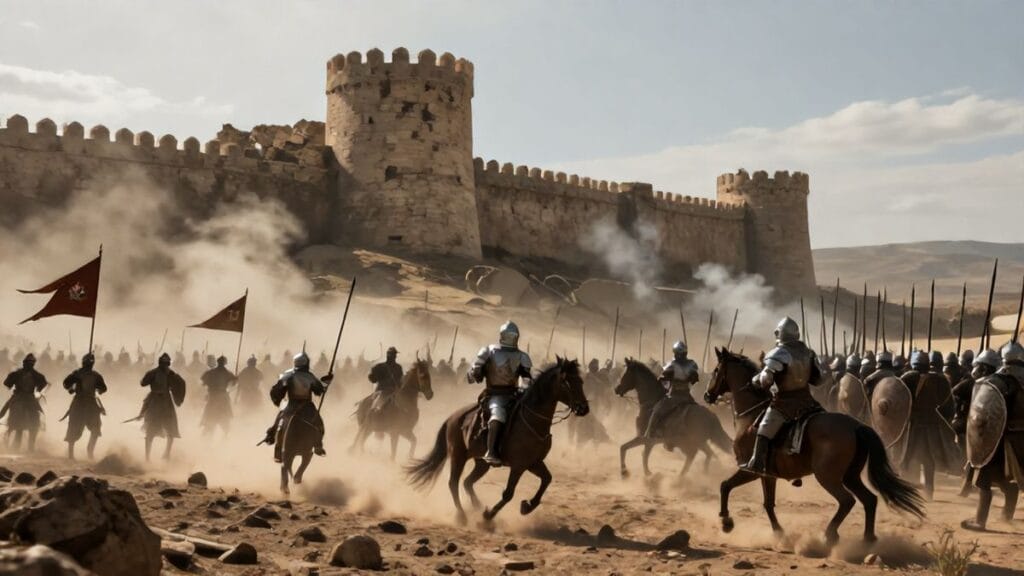
As the first light of August 10 washed over the fields, the contours of the battlefield emerged in stark clarity. The fortress of Harim loomed to one side, its embattled defenders peering out to watch the approaching drama. The Orontes plain, though not entirely flat, offered enough open space for cavalry maneuvers, with slight rises and depressions that could conceal movement or expose an incautious advance. Dust rose quickly under the hooves of horses as both armies formed up.
The Latin commanders arranged their forces in a familiar formation. The heavy cavalry, the shock weapon upon which their hopes rested, took the central position, flanked by lighter cavalry and infantry. Banners bearing crosses and heraldic symbols fluttered above the ranks: the lions of Tripoli, the devices of Antioch, the colors of Armenian allies. Priests walked along the line, making the sign of the cross, sprinkling holy water, exhorting the men to remember Jerusalem, the True Cross, and the martyrs of old. Trumpets and horns pierced the morning air.
Opposite them, Nur ad-Din’s army deployed more flexibly. Light cavalry screeners, many of them Turkmen horse-archers, fanned out in front, ready to harass and lure. Behind them, blocks of infantry and more heavily armed cavalry formed a deep, elastic defense. The black and white banners of Nur ad-Din’s household troops flapped above the central reserve, while allied contingents took up their positions on the wings. Drums and war cries answered the Latin trumpets, and the clash of cultures—Arabic invocations of God and Latin Christian prayers—echoed across the space between the lines.
At some signal—perhaps a trumpet call, perhaps a standard dipped—the Latin charge began. Knights spurred forward, lances couched, hooves pounding. The earth shook with the collective momentum of armored horses driving into the space where the Muslim vanguard had stood moments before. But those forward screens had already begun to fall back, not in panic, but in a calculated feint. Arrows whistled through the air, striking shields, armor, and the vulnerable joints between them. Some horses screamed and fell, tumbling their riders onto the trampled ground.
Yet the knights pressed on, determined to punch through the cloud of skirmishers and strike at the main body. Dust rose thicker now, obscuring vision. Units became intermingled; signals were missed. To the Latin eyes at the front, the enemy seemed to be in disorderly retreat. Some shouted that victory was at hand, pushing their exhausted mounts harder, seeking to complete what looked like a breaking of enemy lines.
But this was exactly what Nur ad-Din had anticipated. As the Latin cavalry surged forward, stretching their formations and outrunning their infantry support, the Muslim wings wheeled inward. Fresh cavalry units, held back until this moment, charged into the flanks of the crusader advance. Arrows rained from semi-circling horse-archers, sowing confusion. Suddenly, what had moments earlier looked like a fleeing enemy coalesced into a tightening ring of steel and shafts.
In the center, the Latin vanguard encountered not a shattered host but a prepared line of infantry and cavalry braced to receive them. The impact was fierce; some sections of Nur ad-Din’s line bowed under the shock. But the momentum of the knights had been sapped by the long pursuit under arrow fire, and their coordination had frayed. As individuals displayed great heroism—charging, hacking, attempting to carve a path—the larger formation began to lose coherence. Isolated pockets of Latin warriors found themselves surrounded, cut off from any route of retreat.
The battle of harim, in these critical minutes, pivoted from a contest of courage to a test of tactical resilience. Nur ad-Din’s forces, drawing on years of hard-won experience against Frankish armies, refused to offer the kind of static target that a massed charge could easily break. Instead, they absorbed, redirected, and then counter-attacked with devastating effect. The dust that hung over the plain concealed from many Latin commanders the full extent of their peril until it was already too late.
The Breaking of the Crusader Line: Capture, Rout, and Chaos
Once the Latin line began to buckle, events moved with terrifying speed. Knights who had charged forward expecting to drive the enemy from the field suddenly found themselves enveloped. Horse-archers circled constantly, loosing arrows at close range; spearmen and swordsmen swarmed any rider whose mount stumbled or slowed. The proud banners that had marked the positions of Bohemond III and Raymond III disappeared into the churn of bodies and dust.
Some pockets of resistance formed, where small groups of knights and sergeants rallied around surviving standards. In these makeshift redoubts, the fighting was hand-to-hand and merciless. Chroniclers describe Latin warriors fighting “like cornered lions,” striking down foes even as they themselves succumbed to wounds and exhaustion. Yet bravery, however sincere, could not conjure fresh horses or reorganize shattered formations. For every gallant stand, there were others where men, seeing their leaders taken or slain, broke and fled toward the rear—only to find their routes cut off by encircling cavalry.
Nur ad-Din had given instructions to prioritize the capture of high-ranking nobles wherever possible. Prisoners of such stature could later be ransomed for immense sums or used as bargaining chips in the delicate chess game of Levantine diplomacy. As the Latin army crumbled, his troops focused on seizing knights with recognizable armor or richly adorned harness. Bohemond III, Raymond III, and other prominent lords were dragged from their horses, disarmed, and bound, spared from immediate death only by the value their captors knew they represented.
For the rank-and-file, there was rarely such mercy. Many foot soldiers were cut down as they tried to run; others were trampled in the crush of retreating comrades. Some attempted to throw down their arms and surrender, but in the chaos of a general rout, offers of capitulation went unnoticed or were met with the sword. The fields around Harim, so quiet the night before, now rang with screams, shouts, and the clash of steel. Blood mingled with dust, turning the dry ground into a dark, sticky paste beneath running feet and hooves.
From the fortress of Harim, the garrison watched in horror as the relief army that had seemed their salvation dissolved before their eyes. Any hope that they could sally forth to aid their comrades vanished. Instead, they understood with sinking hearts that once the battle ended, the full weight of Nur ad-Din’s army would turn its attention to them. The sight of captured banners and riders fleeing in panic sent a collective shudder through those walls; even from a distance, the outcome was unmistakable.
By midday, organized resistance had collapsed. The Latin host was no longer an army but a scattering of fugitives, some making desperate attempts to reach the safety of distant strongholds, others hiding among the scrub and ravines, praying not to be discovered. Nur ad-Din’s men fanned out in pursuit, though he is said to have curbed excessive slaughter in favor of securing captives and consolidating control of the field. The battle of harim had ended not as a contested engagement, but as a comprehensive disaster for the crusader leadership of northern Syria.
Prisoners of Victory: Chains, Ransoms, and Humiliation
When the dust settled and the cries of battle faded, the victorious army faced the grim task of sorting the dead from the living. Among the prisoners, the presence of such high-ranking captives as Bohemond III of Antioch and Raymond III of Tripoli was a triumph beyond Nur ad-Din’s most optimistic hopes. The very fact that both principal northern Latin rulers had fallen into his hands turned a military victory into a political earthquake.
The treatment of these captives followed patterns that were both brutal and deeply pragmatic. Nobles of high rank were bound, sometimes with chains, and placed under guard. They could expect to be held for months or even years until suitable ransom arrangements were made. The sums demanded were often enormous, reflecting the importance of the prisoner’s status and the economic potential of his lands. Ransoms might take the form not only of gold and silver, but of territorial concessions, political agreements, or promises of neutrality.
The fate of lower-ranking captives was far more uncertain. Some were sold into slavery, taken to markets in Aleppo, Damascus, or further afield. Others were executed, either immediately on the battlefield or later as a grim demonstration of victory. Contemporary Muslim chroniclers sometimes present these actions as just retribution for earlier atrocities committed by the Crusaders; Latin writers, for their part, recount them as martyrdoms, underscoring the suffering of the faithful at the hands of their enemies. Between these polarized perspectives lies the harsh reality of medieval warfare, in which mercy was uneven and often contingent upon practical considerations.
For the captured nobles, captivity was not only a physical ordeal but a profound humiliation. Bohemond III, heir to a line of princes that had once marched triumphantly into these lands, now lay at the mercy of a ruler his ancestors would have derided as a distant threat. Raymond III, who prided himself on political acumen, found himself reduced to bargaining for his life and freedom from within the walls of a prison. Their absence from their principalities left power vacuums that could not easily be filled, especially under the shock of such an unexpected calamity.
Nur ad-Din, however, understood the symbolic capital he had acquired. Possessing the leading figures of Antioch and Tripoli allowed him to negotiate from a position of extraordinary strength. He could demand not only money, but guarantees that these lords would refrain from aggressive campaigns against his territories—at least for a time. In one stroke, the battle had removed the primary leaders of the northern Latin states from the chessboard and placed them, quite literally, in his custody.
One modern historian has aptly noted that “Harim handed Nur ad-Din the northern crusader aristocracy in chains,” a striking image that captures both the literal and figurative implications of the day’s outcome. The human stories behind those chains—of families left without their heads, of lords confronted with the fragility of their power—would reverberate through Antioch, Tripoli, and beyond for years to come.
Aftermath in Antioch: Panic, Politics, and Survival
News of the defeat at Harim did not travel slowly. Messengers, some wounded and exhausted, others half-mad with terror, galloped toward Antioch as soon as the outcome became clear. By the time they reached the city walls, their tales of catastrophe had already swollen with rumors: everyone was dead, the princes were slain, Nur ad-Din himself was marching on the city with an unstoppable host. Panic gripped the streets as word spread. Merchants hurried to secure their goods; families debated whether to stay behind the walls or flee to the coast.
In the palaces and council chambers, the shock was even more profound. With Bohemond III in captivity, Antioch’s leadership structure tottered. The regency question, already delicate due to previous political fractures, resurfaced with new urgency. Queen-regent arrangements, the influence of Byzantine alliances, and the role of military orders all came under scrutiny. The city’s elites understood that any appearance of disarray could invite not only external aggression but also internal upheaval.
Nur ad-Din, for his part, capitalized swiftly on his victory. Harim itself fell into his hands, its garrison likely compelled to surrender under the psychological weight of the battlefield defeat. Other Latin or allied strongholds in the region reconsidered their positions, some opting to negotiate terms rather than face potential siege. The buffer zone that had once separated Antioch from his domains shrank alarmingly, bringing the boundaries of Muslim Syria closer than ever before to the city’s heartland.
Yet behind the celebrations in Aleppo and Damascus, practical limitations remained. Nur ad-Din had won a stunning victory, but fully besieging and capturing Antioch itself required resources and time. Moreover, he had to consider the broader strategic picture: Amalric I of Jerusalem could still move north, and opportunities in Egypt beckoned. So while the victory at Harim crippled Latin field strength in the north, it did not immediately translate into the fall of Antioch. Instead, the city entered a period of tenuous survival, propped up by diplomatic maneuvering, external alliances, and sheer determination.
Over time, ransoms were negotiated. Bohemond III and Raymond III would eventually regain their freedom, though at great cost. Antioch endured, but it was never quite the same. The memory of Harim hovered over subsequent generations of its nobility, a stark reminder that Latin power was no longer unassailable and that miscalculating Nur ad-Din could prove fatal. The principality had skirted the edge of annihilation and survived only because circumstances, and perhaps Nur ad-Din’s broader priorities, postponed the final reckoning.
Ripples Across Christendom and Islam: Harim in Wider Perspective
Though the battle unfolded on a relatively small patch of land, its consequences were felt across a wide geographical and cultural span. In the Islamic world, Harim confirmed Nur ad-Din’s standing as a champion of the faith and a formidable strategist. Poets, preachers, and chroniclers lauded his success, interpreting it as a sign of divine favor upon his project of unifying Muslim forces against the Crusaders. Friday sermons in Aleppo and Damascus invoked the victory as proof that steadfastness and piety could overcome the once-feared Frankish cavalry.
In Latin Christendom, the news traveled more slowly, carried by merchants, returning pilgrims, and diplomatic letters. When it reached the courts of Europe, it blended with other troubling reports: the failure of the Second Crusade, the growing ambitions of Nur ad-Din, the precarious status of Jerusalem and its neighbors. While Harim did not immediately trigger a new crusade, it contributed to an emerging narrative that the Holy Land was again at risk. Church leaders and chroniclers began to speak more frequently of the need for renewed effort, for greater unity among Christian rulers, and for fresh expeditions to shore up the faltering crusader states.
Within the Kingdom of Jerusalem, the implications were even more direct. King Amalric I, engaged in his Egyptian campaigns, could not ignore the fact that his northern allies had been gravely weakened. The security of Jerusalem had always depended on a delicate balance: as long as Antioch and Tripoli held firm, they acted as buffers against invasions from the north. The loss of so many northern nobles and the shrinkage of Antioch’s frontier after Harim forced Amalric to weigh his Egyptian ambitions against the need to preserve what remained of the crusader position in Syria.
Diplomatically, Harim altered the calculus of neighboring powers. The Armenian Kingdom of Cilicia, ever watchful of both Latin and Muslim neighbors, reassessed its alliances. The Byzantine Empire, which considered Antioch part of its sphere of influence and sometimes claimed suzerainty over it, saw in Nur ad-Din’s victory both a challenge and an opportunity. Some Byzantine statesmen hoped that a weakened Antioch might be more amenable to imperial control; others feared that too great a Muslim advance in the region would ultimately threaten Byzantine holdings as well.
Over the longer term, the battle of harim contributed to a larger shift in the strategic narrative of the crusader era. It underscored that the initiative now often lay with Muslim rulers, particularly those like Nur ad-Din who could combine religious legitimacy with military skill. It also highlighted how vulnerable the Crusader states were when deprived of their leading aristocrats and when compelled to fight major battles far from the secure walls of their cities. Harim thus joined a growing list of engagements—such as Inab and the loss of Edessa—that collectively signaled a gradual erosion of Latin power in the Levant.
Harim and the Rise of Saladin: A Crucial Prelude
In retrospect, it is tempting to view the events of the mid-twelfth century through the lens of a single towering figure: Saladin, the Kurdish leader who would later seize Jerusalem and become a symbol of Islamic resistance to the Crusades. Yet Saladin did not emerge in a vacuum. His rise was intimately tied to the groundwork laid by Nur ad-Din, and in that sense, the battle of harim can be seen as one step along the path that ultimately led to Hattin and the fall of Jerusalem in 1187.
At the time of Harim, Saladin (Salah ad-Din Yusuf ibn Ayyub) was still a relatively young man, serving under his uncle Shirkuh in campaigns that focused largely on Egypt. Nur ad-Din’s interest in Egypt had grown as the Fatimid Caliphate weakened, and his strategy involved sending trusted generals to extend his influence there. While Harim unfolded in northern Syria, these Egyptian ventures were developing in parallel, creating a two-front approach that would later give rise to an empire stretching from the Nile to the Euphrates.
The victory at Harim strengthened Nur ad-Din’s hand in multiple ways. It enhanced his prestige, making it easier for him to demand loyalty from other Muslim princes who might otherwise have hesitated to submit. It reduced the capacity of the northern crusader states to interfere with his designs on Egypt, since Antioch and Tripoli now had to focus on basic survival rather than distant adventures. This strategic breathing space allowed Nur ad-Din to continue funneling resources and support into the Egyptian theater, where Saladin would eventually outmaneuver rivals and take control.
When Nur ad-Din died in 1174, his disparate territories did not automatically cohere under a single, unquestioned heir. Saladin moved quickly to secure Damascus and then other Syrian cities, presenting himself as the natural successor to Nur ad-Din’s mission of jihad against the Crusaders. In doing so, he inherited not only lands but a narrative: that Muslim unity and purposeful resistance were both possible and effective, as Harim and other victories had shown.
Thus, while Saladin did not fight at Harim, the battle’s outcome shaped the conditions under which he rose. It contributed to the weakening of the northern Latin frontier, bolstered the legitimacy of Nur ad-Din’s vision, and indirectly facilitated the consolidation of power that would eventually pass into Ayyubid hands. When Saladin later confronted the Crusaders at Hattin, he did so at the head of a political and ideological project that owed much to Nur ad-Din’s earlier successes—including the crushing blow at Harim.
Voices from the Past: Chronicles, Biases, and Memory
Our understanding of the battle of harim does not come from a single, neutral account but from a mosaic of narratives, each shaped by the perspectives and agendas of those who wrote them. Latin chroniclers such as William of Tyre approached events like Harim with a mixture of sorrow, moral reflection, and political concern. William, writing in the later twelfth century, viewed Harim as part of a broader story of missed opportunities and divine chastisement. In his pages, the battle’s outcome is both a tragedy and a lesson: a warning that internal divisions and overconfidence invite disaster.
On the Muslim side, chroniclers like Ibn al-Qalānisi and later Ibn al-Athir present Harim as a sign of God’s favor upon Nur ad-Din and the righteous cause of resisting the Franks. Ibn al-Athir, writing in the early thirteenth century, frequently emphasizes the religious dimension of Nur ad-Din’s campaigns, portraying victories such as Harim as rewards for piety and steadfastness. At the same time, he offers valuable details about troop movements, the capture of prisoners, and the atmosphere in Muslim cities upon hearing the news.
Modern historians must navigate these sources carefully, aware of their biases but also grateful for their richness. The Latin authors, even when describing defeat, bring a keen eye for the internal politics of the Crusader states, noting how leadership struggles and competing priorities influenced strategic choices. Muslim chroniclers, while often more united in their admiration of Nur ad-Din, provide essential context about his motives, his religious policies, and the interplay between different cities and factions in Syria and beyond.
Citation of primary sources helps anchor this reconstruction. For example, William of Tyre, in his Historia rerum in partibus transmarinis gestarum, describes the devastating capture of so many Latin nobles at Harim and the blow this dealt to the principality of Antioch. Likewise, Ibn al-Athir’s al-Kāmil fī al-tārīkh details Nur ad-Din’s satisfaction at the victory and the celebration it caused throughout the Islamic world. These accounts, though colored by faith and allegiance, converge on the central fact: Harim was no minor skirmish, but a major rupture in the balance of power.
Memory of Harim would be filtered through these narratives for centuries. In the Latin West, overshadowed later by the far more famous loss of Jerusalem to Saladin, Harim nonetheless remained a warning cited by some clerics and historians when urging repentance or reform. In the Muslim world, it fitted neatly into a larger narrative arc that ran from the humiliation of the First Crusade to the eventual reconquest of Jerusalem. By listening carefully to these voices—discordant, partial, yet vivid—we gain not only facts about troop numbers and casualties, but insights into how contemporaries understood and mythologized the clash that unfolded beneath Harim’s walls.
War, Society, and Faith: Human Stories Behind the Lances
It is easy, when recounting a battle, to focus on princes, banners, and marching columns, and to forget the countless less-exalted lives swept up in the storm. Yet the battle of harim was experienced most immediately not by chroniclers or rulers, but by ordinary soldiers, villagers, and families whose fates were tied to forces they could neither control nor fully comprehend.
Among the Latin ranks, many of the infantry were native to the Levant: Syriac Christians, Armenians, and others who lived under crusader rule. For them, fighting at Harim was partly a defense of their homes and fields against a neighboring power. Some may have felt ambivalent, living as they did amid overlapping cultural and religious currents; others no doubt believed sincerely in the cause for which their lords summoned them. Their deaths and survivals rarely made it into the chronicles, but their absence would be keenly felt in the villages and neighborhoods they left behind.
On the Muslim side, too, not every warrior rode to battle with clear ideological conviction. Some were professional soldiers, attached to Nur ad-Din’s armies by bonds of pay and patronage. Others were tribal fighters whose participation was driven by local allegiances, prospects of booty, or the influence of charismatic preachers. And yet, for many, the language of jihad and the memory of the First Crusade’s massacres lent the conflict a powerful moral framework. The idea that Harim represented not just a border skirmish but a sacred struggle infused the day’s violence with an additional, potent meaning.
Behind the front lines, families waited and watched. Wives of knights and merchants in Antioch’s bustling quarters, Armenian matriarchs in Cilician towns, Muslim households in Aleppo and Damascus—all followed the vague, often contradictory news with a mixture of dread and hope. The outcome of a battle could determine whether taxes rose, whether raiders burned their crops, whether their sons returned or vanished into unmarked graves or distant slavery.
Religious institutions played a central role in shaping how these human experiences were interpreted. In churches across the Latin East, priests led processions and fasts, beseeching God for victory. After Harim, they organized masses for the dead, comforted widows, and tried to frame the disaster in spiritual terms: perhaps as punishment for sin, or as a test of faith. In mosques, imams and Sufi preachers used news of victory to stir gratitude and to call for continued vigilance. The triumph at Harim became a sermon topic, an illustration of how steadfastness in the path of God could yield tangible, worldly rewards.
For the survivors, the scars of Harim were not merely physical. Men who returned from the battle, whether as ransomed captives or as fugitives who had escaped the rout, carried with them memories of chaotic flight, glimpses of friends cut down, the sound of enemies’ shouts closing in. Such memories shaped their attitudes toward future campaigns, their trust (or distrust) in their leaders, and their sense of vulnerability in a land where war was never far away.
A Battlefield Remembered: Topography, Archaeology, and Legend
The precise contours of the battlefield of Harim have changed over the centuries, as rivers shifted slightly, villages rose and fell, and new roads carved fresh lines through the landscape. Yet the fortress of Harim itself—modern Harim in northwestern Syria—still stands as a tangible link to that day in 1164. Perched on high ground near the Orontes, its walls command the surrounding area much as they did in Nur ad-Din’s time, even if later fortifications and reconstructions have altered its profile.
Archaeological work in the region has been constrained by modern conflicts and limitations on access, but the broad outlines of the topography correspond well with the descriptions in the sources: a stronghold overlooking a plain where armies could deploy, near enough to Antioch to be both a strategic threat and an attractive target. Standing there today, one can imagine the dust clouds raised by cavalry, the glint of sun on armor, the sound of distant horns—or so those who have visited often report.
Local memory and legend, though far from systematic, have sometimes preserved echoes of medieval battles long after written records fade. In some villages near Harim, stories circulate of “Frankish” bones unearthed in fields, of ancient armor pieces found by farmers’ plows. Whether these relics truly date from 1164 or from later conflicts, they testify to a landscape where war has been a recurrent visitor. For the inhabitants, history is not an abstract subject but something that literally emerges from the earth.
Modern historians and travelers who have traced the path of the Crusades often speak of a visceral reaction upon seeing such sites. To read about the battle of harim in the pages of William of Tyre or Ibn al-Athir is to engage with a narrative, rich yet mediated. To stand on the ground where it occurred, feeling the sun’s heat and surveying the distances that cavalry once crossed in minutes, is to connect those narratives to physical reality. The gradients of the land, the distance to the fortress walls, the relationship between river and ridge—all these influence how one imagines the deployment of forces and the dynamics of the battle.
In an era when so many medieval battlefields have been obscured by modern development, the relative openness of the Harim region offers a rare opportunity. Though political instability has hindered sustained archaeological investigation, future work may yet shed more light on the material traces of the conflict: arrowheads, bits of armor, mass graves, or structural changes to the fortress that reflect the siege and its aftermath. Such discoveries would not change the broad outline of what we know, but they might provide poignant, tangible details, anchoring the sweeping story in the small, enduring remnants of lives cut short.
From Harim to Hattin: Strategic Lessons and Historical Echoes
Looking back from the vantage point of later events, historians often draw a line from Harim to another, even more famous battlefield: Hattin, where in 1187 Saladin annihilated the main army of the Kingdom of Jerusalem and opened the way to the recapture of the Holy City. While the contexts of the two battles differ, there are striking resonances that suggest important lessons—lessons that some contemporaries understood, but which the crusader leadership as a whole failed to fully internalize.
At Harim, Nur ad-Din demonstrated the effectiveness of flexible, combined-arms tactics against a Latin force that relied heavily on the shock of its heavy cavalry. By refusing to meet the crusader charge in a simple, linear engagement and instead using feigned retreats, envelopment, and sustained missile fire, he turned the knights’ greatest strength into a liability. At Hattin, Saladin would apply similar principles on a larger scale, harassing the crusader host, denying it water, and choosing the time and place of engagement so as to maximize their exhaustion and disarray.
Both battles also highlight the dangers of overextending in hostile terrain. The Latin leaders at Harim marched aggressively to relieve a siege without fully appreciating how vulnerable their army could become if it advanced too far, too fast, and without secure lines of retreat. At Hattin, Guy of Lusignan led the Jerusalemite army into a trap, lured away from reliable water sources and hemmed in by enemy forces. In each case, the desire to respond decisively to a Muslim strategic move led to decisions that played into the opponent’s hands.
Another echo lies in the consequences of leadership capture. Harim removed the key aristocrats of the northern crusader states from the field at a critical moment, forcing their polities into a defensive posture and limiting their ability to coordinate broader strategies. Hattin did something similar to the Kingdom of Jerusalem, capturing King Guy, many of his leading barons, and the bulk of the military orders’ leadership. The cumulative effect of these episodes was to enfeeble the crisscrossing networks of personal bonds and feudal obligations that underpinned Latin power in the Levant.
Yet, there is a crucial difference. After Harim, despite the severity of the defeat, Antioch survived. The crusader presence in the north was weakened but not erased, partly because Nur ad-Din’s attention was divided and because the broader strategic situation was still fluid. After Hattin, by contrast, the Kingdom of Jerusalem’s heart was laid bare, and Saladin moved swiftly to exploit his victory, culminating in Jerusalem’s fall. In this sense, Harim was a warning shot, a harbinger of what was possible when Muslim leaders employed coordinated strategy and when Latin commanders misjudged their adversary. Hattin was the catastrophe that occurred when that warning went unheeded.
For students of medieval warfare, Harim thus holds enduring significance. It marks an inflection point where tactical innovation, ideological commitment, and strategic vision combined to shift the balance. It reminds us that battles are not isolated events but moments in a chain, each linked to past experiences and future outcomes. To understand Hattin fully, one must grasp Harim; to comprehend the ultimate fate of the Crusader states, one must stand, at least imaginatively, on that dusty August field in 1164 and watch as Latin confidence breaks under Nur ad-Din’s calculated assault.
Conclusion
The battle of harim, fought on a sweltering August day in 1164, was more than the clash of two armies beneath the walls of a frontier fortress. It was a revelation of shifting realities in the Levant: the waning of crusader dominance, the consolidation of Muslim power under leaders like Nur ad-Din, and the rising role of ideology—both Christian and Islamic—in shaping war and politics. On that day near the Orontes, the Latin princes of Antioch and Tripoli discovered the price of miscalculation, as their army shattered and their own persons passed into captivity.
Yet Harim was not merely a story of defeat and victory in military terms. It was a crucible in which countless individual lives were upended, from knights and emirs to peasants and townsfolk whose fortunes depended on the outcomes of battles decided far above their heads. It was a test of political systems, revealing the vulnerabilities of a crusader society dependent on a narrow elite and exposed to the strategic flexibility of its foes. It was also a chapter in the longer narrative that would lead, through Nur ad-Din’s campaigns and Saladin’s rise, to Hattin and the temporary eclipse of Latin rule in Jerusalem itself.
Through the voices of chroniclers like William of Tyre and Ibn al-Athir, through the enduring presence of Harim’s fortress, and through the careful reconstructions of modern historians, the events of that day still speak to us. They tell of courage and folly, of faith invoked in moments of extremity, of plans brilliantly executed and others disastrously flawed. They challenge simplistic notions of crusading heroism or inevitable Muslim triumph, revealing instead a complex interplay of personalities, structures, and circumstances.
Standing back from the details, one sees in Harim a timeless lesson about power and its limits. No city, no principality, no coalition can long rely solely on past glories or on a single tactical strength. Adaptation, unity of purpose, and a clear-eyed understanding of one’s adversaries are essential. In 1164, Nur ad-Din possessed more of these qualities than did his Latin opponents, and the fields of Harim bear witness to the consequences. The dust has long since settled, the banners have rotted away, but the story endures—a reminder that in history, as on the battlefield, moments of decision often come suddenly, and their echoes stretch far beyond the horizon of those who lived through them.
FAQs
- What was the Battle of Harim and when did it take place?
The Battle of Harim was a major engagement between the forces of the Crusader states—primarily the Principality of Antioch and the County of Tripoli—and the army of Nur ad-Din, ruler of Aleppo and Damascus. It took place on 10 August 1164 near the fortress of Harim in northern Syria, close to the Orontes River. The battle resulted in a crushing defeat for the crusader coalition and the capture of several leading Latin nobles. - Why was the Battle of Harim strategically important?
Harim’s location near the frontier between Antioch and Nur ad-Din’s territories made it a key stronghold controlling access along the Orontes valley. The battle’s outcome dramatically weakened the military leadership of the northern Crusader states, as princes such as Bohemond III of Antioch and Raymond III of Tripoli were taken prisoner. This shifted the regional balance of power in favor of Nur ad-Din and reduced the ability of the crusader states to coordinate effective resistance in Syria. - Who commanded the opposing forces at Harim?
The Muslim forces were led by Nur ad-Din Mahmud, the atabeg of Aleppo and Damascus, a ruler renowned for his piety and strategic acumen. On the crusader side, the main commanders included Bohemond III, Prince of Antioch; Raymond III, Count of Tripoli; and the Armenian lord Thoros II, along with contingents from the military orders. Their combined host was intended to relieve the besieged fortress of Harim but instead fell into Nur ad-Din’s tactical trap. - How did Nur ad-Din achieve victory over the Crusaders?
Nur ad-Din used a combination of flexible tactics and careful planning. He maintained the siege of Harim to lure the crusader relief army into advancing aggressively. His forces employed light cavalry and horse-archers to harass and draw out the Latin heavy cavalry, then executed enveloping maneuvers to attack the flanks and rear. By refusing a simple frontal confrontation and exploiting the crusaders’ overextension, he turned their charge into a rout and captured many high-ranking nobles. - What happened to the captured crusader leaders after the battle?
The captured leaders, including Bohemond III and Raymond III, were imprisoned and held for ransom. In keeping with medieval practices, they were valuable bargaining chips and sources of potential wealth. Over time, negotiations led to their release in exchange for large payments and, in some cases, political concessions. Their captivity, however, left Antioch and Tripoli temporarily leaderless and contributed to a period of instability and defensive retrenchment. - Did the Battle of Harim lead directly to the fall of Antioch?
No, Harim did not result in the immediate fall of Antioch, though it brought the principality dangerously close to collapse. While Nur ad-Din’s victory stripped Antioch of much of its field army and key leaders, he did not or could not follow up with a full-scale siege of the city at that time, partly because of other strategic priorities. Antioch survived, but in a weakened state and increasingly dependent on external alliances, especially with the Kingdom of Jerusalem and, at times, the Byzantine Empire. - How did the Battle of Harim influence the later rise of Saladin?
The victory at Harim strengthened Nur ad-Din’s prestige and consolidated his control over Syria, giving him greater freedom to focus on extending his influence into Egypt through trusted generals like Shirkuh and Saladin. By weakening the northern crusader states and reducing their ability to interfere, Harim indirectly created conditions that facilitated Saladin’s later rise. After Nur ad-Din’s death, Saladin inherited much of this political and ideological legacy, using it as a foundation for his own campaigns against the Crusaders, culminating at Hattin. - What sources do historians use to study the Battle of Harim?
Historians rely on a combination of Latin and Arabic chronicles, along with later analyses and, where possible, archaeological evidence. Key written sources include William of Tyre’s Historia rerum in partibus transmarinis gestarum and Muslim chroniclers such as Ibn al-Qalānisi and Ibn al-Athir, particularly the latter’s al-Kāmil fī al-tārīkh. Each source reflects its author’s cultural and religious perspective, so modern scholars compare accounts critically to reconstruct the most plausible sequence of events. - Is the battlefield of Harim identifiable today?
Yes, the general location is known: the modern town and fortress of Harim in northwestern Syria correspond to the medieval site. The surrounding plains match descriptions of the battlefield’s open terrain suitable for cavalry operations. However, ongoing conflict and limited archaeological access have hindered detailed investigation. While the broad setting is identifiable, many specific features of the battlefield remain to be explored by future research. - How does Harim compare to other major crusader battles like Hattin?
Harim and Hattin share several features: both involved crusader armies overextending to confront a Muslim host, both saw the capture of key Latin leaders, and both showcased effective Muslim use of mobile tactics against heavy cavalry. However, Harim’s impact was more regional and did not immediately result in the fall of a major capital, whereas Hattin led directly to the loss of Jerusalem. In strategic terms, Harim can be seen as a precursor and warning sign—demonstrating vulnerabilities that, when repeated on a larger scale at Hattin, proved catastrophic for the crusader project.
External Resource
Internal Link
Other Resources
- Encyclopaedia Britannica – general search for the exact subject
- Google Scholar – academic search for the exact subject
- Internet Archive – digital library search for the exact subject

