Table of Contents
- Setting the Stage: Europe on the Brink of Change
- The Chessboard of Power: Austria, Prussia, and the German Question
- The Spark Ignites: Causes of the Austro-Prussian Conflict
- The March to War: Mobilization and Strategy
- Sadowa, July 3, 1866: Dawn before the Storm
- Clash of Titans: The Battle Begins
- The Flank Attack: Helmuth von Moltke’s Masterstroke
- The Austrian Struggle: Soldiers amid Chaos
- The Role of Technology: Railways, Rifles, and Telegraphs
- Turning the Tide: Prussian Persistence and Austrian Retreat
- Casualties and Carnage: Human Cost of Königgrätz
- Voices from the Battlefield: Letters, Diaries, and Witness Accounts
- Immediate Aftermath: Political Shockwaves and Armistice
- The Peace of Prague: Redrawing the Map of Germany
- The Rise of Prussia: Path to German Unification
- Austria’s Decline and the Shift in European Balance of Power
- Legacy of Königgrätz: Military Innovations and Doctrine
- The Memory of Sadowa: Commemoration and National Narratives
- Lessons from the Battlefield: Diplomacy and Modern Warfare
- Conclusion: The Battle that Reshaped a Continent
- FAQs: Understanding the Battle of Königgrätz
- External Resource
- Internal Link
1. Setting the Stage: Europe on the Brink of Change
The summer of 1866 in Central Europe shimmered beneath a blazing sun, the air heavy with anticipation and the scent of gunpowder. On July 3, in the quiet fields near the Bohemian town of Sadowa—known in German as Königgrätz—a monumental conflict was poised to erupt, one that would determine the fate of a continent and redraw the map of Germany.
The scene was both pastoral and ominous: rolling hills dotted with dense woods, tranquil rivers weaving their way through the landscape, local villagers going about their daily lives as murmurs of war swirled from the horizon. The gentle clinking of harnesses, the nervous shouts of soldiers gearing up—these sounds soon gave way to the thunderous roar of cannons and the relentless rhythm of marching feet. The Battle of Königgrätz, arguably the greatest clash of mid-19th century Europe, was about to unfold.
This was no ordinary battle; it was the decisive confrontation in a conflict that pitted brother against brother within the heart of Germany, the Austro-Prussian War. And its outcome would tip the scales of power, transforming the German states from a fractured patchwork into a unified force under Prussian dominance. But how did this fateful day come to be? What were the forces that dragged two powerful empires into war? And what human stories rose amidst the smoke and chaos?
2. The Chessboard of Power: Austria, Prussia, and the German Question
By the mid-19th century, Central Europe was a mosaic of dozens of German-speaking states loosely connected within the German Confederation, a political entity dominated by Austria, an empire sprawling across diverse peoples and territories. Prussia, a kingdom to the northeast, was ascending in power, driven by a modernized army and an iron-willed statesman—Otto von Bismarck.
Both Austria and Prussia vied for supremacy over the German territories. The "German question"—who would unite the German states, and on what terms—was the central tension of this era. Austria had long claimed the role of protector and leader, but emerging Prussia challenged this hegemony aggressively, fueled by nationalism and a vision of a "kleindeutsch" (small Germany) without Austria.
The rivalry was as much ideological as political. Austria, a sprawling but aging empire, clung to conservative multinationals trying to maintain imperial cohesion. Prussia embraced military modernization, constitutional monarchy tempered by realpolitik, and a calculated approach to diplomacy aiming at dismantling Austria’s German influence.
3. The Spark Ignites: Causes of the Austro-Prussian Conflict
The immediate cause of war centered on the administration of Schleswig and Holstein, two duchies wrested from Denmark in 1864 by a joint Austro-Prussian force. The question of how to govern these territories exposed deep rifts between the allies.
Bismarck, ever the strategist, sought to exploit this tension. He provoked Austria into withdrawing from the German Confederation and declared Prussia the defender of German unity. His diplomatic maneuvers isolated Austria politically: he secured neutrality or tacit support from France, Italy, and Russia, thus depriving Austria of allies.
Underlying this were longer-term ambitions: Prussia’s determination to exclude Austria from German affairs and to unify the northern German states under its leadership, reshaping Central Europe’s balance forever. The stage was set for an armed showdown.
4. The March to War: Mobilization and Strategy
By early June 1866, both powers were preparing for conflict. Moltke the Elder, chief of the Prussian General Staff, unfolded a complex, calculated plan relying heavily on rapid mobilization, railway logistics, and superior communication—a nascent form of modern warfare.
Prussia’s army, equipped with the revolutionary Dreyse needle gun allowing faster firing, was poised to strike decisively. Austria, relying on numerical superiority but encumbered by outdated tactics and internal divisions, was caught somewhat on the back foot.
Troops streamed across borders; villages became encampments, and command posts buzzed with reports and dispatches. The tension mounted day by day, with the promise of battle looming ever larger.
5. Sadowa, July 3, 1866: Dawn before the Storm
As dawn broke on July 3, the skies over Sadowa were streaked with pink and orange, a deceptive serenity before the storm. The Prussian First and Second Armies, numbering approximately 210,000 men, advanced into the Bohemian heartland, while the Austrians, roughly 134,000 strong under General Ludwig Benedek, took position along the ridge overlooking the Bistritz River.
Farmers looked on nervously from their fields; church bells tolled faintly as soldiers prepared the cannon and aligned their ranks. The nervous tension was palpable. Soldiers drank water, tightened straps, whispered prayers—no one could predict the carnage to come.
The air carried a strange mixture of hope and dread: some believed victory would come swiftly; others feared the grinding brutality of prolonged combat.
6. Clash of Titans: The Battle Begins
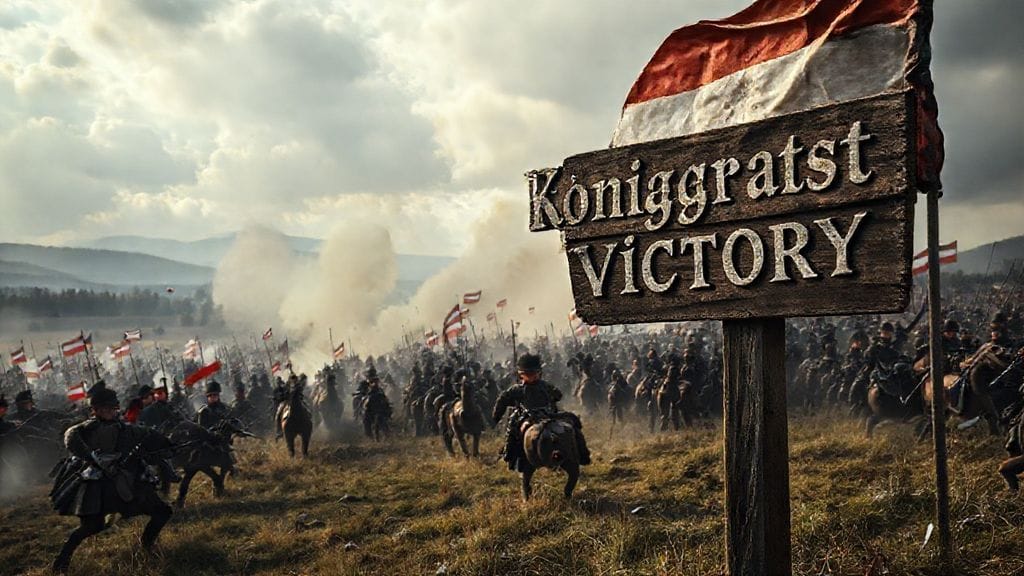
At around 5:30 a.m., the tranquility shattered as Prussian artillery opened fire. The battle unleashed a whirlwind of musketry, cannonades, and thunderous charges. Infantry moved through forests and hills, while cavalry probed flanks.
Benedek’s forces, despite their bravery, faced a Prussian juggernaut. Moltke’s deployment in three widely separated armies aimed to envelop and crush the Austrians from multiple directions.
A defining feature was the scale: tens of thousands of combatants tangled across a nearly nine-mile front. The battlefield became a tapestry of smoke, dirt, blood, and resolute fighting men.
7. The Flank Attack: Helmuth von Moltke’s Masterstroke
Moltke’s brilliance lay in his indirect approach. Instead of frontal assault, the Prussian armies aimed to sever the Austrian left flank. The arrival of the Prussian Second Army under Crown Prince Frederick William on the Austrian flank late in the morning marked a turning point.
The Prussian “needle gun” conferred a deadly advantage; faster reload times translated into devastating volleys. Austrian soldiers, armed mainly with muzzle-loading rifles, were outmatched in rate of fire.
The combined pressure broke the Austrian lines. Benedek struggled to redeploy reserves, but confusion and exhaustion had taken their toll. The battlefield began to tilt irrevocably in favor of Prussia.
8. The Austrian Struggle: Soldiers amid Chaos
For the Austrian troops, the battle was grueling. Relying on courage and discipline, units fought fragmented engagements, often isolated by terrain and surge of enemy troops.
Letters from Austrian soldiers speak of horror and valor: “The roar was deafening; comrades fell like trees in a storm… Yet, there was no surrender, only the will to hold ground.”
Command breakdowns and delayed orders exacerbated difficulties. Benedek himself suffered under immense pressure, his morale shaken as reports of faltering lines arrived.
And beyond military maneuvers, the human cost unfolded: wounded lay unattended in fields, medics swarmed; cries of pain and calls for help echoed long after the cannonade ceased.
9. The Role of Technology: Railways, Rifles, and Telegraphs
Königgrätz was more than a battle; it was a glimpse of the future of warfare. Railroads had enabled Prussia’s rapid mobilization and logistic support—troops arrived in days what once might have taken weeks.
Communication via telegraph allowed commanders to coordinate with unprecedented speed. The needle gun, firing a bolt from a closed bolt mechanism, revolutionized infantry firepower.
These factors underscored Prussia’s militaristic modernity and contributed decisively to the outcome. Austria’s inability to match these innovations revealed the gap between tradition and progress.
10. Turning the Tide: Prussian Persistence and Austrian Retreat
By mid-afternoon, Prussian forces pressed on the weakening Austrian center and left. The battlefield, once a place of stalwart resistance, became a scene of disintegration.
Benedek’s order to retreat came too late to prevent disaster. Austrian troops withdrew in disorder across the Bistritz, leaving artillery and supplies behind.
Prussian pursuit was restrained but effective, consolidating their battlefield dominance. The victory was unmistakable—and devastating.
11. Casualties and Carnage: Human Cost of Königgrätz
The carnage of Königgrätz was staggering. Estimates suggest some 44,000 men were killed, wounded, or captured that day. Around 9,000 Austrians lay dead; Prussian losses numbered about 9,500.
Mass graves dotted the landscape; villages were overwhelmed with the wounded. The trauma rippled across families and communities. Yet, amid loss, new heroes were born and legends forged.
12. Voices from the Battlefield: Letters, Diaries, and Witness Accounts
Survivors told stories of bravery and despair. One Prussian officer wrote: “The field was a nightmare, and yet I felt the thrill of victory, bitter and sweet.”
An Austrian nurse recalled: “We labored through the night, stitching wounds, whispering comfort. War makes saints, though it is cruel.”
These testimonies paint a human portrait of battle—not just strategy and tactics, but lives shaped and broken in the crucible of war.
13. Immediate Aftermath: Political Shockwaves and Armistice
News of the defeat sent shockwaves through Vienna. Emperor Franz Joseph was forced to accept armistice negotiations. The Austro-Hungarian Empire faced internal turmoil and external humiliation.
Sadowa marked the end of Austrian dominance within Germany. Bismarck’s Prussia emerged as the new German leader, able to dictate terms and future policies.
14. The Peace of Prague: Redrawing the Map of Germany
The Treaty of Prague, signed in August 1866, formally ended the conflict. Austria ceded Holstein to Prussia, withdrew from German affairs, and dissolved the German Confederation.
Prussia established the North German Confederation, excluding Austria, laying groundwork for the eventual unification of Germany under Prussian leadership.
15. The Rise of Prussia: Path to German Unification
Königgrätz was the keystone in Bismarck’s plan. By crushing Austria, Prussia cleared the path to unite German states into a powerful nation-state.
Just four years later, in 1871, the German Empire was proclaimed in the Hall of Mirrors at Versailles, a monumental shift in European geopolitics.
16. Austria’s Decline and the Shift in European Balance of Power
Austria’s defeat diminished its influence as a German power, forcing it to refocus on multi-ethnic empire management and internal reforms.
For decades to come, Central Europe’s balance tilted towards Prussia and later unified Germany, with consequences rippling into the 20th century.
17. Legacy of Königgrätz: Military Innovations and Doctrine
The battle influenced military thought worldwide. The successful use of rapid mobilization, railways, and superior firepower became a model studied and emulated.
Königgrätz bridged traditional linear tactics and modern warfare’s mechanized, coordinated approach.
18. The Memory of Sadowa: Commemoration and National Narratives
In both Austria and Germany, Königgrätz took on symbolic significance. Memorials, histories, and artistic depictions shaped national memory.
For Germans, Sadowa was a proud milestone of unity and power. For Austrians, a solemn reminder of a lost era and a call for renewal.
19. Lessons from the Battlefield: Diplomacy and Modern Warfare
Beyond bloodshed, Königgrätz teaches the blend of diplomacy, technology, and military strategy needed in modern statecraft.
Bismarck’s masterful orchestration of alliances and war left enduring lessons about the power of realpolitik and calculated risk.
20. Conclusion: The Battle that Reshaped a Continent
The Battle of Königgrätz was more than a clash of armies; it was the crucible in which Central Europe’s future was forged. Through smoke and fire, borders were redrawn, empires transformed, and national destinies sealed.
It stands as a vivid testament to the human costs of power struggles, the relentless march of progress, and the thrilling drama of history in motion.
Conclusion
The sun that set over the fields of Königgrätz on July 3, 1866, marked not only the end of a brutal day of combat but a turning point for an entire continent. In the chaos of battle, strategy, technology, and sheer human will collided to rewrite Europe’s destiny. Prussia’s victory was a herald of change, signaling the dawn of united Germany and the reconfiguration of empires.
Yet beneath the military triumph lay a complex tapestry of human stories—of soldiers facing fear and death, of commanders navigating impossible decisions, and of civilians caught between the tides of history. The echoes of Königgrätz remind us that history is never static; it moves with the rhythm of human endeavor, shaped by both grand designs and personal courage.
As we reflect on this moment, we are invited to consider the fragile balance between war and peace, ambition and restraint, progress and memory. Königgrätz teaches that the past is alive, and through it, we glimpse the future.
FAQs
Q1: What triggered the Austro-Prussian War and the Battle of Königgrätz?
A1: The immediate trigger was the dispute over the administration of Schleswig and Holstein after their joint conquest from Denmark. Tensions escalated over control, with Bismarck exploiting the conflict to isolate Austria and assert Prussian dominance over German affairs.
Q2: Who were the key military figures in the battle?
A2: Helmuth von Moltke, the Chief of the Prussian General Staff, masterminded the strategy, while General Ludwig Benedek commanded the Austrian forces. Crown Prince Frederick William led the crucial flank attack for Prussia.
Q3: How did technology influence the outcome of Königgrätz?
A3: Prussia’s use of the Dreyse needle gun allowed faster rifle fire, and the effective use of railways and telegraphs facilitated rapid troop movement and communication, giving Prussia a decisive logistical and tactical advantage.
Q4: What were the casualties at the Battle of Königgrätz?
A4: Approximately 44,000 men were killed, wounded, or captured. Prussian losses were around 9,500; Austrian casualties were roughly 30,000, including dead, wounded, and captured.
Q5: How did the battle affect the political landscape of Europe?
A5: It ended Austrian influence over the German states, led to the formation of the North German Confederation under Prussia, and set the path to German unification, significantly altering European power dynamics.
Q6: How is Königgrätz remembered today?
A6: The battle is commemorated in memorials in Austria and Germany and remains a symbol of both military innovation and national transformation. It is studied as a turning point in 19th-century European history.
Q7: Did the battle have any influence on future wars?
A7: Yes, the innovations and strategies displayed influenced military doctrines leading into World War I, showcasing the importance of technology, rapid mobilization, and combined arms coordination.
Q8: What role did diplomacy play before and after the battle?
A8: Bismarck’s diplomatic isolation of Austria was key to Prussia’s success. Post-battle diplomacy led to the Treaty of Prague, reshaping Central Europe and avoiding a broader, prolonged conflict.