Table of Contents
- A Winter Besieged: Setting the Stage at Kinsale
- Ireland in Turmoil: The Long Road to War
- Hugh O’Neill and the Making of a Reluctant Rebel
- Elizabeth’s Empire and the English War Machine in Ireland
- A Spanish Gamble on the Edge of Europe
- Landfall in the Storm: The Spanish Fleet Reaches Kinsale
- The Ring Tightens: Mountjoy’s Siege of the Town
- Across a Frozen Island: O’Neill and O’Donnell March South
- Inside the Camps: Fear, Hunger, and Waiting for Dawn
- The Battle of Kinsale: Dawn Assault on the Marshes
- Panic, Missteps, and Collapse: How Victory Slipped Away
- Surrender in the Harbor Town: The Spanish Capitulate
- From Kinsale to Flight: The Fall of Gaelic Ireland
- Winners, Losers, and Propaganda: Memory of the Battle
- Faith, Identity, and the Religious Shadow of Kinsale
- Echoes Through Centuries: Kinsale in Irish National Imagination
- Reading the Battlefield Today: Landscape as Archive
- Conclusion
- FAQs
- External Resource
- Internal Link
Article Summary: On a cold December morning in 1601, on the southern coast of Ireland, the battle of kinsale unfolded as a clash that would reshape the island’s history for centuries. This article traces the deep roots of the conflict, from Tudor expansion and Gaelic resistance to the desperate hopes placed in a Spanish fleet that anchored in Kinsale’s harbor. Moving chronologically, it follows Hugh O’Neill, Red Hugh O’Donnell, and Lord Mountjoy through strategy, hardship, and fatal miscalculation. The narrative explores the battlefield hour by hour, then widens to examine the political and social consequences of the defeat for Gaelic Ireland and Catholic Europe. It shows how the battle of kinsale became both an Irish tragedy and an English imperial triumph, enshrined in propaganda and legend. The article also delves into the religious and cultural aftershocks, including the “Flight of the Earls” and the plantation of Ulster. Finally, it reflects on how the battle of kinsale is remembered today, how the landscape still holds faint traces of that winter siege, and why this remote clash on a marshy field remains one of the turning points of early modern Europe.
A Winter Besieged: Setting the Stage at Kinsale
In the last days of December 1601, as the year withered in wind and rain, the small harbor town of Kinsale in southern Ireland lay caught between two worlds. Within its walls, Spanish soldiers shivered under foreign skies, staring out toward a gray Atlantic that had failed to bring the reinforcements they craved. Outside, in the sodden fields and bitter cold, English troops ringed the town in a tightening siege line, their campfires flickering in the darkness like a necklace of flame. Beyond them again, somewhere out there in the flooded countryside, moved the shadowy forces of Hugh O’Neill and Red Hugh O’Donnell, the Gaelic lords who had staked the fate of Ireland on this remote coastal corner. The stage was set for the battle of Kinsale, an encounter that would not merely decide a siege but would determine whether Ireland would remain a patchwork of native lordships or be remade into a conquered, colonized kingdom.
Anyone walking the muddy roads that winter would have heard many tongues. Spanish murmurs and Castilian commands drifted from the town’s ramparts. Harsh English orders cut through the wind in the siege lines. In the distance, in the hedgerows and bogs, Irish voices whispered prayers and curses in Gaelic. Yet all these languages were converging on a single, stark question: who would control Ireland? For the English crown of Elizabeth I, Kinsale was a test of imperial will, the culmination of a long and brutal effort to bend the island to royal authority. For the Gaelic chiefs of Ulster, it was the last, desperate throw of the dice in a war that had burned for nearly a decade. And for Spain, locked in conflict with England across Europe and the Atlantic, Kinsale was a chance to open a new front on the empire of its Protestant rival.
But this was only the beginning. Before the sabers flashed on the marshy fields, before cavalry charges broke and scattered in the morning mist, a far longer story had unfolded—of encroaching power, religious fracture, and the stubborn resilience of a people who refused to surrender easily. To understand why men marched into the freezing rain that December, one must trace the roots of the conflict far back into the 16th century, when Ireland’s political map and social fabric first began to strain under the pressure of Tudor ambition.
Ireland in Turmoil: The Long Road to War
In the early 1500s, Ireland was a land of overlapping loyalties and competing identities. The English crown claimed sovereignty, but in truth its effective control barely extended beyond the fortified enclave known as the Pale around Dublin. Beyond that perimeter lay the lordships of Gaelic chieftains and “Old English” families—descendants of medieval Anglo-Norman settlers who, over centuries, had become almost indistinguishable from their Irish neighbors in language, custom, and Catholic faith. It was a patchwork order held together by fragile truces, local bargains, and the complex etiquette of Gaelic lordship.
All this began to change under the Tudor monarchs. Henry VIII’s break with Rome and his declaration as King of Ireland in 1541 triggered a new phase of direct English intervention. The policy was twofold: “surrender and regrant” aimed to convert Irish chieftains into English-style nobles loyal to the crown; and where persuasion failed, force followed. Forts, plantations, and punitive campaigns gnawed into the autonomy of native lords. The religious dimension, at first blurred, gradually sharpened as England became firmly Protestant and Ireland remained overwhelmingly Catholic. By the time Elizabeth I came to the throne in 1558, the conflict over land and authority was increasingly seen—on both sides—through the lens of faith.
Throughout the latter half of the century, Ireland lurched from rebellion to rebellion. The Desmond Rebellions in Munster in the 1560s and 1570s were crushed with ferocity, leaving the southern province scarred by famine and massacre. English officials described the countryside in grim phrases: villages burned, harvests destroyed, people “wasted” in great numbers. In the wake of this devastation, vast tracts of land were confiscated and granted to English settlers in the Munster Plantation, a prototype of the more extensive colonial projects yet to come. The pattern was clear: resistance led to conquest; conquest led to colonization.
Yet behind the celebrations in London of each “pacification,” resentment grew in Ireland. Gaelic lords watched their independence slowly eroded by new legal codes, new taxes, and a stream of English officials who treated them as subjects rather than partners. The gunpowder-smoke of local battles drifted upward into a thicker, more dangerous cloud: a sense that the old order could not survive without a decisive stand. Into this moment of tension stepped one of the most complex figures of the age—Hugh O’Neill, Earl of Tyrone.
Hugh O’Neill and the Making of a Reluctant Rebel
Hugh O’Neill was, in many ways, the embodiment of Ireland’s contradictions at the end of the 16th century. Born into the powerful O’Neill dynasty of Ulster, he was nonetheless raised for a time within the English Pale and educated in the ways of his enemies. He understood English law and courtly manners, spoke the language, and knew how to navigate the web of royal patronage. In London he could bow and flatter with the best of them, pressing his claims at court and securing the title of Earl of Tyrone in 1585. Yet once back in Ulster, he moved seamlessly into the role of Gaelic chieftain, presiding over traditional ceremonies and drawing on the loyalty of kin and client families.
This dual identity made O’Neill both useful and dangerous. To English administrators, he was at first a valuable ally—an Irish lord who might help extend royal authority into the north. To many in Ulster, however, he was a hope: a leader who could read the strategies of the crown and perhaps outmaneuver them. The tension in his position grew as English forts crept into Ulster, most symbolically at the Blackwater, and as royal policy turned more intrusive. Local grievances multiplied: disputed land, broken promises, harsh sheriffs, and the affront of foreign troops on ancestral soil.
By the mid-1590s, conflict became unavoidable. O’Neill, joined by other northern leaders such as Red Hugh O’Donnell of Tyrconnell, slid from uneasy cooperation into open resistance. What began as a regional revolt in Ulster against specific garrisons and officials expanded into a wider confrontation with English rule. The conflict that erupted—known as the Nine Years’ War—was no brief uprising. It was a grueling, country-wide struggle pitting the tactical ingenuity of O’Neill’s forces against the resources of the English crown.
O’Neill proved a formidable commander. He adapted guerrilla tactics to the Irish terrain, ambushing English columns in forests and passes, cutting supply lines, and exploiting the crown’s logistical difficulties. At the battle of the Yellow Ford in 1598, his forces inflicted a devastating defeat on an English army, sending shockwaves back to Dublin and London. For a moment, it seemed possible that Gaelic Ireland might actually force the crown into a negotiated settlement on favorable terms.
Yet O’Neill knew that time and numbers were not on his side. England’s population and wealth vastly exceeded Ireland’s, and each victory carried its own cost in lives and resources. To break the stalemate, he needed outside help—help that could balance the scales. In his eyes, there was only one plausible source: Catholic Spain, England’s great enemy and the leading power championing the Counter-Reformation across Europe.
Elizabeth’s Empire and the English War Machine in Ireland
While O’Neill refined his strategy in the bogs and woods of Ulster, English policymakers in Dublin Castle and Whitehall assessed Ireland in stark strategic terms. For Elizabeth I and her secretary of state, Sir Robert Cecil, the island was a dagger pointed at England’s western flank. In an age when Spanish fleets prowled the seas and the ghost of the failed Armada of 1588 still haunted England’s imagination, the prospect of a hostile Ireland allied to Spain was intolerable. Ireland had to be secured, not merely pacified.
This calculation drove the escalation of English military commitment throughout the Nine Years’ War. Thousands of soldiers were shipped across the Irish Sea, many of them inexperienced recruits or foreign mercenaries. New commanders were sent to replace those who failed: among them Charles Blount, Lord Mountjoy, who would ultimately command at the battle of Kinsale. Mountjoy was intelligent, disciplined, and grimly determined. He understood that victory in Ireland required not only battlefield success but the systematic destruction of the rebels’ economic base.
Thus the English war machine in Ireland was as much about famine as about fighting. Scorched-earth campaigns destroyed crops, burned barns, and drove people from their homes. Livestock, the lifeblood of Gaelic society, were seized or slaughtered. The aim was brutal but clear: starve the rebels into submission and make support for them too costly for local populations to bear. Contemporaries recorded harrowing scenes of hunger and disease as the war dragged on. As one English observer noted with chilling satisfaction, “Hunger is the best and most forcible friend that we Irish governors can have.”
Yet, despite their growing edge, English forces still struggled to deliver a decisive blow. The harsh terrain, broken political alliances, and sheer persistence of Gaelic fighters blunted many campaigns. The government knew that if Spain were to intervene in force—landing troops, guns, and money—O’Neill’s cause might yet be revived and transformed into a serious European war on Irish soil. That nightmare was about to step from theory into reality when Spanish sails appeared off the southern coast, not in Ulster, but at Kinsale.
A Spanish Gamble on the Edge of Europe
To understand why Spanish soldiers found themselves shivering in Kinsale in the winter of 1601, one must step back to see the broader canvas of European conflict. Spain, under Philip II and later Philip III, was the preeminent Catholic power of the age, embroiled in costly wars in the Low Countries, the Mediterranean, and the Atlantic world. England, especially after the execution of Mary, Queen of Scots in 1587, had become a central Protestant antagonist. The failed Armada of 1588 had not ended Spanish ambitions; it had merely redirected them.
From Madrid’s perspective, Ireland presented both an opportunity and a risk. An opportunity, because helping Irish Catholics rebel against English rule might force Elizabeth to divert troops and treasure away from other fronts. A risk, because the logistics of supporting a distant rebellion across stormy seas were daunting. Still, the Vatican and Catholic networks urged support for the Irish cause. Envoys from O’Neill and O’Donnell painted a persuasive picture: a devout Catholic nation, ready to rise in arms if only Spain would send soldiers and arms to its shores.
After much hesitation, the Spanish monarchy approved an expedition. The plan, as envisioned, was bold. A substantial force under Don Juan del Águila would sail to Ireland, preferably landing in the north where O’Neill and O’Donnell held sway. There, combined Spanish-Irish forces might build a bridgehead, fortify key positions, and turn Ireland into a permanent thorn in England’s side—a Catholic bastion on the doorstep of a Protestant power.
Reality intervened in the form of weather, miscommunication, and the sheer uncertainty of 17th-century navigation. Storms battered the Spanish fleet, scattering ships and driving them off course. When at last a significant portion of the armada sighted land in September 1601, it was not the northern coastline that loomed before them, but the more accessible southern harbor of Kinsale in County Cork. Weary, damaged, and running low on provisions, the Spanish commanders made a fateful decision: they would anchor there, occupy the town, and hold it while they waited for the Irish allies to come to them.
It’s astonishing, isn’t it? A war that had been fought primarily in the northern forests and mountains would be decided on a marshy field far to the south, largely because of wind and waves. The Spanish gamble, meant to be a swift intervention in support of triumphant rebels, had instead become a risky foothold—a promise of salvation that required O’Neill and O’Donnell to march their exhausted armies hundreds of miles through enemy-held territory in the dead of winter.
Landfall in the Storm: The Spanish Fleet Reaches Kinsale
The arrival of the Spanish fleet at Kinsale in late September 1601 came as both a shock and a revelation. For the inhabitants of the small port town, accustomed to the rhythms of fishing and trade, the sight of warships crowding the harbor must have seemed like a vision torn from the great conflicts of the continent. Don Juan del Águila disembarked with around 3,000 troops—veteran infantry hardened by campaigns in Flanders and elsewhere. They brought banners, artillery, and the aura of Spain’s military prestige.
Initial contacts with local Irish were hopeful but cautious. The southern province of Munster had been ravaged less than two decades before in the Desmond Rebellions, and the scars of English reprisal were still raw. Many local nobles and landholders had reason to hate the English administration, but they also feared risking everything on a Spanish intervention whose outcome was far from certain. Del Águila quickly set to work fortifying Kinsale, repairing its walls, strengthening its defenses, and preparing for an inevitable English response.
Messages sped northward, carried over land and by sea, to inform O’Neill and O’Donnell that their long-anticipated allies had arrived—though not where they had been expected. The news was as thrilling as it was troubling. On the one hand, the Spanish presence provided a tangible symbol that Ireland had not been abandoned by Catholic Europe. On the other, the location was disastrous. Kinsale lay deep in English-held territory, far from the strongholds of Ulster. Any attempt to reach it would mean exposing their armies to attrition, ambush, and the grinding strain of forced marches through the worst season of the year.
Meanwhile, the English authorities reacted with a mix of alarm and iron resolve. The landing confirmed their greatest fear: that Ireland could become a base for Spain. To prevent that nightmare, speed was essential. Lord Mountjoy moved swiftly, drawing troops from across the island and directing them toward Kinsale. Naval support helped bottle up the harbor to prevent further Spanish reinforcements. Within weeks, the town that had seemed a safe harbor for del Águila was ringed by English camps and artillery positions. The hunter had become the hunted.
The Ring Tightens: Mountjoy’s Siege of the Town
By late autumn, the siege of Kinsale had settled into a grim routine of hunger, gunfire, and disease. Mountjoy’s forces, perhaps 12,000 strong at their peak, encircled the town in lines of entrenchments and outposts. The English commander understood that a direct storming of the Spanish positions would be costly and uncertain; instead, he chose to choke the town slowly. Supply lines to Kinsale were cut, foraging parties were harassed, and any attempts by local sympathizers to bring in food or information were brutally punished.
Conditions inside Kinsale deteriorated quickly. The Spanish soldiers, already weakened by their arduous voyage, now faced shortages of food, medicine, and gunpowder. Winter rains turned streets into rivers of mud and seeped into their cramped quarters. Sickness spread. Yet del Águila refused to consider surrender. He sent urgent pleas to O’Neill and O’Donnell: come swiftly, drive the English from our lines, and together we can turn the tide.
Outside the walls, the English troops also suffered. The same rain that dampened Spanish powder drenched English tents. Supply convoys from Cork and other bases had to thread through hostile countryside, always at risk of ambush. Horses grew thin, boots rotted, and morale sagged. Desertion, disease, and sheer exhaustion gnawed at Mountjoy’s numbers. But he held his ring, knowing that each passing week tightened the pressure on the besieged Spaniards and increased the likelihood that O’Neill, forced to come south, would have to fight at a disadvantage.
Both sides now awaited the same figure: Hugh O’Neill. For the Spanish in the town, he was the savior whose arrival could rupture the English siege and join Latin and Gaelic arms. For the English, he was the last major threat, the lance that had to be broken once and for all. As the year crept toward its end, news finally reached Kinsale that O’Neill and O’Donnell had begun their long march. The decisive confrontation of the battle of Kinsale was drawing near, though none of the commanders could yet know how disastrously it would unfold for the Irish cause.
Across a Frozen Island: O’Neill and O’Donnell March South
The march from Ulster to Kinsale in the late autumn and early winter of 1601 was itself an epic of endurance. O’Neill and O’Donnell, each commanding several thousand men, had to move their forces across an island increasingly dominated by English garrisons, through terrain turned treacherous by weeks of rain and cold. They carried what provisions they could, relying heavily on uncertain local support along the way. Every mile put more strain on their weary soldiers and more mud on their worn shoes.
Strategically, the decision to march south was a gamble that revealed the depth of their commitment to the Spanish alliance. Had they remained in Ulster, they might have preserved their strength for another season, forcing the English into protracted campaigning in hostile terrain. But to abandon the Spanish at Kinsale would have meant not only the loss of valuable allies but also a catastrophic blow to Catholic morale across Europe. For leaders who had framed their struggle as part of a wider religious cause, that was unthinkable.
Accounts describe men trudging through flooded fields, crossing rivers swollen by winter rains, and bivouacking in forests where firewood was scarce and damp. Armor rusted. Bows, muskets, and powder needed constant care. Many of the Irish forces were lightly armed compared to Spanish or English regulars; their strength lay in mobility, knowledge of the land, and the ferocity with which they defended their homes. But here, far from the familiar haunts of Ulster, those advantages were blunted.
By the time the Irish armies drew near Kinsale in December, they were tired, under-provisioned, and perhaps no longer united in strategic purpose. O’Donnell favored a bold stroke, an aggressive attack to break the siege at once, rescue the Spanish, and create a new front in Munster. O’Neill, more cautious by temperament and experience, hesitated. He knew the strengths of English discipline in open-field battle and the risks of leading troops across unfamiliar ground in poor conditions. Yet the very logic that had driven him southward now pressed upon him once more: delay might be fatal; action, even risky action, seemed the only hope.
Inside the Camps: Fear, Hunger, and Waiting for Dawn
In the days immediately before the battle of Kinsale, three anxious camps lay within a few miles of one another, each filled with men who sensed that something irreversible was about to happen. Inside Kinsale, the Spanish garrison watched the surrounding hills for any sign of their Irish allies. They listened for distant gunfire that might signal a clash in the English lines, checked their dwindling stores, and debated how best to coordinate with the relief force they had never yet met on the battlefield.
In the English camp, Mountjoy and his lieutenants pored over reports from scouts and spies. They knew the Irish were near; skirmishes with advance parties had confirmed as much. But the exact size and intentions of O’Neill’s army remained unclear. Some English officers argued for a pre-emptive strike; others warned of the risks of abandoning the siege lines in the face of a still-formidable Spanish garrison. Mountjoy opted for a flexible defense, prepared to respond rapidly to any Irish movement while keeping Kinsale firmly under pressure.
In the damp fields where the Irish had encamped, the sense of expectation was thick with unease. Soldiers from Ulster and Connacht mingled uneasily on ground that held no personal memory for them. The weather had turned colder, with rain giving way at times to frost that gleamed on spearheads at first light. Many men were hungry. Fires sputtered in the wet air. Messengers traveled between the Irish leaders and the Spanish within Kinsale, but misunderstandings abounded. Differences of language, military doctrine, and temperament weighed heavily on every plan drawn up by torchlight.
There is a haunting intimacy to imagining the night before a decisive battle. Men who had fought in skirmishes and ambushes for years now contemplated the prospect of a pitched engagement in the open, with cavalry charges, artillery, and tight formations of pikes. Some, no doubt, whispered prayers in Latin and in Irish. Others sharpened blades that had already tasted blood during the long war. And far from home, under skies they shared with strangers, they wondered whether they would ever see their own fields and families again. Dawn was approaching, and with it, a set of choices that would either save or doom the Irish cause.
The Battle of Kinsale: Dawn Assault on the Marshes
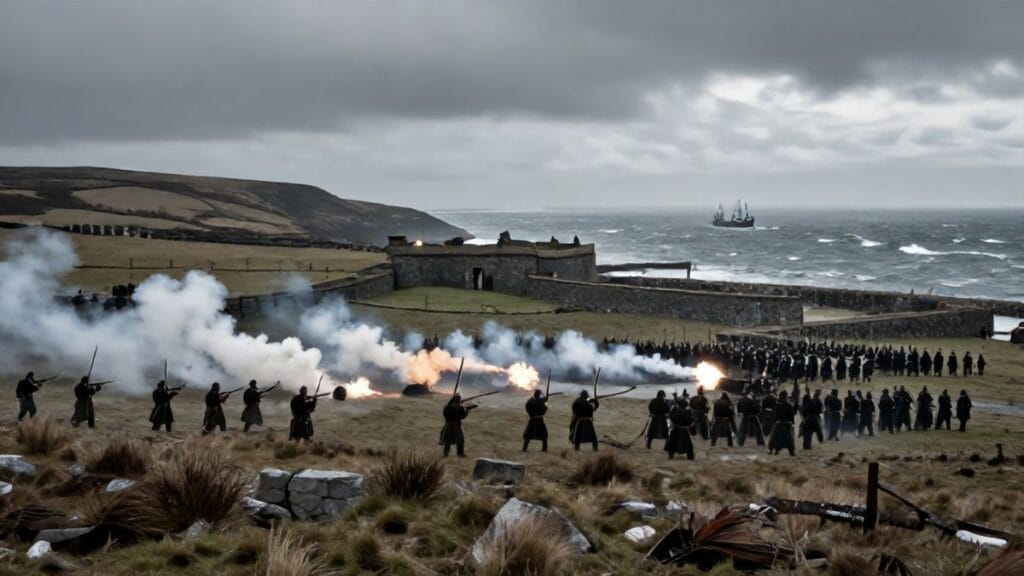
The morning chosen for the assault—24 December 1601 by the Old Style calendar—broke cold and murky. A low mist clung to the ground, obscuring the contours of the land. This would be the day of the battle of Kinsale, though many who marched into the half-light could not yet grasp its historic weight. The Irish plan, as reconstructed by historians through fragmentary reports, aimed at surprise. O’Neill and O’Donnell intended to launch an early-morning attack on the English positions, striking before Mountjoy could fully deploy his forces. Spanish troops from Kinsale were to make a coordinated sortie at the right moment, sowing confusion and allowing the encirclement of English units between two hammer blows.
But almost from the first steps, things began to go wrong. The ground chosen for the Irish approach—low-lying and waterlogged—proved a treacherous trap. Cavalry horses floundered in the marshy soil. Formations struggled to maintain cohesion as men slipped and stumbled. The fog, which might have been an ally, became an enemy, obscuring signals and making it difficult for commanders to see how their lines were forming. Some units veered off course; others halted in uncertainty. As the Irish moved, they lost the tempo that surprise requires.
Mountjoy, warned by scouts of the Irish movements, reacted with speed and precision. English cavalry units were dispatched to probe the advancing Irish columns, harassing their flanks and withdrawing before counter-attack. Drums beat in the English camp as infantry were roused and ordered into battle formation. Cannon were wheeled into position where the ground permitted. Within a short period, the English forces—disciplined, drilled, and familiar with set-piece engagements—had shifted from a siege posture into a field army ready to receive the assault.
For the Irish troops, advancing in fits and starts, the first real shock of the battle came when English cavalry charged at vulnerable points along their line. These charges, well-timed and coordinated, targeted units that had become disordered by the marshy ground. Irish cavalry, less heavily armored and struggling in the mire, could not respond effectively. Panic began to ripple through ranks as some elements fell back, colliding with those still pushing forward. The line, which on paper had been a coherent force, started to fracture into clumps of confused, frightened men.
Inside Kinsale, the Spanish garrison heard the distant echo of gunfire and trumpets. Yet coordination with the Irish outside the walls broke down. Del Águila, uncertain of the exact timing and scale of the Irish assault—and wary of exposing his already weakened garrison to a potentially disastrous sortie—hesitated. By the time any Spanish movement could have helped, the dynamics of the field had already swung sharply in Mountjoy’s favor. The two allied forces, separated by walls and poor communication, never managed the decisive, synchronized blow that might have overwhelmed the English.
Panic, Missteps, and Collapse: How Victory Slipped Away
As the morning wore on, the battle of Kinsale tilted inexorably toward catastrophe for the Irish. The initial disorder caused by the terrain and English cavalry probes turned into something more dangerous: cascading fear. Units that had been trained for guerrilla warfare in familiar landscapes now found themselves exposed in open country, facing disciplined volleys of musket fire and coordinated charges. The psychological shock of this different kind of combat cannot be underestimated.
O’Neill and O’Donnell tried to rally their men, but the fog of war was literal as well as metaphorical. Signals were missed or misinterpreted. Orders sent down the line arrived too late or in garbled form. Meanwhile, Mountjoy pressed his advantage. English infantry advanced in steady blocks, their pikes bristling, while supporting fire from arquebusiers and musketeers disrupted any attempt by the Irish to counter-attack in a coordinated fashion.
One of the most crucial factors in the collapse was the breakdown of Irish cavalry resistance. Traditionally a key strength of Gaelic warfare, the Irish horsemen were hampered by the sodden ground and the confusion in their own ranks. When English cavalry struck in well-directed charges, they found opportunities to drive wedges into already faltering formations. Each successful charge not only inflicted casualties but also eroded morale. What had started as tactical setbacks soon deepened into a sense that the entire advance was unraveling.
According to later English accounts—admittedly colored by triumphalism—some sections of the Irish army began to flee the field. Whether this “flight” was as widespread as these reports claim is debated, but there is no doubt that many units pulled back in disarray. Once retreat began, restoring order was nearly impossible. In open battle, a retreating army becomes an easy target: men are cut down from behind, standards are lost, and leaders struggle to even locate their own contingents in the chaos.
In the end, the Irish commanders had no choice but to accept that the day was lost. O’Neill, with bitter clarity, ordered a general withdrawal. What had been conceived as a daring strike to break the siege and inaugurate a new phase of the war had instead become a rout that crippled the Irish capacity to continue large-scale operations. The casualties were not only in dead and wounded, but in lost weapons, horses, and—most importantly—confidence. The myth of Irish invincibility against English armies, nurtured since the victory at Yellow Ford, was shattered on the marshes near Kinsale.
Surrender in the Harbor Town: The Spanish Capitulate
The collapse of the Irish assault left the Spanish in Kinsale isolated beyond rescue. Del Águila, watching from the walls or hearing grim reports from scouts, must have realized that the strategic picture had changed irrevocably. Without a strong Irish army in the field to relieve the siege, the Spanish garrison could hope for little more than a slow, grinding attrition ending in surrender or annihilation.
Negotiations between del Águila and Mountjoy began not long after the failed Irish attack. Both men were seasoned commanders, aware of the rituals of honor and pragmatism that governed early modern warfare. Mountjoy, having won the decisive battlefield advantage, was in no hurry to waste lives in a final, bloody storming of Kinsale’s walls. Del Águila, for his part, had to balance the demands of valor with the need to preserve what remained of his force for Spain’s future wars.
The terms eventually agreed were relatively generous by the brutal standards of the age. The Spanish were allowed to surrender the town and sail home under a promise of safe conduct, though not all ships and men would make it back unscathed. They left behind their Irish allies, some of whom had fought alongside them within the town, to face English retribution. The sight of Spanish banners being lowered and English flags rising over Kinsale’s ramparts symbolized not only a local defeat but the collapse of years of hope that foreign Catholic intervention might permanently alter Ireland’s destiny.
Back in Spain, news of the failed expedition was received with disappointment but also a weary sense of inevitability. The empire was overstretched, and Ireland had always been a distant theater compared to the burning priorities of the Netherlands and the Mediterranean. In England, by contrast, the victory at Kinsale was celebrated as proof of divine favor and military superiority. One contemporary English chronicler exulted that “God had set His face against the Pope’s designs and the Spanish pride.” The psychological impact was immense: the specter of a Spanish-backed Catholic Ireland receded into the realm of defeated fantasies.
From Kinsale to Flight: The Fall of Gaelic Ireland
The battle of Kinsale did not end the Nine Years’ War overnight, but it broke its backbone. O’Neill and O’Donnell retreated northward with their surviving forces, trying to salvage what they could from the wreckage. English pressure intensified. Mountjoy, now free from the immediate threat posed by the Spanish, focused his energies on Ulster, applying the same tactics of devastation that had proven effective elsewhere. Crops were burned, cattle seized, and entire districts laid waste to starve out resistance.
Red Hugh O’Donnell, restless and impetuous as ever, chose to seek renewed Spanish support by traveling to the continent. His journey, however, ended in disappointment and death; he died in Spain in 1602, far from the rugged hills of Donegal he had fought to defend. O’Neill, more cautious and burdened by the responsibilities of leadership, sought terms. By 1603—ironically, the year also of Elizabeth I’s death—he submitted to the new king, James I, in what came to be known as the Treaty of Mellifont.
On the surface, the terms seemed not entirely ruinous. O’Neill was restored to some of his titles and lands, and outwardly reconciled with the crown. But beneath the ceremonial gestures, the structure of Gaelic power had been fatally weakened. English law, administration, and plantations continued to advance. The old system of clan-based lordship, upheld by customary rights and personal loyalties rather than written statutes, now found itself increasingly pushed aside by a more rigid, centralized, and colonizing state.
In 1607, the fragile compromise shattered in a single dramatic gesture: the “Flight of the Earls.” Hugh O’Neill, Rory O’Donnell (brother of the late Red Hugh), and a group of other leading Gaelic nobles boarded a ship at Rathmullan, Lough Swilly, and sailed into exile on the continent. Their departure has echoed through Irish memory ever since. It marked, symbolically and practically, the end of the old Gaelic aristocracy as an independent political force within Ireland. As historians such as Nicholas Canny have argued, the path from the battle of Kinsale to the Flight of the Earls and the plantation of Ulster forms a continuous arc of dispossession and colonization.
Winners, Losers, and Propaganda: Memory of the Battle
The victors of Kinsale were quick to shape the narrative of what had happened there. In English accounts, the battle was often portrayed as a clash between civilization and rebellion, between a lawful Protestant monarch and disorderly Catholic insurgents backed by Spain. Mountjoy’s leadership and the discipline of English troops were praised at length. Printed pamphlets and official reports circulated in London and beyond, using Kinsale as evidence that God favored the English cause and that Ireland could at last be brought under secure, “civil” governance.
Spanish and Irish perspectives, though less widely disseminated in print at the time, also began to crystallize. For many Irish Catholics, Kinsale became a byword for tragic mischance and divine testing. If God had not wholly abandoned them, then perhaps their sins or divisions had rendered them unworthy of the victory that seemed so close. Stories of heroism on the field, of brave stands and narrow escapes, circulated orally in Gaelic song and lore even when official histories remained silent. The sense of what might have been—that if only coordination had been better, if only the ground had been kinder, if only the weather had favored them—haunted these tales.
Over time, Kinsale came to mean different things to different communities. For English and later British imperial narratives, it was a milestone on the road to a unified kingdom, a triumph over foreign meddling and internal disorder. For Irish nationalists in the 19th and early 20th centuries, looking back across centuries of subjugation, it loomed as a lost opportunity when freedom had appeared briefly within reach. A modern historian once summarized the battle’s irony with pithy clarity: “Kinsale was the moment when Ireland almost became the cockpit of Europe—and instead became its colony.” The emotional charge contained in that “almost” would resonate through the generations.
Yet behind the broad strokes of propaganda and counter-propaganda lies a more intimate set of questions. How did ordinary soldiers remember the day? Did veterans of Kinsale live long enough to see the plantations rise on lands they had once defended? And how did the families left behind to rebuild shattered communities tell the story to their children? These quieter, human narratives rarely surface in official records, but they are the threads from which the fabric of historical memory is truly woven.
Faith, Identity, and the Religious Shadow of Kinsale
The battle of Kinsale was not only a military encounter; it was also a deeply religious event in the minds of those who fought and those who watched from afar. On the Irish and Spanish side, the war was framed as a Catholic struggle against Protestant heresy. Priests traveled with the Irish armies, hearing confessions and blessing weapons. Spanish banners bore religious iconography, and masses were said for victory. Rome and Madrid sent indulgences and spiritual encouragement alongside guns and money.
On the English side, the rhetoric was equally infused with notions of divine favor. Preachers in London and Dublin presented the conflict as a just war against rebellion and foreign tyranny. After Kinsale, sermons celebrated the victory as a sign that God smiled upon the reformed church in England and disfavored the schemes of Rome and Spain. Printed broadsides blended military news with scriptural references, casting Mountjoy and his soldiers in the role of Old Testament heroes smiting God’s enemies.
The defeat at Kinsale deepened the sense among many Irish Catholics that their fate was being worked out on a stage far larger than their island. They were not only subjects of a foreign Protestant crown but also pawns—or martyrs—in a pan-European contest between Faiths. This perspective fed into later developments: the identification of Irishness with Catholicism, the readiness of many Irish exiles to serve in Catholic armies abroad, and the enduring suspicion of English rule as inherently hostile to their religion.
In the centuries that followed, Kinsale would be remembered in sermons, songs, and histories not merely as a lost battle but as part of a wider narrative of suffering for the faith. The sense that Ireland had stood, almost alone, as a Catholic bastion against a Protestant empire reinforced a powerful self-image of endurance. Yet this religious framing also had its costs, sometimes obscuring the complex internal divisions within Irish society and the strategic miscalculations of its leaders behind a veil of sanctified victimhood.
Echoes Through Centuries: Kinsale in Irish National Imagination
By the 19th century, when modern nationalism began to reshape political consciousness across Europe, the battle of Kinsale resurfaced with renewed significance. Irish nationalist writers, poets, and historians looked back over centuries of resistance and defeat, seeking key moments that could explain their present condition and inspire future struggle. Kinsale, alongside other landmarks like the Flight of the Earls and the Cromwellian conquest, emerged as one of those laden episodes where history seemed to pivot.
Romanticized accounts dwelt on the bravery of O’Neill and O’Donnell, sometimes smoothing their complexities into clear-cut heroes. The Spanish alliance took on a semi-mythic quality, a symbol of international solidarity abandoned too soon. Songs and literary works evoked the pain of near-victory: the image of Irish and Spanish banners almost touching across the battlefield, only for confusion and misfortune to prevent their union. In this telling, Kinsale became less a story of strategic failure and more a lament for dreams deferred.
Yet nationalist thinkers were not uniformly sentimental. Some writers used Kinsale as a cautionary tale about internal division, inadequate planning, and over-reliance on foreign support. They argued that true liberation would require self-reliance, unity, and a clear-eyed understanding of Ireland’s geopolitical position. In this way, the memory of Kinsale did double duty: it nourished the emotional roots of nationalism while also prompting sober reflection on the mistakes of the past.
By the time of the Irish independence movement in the early 20th century, Kinsale had become one tile in a long mosaic of historical injustices and heroic failures invoked to justify the creation of a sovereign Irish state. Leaders and activists, whether consciously or unconsciously, drew on the reservoir of feeling associated with events like Kinsale when they spoke of ending “seven centuries of foreign rule.” The echoes of that winter battle thus resounded not only in historians’ monographs but in political speeches, commemorations, and popular imagination.
Reading the Battlefield Today: Landscape as Archive
Today, Kinsale is a picturesque town known more for its colorful harborfront, seafood restaurants, and sailing culture than for the acrid smoke and fear that once filled its air. Tourists stroll along narrow streets, unaware that beneath their feet lies soil once churned by the boots of Spanish, English, and Irish soldiers. Yet for those who know where to look, the landscape still bears faint traces of 1601, like old scars barely visible under the skin.
The fields outside the town—though altered by centuries of agriculture, development, and changing land use—can still, in places, suggest the contours that shaped the battle of Kinsale. Low-lying ground, prone to waterlogging, hints at why cavalry movements were so treacherous that day. Slight rises and hollows, almost imperceptible to casual eyes, mattered hugely to commanders seeking vantage points or secure positions for artillery. To walk there with a map in hand, overlaid with historical reconstructions, is to feel a ghostly resonance between the present and that distant December morning.
Historians have long debated the exact positions of forces and the detailed sequence of events during the battle, drawing on a patchwork of English, Spanish, and Irish sources. Archaeological investigations, though limited, have occasionally turned up musket balls, fragments of military equipment, and other small artifacts that testify to the clash. The landscape itself becomes a kind of archive, preserving in its undulations and watercourses the constraints under which commanders made their choices.
For local communities, the memory of the battle has shifted from immediate trauma to historical curiosity, and in some cases, quiet pride in living near a site of global significance. Commemorations, plaques, and educational initiatives have sought to make the story accessible, weaving it into Ireland’s broader heritage narrative. In this way, the battle of Kinsale continues to live not only in scholarly debates but also in the everyday consciousness of a town that has reinvented itself many times since 1601. Standing on a windy hill overlooking Kinsale today, it is possible to imagine the flicker of ancient campfires in the dusk—and to sense how profoundly that single encounter shaped the fate of an island.
Conclusion
The battle of Kinsale was, in one sense, a brief and localized event: a few hours of confusion and carnage on a winter’s morning near a small harbor town. Yet its consequences radiated outward in widening circles that touched the highest courts of Europe and the humblest cottages of Ulster. It marked the effective end of serious military resistance to English rule in Ireland for generations, the collapse of hopes that Spain might tip the balance, and the beginning of a new, more systematic phase of colonization epitomized by the Ulster Plantation.
For the Irish leaders who staked everything on the alliance with Spain, Kinsale was the hinge on which their world turned. Before it, O’Neill and O’Donnell could imagine a future in which Gaelic lordships coexisted with, or even dominated, English authority under a Catholic banner. After it, the horizon narrowed to survival, exile, or reluctant accommodation. The Flight of the Earls, the spread of plantations, and the slow erosion of Gaelic culture as a political force all flowed from the defeat crystallized on that marshy ground.
And yet, the story of Kinsale is not only one of loss. It is also a lens through which to view the resilience of a people and the complexity of historical change. The memory of the battle of Kinsale nourished later generations who sought to understand why their land was ruled from elsewhere and how they might one day reclaim it. It intertwined with questions of faith, identity, and sovereignty that still resonate in modern Ireland and beyond. As the historian Steven G. Ellis has observed in a broader context, “Ireland’s past is never simply past; it is a living argument about what the country is and may yet become.” Kinsale is one of the sharpest points in that argument.
Looking back across more than four centuries, we can see Kinsale as both a tragic ending and a beginning. It closed the chapter of medieval Gaelic Ireland while opening the pages of a new, colonial, and later national story. The men who struggled through the mud that December could not have foreseen all that would follow, but their choices and misfortunes shaped it profoundly. To walk the fields today, and to tell their story with care, is to recognize how a single battle can reverberate through time—altering maps, minds, and destinies far beyond the sound of its last musket shot.
FAQs
- What was the battle of Kinsale?
The battle of Kinsale was a decisive engagement fought in late December 1601 near the town of Kinsale in County Cork, Ireland. It pitted the forces of the English crown under Lord Mountjoy against a combined Irish and Spanish effort led by Hugh O’Neill, Red Hugh O’Donnell, and Don Juan del Águila. The battle took place during the Nine Years’ War and effectively ended organized Gaelic resistance to English rule. - Why did Spain get involved in the conflict in Ireland?
Spain intervened in Ireland as part of its wider struggle against Protestant England during the late 16th and early 17th centuries. Supporting Irish Catholic rebels offered Madrid a way to destabilize England, open a new theater of war, and potentially create a friendly Catholic base close to English shores. The Spanish landed at Kinsale hoping to join forces with Irish leaders and turn Ireland into a strategic ally. - Who were the main Irish leaders at Kinsale?
The principal Irish leaders at the battle of Kinsale were Hugh O’Neill, Earl of Tyrone, and Red Hugh O’Donnell, Lord of Tyrconnell. O’Neill was an experienced commander who had led resistance to English rule in Ulster for years, while O’Donnell was a younger, more impulsive leader famed for his daring escapes and campaigns. They coordinated with the Spanish commander Don Juan del Águila, though communication problems hampered their efforts. - What tactical mistakes contributed to the Irish defeat?
Several factors undermined the Irish attack: the choice of marshy ground that hindered cavalry and disrupted formations, poor coordination between Irish and Spanish forces, delayed or misunderstood signals, and the difficulty of executing a surprise assault in bad weather and low visibility. The English, under Mountjoy, responded rapidly, using disciplined infantry and effective cavalry charges to exploit Irish disarray. - What were the immediate consequences of the battle?
Immediately after the battle of Kinsale, the Irish armies retreated north in a weakened state, and the Spanish garrison soon negotiated a surrender and evacuation. The English tightened their control over southern Ireland and gained a powerful psychological advantage. The defeat shattered Irish hopes of large-scale foreign support and made continued resistance far more difficult. - How did Kinsale lead to the Flight of the Earls?
The defeat at Kinsale undermined the political and military position of Gaelic leaders like Hugh O’Neill. Although O’Neill formally submitted to the English crown in 1603, English power continued to expand, and suspicion of the old Gaelic nobility remained strong. In 1607, facing mounting pressure and dwindling options, O’Neill and other nobles chose exile in what became known as the Flight of the Earls, effectively ending the traditional Gaelic aristocracy’s role in Irish politics. - Why is the battle of Kinsale considered a turning point in Irish history?
Kinsale is seen as a turning point because it marked the end of serious military resistance to English conquest in Ireland and cleared the way for extensive plantations and deeper integration of Ireland into a centralized, Protestant-ruled kingdom. It also cemented the failure of foreign Catholic powers to alter Ireland’s political trajectory, shaping the island’s subsequent history of colonization, religious division, and eventual nationalist movements. - Can you visit the battlefield site today?
Yes. While the exact limits of the battlefield are debated and the landscape has changed over four centuries, visitors to Kinsale can explore the surrounding countryside, where interpretive materials, walking routes, and local guides help connect the modern terrain to the events of 1601. Nearby historic sites, such as Charles Fort and James Fort (from a slightly later period), add further depth to understanding the strategic importance of Kinsale’s harbor. - How reliable are the historical sources about the battle?
Sources on the battle of Kinsale include English military reports, Spanish accounts, later Irish narratives, and a few contemporary chronicles. Each is shaped by its authors’ perspectives and aims—victory reports often exaggerate enemy losses, while apologetic accounts may downplay mistakes. Modern historians cross-check these documents, use archaeological evidence, and compare differing testimonies to reconstruct events as accurately as possible, while acknowledging remaining uncertainties. - Did religion or politics matter more at Kinsale?
Religion and politics were tightly intertwined at Kinsale and cannot be easily separated. Politically, the battle was about control of Ireland and English fears of a foreign-backed rebellion. Religiously, it formed part of the broader Catholic-Protestant struggle of the age, with both sides framing the conflict in spiritual terms. Each dimension reinforced the other: political loyalty was often mapped onto confessional identity, making Kinsale both a dynastic and a religious watershed.
External Resource
Internal Link
Other Resources
- Encyclopaedia Britannica – general search for the exact subject
- Google Scholar – academic search for the exact subject
- Internet Archive – digital library search for the exact subject

