Table of Contents
- Storm Clouds over the Atlantic: Setting the Stage for La Rochelle
- England’s Ocean Empire and the Fragile Glory of Edward III
- France in Ruins and in Revival: Charles V Plans a New Kind of War
- The Rise of Castile’s Atlantic Power and a New Naval Order
- La Rochelle, Border City of the Sea: Port, People, and Tensions
- The Road to June 1372: Convoys, Ambitions, and Secret Alliances
- Fleets Converging: The English Armada and the Castilian Squadrons
- Eve of Destruction: Night before the Battle of La Rochelle
- Dawn on 21 June 1372: The Trap of Wind and Tide Closes
- Fire, Arrows, and Boarding Hooks: How the Battle Was Fought
- Courage and Catastrophe: The English Commanders’ Last Stand
- Shipwrecked Pride: Captives, Corpses, and the Silent Bay
- Voices from the Waves: Chroniclers, Myths, and Disputed Memories
- Aftermath in London and Paris: Shock, Strategy, and Spin
- A Turning Tide in the Hundred Years’ War
- Merchants, Mariners, and Refugees: Human Lives Reshaped by Defeat
- The Long Legacy of La Rochelle in Naval Warfare
- La Rochelle Remembered: From Medieval Harbor to Modern Memory
- Conclusion
- FAQs
- External Resource
- Internal Link
Article Summary: In the summer of 1372, off the Atlantic port of La Rochelle, an English convoy met a Castilian fleet in a clash that would quietly transform the balance of power in the Hundred Years’ War. This article follows the battle of la rochelle from its deep political roots in Anglo-French rivalry and Iberian diplomacy to the decisive encounter at sea, where wind, tide, and tactics shattered the myth of English invincibility. Through a cinematic reconstruction of events, it shows how ambitious kings, hardened sailors, and terrified townspeople were caught up in a struggle that played out mile by mile across the waves. We explore the strategies of Edward III, Charles V, and Henry of Trastámara, and the dramatic miscalculations that doomed the English fleet. The narrative then traces the shockwaves of defeat in London and the celebrations in Paris and Castile, revealing how this naval disaster undermined English logistics and helped Charles V reclaim much of western France. Social and economic consequences are woven into the story, from ruined merchants to emboldened privateers and shifting trade routes. Returning again and again to the battle of la rochelle as a pivotal turning point, the article examines how chroniclers, later historians, and the city itself remembered—or sometimes forgot—this violent day at sea. In the end, the engagement emerges not simply as a single medieval battle, but as a moment when the Atlantic world, sea power, and the very direction of the war began to change.
Storm Clouds over the Atlantic: Setting the Stage for La Rochelle
The battle of La Rochelle did not burst from a clear blue sky. For decades before 21 June 1372, the Atlantic coast of France had become a long, jagged frontier where ships, not only armies, decided the fate of kingdoms. The harbor of La Rochelle, with its twin towers guarding the channel and its forest of masts nodding gently on the tide, stood at the intersection of these tensions. It was here that English and French interests crossed most dangerously: wine and salt sailed out, wool and cloth sailed in, and with every voyage came rumors of alliances, piracies, and broken truces.
By the early 1370s, the Hundred Years’ War had entered a new, uncertain phase. The thunderclap English victories of Crécy (1346) and Poitiers (1356) had given England an aura of military genius on land. In the 1360 Treaty of Brétigny, Edward III of England extracted from France an enormous territorial settlement that effectively carved a second kingdom out of western France under English control. Yet, as the sea winds scoured the coasts and the memories of those victories aged, France and its allies quietly learned, rearmed, and adapted. The ocean, which had carried English armies to their triumphs, was about to turn against them.
Along the Atlantic seaboard, from the estuaries of Brittany to the estuaries of the Gironde and Charente, fishermen and longshoremen saw signs of change more quickly than kings. New ships bearing the colors of Castile appeared on the horizon, sleeker and tougher than the older hulks of northern waters. In taverns and waterfront chapels, sailors whispered about Iberian captains who could turn a ship against the wind as if by sorcery, and about French gold buying foreign steel. Meanwhile, English captains, long accustomed to relative dominance in the Channel, found the wider Atlantic a more perilous, less predictable arena.
War, at this point, was no longer limited to set-piece battles or grand chevauchées—those devastating mounted raids that had burned so much of the French countryside. It seeped into all corners of life, especially wherever a ship’s hull scraped a quay. Convoys had to be escorted. Insurance rose. Merchants found profits eaten away by the costs of protection and the risks of capture. The future of the conflict, though few fully realized it yet, would increasingly hinge on who could control sea lanes to and from places like La Rochelle. In that liminal, salty space between shore and open ocean, the battle of La Rochelle would soon erupt, turning theory into brutal reality.
England’s Ocean Empire and the Fragile Glory of Edward III
To understand why the battle of La Rochelle mattered so fiercely to the English crown, one must look back to the towering figure of Edward III. In the 1340s and 1350s, Edward’s England had seemed almost unstoppable. English longbowmen had cut down French chivalry in fields drenched with mud and blood. At sea, English fleets had broken French naval forces at the Battle of Sluys in 1340, opening the way for invasions and resupply. That early naval success had fostered a belief in English maritime superiority that would linger long after it ceased to be justified.
The English regime depended heavily on the wealth of its continental territories. Gascony’s wine, flowing from Bordeaux and surrounding ports, was taxed to fill England’s coffers. La Rochelle, though often contested and shifting in allegiance, lay on vital arteries of trade connecting England to its lands in the southwest of what is now France. If the sea routes to these possessions could be reliably controlled, English power there might seem firm. But if those routes were cut, English garrisons would be isolated, vulnerable, and eventually unsustainable.
By 1372, Edward III was an old man. Once vigorous, he was now plagued by age and the loss of many of his closest companions and advisers. His celebrated son, Edward of Woodstock—the Black Prince—was worn down by illness and by the weight of governing Aquitaine. The emotional and political center of the English war effort had grown unsteady. Still, the memory of past triumphs acted like a drug, seducing the English political class into thinking that they could always recapture their former glory with one more decisive campaign.
It is astonishing, isn’t it, how much of a kingdom’s strategy can rest on memory? At Westminster, many lords still thought of naval war in terms of hastily assembled fleets of cogs and impressed merchantmen, as had been done before Sluys. They believed England could command the sea whenever it wished, by summoning coastal communities to supply ships and by levying mariners. This approach was cumbersome, seasonal, and often improvised. It gave them numbers, but not necessarily expertise, coordination, or technological edge. In their minds, the battlefield, not the ocean, remained the true arena of decision.
Yet the war had evolved. Edward’s enemies had watched, learned, and adapted in ways that did not fit the comfortable stories told in London’s great halls. Where the English saw themselves as natural rulers of the waves, others saw an opportunity to chip away at that assumption—one convoy at a time. The battle of La Rochelle would blossom from this dangerous mismatch between English self-confidence and the new realities of naval warfare in the later fourteenth century.
France in Ruins and in Revival: Charles V Plans a New Kind of War
If England marched toward La Rochelle buoyed by ghosts of its own past, France came armed with the hard lessons of humiliation. After the disasters of Crécy and Poitiers, and the captivity of King John II, France had been pushed to the edge of collapse. Territory was lost, ransoms were crushing, and large bands of unemployed soldiers—“free companies”—roamed and pillaged the countryside. Yet out of this bleak landscape stepped a ruler of uncommon patience and subtlety: Charles V, often called “the Wise.”
Charles V understood something his predecessors had neglected: that the war could not be won through reckless displays of knightly valor alone. He embraced Fabian tactics, avoiding large-scale field battles against the English, focusing instead on sieges, fortified towns, and a slow, grinding recovery of lost lands. But Charles also grasped the critical importance of the sea. To break England’s grip on western France, he needed to isolate English strongholds from reinforcement. That meant contesting the channels through which men, horses, weapons, and coin moved between the two realms.
France’s own navy, however, had suffered greatly in previous decades. To rebuild power on the water, Charles turned outward. He cultivated alliances and partnerships, particularly with the rising power of Castile on the Iberian Peninsula. Through diplomacy and subsidies, he sought not just ships, but a different kind of naval expertise. Castilian crews had long sailed the stormy Bay of Biscay and beyond, grappling with pirates, merchants from the Hanseatic League, and rivals from Portugal and Aragon. From this seafaring culture, France could draw a new cutting edge.
At the same time, Charles V strengthened the royal administration, making it more capable of raising taxes and organizing military resources across the kingdom. He encouraged the construction and improvement of fortifications in key coastal locations, including those in the region around La Rochelle. In this grand strategy, the harbor was more than a local port; it was a lever which, if properly controlled, could pry English fingers loose from southwestern France. The battle of La Rochelle would be an early, dramatic test of these policies—a kind of proof of concept for a broader French resurgence.
In the French king’s councils, the horizon off La Rochelle was not an empty blue space; it was a chessboard of moving hulls, carrying the fates of garrisons, towns, and whole provinces. A decisive strike against an English convoy at sea could have the same strategic effect as capturing a fortress—perhaps more. As chronicler Jean Froissart later observed when describing this period, Charles “made war more by skill than by force,” a line that historians have often cited to highlight the shift from chivalric to more calculated warfare. Off La Rochelle in 1372, that calculated approach would soon pay off in spectacular fashion.
The Rise of Castile’s Atlantic Power and a New Naval Order
While England and France wrestled over territories and titles, a third power was steadily carving its own arc across the Atlantic: the Kingdom of Castile. In the fourteenth century, Castile’s strength lay not only in its armies of knights pushing south against Muslim-held Granada, but also in its growing maritime capacity. Its ports—Santander, Seville, Bilbao, and others—bustled with shipwrights, merchants, and sailors who had learned to read the complex moods of the ocean better than most of their northern counterparts.
Castile’s internal politics had been violent. The civil war between King Pedro I and his half-brother Henry of Trastámara had drawn in both England and France. The Black Prince had intervened on behalf of Pedro I, leading a brilliant but exhausting campaign in Spain. It ended in mixed results, leaving Edward’s health shattered and his finances strained. In time, Henry of Trastámara—supported by the French—secured the throne as Henry II of Castile. This outcome decisively shifted Castile into the French orbit and set the stage for a potent Franco-Castilian naval axis.
Henry II owed much to his French allies and was eager to prove a loyal partner. He also had his own maritime grievances against England, whose privateers and allies had long harassed Iberian shipping. Castile’s navy, hardened in bitter conflicts with Portugal and in safeguarding pilgrim routes and commerce, was ideally placed to strike at English forces along the Atlantic fringe. The Spanish ships that would gather off La Rochelle were not mere auxiliaries; they were the spearhead of a new kind of naval war.
Castilian fleets often included large, high-sided vessels ideal for boarding actions, as well as nimbler craft, all crewed by sailors thoroughly familiar with Atlantic storms and currents. They were comfortable fighting at close quarters, on slick decks that pitched and rolled underfoot. Their commanders understood the interplay of wind and tide and did not hesitate to use environmental conditions as weapons. Henry II placed some of his best men at the disposal of Charles V, including the seasoned admiral Ambrosio Boccanegra, scion of a prominent Genoese family transplanted into Castilian service.
Genoese influence, indeed, permeated these fleets. Long before the battle of La Rochelle, Italian maritime republics such as Genoa and Venice had refined naval techniques, including the use of professional crossbowmen on shipboard and the careful coordination of maneuver and missile fire. In Castile’s service, this experience was blended with local seamanship to produce an Atlantic force particularly suited to the harsh conditions of the Bay of Biscay. When that force slipped its moorings and sailed toward the French coast in 1372, it carried with it not just soldiers and steel, but a whole new model of naval warfare that the English were ill-prepared to meet.
La Rochelle, Border City of the Sea: Port, People, and Tensions
La Rochelle itself was a city of borderline identities. Poised between land and sea, between the influence of English and French crowns, it was a place where loyalties could be as shifting as the tides in its narrow harbor mouth. In earlier decades, La Rochelle had often leaned toward English protection, attracted by the lucrative trade links to England’s voracious markets for wine and other goods. Yet beneath the surface, resentment and opportunism coexisted with commercial pragmatism.
The city’s skyline in 1372 was dominated by defensive towers and the masts of ships. Narrow, twisting streets connected warehouses stacked with casks of wine from the hinterland. Salt merchants, important actors in the region’s economy, brokered deals that sent precious crystalline piles north and east. Innkeepers on the quays had grown used to hearing a jumble of languages—French, English, Gascon, Castilian, even the occasional Italian — drifting in from late-night bargaining sessions and drunken arguments.
Townspeople had lived through raids, blockades, and changing banners. They knew that their port was coveted. Control of La Rochelle meant access to regional resources and a strategic foothold on the Atlantic coast. But for fishermen, dockworkers, and small artisans, questions of who technically ruled mattered less than whether the next cargo would arrive, whether investors would risk another voyage, whether ships would sail in or vanish without trace beneath foreign flags.
In 1372, as news spread that a substantial English convoy was approaching to reinforce and resupply the region, tension prickled through the streets. Some burghers welcomed the prospect; English garrisons, after all, could offer protection and guarantee payments on outstanding debts. Others worried that a visible English presence would draw French and Castilian hostility and turn La Rochelle into a battlefield. The city watched the horizon uneasily, sensing that it was about to become the stage for something larger than itself.
At the same time, local memories of English rule were mixed. Taxes and requisitions had bitten deeply into the wealth of the region. English military priorities did not always align with local needs. There were those in La Rochelle who quietly sympathized with Charles V’s project of slow reconquest, hoping for a more stable arrangement under the French crown. Against this complicated backdrop, the battle of La Rochelle would unfold, with the city not simply as a passive backdrop, but as a nervous, listening witness to each drumbeat of oars and every shout carried in from the sea.
The Road to June 1372: Convoys, Ambitions, and Secret Alliances
The immediate road to the battle of La Rochelle began with a practical problem: the need to reinforce and supply English holdings in western France. The English crown planned a substantial expedition to secure the region around La Rochelle and to bolster wavering allies. Ships were gathered in southern English ports, loaded with soldiers, horses, weapons, and provisions. The plan was straightforward in concept, but perilous in execution. The channel and the Bay of Biscay were no longer safe English lakes.
Command of the expedition was entrusted to experienced figures. Edward III’s government could not afford a disaster; the stakes were too high. Among those leading the fleet was John Hastings, Earl of Pembroke, an aristocrat whose name carried weight in English political society. Pembroke was not an amateur; he had battlefield experience, and his presence signaled the importance of the mission. Yet he and his colleagues were products of a system that still believed, at some level, that English supremacy at sea was the natural order.
Across the water, French and Castilian leaders were not blind to the preparations. Charles V’s intelligence network, supported by merchants and coastal informants, kept Paris informed of English ship movements. Henry II of Castile, in concert with the French king, ordered his admiral Ambrosio Boccanegra to intercept the English expedition. Boccanegra’s instructions were clear: find the English convoy, fight it, and if possible, destroy it. It was not enough to harry or delay; the goal was decisive destruction, a hammer blow to English logistics.
The resulting dual movement—the English sailing southward to secure their positions, and the Castilian fleet sailing northward to cut them off—resembled the slow closing of a trap. Each side was working from partial information, trying to guess the other’s course and timing. Weather, as always, added an unpredictable ingredient. Atlantic storms could scatter fleets or delay arrivals just long enough to shift the balance between hunter and hunted.
La Rochelle was chosen by fate rather than by any single mastermind as the focal point of this convergence. Its harbor, located roughly midway along the coast between English-held and French-held territories, was a natural magnet for any fleet needing shelter, water, and supplies. As June wore on, reports reached the city that sails had been sighted offshore first in one direction, then another. No one yet knew the scale of what was coming, but everyone could feel the air tighten like a drawn bow.
Fleets Converging: The English Armada and the Castilian Squadrons
The English convoy that approached La Rochelle in June 1372 was formidable in appearance but vulnerable in reality. Its ships varied in size and quality, many of them repurposed merchant vessels impressed into the king’s service. High-sided cogs, slow but capacious, carried troops and equipment; smaller craft flitted among them, acting as scouts or tenders. The mustering of such fleets was always a compromise between the ideal and the available, between naval theory and the practical limits of pressing civilian resources into war.
The fleet carried not only soldiers but also treasure. A substantial quantity of coin was reportedly on board, intended to pay troops and secure the loyalty of allies in the region. That treasure, gleaming dully in chests stowed below decks, made the convoy a rich prize as well as a strategic objective. To lose it would mean not only the death of men, but the evaporation of financial capital critical to England’s continental policy.
Sailing northward, the Castilian fleet under Ambrosio Boccanegra presented a different profile. These were warships built or adapted with combat as their first priority, manned by crews accustomed to naval battle rather than merely to transportation. Boccanegra had at his disposal ships with strong hulls, capable of both ramming and enduring collisions, and armed with contingents of crossbowmen trained to shoot from unstable, moving platforms. In many ways, he represented a professionalization of naval warfare that England had not fully matched.
As the two forces felt their way toward each other along the coast, local fishermen and coastal villagers watched with a mixture of awe and dread. To them, fleets were not just abstract instruments of dynastic politics; they were looming threats to their nets, their boats, and sometimes their lives. A single large battle at sea could churn the waters for miles around, leaving debris and bodies washed ashore for days, even weeks. The convergence of so many ships off La Rochelle promised drama, but also death.
By the time the English fleet neared La Rochelle, it seems likely that they already had some indication of hostile forces in the area. But did they understand the scale and readiness of the Castilian armada waiting for them? Here, the sources diverge. Some chronicle accounts suggest English overconfidence, a belief that they could brush aside any opposition. Others hint at hesitation, at attempts to seek local support or safe anchorage before risking battle. Either way, the stage was nearly set. The outcome would not be decided by numbers alone, but by wind, tide, and tactical flexibility at the crucial moment.
Eve of Destruction: Night before the Battle of La Rochelle
On the night before the clash, the waters off La Rochelle were thick with tension. English sailors, anchored or tacking uncertainly as they assessed their position, would have heard the creak of timbers and the slap of waves against hulls as a kind of restless drumbeat. Torches flickered on deck, throwing jagged shadows across faces hardened by salt and fatigue. Orders were given, murmured, challenged, obeyed. Below decks, soldiers tried to sleep in cramped spaces, armor and weapons close at hand.
Across the water, Castilian and allied ships lay in wait, their crews similarly restless. Ambrosio Boccanegra, pacing or conferring with his officers, knew that the moment he had been preparing for was close. He had chosen his ground—or rather, his water—carefully. The region’s shifting sandbanks, powerful tides, and tricky winds could be made into allies or enemies, depending on how one read them. Boccanegra intended to read them better than his English opponents.
Onshore, the people of La Rochelle listened. From the walls and towers, watchers peered into the gloom, trying to distinguish friendly from hostile sails in the fading light. In houses and taverns, men and women hushed their voices when the sound of distant shouting floated inland. Some prayed for an English victory, others for a French or Castilian one, many simply for an end to uncertainty. Children asked anxious questions about what would happen if the losing ships fled into the harbor, or if the victors decided to sack the town.
Climate and weather also played their part in this nocturnal drama. June nights on the Atlantic coast can be humid and cool, with ground mists creeping inland and obscuring beacons. Stars might be hidden by low clouds, depriving navigators of familiar reference points. Sailors would have relied on the feel of the wind on their faces and the pitch of their ships to sense shifting conditions. Every creak and splash carried ominous meaning. Somewhere out in the dark, death was drawing near.
The battle of La Rochelle, which would erupt at dawn, was therefore not a sudden, unheralded thunderbolt. In its final hours of gestation, it could be felt in cramped bunks, overheard in muttered prayers, and reflected in the eyes of sleepless commanders. Men who had survived storms, pirates, and previous wars sensed that the next day would be extraordinary, perhaps final. But as always in war, they could not yet know whether they would wake to victory, captivity, or the cold embrace of the sea.
Dawn on 21 June 1372: The Trap of Wind and Tide Closes
When dawn came on 21 June 1372, it did not arrive with fanfare, but with that gray, gradual illumination sailors know so well. The horizon off La Rochelle sharpened; blurred masses of shadow resolved into the hard outlines of masts and hulls. Smoke from cooking fires aboard ships rose and mingled with the low clouds. Gulls wheeled overhead, drawn by the promise of offal and refuse cast overboard. The day of the battle of La Rochelle had begun.
Crucially, the conditions of wind and tide favored the Castilian and allied fleet. Accounts agree that the English ships were disadvantaged by the way the tide and wind pinned them, reducing their freedom of maneuver. They found themselves trapped in an awkward position, unable to deploy to full advantage, some vessels dangerously close to shoals or in water too shallow for quick escape. The sea itself, ever impartial yet always decisive, had become a silent accomplice to Boccanegra’s plan.
As the Castilian ships bore down, their captains exploited these environmental factors ruthlessly. Advancing in coordinated groups, they used the wind to control distance and angle, closing in where English ships were clustered too tightly to turn effectively. From English decks, the sight must have been terrifying: ranks of high-sided foreign warships advancing step by step across the waves, their sides crowded with armored men and crossbowmen whose weapons already glinted in the early light.
Pembroke and his officers had little room for subtlety. They ordered their ships to form as coherent a defensive line as possible, anchoring some in place to prevent drift and attempting to create mutually supporting fields of fire from archers. Yet the English advantage in longbowmen was blunted at sea. On a heaving deck, with rigging and masts obstructing line of sight, and with the enemy ships’ high sides providing partial cover, the famous storm of English arrows found fewer vulnerable targets.
Timing was everything. Boccanegra, experienced and calm, waited until he could commit his ships in such a way that their momentum and the tide would carry them decisively into contact with the English line. When the signal flags were raised and the orders shouted, Castilian vessels surged forward. The trap closed, not with a clang of metal gates, but with the roar of surf against hulls and the shouted war cries in different tongues as the two fleets finally met in lethal embrace.
Fire, Arrows, and Boarding Hooks: How the Battle Was Fought
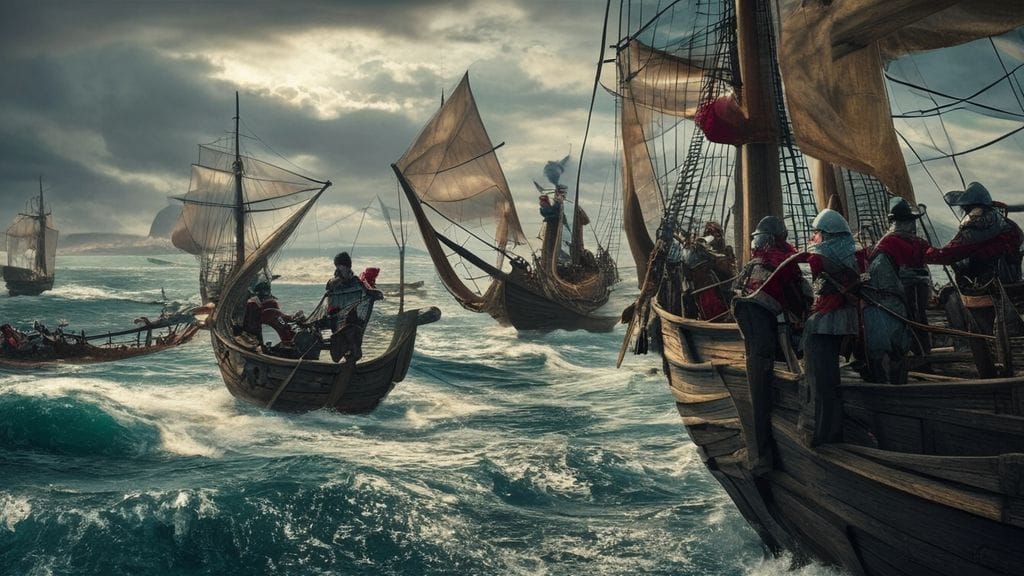
When the fleets collided off La Rochelle, the battle descended into a chaos that chroniclers struggled to describe. Medieval naval warfare was, by and large, an extension of land combat onto an unpredictable surface. Ships were platforms from which men fought with bows, crossbows, spears, and swords. The goal was often to grapple and board, turning a clash of fleets into a series of desperate melees on crowded decks.
Castilian ships, built with boarding combat in mind, drove hard into the English line. Grappling hooks flew through the air, clanging against railings until they found purchase. Ropes were hauled taut, drawing ships together. Wooden hulls groaned and shuddered on impact, men stumbling as deck planks lurched beneath them. From above, crossbow bolts rained down. Castilian and allied crossbowmen, taking advantage of the higher forecastles of their ships, sent volleys into the cramped ranks of English defenders.
English archers answered with arrows wherever they could find a clear shot, but they were fighting uphill, as it were. Their bows were powerful, and a well-placed shaft could still pierce mail or slip between armor plates. Yet the rocking of the water, the press of bodies, and the unfavorable angles dulled the usual terror of the English arrow storm. Many shafts shattered against bulwarks or glanced off helms and shields that would have been more exposed on flat ground.
As ship after ship was grappled, the fight shifted decisively to hand-to-hand combat. Men swung from one vessel to another, clambering over railings, hacking with swords and axes, thrusting with spears. The air was full of the clang of steel, the crack of breaking wood, the screams of the wounded, and the shouted commands of officers trying desperately to impose order. Blood and seawater mixed on the decks, making footing treacherous. More than one man, mortally wounded, slid overboard into the cold green depths without even a chance to cry out.
In some instances, Castilian ships rammed English vessels hard enough to stove in planking or dismount masts, leaving the English ships crippled, drifting hazards. Others maneuvered to pour firepots and incendiaries into enemy ships, igniting sails or causing intense localized blazes that forced defenders to abandon positions. While the exact balance of fire used remains debated, there is little question that fear of flames at sea haunted every participant. A burning ship at sea is a floating deathtrap; men caught between fire and water had no good choices.
The battle of La Rochelle raged for hours. Momentum built slowly, ship by ship, deck by deck. Where the English briefly gained an advantage on one vessel, another succumbed to overwhelming boarding parties only a few hundred yards away. The Castilian fleet’s professional cohesion and superior positioning, coupled with the environmental edge of wind and tide, gradually transformed local successes into an overall pattern of English disintegration. Each captured or destroyed English ship weakened the line further, giving Boccanegra more room to press his advantage.
Courage and Catastrophe: The English Commanders’ Last Stand
In the center of this rolling chaos, the English leaders fought with a desperation that later chroniclers would recount with a mixture of admiration and sorrow. John Hastings, Earl of Pembroke, was at the heart of the struggle. His flagship became a magnet for attacks, as Castilian captains recognized that bringing down the command vessel could shatter what remained of English resistance. Pembroke, like many English nobles, had been raised in a culture that prized personal valor in combat. To flee too soon, or to surrender lightly, would stain his honor.
According to several accounts, Pembroke and his household knights fought tooth and nail as Castilian troops swarmed onto their ship. Surrounded, outnumbered, they formed tight defensive knots, using shields, armor, and sheer discipline to hold back repeated assaults. The treasure aboard the flagship may well have added to the ferocity of the fighting; both sides knew what was at stake, not only symbolically, but in hard currency.
Yet bravery could not indefinitely compensate for the structural disadvantages the English faced that day. Nearby English ships were themselves hard-pressed, immobilized by grappling lines or broken masts, unable to come effectively to Pembroke’s aid. The sea offered no secure flank, no easy retreat. Every possible avenue of escape was clogged with hostile hulls or treacherous shallows. The battle of La Rochelle had become not just a contest of arms, but a killing ground from which there was little hope of withdrawal.
At last, Pembroke was overwhelmed. Bleeding and exhausted, he was taken prisoner rather than slain, a valuable prize for his captors. Other nobles and knights were less fortunate, cut down where they stood or pushed overboard in the crush of combat. The capture of so many high-ranking English figures amplified the psychological impact of the defeat. News of their fate would reverberate back to England like a funeral bell.
English common soldiers and sailors, too, paid a terrible price. Many had gone to sea under coercion or economic necessity, not out of any particular zeal for territorial politics. In the savage intimacy of shipboard combat, they met enemies whose languages and motives might have been mysterious to them. Like so many in medieval wars, they served as the expendable currency of dynastic ambition. Their courage, often recorded only in numbers of dead or captured, was nonetheless real. They fought, bled, and died in cramped spaces that left little room for heroism’s grand gestures, only for stubborn, desperate survival.
Shipwrecked Pride: Captives, Corpses, and the Silent Bay
By the time the sun had climbed higher on that June day, the outcome was beyond doubt. The English convoy was shattered. Many ships had been captured intact, their crews killed, wounded, or taken prisoner. Others were sinking or already submerged, their masts slipping beneath the surface as if swallowed by the sea itself. Wreckage drifted across the bay: broken spars, splintered planks, torn rigging, and the occasional, horrifyingly still body.
The Castilian and allied victors moved quickly to secure their gains. Prisoners of high rank were separated out, their armor stripped, their identities confirmed. They would fetch ransoms commensurate with their status, feeding the economies of war on both sides. Lesser prisoners might be held for more modest payments, pressed into service, or, in some cases, simply discarded. In an age when the laws of war were unevenly observed at best, their fate depended heavily on the discipline and mood of their captors.
For the people of La Rochelle, the immediate aftermath was a mixture of relief, horror, and opportunity. From the walls and docks, they could see the sodden evidence of battle washing ashore. Some rushed to aid survivors clinging to bits of wreckage or staggering onto the beaches. Others eyed the flotsam for salvageable goods: barrels, planks, tools, and perhaps the occasional personal item that could be quietly appropriated. The sea, indifferent to human politics, distributed its spoils without regard to who had planned the battle.
The smell of death soon hung over the region. Corpses bobbed in the shallows or were cast up on remote stretches of shoreline, discovered days later by shepherds or wandering children. Burials were hurried and practical; mass graves were not uncommon in the wake of major naval engagements. Yet even as decay set in, the living continued their routines. Fishermen mended nets, merchants tallied accounts, shipwrights assessed damage to any local vessels that had been involved or threatened.
In the cold arithmetic of war, the battle of La Rochelle was an astonishing bargain for France and Castile. For the price of outfitting and supporting Boccanegra’s fleet, they had destroyed an English convoy worth many times as much in material and political capital. The treasure chests intended for English garrisons now lay in enemy hands. Strategic calculations that had stretched ambitiously from Westminster to Bordeaux were suddenly in ruins, as drowned as the men who had been meant to enact them.
Voices from the Waves: Chroniclers, Myths, and Disputed Memories
In the months and years that followed, the battle of La Rochelle entered the written record through the pens of chroniclers, clerks, and poets. Their accounts, while invaluable, were shaped by their own loyalties and limitations. Among the most famous sources for this period is Jean Froissart, whose sprawling chronicle sought to capture the breadth of the Hundred Years’ War. Froissart, a cleric with aristocratic patrons, wrote with an eye for drama and chivalric color, sometimes at the expense of strict accuracy.
Froissart’s description of La Rochelle emphasizes the bravery of English nobles and the cunning of their enemies, fitting the battle neatly into his broader narrative of fluctuating fortunes in war. He presents the naval defeat as a painful but almost inevitable swing of the pendulum, a counterpoint to earlier English triumphs. Modern historians have compared his account to other, less well-known sources, teasing out contradictions and uncertainties. For example, details of the exact numbers of ships involved, or the precise sequence of events in the melee, vary from one writer to another.
One of the persistent themes in the sources is the shock experienced in England upon learning of the defeat. The notion that English fleets could be decisively beaten at sea by Castilian ships was galling to national pride. Some English commentators, consciously or not, minimized the scale of the disaster, or blamed it on bad luck, treachery, or the inexperience of particular commanders. Others, more clear-eyed, recognized that their maritime enemies had outclassed them in planning and execution.
Myths and exaggerations also crept in over time. Stories circulated of miraculous survivals, of men clinging to floating chests of treasure for days, or of sudden squalls interpreted as divine intervention on one side or the other. In a deeply religious age, defeat and victory were never purely the result of human decisions; they were also read as signals from God. A crushing setback like La Rochelle naturally prompted English moralists to question the sins of the nation, while French and Castilian voices framed their success as a sign of divine favor for their cause.
Later historians, writing with the benefit of hindsight and broader archival research, have reframed the battle as part of a larger transformation in naval warfare. As one modern scholar succinctly put it, “La Rochelle was less a freak catastrophe than a symptom of a shifting maritime balance.” That interpretation, echoing the work of twentieth-century naval historians, invites us to see the battle not as an isolated drama of courage and catastrophe, but as one of several turning points in the long contest for control of the seas between evolving European states.
Aftermath in London and Paris: Shock, Strategy, and Spin
News of the defeat crept back to England slowly at first, borne by survivors and intercepted letters, then with an avalanche of rumors and official confirmations. In London, the reaction was a mixture of disbelief and alarm. The loss of ships, men, and treasure off La Rochelle struck at the heart of English strategy in France. Edward III’s government had counted on that convoy to stabilize the situation in the southwest. Instead, they found themselves facing not only the immediate loss, but the broader implications of a hostile power now clearly dominant along the Bay of Biscay.
Council meetings grew tense. Advisors debated how best to respond. Some argued for a renewed effort at sea, an attempt to restore deterrence through another major fleet, despite the financial strain. Others counseled caution, pointing out that the realm was already heavily taxed, that the Black Death’s demographic shock still lingered, and that reopening old wounds with even larger levies could provoke unrest. Parliament, increasingly assertive in financial matters, had to be persuaded that new funds spent on naval ventures would not simply be swallowed by the waves as at La Rochelle.
Across the Channel, the mood in Paris was very different. Charles V and his circle received news of Boccanegra’s triumph with satisfaction and a sense of vindication. Their long investment in building alliances and avoiding risky land battles had paid off handsomely. The defeat of an English naval expedition off La Rochelle confirmed the effectiveness of their new approach to the war. French propaganda, subtle as it often was, did not hesitate to emphasize this point. The image of English power had been punctured, and that mattered almost as much as the material outcome.
For Henry II of Castile, word of the victory was equally welcome. It reinforced his legitimacy as a king capable of influencing affairs beyond the Iberian Peninsula, and it demonstrated to his own subjects and rivals that Castile could shape the destiny of the wider Atlantic arena. Rewards and honors for Boccanegra and his men signaled the high value placed on their achievement. In both Paris and Castile, the battle of La Rochelle became a symbol of a new era, one in which England would have to share or even surrender its claims to maritime predominance.
Yet behind the celebrations in France and Castile, there was also a sober recognition that the war was far from over. England was wounded, but not destroyed. Its capacity to build ships and raise armies remained considerable, even if strained. The victory at La Rochelle had to be translated into lasting strategic gains. For Charles V, that meant tightening the noose around English-held enclaves in France, continuing to isolate them by land and sea until they could be retaken piecemeal. For Henry II, it meant preserving and enhancing Castile’s naval capabilities so they could be called upon again when needed.
A Turning Tide in the Hundred Years’ War
When historians call the battle of La Rochelle a turning point, they do not mean that it instantly decided the outcome of the Hundred Years’ War. The conflict would grind on for decades more, through shifting alliances, new campaigns, and intermittent truces. But La Rochelle did mark a decisive change in the strategic environment in which both sides operated. It was a clear, undeniable reminder that control of the sea could no longer be taken for granted by England, and that France, with the help of allies like Castile, could challenge English movements far from any battlefield.
In the years that followed, Charles V exploited this naval shift with care. English garrisons in western France found themselves increasingly isolated, their resupply efforts harassed or intercepted. Without regular reinforcement and payment, local support for English authority eroded. Towns once loyal to England began to reconsider their options, weighing the practical benefits of aligning with a resurgent French crown whose armies and bureaucrats were steadily reclaiming lost ground.
La Rochelle’s role in this process was emblematic. The city and its surrounding region entered more firmly into the French sphere as English ability to project power from across the Channel diminished. While control of the city would still be contested in various ways in subsequent years, the defeat of 1372 made it clear that England could not simply sail in whenever it wished with an overwhelming convoy and reshape the political map. The psychological barrier had been broken.
On a broader level, the battle influenced English strategic thinking. Although institutional inertia and financial constraints limited how quickly England could reform its navy, the shock of La Rochelle highlighted the need for more permanent, professional naval forces and better understanding of Atlantic conditions. The lesson would not fully bear fruit until much later centuries, but a seed had been planted: ruling the waves required more than pressing merchantmen into temporary service and relying on the memory of old victories.
For France and Castile, the victory reinforced the value of cooperation and of combining complementary strengths. France’s resources and political will, coupled with Castile’s seafaring expertise and ships, had produced a result that neither might have achieved as easily alone. This model of coalition warfare at sea foreshadowed patterns that would become common in early modern European conflicts, as states realized that alliances could project power far beyond their own coastlines.
Merchants, Mariners, and Refugees: Human Lives Reshaped by Defeat
Beyond kings and chronicles, the battle of La Rochelle reshaped countless ordinary lives in ways both immediate and enduring. For merchants, the loss of a major English convoy was a financial earthquake. Invested cargoes vanished, expected payments failed to arrive, and insurers—or their medieval equivalents in the form of risk-sharing partnerships—confronted ruinous claims. Some families that had staked their fortunes on the safe arrival of that fleet found themselves bankrupt almost overnight.
Mariners who survived the battle faced uncertain futures. Captured English sailors might be held in coastal fortresses or in makeshift prisons in Castilian ports, awaiting ransom that might never come. Those who escaped or were released returned to communities where their tales of defeat were met with a mixture of sympathy, suspicion, and fear. Who had failed whom? Were the commanders incompetent, the ships unseaworthy, or had God simply turned his face away from England that day?
In and around La Rochelle, the human repercussions were equally complex. Some locals who had provided quiet assistance to French or Castilian efforts found their fortunes rising with the new order. Others, who had bet heavily on English protection, saw debts go unpaid or social standing diminish. The harbor, once a relatively neutral space of trade, became more closely associated with French and allied power, influencing who dared to dock there and under what terms.
Refugees, too, were a recurring feature of this time. Families connected to English administration or military structures in the region sometimes chose to flee rather than risk the slow tightening of French control. They boarded ships—when they could find them—bound for England or for other English-held territories, bringing with them stories of lost vineyards, confiscated warehouses, and broken oaths. For every noble household that relocated to the relative safety of England, many more modest folk tried desperately to adapt in place, changing allegiances or identities as circumstances demanded.
It is easy, in reviewing grand battles, to focus on commanders and campaigns. Yet the true measure of an event like the battle of La Rochelle lies also in these quieter, scattered stories: a widow in Southampton who never receives word of her husband’s fate; a La Rochelle dockworker who suddenly has more work salvaging and refitting captured vessels; a Gascon vintner who must renegotiate contracts under a new political regime. History’s tides, like the sea’s, lift some and drown others, often with little regard for their virtue or vice.
The Long Legacy of La Rochelle in Naval Warfare
In the longer arc of naval history, the battle of La Rochelle stands as an early marker of changing practices and priorities. It highlighted the importance of specialized warships and professional crews in an age when many states still relied heavily on requisitioned merchant vessels. Castile’s success demonstrated that mastery of the sea required more than occasional mobilization; it demanded continual investment in shipbuilding, training, and tactical innovation.
La Rochelle also underscored the role that environmental factors could play in naval engagements. While every sailor knows that wind and tide matter, Boccanegra’s exploitation of those conditions against the English convoy showed how they could be integrated into strategic planning, not merely endured as unavoidable constraints. Future admirals, reading accounts of the battle, could not miss the lesson: choose your ground—or your water—carefully, and let nature fight on your side whenever possible.
The psychological impact on England’s naval self-image was subtle but lasting. Although centuries would pass before England emerged again as a renowned maritime hegemon, the memory of early defeats like La Rochelle coexisted with later triumphs, reminding planners and commentators that dominance at sea was never guaranteed. As naval historian N. A. M. Rodger later observed in a broader context, sea power is as much about sustained systems of logistics, finance, and policy as it is about individual battles; La Rochelle was a vivid early example of what happens when those systems are outmatched.
On the French side, the battle reinforced the rationality of Charles V’s strategic shift. By investing in allies and indirect methods of undermining English power, he helped inaugurate a more modern style of warfare that blurred the lines between theaters. What happened off La Rochelle’s coast affected campaign possibilities hundreds of miles inland. Supply lines, morale, political bargaining positions — all were touched by the fate of wooden hulls and the men who fought upon them.
As for Castile, La Rochelle contributed to a tradition of Atlantic enterprise that would, in later centuries, feed into Iberian oceanic expansion. While there is no straight line from Boccanegra’s victory to Columbus’s voyages or to the great armadas of the sixteenth century, the competence and confidence displayed in 1372 formed part of the maritime culture upon which those later endeavors were built. The Bay of Biscay, once seen by many northerners as a dangerous backwater, was revealed as a crucible in which future Atlantic powers were tempered.
La Rochelle Remembered: From Medieval Harbor to Modern Memory
Today, visitors to La Rochelle see a charming port city with well-preserved towers guarding the entrance to its old harbor. Cafés line the quays where once soldiers and sailors jostled for space. Pleasure boats bob where warships once gathered, and tourist guides recount tales of Huguenot sieges and early modern fortifications. The medieval battle of 1372 is less immediately visible, its traces worn away by time and by the more recent layers of history that have settled upon the city.
Yet the memory lingers, if one knows where to look. Maritime museums and local historians occasionally bring the battle of La Rochelle back into focus, reminding audiences that the city’s story as a “border of the sea” long predates the age of cannons and colonial trade. Models of medieval ships, reconstructed from archaeological and textual evidence, give a sense of the cramped, precarious worlds in which fourteenth-century sailors lived and fought. Plaques, exhibits, and scholarly works, though sometimes overshadowed by later events, ensure that 1372 is not entirely forgotten.
For the broader public, however, the Hundred Years’ War tends to conjure up images of land battles like Agincourt or of iconic figures such as Joan of Arc. Naval engagements like La Rochelle often remain in the shadows, despite their significant impact. This imbalance in popular memory is understandable; field battles lend themselves more easily to heroic narratives and vivid imagery. Ships at sea, their struggles half-hidden by distance and spray, are harder to romanticize, even though their consequences can be equally decisive.
Modern scholarship has helped rebalance this picture. Through painstaking work in archives across Europe, historians have reconstructed the logistical and diplomatic context of the battle, as well as its tactical details. They have drawn attention to the multinational character of medieval naval warfare, with crews and commanders crossing linguistic and cultural boundaries in pursuit of royal or personal gain. The battle of La Rochelle appears in these studies as a richly complex episode, one that defies simplistic tales of “English versus French” and instead reveals a dense web of alliances, rivalries, and evolving techniques.
Standing on the quays of La Rochelle at sunset, watching the modern harbor quiet as lights flicker on in the old stone towers, one can almost imagine the ghostly silhouettes of fourteenth-century ships assembling offshore. The cries of vendors and tourists echo faintly the shouts of sailors long dead. The city’s beauty today does not erase its martial past; rather, it frames it, showing how places scarred by conflict can, over centuries, transform into spaces of leisure and reflection. Yet beneath the calm surface, the memory of 21 June 1372 still stirs, a reminder that even peaceful harbors have known days when the sea itself seemed to burn.
Conclusion
The battle of La Rochelle, fought off the French Atlantic coast on 21 June 1372, was more than a violent collision of wood and steel; it was a moment when the deep currents of medieval politics, economics, and technology briefly surfaced in plain view. Born from England’s determination to sustain its continental empire, from France’s quiet strategic revolution under Charles V, and from Castile’s emergence as a formidable naval power, the engagement condensed decades of tension into a few hours of ferocious combat. The English convoy, heavy with treasure and expectation, found itself trapped by adverse wind and tide, then systematically dismantled by a professionalized enemy fleet that understood the sea in ways England had not yet fully mastered.
In the short term, the defeat removed men, money, and matériel from England’s arsenal, weakened its grip on western France, and emboldened its enemies. In the longer term, it altered perceptions of maritime power, illustrating that control of the seas required continuous, specialized investment and international collaboration—not just memories of earlier victories. The repercussions rippled through the lives of merchants, sailors, townsfolk, and nobles, reshaping fortunes and loyalties from La Rochelle’s quays to the royal courts of London, Paris, and Castile.
Remembered in chronicles, reinterpreted by modern historians, and faintly echoed in today’s tranquil harbor, the battle of La Rochelle stands as a testament to the ways in which the ocean has always been more than empty space between lands. It is a contested arena, a pathway for goods and ideas, and at times a battlefield where the fate of empires is decided. In that sense, the events of 1372 belong not only to the medieval past but also to the enduring story of how sea power shapes the world. To look back on that day is to be reminded that much of human history has been written not only on fields and in cities, but also on the restless, unforgiving face of the waters.
FAQs
- What was the Battle of La Rochelle?
The Battle of La Rochelle was a major naval engagement fought on 21 June 1372 off the port of La Rochelle in western France during the Hundred Years’ War. A Castilian fleet allied with France decisively defeated an English convoy commanded by John Hastings, Earl of Pembroke, capturing or destroying many ships and seizing a large amount of treasure intended to support English forces in France. - Why did the Battle of La Rochelle occur?
The battle occurred because England sought to reinforce and resupply its possessions in western France, while France, allied with Castile, aimed to cut those sea lines of communication. Charles V of France and Henry II of Castile coordinated their efforts, dispatching Admiral Ambrosio Boccanegra to intercept the English convoy near La Rochelle, a strategically significant Atlantic port. - Who commanded the fleets at the Battle of La Rochelle?
The English convoy was commanded by John Hastings, Earl of Pembroke, supported by various naval captains in charge of the individual ships. The opposing fleet was led by Ambrosio Boccanegra, a Castilian admiral of Genoese origin, serving King Henry II of Castile in close alliance with the French crown. - What were the main reasons for the English defeat?
The English were defeated due to a combination of factors: they relied heavily on converted merchant ships rather than purpose-built warships, they were caught in an unfavorable position by wind and tide, and they faced a highly professional, tactically adept Castilian fleet. The English advantage in longbowmen was blunted at sea, while Castilian crossbowmen and boarding tactics proved devastating in close combat. - How did the Battle of La Rochelle affect the Hundred Years’ War?
The defeat weakened England’s ability to sustain its garrisons and allies in western France, contributing to a broader French reconquest under Charles V. It demonstrated that England could no longer assume naval superiority in the Atlantic, complicating its continental strategy. In the longer term, it encouraged both sides to take naval logistics and professional fleets more seriously as central elements of warfare. - What happened to the Earl of Pembroke and other English leaders?
The Earl of Pembroke was captured during the battle after a fierce defense of his flagship. Many other English nobles and knights were also taken prisoner and later ransomed, while numerous common soldiers and sailors were killed or drowned. The capture of so many high-ranking figures magnified the political impact of the defeat in England. - Why is the Battle of La Rochelle historically significant?
The battle is historically significant because it marked a clear shift in maritime power during the Hundred Years’ War, showcasing the effectiveness of Franco-Castilian naval cooperation and highlighting the growing importance of specialized fleets and Atlantic seamanship. It undermined English confidence at sea and helped set the stage for France’s gradual recovery of territories lost earlier in the war. - Can the Battle of La Rochelle be visited today as a historic site?
While the battle itself took place offshore, visitors to La Rochelle can explore the historic harbor, including its medieval towers and waterfront, which formed the backdrop to the events of 1372. Museums and local historical resources offer context about the city’s maritime past, though many visible fortifications date from later periods, especially the early modern era.
External Resource
Internal Link
Other Resources
- Encyclopaedia Britannica – general search for the exact subject
- Google Scholar – academic search for the exact subject
- Internet Archive – digital library search for the exact subject

