Table of Contents
- The Calm Before the Storm: Byzantium on the Eve of Manzikert
- Ambitions and Anxieties: The Seljuk Turks and Their Rise
- Emperor Romanos IV Diogenes: The Reluctant Warrior
- The March to Manzikert: Preparing for Confrontation
- August 26, 1071: Dawn of the Decisive Battle
- Battlefield Chaos: The Crumbling Byzantine Lines
- The Role of Treachery: Betrayal Within the Byzantine Ranks
- Alp Arslan’s Masterstroke: The Seljuk Victory Sealed
- The Capture of Romanos IV: A Life in the Balance
- Aftermath in Manzikert: Immediate Consequences for Byzantium
- The Ripple Effect: How Manzikert Shook Anatolia and Beyond
- The Beginning of the End: Political Turmoil and Fragmentation
- Anatolia’s Transformation: From Byzantine Heartland to Turkish Domain
- Crusades and the Shifting Balance of Power
- Manzikert in Memory: Legends, Myths, and Historical Reinterpretations
- Lessons from Manzikert: Military, Political, and Cultural Insights
- The Lasting Legacy in Modern Turkey and Byzantine Studies
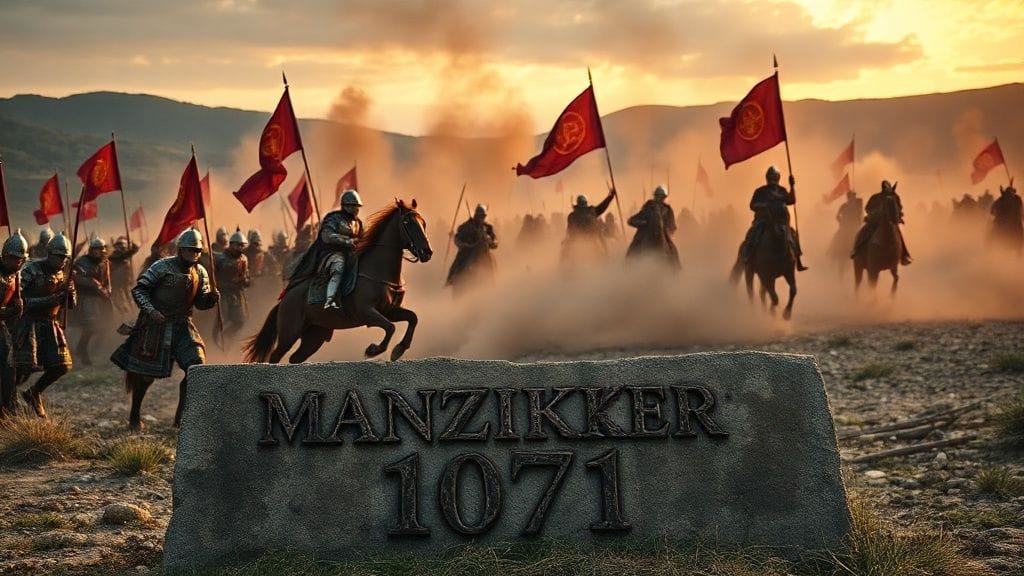
The sun rose heavily over the rugged Anatolian plateau on the morning of August 26, 1071. An uneasy silence stretched beyond the camps of two titanic armies facing each other—on one side, the proud and stretched-thin Byzantine forces under Emperor Romanos IV Diogenes, veterans of countless campaigns but wearied by decades of internal strife and external threats. Opposing them stood the agile, fiercely determined Seljuk Turks under their sultan, Alp Arslan, heirs to a rapidly rising power that thirsted for land and dominion. The air was electric with anticipation and dread, the ground soon to be soaked in blood and history. The Battle of Manzikert was about to begin—and with it, a turning point that would redefine the fate of empires.
The Calm Before the Storm: Byzantium on the Eve of Manzikert
By mid-11th century, the Byzantine Empire was a colossus stretched perilously thin. Having enjoyed centuries as the eastern bastion of Roman civilization, its vast territories included parts of the Balkans, the Levant, and Anatolia—the empire’s vital breadbasket and defensive frontier. Yet internal decay gnawed at its core. Political intrigue, court factions, and military revolts had eroded the authority of emperors. At the same time, the empire faced escalating pressure from new and formidable enemies on its eastern borders.
Anatolia was key: fertile, populous, and strategically vital, it was the empire’s shield and spear. However, the region was under constant strain from nomadic Turkic groups who had begun to drift steadily westward from Central Asia into the Muslim Middle East, and increasingly into Byzantine lands. The empire had learned to manage these incursions through diplomacy and warfare, but cracks had begun to show.
Enter Romanos IV Diogenes, a warrior emperor, determined to halt the empire’s slow decline. Elevated to the throne in 1068, he dreamt of reclaiming lost honor and territory. But his ambitions faced stiff challenges—not just from the Seljuk Turks but from within his own court, where powerful families and factions hesitated to support his efforts fully.
Ambitions and Anxieties: The Seljuk Turks and Their Rise
The Seljuks were a Turkic people who emerged from the steppes, united under the leadership of the dynamic Alp Arslan, meaning “Heroic Lion.” Their rapid expansion during the mid-11th century was nothing short of remarkable. They had carved out vast territories in Persia and Mesopotamia, challenging long-standing Islamic dynasties, and now set their sights on the richest prize of all—Anatolia.
The Seljuk Turks brought with them not only martial prowess but also a new political vision. They were adept horse archers, masters of hit-and-run tactics, and had embraced Sunni Islam, which gave them both ideological zeal and legitimacy in the Muslim world. Their raids into Byzantine lands had grown bolder, and while Byzantium still boasted heavily armored cataphracts—its elite cavalry—the rapidly mobile Seljuk forces were becoming increasingly hard to counter.
The stage was set for a collision—a test of two civilizations, military doctrines, and empires on the brink of transformation.
Emperor Romanos IV Diogenes: The Reluctant Warrior
Romanos IV was not a born emperor but earned his crown through marriage and his military credentials. He was a man of courage and resolve, known for his battlefield leadership and desire to restore order to a fractious empire. Yet his reign was marred by political opposition from powerful Byzantine aristocrats, who chafed under his strong-handed efforts at reform and military campaigns.
Aware that the Seljuk threat was existential, Romanos marshaled a sizeable army in 1071, estimated by contemporary and modern sources to be around 30,000 men, including Byzantine troops and allied contingents from Armenian and Georgian forces. His goal was to push back Seljuk incursions, secure the eastern frontier, and reassert imperial dominance in Anatolia.
But the emperor’s challenges were manifold. His army was diverse, composed of different ethnic groups with varying loyalties. Worse still, internal disunity and rivalries among the commanders would soon undermine his campaign.
The March to Manzikert: Preparing for Confrontation
Romanos led his forces eastwards from the heart of Anatolia in late summer 1071, advancing cautiously. The campaign was carefully planned at first—careful reconnaissance, securing supply lines, and gathering intelligence on the Seljuk movements. Manzikert, a fortress town perched strategically near the upper Euphrates, became the focal point.
Alp Arslan, having anticipated this offensive, moved rapidly from his capital in Persia with a mobile force, keen to confront the Byzantines before they could consolidate gains. His strategy was classic steppe warfare—avoid direct entanglement until conditions favored swift, devastating strikes.
The two armies eventually converged near Manzikert. Romanos set camp, confident in his superior numbers and the strength of his heavy cavalry. Alp Arslan, aware that outright victory depended on exploiting Byzantine weaknesses, prepared his forces with cunning patience.
August 26, 1071: Dawn of the Decisive Battle
The day began under a hot Anatolian sun. Byzantine scouts reported fragmented enemy sightings but the terrain was difficult—a mix of hills, marshes, and open plains that suited the Seljuks’ mobile cavalry but challenged the Byzantines' slower infantry and heavy horse.
The battle commenced with a series of skirmishes and probing attacks by the Seljuk horse archers, who pelted Byzantine lines with endless volleys of arrows. Romanos ordered his elite cataphracts into action, aiming to break the elusive enemy lines. The clash was brutal and chaotic, with the two forces swirling in a deadly dance of charge and retreat.
But slowly, cracks appeared in the Byzantine formation. The infamous treachery of Andronikos Doukas, a powerful court noble commanding a reserve force, proved decisive—as Doukas withdrew his troops at a critical moment, the Byzantine right flank was exposed and morale collapsed.
Battlefield Chaos: The Crumbling Byzantine Lines
From order to disarray, the Byzantine army splintered. Communication faltered amidst the dust and screams. Romanos desperately tried to rally his men, but betrayal and exhaustion were overwhelming. The Seljuk tactics of encirclement and feigned withdrawal had fractured the imperial lines.
By noon, the Byzantines were in full retreat, many soldiers abandoning their posts. Alp Arslan seized the moment, his horsemen striking down fleeing soldiers and capturing banners. The battle, which had promised a potential Byzantine victory earlier that morning, turned into a humiliating rout.
The Role of Treachery: Betrayal Within the Byzantine Ranks
The story of the Battle of Manzikert would be incomplete without exploring the internal betrayals that hastened the empire’s downfall. Andronikos Doukas, son of the former emperor Constantine X, reportedly saw an opportunity to weaken Romanos and further his own family’s ambitions. By withdrawing his contingent—a move possibly prearranged or impulsive—he shattered the cohesion of the imperial army.
This act of treachery was pivotal. It signaled not only personal ambition but also the fracturing political landscape of Byzantium, where internal rivalries undermined collective strength. Romanos’s enemies in Constantinople would later capitalize on this defeat to depose and imprison him.
Alp Arslan’s Masterstroke: The Seljuk Victory Sealed
Alp Arslan displayed remarkable magnanimity following the battle. Instead of executing Romanos IV, he treated the captured emperor with respect, famously asking what treatment he wished to receive. Romanos requested mercy for his soldiers and safe conduct, to which Alp Arslan agreed.
This episode heightened the Seljuk reputation as formidable but honorable foes, and solidified Alp Arslan’s image as a wise ruler. The terms of Romanos’s release did little to restore Byzantine authority, however. The empire’s collapse in Anatolia was already inevitable.
The Capture of Romanos IV: A Life in the Balance
Romanos’s capture was a shock to the Byzantine Empire. Back in Constantinople, his enemies wasted no time. Upon his return, they arrested him, blinded him—a physical and symbolic act of brutal political vengeance—and eventually led to his death in captivity.
His fall illustrated the brutal nature of Byzantine politics and underscored how military defeat could become an imperial death sentence. More than a military loss, Manzikert became a marker of the empire’s internal weaknesses and waning influence.
Aftermath in Manzikert: Immediate Consequences for Byzantium
The immediate aftermath was catastrophic for Byzantine control over Anatolia. The military defeat plunged the empire into chaos. Many towns and fortresses quickly fell to the advancing Seljuks, encouraged by their victory.
Local populations, faced with threats and instability, sometimes chose accommodation with the new Turkish rulers. Byzantine administrative systems crumbled in the region, and the once impregnable eastern provinces became a patchwork of contested territories.
The Ripple Effect: How Manzikert Shook Anatolia and Beyond
Manzikert’s impact extended far beyond the battlefield. It marked the beginning of Turkic dominion over large parts of Anatolia, which would become the heartland of the emerging Islamic world in the centuries to come.
For Christian Europe and the Byzantine Empire, it was a wake-up call. The loss of Anatolia—both a source of manpower and wealth—weakened Byzantium drastically. This shift emboldened Muslim powers and alarmed Western Christendom, sowing seeds of what would culminate in the Crusades four decades later.
The Beginning of the End: Political Turmoil and Fragmentation
The battle accelerated Byzantium’s internal decline. Successions became violent, the empire’s once stable bureaucracy faltered, and military resources became scarce. Anatolia, previously the empire’s breadbasket, was now effectively lost.
The resultant political instability weakened Byzantium’s ability to resist future invasions and to project power. It also fomented divisions between the eastern and western Christian worlds, contributing to the rupture that would culminate in the Great Schism of 1054 and later tensions.
Anatolia’s Transformation: From Byzantine Heartland to Turkish Domain
In the century following Manzikert, waves of Turkish settlers, warriors, and administrators transformed Anatolia. Cities became centers of Islamic culture, trade, and learning under the Seljuks and later Ottoman Turks.
This transformation was profound and irreversible. What had been a bastion of Byzantine culture turned into a melting pot where East met West in new forms, languages evolved, and civilizations clashed in unexpected ways.
Crusades and the Shifting Balance of Power
The shock of Manzikert resonated deeply in Western Christendom. Pope Urban II was moved to call the First Crusade in 1095, partly to aid Byzantium and reclaim lost Christian lands from Muslim control.
Though the Crusades had complex and mixed outcomes, they were in many ways a direct consequence of the power vacuum Manzikert helped create. The battle’s legacy intertwined with one of medieval history’s grandest and bloodiest ventures.
Manzikert in Memory: Legends, Myths, and Historical Reinterpretations
Through centuries, Manzikert took on almost mythical qualities. For Turks, it is remembered as the great victory that opened the gates of Anatolia and led to the rise of an empire; for Greeks, a tragic reversal marking the start of decline.
Historians have debated Manzikert’s tactical and strategic details endlessly. Was the defeat inevitable? Was Romanos a hero betrayed? The battle’s story has been reshaped to serve various national narratives, reminding us how history is not only about facts but also memory and identity.
Lessons from Manzikert: Military, Political, and Cultural Insights
Manzikert teaches lessons still relevant: the dangers of internal division; the importance of cohesion and discipline in warfare; the impact of terrain and tactics.
It reveals the fragility of empires facing new threats and changing times, and how a single battle can echo through centuries to reshape peoples and states.
The Lasting Legacy in Modern Turkey and Byzantine Studies
Today, Manzikert holds a special place in Turkey’s national identity—a symbol of Turkic strength and perseverance. In Byzantine scholarship, it remains a subject of intrigue and reevaluation.
Excavations and studies continue to uncover fresh insights, allowing us to appreciate Manzikert not only as a military event but as a pivot on the great axis of medieval history.
Conclusion
Manzikert was more than a battle fought on an Anatolian plain; it was a moment when the tides of history converged to usher in a new era. For Byzantium, it was a profound loss, a shattering blow that exposed the empire’s internal fractures and set it on a path to decline. For the Seljuks and emerging Turkish powers, it was a herald of expansion, influence, and transformation.
But beyond armies and emperors, Manzikert reminds us that history is shaped by choices, by alliances fragile and fierce, by men who betray and those who rise. It is a testament to the power of human resolve and the unpredictable swirl of events that can change the world forever.
Standing here, tracing the echoes across centuries, one feels the weight of ambition and the cost of failure—and recognizes in Manzikert a story as alive today as it was on that scorching August day in 1071.
FAQs
Q1: What were the main causes that led to the Battle of Manzikert?
A1: The battle was precipitated by the Seljuk Turks’ steady expansion into Anatolia, threatening Byzantine territorial integrity. Byzantium's internal political divisions and military overstretch also made a decisive confrontation inevitable.
Q2: Who was Emperor Romanos IV Diogenes and what role did he play?
A2: Romanos IV was a military emperor determined to restore Byzantine control over Anatolia. He led the Byzantine army at Manzikert but was ultimately betrayed and captured, his defeat marking the end of his reign.
Q3: How did Alp Arslan manage to defeat a larger Byzantine force?
A3: Alp Arslan used superior mobility, effective horse archery tactics, and exploited dissent within the Byzantine ranks, especially the withdrawal of Doukas’s troops, turning the battle decisively in his favor.
Q4: What were the immediate consequences of the battle for Byzantium?
A4: Byzantium suffered massive territorial losses in Anatolia, political instability, and the eventual weakening of its military and economy, hastening the empire's decline.
Q5: Did the Battle of Manzikert lead directly to the Crusades?
A5: Indirectly, yes. The loss at Manzikert and the rise of Muslim powers in Anatolia alarmed Western Christendom, contributing to Pope Urban II's call for the First Crusade in 1095.
Q6: How is the battle remembered in modern Turkey?
A6: It is celebrated as a foundational victory symbolizing the Turkish entry into Anatolia, a key moment in the genesis of the Turkish nation and identity.
Q7: What role did internal Byzantine treachery play in the battle?
A7: Treachery was crucial; the withdrawal of Doukas’s troops at a critical juncture broke Byzantine cohesion and morale, tipping the scales in favor of the Seljuks.
Q8: How has modern historiography reevaluated the Battle of Manzikert?
A8: Recent scholarship has moved beyond simplistic narratives of inevitable Byzantine failure, focusing on complex political dynamics, military tactics, and the broader regional context.

