Table of Contents
- A Dawn Shrouded in Legend: The Battle of Mons Badonicus
- The Landscape of Post-Roman Britain: A World in Flux
- Who Were the Combatants? Romano-Britons and Anglo-Saxon Invaders
- The Collapse of Rome’s Western Bastion and Its Aftermath
- The Rise of Local Leadership amidst Chaos
- The Political and Social Fractures of Late 5th Century Britain
- Tensions Mount: The Anglo-Saxon Expansion into the West
- Mons Badonicus: The Defensive Stand of a People on the Brink
- The Battle Described Through Time: From Gildas to Geoffrey of Monmouth
- Myth and Reality: King Arthur’s Possible Role in Mons Badonicus
- The Strategic Elements of the Battle: Terrain, Tactics, and Triumph
- The Psychological Impact: A Morale Boost for the Romano-Britons
- Anglo-Saxon Retrenchment: A Generation of Halted Advance
- Legacy in Literature and Lore: Mons Badonicus as a Cultural Touchstone
- The Long Shadow of Mons Badonicus in British Memory
- The Archaeological Quest: Searching for the Battlefield
- How Mons Badonicus Shaped Early Medieval Britain
- The Battle’s Role in the Formation of British Identity
- Lessons from Mons Badonicus: Resistance and Resilience
- Conclusion
- Frequently Asked Questions
- External Resource
- Internal Link
1. A Dawn Shrouded in Legend: The Battle of Mons Badonicus
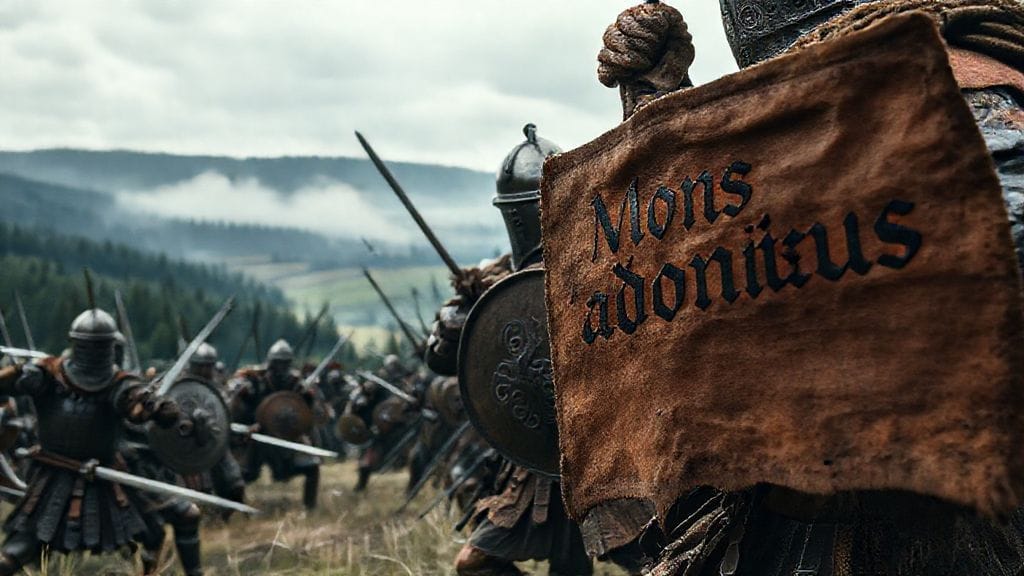
Imagine a misty morning on the rolling hills of southern Britain, somewhere in the late fifth century, a moment suspended between the twilight of the Roman Empire and the dawn of Anglo-Saxon dominance. The fog clings to twisted oaks and ancient stone, the air heavy with the tension of impending conflict. From one side, the last embers of Romano-British resistance assemble—warriors and farmers, their bonds forged in years of upheaval. Facing them, the relentless force of Anglo-Saxon warbands, hungry to claim territory and reshape the land’s future. This is Mons Badonicus, a battle that would become the fulcrum upon which the destiny of Britain teetered, its echoes resonating for centuries, veiled today in myth and mystery.
The Battle of Mons Badonicus, traditionally dated to the late 5th century, is more than an isolated clash; it is a symbol of resistance, an enigma of deep historical significance. It represents the final, decisive stand of the Romano-British peoples against the inexorable tide of Anglo-Saxon incursion. Yet, despite its legendary status, the battle remains elusive in the historical record—a dark well where fact and folklore entwine.
2. The Landscape of Post-Roman Britain: A World in Flux
To understand Mons Badonicus, one must first peer into the Britain of its time—a land unraveling from its Roman past. With Rome’s formal withdrawal around 410 CE, the British Isles were cast adrift, stripped of the imperial structure that had linked them to a vast Mediterranean world. Cities once bustling with Roman administration settled into quieter rhythms; villas and towns deteriorated; garrisons thinned or vanished. Without Rome’s legions and central authority, Britain fragmented into a mosaic of smaller, competing kingdoms and tribal lordships.
This was not a peaceful transition. Instead, it was a crucible of instability, where survival hinged on swift adaptation and fierce protection of dwindling resources. The native Britons, heirs to classical culture and Roman civic order, confronted an uncertain future facing new external enemies and their own internal divisions. In this chaotic swirl, the stage was set for a decisive confrontation.
3. Who Were the Combatants? Romano-Britons and Anglo-Saxon Invaders
On one side stood the Romano-Britons: descendants of the Romanized inhabitants, ranging from landed aristocrats to rural folk, carrying remnants of Roman military tradition, language, and Christian faith. They sought to defend their homes, culture, and remaining political autonomy. Command structures were fragmented, but local warlords and leaders emerged as champions of resistance.
Opposing them were the Anglo-Saxons, migrant peoples from the regions of modern northern Germany, Denmark, and the Netherlands. Their arrival was gradual but relentless: initially as mercenaries and settlers invited by the Britons themselves, before rapidly turning into invaders seeking land and control. Their arrival marked a cultural and linguistic rupture, as well as a military threat, for the native Britons.
4. The Collapse of Rome’s Western Bastion and Its Aftermath
Rome’s retreat from Britain was the unraveling of centuries of imperial governance. The legions’ departure meant no reinforcements, no centralized defense against barbarian incursions—just scattered local militias and warbands. Economically, the island’s sophisticated trade networks diminished; traditional connections to continental Europe faltered. Politically, power devolved to regional commanders, bishops, and tribal kings, turning Britain into a patchwork of competing fiefdoms, often distrustful of each other.
The vacuum created fertile ground for the Anglo-Saxon advances, which exploited the fragmentation and lack of unified resistance. The Anglo-Saxons brought new pagan beliefs and customs, challenging the Romano-British Christians. This shifting ideological, moral, and military landscape was ripe for a stand such as Mons Badonicus.
5. The Rise of Local Leadership amidst Chaos
In this fractured environment, traditional Roman structures no longer held sway. Yet, new leaders rose from the embers of the old world, individuals capable of rallying disparate groups. Their names drift through the historical haze: figures like Ambrosius Aurelianus, a Romano-British war leader celebrated by the monk Gildas; or the possibly legendary King Arthur, a warrior-king whose deeds became mythic.
These leaders became beacons of hope, rallying warriors across fragmented territories for a common cause: halting the relentless Anglo-Saxon advance and preserving their cultural legacy. Leadership in 5th century Britain meant not only martial skill but also diplomatic cunning and the ability to inspire amidst decline.
6. The Political and Social Fractures of Late 5th Century Britain
Beneath the military narrative, social upheaval roiled. The Roman social order, reliant on a complex network of patronage and urban privilege, frayed. Rural populations, increasingly isolated, depended on local lords for protection. Competing kingdoms jockeyed for power, forging unstable alliances and rivalries.
Christianity, which had taken root under Rome, added layers of tension. Bishops wielded significant influence, sometimes clashing with secular rulers, sometimes serving as unifying figures. The Anglo-Saxon paganism juxtaposed sharply with this established order, creating cultural fault lines. These fractures shaped how Mons Badonicus was fought and remembered.
7. Tensions Mount: The Anglo-Saxon Expansion into the West
By the later decades of the 5th century, the Anglo-Saxon presence had grown more aggressive and expansive. Early settlements in eastern Britain rapidly multiplied, and warbands scoured further westward. Their strategy was ruthless: swift raids, seizure of fertile lands, and establishing new centers of power.
This expansion threatened not only territorial control but cultural survival itself. The Romano-Britons faced loss of language, belief systems, and social order. As these incursions intensified, their leaders realized that piecemeal resistance was insufficient. A consolidated stand became imperative, setting the stage for Mons Badonicus.
8. Mons Badonicus: The Defensive Stand of a People on the Brink
The battle itself is shrouded by the mists of time, but it represents a pivotal moment of resistance. The Romano-Britons, led by an unknown but arguably charismatic figure—possibly Arthur or Ambrosius—consolidated forces on a strategic high ground: Mons Badonicus, literally “Mount Badon.” Choosing terrain that favored defense, the Britons prepared for the onslaught.
Accounts point to a fierce encounter, with substantial Anglo-Saxon losses and a rout that temporarily stalled their expansion. This victory was more than military; it was a psychological bolster for the Britons, a beacon in a dark era. The battle embodied the desperate struggle of a vanishing world.
9. The Battle Described Through Time: From Gildas to Geoffrey of Monmouth
Our sources are frustratingly sparse and fragmented. The earliest mention comes from Gildas, a 6th-century monk, who wrote of a great victory over the Saxons at “Mount Badon” without lavish detail. Later medieval chroniclers like Bede and the anonymous Historia Brittonum added layers, while Geoffrey of Monmouth’s 12th-century Historia Regum Britanniae gilded the tale with Arthurian legend, transforming the battle into a grand epic of knightly valor.
Each source, though colored by time and perspective, contributes to a tapestry of collective memory. The elusive nature of Mons Badonicus only deepens its allure, demanding historians sift between history and myth.
10. Myth and Reality: King Arthur’s Possible Role in Mons Badonicus
King Arthur’s association with Mons Badonicus is arguably the most enduring feature in British cultural memory. Though no contemporary account explicitly names Arthur, later medieval traditions paint him as the heroic commander of the battle. Was Arthur a real war leader, a composite figure, or purely legendary?
Modern scholarship remains divided. Some view Arthur as a symbol of native resilience and unity, a personification of brutal reality transformed into inspiring myth. Regardless, the confluence of Arthurian legend with Mons Badonicus enriches the narrative, reminding us how history blends with imagination to create meaning.
11. The Strategic Elements of the Battle: Terrain, Tactics, and Triumph
Strategically, Mons Badonicus was not simply a clash of armies but a choosing of battleground that favored the defenders. The elevated position offered visibility and natural defense. The Britons likely used infantry formations rooted in Roman practice and local warfare, ranging from shield walls to guerrilla tactics in terrain they knew well.
The Anglo-Saxons, accustomed to mobile, aggressive strikes, found themselves confronted by a well-prepared and determined enemy, undercutting their momentum. This tactical stalemate shifted the balance and checked their advance—at least for a time.
12. The Psychological Impact: A Morale Boost for the Romano-Britons
Victories are measured not only in territory gained or lost but in morale restored. Mons Badonicus instilled hope in a demoralized population, giving the Britannic peoples a collective narrative of triumph amidst adversity. As a rallying point, it explained survival and fostered cultural persistence.
This morale boost likely contributed to a generation-long pause in Anglo-Saxon expansion, allowing Romano-British culture and political entities to endure in the West and South-West of the island for decades more.
13. Anglo-Saxon Retrenchment: A Generation of Halted Advance
Following Mons Badonicus, the Anglo-Saxon invasion slowed markedly. Textual sources indicate a period—perhaps half a century—where expansion was checked or paused. This breathing space governed the map of Britain’s cultural geography well into the 6th century.
For the Anglo-Saxons, regrouping and consolidating became necessary. Yet, this pause preserved Romano-British enclaves where Celtic, Christian, and Roman traditions could evolve more distinctly before eventual absorption or transformation in later centuries.
14. Legacy in Literature and Lore: Mons Badonicus as a Cultural Touchstone
Mons Badonicus occupies a unique place in the British imagination. From its earliest mentions in early medieval texts to modern historical fiction and fantasy, it symbolizes the last stand of a fading world against transformative invaders. Its resonance is felt in Arthurian romances, nationalist narratives, and even popular culture today.
The battle’s lasting appeal lies in its narrative tension: a clash not only of armies but of epochs and identities. It reveals human yearning for heroes, survival, and the meaning of resistance.
15. The Long Shadow of Mons Badonicus in British Memory
Centuries after the battle, Mons Badonicus remains a potent symbol. It inspired medieval chronicles, Renaissance histories, and Victorian romanticism. Beyond literature, it has shaped academic debates, nationalist ideologies, and community memories across Britain.
The site itself remains unidentified, a mystery inviting debate and research. Whether a singular battlefield or a symbolic locus, Mons Badonicus endures as a testament to the fragility and determination of early medieval Britain.
16. The Archaeological Quest: Searching for the Battlefield
Archaeologists have long sought physical traces of Mons Badonicus. Proposed locations stretch from southern England’s chalk downs to Welsh hills and forested highlands. Excavations have uncovered evidence of settlements, fortifications, and occasional weapons, but no definitive battle site.
These challenges stem from the battle’s antiquity and sparse historical records. Yet, each discovery illuminates aspects of late Roman and early medieval Britain, enriching our understanding of the era’s complexity.
17. How Mons Badonicus Shaped Early Medieval Britain
Mons Badonicus was not the end but a turning point. Its successful defense preserved Romano-British enclaves where Roman traditions fused with Celtic cultures, influencing language, governance, and religion. The battle’s outcome shaped the political geography, contributing to the persistence of Brittonic kingdoms such as Dumnonia and Strathclyde.
This patchwork of resistance influenced subsequent Anglo-Saxon and later Norman relations, embedding itself within the layered history of the British Isles.
18. The Battle’s Role in the Formation of British Identity
Mons Badonicus contributed deeply to the evolving sense of Britishness. It represented more than tactical victory; it embodied the struggle to define identity amid transformation. The conflict between native Britons and Anglo-Saxon newcomers posed questions of belonging, culture, and power that resonate even today.
As a foundation myth, the battle offers an early narrative of a Britain that is both contested and intertwined, echoing contemporary dialogues on cultural heritage and historical memory.
19. Lessons from Mons Badonicus: Resistance and Resilience
In examining Mons Badonicus, we glimpse broader human themes: resilience against overwhelming forces, the costs of cultural survival, and the interplay of history and myth. The battle teaches that history is not merely recorded fact but lived experience shaped by hope, fear, and imagination.
The courage of those who fought on that misty hillside, whether mythic or real, continues to inspire discussions on identity, unity, and resistance to change.
Conclusion
The Battle of Mons Badonicus remains an evocative chapter in the story of Britain—an emblem of a people at a crossroads, caught between the fading world of Rome and the emerging order of Anglo-Saxon England. Despite shadows swallowed by time and legend, its impact is profound: a testament to fierce defense, cultural endurance, and the intoxicating power of myth.
Mons Badonicus resonates beyond the details of its occurrence because it touches on universal struggles—of identity, survival, and the shaping of history itself. It reminds us that history is not only about victors or vanquished but about the meaning we distill from their clash. Perhaps, in the fog of that ancient battlefield, lies the heart of Britain’s enduring spirit.
Frequently Asked Questions
Q1: When did the Battle of Mons Badonicus likely take place?
The battle is traditionally dated to the late 5th century, sometime between 490 and 520 CE, though exact dating remains uncertain due to sparse sources.
Q2: Who fought at Mons Badonicus?
The battle was between Romano-British forces—descendants of Romanized Britons—and invading Anglo-Saxon warbands from continental Europe.
Q3: Was King Arthur involved in this battle?
There is no contemporary evidence directly linking King Arthur to Mons Badonicus, but medieval tradition often associates him as the battle's heroic leader.
Q4: Why is Mons Badonicus considered important in British history?
It marks the last significant successful resistance by Romano-Britons against Anglo-Saxon expansion, leading to a pause in invasions and shaping early British kingdoms.
Q5: Where exactly did the battle take place?
The precise location of Mons Badonicus is unknown, with many proposed sites in southern Britain but no archaeological consensus.
Q6: What sources describe the battle?
Early accounts come from Gildas, with later chronicles such as Bede’s Ecclesiastical History, the Historia Brittonum, and Geoffrey of Monmouth's writings expanding the narrative.
Q7: How did the battle affect Anglo-Saxon expansion?
The battle halted Anglo-Saxon advances for several decades, allowing Romano-British cultures to persist longer in parts of Britain.
Q8: What is the legacy of Mons Badonicus today?
It lives on through literature, folklore, and historiography, symbolizing resistance and the blending of history with legend in Britain’s cultural memory.

