Table of Contents
- The Final Storm near Vesuvius: Setting the Stage for Mons Lactarius
- Italy on the Brink: The Ostrogothic Kingdom in Crisis
- Justinian’s Vision: The Campaign to Reclaim the West
- The War of Reconquest: From Rome to Ravenna
- Narses, the Imperial General: The Architect of Victory
- The Ostrogothic Leadership: Totila’s Death and Teia’s Rise
- The Aftermath of Bad Weather and Morale on Both Sides
- The Gathering Forces at Mons Lactarius
- The Landscape of Vesuvius: A Volcanic Theater of War
- The Opening Clashes: Strategy and Command Decisions
- The Battle Unfolds: A Clash of Steel and Will
- The Ostrogothic Last Stand: Tenacity Amidst Desperation
- The Fall of Teia: Death of a King and a Cause
- The Roman Victory and the End of the Gothic Resistance
- The Immediate Aftermath: Casualties and the Fate of Survivors
- The Political Consequences: The Reunification of Italy
- The Cultural Impact: Ostrogothic Legacy and Roman Revival
- Economic Reverberations: War’s Toll on Italy and Byzantium
- The Battle in Historical Memory and Chronicles
- Mons Lactarius and the Byzantine Empire: A New Chapter
- The Questions Left Behind: What If the Ostrogoths Had Won?
- Conclusion: The Human Echoes of a Final Stand
- FAQs on the Battle of Mons Lactarius
- External Resource
- Internal Link
The Final Storm near Vesuvius: Setting the Stage for Mons Lactarius
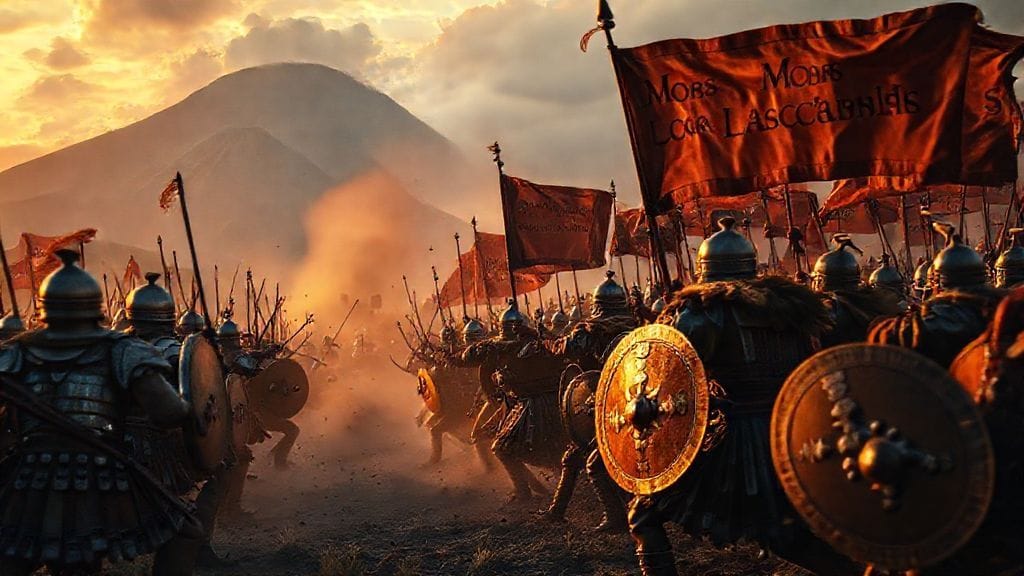
In the shadow of the ever-watchful Vesuvius, whose fiery peaks have witnessed centuries of human drama, a decisive conflict was about to write its last lines in the ancient sands of Italy. The year was 552 A.D., and the cold breath of winter sharpened the edges of men’s resolve as two worlds prepared to collide one final time. This was no mere skirmish—it was the culminating clash between the Ostrogoths, the last incarnations of barbarian kingship in Italy, and the resurgent Roman forces of Justinian’s Byzantine Empire. The Battle of Mons Lactarius would prove not just a contest of arms, but the death knell of Gothic independence and a turning point in the fate of the Italian peninsula.
The very air seemed tense that day; fog settled on the volcanic slopes with an oppressiveness that foreshadowed doom. Legends suggest that to the local farmers, the mountain itself mourned the inevitable end of an age. For the warriors, though, there were no pauses—only the deafening cadence of marching feet, the clink of armor, and the distant rumble of volcanic earth beneath them.
Italy on the Brink: The Ostrogothic Kingdom in Crisis
The Ostrogothic kingdom, once secure under the rule of Theodoric the Great, had suffered a slow but relentless decay under the weight of internal dissent and ever-pressing Byzantine aggression. By the mid-6th century, political fragmentation and dwindling resources had sapped the kingdom’s strength. After the death of Totila, the visionary warlord who rekindled Gothic hopes with daring campaigns, leadership fell to Teia, a warrior prince desperate to preserve what remained of his people's sovereignty.
Yet the scars of a decade-long war had marked the Italian landscape—towns burned, economies shattered, and populations displaced. Italian cities that had once flourished under Roman rule now bore the wounds of destruction and neglect. The Ostrogoths themselves were a mix of traditional warrior bands and native Italic populations, who often found themselves torn between allegiances.
Justinian’s Vision: The Campaign to Reclaim the West
Emperor Justinian I, ruling from Constantinople, saw Italy not just as a prize of war but as the symbolic heart of the Roman world. His ambitious vision to “restore the Roman Empire” drove his generals and legions to reclaim territory lost during the barbarian invasions of the 5th century. The Gothic War, which began in 535, was a brutal, drawn-out effort marked by sieges, famine, and complex diplomacy.
By 552, after years of costly engagements, Justinian placed his trust in the hands of Narses, a eunuch general renowned for his strategic genius and iron will. The imperial armies were battle-hardened yet weary. They marched southwards, through rugged landscapes and broken towns, to force the last stand of the Ostrogoths near the feared slopes of Mount Vesuvius.
The War of Reconquest: From Rome to Ravenna
The conflict had swung like a pendulum—victories and losses on both sides marked by fierce fighting and shifting alliances. After the fall of Rome in 540 to the Byzantines, the Gothic kings retreated to Ravenna, their stronghold in northeastern Italy. The siege of Ravenna was lengthy and devastating, but it culminated in the city’s capitulation, severely diminishing Gothic power.
Still, Gothic warriors under Teia refused to surrender, gathering the remnants of their forces around Mons Lactarius. They were fighting not just a military battle but a desperate plea for survival, dignity, and the hope that one last stand could turn the tide.
Narses, the Imperial General: The Architect of Victory
Narses was no ordinary commander. Despite the skepticism faced due to his status as a eunuch and former palace official, he commanded through sheer intellect, discipline, and innovative tactics. His leadership turned the tide of the war in Byzantium’s favor. He understood that to finish the Gothic threat, the battle had to be swift, decisive, and total.
His troops, a formidable mix of Byzantine infantry, cavalry (including famed Heruli and Lombard mercenaries), and seasoned veterans from the eastern front, took up position with the cold determination of men weary of years in battle. The victory at Mons Lactarius would cement Narses’s reputation as one of history’s great strategists.
The Ostrogothic Leadership: Totila’s Death and Teia’s Rise
The death of Totila in 552, killed in a skirmish near Faventia, was a blow from which the Goths never fully recovered. Totila had been gifted—both as a military commander and a leader beloved by his people. His death left a vacuum swiftly filled by Teia, a fierce but less politically adept warrior who could inspire fierce loyalty but struggled to unite the Gothic factions.
Teia’s decision to make a stand at Mons Lactarius was born out of necessity, yet it also carried a symbolic weight: it was the place where the Gothic kings, once lords of Italy, would either carve their final monument in history—or vanish into oblivion.
The Aftermath of Bad Weather and Morale on Both Sides
The campaign was fought under brutal conditions—a cold, wet season that chilled soldiers to the bone and added an unpredictable element to the battle. Reports speak of rain turning battlefields into mud, and the terrain near Vesuvius—with its volcanic ash and uneven slopes—challenging even the most seasoned troops.
Despite these hardships, morale on the Byzantine side was bolstered by reinforced supply lines and fresh troops, while Gothic morale was a fragile blend of hope and despair. The realization that this could be their final battle lent both sides a sense of fatalistic urgency.
The Gathering Forces at Mons Lactarius
The battlefield itself was chosen not at random. Mons Lactarius, on the southeastern slopes of Vesuvius, was a rugged terrain of volcanic hills and rocky outcrops—a natural fortress that could favor defenders. Teia’s forces assembled here, roughly estimated by ancient chroniclers at 10,000 warriors, determined to hold off what seemed an unstoppable force.
Narses, understanding the challenges of frontal assault in such conditions, prepared a combination of diversionary attacks and concentrated strikes—his troops deployed carefully among the twisted ridges and narrow passes.
The Landscape of Vesuvius: A Volcanic Theater of War
Vesuvius was more than a mere backdrop; its looming presence played a psychological role. For centuries, locals revered and feared the mountain, its sleeping fires a potent symbol of destruction and rebirth. The battle harnessed this duality—the fiery passions of men erupting in conflict under the watchful eye of a dormant god of destruction.
The battlefields were sharp and unforgiving—cliffs and slopes that hampered movement and magnified every tactical error. Soldiers fought not just each other but also against nature’s indifferent challenges.
The Opening Clashes: Strategy and Command Decisions
The battle commenced with both sides probing the enemy’s formations, looking to exploit weaknesses. Narses deployed his cavalry in swift, sweeping maneuvers designed to isolate Gothic detachments, while maintaining fortified infantry lines.
Teia responded with ferocity, ordering counterattacks in desperate attempts to break enemy cohesion. Yet, the exhaustion weighing on his men became apparent; they absorbed the blows but could not retaliate with the same vigor.
The Battle Unfolds: A Clash of Steel and Will
As the sun climbed higher, the intensity of combat escalated into a crescendo of swordplay, shield-bashing, and the cries of warriors locked in mortal combat. The battlefield was a chaotic theater where individual acts of heroism were swallowed by the vast machinery of war.
Eyewitness accounts, albeit sparse, speak of Gothic cavalry charges that pierced Byzantine lines, only to be repelled by coordinated volleys of arrows and disciplined infantry squares. The sense of a grinding, relentless struggle pervaded the day.
The Ostrogothic Last Stand: Tenacity Amidst Desperation
Despite being outnumbered and outmaneuvered, the Ostrogoths displayed tenacious resistance. One account tells of Teia rallying his men atop a rocky promontory, sword raised high, vowing to die rather than surrender their ancestral lands.
But as dusk neared, the tide turned unmistakably. Exhaustion drained the Gothic ranks, and fractures appeared in their battle lines. The legendary Gothic resilience, honed over centuries of warfare, could not withstand the strategic brilliance and superior logistics of Narses’s forces.
The Fall of Teia: Death of a King and a Cause
The death of Teia during the battle was both unsurprising and monumental. According to Procopius, the chronicler of Justinian’s wars, the Gothic king fell in combat, fighting at the forefront of his men. His death shattered the morale of the surviving Ostrogoths.
Without their leader, the remnants dispersed or surrendered. The battle was decisively over, marking an end to the Gothic dream of an independent Italy.
The Roman Victory and the End of the Gothic Resistance
Narses’s triumph at Mons Lactarius was not merely a battlefield success; it was the symbolic closing of a tumultuous era. The Ostrogothic kingdom, once a formidable force against Roman successor states, ceased to exist.
The victory allowed Byzantine control to reassert over the Italian peninsula, although this new dominion would be tested by Lombard invasions in the decades to follow.
The Immediate Aftermath: Casualties and the Fate of Survivors
The battle’s cost was heavy. Ancient sources, often vague, suggest thousands of casualties on both sides, with many survivors among the Goths taken prisoner or sent into obscurity. The land itself bore the scars—fields trampled by war and burnt villages mourning the loss of their defenders.
For the Byzantine Empire, the victory brought prestige but also the burden of governance over a restless, war-torn population.
The Political Consequences: The Reunification of Italy
With the Ostrogothic resistance crushed, Justinian’s dream of Roman restoration appeared realized. Italy was nominally reunited under Byzantine administration, its cities rebuilt and its aristocracy co-opted or displaced.
However, the years of conflict had left Italy weakened, vulnerable to new challenges. The fragile peace lasted only a few decades before new forces, such as the Lombards, began carving out their own new kingdoms.
The Cultural Impact: Ostrogothic Legacy and Roman Revival
Though militarily defeated, the Ostrogoths had left an indelible mark on Italy’s cultural landscape. Their fusion of Germanic warrior traditions with Roman institutions influenced local customs and governance.
Conversely, Byzantine policies sought to restore classical Roman grandeur through art, religion, and law, initiating a renaissance that would echo into the Middle Ages.
Economic Reverberations: War’s Toll on Italy and Byzantium
The prolonged war had devastated Italy’s economy. Fields lay fallow, trade routes disrupted, and urban centers depopulated. Byzantine resources—already stretched thin by wars in Persia and North Africa—were further burdened by the costs of occupation and reconstruction.
Yet, strategic control of Italy also promised long-term benefits, re-opening Mediterranean trade and strengthening the empire’s western frontier.
The Battle in Historical Memory and Chronicles
The Battle of Mons Lactarius occupies a somewhat shadowed place in historical memory—overshadowed by other great battles or lost in the grand narrative of Justinian's larger reconquests.
Yet, chroniclers like Procopius provide a gripping account, blending facts with the drama of heroism and tragedy. Later historians would view the battle as symbolic of the waning of the barbarian kingdoms and the brief resurgence of Roman imperial power.
Mons Lactarius and the Byzantine Empire: A New Chapter
For the Byzantine Empire, Mons Lactarius was a final step in securing Italy as a western province under imperial rule. It marked the beginning of direct Constantinopolitan governance and efforts to integrate Italy into the empire’s complex administrative system.
This political reality shaped much of Italy's early medieval trajectory, setting the stage for the fracturing and realignments in the centuries that followed.
The Questions Left Behind: What If the Ostrogoths Had Won?
Speculation lingers—had Teia and his warriors triumphed at Mons Lactarius, would the Ostrogothic kingdom have persisted? Would Italy have taken a different path, avoiding centuries of fragmentation and foreign invasion?
These “what if” scenarios remind us of history’s precarious balance and the human cost of empires rising and falling.
Conclusion: The Human Echoes of a Final Stand
The Battle of Mons Lactarius was more than the clash of swords or the shifting of borders—it was a human drama of courage, desperation, and the relentless march of history. Soldiers fighting on volcanic slopes, a king dying for his people’s last hope, and an empire daring to dream again.
In the cold breath of that Italian winter, as the smoke cleared and the dust settled, the echoes of war whispered of an end, yes—but also of new beginnings—historical tides that would shape the future of a continent.
FAQs on the Battle of Mons Lactarius
Q1: Why was the Battle of Mons Lactarius significant?
A1: It marked the final defeat of the Ostrogoths in Italy and solidified Byzantine control over the peninsula, ending the Gothic War and symbolizing the brief restoration of Roman dominion under Justinian.
Q2: Who were the main commanders involved?
A2: On the Byzantine side, the general Narses led the forces, while the Ostrogoths were commanded by King Teia, who died during the battle.
Q3: What were the main causes of the conflict?
A3: The battle was the climax of the Gothic War, rooted in Justinian’s ambition to reclaim Italy and the Ostrogoths’ determination to preserve their kingdom.
Q4: How did geography affect the battle?
A4: The rugged volcanic terrain around Vesuvius made movement difficult, favored defensive tactics and required careful strategic deployment.
Q5: What were the casualties and consequences for civilians?
A5: Both armies endured heavy losses. Civilians suffered from destruction of property, famine, and displacement due to the protracted war.
Q6: Did the Byzantine victory lead to lasting peace in Italy?
A6: No, although Byzantium briefly regained Italy, subsequent Lombard invasions soon challenged this control.
Q7: How is the battle remembered in history?
A7: It is often overshadowed by other events but remains a key moment in the Gothic War and the narrative of Justinian’s reconquests.
Q8: What was the legacy of the Ostrogoths after the battle?
A8: Militarily defeated, the Ostrogothic culture and traditions lingered in Italy, influencing medieval institutions and societal structures.

