Table of Contents
- The Dawn of Resistance: Switzerland on the Edge of Conquest
- The Storm Brewing: Political Tensions in Early 14th Century Europe
- The Weight of Empire: The House of Habsburg’s Expanding Ambitions
- The Forest and the Mountain: Morgarten’s Strategic Landscape
- November 15, 1315: The Calm Before the Storm
- Sound of Hooves and Battle Cry: The Clash Begins
- The Swiss Tactics: Guerrilla Warfare in the Shadow of the Alps
- Fall of the Noble Knights: Habsburg Forces in Disarray
- The Aftermath on the Battlefield: Counting the Costs
- Echoes in the Confederation: The Birth of Swiss Unity
- From Defeat to Legend: Morgarten in Swiss Collective Memory
- The Habsburgs’ Retreat and the Rebalancing of Power
- The Political Ripples: How Morgarten Shaped Regional Alliances
- Cultural Renaissance: The Tale Retold through Art and Song
- Morgarten’s Place in the Making of Modern Switzerland
- Lessons from the Forest: Military Innovation and Social Solidarity
- The Long Shadow: Morgarten’s Enduring Symbolism Today
- The Role of Geography in Shaping National Identity
- Chroniclers and Historians: Perspectives Through the Centuries
- The Battle in Numbers: Forces, Casualties, and Strategy
- Women and Civilians: The Silent Voices of Morgarten
- From Oral Tradition to Written Record: Preserving History
- Morgarten Compared: Similar Peasant-led Victories in Medieval Europe
- Commemoration and Memorials: Sites of Memory in Switzerland
- Reflections on Freedom: Morgarten’s Human Story
1. The Dawn of Resistance: Switzerland on the Edge of Conquest
The cold breath of November enveloped the dark forest around Morgarten Pass as dawn broke on November 15, 1315. A tension hung in the air, thick with more than mist—this was the edge of survival, the precipice of defiance. In the shadowed undergrowth, a band of Swiss peasants and local militia steeled themselves against a foe whose banners had spread menace and dominion through their valleys for decades: the formidable House of Habsburg. Their stakes were simple yet profound—to preserve a freedom forged not by crown or title, but by the grit of mountain farmers, hunters, and tradesmen. On that day, amid silent trees and frost-hardened soil, the fate of regions—perhaps the future of Switzerland itself—would pivot forever.
2. The Storm Brewing: Political Tensions in Early 14th Century Europe
Europe in the early 1300s was a continent teetering on transformation and fracture. The Holy Roman Empire, a labyrinthine collection of fiefdoms and principalities, meant that the ambition of one noble house rippled far beyond its borders. The Habsburgs had grown influential, carving a path through marriage, diplomacy, and war, steadily tightening their grip over what is now southwestern Germany and the Alpine regions. But even as their coffers swelled and their knights rode with shining armor, whispers of dissent fanned across the mountain hamlets—an unease born of a longing for self-rule that defied imperial decree. The traditional autonomy of the Swiss cantons was under threat; the centuries-old practice of local justice, communal land, and self-defense stood against the tide of feudal subjugation.
3. The Weight of Empire: The House of Habsburg’s Expanding Ambitions
The Habsburg dynasty, ascending with calculated patience from regional lords to imperial powerbrokers, viewed the Swiss Confederation as a mere obstacle in a greater political game. Their aims were clear: control the Alpine passes, secure trade routes, and integrate the fiercely independent mountain peoples into their expanding domain. For the Habsburgs, Morgarten was more than a battlefield; it was a symbol of their claim over a wild and unruly region. Duke Leopold I, known for his stern resolve and military prowess, led the effort. Yet, the arrogance of overwhelming force was to meet an unexpected challenge, one born not of armor and sword alone, but of intimate knowledge of the land and communal resolve.
4. The Forest and the Mountain: Morgarten’s Strategic Landscape
Morgarten might be reduced in maps to a mere patch of mountain forest near Lake Ägeri, but it was a natural fortress. The narrow path wound perilously through dense pine woods and rocky escarpments—terrain rife with ambush points and invisible killers. The land itself seemed to side with the defenders, who knew every root, every bend of the trail. The Habsburg knights, burdened with heavy armor and long columns of men-at-arms, would find little room to maneuver, a fact the Swiss leaders understood profoundly. This was not a battlefield of open fields but a trap concealed beneath the canopy, where cunning and patience would outweigh brute strength.
5. November 15, 1315: The Calm Before the Storm
As mist hung low on that November morning, the men of the Forest Cantons—Uri, Schwyz, and Unterwalden—gathered in quiet anticipation. Their weapons were simple: halberds, pikes, and stones. Their armor was nothing like the shimmering steel of the knights above. Yet, their morale was spirited by a shared ethos—defense of hearth, freedom, and way of life. News had come that Duke Leopold was moving, confident of victory. The Swiss, however, had other plans. They lingered in shadow, waiting for the moment when nature, strategy, and spirit would converge to let them seize fate by the throat.
6. Sound of Hooves and Battle Cry: The Clash Begins
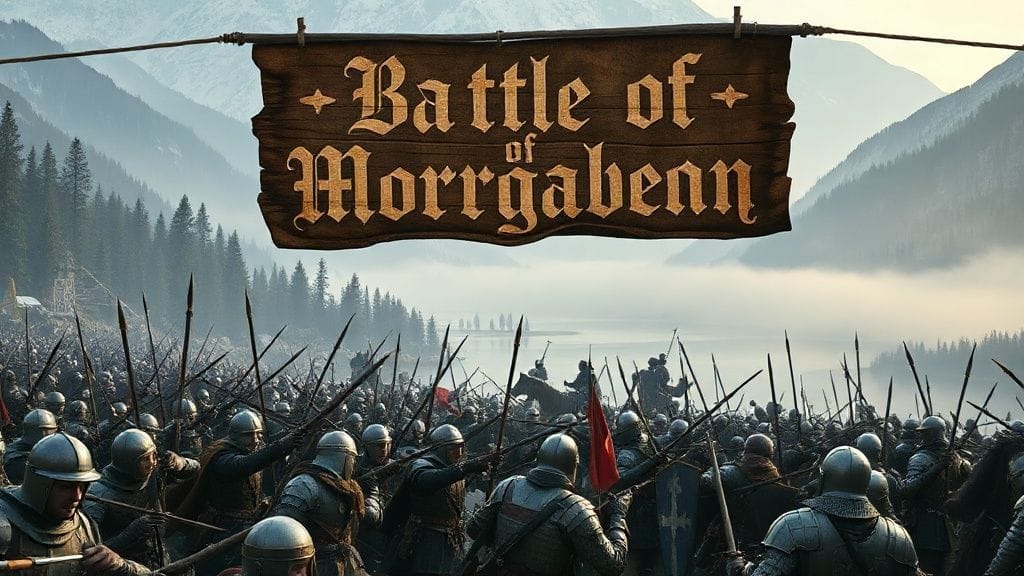
The thunder of hooves sliced the silence as Habsburg forces maneuvered through the narrow pass, unaware of the trap being sprung. Then came the sudden shattered branches and crashing stones—Swiss warriors leapt from hidden vantage points into the chaos. The forest erupted into screams, metal on metal, and desperate cries. Cavalry were caught at a disadvantage, sliding on the rocky ground, unable to keep formation. Horses reeled in pain from arrows and falling logs, knights tumbled from their mounts trapped in a deadly mire. The clash was brutal, chaotic—a stark contrast to the ordered jousts of noble chivalry. For the Swiss, it was a fight for survival; for the Habsburgs, a startling, crushing defeat.
7. The Swiss Tactics: Guerrilla Warfare in the Shadow of the Alps
It is impossible to overstate the brilliance of the Swiss tactical approach that day. Bypassing the traditional battlefield rules, these mountain men exploited their environment and esprit de corps. Local historians detail how Swiss forces coordinated ambushes using terrain to funnel enemy forces into kill zones, using stakes and pitfalls, and wielding halberds designed for close combat with mounted knights. The cooperation between the cantons, each bringing its small but fiercely loyal militia, set a precedent for the future Swiss Confederation’s cohesive military spirit—a blend of citizen-soldier valor combined with intimate understanding of the Alps’ rugged geography.
8. Fall of the Noble Knights: Habsburg Forces in Disarray
The medieval knight, clad in polished armor and accustomed to the decorum of courtly battle, met a harsh awakening in the underbelly of the Swiss forest. The Habsburg cavalry, forced into narrow passes and ambushed by trees and rocks, could neither charge effectively nor regroup. Many noble knights perished or were captured; morale broke. Chronicles speak of the panic that spread through the Habsburg ranks, turning a confident march into a frantic retreat. Among the casualties was the loss of significant commanders, including the death of Count Friedrich of Toggenburg—a blow that echoed far beyond the battlefield.
9. The Aftermath on the Battlefield: Counting the Costs
The forest quieted once more, save for the ragged breaths and groans. The Swiss had won, but at a price. Casualties on both sides numbered in the hundreds—marks of a fierce and desperate fight. The bodies of knights, peasants, and mercenaries lay scattered in the cold soil, their blood absorbed into the earth they had fought to claim. But beyond human loss was a more profound consequence—the shattering of Habsburg invincibility in the region and the unmistakable message that the Alpine communities would no longer bow without fight. Morgarten was not just a battle; it was a turning point.
10. Echoes in the Confederation: The Birth of Swiss Unity
In the wake of this unexpected victory, the loose alliance of Swiss cantons found renewed strength. The legend of Morgarten became a rallying cry, symbolizing collective resolve and shared destiny. It helped propel formal bonds like the Federal Charter of 1291 into a recognized political entity. The battlefield victory was intertwined with ideals of communal defense and autonomy, laying vital groundwork for the Swiss Confederation’s evolution from disparate communities into a unified nation capable of resisting imperial hegemony.
11. From Defeat to Legend: Morgarten in Swiss Collective Memory
Morgarten’s defeat of the Habsburgs quickly transcended facts, transforming into a powerful national mythos. Poets, chroniclers, and later historians wound the tale into the fabric of Swiss identity—a story of brave peasants defying aristocratic oppression against all odds. This narrative has been preserved in countless folk songs, murals, and public commemorations. Even today, Morgarten resonates as a symbol of freedom, resilience, and the mountain spirit imprinted indelibly on the Swiss consciousness.
12. The Habsburgs’ Retreat and the Rebalancing of Power
Humiliated but not crushed, the Habsburg dynasty reevaluated its approach toward the Swiss territories. Morgarten exposed the limitations of sheer force in such terrain, forcing political concessions and a more diplomatic posture in the decades hence. Though the Habsburgs remained a dominant power across Europe, their authority over the Swiss would loosen, setting in motion a slow but inevitable erosion of their grip and encouraging other regions to resist imperial reach.
13. The Political Ripples: How Morgarten Shaped Regional Alliances
Morgarten did not only strengthen the Swiss but also sent ripples through neighboring powers. The victory fostered new alliances, as other principalities eyed the Habsburgs’ vulnerability. Burgundy, Savoy, and other influential houses watched with interest, some choosing to support or negotiate with the Swiss cantons. The shifting mosaic of alliances in Central Europe can trace one of its turning points to this rugged pass, where a determined few had rewriting the rules of power.
14. Cultural Renaissance: The Tale Retold through Art and Song
Beyond the strategic and political, Morgarten ignited a cultural flowering celebrating heroism and liberty. Minstrels courted courts and taverns alike with ballads; manuscripts captured the valor and drama. The battle became an essential element of Swiss national heritage, inspiring illustrators like Hans Leu and playwrights centuries later. This artistic injection helped ensure the permanence of Morgarten’s legend beyond dusty archives into the living hearts of people.
15. Morgarten’s Place in the Making of Modern Switzerland
Looking through the lens of modernity, Morgarten stands as a foundational moment in the protracted process that forged Switzerland’s sovereignty and federal identity. It exemplified not just a military triumph, but the assertion of community governance, shared responsibility, and grassroots political will. In an era shaped by monarchs and empires, the Swiss showed the potency of collective identity rooted in geography, culture, and unyielding resolve.
16. Lessons from the Forest: Military Innovation and Social Solidarity
Morgarten offers rich lessons on how terrain, tactics, and social cohesion can trump numerical or technological superiority. Its success challenged medieval military orthodoxy and foreshadowed the increasingly important role of militias drawn from local populations. This fusion of military innovation and social solidarity became a hallmark of Swiss defense, influencing future engagements and contributing to Switzerland’s reputation for resilience and neutrality.
17. The Long Shadow: Morgarten’s Enduring Symbolism Today
Even 700 years later, Morgarten remains a powerful symbol in Swiss national education, political discourse, and civic identity. Annual commemorations and historical reenactments keep the memory alive for new generations, fostering a sense of pride and continuity. It raises meditations on the meaning of freedom and the complexities of self-determination in a world still shaped by power struggles.
18. The Role of Geography in Shaping National Identity
Switzerland’s dramatic landscapes, with mountains that both divide and protect, played a starring role in this story. Morgarten reminds us how geography can be a silent ally in the fight for autonomy, embedding itself in national myths and shaping political trajectories. The Alps are not just backdrops but active agents in the making of Swiss identity.
19. Chroniclers and Historians: Perspectives Through the Centuries
From medieval annals to modern scholarship, Morgarten has been viewed through many lenses. Early chroniclers often idealized the event; Enlightenment thinkers sought lessons in liberty; contemporary historians analyze its socio-political fabric meticulously. This historiographical evolution enriches our understanding, revealing how history is as much about interpretation as fact.
20. The Battle in Numbers: Forces, Casualties, and Strategy
While precise figures elude certainty, contemporary estimates place Habsburg forces at several thousand men, with the Swiss defenders numbering under a thousand militia. Casualties accounted for hundreds on both sides, with disproportionate losses among the heavily armored knights. The disparity in preparation and terrain advantage turned the numerical imbalance in favor of the Swiss, a testament to strategy over strength.
21. Women and Civilians: The Silent Voices of Morgarten
History often overlooks the impact on wives, children, and non-combatants who endured the uncertainty and loss of war. Local lore suggests women played crucial roles in logistics, moral support, and preserving communal cohesion during and after the conflict. Their stories remind us that battles are not fought solely on fields but in homes and hearts.
22. From Oral Tradition to Written Record: Preserving History
Initially passed down through oral tradition, stories of Morgarten found their way into chronicles like the White Book of Sarnen. The transition from word-of-mouth legend to documented history ensured the battle’s place in the annals of Europe. This reflects broader medieval practices where oral memory and written record intertwined to preserve identity.
23. Morgarten Compared: Similar Peasant-led Victories in Medieval Europe
Morgarten stands among notable medieval conflicts where peasant or militia forces upended feudal armies: the Battle of Bannockburn (1314) in Scotland or the Flemish victory at the Battle of the Golden Spurs (1302). These events collectively signaled shifting power dynamics and the rise of new military paradigms beyond knightly dominance.
24. Commemoration and Memorials: Sites of Memory in Switzerland
The Morgarten monument, erected centuries later, marks not only a battlefield but a national memory site. Annual commemorations draw thousands, reinforcing historical continuity and patriotism. Nearby museums and interpretive trails invite visitors to walk the ground where history unfolded, engaging with the past tangibly.
25. Reflections on Freedom: Morgarten’s Human Story
At its core, Morgarten is a human story of courage, community, and the yearning to shape one's destiny. It moves beyond dates and strategies into a realm of shared human experience—fear and hope, despair and triumph. This story echoes timelessly, reminding us why the struggle for freedom commands such enduring power in history.
Conclusion
The Battle of Morgarten stands as a radiant beacon in the tumultuous history of medieval Europe—a testament to the power of ordinary people united by common cause, weaponizing not just arms, but knowledge of their land and a unbreakable spirit. It was more than a victory on a cold November day; it was the opening chapter in the story of a Confederation that would defy giants and carve a unique path through time. Morgarten captures not only the clash of swords but the clash of ideals—between liberty and dominion, community and empire. In remembering Morgarten, we honor the timeless human quest for self-determination, resilience, and hope amid adversity.
FAQs
Q1: What initiated the conflict leading to the Battle of Morgarten?
A1: The conflict stemmed from the House of Habsburg’s attempts to extend its control over the autonomous Swiss cantons, threatening their independence and communal rights, resulting in escalating tensions between imperial ambitions and local self-rule.
Q2: Who were the main leaders at Morgarten?
A2: The Habsburg forces were led by Duke Leopold I, while the Swiss defenders were chiefly militia from the Forest Cantons of Uri, Schwyz, and Unterwalden. Specific Swiss leaders are less clearly recorded but included local community heads and military coordinators.
Q3: How did the Swiss manage to defeat a superior Habsburg force?
A3: They exploited their intimate knowledge of the mountainous terrain to set ambushes in the narrow Morgarten pass, using guerrilla tactics, close-quarter weapons like halberds, and the difficult landscape to neutralize the knights’ cavalry advantage.
Q4: What were the immediate consequences of the Swiss victory?
A4: The Swiss solidified their alliance and autonomy, inspiring further defense against imperial encroachment, while the Habsburgs suffered losses in prestige and territorial control, initiating a reevaluation of their approach toward Switzerland.
Q5: How has the Battle of Morgarten influenced Swiss national identity?
A5: Morgarten became a foundational myth symbolizing Swiss bravery, independence, and solidarity, deeply embedded in cultural memory and celebrated as a pivotal point in the formation of the Swiss Confederation.
Q6: Are there any memorials commemorating Morgarten today?
A6: Yes, monuments stand near the battlefield, and annual commemorations celebrate the victory. Museums and historical trails provide educational resources about the battle's significance and legacy.
Q7: How reliable are the historical accounts of the battle?
A7: Early records mix fact and legend, typical of medieval chronologies, but modern historians use cross-referencing and archaeological evidence to piece together a more accurate account while acknowledging the battle’s mythic status.
Q8: Did the Battle of Morgarten have wider European significance?
A8: Yes, it demonstrated that peasant militias could successfully challenge noble armies, influencing military tactics and political dynamics in Europe, and inspiring other communities seeking autonomy against feudal monarchies.

