Table of Contents
- The Chilling Morning at Paardeberg: A Moment Frozen in Time
- South Africa at the Dawn of the 20th Century: The Cauldron of Conflict
- British Empire versus Boer Republics: The Clash of Titans
- Prelude to Paardeberg: The March and Motivation of Lord Roberts
- General Piet Cronjé: The Boer Commander’s Dilemma
- The Siege Unfolds: Encirclement and Desperation
- The Human Face of War: Soldiers and Civilians in the Frozen Trenches
- Tactical Gambits and Deadly Miscalculations
- The Artillery Duel: Bombardments and Counterattacks on the Killing Fields
- Frostbite, Hunger, and Morale: The Silent Enemies
- The Moment of Surrender: February 27, 1900
- How the News Echoed Across an Empire
- Victors and Vanquished: The Aftermath for the Boer Forces
- The Significance of Paardeberg in the Anglo-Boer War
- International Perspectives and the Shifting Balance of Empire
- The Legacy of the Surrender in South African Memory
- The Boer War Nurses: Unsung Heroines of Paardeberg
- Letters from the Front: Voices from the Encirclement
- The Psychological Weight of Defeat and the Road to Guerrilla Warfare
- Paardeberg’s Place in Military History
- Commemorations, Monuments, and History’s Reckoning
- Conclusion: Paardeberg, More Than a Surrender—A Turning Point in Empire
- FAQs About the Battle of Paardeberg Surrender
- External Resource
- Internal Link
The bitter winds swept mercilessly across the frost-hardened veldt, carrying with them the haunting echoes of gunfire and the faint murmurs of men caught between hope and despair. The sun, pale and distant just beyond an overcast sky, cast ghostly shadows upon the ruined earth of Paardeberg. Here, on February 27, 1900, amid cold trenches and bloodied red soil, a chapter of imperial history came to a gripping close. The surrender at Paardeberg was not merely a military capitulation; it was a moment that held the fate of the Boer Republics and the British Empire in precarious balance, a drama etched into the annals of the Anglo-Boer War with lasting consequences.
South Africa at the Dawn of the 20th Century: The Cauldron of Conflict
At the turn of the century, the South African landscape was a mosaic of colonial ambitions and indigenous sovereignties. The British Empire, reaching the zenith of its global influence, sought to consolidate power over the rich mineral wealth and strategic advantage of Southern Africa. Yet, this desire collided fiercely with the determined independence of the Boer Republics — the South African Republic (Transvaal) and the Orange Free State — whose rugged farmers and burghers clung tenaciously to their land, laws, and way of life.
The discovery of vast gold deposits near Johannesburg had jangled the political and economic needles, inviting British imperial scrutiny and intensifying tensions that had been simmering since the late 19th century. Beyond economics, cultural and racial dynamics interlaced the conflict: Boer nationalism against British colonialism, and a complex web involving indigenous African peoples caught often tragically in the crossfire.
British Empire versus Boer Republics: The Clash of Titans
The stage for the Second Anglo-Boer War was set not just by political disputes but by contrasting visions of governance, sovereignty, and identity. The Boers, descended from Dutch settlers with a fiercely independent spirit, stood firm against British attempts to impose control. The conflict erupted into a brutal guerilla-style war, mixing conventional battles with drawn-out sieges and skirmishes.
The British army, confident in their regimental traditions yet frustrated by unconventional Boer tactics, faced a daunting challenge. The Boers were expert marksmen and skilled trackers, using intimate knowledge of the veldt to outmaneuver their British adversaries.
Prelude to Paardeberg: The March and Motivation of Lord Roberts
Field Marshal Frederick Roberts, a seasoned Victorian war hero, had been entrusted with the arduous task of quelling the Boer rebellion and securing British dominance. By early 1900, he was leading a massive, multi-pronged advance into the heartland of the Boer republics, seeking to crush resistance through overwhelming force.
Roberts’ strategy was methodical and relentless. One key aim was to isolate and force the surrender of the Boer forces led by General Piet Cronjé, who had entrenched his troops near the Modder River by Paardeberg Drift, bolstering defenses but risking encirclement.
General Piet Cronjé: The Boer Commander’s Dilemma
Piet Cronjé, a stern and resolute commandant, commanded immense respect within the Boer ranks. Yet, by late February 1900, his position had become perilous. His men were dug in but surrounded — British forces closing in from multiple directions, cutting off supply lines and avenues of retreat.
Cronjé’s choices were stark: attempt a risky breakout, hold out in hope of relief, or negotiate surrender. His pride and commitment to the Boer cause made surrender unthinkable until the bitter end.
The Siege Unfolds: Encirclement and Desperation
January had seen intense fighting at Paardeberg, with British troops storming the Boer defensive lines. Yet, progress was slow, cruelly hampered by the Boer’s stubborn resistance and the harshness of the South African winter.
Trenches and makeshift fortifications became the arena of attrition. The British lines, densely interwoven, formed an iron grip that tightened daily. Inside the encirclement, Boer soldiers faced dwindling ammunition, sparse food rations, and exposure.
The Human Face of War: Soldiers and Civilians in the Frozen Trenches
To imagine Paardeberg is to see more than maps and troop movements: it is to picture exhausted men — young and old — sheltering in muddy trenches, their breath visible in the freezing air, their eyes reflecting fear, fatigue, and fierce resolve.
Medical officers fought against scurvy and frostbite, nurses tended wounds far from comfortable hospitals, and letters home carried the heavy weight of hope and dread. Civilians nearby were swept up in the maelstrom—farmsteads destroyed, families displaced, futures uncertain.
Tactical Gambits and Deadly Miscalculations
Several times, Boer forces attempted to break the British lines. Desperate charges met with volley after volley of rifle fire tested both sides’ endurance. Each attack and counter-attack painted a grim narrative of courage and carnage.
British commanders struggled with the terrain’s challenges and Boer sharpshooters, while the Boers found their mobility severely curtailed. Yet, Cronjé’s decision to hold fast ultimately sealed their fate.
The Artillery Duel: Bombardments and Counterattacks on the Killing Fields
The roar of artillery became irreversible, a thunderous drumbeat over the battlefield. British heavy guns bombarded Boer positions relentlessly, wrecking earthworks and sapper trenches.
The Boer response, though heroic, was limited by shortages of shells and worn equipment. Over days, the bombardment shattered morale and physical defenses alike.
Frostbite, Hunger, and Morale: The Silent Enemies
Beyond bullets and shells, the cold was an enemy that spared no one. Weather reports from the time spoke of temperatures barely rising above freezing, nights that stiffened blood.
Hunger gnawed at breasts and bellies; water was scarce or frozen. Disease and exhaustion crept silently, reducing fighting capacity and darkening spirits.
The Moment of Surrender: February 27, 1900
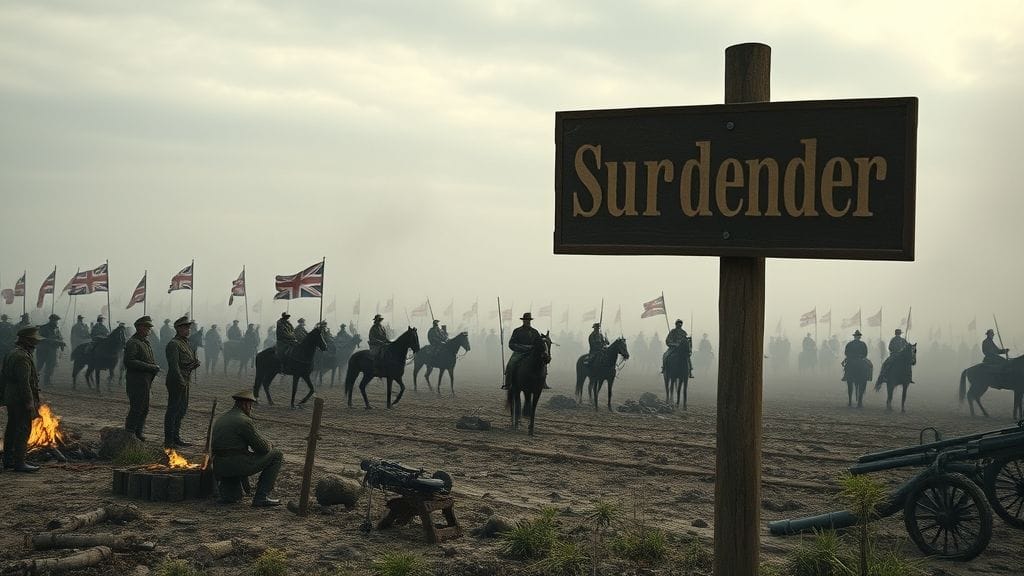
On that decisive day, under the bleak sky of late summer (Southern Hemisphere), General Piet Cronjé made the agonizing decision to surrender.
Around 4,000 Boer soldiers laid down their arms. The iconic image of Boer commandants walking toward British lines symbolized the end of a grueling chapter in the war. Among those who witnessed the surrender was a young Winston Churchill, then a war correspondent, who later described the scene with bittersweet respect for the courage on both sides.
How the News Echoed Across an Empire
The surrender at Paardeberg sent shockwaves throughout the British Empire and beyond. For London, it was heralded as a triumph, proof of British military supremacy.
Newspapers ran headlines of victory; politicians seized on the event to bolster imperial confidence. Yet, for the Boers, and those sympathetic to their cause, it was a moment of mourning, but also of determination to continue the fight through guerrilla warfare.
Victors and Vanquished: The Aftermath for the Boer Forces
While the loss was devastating, the Boer resistance was far from over. Many fighters melted into the countryside, initiating a painful guerilla campaign that prolonged the war for two more years.
Captured soldiers faced internment; families suffered displacement. The surrender marked a defining shift—away from open-field engagements toward a more fragmented, asymmetrical conflict.
The Significance of Paardeberg in the Anglo-Boer War
Military historians point to Paardeberg as a pivotal moment when the British gained critical momentum. It was the first major surrender of Boer forces, boosting British morale and paving the way toward eventual conquest of the Transvaal.
But it also exposed limitations in British strategy, foreshadowing the brutal, protracted nature of the conflict.
International Perspectives and the Shifting Balance of Empire
Global observers watched South Africa with keen interest—from European capitals to the United States and beyond. Paardeberg underscored the fierce struggles involved in maintaining imperial power.
The war’s images and stories fueled debates about colonialism, warfare’s human cost, and the emerging modern world order.
The Legacy of the Surrender in South African Memory
For South Africans, the Battle of Paardeberg and its surrender became more than military history; it evolved into a symbol of resilience, sacrifice, and national identity.
Memorials erected decades later honor the dead and living, reminding future generations of the tragic consequences of empire and war.
The Boer War Nurses: Unsung Heroines of Paardeberg
Amidst the violence, women’s roles emerged as crucial. Nurses braved the front lines, treating the wounded with scant resources and unwavering compassion.
Their stories, long overshadowed, have gained recognition as integral to understanding the conflict’s full human picture.
Letters from the Front: Voices from the Encirclement
Personal letters and diaries reveal the inner worlds of soldiers — moments of hope, fear, humor, and despair. These writings allow us to connect to the men behind the uniforms, lending humanity to historical facts.
The Psychological Weight of Defeat and the Road to Guerrilla Warfare
Defeat at Paardeberg stung deeply but sparked a shift in Boer tactics. The war morphed into hit-and-run attacks, sabotage, and prolonged hardship, compelling the British into an exhausting counter-insurgency.
Psychologically, both sides were tested as the war’s brutality intensified.
Paardeberg’s Place in Military History
Analysts regard the engagement as a classic case of siege warfare, testing evolving military doctrines on entrenchment, artillery, and logistics.
It remains a study in leadership, resolve, and the grim realities of imperial conflict.
Commemorations, Monuments, and History’s Reckoning
Sites around Paardeberg host monuments and annual ceremonies, where descendants and historians reflect on the cost of empire and war.
This process of remembrance shapes understanding of South Africa’s contested past.
Conclusion
The surrender at Paardeberg was not merely an event marked by the fall of a flag or the silence after last shots fired. It was a transformative crucible—where courage met despair, where the stubborn independence of the Boers collided with the vast arm of the British Empire. The frostbitten veldt bore witness to men grappled not only with weapons but with the crushing weight of history itself.
More than a military defeat, Paardeberg was a turning point that reshaped strategies, identities, and futures. It exposed the limits of imperial ambition and the resilience of those who fight for home and hearth. Today, as remembrance ceremonies echo across the plains, the spirit of Paardeberg endures — a testament to the complexities of conflict, the costs of war, and the enduring quest for dignity in the face of overwhelming odds.
FAQs About the Battle of Paardeberg Surrender
1. What were the main causes leading to the Battle of Paardeberg?
The battle was a direct result of tensions over British imperial expansion into Boer territories, particularly after the discovery of gold in the Transvaal. The war emerged from disputes over political control, sovereignty, and racial dynamics in South Africa.
2. Who was General Piet Cronjé and what role did he play?
General Piet Cronjé was a Boer commander tasked with defending the Modder River crossing. His decision to entrench his forces near Paardeberg led to their eventual encirclement and surrender.
3. How significant was the British victory at Paardeberg?
The victory was pivotal, marking the first major surrender of Boer forces. It boosted British morale and set the stage for further advances, though it did not end the war.
4. What hardships did soldiers endure during the siege?
Soldiers on both sides suffered from cold weather, hunger, disease, and exhaustion. The harsh South African winter compounded these difficulties.
5. How did the surrender affect the broader war?
Though a setback, the surrender prompted Boer forces to shift toward guerrilla warfare, prolonging the conflict and complicating British military efforts.
6. What is the legacy of the Battle of Paardeberg today?
Paardeberg remains a symbol of sacrifice and resilience in South African history, commemorated for its role in shaping national identity and the struggle against imperial domination.
7. Were civilians affected by the battle?
Yes, local populations experienced displacement, property destruction, and suffering caused by proximity to the fighting.
8. How is Paardeberg remembered outside South Africa?
Internationally, it is studied as a key episode in colonial warfare and a reflection of the broader challenges faced by empires at the dawn of the 20th century.