Table of Contents
- Storm over the Danube Frontier
- Empires on the Edge: Europe before Petrovaradin
- Prince Eugene of Savoy: The Reluctant Genius of War
- The Ottoman War Machine in its Twilight
- Fortress on the Rock: Petrovaradin before the Storm
- Gathering Thunder: The March to Battle in the Summer of 1716
- Eve of Destruction: Night before the Assault
- The Morning of 5 August 1716: Fire over the Danube
- Infantry, Cavalry, and Cannon: How the Battle Unfolded
- A Duel of Wills: Eugene versus Damat Ali Pasha
- Voices from the Battlefield: Eyewitness Traces and Human Stories
- Tally of Victory: Casualties, Captures, and the Broken Crescent
- From Petrovaradin to Belgrade: The Rolling Tide of Habsburg Advance
- Shifting Borders, Shifting Lives: The People of the Frontier
- Memory, Myth, and Monument: How Petrovaradin Was Remembered
- Petrovaradin in the Long Story of Europe
- Why the Battle Still Matters Today
- Conclusion
- FAQs
- External Resource
- Internal Link
Article Summary: On 5 August 1716, on the high bluffs above the Danube near Petrovaradin, one of the decisive clashes of early modern Europe unfolded: the battle of petrovaradin. There, a Habsburg army led by Prince Eugene of Savoy faced a larger Ottoman force commanded by Damat Ali Pasha, in a fight that would reshape the balance of power in southeastern Europe. This article traces the long road to that encounter, exploring decades of conflict, diplomacy, and imperial rivalry along the shifting frontier. It dives into the preparations, strategies, and human experiences that shaped the battle of petrovaradin, from the anxious night before the fighting to the brutal, smoky chaos of the battlefield itself. Beyond tactics, it follows how the victory opened the way to further Habsburg advances, including the capture of Belgrade, and how it altered the lives of soldiers, peasants, and city dwellers across the region. The narrative also examines how the battle of petrovaradin was later remembered, commemorated, and sometimes mythologized in both Habsburg and Ottoman traditions. Finally, it reflects on the lasting significance of the battle of petrovaradin in the broader history of Europe, as a moment when one imperial era waned and another pressed forward over the Danube frontier.
Storm over the Danube Frontier
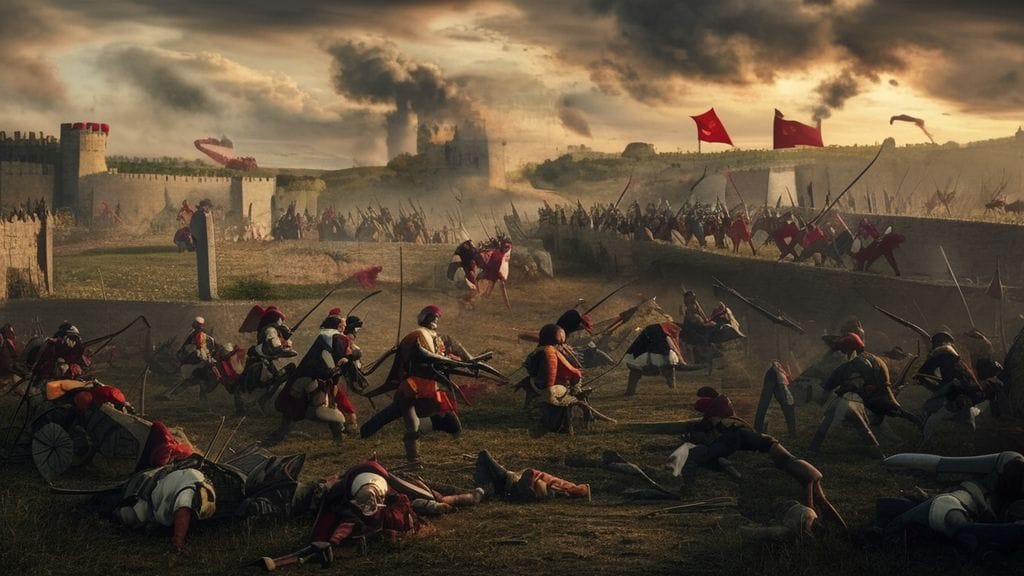
The dawn of 5 August 1716 broke over the Danube with a muted, coppery light, filtered through powder-smoke that had already begun to rise even before the first full volley thundered across the river valley. The fortress of Petrovaradin, perched on its rocky promontory above the waterway, loomed like a jagged ship of stone cutting through a sea of tents, earthworks, and fluttering banners. For those who stood on the ramparts that morning—the infantrymen in sweat-soaked coats, the gunners beside their bronze cannon, the officers peering through spyglasses—this was not a distant political encounter. It was survival, faith, fear, and fame compressed into a few terrifying hours.
They knew that below them, on the plains stretching toward the horizon, a vast Ottoman army had gathered. The colors of that host, the crescents and horsetail standards, the ranks of spahis and janissaries, shimmered in the early haze. Rumors had swept through the Habsburg lines in the days before: that the enemy outnumbered them two to one, that elite troops from all corners of the empire, from Rumelia to Anatolia, had arrived under the command of Damat Ali Pasha, the Grand Vizier himself. To some of the soldiers on the walls, this was simply the next brutal step in a long war; to others, it felt like the decisive moment in a struggle much older than they were, a contest over faith, land, and dominion along the Danube that had burned for centuries.
High on the fortress, a compact, stern figure in a powdered wig and carefully tailored coat moved from position to position, speaking in quick bursts of Italian, German, and French to his officers. This was Prince Eugene of Savoy, the man whose name would soon be bound forever to the battle of Petrovaradin. To some in Vienna’s salons he had once been an improbable commander, the slight, rejected youth who failed to receive a commission in Louis XIV’s army and instead had offered his sword to the Habsburgs. But on this morning in 1716, the soldiers around him did not see a courtly misfit; they saw the architect of Blenheim and Zenta, the general who had already clashed with the Ottomans and emerged victorious from storms as fierce as the one about to break.
Yet, as the cannons were swabbed and primed, as the cavalry horses snorted impatiently in the rear lines, nothing about the outcome was guaranteed. The Danube frontier had swallowed countless lives before, and it did not care whether the banners above them bore a double-headed eagle or a crescent moon. The battle of Petrovaradin would be decided not only by strategy, but by missteps, sudden bursts of courage, and the tragic arithmetic of gunfire and cold steel. It would also be shaped by the weight of history—the memory of past defeats and glories on both sides—that each commander carried with him as he prepared to throw his army into the fire.
But this was only the beginning. To understand why two empires converged in blood on this bend of the Danube, we must step back, far beyond that single summer morning, into the long and agonizing story of a continent divided and contested, where borders were written and erased in iron and flame.
Empires on the Edge: Europe before Petrovaradin
By the early eighteenth century, Europe was a landscape of exhausted powers and unresolved conflicts. The Thirty Years’ War and its aftermath had shattered old certainties in the Holy Roman Empire. The Sun King, Louis XIV, had cast a long, aggressive shadow across the continent, pulling states into one conflict after another. Yet in the southeast, beyond the familiar courts of Paris, Vienna, and Berlin, another, older rivalry simmered along the marches of Hungary, Croatia, and the Balkans: the centuries-long opposition between the Habsburg Monarchy and the Ottoman Empire.
Since the late fifteenth century, the Ottoman advance into central Europe had defined an entire geopolitical era. The fall of Belgrade in 1521, the capture of Buda in 1541, and the long presence of Ottoman garrisons along the middle Danube had built a line of fear in the imagination of Christian Europe. The failed Ottoman siege of Vienna in 1683—still fresh in the memory of older officers at Petrovaradin—had once seemed like the climax of this story, when the city, encircled and starving, was rescued by a coalition army under King Jan Sobieski of Poland. After that, the so-called Great Turkish War swung the pendulum decisively toward the Habsburgs, who pushed southwards and recaptured vast territories in Hungary and Transylvania.
The Treaty of Karlowitz in 1699 formally recognized much of that Habsburg advance. It was a turning point, but not an ending. The ink on the treaty was barely dry when new grievances, border disputes, and insurgencies began bubbling up. The Ottomans, humiliated by the loss of their central European holdings, sought ways to reverse the tide. Within the Habsburg Monarchy, meanwhile, there were deep anxieties about how to govern their expanding, ethnically and religiously diverse frontier territories. Croats, Serbs, Hungarians, Germans, Vlachs, and others lived side by side along a line that was less a neat border than a porous, militarized zone.
When the War of the Spanish Succession erupted in the west (1701–1714), drawing in Prince Eugene of Savoy as one of its key architects on the Habsburg side, the eastern frontier did not fall silent. Local skirmishes with Ottoman vassals, internecine rebellions, and banditry continued. Yet both great powers, Habsburg and Ottoman, were war-weary. Their finances were strained, their internal politics volatile. Still, neither was prepared to concede the Danube basin as settled.
In Constantinople, factions around the sultan debated how to restore lost prestige and territory. In Vienna, ministers weighed the costs of further expansion versus consolidation. The Danube, as ever, served both as a lifeline of trade and as a highway of war. It is astonishing, isn’t it, that rivers which link cities and communities in peacetime so often become the axes along which armies march?
By 1714, new crises in the Mediterranean—particularly the Venetian–Ottoman war over the Peloponnese—began to ripple inland. The Republic of Venice, long a maritime rival of the Ottomans, reached out to Vienna, hoping to draw the Habsburgs into a new anti-Ottoman coalition. The Habsburgs hesitated at first. But Prince Eugene, now one of the empire’s most influential voices on military affairs, sensed that the Ottomans’ internal weaknesses might open a window of opportunity. When border clashes broke out and Ottoman envoys demanded concessions, Vienna refused. The stage was slowly being set for a new clash of arms along the Danube.
Prince Eugene of Savoy: The Reluctant Genius of War
To understand why the battle of Petrovaradin unfolded as it did, one must understand the man who orchestrated the Habsburg side of it. Prince Eugene of Savoy, born in Paris in 1663, was not destined—at least in the eyes of the French court—to be one of Europe’s great captains. Slight, sickly as a child, more devoted to study and piety than to the ostentatious pageantry of Versailles, he reportedly asked Louis XIV for a commission in the army and was rebuffed. The king allegedly dismissed him as fit only for the Church, a slight Eugene never forgot.
Exiled by pride and necessity, he offered his services to the Habsburg emperor Leopold I. In that moment of personal disappointment, the future of central Europe shifted subtly but profoundly. Eugene’s rise in Vienna was swift, propelled by his ferocity against the Ottomans at the relief of Vienna in 1683 and in subsequent campaigns. He was not a boisterous field marshal; rather, he combined icy clarity with a relentless work ethic, studying plans late into the night, drilling his troops and demanding discipline. Over several decades he forged himself into the sharpest sword in the Habsburg arsenal.
By 1716 Eugene was seasoned by victories such as Zenta (1697), where he had already inflicted a devastating defeat on Ottoman forces, and by his strategic cooperation with the Duke of Marlborough against France in the War of the Spanish Succession. He believed in rapid, decisive action and in taking calculated risks. Whereas some Habsburg generals preferred to hide behind fortresses and wait out campaigns, Eugene favored offensive moves: surprise marches, preemptive strikes, and bold deployments.
Yet behind the steel of his reputation lay a more complex personality. Contemporary letters describe him as austere, even distant, a man who rarely indulged in personal warmth, but who inspired fierce loyalty among his inner circle of officers. He was also a patron of the arts, building palaces in Vienna and collecting books and manuscripts. The very man who oversaw slaughter on battlefields like Petrovaradin also walked marble halls lined with paintings and tapestries, a paradox typical of early modern aristocratic commanders.
In 1716, when the Habsburg court debated how to confront renewed Ottoman pressure, Eugene argued firmly for an active campaign in the Balkans. The empire, he believed, must seize the initiative before the Ottomans could consolidate their forces. He was acutely aware that Vienna’s finances were strained and that prolonged wars could destabilize already fractious realms like Hungary. Therefore, he reasoned, any new conflict must be fought with speed and decisiveness. Petrovaradin, a fortress crouched on a crucial bend in the Danube, would become his first great experiment in this new phase of the struggle.
The Ottoman War Machine in its Twilight
Opposite Eugene, another empire was wrestling with the strains of time. The Ottoman Empire in the early eighteenth century was not the unstoppable colossus of the sixteenth century that had once threatened Vienna. But neither was it yet the “sick man” of nineteenth-century clichés. It remained a formidable multi-ethnic, multi-confessional power spanning three continents, with deep administrative traditions and a long experience of war.
Still, cracks were visible. The janissary corps, once a disciplined infantry elite drawn from devşirme levies and trained in strict barracks, had grown in many places complacent and politicized. Provincial governors (beys and pashas) often pursued their own interests, enriching themselves at the expense of central authority. Taxation systems strained under the weight of warfare and corruption. Reform-minded statesmen in Constantinople tried fitfully to modernize aspects of the army and bureaucracy, but vested interests resisted.
In 1716 the Ottoman high command placed its hopes in Damat Ali Pasha, a Grand Vizier with a reputation for toughness and resolve. Married into the imperial family (hence the title “Damat,” meaning “son-in-law”), Ali Pasha had navigated the tides of palace politics and now wielded the sultan’s trust. He believed that the recent Habsburg gains in Hungary and the Balkans were neither inevitable nor irreversible. If he could strike a major blow against the Austrians—retaking key fortresses and perhaps threatening their lines deeper into Hungary—he might reassert Ottoman prestige and force Vienna back to the negotiating table.
The decision to march toward Petrovaradin was part of this broader vision. The fortress represented more than a military obstacle: it was a symbol of Habsburg entrenchment along the Danube. By crushing the garrison there and defeating any Habsburg field army that dared to intervene, Ali Pasha hoped to open a door back into lost territories. The Ottoman army he assembled drew men from diverse provinces: Anatolian infantry, Balkan cavalry, artillery from the imperial foundries, and contingents from vassal states. Estimates of its size vary, but many historians place it between 80,000 and 100,000 men, a number that dwarfed the smaller Habsburg host Eugene would lead.
Yet raw numbers concealed vulnerabilities. Logistics along the march northward were complicated; supply depots had to be organized, and the army’s sheer scale created bottlenecks. Some provincial units were poorly motivated; others were fierce but difficult to coordinate. Command structures were not always clear, and the janissaries, whose voices carried weight in the capital, did not always obey their commanders with the old iron discipline. These cracks would not doom the Ottomans by themselves, but in the furnace of a major engagement like the battle of Petrovaradin, they could widen into fatal breaks.
Fortress on the Rock: Petrovaradin before the Storm
Long before the cannons of 1716 roared, the rocky outcrop at Petrovaradin had been recognized as a natural stronghold. Situated on the right bank of the Danube, opposite the town of Novi Sad (then a modest settlement), the height commanded both river traffic and the approaches from the south and east. Various fortifications had existed there in medieval times, but it was under Habsburg rule, after their advance in the late seventeenth century, that Petrovaradin began to transform into a modern bastion fortress.
Inspired by the star-fort designs of engineers like Vauban in France, imperial planners oversaw the construction of a complex system of walls, bastions, and underground galleries. The rocky soil allowed deep tunnels and casemates to be carved out, offering protection for magazines and troops during bombardments. By 1716, the fortress was still being improved, but its essential outline was already in place: a layered defense of stone and earth that turned the hill into what some contemporaries called the “Gibraltar on the Danube.”
Garrison duty at Petrovaradin was hard. The climate along the river could be punishing, with humid summers that bred disease and bitter winters when icy winds howled through barrack windows. The soldiers posted there were a microcosm of the Habsburg Monarchy: Germans from the Austrian lands and the Empire, Hungarians, Croats, Serbs from the Military Frontier, Czechs, Italians, and others. Officers struggled to maintain discipline amid language barriers and the temptations of smuggling and illicit trade that accompanied any major fortress.
For the local civilian population—farmers in nearby villages, merchants in Novi Sad—the fortress was both shield and burden. It offered protection against raids and invasions, but it also demanded supplies, labor, and sometimes blood. Militia obligations, requisitions of grain, and the billeting of soldiers in private homes were constant irritants. Still, many locals understood that the Danube frontier was their fate; their lives, livelihoods, and even their religious freedoms were bound up with whichever power controlled the guns on the hill.
When word first came in 1716 that an enormous Ottoman army was marching north, Petrovaradin’s population reacted with a mix of fatalism and dread. Priests and pastors called for prayers. Military engineers hurried to finish earthworks, strengthen palisades, and position artillery. Civilians, those who could, packed up belongings and fled into the countryside or into the shelter of the fortress itself, hoping its walls would hold. Others stayed, unwilling or unable to abandon their homes. In the months before the battle of Petrovaradin, the fortress ceased to be merely a posting; it turned into a crucible in which the future of the region would be tested.
Gathering Thunder: The March to Battle in the Summer of 1716
The campaign of 1716 unfolded under a hot, dust-laden sun. Prince Eugene moved swiftly once war was declared. Knowing that time favored the larger Ottoman host—whose full arrival would make any Habsburg offensive riskier—he assembled his army in Hungary and began a rapid march toward the Danube line. The Habsburg force, perhaps around 60,000 strong if we count all arms and auxiliaries, was smaller than what Ali Pasha commanded but better drilled and more cohesively organized.
Eugene’s men trudged through fields of ripening grain, along roads choked with wagons and artillery pieces. Letters from the time speak of the monotonous grind of the march: boots rubbing blisters, uniforms stained with sweat and mud, horses collapsing from exhaustion. Yet there was also a sense of grim purpose. Many soldiers had fought the Ottomans before; veterans of Zenta and other battles carried with them vivid memories of narrow escapes and savage fighting. New recruits, too young to remember earlier campaigns, listened to their stories with a mixture of awe and apprehension.
On the Ottoman side, the march from the Balkans northward generated its own hardships and frictions. Ali Pasha’s army pulled men from distant provinces, which meant different languages, customs, and expectations. The logistical burden of feeding tens of thousands of soldiers and their horses strained supply lines. As the army neared the Danube, scouts brought in reports of Habsburg movements. Ali Pasha understood that he could not merely rely on siege warfare; a field battle was likely, even inevitable.
The two armies were like thunderheads drifting toward each other over the same plain, each thick with potential destruction, each shaped by invisible currents of politics and personality. In late July, Eugene reached the vicinity of Petrovaradin and joined forces with the fortress garrison. Rather than simply hiding behind the walls and waiting for a siege, he chose a bolder stance. He positioned his army in front of the fortress, using its guns as a massive anchor on his right flank. It was an invitation to battle, thrown like a gauntlet at the advancing Ottomans.
Ali Pasha accepted. Confident in his numerical superiority and perhaps encouraged by reports of discontent in some Habsburg territories, he moved to envelop the Habsburg positions. By the first days of August, the plains around Petrovaradin were transformed. Where wheat fields had rustled in the wind, tents now sprouted in dense rows. Horses cropped the grass to stubble. Campfires flickered at night as both armies prepared, prayed, argued, and imagined the carnage to come.
Eve of Destruction: Night before the Assault
The night of 4 August 1716 settled slowly over Petrovaradin, heavy and suffocating. In the Habsburg camp, lanterns burned low, their light picking out the gleam of bayonets stacked in neat pyramids and the contours of cannons crouched in the dark like great, sleeping beasts. Priests moved from unit to unit, offering blessings, hearing confessions, murmuring words of comfort to men who clutched rosaries or small tokens from home. Protestant soldiers whispered their own prayers, while Orthodox frontiersmen crossed themselves and invoked saints in the Slavic tongues of the borderlands.
Prince Eugene convened a council of war. Maps were unfurled, and officers traced lines across them with gloved fingers, arguing over the strengths and weaknesses of the Ottoman positions. Eugene listened more than he spoke. When he did speak, it was decisive: the Habsburg army would attack at dawn. Rather than waiting passively for the Ottomans to fully deploy and perhaps encircle his forces, he would strike first, aiming to disrupt and disorient Ali Pasha’s lines. It was a gamble, but gambling was nothing new to a man whose life had been defined by risks that others thought unwise.
Across the field, in the vast Ottoman encampment, the atmosphere was both confident and tense. The Grand Vizier’s pavilion stood at the center of a sea of tents, guarded by elite troops. Muezzins’ calls rose into the dark, mingling with the clang of hammers making last repairs to weapons, the braying of pack animals, and the murmur of countless conversations. Some soldiers boasted of the riches they would seize from the Habsburg lands; others worried about the fortress guns above them, whose power they had already tasted in intermittent bombardments.
Ali Pasha, like Eugene, weighed his options. He believed that his numerical advantage, combined with the quality of his cavalry and the resolve of his janissaries, would overwhelm the smaller Habsburg host in open battle. Yet he also faced the awkward reality of fighting under the guns of a formidable fortress. To press home an attack, his men would have to move within range of Petrovaradin’s artillery, which could rake their flanks and rear. He decided that overwhelming force, applied quickly and surely, could blunt that threat. At dawn, too, the Ottomans would be ready.
Among the rank and file on both sides, the night felt endless. A Hungarian grenadier might share a piece of bread with a comrade and speak of fields back home, far from this contested frontier. A janissary from Anatolia might sit sharpening his blade, thinking of family in a distant village. They were far from their homes yet bound together by a fate none of them could see clearly. If one could have walked invisibly through both camps, hearing snatches of song and prayer in dozens of languages, one might have realized how arbitrary the lines between “Habsburg” and “Ottoman” could be—how many of these men shared the same fears, hopes, and weariness.
Just before midnight, a brief summer storm flickered over the horizon, lightning illuminating the outlines of Petrovaradin’s walls and the sea of tents below. The rain fell lightly, hardly enough to dampen the dust, but it cooled the air and added a strange, spectral sheen to the scene. Then the night closed in again, and with it came the last few hours before the cannonade that would awaken the Danube.
The Morning of 5 August 1716: Fire over the Danube
Dawn rose behind a thin veil of mist on 5 August. The first pale light revealed a tableau poised on the knife-edge of violence. On the Habsburg lines, drums beat a steady tattoo as regiments formed up in their designated positions. Officers barked orders; sergeants straightened ranks, cursed laggards, adjusted muskets. The fortress above them bristled with cannon, their muzzles trained outward, crews already at their posts, some having barely slept.
Prince Eugene rode along the front, his horse’s hooves churning up clods of damp earth. The soldiers watched him pass with something between admiration and superstitious hope. He was not a towering, theatrical figure; his power lay instead in his calm. If he felt anxiety that morning, he concealed it behind a mask of composure. An officer later recalled in a letter that Eugene spoke “few words, yet each fell upon us like a stone, steadying our hearts.”
On the Ottoman side, the mass of men began to stir. As the sun crept higher, silver domes of helmets and spearpoints flashed. Cavalry units mounted, banners unfurled, and the janissary ranks shuffled into formation with a slow, deliberate confidence. Muezzins’ calls mingled with the drums and horns of the army. Ali Pasha, mounted and resplendent in rich garments befitting his office, surveyed the scene, intent on pressing his attack and crushing the Christian army that dared stand before him.
The first guns spoke from the fortress. A single cannon roared, its sound rolling across the field like a wave. Then another, and another, until Petrovaradin’s walls spat fire in a concerted barrage against the forward Ottoman positions. Earth erupted in fountains where balls landed; horses reared and bolted; men threw themselves to the ground. The battle of Petrovaradin had begun in earnest.
Yet this opening bombardment was only a prelude. As planned, Eugene ordered his infantry to advance from their entrenched positions, supported by field artillery. Their lines moved forward with measured steps, flags snapping in the wind, faces set. They advanced not only under fire from Ottoman guns but also in the shadow of uncertainty. Any misstep, any breakdown in coordination, could expose them to devastating cavalry charges that might tear holes in their ranks.
The sun climbed higher, burning away the last mist. Heat pressed down on armored heads and wool coats. Sweat stung eyes already irritated by smoke. Gunpowder residue coated tongues with a bitter taste. Over it all, as powder-smoke thickened and the cries of the wounded rose, the Danube flowed implacably, a shining ribbon that seemed absurdly calm beside the human storm unleashed on its banks.
Infantry, Cavalry, and Cannon: How the Battle Unfolded
The choreography of the battle of Petrovaradin was complex, and in the noise and confusion many of its participants perceived only fragments. Yet analysis of dispatches, letters, and later reconstructions allows us to trace the key movements of that chaotic day.
Initially, Eugene’s plan hinged on a strong, cohesive advance of his infantry center, anchored on the fortress and supported by artillery. His right wing was effectively shielded by Petrovaradin itself, whose guns could enfilade any Ottoman attempt to outflank. His left, more exposed in the open plain, was reinforced with cavalry to counter expected Ottoman mounted assaults.
Ali Pasha, by contrast, sought to leverage his numerical superiority and the renowned power of his cavalry. He pushed large formations forward against the Habsburg center and left, aiming to break their lines and roll them up before the fortress guns could inflict too much damage. Janissary units, still elite despite their internal issues, advanced stoutly against the Habsburg infantry, their distinctive uniforms and disciplined volleys marking them as a formidable foe.
The first major clashes involved artillery duels. Ottoman field guns answered the fortress barrage, sending roundshot and explosive shells into the Habsburg ranks. Then muskets spoke in ragged volleys as infantry on both sides fired, reloaded, and fired again, each shot accompanied by a sharp kick against the shoulder and a cloud of acrid smoke. Casualties mounted rapidly in the center as lines drew within killing distance.
On the Habsburg left, as Eugene anticipated, Ottoman cavalry surged forward. Spahis and other mounted troops thundered across the field, lances leveled, swords raised. Their charge, terrifying to behold, aimed to find or create gaps in the Habsburg dispositions and exploit them mercilessly. Yet the Habsburg commanders had prepared. Infantry squares bristling with bayonets awaited the horses, while supporting cavalry maneuvered to hit the Ottoman riders in the flanks.
At moments, it must have seemed the entire battlefield was dissolving into swirling eddies of men and horses. Here, a Habsburg dragoon regiment locked sabers with Ottoman cavalry; there, clusters of infantry fought hand-to-hand, muskets wielded as clubs when bayonets snapped. Drums, trumpets, and shouted orders often went unheard amid the din. The only constant was the cannon’s deep, brutal punctuation, tossing bodies and earth alike into the air.
In the center, the fight swayed back and forth. At one point, Ottoman janissaries pushed the Habsburg infantry dangerously close to their own lines of entrenchments. A Habsburg unit bent under the pressure, some soldiers turning to flee. Panic threatened to spread. It was here that Eugene’s personal intervention proved decisive. He rode into the threatened sector, rallying men with fierce, clipped exhortations and threatening deserters with summary punishment. His presence, combined with reinforcements he directed into the breach, prevented a collapse that might have spelled disaster.
Meanwhile, the fortress artillery continued to hammer Ottoman positions. Some Ottoman units found themselves caught between the advancing Habsburg infantry and the relentless fire from Petrovaradin’s walls. A modern historian, assessing the battle, would later write that “the fortress ceased to be a passive backdrop and instead became an active participant, its guns as influential as any field maneuver.” This synergy between fortress and field army was one of Eugene’s greatest strengths.
As midday approached, the initial Turkish momentum began to stall. Habsburg lines that had wavered now firmed. Cavalry counterattacks, coordinated with infantry volleys, began to peel away Ottoman assaults. The sheer brutality of the fighting, the inability to quickly break the Habsburg position, and the mounting toll from artillery fire all started to sap Ottoman morale. Yet the Grand Vizier was not ready to concede the field. He would try to turn the tide with renewed efforts, particularly focused on the center, where both armies still strained in deadly equilibrium.
A Duel of Wills: Eugene versus Damat Ali Pasha
Though tens of thousands of men fought and bled at Petrovaradin, the battle was in many ways a duel of wills between two commanders: Prince Eugene of Savoy and Damat Ali Pasha. Each had brought his army there under the weight of expectations—imperial, political, personal—and each now struggled to bend the chaos of war to his design.
Eugene, attentive to the flow of the battle, recognized that the moment was coming when the Ottomans’ initial impetus could be reversed. He ordered a general offensive at selected points, timing it to coincide with intensified artillery fire from the fortress. His plan was not to launch reckless assaults but to press firmly where the Ottomans were already strained, hoping to trigger a wider unravelling.
Ali Pasha, for his part, remained near the heart of his army. Accounts differ on the precise details of his movements, but most agree that he was actively engaged in directing his troops, rallying faltering units and dispatching messengers with fresh orders. He still believed—or needed to believe—that the Habsburg lines could be pierced. A decisive thrust, he may have thought, would not only crush Eugene’s army but also silence critics at the Ottoman court who doubted the empire’s ability to regain lost ground.
The critical moment came as Habsburg counterattacks, backed by accurate artillery fire, inflicted mounting casualties on the Ottoman center. Confusion spread in some Ottoman ranks; signals were misread or not received at all. Dust, smoke, and the sheer density of men obscured the battlefield. In this maelstrom, Ali Pasha reportedly tried to bring forward reserves to stabilize the situation and perhaps mount a fresh attack.
Instead, he rode directly into danger. Contemporary Habsburg reports claim that a cannonball—or, in some versions, a burst of musket fire—struck the Grand Vizier, mortally wounding him. It is difficult to verify the exact cause of his death, but most sources agree that Ali Pasha fell during the thickest of the fighting. With him died not only a commander but also the symbolic keystone of Ottoman authority on the field.
The impact on Ottoman morale was immediate and profound. Rumors of the Grand Vizier’s death raced through the ranks. Some units, especially those that had already been shaken by heavy losses, lost heart. Command and control, never easy in a pre-modern battle of this scale, deteriorated further. Attempts by other officers to assume leadership could not fully compensate for the psychological blow.
Eugene, sensing weakness, drove his advantage. He ordered a more aggressive advance, pushing his infantry and cavalry forward to exploit the faltering of Ottoman units. In one of history’s cruel ironies, the death of a single man, however powerful, helped tip the fate of tens of thousands. “The fall of Ali Pasha,” wrote one later chronicler, “was the moment at which the arc of the battle bent irrevocably toward Habsburg victory.”
By afternoon, what had begun as a near-even struggle turned into a rout in key sectors. Ottoman troops began to retreat in disorder, some fighting desperate rearguard actions, others fleeing outright. The duel of wills was over. Eugene had held his nerve, maintained cohesion, and exploited the enemy’s misfortunes. Ali Pasha, brave but ultimately unlucky, lay dead on the field, his ambitions buried beneath the smoke and dust of Petrovaradin.
Voices from the Battlefield: Eyewitness Traces and Human Stories
The broad contours of the battle of Petrovaradin can be drawn from official reports and strategic analyses, but its human texture emerges most vividly from more intimate sources: letters, diaries, later memoirs, and local traditions. These voices, though filtered through memory and bias, pierce the abstraction of troop movements and casualty figures.
A Habsburg artillery officer, writing to his brother some weeks after the battle, described the eerie dissonance between the fortress vantage point and the slaughter below: “From our bastion,” he wrote, “we could see the waves of them advance and fall back, advance and fall back, like a sea that breaks upon the rocks. Each discharge of our guns tore great rents, yet always others came behind. The smoke grew so thick that at times the field was but a grey void, lit by flashes and filled with cries.” His words, preserved in an Austrian archive, offer a glimpse of the overwhelming sense of being simultaneously actor and spectator in a grand, terrible theater.
On the Ottoman side, the voices that reach us are fewer in number and often mediated through later historians. Yet some accounts survive. One later Ottoman chronicler, drawing on reports from veterans, wrote that “the day at Petrovaradin was a day when courage wrestled with fate, and fate proved the stronger.” He described janissaries pressing forward under a hail of shot, “their ranks thinned but not broken, until the news came like a black wind that the Vizier had fallen.” At that moment, he claimed, “hearts became like wax before the fire.” While stylized, such narratives underline the central emotional shock of the Grand Vizier’s death.
Beyond officers and chroniclers, there were the nameless many. Imagine a frontier soldier from the Military Border, a Serb in Habsburg service, who had grown up hearing stories of Ottoman raids into his grandparents’ village. For him, Petrovaradin might have felt like both revenge and dread fulfillment. Or consider a janissary whose father had fought at Zenta and survived; did he march into battle with a sense of avenging that older humiliation, only to meet a similar fate?
We also hear faint echoes from civilians. Local oral traditions in the region speak of families hiding in cellars while the battle raged, hearing the continuous roar like distant thunder. Some later tales, likely embellished, describe flocks of birds startled into flight by the cannonade, circling in panic over the field. One can imagine a child in a nearby village clutching a mother’s skirts, asking why the earth seemed to shake.
Yet behind the celebrations of victory in Vienna and the laments in Constantinople lay another truth: for the vast majority who experienced Petrovaradin, the battle was not a glorious tableau but a day of terror, exhaustion, and loss. Limbs torn by shot, bodies crushed under falling horses, screams of men calling for water or for absent loved ones—these details, often omitted in high diplomatic accounts, remind us that history’s turning points are written in human suffering as much as in banners and treaties.
Tally of Victory: Casualties, Captures, and the Broken Crescent
When the guns finally fell silent and the last scattered skirmishes died away, the battlefield around Petrovaradin was a landscape of devastation. Estimates of casualties vary, as they so often do in early modern warfare, but most historians agree that Ottoman losses were significantly higher than those of the Habsburgs. Some contemporary Habsburg reports boasted of tens of thousands of enemy dead—a figure perhaps inflated for propaganda reasons—but even cautious modern scholars suggest that Ottoman casualties, including dead, wounded, and captured, likely exceeded 20,000.
The Habsburg army, though victorious, did not emerge unscathed. Thousands of its soldiers lay dead or wounded on the field. The exact numbers are debated—some estimates place Habsburg losses at around 3,000 to 5,000 men—but even the lower figures represented a heavy toll for an army of its size. For every regiment that returned to camp that evening, there were gaps in the ranks where familiar faces were missing.
The material booty captured from the Ottomans was substantial. Habsburg troops seized artillery pieces, banners, supply wagons, and personal valuables. One symbol in particular captured the imagination of contemporaries: the capture of the Grand Vizier’s seal and other personal regalia. These trophies were paraded in Vienna as tangible proof of the scale of the victory. In a Europe accustomed to reading political messages through ceremony and display, such spoils spoke loudly.
News of the triumph spread quickly. In Vienna, church bells rang and Te Deums were sung in thanksgiving. Court poets and propagandists framed the battle of Petrovaradin as another great milestone in the “defense of Christendom” against Ottoman aggression, following in the line of Lepanto (1571) and the 1683 relief of Vienna. Pamphlets and broadsheets circulated, some adorned with woodcuts depicting Prince Eugene triumphant amid heaps of defeated foes. One contemporary publication declared that “the Crescent has been struck a mighty blow upon the Danube,” a formulation that cemented the religious framing of what was also a struggle for land and resources.
In Constantinople, the reaction was somber, even shocked. The death of a Grand Vizier in battle was rare and destabilizing. Courtiers and chroniclers struggled to explain the defeat in ways that did not openly impugn the sultan’s authority. Some blamed misfortune, others blamed internal corruption or insufficient zeal among the troops. The Ottoman elite understood, however, that Petrovaradin was not a minor setback but a major strategic reversal. It would embolden their enemies and complicate their diplomatic positions.
The immediate strategic consequence was clear: the Habsburg army, no longer checked on the Danube, had room to maneuver southwards. The Ottoman defensive line in the region had been gravely weakened. Petrovaradin thus became more than a local victory; it was the opening wedge in a larger campaign that would soon push the Habsburg frontiers even deeper into former Ottoman territory.
From Petrovaradin to Belgrade: The Rolling Tide of Habsburg Advance
Victory at Petrovaradin did not end the war. Instead, it opened the door to further campaigns that would culminate in one of Prince Eugene’s crowning achievements: the capture of Belgrade in 1717. The battle of Petrovaradin had broken the main Ottoman field army in the region, killed its commander, and shaken Ottoman confidence. Eugene, always eager to exploit favorable conditions, moved quickly to build on this advantage.
In the months following the battle, Habsburg forces consolidated their hold on the surrounding territory. They repaired and expanded fortifications, secured supply lines, and brought additional troops forward. The Danube, with Petrovaradin as a key node, served as both a barrier and a conduit, allowing the transfer of men, munitions, and provisions. Local populations, some of whom had long chafed under Ottoman rule, now found themselves courted by Habsburg authorities eager to stabilize the newly won lands.
Eugene understood that Belgrade, strategically situated at the confluence of the Sava and Danube rivers, was the next great prize. Held by the Ottomans since the late seventeenth century, the city guarded access to the Balkans and dominated major river routes. So long as it remained in Ottoman hands, Habsburg gains south of the Danube were precarious. Thus, in 1717, he prepared for an ambitious siege.
The story of Belgrade’s fall is its own great drama: daring river crossings, brutal trench warfare, and another ferocious Ottoman attempt to relieve the city. But it was only possible because Petrovaradin had given Eugene the strategic breathing space he needed. The psychological effect of the earlier victory cannot be underestimated. Habsburg soldiers went into the Belgrade campaign with the memory of Petrovaradin’s success behind them, while many Ottoman troops carried the memory of that defeat as a leaden weight.
The resulting Treaty of Passarowitz, signed in 1718, formalized the new balance of power. The Habsburg Monarchy gained extensive territories, including much of present-day northern Serbia and parts of the Banat and Wallachia. These acquisitions extended Habsburg influence deep into lands long under Ottoman sway. Petrovaradin, as the first great stepping stone in this advance, assumed an aura of near-mythic importance in Habsburg narratives of triumph.
It is no exaggeration to say that without the battle of Petrovaradin, the map of southeastern Europe in the eighteenth century would have looked very different. Borders drawn at Passarowitz, influenced by the victories of 1716–1717, shaped not only imperial administration but also the lives of countless communities, who now found themselves subjects of a new ruler, governed by new laws, taxed by new officials, and drawn into new military obligations.
Shifting Borders, Shifting Lives: The People of the Frontier
Grand narratives of empire, strategy, and diplomacy can obscure a quieter, more intimate history: the ways in which frontier populations experienced the shifts wrought by battles and treaties. The lands around Petrovaradin were not empty spaces onto which Habsburg and Ottoman power projected their ambitions; they were inhabited by farmers, artisans, traders, and clergy who had to adapt, again and again, to new overlords.
After the Habsburg victories of 1716–1718, these communities faced a cascade of changes. New administrative structures were imposed, often with unfamiliar legal codes and tax systems. The Habsburg authorities, wary of Ottoman return and internal unrest, maintained a strong military presence in the region. The so-called Military Frontier system, already in place in earlier decades, expanded and evolved. In it, frontier communities—many of them Orthodox Serbs and other Slavs—were granted certain privileges and land in exchange for military service and readiness.
For some, this arrangement offered opportunities. A peasant who might have been vulnerable to raids or heavy taxation under previous regimes could now access land under relatively secure conditions, as long as he fulfilled his obligations as a border soldier. For others, the military discipline, constant drills, and obligations to distant imperial authorities were burdensome. The frontier was both a shield and a cage.
Religious life shifted as well. Catholic institutions, backed by the Habsburg state, gained greater latitude. Churches and monasteries were rebuilt or newly established. At the same time, Orthodox communities negotiated their position under Catholic rulers, seeking to preserve their rites and hierarchies. These religious dynamics were not purely spiritual; they intersected with questions of ethnicity, loyalty, and identity. A Serbian Orthodox peasant serving in the Habsburg army might feel both gratitude for protection against the Ottomans and resentment toward imperial officials who viewed him as culturally inferior.
Trade and commerce, too, responded to the new order. With major battles over and the frontier pushed further south, merchants found opportunities in supplying garrisons, provisioning new settlements, and moving goods along the now more securely controlled Danube. Petrovaradin and nearby Novi Sad benefited from this traffic, gradually evolving into important nodes of regional exchange. Yet prosperity was uneven. War had devastated many villages, and rebuilding took time and resources that were not always available.
On the former Ottoman side of the new border, communities that had once looked northward for markets and alliances now found themselves cut off. Some families migrated, following retreating Ottoman forces into the deeper Balkans or Anatolia. Others stayed, adjusting their lives to the new geopolitical reality. The human mosaic of the region became even more complex, layered with memories of who had ruled when and what that had meant for daily existence.
In these borderlands, the consequences of the battle of Petrovaradin were not simply matters of imperial pride. They manifested in the language used in churches and schools, in which uniforms young men wore, in where grain was sold and taxed, and in the stories grandparents told by the hearth about the days when the sky over the Danube burned and the world seemed to crack open.
Memory, Myth, and Monument: How Petrovaradin Was Remembered
In the years and decades after 1716, the battle of Petrovaradin moved from event to memory, from lived experience to narrative. It was recounted in letters and reports, enshrined in official histories, evoked in sermons and patriotic songs, and eventually commemorated in monuments and place-names. Each retelling reshaped it slightly, emphasizing some aspects while silencing others.
In Habsburg lands, Petrovaradin quickly became part of the cult of Prince Eugene. His portrait, already prominent after earlier victories, gained new luster. Court historians and propagandists cast him as the defender of Christendom, a chivalric yet modern commander whose genius had checked Ottoman ambitions once and for all. Paintings depicted him on the field, sword raised, with the fortress looming behind and defeated Turks in the foreground. Such imagery was less about accurate reportage and more about building a usable past—a story of Habsburg virtue vindicated.
Churches in Austria and Hungary held annual services of thanksgiving for the victory. Some communities dedicated altars or chapels in honor of the triumph, inscribing on stone the date of the battle and invocations of divine favor. Religious and political narratives intertwined: God, it was said from many pulpits, had clearly favored the Habsburg cause, granting them victory against overwhelming odds.
Among local populations in the Petrovaradin region, memory was more ambivalent. While some celebrated liberation from Ottoman rule, others remembered the destruction and disruption war had brought. Folk songs and tales circulated that spoke of brave officers and treacherous commanders, of miraculous escapes and tragic losses. In these vernacular traditions, heroes were sometimes Habsburg, sometimes local, and occasionally even Ottoman. The line between “friend” and “foe” blurred when told from the standpoint of those who primarily wanted peace and stability.
In Ottoman narratives, Petrovaradin posed a more delicate challenge. Acknowledging the scale of the defeat and the loss of a Grand Vizier was unavoidable, yet chroniclers often framed it within a broader story of divine testing or temporary misfortune. Some emphasized the valor of Ottoman soldiers even in defeat, suggesting that internal corruption or ill-starred leadership, rather than the intrinsic superiority of the enemy, had caused the catastrophe. Over time, as later wars and losses overshadowed the events of 1716, Petrovaradin’s place in Ottoman collective memory dimmed somewhat, though it remained a cautionary example for reform-minded officials.
The fortress itself, ever-present above the Danube, became a physical anchor for memory. As its defenses were upgraded in subsequent decades, as new barracks and bastions were added, each generation of soldiers stationed there walked the same ground where their predecessors had bled in 1716. Even when the thunder of cannon was absent, the stones of Petrovaradin whispered those earlier stories to anyone who paused to listen.
In the nineteenth and twentieth centuries, as national movements swept across central and southeastern Europe, Petrovaradin’s memory was refracted through new lenses. Serbian, Croatian, Hungarian, and Austrian historians, each with their own agendas, revisited the battle, sometimes elevating local contributors who had been overlooked in imperial accounts, sometimes criticizing the old heroic narratives. The battle of Petrovaradin, like so many historical events, proved malleable—its facts relatively fixed, its meanings endlessly debated.
Petrovaradin in the Long Story of Europe
Placed within the broader arc of European history, the battle of Petrovaradin stands at a crossroads between eras. It belongs firmly to the age of dynastic wars, of composite monarchies and aristocratic commanders, yet it also foreshadows shifts that would reshape the continent in the centuries to come.
Strategically, Petrovaradin marked a significant moment in the long retreat of Ottoman power from central Europe. It confirmed that the Habsburg Monarchy, for all its internal complexities, had achieved a durable military and administrative ascendancy along the Danube. This shift in the balance of power influenced not only local border arrangements but also great-power politics. Russia, for instance, watched closely as Habsburg arms drove southwards, weighing its own ambitions in the Black Sea and Balkans. The decline of one imperial presence often opens space for others, and Petrovaradin contributed to the slow reconfiguration of eastern Europe as a chessboard of rivalry between Vienna, St. Petersburg, and eventually other powers.
At the same time, the battle exemplified the continued importance—and the growing limits—of fortress warfare. Petrovaradin’s defenses played a vital role in the outcome, demonstrating how modern bastion fortifications, integrated with a field army, could shape a campaign. Yet within a century, advances in artillery and changes in military organization would begin to erode the dominance of such fortresses. In this sense, Petrovaradin captures a high point of the classic early modern fortress paradigm, even as the seeds of its obsolescence were already being sown.
The battle also illustrates how religious rhetoric could still electrify populations and justify policy, even when underlying motives were dynastic and territorial. Habsburg and Ottoman propaganda alike framed the struggle in confessional terms, as a contest between Christian and Muslim powers. These narratives did not entirely fabricate reality—faith did matter deeply to many participants—but they simplified a more nuanced picture of alliances, loyalties, and interests. Later nationalisms, emerging in the nineteenth century, would recycle aspects of these older confessional frames, often with new and volatile combinations.
For ordinary people, the battle’s place in the long story of Europe is measured less in terms of “civilizational” clashes and more in the cumulative impact of such conflicts on the landscape of states and identities. Each victory, each treaty, carved and recarved boundaries that determined who collected taxes, who enforced laws, which language dominated schools and courts, and which young men were conscripted into whose armies. Petrovaradin, though fought by aristocratic commanders under imperial banners, thus helped lay the groundwork for later national questions in the Balkans and the Habsburg lands.
In modern European memory culture, Petrovaradin is less universally known than battles like Waterloo or Leipzig, yet in the regions around the Danube its echoes remain discernible. It is one of the many hinges on which the continent’s story turned, a reminder that seemingly marginal frontier clashes can, in retrospect, mark major transitions in the life of empires.
Why the Battle Still Matters Today
Three centuries have passed since musket smoke drifted over Petrovaradin, yet the battle still matters, both as a subject of historical inquiry and as a lens through which to examine enduring questions about power, identity, and memory. The story of the battle of Petrovaradin invites us to consider how military events can reshape entire regions, not only through immediate destruction but also through subtler, longer-term transformations.
First, Petrovaradin reminds us of the fragility of imperial dominance. The Ottoman Empire, after all, had once seemed unassailable along the middle Danube, just as the Habsburgs later seemed secure in their newfound ascendancy. Yet empires rise and fall, sometimes gradually, sometimes through sharp shocks like those delivered in 1716. Looking back from a twenty-first-century perspective, in an age when borders in Europe have once again been contested and redrawn, the battle underscores how political orders we take for granted can change more quickly than we imagine.
Second, the battle offers a case study in how leaders’ decisions, shaped by personality and experience, can alter historical trajectories. Prince Eugene’s choice to fight a forward, aggressive battle rather than retreating behind fortress walls; Ali Pasha’s determination to seek a decisive engagement near Petrovaradin; the tactical innovations and miscalculations on both sides—these individual acts intersected with broader structural forces to produce the outcome. For historians, such episodes are laboratories of causality, where contingency and necessity tangle in complex ways.
Third, Petrovaradin is a window into the lives of people who inhabited the fault lines between great powers. Their experiences—negotiating new rulers, adapting to war and peace, preserving or reshaping cultural practices—echo in modern communities that find themselves similarly perched on geopolitical frontiers. In an era when debates about borders, migrations, and cultural coexistence are once again central, the history of the Danube frontier has a sobering relevance.
Finally, the way Petrovaradin has been remembered—or forgotten—in different times and places illuminates how societies use the past. In some narratives, it is a heroic landmark of Christian victory; in others, a tragic symbol of Ottoman decline; in yet others, a footnote in the larger story of European diplomacy. The same battle, the same day of bloodshed, is woven into different tapestries depending on who is telling the story and for what purpose. That malleability of memory is something we must approach critically, especially when older conflicts are invoked to legitimize present-day agendas.
To walk today on the ramparts of Petrovaradin fortress, looking down at the Danube and the city of Novi Sad, is to stand at a crossroads of times. The guns are silent; tourists stroll where soldiers once ran; music festivals echo where drums once beat the charge. Yet beneath the cobblestones lie layers of history, including the shockwaves of 5 August 1716. The battle of Petrovaradin endures not as a call to renew old hostilities, but as a reminder of how costly such hostilities have been—and of how much is at stake whenever human societies choose war over compromise.
Conclusion
The battle of Petrovaradin, fought on a hot August day in 1716, was far more than a collision of two armies along a contested river. It was the crystallization of decades—indeed, centuries—of rivalry between the Habsburg and Ottoman empires, a moment when accumulated tensions exploded into a single, decisive encounter. On that day, the fortress on the Danube, the skills and flaws of commanders like Prince Eugene of Savoy and Damat Ali Pasha, the courage and terror of thousands of anonymous soldiers, and the deep currents of imperial ambition all converged.
In its immediate aftermath, the battle reshaped the strategic map of southeastern Europe. It opened the way to further Habsburg conquests, culminating in the capture of Belgrade and the sweeping territorial changes of the Treaty of Passarowitz. It weakened Ottoman authority along the Danube frontier and emboldened reformers and rivals who saw in the defeat both a warning and an opportunity. For frontier populations, it brought new rulers, new obligations, and new uncertainties, even as it promised a measure of stability after years of war.
Over time, Petrovaradin’s significance migrated from the field to the realm of memory. It was celebrated, mourned, and debated; folded into dynastic myths, national narratives, and scholarly arguments. In some eras it loomed large as a symbol of “civilizational” struggle; in others it retreated into the specialist literature of military historians. Yet it never vanished completely, because the questions it raises—the nature of power, the cost of war, the fluidity of borders, the uses of memory—remain with us.
To study Petrovaradin today is not simply to admire the tactics of Prince Eugene or to catalog the movements of regiments. It is to confront a world in which political and religious identities were fluid yet fiercely contested, in which ordinary people were repeatedly forced to adjust to the ambitions of distant capitals. It is also to recognize that what seems, in one moment, like the triumphant expansion of an empire can, in hindsight, appear as one step in a longer cycle of rise and decline.
Standing at the edge of that Danube bluff in imagination, hearing once more the distant echo of cannon, we are reminded that history is neither a straight line of progress nor a simple tale of heroes and villains. The battle of Petrovaradin is a chapter in a vast, tangled story—a chapter written in smoke and blood, but also preserved in stone, song, and scholarship. By reading it carefully, we gain not only knowledge of the past but also a sharper sense of the precariousness and responsibility of our own place in history.
FAQs
- What was the Battle of Petrovaradin?
The Battle of Petrovaradin was a major engagement fought on 5 August 1716 between the Habsburg Monarchy and the Ottoman Empire near the fortress of Petrovaradin, in what was then the Habsburg-controlled region along the Danube. A Habsburg army led by Prince Eugene of Savoy decisively defeated a larger Ottoman force commanded by Grand Vizier Damat Ali Pasha. - Why was the Battle of Petrovaradin important?
The battle was important because it broke the main Ottoman field army in the region, killed the Grand Vizier, and opened the way for further Habsburg advances, including the capture of Belgrade in 1717. It helped shift the balance of power in southeastern Europe, leading to significant Habsburg territorial gains confirmed by the Treaty of Passarowitz (1718). - Where exactly did the battle take place?
The battle took place near the fortress of Petrovaradin, on a high bluff above the right bank of the Danube River, opposite the town of Novi Sad in present-day Serbia. The fortress itself played an active role in the combat, with its artillery supporting the Habsburg field army deployed on the plain below. - Who commanded the armies at Petrovaradin?
The Habsburg army was commanded by Prince Eugene of Savoy, one of the most accomplished generals of his era, known for his victories in both western and eastern theaters. The Ottoman army was led by Grand Vizier Damat Ali Pasha, a powerful statesman and military commander who was killed during the battle. - How large were the opposing forces?
Exact numbers are debated, but most historians estimate that the Ottoman army fielded between 80,000 and 100,000 men, including janissaries, cavalry, and provincial troops, while the Habsburg force numbered around 60,000. Despite being outnumbered, the Habsburgs benefited from better cohesion, effective use of fortress artillery, and Eugene’s leadership. - What role did the fortress of Petrovaradin play?
The fortress provided a secure anchor for the Habsburg right flank and contributed powerful artillery fire that raked Ottoman formations throughout the battle. Rather than remaining a passive defensive position, Petrovaradin’s guns acted as a force multiplier for Eugene’s field army, helping to disrupt enemy attacks and support counteroffensives. - What were the casualties in the battle?
Precise casualty figures are uncertain, but Ottoman losses were heavy, likely exceeding 20,000 dead, wounded, and captured. Habsburg casualties were significantly lower, though still substantial, with estimates often ranging between 3,000 and 5,000. The death of Grand Vizier Damat Ali Pasha was a particularly severe blow to the Ottoman side. - How did the battle affect the local population?
For local communities around Petrovaradin and along the Danube frontier, the battle meant destruction in the short term and major political change in the long term. Villages were damaged or abandoned, civilians fled or hid during the fighting, and afterwards many found themselves under new Habsburg rule, facing different taxes, laws, and military obligations. - What were the long-term consequences of the victory?
The victory at Petrovaradin set the stage for the Habsburg capture of Belgrade in 1717 and the subsequent Treaty of Passarowitz in 1718, which granted the Habsburg Monarchy extensive territories in the Balkans and along the Danube. This expansion solidified Habsburg dominance in central Europe and marked another step in the gradual Ottoman retreat from the region. - Can you visit Petrovaradin today?
Yes. The Petrovaradin fortress still stands above the Danube in modern Serbia, overlooking the city of Novi Sad. Visitors can walk its ramparts, explore its tunnels and bastions, and view the river and plains where the 1716 battle unfolded. The site also hosts cultural events and festivals, offering a striking contrast between its war-torn past and its contemporary role as a place of gathering and celebration.
External Resource
Internal Link
Other Resources
- Encyclopaedia Britannica – general search for the exact subject
- Google Scholar – academic search for the exact subject
- Internet Archive – digital library search for the exact subject

