Table of Contents
- The Dawn of October 23, 1086: A Tense Prelude to Battle
- Iberia in Flames: Fragmented Kingdoms and the Reconquista
- The Rising Tide: The Almoravid Empire Moves West
- Alfonso VI’s Expanding Kingdom: Dreams and Dangers
- The Almoravid Call to Arms: Yusuf ibn Tashfin’s Mission
- Forces Assembled: Size, Strategy, and Stakes
- The March to Sagrajas: Terrain, Morale, and Men
- Clash at Zallaqa: The Battle Unfolds
- The Turning Point: Almoravid Discipline and Cavalry supremacy
- Alfonso VI’s Struggles and Tactical Missteps
- The Aftermath: Bloodied but Not Broken
- Reverberations in Iberian Politics: Muslim Unity Rekindled
- The Reconquista Stalled: New Realities on the Peninsula
- Folklore and Memory: The Battle through Christian and Muslim Eyes
- The Almoravid Legacy: A Brief Fortress in Iberia
- Lessons from Sagrajas: Leadership, Faith, and the Fragility of Empire
- Conclusion: Echoes of Sagrajas in Modern Reflections
- FAQs: Debating the Battle of Sagrajas
- External Resource: Wikipedia Link to the Battle of Sagrajas
- Internal Link: Visit History Sphere
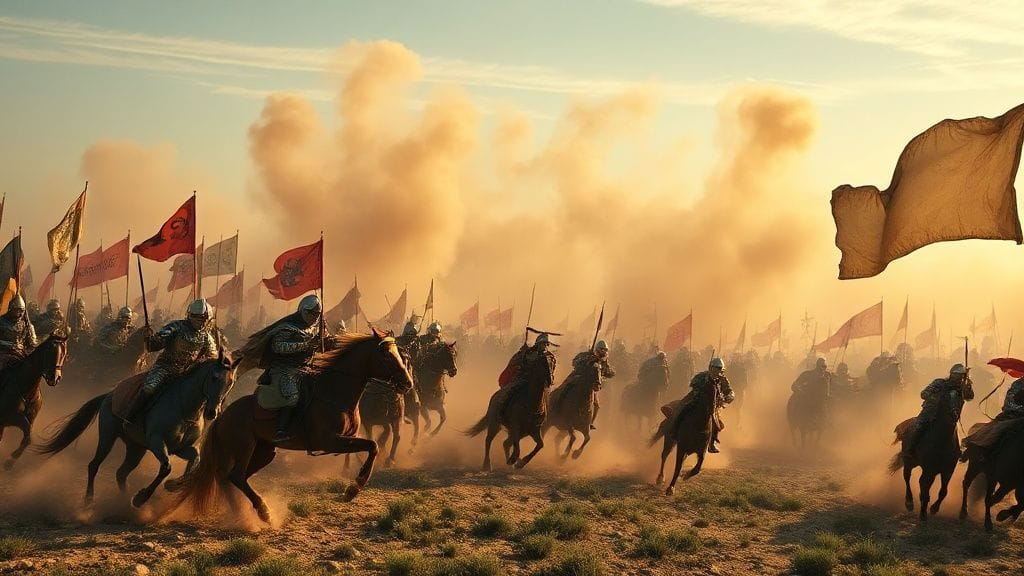
October 23, 1086, dawned cold and crisp over the rolling hills near Badajoz. A gale whispered through the sparse oaks, carrying the scent of dust and war—yet beneath the mundane hush, history was breathing. On this day, the fateful battle of Sagrajas (known as Zallaqa in Arabic) would unfold—a confrontation that would shake the very foundations of Christian and Muslim realms in medieval Iberia, arresting the Christian Reconquista’s triumphant tide. The earth, soon torn by hooves and steel, would witness a clashing collision of cultures, faiths, and ambitions that rippled beyond its fields to shape centuries.
Iberia in Flames: Fragmented Kingdoms and the Reconquista
The Iberian Peninsula of the late 11th century was a simmering mosaic of fragmented political entities—Christian kingdoms pressing southwards under the banner of Reconquista, while Muslim taifas battled for survival or dominance. Centuries after the initial Umayyad conquest, Al-Andalus had fractured into smaller, fractious states whose rulers juggled power, wealth, and alliances.
This was a land scarred not just by military conflict but by religious ambition and cultural pride. Christian kingdoms—Castile, León, Aragon, Navarre, and Portugal—gradually chipped away at Muslim-held territories. The decisive Christian capture of Toledo in 1085, under Alfonso VI of Castile, marked a bold milestone. Yet this triumph sent tremors across the Strait of Gibraltar, rallying Muslim powers to stem the tide.
The Rising Tide: The Almoravid Empire Moves West
Farther south lay the Almoravid dynasty—a puritanical Berber empire born out of North Africa's deserts. Led by the charismatic and resolute Yusuf ibn Tashfin, the Almoravids had consolidated territories from the Sahara to Morocco, imposing a rigorous Islamic creed and military discipline. Their call to arms was as much religious as it was political: the defense of Islamic lands against the encroaching ‘infidel’ Christian kingdoms.
When the taifas pleaded for aid following Alfonso VI’s conquest of Toledo, Yusuf responded—not simply as a mercenary protector but as a unifier destined to resist Christian expansion. His arrival was more than reinforcement; it was a game-changer destined to alter Iberia’s fate.
Alfonso VI’s Expanding Kingdom: Dreams and Dangers
Alfonso VI of Castile and León embodied the aggressive momentum of the Reconquista. Having declared himself “Emperor of all Spain,” his goal was a united Christian Iberia. Toledo’s fall was a crowning jewel of his ambition, but it came with peril. The taifas of southern Iberia were desperate, fragmented, and unpredictable, and the Almoravid intervention had turned a regional conflict into a broader, more complex war.
Alfonso was no stranger to diplomacy or war, but the challenge of facing leagues formed by the Almoravids meant confronting a professional force that understood both desert and mountain warfare, with religious zeal to boot.
The Almoravid Call to Arms: Yusuf ibn Tashfin’s Mission
Yusuf ibn Tashfin’s decision to cross into Iberia was calculated and fateful. Known for military strategy and devout fidelity, he rallied alliances among taifas whose territorial pride had stalled unified resistance. His presence commanded respect and fear, and he brought a disciplined army capable of confronting the Christian knights.
The Almoravids blended the fierce camel cavalry of the Sahara with the infantry tactics of settled lands. Yusuf’s leadership was decisive—he sought not only to protect Muslim Spain but to reimpose strict Islamic law, which both alienated and stabilized the taifas.
Forces Assembled: Size, Strategy, and Stakes
Historical sources vary, but contemporary accounts suggest an enormous gathering: Alfonso’s Christian army likely comprised tens of thousands of men, including heavily armored knights and infantry levies. Opposing them, Yusuf’s Almoravids fielded comparable numbers, bolstered by fast-moving cavalry and skilled archers.
The stakes were monumental. Victory for Alfonso meant further Christian advances deep into Muslim territories; defeat could reverse years of conquest and embolden Muslim rulers to retake lost ground.
The March to Sagrajas: Terrain, Morale, and Men
The chosen battlefield—near the Sagrajas stream, called "Zallaqa" (slippery) by Arabs—was a natural amphitheater vulnerable to cavalry maneuvers. Both armies faced grueling marches; supply lines were stretched, and morale fluctuated between optimism and dread.
Eyewitness descriptions paint vivid pictures: armor glinting under pale sunlight, war cries sounding over dusty plains, and the tension of millions of prayers whispered by soldiers before clashing steel.
Clash at Zallaqa: The Battle Unfolds
The battle dawned with careful posturing, skirmishes testing enemy strength and probing for weaknesses. Almoravid horse archers harassed the Christian lines, wearing them down steadily. When the main engagement erupted, the disciplined Almoravid formations held firm, counteracting the famed Christian cavalry charges with counter-maneuvers.
Chaos overwhelmed parts of the battlefield, with the clash of swords, screams of the wounded, and cries of commanders resonating across the hills. The Almoravid use of flexible cavalry and archery was crucial; they exploited every tactical opportunity.
The Turning Point: Almoravid Discipline and Cavalry Supremacy
Despite the valor of Castilian knights, the Almoravid forces, led by Yusuf ibn Tashfin himself, maintained cohesion. Their rigid religious motivation and battlefield discipline contrasted with the somewhat fragmented Christian forces, which suffered from coordination issues and fatigue.
One decisive moment came when Almoravid horsemen encircled a key portion of Christian troops, cutting off retreat and forcing Alfonso VI to personally rally his men to prevent collapse. Yet, as the sun set, the field tilted irrevocably—Almoravids claimed victory.
Alfonso VI’s Struggles and Tactical Missteps
The defeat was a bitter pill for Alfonso. His aggressive strategies underestimated the Almoravid cohesion, and his alliances with the taifas failed to guarantee unified support. Some historians speculate that overconfidence from prior successes clouded his judgment.
But Alfonso’s endurance was remarkable. Though forced to retreat, his realm survived intact, allowing time to regroup, fortify, and prepare for future conflicts. The battle was a harsh lesson in the perils of overreach and the strength of united defense.
The Aftermath: Bloodied but Not Broken
Sagrajas was not a total rout but a sobering check on Reconquista momentum. Muslim forces, reinvigorated by their victory, reclaimed lost prestige and shepherded the peninsula into a period of uneasy balance.
The battle secured a political environment where the Christian kingdoms reassessed their approach while Muslim rulers cherished a fleeting moment of unity before internecine struggles resumed. The loss slowed Christian expansion but did not extinguish the larger reconquest trajectory.
Reverberations in Iberian Politics: Muslim Unity Rekindled
The campaign strengthened Yusuf ibn Tashfin’s authority and temporarily quelled the fractious taifa independence. The Almoravids established a new order in southern Iberia, introducing reforms and military organization to resist Christian advances.
However, their imposition of orthodox Islam alienated some local Muslims and aristocrats, sowing seeds of future dissent but, for the time being, marking the high water mark of Muslim resistance in the region.
The Reconquista Stalled: New Realities on the Peninsula
Following Sagrajas, the Christian kingdoms faced a sobering reality: conquering Al-Andalus required not just valor but strategic patience, alliances, and learning Muslim warfare tactics. The battle underscored the complex interplay between religion, politics, and culture that would dominate Iberian history for centuries.
For decades after, neither side achieved decisive dominance, giving rise to a protracted, multifaceted conflict that shaped identities and borders into the late Middle Ages.
Folklore and Memory: The Battle through Christian and Muslim Eyes
Both Christian and Muslim chroniclers framed the battle within their religious narratives. Muslim historians praised Yusuf ibn Tashfin as a divinely favored warrior who preserved the faith; Christian tales lamented the loss but exalted Alfonso’s courage, portraying the battle as a tragedy en route to eventual triumph.
Legends, songs, and poems emerged, keeping the memory alive in cultural consciousness, symbolizing both loss and resilience.
The Almoravid Legacy: A Brief Fortress in Iberia
Despite their victory, the Almoravids’ grip on Iberia was transient. Internal conflicts, pressures from the north, and emerging enemies would eventually eclipse their influence by the mid-12th century. Yet their intervention at Sagrajas remains a testament to the impact of cross-Mediterranean politics and the fragile balance of power.
Their legacy endured in military tactics, judicial reforms, and cultural exchanges that subtly flowed into Iberian development.
Lessons from Sagrajas: Leadership, Faith, and the Fragility of Empire
The battle crystallizes themes recurrent in history: the interplay between leadership and luck, the bridging and clashing of civilizations, and the precariousness of imperial ambition. Yusuf ibn Tashfin’s decisive role contrasted with Alfonso VI’s resilience, underscoring human tenacity amid shifting fortunes.
Religious zeal, while a powerful motivator, proved both uniter and divider, shaping alliances and fueling conflicts with lasting consequences.
Conclusion
The Battle of Sagrajas is more than a distant medieval clash; it is a vivid chapter illuminating the complexities of faith, power, and culture in a land at war with itself yet ripe with possibility. Here, across a slippered stream near Badajoz, the destinies of empires intertwined—each side charging forward not just with sword and shield, but with the hopes of generations.
Alfonso VI’s halted advance and Yusuf ibn Tashfin’s victorious stand remind us that history is seldom linear; it is a tapestry woven from triumph and loss, conquest and resistance. Sagrajas marked a pause, a recalibration, and an enduring echo in the saga of Iberia—telling us that the past’s scars often map the routes to the future.
FAQs
Q1: Why was the Battle of Sagrajas significant in the Reconquista?
A1: The battle was pivotal because it halted Christian territorial expansion after the capture of Toledo, demonstrating that Muslim forces, under the Almoravids, could mount a strong, unified defense and temporarily reverse Reconquista momentum.
Q2: Who was Yusuf ibn Tashfin, and why was he important?
A2: Yusuf ibn Tashfin was the Almoravid leader who crossed from North Africa to reinforce Muslim taifas in Iberia. His leadership and disciplined military force decisively influenced the battle’s outcome and temporarily unified Muslim Spain.
Q3: What were the strengths and weaknesses of Alfonso VI’s forces?
A3: Alfonso’s army included well-armed knights with heavy cavalry, benefiting from previous victories. However, internal divisions, overconfidence, and unfamiliarity with Almoravid tactics weakened their effectiveness at Sagrajas.
Q4: How did the aftermath of the battle affect Muslim political unity in Iberia?
A4: The victory reinforced Almoravid dominance over the taifas, consolidating Muslim political unity briefly and introducing reforms, although underlying tensions remained.
Q5: Did the Battle of Sagrajas mark the end of the Reconquista?
A5: No. While the battle stalled Christian advances, the Reconquista continued for centuries, culminating in 1492. Sagrajas was a significant setback but not a permanent halt.
Q6: How is the battle remembered differently in Muslim and Christian histories?
A6: Muslim accounts celebrate it as divine vindication and military brilliance, while Christian narratives view it as a tragic but temporary reversal en route to ultimate victory.
Q7: What lessons can modern historians draw from Sagrajas?
A7: The battle teaches about the importance of leadership, cultural understanding, and flexible strategy in conflicts shaped by intersecting identities and ambitions.
Q8: How did the Almoravids influence Iberian culture beyond military campaigns?
A8: They impacted Iberian society through religious reforms, judicial structures, and cultural exchanges between North African and Iberian traditions.

