Table of Contents
- Dawn on the Banks of the San Jacinto
- The Texan Struggle for Independence: Seeds of Rebellion
- Mexican Ambitions and the Alamo’s Shadow
- The Gathering Storm: Forces Prepare for Decisive Clash
- Sam Houston: The Reluctant Commander
- Santa Anna’s Quest for Order and Control
- The Texan Army: A Motley Force United by Hope
- April 21, 1836: The Battle Begins
- The Thunderclap Assault: Chaos and Courage
- Santa Anna Caught Off Guard: Flight and Capture
- Aftermath on the Battlefield: Silence and Shock
- The Birth of the Lone Star Republic
- International Repercussions: The United States and Mexico
- The Human Cost: Heroes, Losses, and Legacies
- San Jacinto’s Place in American and Texan Memory
- The Mythology of Victory: Tales and Truths
- Santa Anna’s Fate and the Shifting Sands of Power
- The Road to Texas Statehood: A New Chapter
- Reflections on Freedom, Identity, and Conflict
- San Jacinto Today: Preserving History and Inspiring Future Generations
Dawn on the Banks of the San Jacinto
The morning sun bathed the dense, humid air of the coastal Texas prairie in a fiery orange glow that promised a relentless heat. The scent of wild sage mingled with the distant murmur of the buffalo bayou, setting the stage for a confrontation that would echo through the ages. On April 21, 1836, near the site of present-day Houston, a ragtag army of Texian rebels, tired and determined, prepared for battle. Across the grassy field, a well-disciplined but overconfident Mexican force under General Antonio López de Santa Anna arranged their lines, unaware that within hours, their fortunes would irreversibly change.
The Battle of San Jacinto was not merely a military engagement; it was the crucible in which the fiercely contested identity of Texas was forged. It was the fiery crescendo to months of brutal conflict—a clash of empires and ideologies, of dreams of self-rule against imperial control. In a matter of minutes, the course of history in North America would be altered forever, carving the path for a new republic and the expansion of the United States.
The Texan Struggle for Independence: Seeds of Rebellion
To understand the Battle of San Jacinto, one must first navigate the tangled web of grievances that brought the Texian settlers and the Mexican government to this boiling point. Texas, then part of Mexico, was a vast land sparsely populated by Native American tribes and a growing number of Anglo-American settlers encouraged by the Mexican government during the 1820s. Mexico hoped to stabilize the region and spur its development, offering land grants to settlers under certain conditions, including allegiance to the Mexican state and Catholicism.
However, tensions soon festered. The influx of settlers brought cultural clashes, differing legal traditions, and, crucially, the issue of slavery—an institution Mexico was beginning to abolish, but which many Anglo settlers sought to maintain. The Mexican government, wary of losing control over this northern frontier, tightened regulations and insisted on adherence to Mexican laws, igniting resentment and fears among settlers.
By 1835, open revolt was underway. The Texians—American immigrants and native-born residents alike—united under a banner of independence, their grievances escalating into a full-fledged revolution. The early stages saw a patchwork of victories and defeats, with both sides struggling to impose order and authority.
Mexican Ambitions and the Alamo’s Shadow
The Mexican government, led by President and General Santa Anna, regarded the Texan insurrection as a dangerous rebellion—an affront to national sovereignty. Santa Anna, a charismatic and formidable leader, resolved to quash the revolt with decisive force.
The tragic siege and fall of the Alamo in March 1836—where a small band of Texian defenders held out heroically against overwhelming Mexican forces—seared itself into the collective Texian consciousness. “Remember the Alamo!” became a rallying cry, symbolizing the price of freedom and the ferocity of their fight.
Yet, the Alamo was also a stark warning: Santa Anna was relentless, ruthless, and determined to restore order at all costs.
The Gathering Storm: Forces Prepare for Decisive Clash
After the Alamo, Texan hopes wavered. However, General Sam Houston’s leadership injected a vital spark of discipline and strategy into the Texan army. Retreating eastward from San Antonio, Houston meticulously gathered reinforcements, training, and supplies, biding his time as Santa Anna advanced.
Santa Anna, confident in his superior numbers and experience, pursued the Texians deeper into the harsh Texas terrain, eager to deliver a crushing blow. The two armies converged near the San Jacinto River, on terrain favorable to surprise attacks and swift maneuvers.
Sam Houston: The Reluctant Commander
Few military leaders embody ambivalence and resolve quite like Sam Houston. A former governor of Tennessee and seasoned frontiersman, Houston’s complexities extended beyond the battlefield. His command came with pressure—both political and personal—as he balanced the demands of a fledgling republic’s survival against his own doubts and the rawness of the Texian forces.
Houston’s strategy was as bold as it was risky: to attack swiftly and unexpectedly, capitalizing on Mexican complacency and fatigue. His leadership was a blend of cautious patience and explosive action, qualities that proved critical in the hours ahead.
Santa Anna’s Quest for Order and Control
Santa Anna’s trajectory to the battlefield was marked by confidence rooted in military prowess and decades of political power. He embodied the Mexican government’s determination to maintain its territorial integrity and authority in the face of fragmentation.
Yet, the campaign had stretched his resources thin and the morale of his troops wavered. Overconfidence, the sweltering heat, and underestimation of Texian resolve clouded his judgment—a fatal miscalculation at San Jacinto.
The Texan Army: A Motley Force United by Hope
The Texan army was a colorful blend of frontier riflemen, volunteers from the United States, Tejanos (Texans of Mexican heritage), and enslaved African Americans seeking freedom. Despite their lack of professional military training, their unity was forged in shared desperation and hope.
They faced overwhelming odds: fewer men, scarcity of supplies, and the shadow of defeat looming after the fall of the Alamo and the Goliad massacre. Yet their spirits remained unbroken, fueled by the belief that liberty was worth every hardship.
April 21, 1836: The Battle Begins
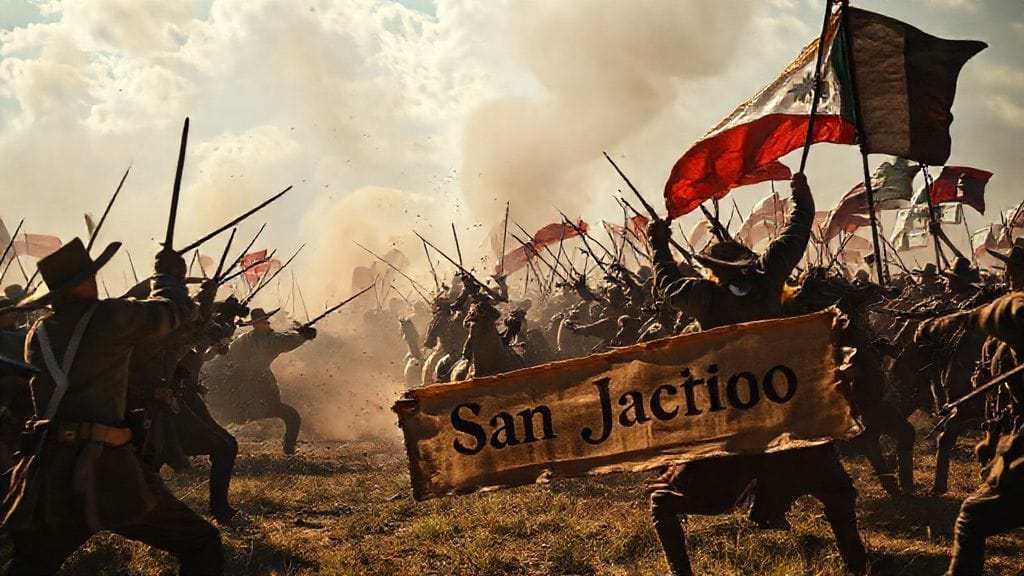
In the late afternoon of April 21, Houston ordered a sudden and ferocious assault against the Mexican camp near the San Jacinto River. The element of surprise was complete; many Mexican soldiers were off guard, resting or even singing as their Texian foes launched a thunderous attack.
The field erupted into chaos—gunfire, shouting, and the clash of bayonets filled the air. Texan volunteers charged with ferocity that confounded the seasoned Mexican troops. In under 18 minutes, what had begun as a quiet afternoon exploded into a decisive and bloody confrontation.
The Thunderclap Assault: Chaos and Courage
Accounts speak of courage on both sides, the desperation of men fighting not just for victory but for survival. Texan sharpshooters targeted officers; bayonets and rifles shattered lines. The Mexican army, caught in confusion and unable to mount an effective counterattack, crumbled.
Amid the turmoil, Santa Anna fled but was soon captured, disguised as a common soldier. His loss demoralized the Mexican forces instantly.
Santa Anna Caught Off Guard: Flight and Capture
Santa Anna’s capture turned the tide unequivocally. Unable to continue directing his army, and facing a well-coordinated Texan force, the Mexican troops surrendered or fled into the wilderness.
The prisoner was treated with a complex mixture of indignity and political leverage by Houston, signaling the interwoven destinies of these two men and their nations.
Aftermath on the Battlefield: Silence and Shock
The slaughter was staggering—over 600 Mexican soldiers killed or wounded, compared to a mere 9 Texan casualties. Yet the horror was not confined to numbers. The carnage deeply scarred survivors and observers alike.
For many Texans, the victory felt surreal, a divine intervention after weeks of desperation. For Mexico, it was a catastrophic blow that shattered hopes of maintaining Texas.
The Birth of the Lone Star Republic
With San Jacinto, Texas asserted its independence, declaring itself a sovereign nation—the Republic of Texas. The battle paved the way for an era of fragile self-government, tenuous recognition, and ongoing conflict over the territory’s future.
This new identity was both a cause célèbre and a contentious symbol in the wider geopolitical arena.
International Repercussions: The United States and Mexico
The conflict resonated beyond Texas and Mexico. The United States was torn between expansionist enthusiasm and the thorny issue of slavery’s expansion into new territories. Mexico, humiliated and destabilized, refused to recognize Texas’s independence, setting the stage for future wars.
European powers watched closely, mindful of opportunities and threats in the Western Hemisphere.
The Human Cost: Heroes, Losses, and Legacies
Beyond strategy and politics, San Jacinto was a crucible of human sacrifice. Men like Deaf Smith, William B. Travis, and Juan Seguín carved their names into history through acts of valor and steadfastness.
Families mourned lost sons; narratives of heroism mingled with sorrow and survival. The battle embodied the brutal price paid for freedom and the complexities of frontier warfare.
San Jacinto’s Place in American and Texan Memory
Over time, San Jacinto became mythologized—a foundational myth symbolizing rugged individualism, courage, and destiny. Monuments, annual celebrations, and textbooks enshrined its narrative.
Still, historians and descendants grapple with the diverse perspectives entwined in its legacy, from Mexican sorrow to Texan pride.
The Mythology of Victory: Tales and Truths
“Remember the Alamo” and “Remember Goliad” echoed through the Texian ranks, but San Jacinto’s victory was unique. Some accounts romanticize the battle’s brevity and decisiveness, while others highlight the grim realities and moral ambiguities inherent in such conflicts.
Separating fact from legend remains a challenge but enriches our understanding.
Santa Anna’s Fate and the Shifting Sands of Power
Santa Anna’s capture marked the decline of his dominance. Released under conditions that led to temporary peace, he later returned to power but never regained his former authority.
His political and military career embodied Mexico’s turbulent 19th century struggles as it wrestled with modernization and territorial loss.
The Road to Texas Statehood: A New Chapter
Texas’s independence was a brief interlude before joining the United States in 1845—a decision that inflamed tensions between Mexico and the U.S., culminating in the Mexican-American War (1846-1848).
San Jacinto’s legacy thus extended well beyond its immediate aftermath, entwined with the broader narrative of American expansion and conflict.
Reflections on Freedom, Identity, and Conflict
The battle underscores enduring questions: What defines freedom? How do identity and allegiance shape history? It illustrates the paradoxes of revolution—hope interlaced with violence, unity tinted with division.
San Jacinto invites us to contemplate the costs and meanings of nationhood.
San Jacinto Today: Preserving History and Inspiring Future Generations
Today, the San Jacinto Battleground State Historic Site preserves this pivotal moment. Museums, re-enactments, and educational programs keep the story alive, reminding visitors of the bravery, complexity, and consequences of the fight.
The battle remains a touchstone of Texas identity and a testament to the enduring human spirit confronting adversity.
Conclusion
The Battle of San Jacinto stands as a testament to the extraordinary power of courage, leadership, and conviction in shaping the destinies of nations. In a mere eighteen minutes, the course of Texas, Mexico, and the broader North American continent shifted profoundly. Yet behind the swift victory lay a tapestry of human stories — of sacrifice, hope, despair, and determination.
This clash was not just a military triumph but a vivid human drama, unfolding on a humid April day that decided questions larger than any one people or place. It calls upon us to reckon with the complexities of freedom and identity, to remember that history’s turning points are lived moments full of texture and consequence.
San Jacinto endures not only as a landmark on the map but as an eternal symbol of the struggle to claim one’s destiny amidst the unpredictable forces of history.
FAQs
Q1: What were the main causes leading up to the Battle of San Jacinto?
The causes included cultural and political tensions between Texian settlers and the Mexican government, disagreements over laws and slavery, and Mexico’s efforts to reassert control over Texas, which escalated into armed rebellion.
Q2: Who was Sam Houston, and why was his leadership critical?
Sam Houston was a seasoned military leader and politician whose strategy of patience and surprise attack at San Jacinto was pivotal. His leadership unified the Texian forces and turned the tide of the revolution.
Q3: How did the victory at San Jacinto affect Mexico?
It was a devastating defeat, leading to the loss of Texas as Mexico’s northern province and damaging Santa Anna’s political standing. Mexico refused to recognize Texas’s independence, setting the stage for further conflict.
Q4: What role did the Battle of the Alamo play in motivating the Texian army?
The Alamo was a tragic symbol of sacrifice that galvanized Texian resolve. “Remember the Alamo” became a rallying cry at San Jacinto, fueling the fighters’ determination.
Q5: How did the battle influence Texas’s future?
San Jacinto secured Texas’s independence, eventually leading to its annexation by the United States and contributing to subsequent conflicts, including the Mexican-American War.
Q6: Were there Tejanos and other minorities involved in the battle?
Yes, Tejanos (Texans of Mexican descent), African Americans, and volunteers from various backgrounds participated, highlighting the diverse makeup of the Texian forces.
Q7: How is the Battle of San Jacinto remembered today?
It is commemorated through monuments, museums, and annual celebrations in Texas, preserved as a foundational event in the state’s history and identity.
Q8: What lessons does the Battle of San Jacinto provide about leadership and conflict?
It shows the power of strategic patience and surprise, the impact of morale and unity, and the complexities of war as a human and political endeavor.