Table of Contents
- A Tuscan Dawn: Setting the Stage for War in 1432
- Florence and Siena at Odds: Rival Republics in a Fractured Italy
- The Condottieri Age: Mercenary Captains and the Economics of Blood
- Niccolò da Tolentino and Bernardino della Ciarda: Men Behind the Armor
- Road to San Romano: Maneuvers, Ambushes, and Miscalculations
- The Tuscan Landscape as Battlefield: Fields, Hills, and Hidden Ditches
- First Clash at Dawn: Confusion, Dust, and the Shock of Lances
- Turning the Tide: Reinforcements, Broken Lines, and Desperate Charges
- Blood and Banner: The Capture of Bernardino della Ciarda
- Victory Claimed, Truth Contested: Who Actually Won at San Romano?
- A Renaissance of War: Armor, Weapons, and Tactics in the 1430s
- The Aftermath in Florence: Medici Power, Public Memory, and Propaganda
- Siena’s Wounds: Political Fallout and the Price of Defeat
- From Battlefield to Masterpiece: Paolo Uccello Paints the Battle of San Romano
- Perspective, Illusion, and Glory: Reading Uccello’s Panels as Historical Texts
- Lives in the Shadows: Soldiers, Peasants, and the Human Cost of a Single Day
- The Long Echo: How San Romano Shaped Italian Warfare and Renaissance Politics
- Conclusion
- FAQs
- External Resource
- Internal Link
Article Summary: On the first of June 1432, in the rolling countryside of Tuscany, the battle of san romano unfolded as a violent episode in a longer war between Florence and Siena, two proud republics locked in rivalry. This article traces the political tensions, economic pressures, and personal ambitions that led to the clash, exploring how mercenary captains, or condottieri, turned the art of war into a business contract. It follows the movements of Niccolò da Tolentino and Bernardino della Ciarda, from their preparations to the chaotic fighting amid hedges, orchards, and concealed ditches. The narrative then turns to the contested outcome of the battle of san romano and the way each side reshaped the story to claim honor and advantage. We examine how, in its aftermath, Florence harnessed the memory of the engagement to bolster Medici prestige while Siena struggled with the sting of setback. The article also explores Paolo Uccello’s famous paintings of the battle of san romano, reading them as both art and propaganda, shimmering with lances, horses, and meticulously rendered perspective. Finally, it considers the human cost of a single day of fighting and the enduring legacy of this Tuscan encounter in Renaissance politics, warfare, and visual culture. By the end, the battle of san romano emerges not only as a military event, but as a window into how a society at the dawn of the Renaissance fought, remembered, and mythologized its own history.
A Tuscan Dawn: Setting the Stage for War in 1432
On the morning of 1 June 1432, the Tuscan countryside around the small locality of San Romano did not yet know that it was about to become a stage for legend. The mist clung low in the hollows, the smell of turned earth and ripening crops hung in the air, and peasants, half-aware of distant rumors of war, went about their work under a pale sky. Yet beyond the undulating fields and vineyards, armored men were already on the move. The battle of San Romano, which posterity would later immortalize in paint and parchment, began not with a trumpet blast but with quiet marches at first light—columns of cavalry winding their way between hedgerows, hooves muffled by damp soil.
This was Italy in the early fifteenth century: not a single kingdom, but a patchwork of fiercely independent city-states, principalities, and republics, each jostling for territory, trade routes, and prestige. In that fractured world, war was a language that cities spoke as readily as they did diplomacy. The battle of San Romano was one such sentence in a long, bitter dialogue between Florence and Siena—two neighbors bound together by geography and history, yet divided by ambition.
The day itself seemed deceptively ordinary. Birds still wheeled in the dawning light, and far-off bells rang the hours within walled towns. But woven into this calm were threads of tension drawn taut over years: Florentine anxieties over trade and security, Sienese fears of encirclement, and the hunger of ambitious condottieri for contract, pay, and plunder. The fields of San Romano were no grand, open plain; they were intimate, broken spaces—orchards, ditches, embankments—that would soon dictate the shape of the coming fight. It’s astonishing, isn’t it, how a place meant for tilling and harvest can, in a matter of hours, become a crucible of smoke, metal, and blood?
By the time the sun climbed higher, the quiet patterns of rural life would be smashed under the weight of armoured horses, shouts in Florentine and Sienese dialects, and the splintering of lances. The battle of San Romano was about to begin, and though no chronicler that morning could have known it, the echoes of that encounter would travel far—into chancery archives, into diplomatic treaties, and centuries later, into the painted panels of a Florentine master whose obsession with perspective would give the clash an almost dreamlike immortality.
Florence and Siena at Odds: Rival Republics in a Fractured Italy
To understand why men risked their lives in the fields of San Romano, one must leave the countryside behind and step into the echoing halls of republican government, where policy was argued amid frescoed walls and wax-dripping candles. Florence in the early fifteenth century was a republic in name, but it was a republic increasingly guided—some would say dominated—by the banking dynasty of the Medici. Its lifeblood was trade, finance, and cloth production: Florentine bankers extended credit across Europe, and its merchants moved bales of wool and silks along Mediterranean and continental routes.
Siena, to Florence’s south, was smaller but proud, a republic with its own traditions and a long history of rivalry with its northern neighbor. Its magnificent Piazza del Campo and public buildings bore witness to earlier ages of splendor. Yet by 1432 Siena felt the pressure of the political currents swirling all around it. Milan, Venice, the Papacy, and the Kingdom of Naples all sought clients and allies among the Tuscan cities. To align with one power risked antagonizing another; to remain neutral risked marginalization.
For Florence, controlling the Tuscan interior was both a matter of security and of prestige. Safe land routes for goods moving toward the Tyrrhenian Sea, control over smaller towns and passes, and a buffer against Milanese or Neapolitan influence: all of this made Florence look anxiously toward the lands held or influenced by Siena. Meanwhile, Siena saw Florence’s ambitions as a direct threat to its autonomy and its own network of alliances. Old injuries—trade disputes, border incidents, the memory of earlier wars—simmered beneath every council deliberation.
The 1430s were a decade of near-constant realignments in Italy. Alliances were written and rewritten faster than the ink could dry. Florence, often aligned with Venice against the expanding Duchy of Milan, regarded any Sienese maneuvering with suspicion, especially if it hinted at Sienese collaboration with Milanese or Aragonese interests. War, in that context, was not an aberration but a continuation of politics by other means. When military commissioners in Florence pushed for a show of strength, they were not merely thinking of local fields and peasants; they were thinking of messages to ambassadors in Venice, Milan, and Rome.
Within this tense landscape, even a relatively small engagement could take on outsize political significance. The clash that would become known as the battle of San Romano was, in strategic terms, part of a broader campaign that Florentines called the “war against Lucca,” in which Siena offered assistance to Florence’s enemies. Yet behind the labels lay something more visceral: two neighboring republics, each anxious not to show weakness, each confident in its hired captains, each gambling that force might secure what negotiation could not.
The Condottieri Age: Mercenary Captains and the Economics of Blood
The armies that converged near San Romano in 1432 were not composed primarily of citizen militias driven by patriotic fervor. They were, instead, the professional instruments of a distinctive Italian institution: the condotta, the military contract. At its heart stood the condottiere, a mercenary captain who sold his services—and those of his company of horse and foot—to whichever city-state could afford his terms.
These contracts were detailed, specifying the number of lances (a unit of cavalry that usually included a fully armed knight, a squire, and one or more mounted attendants), the pay, the length of service, and the conditions under which the captain was obligated to fight. War, for a condottiere, was both livelihood and stage. Talented commanders, like actors admired on multiple courts, could command higher fees, better terms, and even political favors. Failed battles could ruin reputations; victories could mint them anew.
The battle of San Romano unfolded in precisely this world of professionalized war. The Florentines and Sienese alike relied on condottieri and their bands, men who might have fought for other employers just a few years before, and who might easily change sides in the future if money and circumstances dictated. The condottiere balanced a delicate equation: he had to demonstrate courage and effectiveness to maintain his market value, but he also had to preserve his own forces. A captain who threw away men and horses recklessly, even for a dazzling victory, could find himself powerless in the next campaign season.
This logic helps explain some characteristics of Italian warfare in the period that puzzled later observers. Contemporary chroniclers and later historians noted that battles could be long, hard-fought, and full of maneuvering, yet produce surprisingly few deaths among the armoured elite. The heavy cavalry, encased in plate, were expensive assets. Better to capture a noble or captain and ransom him than to leave him lifeless on the field. Pietro Lapini, a Florentine chronicler, remarked that in such wars “they fought more for prisoners than for corpses,” a wry observation that captures the economic undercurrent of these clashes.
Yet this did not mean that war was bloodless. It simply meant that those without armor, patronage, or ransom value—with little more than a pike, crossbow, or farmhand’s strength—bore the brunt of casualties. In the battle of San Romano, as in so many Italian battles of the age, the armored few rode at the center of the narrative, but it was the many on foot, the grooms, pages, and peasants swept into the maelstrom, who would supply a silent chorus of the dead and maimed. The calculus of condotta warfare, rational on parchment, became messy and tragic in the dust of real combat.
Niccolò da Tolentino and Bernardino della Ciarda: Men Behind the Armor
On one side of the field at San Romano stood Niccolò Mauruzi da Tolentino, a seasoned condottiere in the service of Florence. Born in the Marche, Niccolò had spent his life on horseback, moving from one contract to another, mingling with princes and common soldiers alike. By 1432 he was no young firebrand but a hardened professional, familiar with the rhythms of war: the boredom of waiting, the sudden bursts of violence, the delicate dance between daring and prudence. Florentine officials valued him enough to name him capitano generale, overall commander of their field forces.
Across from him, leading Sienese forces, was Bernardino della Ciarda, another condottiere whose name would become forever associated with that day. Bernardino, tied to the Sienese cause, had his own reputation to uphold. Both men knew that a battle could shape not only the fortunes of their employers but the trajectories of their own careers. Reputation was a kind of currency in the marketplace of Italian war. A captured captain risked humiliation; a victorious one could bargain for better terms and immortality in civic memory.
They were not caricatures of knights in shining armor, but complex figures navigating a violent profession. They negotiated their contracts with sharp legal minds, yet once the terms were set, they had to improvise in the chaos of confrontation. Niccolò da Tolentino was known for his boldness. It was said he did not easily shy away from engagement. Bernardino, for his part, was no coward; whatever fault historians ascribed to him after San Romano, it was not a lack of willingness to commit his men to the fray.
The battle of San Romano has often been retold through the later artistic lens of Paolo Uccello’s panels, where Niccolò appears as a near-mythic cavalry hero, surging forward at the head of a gleaming charge while Bernardino della Ciarda is shown falling, unhorsed and captured. Yet the real men were more ambiguous. They were employers and commanders, men juggling the loyalty of their lieutenants, the hunger of their soldiers for pay and plunder, and the impatient expectations of distant civic councils. In letters and dispatches, Florentine officials alternated between praise and exasperation when dealing with condottieri like Niccolò; they needed him, but they never fully trusted him.
When their scouts and advance elements probed the surroundings of San Romano in late May and early June, Niccolò and Bernardino were making rapid calculations: the ground, the relative strength of cavalry and infantry, the likelihood of reinforcements, the morale of their men, and the political imperatives behind them. To retreat might be tactically sensible but politically disastrous; to attack might win favor at home—but only if one could fashion the result into a plausible story of success.
Road to San Romano: Maneuvers, Ambushes, and Miscalculations
The battle of San Romano did not erupt from nowhere. It was the culmination of days and weeks of movement, probing, and wary engagement within the broader Florentine campaign against Lucca, in which Siena chose to oppose Florentine expansion. Columns comprising hundreds of horsemen and supporting infantry had been edging across the Tuscan landscape, avoiding full-scale battle while seeking advantage. Raids were carried out on supply lines, foraging parties skirmished, and scouts traded arrows in hedged lanes and over narrow bridges.
Florence’s leaders, eager to break the stalemate, pressed their captains toward more decisive action. Niccolò da Tolentino, with a strong cavalry force, was sent to operate aggressively, to harass enemy movements and, if opportunity arose, to strike hard. Bernardino della Ciarda, charged with checking Florentine advances, likewise combed the countryside for a chance to catch his adversaries off guard.
As is so often the case in pre-modern warfare, much was determined by incomplete information. Intelligence arrived late or garbled; rumors of enemy reinforcements could not be confirmed. The narrow lanes and broken fields around the village of San Romano limited visibility. It appears that elements of Niccolò’s force found themselves isolated, at some remove from the main Florentine contingent commanded by Micheletto Attendolo and other captains. Bernardino, seeing an opening, moved to strike, hoping to crush this detachment before it could be relieved.
The stage was thus set for what modern military historians would call a meeting engagement, shaped as much by miscalculation as by design. Niccolò may not have anticipated the full weight of Sienese and allied forces he was about to face. Bernardino, for his part, perhaps underestimated the speed with which Florentine reinforcements could be brought to bear or overestimated the extent to which the ground would work in his favor. In the labyrinth of Tuscan lanes, these mistakes would soon become fatal gambles.
On the eve of the battle of San Romano, armorers checked straps and buckles, grooms saw to horses, and captains held hurried councils in canvas tents or under the open sky. Men-at-arms recited prayers, fixed favors and small tokens from loved ones under their gorgets, and exchanged grim jokes about the dawn to come. Somewhere between them lay orchards, fields, and a few scattered farmsteads, all soon to be drawn into the sphere of battle not by their choosing but by the inexorable pull of higher powers and older grudges.
The Tuscan Landscape as Battlefield: Fields, Hills, and Hidden Ditches
The fields around San Romano were not some blank arena upon which commanders maneuvered like chess players. They were a lived-in environment, shaped by centuries of agriculture, with ridges, hedges, drainage ditches, and stands of trees that could help or hinder a mounted charge. This terrain would play a critical role in how the battle of San Romano unfolded.
Accounts suggest that the battlefield was crisscrossed with low embankments and furrows. Vineyards and orchards broke up lines of sight. Streams and irrigation channels, shallow yet treacherous to a galloping horse, cut through the land. For heavy cavalry—armored men atop destriers bred for war—such obstacles could prove deadly. A misplaced hoof or misjudged embankment could send man and animal crashing down, an easy target for advancing foes.
Niccolò da Tolentino and Bernardino della Ciarda had to factor this into their tactics. Yet in the fog of war, such calculations were never perfect. Some historians, reading between the lines of later dispatches, have suggested that Niccolò attempted to place his forces in a position where natural features could cover his flanks, preventing an easy encirclement. Bernardino, by contrast, may have sought to use the broken ground to fragment the Florentine formation, attacking isolated elements and driving them into ditches or constricted gaps.
For the men actually on horseback, however, the landscape was experienced not as an abstract layout but as a series of shocks: a sudden drop in the ground, a hedge that caught a lance, a patch of churned mud that sent horses sliding. Dust rose quickly, blurring outlines. The cries of captains—“Avanti! A loro! To them!”—had to compete with the snorts of animals and the clang of iron. Under such conditions, even carefully laid plans dissolved. The Tuscan fields, indifferent to human schemes, favored those who could adapt quickly once the first lines crossed into action.
Later, when Paolo Uccello painted his celebrated panels, he flattened this chaotic ground into a carefully ordered stage, scattering broken lances and fallen soldiers across a mathematically coherent perspective grid. But in the lived moment of the battle of San Romano, the terrain was anything but tidy. It grabbed at hooves, funneled charges, and transformed orderly lines of shining armor into clumps and knots of struggling men, each fighting for breath, balance, and survival.
First Clash at Dawn: Confusion, Dust, and the Shock of Lances
As dawn broke fully and the mist thinned, scouts and outlying troops from both sides made first contact. An exchange of arrows here, a clash of small cavalry detachments there—these were the sparks that would soon become an inferno. Niccolò da Tolentino, realizing that a substantial enemy force was in proximity, formed his available men-at-arms into battle order. Banners unfurled, bearing the lilies of Florence and the devices of individual captains, catching the early light before the dust would obscure their colors.
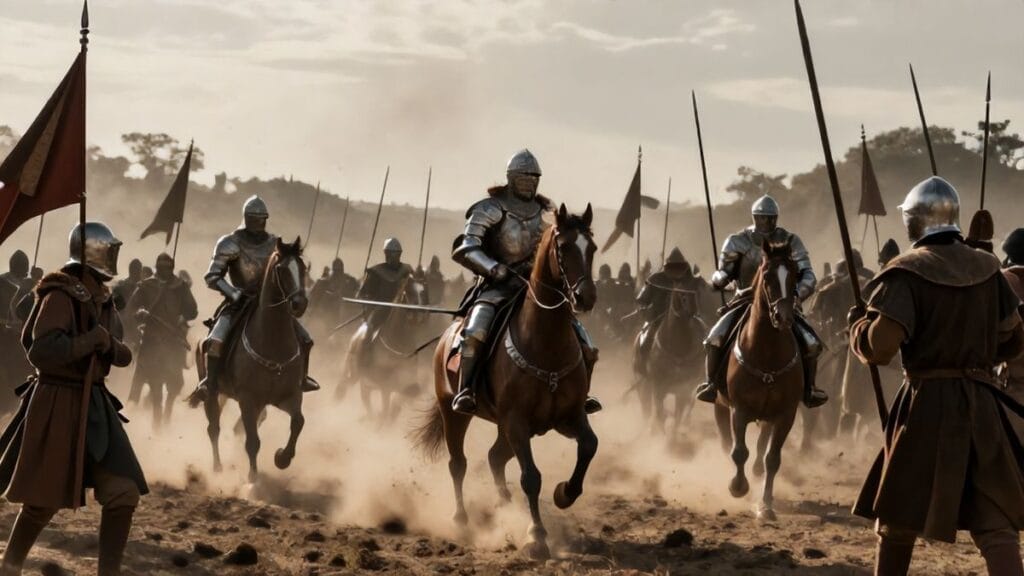
The opening phase of the battle of San Romano was dominated by the shock of mounted lances. Heavy cavalry charged, couched lances aimed at opposing men and horses, in a violent ritual that condottieri had practiced all their lives. Yet this was no tournament. There were no heralds to regulate the bout, no referees to declare a fair encounter. Lines of horses thundered forward, lances leveled, the initial rush propelled as much by bravado and drilled habit as by tactical calculation.
At the first impact, the world shrank to a series of collisions. Lances splintered on shields and armor; some found gaps and slipped under mail or through visors. Horses reared and stumbled as they hit bodies or uneven ground. Men crashed to the earth, their breath knocked from them by the weight of their own armor. Those who remained mounted pushed forward with swords and maces, trying to exploit any break in the opposing line.
Contemporary Italian battles rarely hinged on a single charge, and San Romano was no exception. The initial clash created a tangle of interlocked men and animals, from which both sides tried to disentangle and re-form for renewed attacks. Squadrons wheeled and returned, charging again and again into the melee. Crossbowmen and lightly armored infantry on the fringes tried to find firing angles, loosing bolts and darts into the confusion, sometimes striking their own side in the murk of dust and sweat.
The noise was overwhelming: the metallic ring of weapon on weapon, the dull thud of bodies hitting the ground, the screams of injured men and terrified horses, and over it all the shouted commands of captains attempting to impose order. For the soldier in the middle ranks, vision narrowed to the back of the comrade in front, the long shaft of his lance, and the looming shapes of enemy riders. There was no grand overview, only the desperate immediacy of survival.
Turning the Tide: Reinforcements, Broken Lines, and Desperate Charges
As the engagement wore on, what had begun as a clash between Niccolò da Tolentino’s contingent and Bernardino della Ciarda’s forces drew in more troops. Word of the encounter spread quickly through the countryside. Florentine commanders Micheletto Attendolo and others, alerted to the danger that their general’s detachment might be overwhelmed, spurred to bring reinforcements. On the Sienese side, allied troops tried to close the trap, hoping to finish Niccolò before help could arrive.
This phase of the battle of San Romano was one of balance, with the outcome hovering uncertainly. At moments, it seemed that Niccolò’s Florentines, outnumbered and hemmed in by the landscape, might buckle. Men and horses, exhausted by repeated charges, began to lag. Standards dipped as standard-bearers were unhorsed or forced back. Bernardino pressed forward, sensing that a decisive push might break the enemy line and scatter the remnants.
But it was only the beginning of the day’s drama. As Florentine reinforcements arrived, they crashed into the Sienese flanks, relieving pressure on Niccolò’s embattled core. The sight of fresh banners, the sensation of a new wave of hooves trembling the ground, reinvigorated Florentine morale. Battle narratives from the period often describe such moments when the arrival of allies, or even the rumor of them, could swing the emotional balance of an army. Fear that had edged toward panic shifted back toward grim determination.
The fighting became even more chaotic. Formations degraded into clusters of men centered around their captains’ standards. Captains shouted to rally their companies, and drummers or trumpeters tried to signal maneuvers that only a fraction of the army could actually see or hear. Dust and smoke from discharged firearms—still relatively minor but present—mingled with the earth kicked up by thousands of hooves.
In the melee, individual acts of courage or folly could have outsized impact. A standard-bearer who held his ground might maintain a local anchor point; one who panicked and fled could precipitate a localized collapse. Chroniclers writing after the fact praised Florentine discipline and the bravery of Niccolò’s men, while Sienese-friendly sources emphasized the stubbornness of their own side and attributed setbacks to bad luck or treacherous allies. Both agree, however, that the battle surged back and forth for hours, with no swift and obvious victor.
Blood and Banner: The Capture of Bernardino della Ciarda
Every battle develops its emblematic moment, the image that later generations fix upon as the instant when fate declared itself. At San Romano, that moment, as remembered by Florentines, was the unhorsing and capture of Bernardino della Ciarda. Whether this episode truly decided the outcome or simply symbolized a broader shift, it became the centerpiece of Florentine memory and, later, Florentine art.
According to Florentine accounts, amid the thick of the struggle Bernardino pushed deep into the fighting, intent on pressing what he believed might be a decisive advantage. In the churn of men and horses, he found himself exposed. Whether brought down by a well-placed lance, a thrust from a sword, or a misstep into treacherous ground, he fell from his horse. Before he could remount or be whisked away by his retainers, Florentine men-at-arms closed in and seized him.
The seizure of a leading condottiere on the field carried both practical and symbolic weight. Practically, it could disrupt command and control, demoralizing troops who saw their chief taken prisoner. Symbolically, it provided a potent tale: a great enemy captain humbled and displayed as proof of victory. Chroniclers in Florence lost no time in highlighting the episode, and years later, Paolo Uccello would monumentalize it in paint, showing Bernardino at the center of a tableau of falling horses and triumphant Florentines.
Not all sources, however, agree on the significance of the capture. Some Sienese narratives downplay Bernardino’s role or suggest that the engagement was already waning when he fell into enemy hands. A modern historian, weighing these conflicting accounts, might conclude that while Bernardino’s capture was undoubtedly important, it was only one factor among many. Yet the power of the story is undeniable. In a culture that cherished honor and reputation, the image of a commander struck down and disarmed was too vivid to ignore.
For Bernardino himself, the moment must have been raw and humiliating: dragged from the dirt, armor dented and dust-caked, stripped of weapons, forced into the custody of men he had ridden out to defeat. For Niccolò da Tolentino and his patrons, it was a prize. A high-ranking prisoner could be ransomed; more importantly, he could be paraded, verbally if not physically, in dispatches sent back to Florence. This, they could say, was proof that God and fortune had favored their cause on the fields of San Romano.
Victory Claimed, Truth Contested: Who Actually Won at San Romano?
In the immediate aftermath of the battle of San Romano, both sides rushed to shape the story. War in Renaissance Italy was not only fought with lances and swords; it was waged in letters, reports, and diplomatic conversations. As the dust settled and the dead and wounded were gathered from the fields, messengers galloped toward Florence and Siena, each bearing versions of events tailored for eager civic councils.
From Florence came triumphant proclamations. They celebrated the bravery of Niccolò da Tolentino, the timely arrival of reinforcements, and, above all, the capture of Bernardino della Ciarda. Florentine chroniclers counted prisoners, captured banners, and abandoned equipment as tokens of clear victory. The battle of San Romano, they declared, had demonstrated Florentine prowess and had dealt a serious blow to Sienese arms.
Siena’s reaction was more complex. Some accounts suggest that the Sienese and their allies insisted the battle had been, at worst, indecisive; others hinted that they had achieved some of their objectives and only later been forced to withdraw in good order. Numbers of captured men varied from one report to another. There was also the question of the broader campaign: even if Florence claimed the day at San Romano, did this materially change the strategic picture? These ambiguities opened space for competing interpretations.
Modern historians, examining the sources, have sometimes concluded that the clash was less decisive than Florentine rhetoric suggested. One scholar famously observed that “San Romano was as much a victory of narrative as of arms,” emphasizing that the way Florence told the story mattered as much as the raw military result. Yet chroniclers and artists in Florence succeeded in fixing the idea of San Romano as a Florentine triumph so firmly that later generations seldom questioned it.
In truth, battles of the period rarely produced the kind of clear, annihilating outcomes associated with later warfare. Armies were expensive and slow to replace; even wounded companies could regroup for future campaigns. What mattered, often, was perception: which city seemed ascendant, which appeared to falter. By that standard, Florence’s aggressive claim of victory at the battle of San Romano, amplified by art and ceremony, gave it a psychological and diplomatic edge that transcended the immediate tactical conclusions one might draw from the scattered bodies in the Tuscan fields.
A Renaissance of War: Armor, Weapons, and Tactics in the 1430s
San Romano unfolded at a time when the technology and tactics of warfare were in a state of transition. The gleaming armor and elaborate harnesses of the heavy cavalry, so lovingly detailed in Paolo Uccello’s later panels of the battle of San Romano, represented the height of late medieval martial display. Plate armor covered the body from head to toe, articulated at joints to allow movement while presenting a hard, curved surface to incoming blows. Horses, too, were sometimes caparisoned with protective gear, and richly dyed cloth trappings proclaimed the status of their riders.
Weapons were varied. The long lance remained the principal implement of the initial mounted charge, meant to break the enemy’s front ranks, unhorse riders, and sow confusion. Once the lines closed and lances shattered, men reached for swords, maces, and axes—tools designed as much to dent and crush as to cut, since high-quality plate armor could resist many slashing blows. On foot, pikemen and spearmen tried to fend off cavalry or exploit gaps, while crossbowmen and early handgun-wielders sought vantage points from which to fire into exposed flanks or unarmored sections.
Gunpowder weapons existed but did not yet dominate. Small artillery pieces and handguns were present in Italian armies, but their reliability and rate of fire were limited. At San Romano, the thunder of hooves, the clash of steel, and the hiss of arrows and bolts still formed the heart of the battle’s soundscape. Yet commanders were already thinking in new ways: using field obstacles, integrating missile troops with cavalry, and considering how to protect themselves from the slowly growing menace of firearms.
Tactically, Italian condottieri favored maneuver, feints, and positional play over simple headlong rushes. They were professionals; they understood that conserving their companies was essential to remain in business. This helps explain why, despite the ferocity of engagements like the battle of San Romano, casualty rates among high-status combatants were often lower than one might expect. There was a constant tension between the need to demonstrate decisiveness and the instinct to avoid catastrophic losses—a tension visible in the ebb and flow of the fighting at San Romano as both sides pressed and withdrew, charged and regrouped, in a grim ballet of risk management.
The Aftermath in Florence: Medici Power, Public Memory, and Propaganda
When news of the engagement reached Florence, it arrived not into a political vacuum but into a city in the midst of its own internal transformations. Cosimo de’ Medici, already a leading figure, was methodically consolidating his influence, turning his family’s wealth and network of clients into a durable political machine. For Cosimo and his allies, a victory narrative from San Romano was a welcome gift.
Florence celebrated the battle as vindication of its policies and its chosen commanders. Processions gave thanks to God and the city’s patron saints. Captured banners were displayed in churches or civic spaces, visible tokens of triumph. The names of Niccolò da Tolentino and other captains were praised in public discourse. Yet behind the celebrations, Florentine elites also understood the utility of such stories. They bolstered civic morale, justified war expenditures, and helped silence critics who questioned the wisdom of aggressive campaigns.
Cosimo and his circle were masters at weaving these threads into a broader narrative of Florentine greatness. Over time, the battle of San Romano came to occupy a place in the city’s collective memory as an example of Florentine valor and divine favor. Chronicles commissioned or encouraged by powerful families emphasized the city’s resilience and the skill of its hired captains, aligning military glory with the stability and prosperity that Medici leadership promised.
In this way, an engagement fought in dusty Tuscan fields became part of a political language spoken in palaces and councils. As one fifteenth-century commentator observed of Florentine policy—quoted later by the historian Nicolai Rubinstein—“the deeds of arms were turned to the advantage of those who governed,” a remark that might well have been written with San Romano in mind. The battle’s details, increasingly distant and subject to embellishment, mattered less than the emotional resonance of the victory myth carefully nurtured in the heart of the republic.
Siena’s Wounds: Political Fallout and the Price of Defeat
In Siena, the mood was more somber. Even if some Sienese accounts tried to minimize the scale of the setback, the capture of Bernardino della Ciarda and the Florentine claims of victory were hard to ignore. Siena’s ruling groups had to contend not only with the material losses of men, horses, and equipment but with the intangible blow to prestige and bargaining power.
The immediate political fallout likely included recriminations. Who had advised the course that led to battle? Had allies failed to provide sufficient support? Were there elements of betrayal or incompetence in the field? In the opaque and faction-ridden world of Sienese politics, such questions were never just about military matters; they intersected with rivalries among noble families, guilds, and factions aligned with broader Italian powers.
At the same time, Siena could not afford to admit too much weakness. In a peninsula where stronger states like Milan and Florence watched for any sign of vulnerability, publicly dwelling on defeat was dangerous. Thus, Sienese narratives tended to frame San Romano as a hard-fought encounter with mixed results, part of a larger struggle whose outcome was still undetermined. Yet privately, leaders had to reckon with the implications. A diminished military reputation could complicate the securing of future condotte and alliances; it might also embolden internal opposition.
For the ordinary families of Siena, the consequences were more personal. Sons, brothers, and fathers serving in the companies hired by the republic might not return. Horses and gear, bought on credit or at great expense, were lost. Cemeteries and churches took in the bodies and souls of those who fell. In a society where public rituals marked both triumph and sorrow, San Romano left its own, quieter imprint: in prayers offered for the dead, in the anxious counting of those who came home, in the whispered stories of survivors recounting what they had seen between the hedgerows of a distant field.
From Battlefield to Masterpiece: Paolo Uccello Paints the Battle of San Romano
Decades after the clash, the battle of San Romano underwent a remarkable transformation. What had been a muddied encounter in rural Tuscany became, under the hand of Paolo Uccello, a sequence of shimmering, almost dreamlike panels that now hang separated in London, Florence, and Paris. Uccello, born Paolo di Dono, was a Florentine painter obsessed—contemporaries said almost to the point of monomania—with the new science of perspective. The commission to depict San Romano allowed him to marry this technical fascination with a subject steeped in civic pride.
Uccello painted three large panels, each capturing a different episode: Niccolò da Tolentino leading the charge, the counterattack and the chaos of the engagement, and the moment of Bernardino della Ciarda’s unhorsing. Horses rear and twist in improbable poses, their armor reflecting an idealized gleam. Broken lances lie strewn like so many rulers upon a carefully constructed perspective grid, receding into the painted distance. The background landscape, with its soft hills and dark trees, frames the action in an almost theatrical setting.
These paintings are not eyewitness documents. Uccello was a child when the battle of San Romano took place; he relied on earlier descriptions, heraldic devices, and the expectations of his patrons. Florence wanted not a forensic reconstruction but an epic. Uccello provided exactly that: a visual poem that flattens and clarifies the tumult of combat into balanced compositions where Florentine heroism takes center stage. He emphasized order amid chaos, geometry amid passion.
Yet for all their idealization, the panels carry traces of reality. The elaborate armor and horse trappings reflect actual fashions of the time, even if heightened. The dense clustering of riders, the interlocking forms of men and animals, echo the claustrophobia of massed cavalry melee. Uccello’s work, then, stands at the intersection of memory and myth, a bridge between the lived battle of San Romano and the story Florence wished to tell about it.
According to Giorgio Vasari, writing a century later, the panels were “much praised” in Florence, and their subsequent removal and dispersal into different collections attest to their enduring prestige. Their very survival, while so many other images and documents from the era have been lost, has powerfully shaped how modern viewers imagine the battle. When we think of San Romano today, it is often Uccello’s prancing horses and patterned lances that come to mind, rather than the mud, fear, and confusion experienced by the men who actually fought there.
Perspective, Illusion, and Glory: Reading Uccello’s Panels as Historical Texts
Art historians have long lingered over the technical innovations of Uccello’s battle of San Romano panels—the precise foreshortening, the tiled patterns of lances, the almost mathematical arrangement of figures in space. But the paintings can also be read as historical texts, bearing within them the ideological imprint of Florence’s self-image in the fifteenth century.
In the panel that shows Niccolò da Tolentino leading the charge, Uccello presents the Florentine captain as a near-heroic archetype. He sits astride a richly adorned horse, plume streaming, lance held aloft, his figure dominating the composition. The Sienese forces appear more disordered, their fallen bodies decorating the foreground as trophies of Florentine victory. Perspective lines direct the viewer’s gaze toward the Florentine advance, guiding not only the eye but the narrative: history here is moving in Florence’s favor.
The central panel, with its maelstrom of combat, offers a more complex tableau. Lances crisscross; horses twist; fallen bodies lie at angles carefully chosen to demonstrate Uccello’s mastery of foreshortening. Yet even here, Florentine banners are prominent, while the moment of Bernardino della Ciarda’s unhorsing in the third panel crystallizes the moral of the story: arrogance or opposition to Florence leads to downfall. The enemy captain is frozen in mid-collapse, a cautionary emblem for those who might challenge Florentine arms.
In this sense, Uccello’s paintings do what many historical sources of the period do: they simplify, clarify, and assign meaning. The real battle of San Romano was confusing, its outcome contested, its significance open to interpretation. The painted San Romano, by contrast, is unambiguous: a brilliant Florentine triumph, ordered and almost choreographed. As one modern scholar has noted, “Uccello’s lances are as much lines of argument as lines in space,” a witty but accurate observation on how art can become a form of historical reasoning.
When we place the panels alongside written chronicles, diplomatic letters, and financial records relating to the battle, a richer picture emerges. The Florentine government spent real sums on Uccello’s work, seeing in it an investment in memory and prestige. The panels functioned as propaganda, but also as a kind of secular altarpiece for civic virtue. They invited viewers to see themselves as heirs to a tradition of bravery and order, to believe that their city—despite internal tensions and external threats—was destined to triumph in the turbulent theater of Italian politics.
Lives in the Shadows: Soldiers, Peasants, and the Human Cost of a Single Day
Grand narratives of the battle of San Romano, whether in chronicles or paintings, focus on condottieri, banners, and the dance of armored cavalry. Yet beneath those shining surfaces lay a vast underlayer of human experience, mostly unrecorded. Hundreds of ordinary soldiers—men-at-arms of lesser rank, infantry, crossbowmen, grooms—took the field that day, each with his own tangle of hopes, fears, and obligations.
Many of these men had joined the companies raised by condottieri out of economic necessity. The promised wages, though irregularly paid, offered a livelihood in a world where land and steady work were scarce. Some were seasoned veterans; others were young and untested, having perhaps only participated in minor skirmishes before being thrown into the full chaos of San Romano. They faced not only the obvious dangers of combat but the lingering threats of untreated wounds, disease in camp, and the possibility that if captured without ransom value, they might face harsh imprisonment or enslavement.
The peasants whose fields became the battlefield suffered in quieter but enduring ways. Trampled crops, destroyed fences, burned outbuildings—these were immediate, tangible losses. Requisitioning by both sides, whether compensated or not, stripped larders and barns. After the armies moved on, the local population was left to clear the detritus of war: bodies of men and animals, broken equipment, and the psychological scars of having seen their familiar world invaded by the machinery of high politics.
Church records and local notarial documents occasionally hint at these impacts: sudden changes in property holdings, references to “lands ruined by the passage of soldiers,” bequests hastily made by men going to war. Yet most of the voices remain silent. We do not know the names of the young groom who panicked and fled at the first thunder of hooves, or the farmer who found an abandoned sword in his field weeks later and buried it, unwilling to keep such a bloody token. Still, their invisible presence formed the true ground upon which the celebrated exploits of captains played out.
In remembering the battle of San Romano, it is tempting to dwell on the glittering armor of Niccolò da Tolentino or the dramatic fall of Bernardino della Ciarda. But if we are to understand the event as historians and storytellers, we must also imagine the sweating infantryman who trudged under a hot sun in padded armor, the terrified child watching from a farmhouse doorway as armed men thundered past, the widow counting the days since her husband’s departure and scanning the road for either his return or the messenger who would tell her that he lay somewhere among the unmarked dead in a Tuscan field.
The Long Echo: How San Romano Shaped Italian Warfare and Renaissance Politics
Measured against the great upheavals of European history, the battle of San Romano might seem like a small affair—a single day’s fighting in a localized war between neighboring city-states. Yet its repercussions, when traced through diplomatic records, artistic commissions, and shifting alliances, reveal how even such “minor” battles could reverberate through the fabric of Renaissance Italy.
Militarily, San Romano confirmed both the strengths and limits of the condottieri system. Florence emerged reassured that its investment in professional captains like Niccolò da Tolentino could yield tangible results, yet also reminded that outcomes depended on timely reinforcements, adequate funding, and careful negotiation of contracts. For Siena and other smaller powers, the battle underlined the difficulty of confronting wealthier neighbors who could outspend and outlast them in the hiring of elite companies.
Politically, the narrative of victory at San Romano fed into Florence’s broader posture in Italy. The city’s willingness to fight and its capacity to commission and disseminate a compelling story of triumph signaled to allies and rivals alike that Florence was a force to be reckoned with. In the intricate diplomacy that followed—truces, shifting coalitions, and periodic flare-ups of conflict—memories of episodes like San Romano weighed on calculations. Cities courted or avoided Florence with an awareness of its recent martial record and its reputation for turning battles into enduring symbols of prestige.
In cultural terms, the transformation of the battle into subject matter for high art created a model that other states would emulate. The idea that a city’s identity and legitimacy could be anchored in painted narratives of military glory became one of the hallmarks of Renaissance civic culture. From Mantua to Ferrara, courts commissioned fresco cycles showing victories and sieges, all participating in the same logic that had made Uccello’s San Romano panels so potent for Florence.
Looking back, then, the battle of San Romano was more than a violent interruption of rural life on a June morning in 1432. It was a node in a network of events that shaped how Italian states fought, negotiated, remembered, and represented themselves. Its lances and banners cast long shadows, visible not only in the written chronicles of the fifteenth century, but on the museum walls where Uccello’s painted horses still rear in perpetual, frozen combat, embodying a city’s long-ago bid for honor in a fractured land.
Conclusion
From the quiet dawn over Tuscan fields to the glittering panels that now hang in distant galleries, the story of the battle of San Romano spans war, politics, art, and memory. What began on 1 June 1432 as a hazardous encounter between rival forces—Florentine and Sienese, led by condottieri wary of both defeat and excessive victory—became, over time, a touchstone of Florentine identity. The clash itself was shaped by the practical realities of the condottieri system, by broken terrain that muddled plans, and by the complex dance of reinforcements and morale. In its midst, figures like Niccolò da Tolentino and Bernardino della Ciarda played roles that would be endlessly retold and reimagined.
Yet behind the named captains stood the largely anonymous multitude: soldiers who risked their lives for pay and survival, peasants whose lands were torn by hooves and fire, families in Florence and Siena waiting anxiously for news. Their experiences, though seldom recorded, give depth to the event and remind us that history is not only made by the famous but also borne by the many. In the aftermath, Florence adeptly turned San Romano into a symbol of divine favor and civic prowess, weaving it into the tapestry of Medici-era propaganda, while Siena struggled to absorb the loss and maintain its standing amid stronger neighbors.
The afterlife of the battle in art, most notably in Paolo Uccello’s hauntingly ordered depictions, ensured that San Romano would never entirely fade into archival obscurity. On the contrary, Uccello’s fusion of perspective and pageantry kept the memory vivid, if also idealized, presenting future generations with a stylized drama of armored cavalry, falling captains, and geometric fields of lances. In these images, as in the chronicles that preceded them, reality and narrative intermingle: the messy, contested facts of the battle of San Romano transformed into a story whose meaning served the needs and dreams of a city on the rise.
To revisit San Romano today is to engage not only with a single day’s fighting but with the whole ecosystem of Renaissance Italy: its fractious politics, its economics of mercenary warfare, its capacity to mold memory through art and rhetoric. The battle invites us to ask how events become symbols, how symbols are used, and what gets lost along the way. Between the dust of the actual battlefield and the luminous surfaces of Uccello’s panels lies a rich terrain for historical imagination—one in which lances are both weapons and lines of argument, and where the echoes of a June morning in 1432 still murmur through the corridors of museums and the pages of history.
FAQs
- What was the Battle of San Romano?
The Battle of San Romano was a military engagement fought on 1 June 1432 near the locality of San Romano in Tuscany, between forces allied with the Republic of Florence and those aligned with the Republic of Siena, within the broader context of the Florentine war against Lucca. It involved primarily mercenary forces led by professional condottieri and became famous less for its immediate strategic impact than for the powerful victory narrative Florence built around it. - Who were the main commanders involved in the battle?
The principal commanders were Niccolò da Tolentino, serving as a leading condottiere for Florence, and Bernardino della Ciarda, fighting on the Sienese side. Other important figures included Florentine captains such as Micheletto Attendolo, whose reinforcements played a key role in preventing Niccolò’s forces from being overwhelmed as the fighting intensified. - Which side actually won the Battle of San Romano?
Florence claimed victory, emphasizing the capture of Bernardino della Ciarda and the seizure of prisoners and equipment as proof. Sienese and allied accounts sometimes portrayed the encounter as less decisive. Modern historians generally accept that the Florentine side gained the upper hand tactically and, more importantly, succeeded in shaping the perception of the battle as a Florentine triumph, even if it did not decisively end the wider war. - Why is the battle of San Romano considered important today?
While not a turning point on the scale of major European battles, San Romano is important because it illuminates the nature of Italian warfare in the age of the condottieri and because its memory was skillfully used for political purposes in Florence. Its greatest modern fame comes from Paolo Uccello’s three monumental panels depicting the conflict, which are milestones in Renaissance art and offer insight into how war was remembered and idealized. - What role did mercenaries play in the battle?
Mercenaries—organized under condottieri contracts—were central to the battle. Both Florence and Siena relied on professional companies of cavalry and infantry whose leaders negotiated detailed terms of service. These captains balanced the need to fight effectively with the need to preserve their forces, leading to a style of warfare characterized by maneuver, selective engagement, and an emphasis on capturing high-status prisoners rather than slaughtering them. - How accurate are Paolo Uccello’s paintings as historical records?
Uccello’s panels capture certain authentic elements of fifteenth-century warfare, such as armor styles and the prominence of heavy cavalry, but they are not literal documentary records. Painted decades after the event and shaped by Florentine patronage, they idealize the battle, imposing order and clarity on what was in reality a muddled and bloody encounter. They tell us as much about Florentine self-image and artistic priorities as about the tactical details of the engagement. - What was the broader political context of the battle?
The battle of San Romano took place within the Florentine campaign against Lucca and amid the complex web of Italian city-state rivalries in the early fifteenth century. Florence sought to expand and secure its influence in Tuscany, while Siena resisted and maneuvered among larger powers like Milan and the Papal States. San Romano was one episode in a prolonged struggle for regional dominance and security. - Did the battle significantly change the course of the war?
The battle did not by itself end the conflict or transform the strategic map of Tuscany, but it contributed to Florence’s ability to claim moral and psychological advantage. By presenting San Romano as a clear victory, Florence strengthened its negotiating position and reinforced internal support for its war policy, even though fighting and diplomatic maneuvering continued for some time afterward. - Were there many casualties at San Romano?
Exact numbers are unknown, but consistent with many Italian battles of the period, deaths among heavily armored elites were likely lower than in later, more destructive wars, while losses among lower-ranking soldiers and support personnel were heavier. The emphasis on capturing high-status prisoners for ransom reduced elite fatalities, but for ordinary soldiers and local peasants, the battle could be deadly or economically devastating. - Where can I see artworks related to the Battle of San Romano today?
Paolo Uccello’s three famous panels depicting the battle of San Romano are now divided among major European museums: one is in the National Gallery in London, another in the Uffizi Gallery in Florence, and the third in the Louvre Museum in Paris. Together, they offer a vivid, if stylized, visual narrative of the engagement.
External Resource
Internal Link
Other Resources
- Encyclopaedia Britannica – general search for the exact subject
- Google Scholar – academic search for the exact subject
- Internet Archive – digital library search for the exact subject

