Table of Contents
- On the Eve of Clash: A September Morning in the Principality of Antioch
- Crusader Outpost in a Storm: The Fragile World of Antioch in 1115
- The Men Who Would Decide the Day: Roger of Salerno and Ilghazi
- Sarmin and the Plain of al-Balat: Geography of an Ambush
- Muster of Banners: How the Crusader Coalition Came Together
- The Road to Sarmin: Maneuver, Fear, and the Shadow of Past Defeats
- When Scouts Returned Breathless: The Morning of 14 September 1115
- The Charge and the Trap: Reconstructing the Battle of Sarmin
- Dust, Steel, and Prayers: Voices from the Killing Ground
- Breaking the Crescent: Why the Muslim Coalition Collapsed
- After the Shouting Faded: Casualties, Captives, and the Dead
- Antioch Reprieved: Political Shockwaves of a Narrow Victory
- Merchants, Monks, and Peasants: How Ordinary People Felt the Outcome
- The Battle in Ink: Chroniclers, Rumors, and the Making of a Legend
- From Triumph to Tragedy: Sarmin’s Legacy Before the Disaster of 1119
- Faith, Fate, and Strategy: What the Battle of Sarmin Reveals About the Crusades
- Conclusion
- FAQs
- External Resource
- Internal Link
Article Summary: On 14 September 1115, the small town of Sarmin in the Principality of Antioch became the stage for a battle that briefly reversed the fortunes of the embattled Crusader states. The battle of sarmin pitted a precarious Frankish coalition under Roger of Salerno against a powerful Muslim alliance led by Ilghazi and his fellow commanders, all determined to crush Antioch once and for all. In a world still haunted by the catastrophe of 1104 at Harran, the fight near Sarmin was saturated with memories of past defeats and the fear of annihilation. Through careful maneuvering, intelligent use of terrain, and a rare display of unity among Latin, Armenian, and Syrian Christian forces, the Crusaders managed to spring a decisive counter-ambush. The article traces the wider political context of the battle of sarmin, reconstructs the day’s fighting in immersive detail, and follows the consequences that rippled through Aleppo, Antioch, and beyond. It also explores how chroniclers shaped the memory of the battle of sarmin and why its apparent miracle of survival did not prevent new disasters only four years later. Ultimately, this narrative shows how the battle of sarmin stands at a crossroads of faith, fear, strategy, and chance in the early history of the Crusades.
On the Eve of Clash: A September Morning in the Principality of Antioch
The sun rose over the hills of northern Syria on 14 September 1115 with the kind of deceptive serenity that has so often preceded catastrophe in history. Thin mist lay across the fields near the small town of Sarmin, a settlement of orchards, low stone houses, and narrow lanes resting in the landscape between the Orontes River and the fertile plains that fed the Principality of Antioch. To the east lay the broad expanses stretching toward Aleppo; to the west, distant but palpable, the looming walls and churches of Antioch itself. On that morning, the air smelled of dust, ripening grain, sweat, and fear.
Men were already awake long before dawn. Knights tightened straps on mail hauberks, pages checked the girths of nervous horses stamping in the chill air, and priests whispered hurried masses in makeshift chapels of canvas and wood. In other tents, Armenian lords, Frankish barons, and local Syrian Christian notables hunched over rough maps scratched onto parchment or into the dirt with daggers. They knew the stakes. To the north and east, a coalition of Muslim emirs had gathered—Turkish, Syrian, Artuqid—united for once not by convenience alone, but by the promise of a decisive blow against the Christian stronghold of Antioch.
This was the world into which the battle of sarmin would erupt: a fragile frontier, patched together by treaties, bold gambles, and the sheer will to survive. The men gathered under the standard of Roger of Salerno, the regent-prince of Antioch, were not strangers to peril. They had heard the terrifying stories of Harran, where Crusader pride had already been broken once, and many had family or friends who never returned from that disastrous campaign. Yet, as dawn brushed gold across the plain, some of them allowed themselves a thin thread of hope. The army was larger than usual, reinforced by allies, and—astonishingly for the fractious Latin states—there was, for once, a measure of unity.
But this was only the beginning. Before sunset, this quiet patch of earth would be churned into a chaos of hooves, arrows, and bodies. Sarmin would be known less for its orchards and more for the cries of men dying under Frankish lances and Turkish sabers. And in the smoke and dust of that bloody afternoon, the future of Antioch—and with it, the future course of the Crusader project in northern Syria—would hang suspended on the edge of a sword.
Crusader Outpost in a Storm: The Fragile World of Antioch in 1115
To understand why the battle of Sarmin mattered, one has to step back into the precarious landscape of the early twelfth century, when the first wave of Crusader conquest was already souring into a harsh, unstable reality. The Principality of Antioch, carved out of Byzantine territory and Muslim emirates after a grueling siege in 1097–1098, was never a comfortable possession. It was a fortress thrust deep into hostile territory, surrounded by rival powers who might hate one another but still hated the Latin newcomers more.
By 1115, the Crusader states were nearly a generation old, yet still shockingly fragile. Antioch, though enormously fortified and strategically placed, had a prince who was not a prince at all. Tancred, the fiery Norman who had governed Antioch for years, was dead. His successor, Bohemond II, was still in Europe and too young to rule. Therefore, the principality was under the regency of Roger of Salerno, Tancred’s cousin—able, ambitious, but lacking the unchallenged authority of a sovereign ruler. Every decision he made had to navigate a maze of jealous barons, wary Byzantine neighbors, and ever-watchful Muslim rulers.
The Muslim world around Antioch was fractured, but not disorganized. To the east lay the powerful city of Aleppo, contested by rival Turkish warlords and watched anxiously by the great Seljuk sultanate. South and southeast, the city of Mosul exerted its own gravitational pull. The Artuqid princes—among them the wily Ilghazi—ruled patches of northern Mesopotamia and Syria, shifting alliances as opportunity demanded. Theoretically, these potentates all belonged to a wider Islamic world united in faith. In practice, their rivalries were bitter and often violent. It was this disunity that had allowed the First Crusade to thrust so deep in the first place.
Yet by 1115 there were clear signs the pendulum was swinging back. Muslim leaders had learned from their failures, had observed the Crusader preference for tight infantry formations and heavy cavalry, and had begun to coordinate their raids and campaigns with greater discipline. The disaster at Harran in 1104 had shown that Frankish armies could be routed and captured, their arrogance punished, their cross-emblazoned banners trampled in the dust. Antioch, in particular, was a ripe target. The city commanded the route between Anatolia and Syria; if it fell, the land bridge that nourished the Crusader states from the north could be severed.
Within Antioch itself, society was anything but homogeneous. Latins—mostly French, Norman, and Italian—formed the military and political elite, but the city’s population was largely Armenian, Greek, and Syrian Christian, with Muslim communities as well. Churches and mosques stood not far from one another, symbols of deep tensions but also of daily coexistence. Trade flowed through the city’s markets: spices from the east, timber from the mountains, coins minted with Latin inscriptions but circulating alongside Arabic and Byzantine currencies. Merchants cared more about safe caravans than sacred causes, but their livelihood depended entirely on the outcome of war.
In this context, any large-scale Muslim coalition was terrifying. Rumors in the markets and monasteries spoke of a grand army assembling—an army not merely to raid, but to crush. Frightened peasants in outlying villages buried their valuables or fled toward the relative safety of Antioch’s walls. Armenian lords, always balancing between Latin overlords and Muslim neighbors, sharpened their swords and negotiated quietly with both sides. All eyes turned to Roger of Salerno, who had to decide whether to keep his forces bottled up behind the walls or to risk everything in a field battle that could either save or doom his principality.
The Men Who Would Decide the Day: Roger of Salerno and Ilghazi
History often narrows to the choices of a few individuals at critical moments. The battle of Sarmin was one such moment, and at its heart stood two men: Roger of Salerno, the regent of Antioch, and Ilghazi ibn Artuq, one of the foremost Muslim commanders of his generation. Both were experienced leaders, both hardened by frontier warfare, and both understood the stakes better than anyone beneath their banners.
Roger of Salerno was no royal by birth, but he was steeped in the warrior culture of the Normans. Raised among the descendants of Viking raiders who had carved out duchies in Italy and the Levant, he belonged to a tradition that revered boldness almost as much as piety. Appointed regent after Tancred’s death, he lacked the full legitimacy of a hereditary prince and therefore had to govern through constant negotiation and limited coercion. That made his military reputation all the more important. Roger needed victories to cement his authority, not merely stalemates.
Those who saw him described a man at once practical and proud—someone who could weigh the risks of battle yet still lean toward audacity. He had defended Antioch against multiple threats, carried out raids, and secured alliances. In 1115, his greatest achievement before Sarmin was perhaps not a battle at all, but the hard work of diplomacy: persuading neighboring Latin rulers and local Armenian princes to unite in the face of the danger from Aleppo and Mesopotamia.
On the other side stood Ilghazi, Artuqid ruler and capable general, a man who had navigated the turbulent politics of the Muslim frontier with ruthless skill. His family, the Artuqids, had been carving their own domains out of the weakening Seljuk empire, turning local power into semi-independent emirates. Ilghazi was no idealized holy warrior; like many leaders of the time, his motives mixed piety, ambition, pragmatism, and the pressing need to strengthen his house against rivals.
Ilghazi’s strength lay in his command of the Turkish mounted archer tradition and his reputation among other Muslim commanders. He could gather allies under a banner of jihad and shared interest, drawing in forces from Aleppo, Mosul, and beyond. Yet that coalition, for all its impressive size, was fragile. Every emir had his own aims: plunder, prestige, territorial gain. Coordination was possible, but always precarious. One misjudged maneuver, one rumor of treachery, could undo the entire structure like a tent torn from its pegs by a sudden wind.
Between these two leaders lay not only the immediate tactical question of how to fight near Sarmin, but also the deeper issue of whether unity could override rivalries—on both sides. Roger had to keep Angevins, Normans, Provençals, and Italians in line, not to mention his Armenian allies and the Latin patriarch who insisted on seeing divine will in every military decision. Ilghazi, for his part, had to persuade other emirs to accept his plans and not steal glory or plunder at critical moments. The outcome of the coming clash would depend as much on their personalities and political skill as on the length of their lances and the sharpness of their arrows.
Sarmin and the Plain of al-Balat: Geography of an Ambush
Wars are not fought in abstract space. The land itself—its folds, rivers, and roads—shapes the choices of commanders. The battle of Sarmin unfolded in a terrain that both invited and betrayed armies: the region around the town of Sarmin and the plain known as al-Balat, lying between the Orontes valley and the approaches to Aleppo.
Sarmin was more than a mere village, even if its fame today comes largely from that day in 1115. It lay on a network of roads that linked Antioch and its hinterland to the larger Syrian world. Caravans moving from Aleppo to the coast often passed near it; messengers and pilgrims crossed the same ground. Fertile fields, irrigated by seasonal rains and carefully maintained channels, spread around the town. There were orchards—olive, fig, and pomegranate—interspersed with patches of open land that could quickly turn into a battlefield.
To the inexperienced eye, the plain might have seemed gently undulating, offering no obvious strongpoints. But Roger and his scouts knew every depression, every slight rise that might conceal a contingent of cavalry. Dry streambeds offered cover for infantry or hidden reserves. Clumps of trees, while sparse, could break up a charge or obscure lines of sight. A commander who controlled the approach roads and chose his ground carefully could shape how and where the enemy deployed.
Crucially, the area was close enough to Antioch that Roger could not allow a hostile army to pass unchecked. If Ilghazi broke through here, he could swing toward the Orontes, threaten key fortresses, and possibly isolate Antioch itself. On the other hand, if the Frankish army could intercept the Muslim coalition on this ground, there was a chance—just a chance—to inflict a sharp defeat and roll back the immediate danger. Terrain, in this sense, was not neutral. It was a set of choices, and some of those choices would prove fatal to one side or the other.
Local inhabitants, though rarely named in the chronicles, were deeply aware of the danger. Peasants drove their flocks away from likely lines of march, and small, fortified towers—often held by Armenian or Syrian Christian lords—watched anxiously for dust on the horizon. Sarmin itself would soon find its fields packed with warriors whose quarrels and alliances were only dimly understood by those who just wanted to harvest in peace. But in the age of the Crusades, peace was the most fragile possession of all.
Muster of Banners: How the Crusader Coalition Came Together
It is astonishing, isn’t it, that the same lords who so often quarreled over castles and tolls could, at moments of mortal danger, pull themselves into an uneasy unity. In 1115, with word spreading that a major Muslim alliance was coalescing under Ilghazi and his partners, Roger of Salerno began a frantic effort to gather every ally he could to defend Antioch.
Roger’s first recourse was to his fellow Latins. The King of Jerusalem, Baldwin I, had his own concerns further south—defending the Holy City, battling Fatimid Egypt, and containing threats from Damascus. Yet he understood that if Antioch fell, the balance of power in the east would tilt dramatically against the Crusader states. So Baldwin responded, marching north with a contingent of knights and sergeants. The arrival of the king added both manpower and symbolic weight to the coalition. It signaled that this was not just Antioch’s problem; it was a crisis for the entire Latin project in the East.
Other lords followed. From the County of Tripoli, still relatively new and insecure, came warriors eager to prove their worth. Armenian princes from Cilicia, with long experience navigating between Turkish and Byzantine powers, brought their own forces of mounted archers and infantry. Their motivations were complex: fear of Turkish expansion, the desire to keep Antioch as a counterbalance, and the chance to gain favor—or at least security—from their Latin neighbors. Byzantine involvement was more ambivalent, yet the possibility of auxiliary troops and diplomatic pressure on Muslim rivals hovered in the background.
Roger’s camp became a tapestry of dialects and customs. Norman knights from southern Italy drank beside Provençal barons who had followed Raymond of Saint-Gilles years earlier. Armenian nobles conversed in their own tongue, occasionally slipping into Greek or Arabic when dealing with merchants and envoys. The Latin Church was present as well. Patriarchs and bishops rode with the army, seeing in the looming confrontation a new test of God’s favor. Relics were carried in procession through the camp, crosses raised, prayers intoned for victory.
Yet behind the celebrations of unity, there was tension. Who would command which wing? Who would have the honor of the vanguard? Which lords would be compensated if their lands were raided while they marched with the host? Chroniclers hint at quarrels, patched over by Roger’s delicate hand and perhaps by the stern intervention of the king. The coalition that would fight at Sarmin was a patchwork sewn together in haste. Its strength lay in numbers and in the sheer determination of its leaders not to face the future alone. Its weakness lay in the fragile egos and competing agendas that could easily fray in the heat of battle.
The Road to Sarmin: Maneuver, Fear, and the Shadow of Past Defeats
As summer turned toward autumn in 1115, both coalitions—the Crusader alliance under Roger and the Muslim forces under Ilghazi—began to move. The weeks before the battle of Sarmin were a dance of maneuver, reconnaissance, rumor, and misdirection. Neither side wanted to fight at a disadvantage, and each hoped to lure the other into a fatal mistake.
Memories of Harran weighed heavily on the Latin commanders. In 1104, a Frankish army had been drawn out into open country and outmaneuvered by Turkish forces who feigned retreat, scattered their opponents, and then turned to annihilate them. The result had been catastrophic: counts captured, armies shattered, prestige broken. Baldwin of Edessa, among others, had paid dearly. Roger was determined not to let Antioch suffer a similar humiliation. Thus, while he was willing—even keen—to seek a decisive engagement, he watched carefully for signs of feigned flights or overly tempting opportunities.
Ilghazi, for his part, relied on mounted scouts and local informants to track the Crusader movements. He wanted to force them into a fight on ground that favored his light cavalry: open plains where Turkish horse-archers could ride in wide arcs, harassing and exhausting the heavier Frankish knights. At the same time, he had to keep his multi-ethnic Muslim army fed and cohesive. Every day spent maneuvering saw supplies consumed, tempers frayed, and the risk of desertion grow.
Villages found themselves at the mercy of passing troops—Christian and Muslim alike. Grain stores were seized, wells drained, and livestock slaughtered. For the peasants who tilled the fields along the Orontes valley and the approaches to Sarmin, the grand talk of jihad and holy war mattered little compared to the immediate terror of armed men. Stories filtered back to the cities: of families hiding in caves, of churches stripped of valuables, of small mosques ransacked in revenge raids. The frontier, never truly peaceful, became in those weeks a place of raw, unmediated violence.
Some chroniclers suggest that Roger skillfully masked his real intentions, allowing Ilghazi to believe the Crusaders were either hesitant or poorly coordinated. If so, it was a dangerous bluff. The coalition could easily have fractured if any major lord lost confidence. But Roger managed to keep the army focused, drawing it gradually toward the region around Sarmin and the plain of al-Balat, where he believed he could force Ilghazi into a confrontation on ground at least partially of his own choosing.
All the while, the spiritual temperature rose. In Christian sermons, the looming battle was framed as a test of God’s continued favor—an echo of the First Crusade, when supposedly miraculous victories had convinced many that heaven endorsed their enterprise. Among the Muslim troops, preachers spoke of defending Islam from invaders who had seized cities and desecrated mosques. Thus, when the two armies finally approached each other near Sarmin, they did so not merely as rival polities but as communities convinced they were fighting for their very survival under the eyes of God.
When Scouts Returned Breathless: The Morning of 14 September 1115
The morning of the battle of Sarmin began not with a trumpet call, but with the pounding of hooves as scouts raced back into the Crusader camp. They brought word that the enemy was closer than many had believed, that dust clouds on the horizon were not a mirage but the vanguard of Ilghazi’s army. Horses came in lathered, riders slick with sweat and anxiety. In the command tents, the last debates ended. The time for council had passed; the time for steel had come.
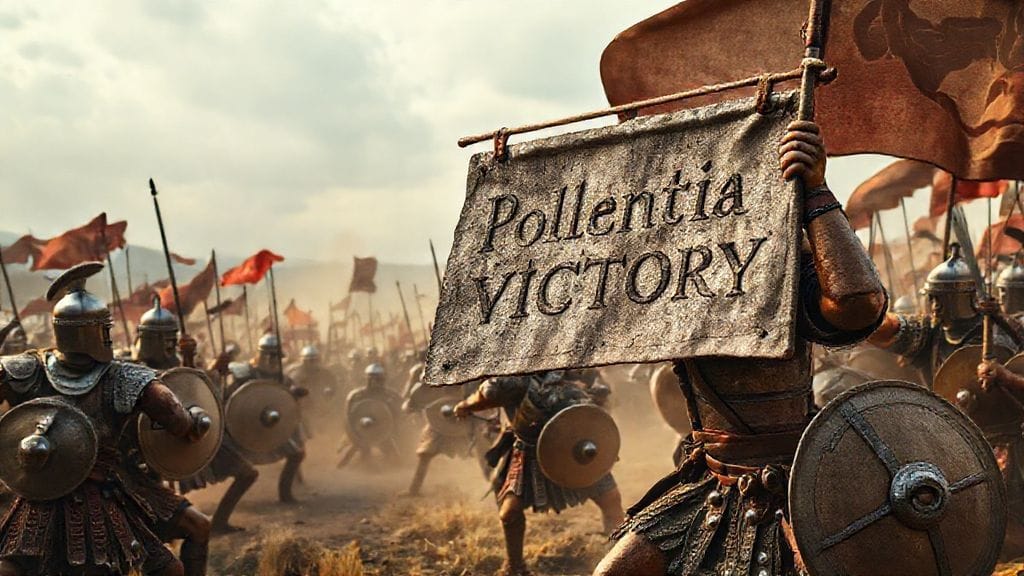
Roger and Baldwin quickly reviewed their deployment options. The Latin forces would be drawn up, as usual, with heavy cavalry at the core: mailed knights whose charge, if delivered in tight formation, could shatter almost any opposing line. Supporting them were infantry—spearmen, crossbowmen, and archers—less glamorous but essential for protecting the flanks and anchoring the battle line. Armenian contingents, skilled horsemen and archers themselves, added flexibility and local knowledge.
According to one narrative preserved by the chronicler Albert of Aachen, the Latin leaders attended mass before they deployed, receiving the Eucharist as if stepping into a final judgment. Whether Albert’s detail is precisely accurate or not, the sentiment certainly fits the mentality of the day. Men made confessions, crossed themselves, and fingered amulets or relics sewn into their garments. Even those for whom war was a profession could not entirely banish the fear that they might soon be judged on more than their skill with lance and sword.
On the far side of the coming battlefield, Ilghazi’s forces were likewise forming ranks. Banners fluttered above clusters of cavalry, their tails snapping in the wind. The long composite bows of the Turkish horse-archers, deadly at range and in motion, were checked and strung. Infantry, though less central to Turkish tactics than to Latin ones, prepared to hold ground where needed, or to secure camp and baggage. Drums and horns sounded, their pulse rolling across the plain like a distant storm.
The two armies could see each other now, not merely as clouds of dust, but as lines and masses of men. Shouts in French, Italian, and Armenian carried on one side; Arabic, Turkish, and Kurdish on the other. The smell of sweat and leather rose with the temperature. Each side tried to gauge the other’s strength. Was the enemy larger? Better positioned? Were those banners on the enemy flank a feint or a serious threat?
In the midst of this, somewhere near the center of the Crusader host, Roger of Salerno had to make one more decision. He could stand on the defensive, waiting for Ilghazi to commit his forces and risk trying to dance around the Latin line. Or he could seize the initiative, attempting to strike first and disrupt the carefully honed rhythm of Turkish cavalry tactics. The choice he made would define the course of the battle of Sarmin.
The Charge and the Trap: Reconstructing the Battle of Sarmin
Contemporary sources for the battle of Sarmin are not as numerous as for the great showpiece engagements of the Crusades, but by piecing together Latin and, more sparsely, Muslim accounts, historians have reconstructed a plausible narrative of that fateful day. What emerges is a portrait of a battle that began in apparent weakness for the Crusaders and ended in a sudden reversal—one that owed as much to tactical cunning as to brute courage.
As Ilghazi’s coalition drew near, their horse-archers likely fanned out in a loose crescent, probing the Crusader flanks with arrows and feigned advances. This was the tested pattern of Turkish warfare: to harass, draw out, and fragment the heavier Latin cavalry, forcing them into disordered pursuits. Once the knights broke formation in their impatience to strike, the Turks would wheel around, isolate them, and cut them down at leisure. It was the grim lesson of Harran, and the Turkish emirs must have hoped to repeat it on an even larger scale.
Roger, however, had no intention of playing the same role in a familiar tragedy. Instead, he deployed his forces in a more compact and disciplined formation than might have been expected. The Crusader infantry, including both Latin and local levies, formed a solid core, their shields overlapping, their spears angled to ward off sudden charges. Crossbowmen and archers were placed where they could respond to Turkish skirmishers. The cavalry were held in check—no easy task—until the moment was right.
The key to the battle appears to have been a combination of defensive restraint and a sudden, concentrated counterattack. For a time, the Crusader line endured the rain of arrows, trusting in their armor and shields. Horses suffered; men winced as shafts thudded into wood and leather. A few knights, perhaps, could not resist spurring forward in rash attempts to catch elusive riders, only to be called back or swallowed by the disciplined line.
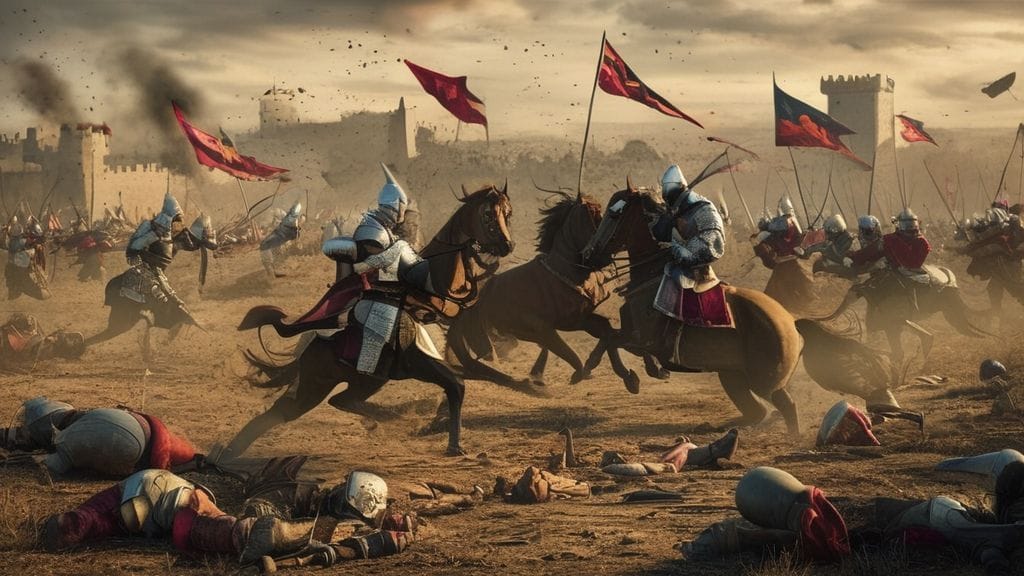
Then, at a moment Roger judged decisive—perhaps when some portion of Ilghazi’s army had come too close or too extended—the Crusader cavalry surged forward in a coordinated charge. Unlike earlier battles where individual bravery undermined cohesiveness, at Sarmin the Latin knights appear to have maintained formation. They struck not at scattered skirmishers, but at a segment of the Muslim line that had, for whatever reason, become vulnerable.
One can imagine the impact: dozens, perhaps hundreds, of armored horses thundering over the plain, lances couched, the sun flashing off mail and helmets. The Turkish cavalry, superb at shooting from a distance and wheeling away, were far less effective when pinned and pressed. If part of Ilghazi’s coalition had indeed ridden close in an attempt to envelop the Crusader flank, they now found themselves the ones surprised, caught in a charge they could not fully evade.
Some sources suggest that Roger also took advantage of the terrain, using slight rises and depressions to conceal portions of his force or to channel the enemy into narrower fronts. If true, this would underline his alertness to geography and his unwillingness to fight on terms dictated solely by Ilghazi. In any case, the sudden, disciplined Latin charge broke the rhythm of Turkish tactics. The crescent faltered; confusion spread down the line.
Historians have debated whether the Muslim coalition at Sarmin was as large and formidable as some Latin chroniclers claim. It is possible that the Crusader writers exaggerated the odds to magnify their victory. Yet even a smaller coalition would have posed a mortal danger to Antioch. The important fact is that the coalition did not hold under the shock. Once one wing began to waver, panic spread; what had moments earlier been a threatening arc of horsemen became a scatter of units trying to avoid encirclement and slaughter.
Thus the battle of Sarmin, for all its initial similarities to earlier eastern encounters, turned into something different: a case where Latin heavy cavalry, used at the right moment and in the right formation, overturned the advantages of mobile archery and forced the enemy into rout.
Dust, Steel, and Prayers: Voices from the Killing Ground
It is tempting, centuries later, to see the battle of Sarmin in lines on a map and neat descriptions of charges and counter-charges. But on that day in 1115, for the men in the thick of it, the world shrank to the few feet of ground beneath their boots and hooves, the swing of a sword, the weight of armor, the taste of dust and blood.
Imagine a knight of Antioch, perhaps a second son of a minor Norman house, who had come east hoping for land and glory. He waits in the line as arrows patter against his shield, his arm already numb from the shock of impact. Sweat runs down his back beneath the hauberk. To his left, an Armenian horseman mutters a prayer in a tongue the Norman barely understands; to his right, a local Syrian Christian, recruited as an infantryman, grips his spear so tightly his knuckles show through the grime.
When the order comes—some shouted command passed irregularly along the line, accompanied by a sudden forward surge—he lowers his lance, spurs his horse, and plunges into a haze of dust. For a few terrifying seconds, he can see almost nothing. Then shapes resolve: men, horses, banners, some turning in surprise, others already wheeling away. His lance strikes something solid; he feels the jolt up his arm, hears a scream in a language he does not know. Suddenly, the lance is gone, torn from his grasp. He draws his sword and presses on, half-blind, deafened by the roar.
On the other side, a Turkish horse-archer sees the charge too late. He had been circling, loosing arrows into the Frankish line, confident that he could stay just out of reach. But now the armored cavalry are too close, their formation tighter than he expected. He tugs desperately at his reins, trying to wheel away, firing one last, hurried shot that goes wide. The armored wall bears down on him. He has time to call out to a companion, an oath to God spilling from his lips, before a lance or sword finds him. Perhaps he falls and is trampled; perhaps he manages to slip free, only to find his comrades already scattering.
Chroniclers, such as the Latin writer William of Tyre a few decades later, would speak of God’s favor shining clearly in the victory at Sarmin (William, writing in the 1170s, retroactively celebrates the day as a sign that “the Lord still stretched His arm over Antioch”). But in the moment, men on both sides felt something far less exalted: terror. Horses screamed as they went down. Men, pierced through by arrows or crushed under hooves, gasped for breath and cried for mothers far away. Standards fell and rose again, sometimes seized by men of lesser rank whose sudden courage or desperation would never be recorded by name.
And yet, above the chaos, there was also grim exultation. Frankish knights who broke into the disordered ranks of Ilghazi’s troops shouted war cries—“Deus vult!” or the names of saints and lords. Muslim warriors, even as the line wavered, cried “Allahu akbar!” and tried desperately to rally around their emirs. Moments of intense personal combat played out: a duel between a Latin noble and a Turkish commander, each hoping that if he could kill the other, his side might yet win. Some of those duels have come down to us in embellished form; others vanished unrecorded, lost in the general slaughter.
When modern historians read the terse lines of twelfth-century chronicles—“and there was great killing on both sides”—they are reading the faint echoes of this lived experience. Sarmin’s fields, that afternoon, were covered not merely with bodies but with broken gear, splintered shields, snapped arrows, and, in the eyes of survivors, broken futures.
Breaking the Crescent: Why the Muslim Coalition Collapsed
In analyzing the outcome of the battle of Sarmin, historians have searched for the precise tipping point at which a dangerous Muslim coalition turned into a routed, retreating mass. No single cause can fully explain it, but several factors, braided together, offer a compelling explanation.
First was the disciplined timing of the Crusader counterattack. Rather than responding piecemeal to Turkish harassment, Roger appears to have held his nerve, allowing his army to absorb the first phases of the enemy’s standard tactics. This required not only personal courage but firm control over his hot-blooded knights. When the Latin charge finally came, it did so as a coordinated blow, concentrating force rather than scattering it. Heavy cavalry, properly deployed, could smash lighter troops who had overcommitted or drifted too close.
Second, the Muslim coalition itself was not a monolith. Ilghazi might have had theoretical command, but the emirs under him retained their own contingents, loyalties, and priorities. Some were vassals in only the loosest sense, more akin to allies of convenience. Once part of the line began to break—whether through the shock of the Latin charge or miscommunication—other elements may have hesitated to stand and risk annihilation for a cause that was not entirely theirs. A strategic withdrawal can quickly become a rout when each contingent decides, almost simultaneously, that self-preservation outweighs the coalition’s aims.
Third, terrain and proximity to the Crusader heartland mattered. The Latin forces at Sarmin stood between the Muslim coalition and Antioch, not deep in hostile territory but relatively close to their own strongholds. If the battle went poorly, they could fall back on fortresses and walls. For Ilghazi’s troops, defeat here meant a long, dangerous retreat over land whose inhabitants were often unfriendly. Once panic set in, the fear of being ridden down or cut off would have grown quickly. Troops at the rear, hearing the tumult ahead but seeing only dust clouds, might have assumed the worst and begun to withdraw even before direct pressure reached them.
Fourth, morale and memory played their parts. For the Latin side, the specter of Harran was a warning not to repeat mistakes—but also a spur to greater determination not to suffer such disgrace again. For the Muslim forces, earlier successes might paradoxically have fostered a degree of overconfidence. If they expected the Franks to behave as they had before—charging rashly, breaking formation—then the Latin discipline at Sarmin would have been a nasty surprise. When reality deviates sharply from expectation in the midst of battle, people are slow to adapt.
Finally, we cannot entirely dismiss the less quantifiable factors that contemporaries summarized under the words “fortune” or “God’s will.” A messenger who arrived late, a commander unhorsed at a critical moment, a banner that fell and was mistaken for the death of a leader—such small incidents could produce outsized psychological effects. At Sarmin, a handful of such contingencies may have lined up in the Crusaders’ favor. The result was that a coalition meant to crush Antioch instead found itself fragmented and fleeing, its hopes of an easy victory evaporated in the autumn heat.
After the Shouting Faded: Casualties, Captives, and the Dead
When the last horn calls faded and the dust began to settle, Sarmin’s fields revealed the brutal arithmetic of the day. Exact casualty figures are lost to us—medieval chroniclers were imprecise and often prone to exaggeration—but it is clear that the Muslim coalition suffered heavily in both dead and captured, while the Crusader losses, though significant, were far lighter than they had feared.
Latin chroniclers, eager to present the battle of Sarmin as a signal triumph, spoke of thousands of enemy dead. Modern scholars caution that such numbers likely blend fact with triumphalist rhetoric. Nonetheless, the qualitative impression is unmistakable: the Artuqid-led coalition was badly mauled. Many of its warriors lay strewn across the plain, their bodies later stripped of armor and weapons by scavengers. Commanders of mid-level rank were taken prisoner; some would be ransomed in the coming months, their captivity turned into a diplomatic lever or a source of income for their captors.
On the Crusader side, the death toll, while lower, left its own scars. Knights and common soldiers alike had fallen, their bodies perhaps distinguished in burial only by the wealth of their gear or the attention paid by chroniclers. Some were interred hastily in mass graves near the battlefield, with a priest murmuring prayers over trenches hastily dug. Others, of higher rank, might be transported back toward Antioch for more solemn rites. Widows, children, and parents far away would eventually learn of their losses via letters or the return of comrades carrying tattered personal effects.
For the local population, the aftermath was a quieter but no less harrowing ordeal. The people of Sarmin and its environs emerged from hiding places—in caves, cellars, churches, and fields—to a landscape transformed. Fields were trampled, irrigation channels torn up or clogged, houses looted by one side or the other. Bodies, both human and animal, lay rotting in the sun, threatening disease. Some locals scavenged arms and armor to sell; others sought to identify kin or neighbors among the dead. Burial customs inevitably blurred under pressure: Muslims and Christians alike, if recognized, might receive rites according to their faith, but many were simply interred as quickly as possible to ward off stench and plague.
Captives formed another grim human ledger. Muslims taken prisoner could expect varying treatment. High-status individuals might be offered the chance to be ransomed—a common practice that bound enemy elites in a cycle of war and negotiation. Lesser men might be sold into slavery or put to work in garrisons and estates. On the other side, any Latin or Christian captives recovered from the field were hailed as survivors snatched from the jaws of death, their stories fueling sermons and campfire tales of divine deliverance.
It is worth pausing here to remember that, for most of those who fell at Sarmin, this battle was not a line in a history book but the abrupt end of everything they knew and hoped. Their stories ended in the dust of a field whose name they did not expect to be immortalized. Yet it is through their collective fate that Sarmin etched itself into the broader narrative of the Crusades.
Antioch Reprieved: Political Shockwaves of a Narrow Victory
News of the victory at Sarmin traveled quickly, carried by messengers and merchants, by triumphant soldiers returning home, and by letters dispatched to Europe and neighboring courts. In Antioch, the reaction was a blend of relief and exaltation. The city’s inhabitants—Latin lords, Armenian tradesmen, Greek clergy, Syrian peasants—had all felt the looming threat of encirclement and annihilation. The defeat of Ilghazi’s army meant, above all, that Antioch would live to see another year.
For Roger of Salerno, the victory was more than a tactical success; it was a political windfall. His position as regent, always somewhat precarious, now shone with new legitimacy. He could present himself not merely as a caretaker but as the savior of the principality. Barons who had previously grumbled about his authority now had to reckon with the fact that under his leadership, Antioch had survived a coordinated offensive that might otherwise have reduced it to a vassal state—or worse, a ruin.
The alliance with Baldwin I of Jerusalem was also strengthened. The king’s participation in the campaign, and his willingness to march north despite his own threats, allowed chroniclers to present Sarmin as a pan-Crusader triumph. It symbolized, if only briefly, a unity of the Latin East that was rare in practice. The Latin states could claim that when truly pressed, they stood together, transcending local rivalries for a higher cause.
In the Muslim world, reactions were more complex. The defeat did not immediately plunge Ilghazi into ruin—he remained a potent force and would later gain terrible revenge against the Franks at the “Field of Blood” in 1119. But the failure at Sarmin undermined the perception that Christian Antioch was ripe for destruction. Rulers in Aleppo, Mosul, and beyond had to recalibrate their expectations. Some may have drawn the lesson that only stronger, more centralized efforts could truly crush the Crusader states; others saw in the debacle a cautionary tale about the perils of entrusting too much to volatile coalitions.
In diplomatic terms, Sarmin bought Antioch time. With the immediate threat checked, Roger could renegotiate alliances, reinforce key fortresses, and engage in the constant bargaining with neighbors that defined frontier politics. Armenian lords who had backed him could point to the victory as evidence that their alignment with the Latins had been wise—for now. Even the distant Byzantine Empire, which still claimed theoretical sovereignty over Antioch, had to acknowledge that the Norman regent had, at least temporarily, safeguarded what had once been imperial territory from Muslim reconquest.
Yet behind the celebrations, a sobering reality remained: Sarmin had prevented disaster, but it had not transformed the fundamental precariousness of the Crusader states. Antioch was still surrounded by hostile or ambivalent powers. The Muslim polities, though chastened, were not broken beyond repair. The fragile equilibrium of the region had shifted, but not decisively. The victory bought breathing space; it did not secure a peaceful future.
Merchants, Monks, and Peasants: How Ordinary People Felt the Outcome
The chronicles of the age dwell on princes and prelates, but the true weight of the battle of Sarmin was borne by ordinary people whose names we will never know. For them, the victory of Roger and his allies was not an entry in a chronicle but a change—subtle or dramatic—in the risks of their daily lives.
In Antioch’s bustling markets, merchants allowed themselves a tenuous optimism. Trade caravans that had been delayed or rerouted for fear of raids now began to flow again, although cautiously. Spices from the east, textiles from inland Syria, and timber from the surrounding hills resumed their dance across the Orontes. Each wagon that entered the city was a small vote of confidence in the future. Yet the scars of war lingered in prices and shortages. Areas devastated by troop movements could not immediately replenish their produce; supplies of grain and livestock were still fragile.
Monks and clergy, too, adjusted their narratives to fit the outcome. In monasteries perched in the hills or nestled near rivers, scribes illuminated new manuscripts that spoke of God’s favor shown at Sarmin. Hymns were composed that likened Roger’s victory to Old Testament deliverances. In sermons, priests and bishops framed the battle as a moral tale: the fruits of unity and piety, the punishment of arrogance on the enemy’s side. Some quoted Scripture—“If God be for us, who can be against us?”—while quietly aware that God’s favor seemed to flicker now here, now there, in the brutal see-saw of the frontier.
For peasants in the countryside around Sarmin, the experience was more immediate and tangible. They had seen armies marching, fields trampled, and perhaps their own homes looted. Now, as the victorious Crusader host returned or moved on, the question was whether taxes and levies would rise to pay for the war. Some might gain small benefits from being under the protection of a triumphant lord; others would simply feel the familiar crush of obligations renewed.
Among the region’s Muslim villagers and townsfolk, the mood was likely one of deep unease. The defeat of Ilghazi’s forces meant that Christian power in northern Syria remained strong. For those living under Crusader rule, that often translated into higher rents, religious discrimination, or the need to navigate a complex social hierarchy that placed Latin Christians at the top. For Muslims still under the authority of their own emirs, there was the fear that Latin raiding might resume, or that their lords, humiliated by defeat, would extract harsher dues to rebuild their forces.
In distant Europe, the impact was more muted but still real. Reports of Sarmin, carried in letters and relayed in courts and cloisters, reinforced the notion that the eastern Crusader states still needed support. The battle could be—and was—framed as proof that God continued to work miracles in the Levant, but only if the faithful in Europe remained engaged. Donations, pilgrimages, and, in the long run, new crusading ventures would draw partial inspiration from such victories, even as defeats elsewhere complicated the picture.
For all these ordinary people, Sarmin was less a triumphal banner and more a shifting of the winds. The frontier remained dangerous, the future uncertain. Yet on that particular September in 1115, one existential fear—of an immediate and overwhelming Muslim conquest of Antioch—retreated, at least for a while, into the shadows.
The Battle in Ink: Chroniclers, Rumors, and the Making of a Legend
No battle is fully complete until it is told. The battle of Sarmin lived on not only in scars and empty chairs at family tables, but in ink scratched across parchment by chroniclers who interpreted, embellished, and sometimes distorted what had happened. Through their eyes, we see both the event and the meanings later generations attached to it.
Latin chroniclers naturally presented Sarmin as a shining victory. For them, it fitted neatly into a narrative in which God periodically confirmed the righteousness of the Crusader presence in the East by granting them unexpected successes against larger forces. Albert of Aachen, though distant from the scene, recorded reports that emphasized the numerical inferiority of the Crusader host and the overwhelming size of the Muslim coalition—a classic motif designed to magnify divine intervention. Later, William of Tyre would weave Sarmin into his great history of the Latin East, portraying it as a moment when virtuous leadership and unity brought reward.
These writers also tended to cast Roger of Salerno in a heroic light at Sarmin, even though his later fate at the “Field of Blood” (Ager Sanguinis) in 1119 would complicate his reputation. Their praise of his tactical skill and piety at Sarmin served multiple purposes: legitimizing his regency, inspiring future leaders to emulate his example, and reassuring western audiences that brave and godly men still defended the Holy Land.
On the Muslim side, sources are thinner, but those that survive hint at a more ambivalent reception. The chronicler Ibn al-Qalanisi, writing in Damascus later in the twelfth century, mentions clashes in the north that did not go as planned, and underscores the volatility of coalitions like the one Ilghazi led. For Muslim audiences, Sarmin was not a sacred disaster on the scale of the loss of Jerusalem in 1099; it was a painful but localized setback in an ongoing struggle.
Rumors and oral tales, circulating among soldiers and civilians, likely embroidered the facts. Stories of miraculous escapes, of saints appearing on the battlefield, or of traitors who switched sides at the last moment were part of the folklore of war. Some of these tales made their way into written chronicles; others died with the generation that first told them. The process of remembering Sarmin was thus selective. It highlighted certain aspects—the courage of this leader, the stupidity of that emir, the obvious hand of God—while quietly ignoring others, such as atrocities committed in the aftermath or strategic mistakes on the victors’ side that happened not to prove fatal.
Modern historians, such as Steven Runciman in his mid-twentieth-century trilogy on the Crusades, have approached Sarmin with more critical eyes. Runciman, for instance, acknowledges the significance of the victory but is careful not to romanticize it, noting that it was “a reprieve rather than a salvation” for Antioch. This kind of measured assessment, drawing on both Latin and Arabic sources, reminds us that even clear battlefield victories can be fragile and contingent in their long-term effects.
In the end, the legend of the battle of Sarmin occupies a middle ground in Crusader memory: overshadowed by the dramatic sieges of Jerusalem and Antioch themselves, yet still remembered as a moment when a relatively small principality stood firm against a concerted effort to crush it. It is a story that reveals as much about the anxieties and hopes of medieval writers as it does about the actual events of 14 September 1115.
From Triumph to Tragedy: Sarmin’s Legacy Before the Disaster of 1119
If history were a morality play, the victory at Sarmin might have ushered in a long era of stability for Antioch. Reality, however, moved along darker, more complicated paths. Within four years of the battle of sarmin, the same principality that had celebrated its deliverance would suffer one of the most devastating defeats in Crusader history: the Battle of the Field of Blood in 1119, where Roger of Salerno himself fell.
This tragic juxtaposition offers a sobering lesson about the limits of single victories. Sarmin had shown that disciplined Latin tactics and broad alliances could defeat a dangerous Muslim coalition. Yet it had not solved the structural problems facing the Crusader states. Their manpower remained limited; their rulers remained fractious; and their enemies remained persistent, learning, and increasingly coordinated. The frontier was a place where fortune could reverse suddenly, where yesterday’s triumphant general could become tomorrow’s corpse.
In the years immediately following Sarmin, Antioch enjoyed a degree of breathing room. Fortresses were repaired; garrisons replenished. Some territories were even recovered or newly fortified. Roger’s prestige allowed him to negotiate from a position of relative strength, extracting concessions or truces from neighboring emirs who wanted to avoid another pitched battle under unfavorable conditions. Pilgrims and settlers from the West continued to arrive, drawn by stories of valiant victories and the promise of land.
Yet beneath this surface of security, the fundamental geography of power in the region continued to shift. Muslim rulers, chastened by Sarmin, did not abandon their ambitions. Instead, they refined their strategies, sometimes focusing on more limited objectives, at other times investing in longer-term plans to concentrate power in the hands of stronger leaders. The emergence of figures like Ilghazi as repeat antagonists shows that defeat did not necessarily destroy their capacity to wage war; it merely redirected it.
Roger himself may have drawn the wrong lessons from Sarmin. The victory could be read as confirmation that courageous offense, when backed by faith and tactical skill, would always carry the day. At the Field of Blood, he would again seek to confront a major Muslim army under Ilghazi, this time without the same level of allied support and perhaps with more overconfidence. The catastrophe of 1119 would stain his memory and overshadow, in some accounts, the earlier brilliance of Sarmin.
Thus, Sarmin’s legacy is bittersweet. It stands as a reminder that on a given day, in a specific place, human choices, courage, and chance can defy the odds. But it also reminds us that broader historical currents—demography, economics, long-term political evolution—cannot be overturned permanently by even the most glittering single victory. Antioch’s reprieve in 1115 delayed its reckoning; it did not cancel it.
Faith, Fate, and Strategy: What the Battle of Sarmin Reveals About the Crusades
Looking back across nine centuries, the battle of Sarmin may seem like a small episode in the vast saga of the Crusades. It involved no great city captured or lost, no holy relic newly discovered or desecrated. And yet, in its modest way, it illuminates key themes of the entire Crusading era: the interplay of faith and strategy, the fragility of frontier polities, and the ways in which both Christians and Muslims adapted to a protracted, grinding conflict.
First, Sarmin underscores that neither side fought as blind fanatics. Piety mattered deeply, but so did pragmatism. Roger of Salerno did not march blindly under the banner of the cross; he weighed alliances, scouted terrain, and adjusted his tactics based on hard experience—his own and that of his predecessors. Ilghazi, for his part, was no mere zealot; he was a canny political actor trying to mobilize a coalition large enough to achieve a decisive objective against a dangerous frontier principality.
Second, the battle illustrates the dynamic nature of military practice in the Levant. The early Crusader states learned, sometimes slowly and at great cost, how to respond to Turkish horse-archer tactics. Sarmin shows a moment when that learning bore fruit: disciplined cavalry charges, more restrained and coordinated than in earlier disasters, proved capable of breaking even large mounted-archer forces when used judiciously. The Muslim side, in turn, would continue to adapt, experimenting with new forms of coordination, use of terrain, and leadership consolidation—developments that would later find full expression under figures like Zengi, Nur al-Din, and Saladin.
Third, Sarmin highlights the importance—and instability—of coalitions. The Crusader states survived not because they were monolithic, but because they could at times forge cooperation across linguistic, ethnic, and even confessional lines. Latin, Armenian, and Syrian Christian forces, with occasional Byzantine involvement, joined under Roger’s command to face Ilghazi’s army. The Muslim coalition, similarly diverse, failed in this instance to maintain unity under pressure. The ability to manage such coalitions would remain a central challenge throughout the Crusades.
Fourth, the battle draws attention to the persistent background of ordinary life behind the banners. Every victory or defeat reshaped the lives of peasants, merchants, monks, and minor nobles. Sarmin temporarily stabilized trade routes, reduced the immediate threat of large-scale raids, and allowed Antioch’s society to function a little more normally—for a time. But the very fact that such a mid-sized battle could have such outsized local consequences reminds us how thin the margin of safety was on this frontier.
Finally, the way Sarmin was remembered—and sometimes forgotten—tells us much about historical memory. Great sieges and dramatic conquests overshadowed smaller but strategically crucial engagements. Yet without the battle of Sarmin and victories like it, the Crusader states might have collapsed decades earlier, long before the names of more famous battles entered the European imagination. Sarmin is, in that sense, a window into the everyday work of survival that underpinned the more spectacular moments of the age.
In the end, the battle of sarmin stands as a moment when skill, courage, and contingency intersected to give Antioch a precious reprieve. It reminds us that history is not simply the story of inevitable rises and falls, but also of fragile pauses, of borrowed time, and of decisions made under pressure by men who could not see the future that we, looking back, so often take for granted.
Conclusion
The fields around Sarmin on 14 September 1115 witnessed a clash that, while lacking the fame of Jerusalem’s fall or Hattin’s catastrophe, carried immense weight for the fragile Latin presence in northern Syria. In that dusty arena, Roger of Salerno and his coalition of Crusader and local Christian forces faced a formidable Muslim alliance under Ilghazi, whose clear goal was to cripple, if not destroy, the Principality of Antioch. Through disciplined tactics, smart use of the terrain, and a rare moment of political unity, the Latins managed to turn what could easily have been another Harran into a striking victory.
The battle of Sarmin did not rewrite the map of the Near East, but it bought time—time for Antioch to reinforce its walls, to renegotiate its relationships with neighbors, to continue serving as a crucial hinge between Anatolia and the Syrian interior. For the Muslim polities around it, the defeat at Sarmin was a painful reminder that the Crusader states, though vulnerable, were not yet ready to be swept away. Both sides took lessons from the encounter, adjusting strategies and expectations in ways that would shape the decades to come.
In human terms, Sarmin was a tapestry of courage and fear, faith and desperation, lived out by men whose names are mostly lost and by communities whose survival depended on decisions taken far above their heads. The chronicles preserved the outlines, often colored by ideology or hindsight, but beneath those texts lies the gritty reality of a frontier society perpetually on edge. Sarmin’s victory, like so many in the age of the Crusades, was real but provisional—a bright flare in a long twilight of contest.
Today, when historians retrace the steps of those armies across the now-quiet landscape, they see in the battle of sarmin a microcosm of the larger Crusading experience: the entanglement of religious conviction with raw power politics, the learning curve of warring cultures forced into prolonged contact, and the fragile thread by which whole states and communities hung. It reminds us that history often turns not on single, monumental events alone, but on the accumulation of such battles—half-remembered, strategically vital, and deeply human.
FAQs
- What was the Battle of Sarmin?
The Battle of Sarmin was a military engagement fought on 14 September 1115 near the town of Sarmin in the Principality of Antioch. It pitted a coalition of Crusader and local Christian forces under Roger of Salerno, supported by King Baldwin I of Jerusalem and Armenian allies, against a large Muslim coalition led primarily by the Artuqid ruler Ilghazi. The battle ended in a notable Crusader victory that temporarily secured Antioch from a serious threat. - Why was the Battle of Sarmin important for the Principality of Antioch?
The battle was crucial because it checked a powerful Muslim attempt to crush or severely weaken Antioch, one of the key Crusader states in the Levant. Had Roger been defeated, Antioch might have been isolated, besieged, or forced into crippling concessions. Instead, victory at Sarmin gave the principality several more years of relative security and strengthened Roger’s political position as regent. - Who were the main commanders involved in the battle?
On the Crusader side, the principal commander was Roger of Salerno, the Norman regent of Antioch, aided by King Baldwin I of Jerusalem and various Latin and Armenian lords. On the Muslim side, leadership centered on Ilghazi ibn Artuq, an Artuqid emir, supported by other regional powers from northern Syria and Mesopotamia. Their forces included significant numbers of Turkish horse-archers and allied contingents. - How did the Crusaders manage to defeat a larger Muslim coalition?
The Crusaders prevailed through a combination of disciplined tactics, strategic use of terrain, and coalition cohesion at a critical moment. Roger held his heavy cavalry in check despite Turkish harassment, then launched a coordinated charge when part of the Muslim line was overextended or poorly positioned. This shock attack broke the rhythm of Turkish mounted-archer tactics and caused sections of the Muslim coalition to collapse and flee. - What were the immediate consequences of the battle?
Immediately after the battle, the Muslim coalition withdrew in disorder, suffering considerable losses in dead and captives. Antioch was spared a potentially devastating campaign, and Roger’s prestige soared. The victory reassured the Latin, Armenian, and local Christian populations that their states could still defend themselves against coordinated attacks, and it stabilized trade and daily life in the region for a time. - Did the Battle of Sarmin change the long-term balance of power in the Crusader states?
While important, the battle did not fundamentally alter the long-term balance of power. It provided a valuable reprieve for Antioch but did not remove the underlying vulnerabilities of the Crusader states: limited manpower, internal rivalries, and encirclement by larger Muslim powers. Within four years, a major defeat at the Field of Blood (1119) would again expose how fragile Antioch’s security truly was. - How reliable are the historical sources about the battle?
The sources for the Battle of Sarmin come mainly from Latin chroniclers, such as Albert of Aachen and later William of Tyre, with fewer and more fragmentary references in Arabic chronicles. These accounts are valuable but must be read critically, as they often exaggerate enemy numbers and emphasize divine intervention. Modern historians compare these sources and consider the broader context to produce more balanced reconstructions. - What does the Battle of Sarmin tell us about warfare during the Crusades?
The battle highlights the interaction between Western heavy cavalry tactics and Eastern mounted-archer warfare. It shows that Crusader commanders could adapt by using more disciplined, well-timed charges and by refusing to be drawn into reckless pursuits. It also illustrates the importance of coalition-building, intelligence, and terrain in a region where neither side could achieve an easy or lasting dominance.
External Resource
Internal Link
Other Resources
- Encyclopaedia Britannica – general search for the exact subject
- Google Scholar – academic search for the exact subject
- Internet Archive – digital library search for the exact subject