Table of Contents
- The Dawn of a Defiant Morning: July 9, 1386
- Switzerland on the Brink: The Building Storm
- The Habsburg Ambition: Power, Pride, and Prejudice
- The Swiss Confederacy: A Mosaic of Courage and Unity
- The Path to Sempach: From Tensions to War
- The Armies Assemble: From Diverse Hills and Valleys
- The Battlefield Landscape: Sempach’s Rolling Terrain
- The Clash Ignites: First Blows and Shattered Calm
- Arnold von Winkelried: The Hero of Legend
- Turning the Tide: Swiss Strategy and Tenacity
- The Habsburg Collapse: A Dynasty in Disarray
- Aftermath on the Field: Blood, Silence, and Reflection
- The Political Reverberations: Shifting Power in Central Europe
- The Rise of Swiss Autonomy: From Battle to Confederation
- The Battle of Sempach in Memory and Myth
- Military Innovations and Tactics Born of Sempach
- Cultural Impacts: Art, Poetry, and Swiss Identity
- Lessons from Sempach: Unity Against Overwhelming Odds
- Sempach’s Legacy in European History
- Echoes of the Battle in Modern Switzerland
- Conclusion: The Flame that Lit a Nation
- FAQs: Understanding the Battle of Sempach
- External Resource
- Internal Link
1. The Dawn of a Defiant Morning: July 9, 1386
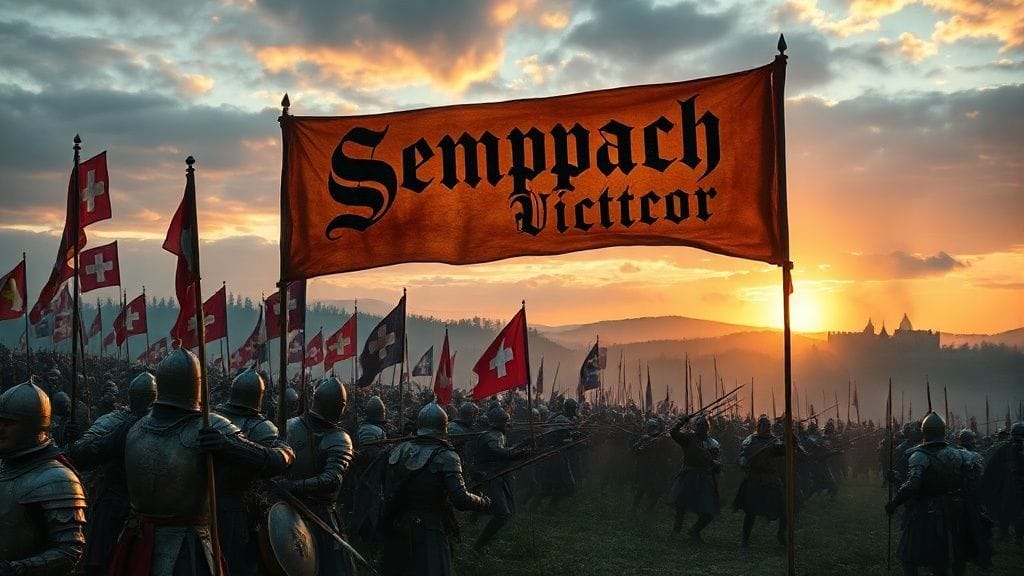
The sun rose over the gentle hills surrounding the town of Sempach in central Switzerland with an unyielding brightness, casting long shadows over fields soon to be stained with the blood of men fighting for their future. The air was thick with the metallic scent of armor and the sharp tension of anticipation. Horse hooves drummed a frantic rhythm, swords gleamed, and the murmur of prayers mingled with shouts and the steady hum of nerves bracing for a battle that would define a nation. The morning of July 9, 1386, was not just another summer day; it was the day when the little Swiss Confederacy dared to challenge the might of the Habsburg Empire—and nearly changed the course of European history forever.
2. Switzerland on the Brink: The Building Storm
Switzerland in the late 14th century was a patchwork quilt of small cantons and territories, raw and restless beneath the weight of foreign dominance. The Habsburgs, with their sprawling dynastic empire, had long cast a shadow over these alpine valleys, their ambitions fuelled by claims over the lands and peoples of the Swiss highlands. But resentment was simmering among the Swiss peasants, merchants, and local knights, who longed for political autonomy and freedom from onerous taxes and feudal oppression.
It was a time rife with tension—economic hardship exacerbated by recent harvest failures, the spread of urban self-governance ideas reminiscent of the Renaissance dawning elsewhere in Europe, and an emerging collective identity among Swiss communities. The spark that would ignite this simmering powder keg was the growing assertiveness of the Swiss Confederacy and the Habsburg response to crush what they perceived as a rebellious nuisance.
3. The Habsburg Ambition: Power, Pride, and Prejudice
The House of Habsburg was no ordinary dynasty. Rising from their origins in the 11th century, their reach now spanned the Holy Roman Empire, positioning them among the era’s most formidable political forces. Their aim was clear: to consolidate and expand their dominions, incorporating Switzerland firmly under their yoke. Duke Leopold III of Austria, a key Habsburg figure, saw the insurgent Swiss as a direct threat to his authority and resources.
To the Habsburgs, the Swiss confederates were backward peasants, unruly and disloyal, whose defiance could not be tolerated. The conflict was framed not only as a tactical military engagement but as a crucial assertion of imperial supremacy and order against perceived chaos.
4. The Swiss Confederacy: A Mosaic of Courage and Unity
Opposed to this was an unlikely coalition—the Old Swiss Confederacy. Formed initially as a defensive alliance between Uri, Schwyz, and Unterwalden, the Confederacy had gradually expanded to include other cantons, united less by cultural homogeneity and more by a shared spirit of defiance and survival. Their forces might have seemed modest in number and equipment, but they wielded something far more potent: unity born from centuries of shared struggle against tyranny.
This coalition was first and foremost a peasant militia, proud of its simplicity and fierce in defense of land and liberty. The Swiss fighting force was characterized by the use of pikes, halberds, and a guerilla-style combat that relied on the intimate knowledge of their mountainous terrain.
5. The Path to Sempach: From Tensions to War
The immediate events leading to Sempach were a tinderbox of provocations, raids, and failed negotiations. The Habsburgs, enraged by repeated acts of Swiss resistance, marched an army deep into Swiss territory to enforce their dominance. The Confederacy had to respond or face subjugation.
Both sides understood that a decisive battle was inevitable. The Swiss chose to make their stand near the small market town of Sempach, nestled near the southern shore of Lake Sempach, a place with strategic importance and symbolic weight. The setting was rife with natural defensive advantages, but the Swiss knew their vulnerability against the heavily armored knights of the Habsburg army.
6. The Armies Assemble: From Diverse Hills and Valleys
The Habsburg force that arrived at Sempach numbered several thousand, predominantly mounted knights, clad in gleaming armor and bearing the banners of Austria and other allied territories. Their confidence was palpable—a professional army used to imposing its will on less organized foes.
In contrast, the Swiss army lacked the heavy cavalry and formal leadership structure of their adversaries. They were an amalgam of peasants, artisans, and minor nobles, led by elected commanders who drew strength from communal solidarity rather than feudal hierarchy. Their weaponry was simple yet effective, with long pikes and halberds designed to pierce armor and disrupt cavalry charges.
7. The Battlefield Landscape: Sempach’s Rolling Terrain
Sempach’s landscape played a crucial role. The uneven, forested hills surrounding the battlefield restricted cavalry maneuvers and neutralized some of the traditional advantages heavy knights enjoyed. Narrow paths and marshy fields funneled attackers into tight formations, perfect for Swiss pikemen to hold their ground and strike.
This knowledge of terrain was a Swiss advantage—they fought on home ground and used every ridge, tree, and marsh to compensate for their inferior armor and numbers. The battle, therefore, was as much a contest of wits as of strength.
8. The Clash Ignites: First Blows and Shattered Calm
As the sun climbed higher on July 9, war cries shattered the morning calm. The Habsburg cavalry charged, relying on their heavy knights to break Swiss lines swiftly. Yet what was intended as a crushing force met an unyielding shield of pikes and halberds. Swiss soldiers locked in formation stood firm, the tips of their weapons rising like a forest before the armored horsemen.
Initial clashes were brutal and chaotic. Horses screamed, steel rang, and the soil was churned as men struggled fiercely in close quarters. The contrast of polished armor and simple weapons stood out—but the Swiss endurance and courage were equally glaring.
9. Arnold von Winkelried: The Hero of Legend
Amidst this desperate melee emerged a figure whose name would be etched into Swiss folklore: Arnold von Winkelried. Chronicled by later historians and balladeers, Winkelried supposedly performed a self-sacrificial act that turned the tide of battle.
According to legend, faced with a deadly wall of pikes, Winkelried threw himself upon the enemy's spears, breaking their formation and creating a gap for his comrades to exploit. Whether wholly factual or partially mythic, this narrative captured the imagination of the Swiss people, symbolizing ultimate bravery and selflessness.
10. Turning the Tide: Swiss Strategy and Tenacity
The battle raged for hours, brutal and unforgiving. Yet the Swiss tempo and tactics gradually wore down the more established Habsburg knights. Pike formations held firm, and the Swiss used the disrupted terrain and the opening, possibly created by Winkelried’s sacrifice, to infiltrate enemy lines.
The Habsburgs found themselves encircled and overwhelmed. Their heavy armor, once a suit of invincibility, became a burden in the gritty, close combat of Sempach’s fields. Slowly, the knights were brought down one by one.
11. The Habsburg Collapse: A Dynasty in Disarray
The outcome was stunning. Duke Leopold III himself perished on the field, his death a poignant symbol of the battle’s significance. The defeat was not a mere military setback but a catastrophic blow to Habsburg morale and power projection in the region.
Their forces scattered, some survivors fleeing into the woods, while the Confederates solidified their hard-won ground. The news of this defeat rippled across Europe, signaling that the rising Swiss confederates were a force to be reckoned with.
12. Aftermath on the Field: Blood, Silence, and Reflection
The fields of Sempach were left strewn with fallen soldiers, both friend and foe. Silence descended on the blood-soaked grounds, interspersed with the distant groans of the wounded. The Swiss had paid a heavy price, but victory was theirs.
This solemn aftermath forged a sense of kinship and commemoration among the Swiss cantons. The battle became not only a military event but a moment of collective identity birth, celebrated and mourned in equal measure.
13. The Political Reverberations: Shifting Power in Central Europe
Sempach’s consequences stretched far beyond the immediate battlefield. Politically, it marked the decisive weakening of Habsburg claims over Swiss territories. For the confederates, it was a step toward greater autonomy and the erosion of medieval feudal hierarchies.
Duke Leopold’s death triggered succession disputes within the House of Habsburg, providing the Swiss with a fragile window of political maneuvering and expansion of influence. Neighboring regions watched warily as the balance of power began to shift subtly but irrevocably.
14. The Rise of Swiss Autonomy: From Battle to Confederation
Victory at Sempach emboldened the Swiss Confederacy. The cantons deepened their alliances, recognizing that shared defense was key to survival. This unity would ultimately become the foundation of modern Switzerland’s identity— a nation forged from the fires of grassroots cooperation rather than imposed authority.
In the years that followed, the confederate model became a powerful example of regional self-determination, a beacon of hope for other peoples under feudal oppression.
15. The Battle of Sempach in Memory and Myth
Centuries later, the Battle of Sempach remains a cornerstone of Swiss national consciousness. Arnold von Winkelried’s sacrifice became emblematic of the Swiss virtues: courage, self-sacrifice, and unity. Monuments, literature, and commemorations honor the moment as the emblematic fight for freedom that transcends time.
Yet, historians caution that myth and reality entwined over time; the true courage lay not just in a heroic individual but in collective sacrifice and resilience.
16. Military Innovations and Tactics Born of Sempach
The battle is studied not only for its dramatic narrative but for its military lessons. The effective use of infantry pikes against cavalry presaged shift in medieval warfare wherein foot soldiers could counter mounted knights decisively.
Swiss tactics influenced European martial doctrines in the centuries to come, heralding the gradual decline of chivalric cavalry dominance in favor of disciplined infantry formations.
17. Cultural Impacts: Art, Poetry, and Swiss Identity
Cultural expressions inspired by Sempach abound. Chronicles and poems from the late medieval period celebrated the battle, embedding it within Switzerland’s burgeoning national literature. Painters captured vivid scenes of valor, while folk songs passed down accounts of bravery through generations.
The battle became a narrative garden where Swiss identity blossomed as defiant, free, and unified.
18. Lessons from Sempach: Unity Against Overwhelming Odds
Beyond tactics, the battle teaches intangible lessons: how common people, when united by purpose and courage, can face and overcome the seemingly insurmountable. The Swiss confederate soldiers embodied a profound belief in communal defense and equality, challenging established power structures.
It’s a timeless reminder that political structures gain their power only as long as people consent—or resist.
19. Sempach’s Legacy in European History
Sempach is a pivotal episode in the Late Middle Ages, embodying growing tensions between emerging nation-states and declining feudal empires. It foreshadowed the political fragmentation and the rise of local sovereignties that would characterize Europe in coming centuries.
Its echoes are found in the later Swiss victories and in the broader narrative of medieval Europe’s transformation toward modern states.
20. Echoes of the Battle in Modern Switzerland
Today, Sempach is not just a historical footnote but a cultural touchstone. Annual commemorations, historical reenactments, and educational programs ensure that the memory remains vivid. It serves as a symbol of Swiss values of democracy, neutrality, and resilience in a complex global panorama.
The battle’s legacy permeates national holidays and political discourse, continually inspiring Swiss societal cohesion.
21. Conclusion: The Flame that Lit a Nation
The Battle of Sempach was more than a clash of arms; it was the fiery crucible in which a people’s identity was forged. Against a superior force, the Swiss Confederates did not merely survive—they triumphed through unity, courage, and strategy. Their victory echoed through history, not just as a military triumph but as a testament to the indomitable human spirit striving for freedom.
Sempach reminds us that history is made not solely by kings or generals, but by people standing resolutely for their beliefs. It is a story of perseverance, sacrifice, and the birth of a nation that would one day proudly embody democracy and independence.
FAQs: Understanding the Battle of Sempach
Q1: What caused the Battle of Sempach?
A1: The battle was caused by longstanding tensions between the expanding Habsburg Empire and the emerging Swiss Confederacy, centered around territorial control, autonomy, and resisting feudal oppression.
Q2: Who was Arnold von Winkelried?
A2: Arnold von Winkelried is a legendary Swiss hero said to have sacrificed himself to break the Habsburg spear wall, opening the way for Swiss victory. While his historical existence is debated, he symbolizes self-sacrifice and bravery.
Q3: Why was the battle significant for Switzerland?
A3: It marked the decline of Habsburg power in the region and solidified Swiss unity and autonomy, laying foundations for the modern Swiss Confederation.
Q4: How did the terrain influence the battle?
A4: The uneven, forested, and marshy terrain limited cavalry effectiveness and favored Swiss infantry tactics, contributing to their success against the heavily armored knights.
Q5: What were the broader European reactions to the battle?
A5: The defeat shook the prestige of the Habsburgs and inspired other regions to resist feudal overlords, signaling shifts in medieval power dynamics.
Q6: How is the Battle of Sempach remembered today?
A6: Through monuments, annual commemorations, cultural works, and its inclusion in Swiss national identity as a symbol of freedom and unity.
Q7: Did the battle introduce any military innovations?
A7: Yes, it highlighted the effectiveness of infantry pike formations over traditional cavalry and influenced future European military tactics.
Q8: What happened politically to the Habsburgs after the battle?
A8: The death of Duke Leopold III led to internal strife within the dynasty, weakening their grip on Swiss territories and paving the way for Swiss expansion.

