Table of Contents
- On the Eve of Shirimni: A Kingdom at the Edge of Two Worlds
- The Long Shadow of Ani: Georgia and Byzantium Before the Storm
- Bagrat IV, George I, and Basil II: Faces Behind the Armies
- March to Shirimni: Roads, Rivers, and Rumors of War
- Land of Fire and Fog: The Battlefield on the Shores of Lake Palakatsios
- Swords and Silk: The Armies That Met at Shirimni
- The Morning of October 11, 1021: Omens, Prayers, and Battle Cries
- Clash at the Center: The First Wave of Steel
- Cavalry on the Flanks: Georgian Charges and Byzantine Counterplay
- A King Unhorsed: George I’s Wound and the Turning of the Tide
- Retreat into the Highlands: Aftermath on the Battlefield
- Smoke over Tao: Political Consequences for Georgia
- Imperial Echoes: What Shirimni Meant for the Byzantine Empire
- Between Empire and Faith: Church, Chronicles, and Memory
- Families Torn and Legends Born: Human Stories of Shirimni
- From Defeat to Resilience: How Georgia Reforged Itself
- Reading the Sources: What We Really Know About Shirimni
- A Battle in the Middle of the World: Shirimni in the Caucasian Geopolitics
- Footsteps on an Empty Field: Shirimni in Modern Georgian Memory
- Conclusion
- FAQs
- External Resource
- Internal Link
Article Summary: This article follows the battle of shirimni, fought in 1021 between the Kingdom of Georgia and the Byzantine Empire, as both a military clash and a turning point in Caucasian history. It opens with the fragile political balance between a rising Georgian monarchy and Basil II’s outward‑pressing Constantinople, then leads you step by step to the misty lakeshore battlefield where iron met iron. Through narrative scenes and analysis, we see how the battle of shirimni was shaped by older disputes over Tao, Ani, and the legacy of David Kuropalates. The story then moves beyond tactics and banners to explore the political consequences: Georgian territorial losses, renewed Byzantine prestige, and the subtle but enduring shifts in regional power. Along the way, the article lingers on the human cost—captured nobles, uprooted peasants, grieving families—and how the memory of the battle of shirimni would be worked into chronicles, sermons, and later national myths. It also probes the reliability of medieval sources, contrasting Georgian and Byzantine accounts and underlining where historians still disagree. Finally, it situates the battle of shirimni within the wider geopolitics of the medieval Caucasus and reflects on how a single defeat could still feed a longer story of resilience, culminating in Georgia’s later “Golden Age.” By the end, the battle of shirimni emerges not as an isolated clash, but as a hinge between eras, empires, and identities.
On the Eve of Shirimni: A Kingdom at the Edge of Two Worlds
The autumn of 1021 did not begin with the clash of steel but with the quieter sound of hooves on mountain paths and whispered councils in stone‑walled halls. The Kingdom of Georgia, barely a century into its slow unification, was perched on the jagged edge of two worlds: to the north, the forests and high pastures of the Caucasus; to the south, the sun‑scorched plateaus where empires rose and fell with almost geological regularity. The battle of Shirimni was still a rumor, a word not yet stained by blood. Yet the air in Tbilisi and Kutaisi carried a tightening tension, as if the land itself sensed that the fragile balance between kingdom and empire was nearing its breaking point.
Georgia’s king, George I, was not a conqueror fashioned in the mold of later medieval legends. He was young, determined, and shaped by inheritance disputes more than by sweeping campaigns of glory. His father, Bagrat III, had labored to fuse diverse principalities—Kartli, Imereti, Abkhazia—into something resembling a single realm. George had inherited not only the crown but also an unfinished project, a kingdom surrounded by wary neighbors and overshadowed by the immense figure of the Byzantine Emperor Basil II. The borders were lines written not on paper but in memory and blood: border towers, fortified monasteries, and stretches of highland where the only law was the reach of a local prince’s spear.
In this tense geography, the lands of Tao and Klarjeti—rich in monasteries, pastures, and strategic passes—had become the glowing ember at the heart of the coming conflagration. Formerly ruled by the influential Georgian prince David Kuropalates, these territories had passed under Byzantine control by treaty after his death. But in the minds of many Georgians, treaty parchment meant little compared with dynastic inheritance and centuries of cultural ties. The battle of Shirimni would not spring out of nowhere; it would be the violent punctuation at the end of a long, heated sentence about legitimacy, honor, and land.
Travelers crossing the mountain passes that year would have noticed the change: more patrols at river crossings, more riders on the horizon. Local peasants in the Tao region spoke in hushed tones of imperial tax collectors and Georgian envoys, while monks in remote monasteries copied not only Psalms and Gospels but also letters filled with veiled threats and desperate appeals for mediation. The great powers of the age—Georgia and Byzantium—were moving toward open confrontation, but for the people who lived between them, the signs came more in the price of grain and the presence of foreign soldiers than in royal decrees.
To stand on the eve of Shirimni is to stand at a crossroads of anxiety and ambition. Georgia’s rulers believed that reclaiming Tao was not only a matter of justice but a symbol of their kingdom’s maturity: a public declaration that they would no longer be a junior partner in the politics of the Caucasus. Byzantium, with its marble‑lined corridors and shimmering mosaics, saw these same lands as the rightful extension of imperial authority, secured through meticulous diplomacy and legal formalities. Two visions of order, two narratives of ownership, were set on an inevitable collision course. The distant sound of marching feet was the sound of those narratives preparing to test themselves in battle.
The Long Shadow of Ani: Georgia and Byzantium Before the Storm
To understand why men would die on the shores of a lake called Palakatsios, one must turn first to the city of Ani and the long, troubled history of the Armenian and Georgian borderlands. Ani, the “City of 1001 Churches,” sat like a jewel on the frontier, coveted by emirs, kings, and emperors. In the late 10th and early 11th century, its fate intertwined with that of Georgia and Byzantium, creating a web of obligations and claims that no one could fully untangle without spilling blood.
David Kuropalates, the Georgian prince who ruled Tao and Klarjeti, had long played the dangerous game of balancing local autonomy with imperial favor. Awarded the high Byzantine court title of “Kuropalates,” he seemed to embody the compromise of the age: a Christian ruler, Georgian in blood and culture, Byzantine in title and alliance. But David had no direct heirs, and in a political culture where succession could be both a legal and a personal matter, his decision to bequeath his territories to the Byzantine Empire after his death in 1001 was nothing less than explosive.
From Constantinople’s point of view, the transfer was legitimate and even elegant. Land was not merely seized; it was inherited by agreement, folded into the empire with a show of legal correctness. In the imperial archives, the matter could be presented as closed. But in the mountain strongholds of Georgia, and in the hearts of nobles who traced their lineage through generations of local rule, the story sounded very different. The lands of Tao were considered part of the Georgian royal family’s rightful patrimony, and the rise of George I in 1014 brought that grievance back to the surface.
Complicating this simmering dispute was the fluctuating power of other regional players: Muslim emirates to the south, Armenian principalities in their own struggles for survival, and the internal tensions within Byzantium itself. Basil II, known to later generations as the “Bulgar‑Slayer,” had spent years crushing revolts and reinforcing central authority over a sprawling empire that stretched from Italy to the Caucasus. Having subdued Bulgaria, he could now turn his gaze eastward with a mixture of weariness and determination. Georgia, in that gaze, was both ally and upstart, both Christian kin and inconvenient rival.
It is astonishing, isn’t it, how often borderlands become the stage on which empires test themselves? The dispute over Tao was a puzzle piece in a much larger pattern: Byzantine attempts to consolidate Christian territories in the eastern frontier, Georgian efforts to secure a coherent kingdom amidst older feudal ties, Armenian princes trying to preserve slivers of independence between them. The shadow of Ani, city of splendor yet also of vulnerability, lay over all these calculations. Whoever held Ani and its surrounding regions would command key roads, mountain passes, and economic routes that connected the Black Sea, the Mesopotamian plains, and the interior of Asia Minor.
By the time George I began to assert his claim over Tao, the diplomatic channels between Tbilisi and Constantinople were already strained. Envoys came and went, bearing letters that mixed scriptural quotations with veiled threats. Titles were contested: Was George to be treated as a respectful subordinate, or as a sovereign who could negotiate as an equal? Every slight, every omission in protocol, became fodder for whispered indignation in both courts. War was not yet unavoidable, but it was increasingly imaginable.
Bagrat IV, George I, and Basil II: Faces Behind the Armies
History often remembers battles through the names of kings and emperors. The battle of Shirimni is no exception, tied in memory to three figures whose lives intersected in that fateful autumn: King George I of Georgia, his young heir Bagrat (later Bagrat IV), and Emperor Basil II of Byzantium. To reduce them to mere names on a battlefield map, though, is to overlook the frailty and complexity that underpinned their decisions.
George I ascended the throne as a youth, inheriting from his father Bagrat III not only a crown but also the weighty ambition of unifying all Georgian lands. His reign began under the shadow of seasoned nobles and clergy who had known his father and watched the kingdom’s delicate consolidation. George was described by later Georgian chroniclers as proud and resolute, perhaps too eager to prove himself on the stage of regional politics. That eagerness would find its testing ground in the conflict with Byzantium. “He trusted in his youth and in the courage of his warriors,” one later chronicle suggests, in a line that reads as both praise and warning.
Basil II, by contrast, was nearing the end of a long and grueling reign. Crowned as a child, he had spent decades in armor, often more at home in a campaign tent than in the ceremonial splendor of Constantinople. His reputation among modern historians is that of a relentless, often ruthless soldier‑emperor who put stability above sentiment. The campaigns against Bulgaria had hardened him; he had faced rebellion after rebellion, reined in over‑mighty generals, and pushed back frontiers that had seemed on the verge of crumbling. By 1021 he was no young conqueror chasing fame; he was an older ruler determined to tidy up unfinished business on his eastern borders.
Between these two rulers stood a child, Bagrat, perhaps no more than five or six years old at the time of the campaign. He would not wield a sword at Shirimni, but he would carry its consequences for the rest of his life. Captured and taken to Constantinople as a hostage after the war, he grew up under the shadow of Byzantine grandeur, educated in the language and customs of the very empire that had humbled his father. When he eventually returned to Georgia and reigned as Bagrat IV, the memory of Shirimni would shape his diplomacy, his wars, and his understanding of what it meant to be a Georgian king on the edge of a powerful empire.
In a sense, then, the confrontation at Shirimni was as much a clash of generations as of armies. Basil, the weathered emperor nearing the dusk of his life, faced George, a young king refusing to accept the legal fiction that had cost him Tao. Between them, invisible on the battlefield but palpable in the stakes of the conflict, was the future of Bagrat and of the Georgian crown. When we speak of the battle of Shirimni, we speak of a moment where personal ambition, dynastic anxiety, and imperial calculation coiled together into a single violent coil of history.
March to Shirimni: Roads, Rivers, and Rumors of War
The march to the battlefield began not with triumphant drums but with logistical calculations, cold nights, and dust‑choked pathways. From the Georgian heartlands, George I led his forces southward through valleys carved by millennia of mountain rivers. Each step closer to Tao was a statement in itself: a king physically entering lands that he believed were his by inheritance, challenging the Byzantine garrisons without yet loosing an arrow.
Supply caravans groaned under the weight of grain sacks, salted meat, and barrels of wine. The Georgian army was not an anonymous mass but a patchwork of contingents: levies from noble houses, retainers sworn to local princes, horsemen from the highlands whose loyalty was as much to their clan as to the distant king. Alongside them marched clerics, carrying icons and crosses, their chants rising in the cold morning air. War, in this world, was inseparable from faith; banners depicted saints and the Virgin as much as lions or eagles.
On the Byzantine side, Basil II had set in motion a more elaborate but equally strained machine. His troops—veteran regiments from Asia Minor, tagmata from the imperial core, Armenian and possibly Varangian units—converged toward the same contested lands by different routes. The emperor’s scribes sent orders ahead to fortresses and towns: prepare supplies, ready stables, secure fords. Allied Armenian lords were asked, or compelled, to contribute men. To the locals in Tao, the sight of both Georgian and Byzantine armies moving through their fields must have been terrifyingly ambiguous. Which side did one support? To do nothing was itself a dangerous choice.
Rumors traveled faster than armies. In taverns and marketplaces, people whispered of looming disaster or unexpected victory. Some insisted that George had allied with Muslim rulers to the south; others claimed Basil had promised Ani’s throne to a pliant ally in exchange for troops. The battle of Shirimni, long before it was named as such, was already wrapped in tales and half‑truths. For many, the concrete reality was simpler: draft orders, increased taxes to fund the campaign, husbands and sons leaving home uncertain of their return.
As the two forces drew nearer, scouts clashed in skirmishes, testing each other’s resolve and mapping the terrain. Somewhere amid these hills and lakes, a battlefield would be chosen—by strategic calculation, by accident, or by the inexorable convergence of paths. Chronicle writers later compressed these days into a handful of lines, but for those who marched, each bend in the road was a question: would the enemy be waiting just beyond that next rise?
Land of Fire and Fog: The Battlefield on the Shores of Lake Palakatsios
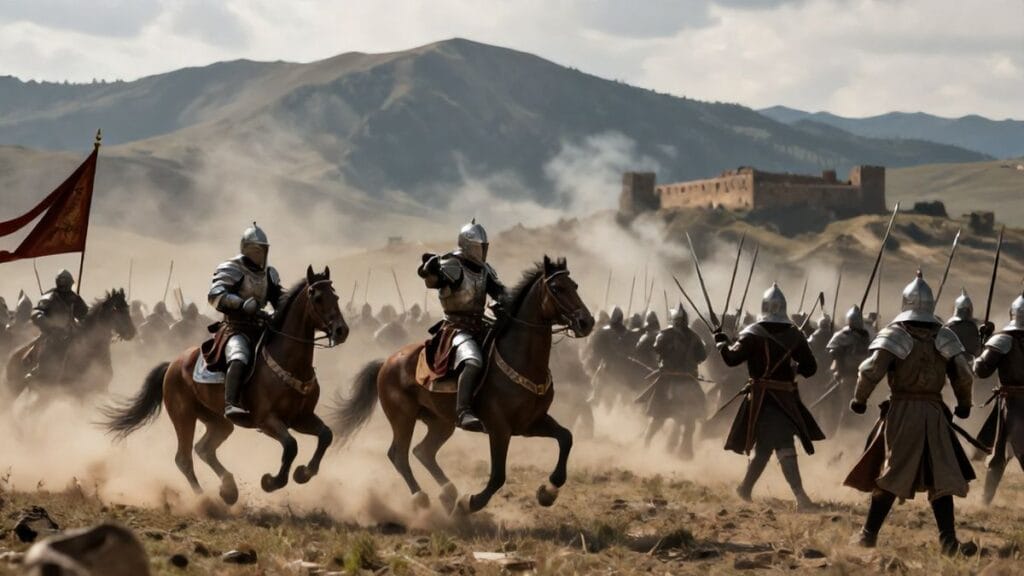
When the armies finally came to a halt near the village of Shirimni, the land itself seemed to hold its breath. Lake Palakatsios—known in later sources as Palakazioi—lay like a gray mirror to the south, its surface sometimes calm, sometimes shivering under the mountain winds. The ground around it was uneven: patches of marsh, rocky outcrops, and strips of firmer earth suitable for heavy infantry. To the north and east, low hills rose, offering vantage points but also the risk of encirclement. This was no idealized plain for chivalric charges; it was a complicated, sometimes treacherous landscape that would magnify any misstep in formation or command.
Choosing to give battle here was itself a strategic act. Basil likely favored ground where his disciplined infantry could anchor the line, supported by archers and heavy cavalry. George, whose forces relied more heavily on mobile cavalry and the courage of noble retinues, had to weigh the risk of attacking a well‑positioned army tied to the lake. Some historians believe the Georgians hoped to exploit the terrain’s irregularities to offset Byzantine numerical or organizational advantages. Others argue that circumstances—supply pressure, morale, the danger of being outflanked—left George with little choice but to accept battle near Shirimni.
In the mornings, the fog would roll in from the water, veiling the far shore and hanging low over the fields. Soldiers woke to damp clothing and the smell of woodsmoke from a thousand small fires. At night, the lake reflected the stars and the dim glows of the encamped armies, two clusters of flickering light facing each other across a dark expanse of grass and water. It was a liminal place, neither wholly land nor wholly water, neither fully day nor night during those half‑lit hours when sentries strained to hear movement beyond their lines.
Men tried to read the landscape as if it were an omen. Some saw the lake’s stillness as favorable; others muttered that water so cold and deep would gladly drink the blood of the fallen. Monks walked the perimeters of the Georgian camp carrying icons, blessing the ground, making the sign of the cross toward the enemy tents. In the Byzantine camp, priests invoked Christ and the saints to uphold the empire’s just claims. The same faith, the same scriptures, sanctified two opposing causes, each side convinced that righteousness was on its side.
On the eve of the battle of Shirimni, the battlefield was both real and symbolic. It was a patch of earth where men would swing swords and loose arrows—and a stage upon which Georgia and Byzantium would perform their competing narratives of law, inheritance, and divine favor. In the stillness before dawn on October 11, 1021, the land around Lake Palakatsios fell into a tense silence that many would remember, in later years, as more terrifying than the battle itself.
Swords and Silk: The Armies That Met at Shirimni
Medieval chroniclers seldom paused to give precise numbers, and when they did, they were often tempted by exaggeration. Yet from scattered hints, we can sketch the armies that faced each other at Shirimni, even if we cannot count every spear. On one side stood the Georgian host—likely smaller, but bound by personal loyalties and a fierce sense of national pride. On the other side, the Byzantine army—more heterogeneous, more professional, trained in the long tradition of imperial military manuals.
The Georgian forces would have included heavy cavalry drawn from the nobility, armored with mail shirts, conical helmets, and long lances for initial impact, followed by close‑quarters combat with swords or maces. These were not faceless warriors; they were lords and their sworn men, many riding beside brothers or cousins, their banners bearing family symbols as much as royal emblems. Their infantry, less elaborately equipped, wielded spears, axes, and bows, forming lines meant to hold while the cavalry sought decisive breakthroughs on the flanks or center.
Byzantium’s troops were more varied. Basil II could draw on the empire’s thematic soldiers from Asia Minor, professional tagmata stationed nearer the capital, Armenian infantry known for their resilience, and possibly the fearsome Varangian Guard—Northmen famed for their towering axes and unflinching discipline. Silk‑embroidered tunics might be glimpsed beneath armor among officers, but the average soldier’s life was one of drill, marching, and the cold familiarity of camp rations. A Byzantine military treatise like the “Taktika” of Nikephoros Ouranos (a general active slightly earlier) gives us a sense of their approach: careful deployment, coordinated use of missile troops, and steady infantry lines designed to absorb and counter enemy charges.
Standards rose above both hosts: the double‑headed eagle or labarum‑like crosses in the imperial camp, the crosses and lions of Georgian nobles around George’s command tent. The languages heard across the field testified to the region’s diversity: Georgian and related Kartvelian dialects, Greek, Armenian, and perhaps snatches of Slavic or Norse among mercenaries. In each tongue, men spoke of fear and courage, cursed the cold, and made nervous jokes about the enemy’s supposed weaknesses.
One imagines the quiet moments: a Georgian noble inspecting his horse’s hooves while trying not to think about the coming clash; a Byzantine officer running a whetstone along his sword’s edge, recalling earlier battles on distant frontiers. In these small gestures, the vast abstractions of empire and kingdom shrank into human scale. The battle of Shirimni would be decided by formations and strategy, yes, but also by the will and fatigue of thousands of individual men who could not see the entire field, only the chaos immediately before them.
The Morning of October 11, 1021: Omens, Prayers, and Battle Cries
The dawn that broke on October 11, 1021, found the camps stirring under a wan, uncertain light. Fog clung stubbornly to the lower ground, muffling sound and turning nearby shapes into ghostly forms. The smell of damp earth mingled with that of smoke as cooks lit fires for what might be a last meal on earth for many of the men gathered there.
In the Georgian camp, priests moved from cluster to cluster, blessing soldiers, raising icons for them to kiss. Some accounts mention the veneration of the Holy Cross and local saints, invoked as protectors of the kingdom and its rightful lands. George I is said to have ridden along the line, speaking to his nobles and men, appealing to their honor, their duty to their ancestors, their obligation to defend Georgia’s claim over Tao. To fight here, he told them, was to defend the very soul of the kingdom—its memory, its future.
Across the field, in the Byzantine camp, Basil II performed his own acts of ritual and morale building. Veterans who had campaigned with him in Bulgaria or Syria would have recognized the routine: prayer before battle, speeches reminding them of their past victories and the justice of imperial claims. Basil’s aura as an undefeated soldier‑emperor was itself a weapon, lending weight to his words. The battle of Shirimni, he might have suggested, was not an attack on a brother Christian kingdom but a necessary step to enforce legitimate imperial rights and ensure stability in the eastern marches.
Omens were sought and found, as they always are on such mornings. A bird’s sudden flight, the fall of a dice cast in a circle of officers, the way a horse snorted at nothing in particular—each was seized on by some as meaningful. In hushed corners, men confessed sins to priests, seeking absolution before stepping into peril. Others sat quietly, clutching charms or family keepsakes, unwilling to admit their fear aloud.
As the sun rose higher, the fog began to lift, revealing at last the true scale of the opposing host. Shouts went up in both camps as soldiers pointed: ranks of spearmen, clusters of cavalry, banners unfurling in the morning wind. The distant glitter of armor turned the field into a moving, shifting sea of light. Trumpets or horns blared; drums, if used, beat a slow, gathering rhythm. Lines formed, commanders rode to their positions, and the open space between the armies became a corridor of impending violence.
But this was only the beginning. The day would stretch on, alternately a blur of violence and a series of sharply etched moments that men would replay in their minds for years—those who survived, at least.
Clash at the Center: The First Wave of Steel
When the first arrows flew, they traced thin, dark arcs across the lightening sky. Skirmishers advanced from both sides, testing the enemy’s resolve, seeking to disrupt formations before the main clash. Arrows thudded into shields, found gaps in armor, or sank harmlessly into the ground. War cries rose, sometimes drowning out the more pitiful sounds of the first casualties: the sudden, shocked cry of the wounded, the dull thump of bodies falling.
At the center of the field, infantry lines began their deliberate advance. The Georgians, likely arrayed in dense formations, moved forward behind their shields, spears bristling. Opposite them, Byzantine infantry—hardened in the Balkan campaigns or by service along the eastern frontier—advanced in a more methodical, almost machine‑like fashion. Standards bobbed above the lines as commanders shouted orders, trying to maintain cohesion as the distance narrowed and the tension grew almost unbearable.
The impact, when it came, shattered the remaining illusions of formation and discipline for many on the front. Shields crashed against shields, spears splintered, and men struggled in the crush, fighting half‑blind amid sweat, blood, and shouted prayers. For a moment, the larger patterns of the battle dissolved into a grim, close‑quarters struggle where individual strength and luck mattered more than any strategy devised by kings.
Chroniclers suggest that the initial Georgian assault at the center was fierce, perhaps even pushing the Byzantine line back in places. The men who fought that day believed they stood not only against soldiers but against the weight of an empire that had claimed their lands by mere parchment. Their rage gave them a desperate, almost reckless energy. Glimpses of George I on horseback at the rear, watching the center and sending messengers to coordinate with the flanks, reassured them that their king was present, sharing the risks in his own way.
Basil, too, watched the unfolding clash with the eye of a veteran. His strength lay not in inspirational speeches alone but in his ability to read the field and redeploy as needed. When portions of the line wavered, he sent in reserves, stiffening faltering ranks with fresh troops. Archers shifted positions, seeking angles from which to strike at concentrated Georgian clusters without hitting their own men. What might have turned into a rout on a less well‑led day became instead a grinding, attritional contest for ground measured in paces, not miles.
In later retellings of the battle of Shirimni, historians would debate whether the Georgians ever truly threatened to shatter the Byzantine center. Some Georgian sources emphasize initial success; Byzantine accounts, unsurprisingly, tend to present the imperial line as steady, bending but never breaking. The truth likely lies somewhere between these partisan memories: a center that buckled under intense pressure but held just long enough for events on the wings to decide the day.
Cavalry on the Flanks: Georgian Charges and Byzantine Counterplay
If the center was a grinding mill of bodies and shields, the flanks were where the battle’s fate began to tilt decisively. Georgian heavy cavalry, the pride of noble households and the terror of many regional foes, gathered for repeated charges. Lances were leveled, horses snorted and pawed the ground, and the roar of hooves built like distant thunder as they surged forward. Against less disciplined enemies, such charges could break a line in a single, devastating impact.
At Shirimni, however, they faced a foe accustomed to facing horsemen. Byzantine commanders arranged their units with an eye toward absorbing and deflecting cavalry assaults. Spearmen formed bristling hedges, archers stood ready to unleash volleys at the last moment, and counters were prepared—armored cavalry held in reserve to strike at overextended attackers. The lake and marshy ground near it limited where charges could be safely launched, forcing the Georgians to attack along narrower corridors that were more easily anticipated.
The first Georgian cavalry assaults likely shook portions of the Byzantine wings. Horses crashed into shield walls, riders leaning forward in saddles as splinters of wood and sparks of steel flew. In some places, Georgian horsemen may have punched through, sowing confusion before being pushed back or cut off. Yet each failed charge came at a terrible cost in exhausted men and wounded or slain mounts. The more time passed, the more the balance tipped toward the side with deeper reserves and a steadier command structure.
Basil’s forceful style of leadership came to the fore here. Seeing where Georgian cavalry concentrated, he could order reinforced lines, adjust the positioning of archers, or unleash a countercharge by imperial kataphraktoi—heavily armored cavalry trained to exploit precisely such moments. The chessboard of the battlefield was not static; it shifted constantly, and on that shifting ground, the side better able to adapt held a crucial advantage.
Still, for those on the Georgian side, there were moments that seemed to offer hope. Stories passed down through later generations spoke of a particularly bold charge in which a Georgian noble, often unnamed, led a small band that nearly reached a key Byzantine standard. Though repulsed, such acts fed a memory of courage that softened, if only slightly, the bitterness of eventual defeat. In their telling, the battle of Shirimni was not a simple collapse but a heroic struggle in which Georgian valor met the grim, unyielding stone wall of Byzantine discipline.
A King Unhorsed: George I’s Wound and the Turning of the Tide
Every battle has its moments of sharp, almost theatrical drama, and at Shirimni, one of them centered on King George I himself. According to Georgian accounts, the king did not remain a distant figure during the fighting; he edged closer to the action, perhaps to rally faltering troops or to seize an opportunity he believed was emerging. In a battle where so many lives hung on morale, the visible presence of the monarch could make the difference between resilience and rout.
But visibility cuts both ways. At some point in the engagement, George was unhorsed and wounded. Whether struck by an arrow, a spear thrust, or the chaos of close combat, he fell from his mount, causing a ripple of alarm among those who saw—or thought they saw—what had happened. The exact details remain murky; no eyewitness report survives in the modern sense. Yet the consensus of tradition is clear: the sight, or rumor, of their injured king shook the coherence of the Georgian army at a critical moment.
For soldiers already strained by hours of fighting, the suggestion that their king might be dead or gravely hurt was like a knife into the heart of their courage. Some may have surged forward in a desperate attempt to reach him; others may already have begun to pull back, fearing the worst. Commanders who should have been focused on rotations and reinforcing weak spots instead had to divert attention to protect or extract their ruler.
Basil II, veteran of many campaigns, understood the significance of such a moment even if he did not see George fall himself. Noticing signs of disarray in the opposing ranks, he ordered renewed pressure across the line. Reserves that had been carefully husbanded were hurled into the fray, turning what had been a gradual shift in momentum into a more obvious, and ultimately decisive, swing. The imperial standards moved forward; Byzantine soldiers who had been fighting defensively now advanced, pushing their foes back step by grinding step.
From this point, the battle of Shirimni tipped decisively toward Byzantium. The Georgian army, no longer confident that its center would hold or that its king remained safely in command, began to lose cohesion. Units retreated in fragments instead of as a unified host, turning rearward glances into a self‑fulfilling prophecy of defeat. The field that had that morning seemed a stage for Georgian assertion now turned into a trap of trampled bodies and abandoned equipment.
George did not die at Shirimni. His wound was serious but not fatal. Yet the psychological impact of seeing him fall—or even hearing that he had—was enough to unmake the day for his army. The king survived to negotiate, to retreat, to rule on. The army did not survive in the same sense; it left too much of itself behind on that lakeshore.
Retreat into the Highlands: Aftermath on the Battlefield
By late afternoon, the screams and clangor of combat at Shirimni gave way to a different, more eerie soundscape: the moans of the wounded, the cawing of circling birds, the low murmur of victors and survivors moving among the fallen. The Georgian army, broken and disordered, streamed northward toward the safety of the highlands, leaving behind a field that told the stark truth of the day more powerfully than any chronicle.
Retreat in those conditions was not a neat, orchestrated withdrawal. Small groups tried to stick together, following leaders they still recognized amid the chaos. Others fled alone, casting aside shields or helmets to move faster, some tossing even their swords when weight became unbearable. Nightfall, when it came, offered cover but also confusion; the same dark that hid them from pursuit also hid the safe paths and fords they needed to reach home.
On the battlefield itself, Byzantine troops set about the grim work of securing the area. Pockets of Georgian resistance that had not yet realized the battle was lost were surrounded and forced to surrender or cut down. Camp followers emerged to scavenge weapons, armor, and anything of value. Officers moved to identify notable prisoners. Among these, the capture—or later seizure—of George’s young son Bagrat and his mother, the queen, would become one of the conflict’s most symbolically potent outcomes, though some details differ between sources.
For the wounded left on the ground, the end of the battle was only the beginning of their suffering. Some were tended by priests and surgeons, friend or foe, their fates determined as much by proximity to help as by the severity of their injuries. Others lay unattended until cold or blood loss brought an end. Stories told in Georgian villages for generations afterward spoke of men returning from Shirimni with missing limbs, scarred faces, and haunted eyes, living reminders of that distant field by the lake.
The immediate tactical result was clear: Byzantium had won a decisive victory. The Georgian army would need time—months, perhaps years—to recover fully. Yet even in defeat, some Georgians carried home a sense of bitter pride: they had dared to challenge the most formidable Christian empire of their age on open ground, and they had not collapsed at the first blow. Their banners might be tattered, but the idea of Georgia as a kingdom worthy of such risks had been etched in blood into the consciousness of both friends and foes.
Smoke over Tao: Political Consequences for Georgia
In the weeks and months that followed the battle of Shirimni, political realities hardened like cooling lava. The Georgian defeat allowed Basil II to press his advantage both on the battlefield and at the negotiating table. Campaigns continued into 1022, with Byzantium leveraging its momentum to secure more favorable terms. The contested lands of Tao and nearby regions, already claimed by legal fiction, now fell more firmly under imperial control by the hard logic of conquest.
For Georgia, this meant more than just redrawn borders. The loss of Tao was a blow to royal prestige and a challenge to the narrative of a steadily unifying kingdom. Regions that had looked to the crown for leadership now saw that crown humbled. Nobles who had hedged their bets, ever alert to the winds of power, recalibrated their loyalties in the quiet calculations that never appear in official documents but always shape political life.
The capture of the young Bagrat and his mother, held as honored hostages in Constantinople, was a particularly sharp instrument of pressure. Their presence in the imperial city served as a living guarantee of Georgian compliance with the new arrangement. George, who had gone to war partly to assert his independence from Byzantine tutelage, now found himself operating under a tighter diplomatic leash. In effect, the battle of Shirimni turned Georgia’s royal household into a bridge between Tbilisi (or more properly Kutaisi, the western capital) and Constantinople—one that could be used for negotiation, manipulation, or subtle control.
Internally, the crown had to explain the defeat. Chronicles written under Georgian patronage naturally sought to preserve the dignity of the kingdom and its ruler, emphasizing courage and the strength of the enemy rather than any incompetence. Blame could be directed outward—to Byzantine duplicity or overwhelming numbers—rather than inward. Still, the shock resonated. Priests, nobles, and common people alike wrestled with the theological implications: had God abandoned them, or was the loss a punishment for some unrepented sin?
Yet even in these dark days, seeds of future resilience were sown. The reality that Byzantium could not be challenged lightly forced Georgian rulers to think more carefully about alliances, internal unity, and the use of diplomacy alongside arms. The pain of losing Tao was etched into the national memory, but so too was the knowledge that the kingdom had survived. Shirimni marked not the end of Georgian ambitions, but a painful recalibration of what those ambitions would cost.
Imperial Echoes: What Shirimni Meant for the Byzantine Empire
From Constantinople’s vantage point, the victory at Shirimni was both a confirmation and a warning. It confirmed Basil II’s enduring military prowess and the effectiveness of the imperial army even after decades of campaigning. A restless frontier had been quieted, a recalcitrant neighbor chastened, and key territories brought more firmly under the imperial fold. The maps in the palace, if such were kept with any accuracy, now showed a more secure Byzantine presence in the Caucasian borderlands.
Yet behind the celebrations, perceptive observers might have sensed the limits of victory. Basil himself was aging; his health would begin to fail not long after these campaigns. The strains placed on the empire by constant warfare, especially in the Balkans and the East, could not be ignored forever. Shirimni had required significant effort and resources to subdue a kingdom that, compared with the great Muslim caliphates or the threat of nomadic incursions, was relatively modest in scale.
Moreover, the conquest of Armenian and Georgian lands, including the eventual absorption of Ani (in 1045, after Basil’s time), brought with it not only new revenues and prestige but also new vulnerabilities. Defending these regions required garrisons, roads, reliable local elites—all of which became harder to maintain as decades passed and less capable emperors sat on the throne. Historians looking back from the vantage point of the later 11th century, when the empire suffered crushing defeats at Manzikert and beyond, often see in Basil’s eastern expansions both a high‑water mark and the start of a dangerously extended frontier.
Immediately, though, Shirimni fed the imperial self‑image. Basil’s reputation as an unconquered soldier‑emperor, already burnished by the subjugation of Bulgaria, gained another gleam. Chroniclers in the capital and provincial cities could present the campaign as an example of just, measured force: the empire merely enforcing rightful claims, correcting the impetuous folly of a youthful king who had overstepped his bounds. The ideological framework of Byzantine rule, which emphasized law, order, and Christian stewardship, found ammunition in the legalistic narrative of David Kuropalates’ bequest and the subsequent war.
In the long run, however, the battle of Shirimni did not permanently subdue Georgian aspirations. It delayed, but did not extinguish, the emergence of Georgia as a significant regional power under later rulers like King David IV “the Builder.” From Constantinople’s perspective, the engagement of 1021 would come to be seen as part of a complex and often frustrating relationship with a proud, stubborn neighbor—too Christian to be treated purely as an enemy, too independent to be relied on as a submissive ally.
Between Empire and Faith: Church, Chronicles, and Memory
War between two Christian polities raised awkward questions for the clergy and chroniclers tasked with explaining God’s will to the faithful. The battle of Shirimni, in which Orthodox Christians on both sides invoked the same saints and prayed to the same Trinity, tested the elasticity of theological and moral reasoning. If both Georgia and Byzantium were, in theory, defenders of the faith, how could God side with one over the other?
Georgian ecclesiastical writers tended to frame the conflict within a narrative of unjust dispossession and righteous, if ultimately unsuccessful, resistance. The kingdom, in their telling, had sought to reclaim ancestral, Christian lands from an overbearing empire that relied on legal tricks rather than true justice. Defeat, though painful, could thus be interpreted as chastisement rather than condemnation: a divine lesson to spur repentance and greater unity, not a repudiation of Georgian claims.
Byzantine churchmen, closer to the corridors of power, leaned into the language of legitimacy. David Kuropalates’ decision to bequeath his territories to Byzantium was presented as a lawful act, one that the empire, as guardian of order in Christendom, was obliged to uphold. George I’s attempt to reverse that transfer could be cast as a form of rebellion against divinely sanctioned hierarchy. Under this interpretation, Shirimni became not a civil war among Christians but a necessary correction within a broader, sacred order.
Chronicles on both sides stitched these theological threads into gripping narratives. One of the main Georgian historical compilations, the “Kartlis Tskhovreba” (“The Life of Kartli”), later included accounts of this era that emphasized the courage of Georgian kings and the enduring righteousness of their cause. Byzantine authors, such as John Skylitzes writing later in the 11th century, depicted Basil II’s eastern campaigns as part of his grand, coherent strategy to strengthen the empire, Shirimni appearing as one episode in a long series of imperial triumphs.
These texts did more than record events; they shaped how future generations would remember the battle of Shirimni. When a later Georgian monk read of George’s stand against Basil, he encountered not merely a history lesson but a moral template about resisting injustice, even at great cost. Likewise, a Byzantine reader of Skylitzes could see in Basil’s march into Georgia a model of firm, legalistic rule in the face of recalcitrant neighbors. Memory, encoded in parchment and illuminated margins, thus perpetuated two parallel but incompatible stories about the same day by Lake Palakatsios.
Families Torn and Legends Born: Human Stories of Shirimni
Beyond kings and emperors, the battle of Shirimni scattered countless smaller stories across the Caucasian landscape. These tales seldom made it into official chronicles, yet they lived on in families, in local traditions, in the quiet grief of mothers and wives who waited for footsteps that never returned.
Imagine a farmer from a village in Tao, conscripted into the Georgian host. He had never traveled far from his home before, yet now he found himself marching under the banner of a king he had only heard of in passing. The journey to Shirimni was a bewildering cascade of new sights: fortified monasteries, bustling way‑stations, the chill of sleeping outdoors among strangers whose dialects he barely understood. On the morning of the battle, he might have clutched a small wooden cross around his neck, saying the same simple prayer his mother had taught him as a child. Whether he died in the first clash or returned, limping and changed, his life was irrevocably marked by that day.
Or consider a noble household in western Georgia, awaiting news of sons and brothers who had ridden south with their retinues. Messengers arrived sporadically, carrying bits of information—a letter written weeks ago, a rumor picked up from another squad of riders. When at last the truth of defeat seeped back, it came not through polished reports but through wounded men arriving unannounced at village edges, their faces gaunt, their clothes stained. “Shirimni,” they would say, and the name alone sufficed to explain their condition.
The capture of the young Bagrat and his mother added another layer of human drama. She, a queen consort suddenly turned hostage, found herself transported from familiar palaces and mountain vistas to the marble corridors and strange etiquette of Constantinople. Her child would grow up hearing Greek as often as Georgian, watching imperial ceremonies that both dazzled and chilled. For them, the battle of Shirimni was not a chapter in a history book but the dividing line between two radically different lives.
Legends grew in the wake of such dislocations. In some villages, tales arose of a single warrior holding a bridge or a narrow pass long enough for his comrades to escape, a story retold whenever courage needed a face. In other places, the narrative centered on miraculous interventions—a saint said to have appeared in a dream to warn a family to flee before imperial tax collectors arrived in the postwar crackdown. These stories cannot be verified in any strict historical sense, yet they tell us how ordinary people processed calamity: by wrapping raw pain in narratives that affirmed virtue, loyalty, or divine care even amid loss.
From Defeat to Resilience: How Georgia Reforged Itself
Viewed in isolation, the battle of Shirimni might seem an unmitigated disaster for Georgia: a lost battle, a wounded king, captive royals, and ceded territory. Yet history rarely stands still at a single moment of defeat. The deeper story is how Georgia absorbed this blow, learned from it, and eventually emerged as a stronger, more cohesive kingdom than it had been in 1021.
In the immediate aftermath, George I continued to rule until his death in 1027, navigating a more cautious path with Byzantium. When Bagrat IV eventually returned from his enforced sojourn in Constantinople to take the throne, he did so as a man who had seen the empire from the inside. That experience, bitter as it must have been at times, equipped him with a sophisticated understanding of Byzantine politics and culture. Under Bagrat, Georgia maintained a wary dance with the empire: sometimes aligning, sometimes resisting, always mindful of the lesson that Shirimni had carved into the kingdom’s memory.
Over the course of the 11th and 12th centuries, a combination of factors—shifts in Byzantine strength, the arrival of new powers such as the Seljuk Turks, and internal Georgian reforms—created space for a renewed Georgian ascent. The political consolidation initiated by Bagrat III and strained but not broken by Shirimni continued. Strong rulers like David IV “the Builder” would later harness this consolidation into vigorous statecraft, military reform, and cultural flourishing. When Georgia entered its so‑called “Golden Age” under David and Queen Tamar, the kingdom’s earlier humiliation at Shirimni had not been forgotten; it had become part of the background against which later triumphs shone more brightly.
Resilience manifested not only in military and political terms but also in culture. Georgian monasteries in Tao and elsewhere, though some fell under Byzantine control, continued to produce scholarship, art, and liturgy that sustained a sense of distinct identity. The very act of writing history—of chronicling both victories and defeats—helped solidify an understanding of Georgia as a continuous, enduring subject of history rather than a series of disconnected principalities. In that narrative, the battle of Shirimni served as a trial by fire, a test of endurance in the face of imperial might.
It is tempting, from a distance, to draw a straight line from defeat at Shirimni to later glory under David IV, as if suffering automatically produces greatness. Reality is messier. But there is no doubt that Shirimni forced Georgian rulers and elites to think harder about unity, about the risks of overreach, and about the importance of strategic patience. The lake where their fathers had bled became, in memory, a warning against both despair and reckless pride.
Reading the Sources: What We Really Know About Shirimni
Any attempt to reconstruct the battle of Shirimni must grapple with the nature of our sources. We possess no official battle reports, no detailed tactical diagrams drawn in the aftermath. Instead, historians rely on later chronicles, often written decades after the events they describe, and on cross‑referencing Georgian and Byzantine accounts that differ in emphasis, detail, and sometimes in chronology.
On the Georgian side, the corpus known as the “Kartlis Tskhovreba” offers narratives of the reigns of Bagrat III, George I, and Bagrat IV. These texts were compiled and edited over centuries, blending earlier materials with later interpretations. They emphasize the legitimacy of Georgian claims to Tao and the courage of their kings. On the Byzantine side, the 11th‑century chronicler John Skylitzes provides an account of Basil II’s campaigns, including those in the Caucasus. Skylitzes presents Shirimni within the broader arc of Basil’s reign, often highlighting the emperor’s strategic genius and underplaying the gravity of any setbacks.
Modern historians treat these sources with both gratitude and caution. They are invaluable—without them, the battle of Shirimni would be lost entirely to time—but they are not neutral. Each writer served a political and cultural context that shaped what could be said and how. For instance, a Georgian chronicler might inflate Georgian successes in the early phases of the battle to preserve national honor, while a Byzantine chronicler might obscure moments when imperial forces were genuinely endangered.
Archaeological evidence for the precise location of the battlefield is limited, though consensus places it near Lake Palakatsios (often associated with modern Lake Çıldır or nearby areas, though the identification remains debated). The lack of extensive battlefield archaeology means that we cannot yet confirm the scale of the engagement through material remains alone—no mass graves or concentrations of weaponry have decisively been tied to Shirimni. Historians instead triangulate from place‑names, landscape descriptions, and logistical plausibility to reconstruct the likely setting.
Secondary scholarship—works by modern historians of Byzantium and the Caucasus—has argued over interpretations: Was George’s decision to fight at Shirimni strategically reckless or a rational gamble given the circumstances? Did Basil intend merely to enforce David Kuropalates’ bequest, or did he harbor broader ambitions to reduce Georgia to semi‑vassal status? Citations in academic works, such as those by Stephen Rapp or Antony Eastmond on Georgian‑Byzantine relations, reveal the ongoing nature of these debates. As one scholar aptly notes, “Shirimni stands at the intersection of law, memory, and force in the medieval Caucasus” (to paraphrase from a modern analysis of the conflict).
The gaps in our knowledge, far from diminishing Shirimni’s importance, emphasize how much of medieval history must be pieced together from partial, biased, and fragmentary evidence. The battle of Shirimni lives not as a perfect reconstruction but as a carefully argued narrative built on the best available clues—one that remains open to revision as new texts are discovered or old ones reinterpreted.
A Battle in the Middle of the World: Shirimni in the Caucasian Geopolitics
To the warriors who fought and died there, Shirimni was the whole world for a single day. From a wider vantage, it was a crucial node in the tangled web of Caucasian geopolitics linking empires, principalities, and faiths. The early 11th century found the region in flux. Arab power, once dominant, had receded from its high tide in the previous centuries. New forces—the Turks, in particular—had not yet fully entered the stage in strength. Into this fluid environment stepped Christian polities like Georgia, Armenia, and Byzantium, each struggling to define their borders and roles.
For Armenia, Shirimni was part of a broader shift in which local dynasties gradually lost ground to Byzantine absorption. Ani and other Armenian centers would, over the coming decades, fall under imperial rule, often through arrangements that echoed David Kuropalates’ bequest: negotiated transfers justified in the language of law and protection, followed by military reinforcement when resistance arose. Armenians watched the Georgian‑Byzantine conflict with a mix of apprehension and opportunism, knowing that the outcome could influence their own prospects of survival or autonomy.
To the south and east, Muslim emirates and rulers observed events at Shirimni with strategic interest. A strong Byzantine presence in Tao could pose a new challenge to their influence, but a weakened Georgia might also create opportunities for raids or territorial gains. Alliances in the region were rarely permanent and often cut across religious lines; a Christian ruler might, in some circumstances, ally with a Muslim neighbor against another Christian state, and vice versa. The battle of Shirimni thus sent ripples through diplomatic channels as distant courts recalibrated their assumptions about who held the advantage in the Caucasus.
Over the ensuing decades, these delicate balances would be disrupted again and again, most dramatically by the Seljuk incursions that culminated in the Byzantine disaster at Manzikert in 1071. In retrospect, Shirimni can be seen as one of the last great set‑piece battles between Byzantium and a Caucasian Christian kingdom before the region’s political map was reshaped by Turkic migrations and conquests. For Georgia, hard lessons learned at Shirimni would later serve as grim preparation for facing new adversaries.
In this sense, the battle of Shirimni is not only a Georgian or Byzantine story; it is a Caucasian story, a chapter in the long narrative of how this mountainous, ethnically and religiously diverse region has absorbed, redirected, and sometimes repelled the ambitions of larger empires pressing in from all sides. The lake where Georgian and Byzantine swords clashed in 1021 lies, figuratively, at the crossroads of continents and cultures.
Footsteps on an Empty Field: Shirimni in Modern Georgian Memory
A thousand years is a long time, yet in Georgia, the echo of Shirimni has never fully faded. Modern historians, writers, and even tourists trace its outlines across maps and landscapes, seeking the physical remnants of a battle that survives more vividly in texts than in stones. Locals near the probable site sometimes point to a hill or a valley and say, “Here,” as if certainty could be summoned by the gesture alone. The truth is more elusive. What is certain is that the memory of Shirimni has been woven into a broader story of national resilience.
In the 19th and 20th centuries, as Georgia experienced new imperial dominations under the Russian Empire and then the Soviet Union, medieval battles like Shirimni took on added symbolic weight. They spoke to a long tradition of standing up to larger powers, even at great cost. Schoolbooks summarized the engagement as a tragedy, but also as an expression of Georgia’s refusal to accept foreign encroachment on lands deemed its own. Poets and novelists occasionally evoked Shirimni as a metaphor for bittersweet struggle, the courage to fight even when the odds are long.
Academic debates over the exact location and details of the battle coexist with these more emotive uses of the past. Conferences on medieval Georgian history include papers dissecting the campaign of 1021–1022, re‑evaluating source reliability, and comparing Georgian and Byzantine strategies. Citations to both Georgian chronicles and Byzantine authors like Skylitzes appear alongside modern works, each new article another layer in the sediment of scholarship that covers the ancient field.
Yet for those who visit the highlands and lakes of Tao—some of which now lie across modern borders—the emotional resonance can be immediate. Standing on a windswept rise, looking out over the water, it is not hard to imagine the thin lines of armored men, the flutter of banners, the awful moment when a king fell from his horse. The landscape itself becomes a kind of silent archive, its contours unchanged even as nations and empires have shifted around it.
In contemporary Georgia, the battle of Shirimni is not commemorated with grand monuments on the scale of more recent wars, but it lingers in the educated consciousness as one of those hinge moments that tested the kingdom’s will. It reminds Georgians that their history has been forged as much in defeat as in victory, and that national identity can grow not only from triumphant parades but also from the solemn, introspective work of remembering loss without surrendering to despair.
Conclusion
Viewed in its full context, the battle of Shirimni emerges as far more than a localized clash in 1021 between Georgia and Byzantium. It was the crystallization of long‑standing disputes over inheritance and legitimacy, the testing ground for a young kingdom’s audacity against a seasoned empire, and a moment when personal fates—those of George I, Basil II, and the child Bagrat—intertwined with the broader currents of Caucasian history. On that cold, fog‑laden morning by Lake Palakatsios, soldiers on both sides believed they were fighting for justice, for faith, for the rightful order of the world. The outcome—Georgian defeat and imperial victory—reshaped borders, humbled a king, and gave Byzantium a stronger foothold in the region.
Yet Shirimni did not end Georgia’s story. Instead, it forced a reckoning: with the limits of military power, with the necessity of internal cohesion, and with the complex dance of diplomacy required when one’s most dangerous rival shares not only a border but also a faith. The kingdom absorbed the shock, mourned its dead, and eventually transformed the memory of that loss into a source of caution and resolve. The later flowering of Georgian power under David IV and Queen Tamar cannot be understood without recognizing the wounds that battles like Shirimni inflicted—and the determination they inspired to avoid similar disasters or, if necessary, to face them more skillfully.
In the chronicles and scholarship that preserve its outline, the battle of Shirimni is both a documented event and a symbol. It stands for the perennial tension between empire and small kingdom, between legalistic claims and lived inheritance, between the harsh arithmetic of force and the softer but enduring power of memory. To walk, even imaginatively, along the field where George’s army broke and Basil’s prevailed is to confront the unromantic core of medieval politics: choices made under pressure, courage that sometimes fails, and the stubborn persistence of peoples who, even in defeat, refuse to vanish from history’s stage.
FAQs
- What was the battle of Shirimni?
The battle of Shirimni was a major engagement fought in 1021 between the Kingdom of Georgia, led by King George I, and the Byzantine Empire under Emperor Basil II. It took place near the village of Shirimni, close to Lake Palakatsios in the Tao region, and ended in a decisive Byzantine victory. - Why did the battle of Shirimni happen?
The battle was the culmination of a dispute over the inheritance of Tao and related territories, which had been ruled by the Georgian prince David Kuropalates. After his death, these lands were legally bequeathed to Byzantium, but Georgian rulers considered them part of their rightful patrimony and attempted to reclaim them by force. - Who were the main leaders involved?
The key figures were King George I of Georgia and Emperor Basil II of Byzantium. George sought to assert Georgian claims over Tao, while Basil, an experienced military ruler, aimed to enforce the imperial inheritance. George’s young son Bagrat (later Bagrat IV) also played an indirect role, as his capture after the campaign became a significant political factor. - Where exactly did the battle take place?
Most historians place the battle near Lake Palakatsios (often associated with Lake Çıldır or nearby lakes in the modern borderlands between Turkey and Georgia), in the historical region of Tao. The precise battlefield has not been definitively identified archaeologically, but descriptions in medieval sources point to a lakeside area with uneven, partially marshy terrain. - What were the consequences for Georgia?
Georgia suffered a military defeat, and King George I was wounded in the fighting. The loss strengthened Byzantine control over Tao and adjacent regions, and the capture of the young heir Bagrat and his mother placed additional diplomatic pressure on Georgia. The kingdom had to accept less favorable terms and recalibrate its approach to Byzantium, though it remained an independent polity. - How did the battle affect the Byzantine Empire?
For Byzantium, Shirimni reinforced Basil II’s reputation as a formidable military leader and helped consolidate imperial holdings in the eastern frontier. However, it also contributed to the empire’s extended and potentially over‑stretched borders in the Caucasus, which would be harder to defend in subsequent generations as new threats, especially the Seljuk Turks, emerged. - How do we know about the battle of Shirimni?
Information about the battle comes primarily from medieval chronicles: Georgian compilations such as the “Kartlis Tskhovreba” and Byzantine authors like John Skylitzes. These texts, written with their own biases and agendas, must be critically compared and supplemented with geographical and limited archaeological evidence to reconstruct the events. - Did the battle end Georgian resistance to Byzantium?
No. While the defeat at Shirimni and the subsequent campaigns of 1022 curtailed Georgian ambitions in Tao for a time, Georgia remained independent and gradually regained strength. In the 11th and 12th centuries, particularly under David IV “the Builder,” Georgia emerged as a potent regional power despite earlier setbacks. - What role did religion play in the conflict?
Both sides were Orthodox Christian, which complicated the moral framing of the war. Each court and church presented its cause as just: Georgians emphasized the defense of ancestral Christian lands, while Byzantines stressed legal inheritance and imperial order. Priests and icons accompanied both armies, and religious interpretation of the outcome shaped how later generations understood the battle. - Is the exact site of the battle marked today?
There is no universally accepted, officially marked battlefield site for the battle of Shirimni today. Scholars have proposed locations near lakes in the historical Tao region, and local traditions point to certain hills and fields, but definitive archaeological confirmation is lacking. The memory of the battle survives more clearly in texts and national narratives than in dedicated monuments on the ground.
External Resource
Internal Link
Other Resources
- Encyclopaedia Britannica – general search for the exact subject
- Google Scholar – academic search for the exact subject
- Internet Archive – digital library search for the exact subject

