Table of Contents
- Dawn Over Solebay: The Sea That Turned to Fire
- Europe on the Brink: The Geopolitical Fuse of the 1670s
- England and the Dutch Republic: Rivals Bound by the Sea
- The Secret Pact: Charles II, Louis XIV, and the Road to War
- Admirals, Princes, and Patriots: The Commanders Who Shaped the Day
- Mustering the Fleets: Life, Labor, and Tension Before the Storm
- The Night Before: Anchored off Solebay, Unaware of the Trap
- The Ambush at Sunrise: How the battle of solebay Began in Chaos
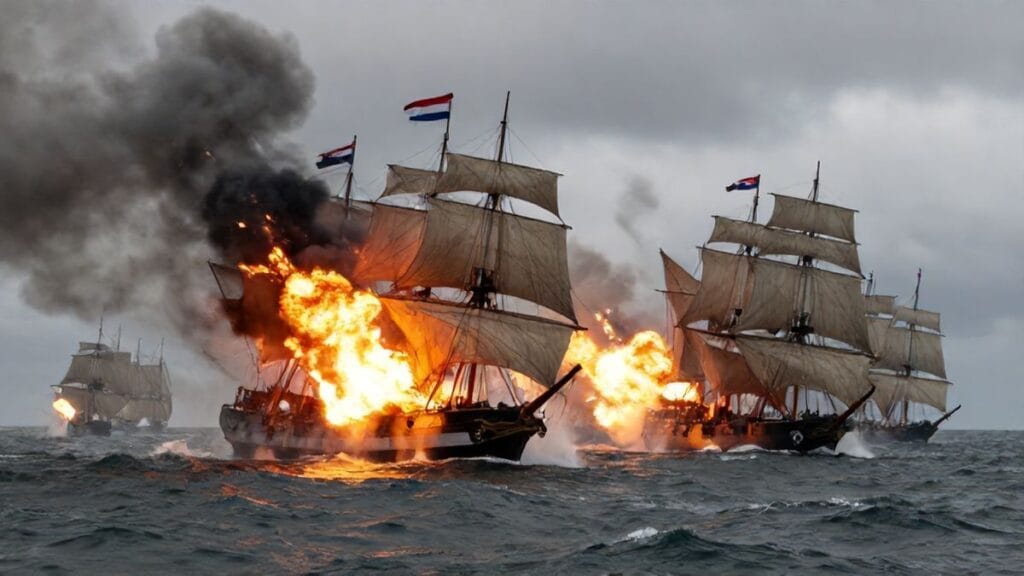
- Fire, Smoke, and Thunder: The Clashing Lines of Battle
- The Death of Edward Montagu: An Admiral’s Final Moments
- Bravery Under the Fleur-de-Lis: The French Squadron’s Controversial Role
- Infernos on the Waves: Fireships and the Terror of Close Combat
- A Battle Without a Victor: Withdrawal, Exhaustion, and Bitter Relief
- The Suffolk Coast in Shock: Survivors, Wreckage, and Local Memory
- From Solebay to the Rampjaar: Political Earthquakes in the Dutch Republic
- England Divided: Propaganda, Parliament, and Public Opinion
- Guns, Ships, and Strategy: What the Admiralties Learned from Solebay
- Remembering the battle of solebay: Myths, Paintings, and Maritime Legend
- Conclusion
- FAQs
- External Resource
- Internal Link
Article Summary: On 7 June 1672, off the windswept Suffolk coast of England, the battle of solebay erupted in a sudden blaze of cannon fire and confusion, setting the North Sea alight and engraving itself into maritime history. This article follows the road to that fateful morning, tracing the web of alliances and rivalries that dragged England, France, and the Dutch Republic into a brutal naval struggle. Through the eyes of admirals, sailors, and civilians, it recounts how an apparently quiet anchorage became the stage for one of the most dramatic sea battles of the Third Anglo-Dutch War. We explore the tactics, the use of fireships, and the bitter losses that gave the battle of solebay its haunting reputation as a victory claimed by none, but paid for by thousands. Beyond the spray and smoke, the narrative examines how the clash reshaped politics in London and The Hague, feeding suspicion, propaganda, and reform. Over time, artists, writers, and local communities along the Suffolk coast helped turn the battle of solebay into legend, even as the grim realities of war at sea remained etched in memory. In tying together strategy, human experience, and long-term consequence, the article seeks to bring this 1672 encounter back to life as both a gripping story and a turning point in European history.
Dawn Over Solebay: The Sea That Turned to Fire
The morning of 7 June 1672 broke over the Suffolk coast with the deceptive serenity that only a North Sea dawn can hold. Fishermen along the low, sweeping shore watched the light stretch across a calm but restless water, rippling like opened silk. Out beyond the sandbanks, where the safe shallow browns fell away into a deeper iron-blue, the Anglo-French fleet lay at anchor in Solebay—an inlet off Southwold—its forest of masts framed against the paling sky. Sails were furled, boats shuttled lazily between hulls, and smoke from galley fires drifted in thin grey lines. To the men aboard, it was another uneasy morning in a long campaign, the tension of war muffled by the routines of a floating city. None of them knew that within hours the sea around them would be turned into a floating battlefield of splintered timbers, burning pitch, and shattered lives.
The battle that followed—known ever since as the battle of solebay—was born out of more than sudden tactics or accidental encounter. It was the crest of a mounting wave of rivalry, religion, commerce, and power that had been gathering for decades across Europe. As the sunlight reached the anchored ships, somewhere beyond the northern horizon another fleet was bearing down upon them with deadly intent: the navy of the Dutch Republic, led by the formidable Admiral Michiel de Ruyter. The Dutch came not as raiders but as men fighting for their republic’s survival; the English and their French allies, meanwhile, were instruments of kings with ambitions that reached from the North Sea to the glittering halls of Versailles. Yet on this morning, those high political stakes were little comfort to the carpenters, gunners, and powder-boys scrambling to their stations as the first alarm rang out.
It is astonishing, isn’t it, how quickly a seemingly tranquil seascape can transform into a theater of catastrophe. Within a few hours, flames would leap from ships struck by fireships, admirals would die at their posts, and the quiet Suffolk shore would echo with cannon thunder that could be heard far inland. Villagers and townsfolk would climb dunes and church towers to gaze at the great plumes of smoke rising offshore, trying to understand the meaning of the carnage unfolding before them. This was not some distant colonial skirmish; this was war at England’s very doorstep. And yet, as we follow the course of events from the first political intrigues to that day of reckoning, we find that the battle of solebay was not merely a local drama. It was a hinge on which the wider European struggle swung, a foreshadowing of crises and coalitions that would define the late seventeenth century.
To understand the battle as more than a chaotic clash of cannon and courage, we must go back—back to the crowded markets of Amsterdam, the smoky taverns of London, the mirrored salons of Versailles. We must trace how promises whispered in private chambers sent thousands of men to die in public waters. Only then can we grasp why, when the Dutch sails finally appeared off Solebay and the alarm bells clanged aboard English ships, the outcome would reverberate far beyond the North Sea winds and the Suffolk sands.
Europe on the Brink: The Geopolitical Fuse of the 1670s
By the early 1670s, Europe was a continent straining against its own seams. The Thirty Years’ War had ended decades before, but its legacy of shifting borders, battered populations, and religious mistrust still weighed heavily on statesmen. At the heart of the continent, the Holy Roman Empire remained a patchwork of troubled principalities. To the west, Spain was declining, its once-vast empire frayed and overstretched. Rising above this landscape was the figure of Louis XIV of France, the “Sun King,” whose ambitions outgrew his already expansive frontiers. Louis looked to the Low Countries and the Rhineland with the hunger of a monarch bent on securing both glory and strategic depth.
In this volatile environment, the Dutch Republic stood out as a small but potent anomaly. A cluster of waterlogged provinces that had wrested their independence from Spain, the Republic had become a commercial and maritime giant, its merchant fleets crisscrossing the globe. Dutch bankers financed not only their own prosperity but the debts of foreign princes. Dutch shipyards set standards for efficient construction. Amsterdam’s stock exchange ticked like the beating heart of Europe’s emerging financial system. These successes, so admired by some, appeared as provocations to others—particularly to England and France, both stung and fascinated by Dutch wealth and reach.
England, under King Charles II, had already clashed twice with the Dutch in the First and Second Anglo-Dutch Wars. Those conflicts were driven by trade rivalries: who would dominate the routes to the East Indies, who would control the flow of sugar, spices, and slaves, who would dictate the price of grain and naval stores. Yet they had also been wars of prestige. English politicians and pamphleteers chafed at the sight of a republic—merchant-dominated, Calvinist, and comparatively small—outpacing a kingdom that claimed ancient traditions and monarchical dignity. The Dutch, for their part, saw English interference as an existential threat to their maritime lifeblood.
Overlaying these economic and political tensions was the religious question. Europe’s confessional wounds had never fully healed. Protestant powers watched Catholic France with wary eyes; within England itself, memories of civil war and regicide still haunted the populace, and suspicion of “popery” ran deep. Louis XIV pursued Catholic uniformity at home even as he sought to expand abroad, while the Dutch Republic sustained a complex balance of Calvinist orthodoxy and commercial pragmatism. Into this tangled fabric of faith and fear stepped secret agreements and clandestine diplomacy, the quiet prelude to the roar that would be heard off Solebay.
By 1672, the year the Dutch would later call the Rampjaar—the Disaster Year—these currents converged. The battle of solebay did not emerge from a vacuum; it was the naval flashpoint of a grand design to break Dutch power and repartition influence in northwestern Europe. To see it, though, we must look more closely at the pivotal triangle: England, France, and the Republic that both sought to bend or break.
England and the Dutch Republic: Rivals Bound by the Sea
On paper, England and the Dutch Republic might have made natural allies. Both were maritime, Protestant, and deeply entwined with trade. English cloth filled Dutch markets, Dutch capital supported English ventures, and sailors from both nations mingled in exotic ports from the Caribbean to the East Indies. Yet shared seas bred rivalry as much as cooperation. Each ship launched by an Amsterdam yard was a reminder in London of Dutch efficiency; every English Navigation Act curbing foreign shipping was received in The Hague as a targeted blow.
The First Anglo-Dutch War (1652–1654), fought under Oliver Cromwell’s Commonwealth, had been a brutal initiation into large-scale naval warfare between the two powers. Line-of-battle tactics, in which great fleets formed parallel lines to unleash coordinated broadsides, had only begun to take shape. The Second Anglo-Dutch War (1665–1667) saw that art refined, with colossal engagements like the Four Days’ Battle and the St. James’s Day Fight. English naval pride soared with spectacular victories, but was humiliated when De Ruyter led a daring raid up the Medway in 1667, burning English ships at anchor and towing away the mighty Royal Charles as a trophy.
These wars left scars not only on ships but on memory. English seamen cursed the “Hollander” with a mixture of envy and respect; Dutch sailors drank to De Ruyter with the fierce pride of a people who believed their survival depended on the sea. The battles also forged a professional cadre of officers and tacticians on both sides, men who would later meet again off Solebay with fierce, almost personal resolve. Yet, beneath the surface, there remained ties of kinship and business. Many English merchants had Dutch counterparts. Some noble families were joined by marriage. The channel between rivalry and fraternity was narrow, and politicians on both shores navigated it with varying degrees of cynicism and hope.
For the Dutch, the republic’s very heart was maritime commerce; any threat to shipping threatened the state’s core. For England, maritime strength was both shield and sword, a way to project power and protect an island kingdom. Each viewed control of the sea lanes as not just desirable but essential. This sense of necessity magnified every insult, every impounded cargo, every intercepted convoy. By the late 1660s, peace between them was brittle, more an exhausted pause than a resolution.
Into this fragile balance stepped the diplomatic maneuvers of Louis XIV and Charles II—men who saw in Dutch vulnerability an opportunity too great to ignore. As the Dutch merchant marine continued to prosper, the idea of cooperating to cut the Republic down to size gained favor in the courts of London and Versailles. The stage was set for a new conflict, but this time, the stakes would be higher, the alliances more treacherous, and the opening act would be played not in some distant sea, but within sight of English shores at the battle of solebay.
The Secret Pact: Charles II, Louis XIV, and the Road to War
Behind the heavy curtains of royal chambers, far from the tar-scented decks of warships, the fate of thousands was quietly being negotiated. In 1670, an agreement now known as the Secret Treaty of Dover bound Charles II of England to Louis XIV of France in a pact that would transform the balance of power in Western Europe. Much of our knowledge of its most sensitive clauses comes from later disclosures and surviving correspondence, but its contours are clear enough: money, religion, and war were interwoven into a single, dangerous arrangement.
Charles II, restored to the English throne in 1660 after years in exile, was constantly short of funds. Parliament, wary of royal overreach, controlled the purse strings. Louis XIV, by contrast, commanded vast resources and aspired to hegemony in Europe. In Dover, the two kings struck a deal: Louis would pay Charles a substantial subsidy, freeing him somewhat from parliamentary constraint, and in return Charles would support French plans against the Dutch Republic. There were religious dimensions too—Charles hinted at his own Catholic sympathies and discussed the possibility of a formal conversion—but in practice it was the promise of war against the Dutch that gave the treaty its sharpest edge.
The public, of course, knew nothing of the secret clauses. English merchants and many members of Parliament were hardly eager to shatter peace with a major trading partner. But Charles, dependent on Louis’s gold and tempted by dreams of naval glory and commercial primacy, moved step by step toward confrontation. He let grievances accumulate, from disputes over trade in the East Indies to alleged Dutch insults to English honor. When French troops prepared to march against the Republic by land, the English fleet was to strike by sea, pincering the Dutch in a deadly vise.
In Versailles, Louis XIV saw the arrangement in grand strategic terms. By crippling the Dutch, he could dominate the continent’s commercial arteries and loosen the web of alliances that constrained him. As the French king’s ministers calculated, Dutch ports could be coerced or conquered, Dutch allies cowed, and the Republic reduced from a proud rival to a dependent buffer. England, meanwhile, would regain some of the prestige it felt had been lost after earlier wars, and would share the spoils of trade and territory. It all sounded clean on paper.
Reality, as so often, would prove messier. The Dutch, though vulnerable, were not passive. Intelligence networks, rumor, and a keen sense of looming danger warned them that storm clouds were gathering. Michiel de Ruyter, the Republic’s admiral, worked tirelessly to ready the fleet, even as political factions in The Hague argued over how to respond to the growing threats on land and sea. When war finally broke out in 1672, the Republic would face invasion on multiple fronts. And somewhere along the English coast, a bay called Solebay would soon become the site where this secret diplomacy spilled out in the form of roaring cannon and burning ships.
Admirals, Princes, and Patriots: The Commanders Who Shaped the Day
Great battles are often remembered through the names of the men who commanded them, and the battle of solebay is no exception. On the Anglo-French side stood figures of high rank and public renown. The English fleet was under the overall command of James, Duke of York—brother to King Charles II and heir presumptive to the throne. James had significant naval experience and had already commanded in earlier wars. His presence on board gave the fleet a direct link to the royal authority, but it also made him a symbol: his safety and honor were matters of state prestige.
Beside the Duke of York sailed Edward Montagu, 1st Earl of Sandwich, a seasoned commander whose career bridged the turbulent years of civil war, commonwealth, and restoration. Sandwich had fought with distinction in earlier Anglo-Dutch conflicts and had earned a reputation for courage and competence. A man of some political subtlety as well as naval skill, he was not just an officer but a statesman of the sea. He flew his flag aboard the Royal James, a massive first-rate ship of the line that would become one of the tragic centers of the coming battle.
The French squadron, allied with the English under the terms of the Dover agreements, was commanded by Admiral Abraham Duquesne and others under the wider strategic direction of the Comte d’Estrées. The French navy was in the midst of transformation: Colbert’s reforms were building a more formidable fleet, but its tactical doctrines and its relationship with allies were still evolving. The French officers who sailed to join the English would later be praised and criticized in equal measure—praised for bravery under fire, criticized for their positioning and degree of engagement.
Opposite them, on the Dutch side, stood a man whose name would echo through the annals of naval history: Michiel Adriaenszoon de Ruyter. Born to modest circumstances in Vlissingen, De Ruyter had worked his way up from deckhand to commander, combining raw seamanship with a profoundly cool temperament under fire. To many Dutch citizens, he embodied the Republic’s stubborn resilience. He had harried English coasts, pulled off audacious raids, and steered his fleet through storms both literal and political. At Solebay, he would again be called upon to risk everything.
Alongside De Ruyter sailed Cornelis Tromp, son of the famous Marten Tromp and himself an experienced admiral. The relationship between De Ruyter and Cornelis Tromp was complex, colored by rivalries and the political struggles within the Dutch Republic between the republican regents and the supporters of the House of Orange. Yet when battle loomed, both men knew that personal tensions had to be set aside for the survival of their country. Their yellow and blue flags, flying above lines of sturdy Dutch ships, personified the Republic’s divided but still determined leadership.
These admirals and princes did not fight alone. Around them clustered scores of captains, lieutenants, gunners, carpenters, surgeons, and ordinary sailors—tens of thousands of human lives concentrated in a narrow strip of sea. The decisions made on the quarterdecks that day—when to turn, when to press on, when to break off—would decide not only tactical outcomes, but also who among those thousands would live to see another sunrise over the North Sea.
Mustering the Fleets: Life, Labor, and Tension Before the Storm
Before a single gun fired off Solebay, months of frantic preparation had gone into readying the fleets. In English dockyards from Chatham to Portsmouth, the air rang with the sharp rhythm of hammers driving home nails, the rasp of saws on timber, the shouted orders of shipwrights and officers. Casks of gunpowder were rolled along creaking piers; cannon were hoisted aboard by block and tackle; sailmakers mended and cut enormous sheets of canvas. Press gangs scoured port towns, dragging reluctant men from taverns and alleys into service. Chronic shortages of experienced seamen meant that many on the English ships were landsmen barely acquainted with the sea, let alone with the terrifying discipline of ship-to-ship combat.
In France, the relatively newer royal navy was also mobilizing. Colbert’s reforms had poured resources into arsenals like Brest and Toulon: new ships, new regulations, new uniforms and flags to symbolize the Sun King’s reach upon the waves. French sailors were drilled, their officers trained in the recently codified tactics of line-of-battle warfare. But coordinating with the English, whose officers had their own traditions and practices, would prove as much a diplomatic task as a military one. Even in the best of times, allied fleets struggled with signals, pride, and differing priorities; in the stress of sudden combat, such differences could be magnified.
On the Dutch side, shipyards along the Zuiderzee and the Maas echoed with similar activity. Yet for the Dutch, 1672 was a year of near-panic: French armies threatened on land, and other enemies circled. The Republic’s resources were strained. Still, the Admiralty Colleges scraped together men and materiel, arming stout ships with careful attention to gunnery. Dutch sailors, long used to trading voyages and earlier wars, blended professional skill with a grim understanding that failure could spell the death of their homeland’s independence. Many had families in port towns that might soon find themselves under foreign occupation.
Life aboard these ships, even before battle, was harsh. Hammocks were slung in dark, crowded gun decks where the air was a mixture of tar, sweat, and stale provisions. Discipline could be brutal, enforced by the boatswain’s rope’s end and the looming threat of the cat-o’-nine-tails. Food was salted, hard, or both; fresh water quickly turned foul. Yet there was also camaraderie: shared songs, crude jokes, the comfort of routines that kept fear at bay. On some English ships, sailors boasted that they would soon teach the “Dutchman” another lesson; on Dutch decks, men spoke in low voices of the Medway raid and promised themselves that they would not be driven back so easily.
As spring 1672 deepened, the Anglo-French fleet patrolled and watched, seeking to intercept Dutch shipping and force a decisive engagement. Eventually, they anchored at Solebay, their hulls rising and falling gently on the swell, their anchors biting into the sandy bottom. Guns were run in, crews were allowed a measure of rest. The impression, for a brief moment, was that of a great machine idling before full power was again demanded. Few expected that the enemy would come to them in such dramatic fashion, turning their place of shelter into a killing ground.
The Night Before: Anchored off Solebay, Unaware of the Trap
On the evening of 6 June 1672, the horizon off the Suffolk coast glowed with the soft pinks and purples of a nearly summer sky. The Anglo-French fleet, anchored in Solebay, presented an almost peaceful tableau to anyone watching from the shore: an irregular line of hulls, the occasional lantern flickering at a masthead, the faint caw of seabirds wheeling overhead. A gentle breeze rustled the rigging; small boats moved between flagships and tenders, carrying orders, supplies, and gossip.
Aboard the Royal James, the Earl of Sandwich conferred with his officers about the fleet’s readiness. The Duke of York’s flagship, the Prince, lay not far off, a symbol of royal presence. French ships, flying their white ensigns, occupied a segment of the anchorage that would later become central to controversy. Some captains complained about the division of positions; others were more preoccupied with getting their men some rest after long periods of vigilance. Reports about the Dutch fleet’s movements were contradictory and, in hindsight, dangerously incomplete. The English and French believed De Ruyter’s main force to be at a distance, not poised to strike at their idle anchorage.
For the sailors, the night meant routine tasks: coiling rope, cleaning weapons, double-checking powder stores, even sewing and mending clothes in the cramped quarters below. Some men wrote quick notes to loved ones, knowing that any opportunity to send them might be fleeting. Others gambled with bone dice on the gun decks, the rattle of the cubes on wood a familiar sound in an unfamiliar anchorage. At mess, salted beef and ship’s biscuit were consumed with the resigned acceptance of men who had long since given up expecting better fare.
On shore, the people of Southwold and surrounding hamlets had become used to the presence of large fleets off their coasts. Children stood on dunes to count the ships at anchor; local traders did what business they could with the men who came ashore on leave or duty. There were likely mixed feelings: the pride of hosting the king’s navy, the anxiety that war—though currently floating politely offshore—might one day wash more directly onto their beaches.
Far beyond the twilight line, unseen sails approached. De Ruyter had maneuvered his fleet with determination, seeking precisely this opportunity: to catch the Anglo-French force at anchor, unformed and unready, and strike a blow that would reverberate through both enemy nations. Dutch officers peered into the night, gauging distance and wind, preparing themselves for a dawn that would demand everything from them. According to one later account, De Ruyter himself walked the deck in quiet contemplation, aware that the tactical advantage he held that night carried with it a grave moral weight: surprise could give victory, but it would also inflict terrible losses.
As darkness deepened, lanterns on both sides blinked like scattered stars on the water. Somewhere in that stillness, the line between routine and catastrophe had already been crossed; they simply did not know it yet. But this was only the beginning…
The Ambush at Sunrise: How the battle of solebay Began in Chaos
With the first pale streaks of dawn on 7 June 1672, lookouts atop the masts of English and French ships rubbed sleep from their eyes and scanned the horizon. At first, they might have seen nothing more than the ordinary mirage of morning sea: low banks of mist, the faint suggestion of cloud. Then, almost imperceptibly, details sharpened. Dark specks where no specks should be. Lines of sail where only open water was expected. Shouts went up, voices sharpened by sudden alarm. Drums beat to quarters; cabins emptied; men ran for their posts as the word rippled from deck to deck: the Dutch fleet was upon them.
The battle of solebay had begun not with stately lines drawn up in open sea, but with a panicked scramble to turn a sprawling, anchored mass into a coherent fighting force. Anchors had to be raised, often under fire. Ships jockeyed for position, trying desperately not to collide as they swung around to face their attackers. Officers screamed orders above the rising clamor of creaking timber, flapping canvas, and the first booming reports of Dutch cannon. For a few crucial minutes—perhaps longer—confusion reigned.
De Ruyter had achieved his goal: he had surprised the Anglo-French fleet in its supposed safe harbor. His ships bore down with the wind behind them, intent on sowing disorder before the enemy could form up. Yet even surprise does not guarantee easy victory. The English and French were not inexperienced or cowardly; many captains reacted with admirable speed, cutting anchor cables, ordering sails loosed, and swinging their bows toward the incoming threat. In some cases, the anchors themselves were left behind on the seabed, sacrificed in the urgent need to maneuver.
From the shore, the scene must have been bewildering. Where a moment before lay an almost serene array, there now erupted chaos: ships wheeling, gunflashes flaring, smoke beginning to curl upward in thickening sheets. The sound reached land a little after the sight, the deep, rolling thud of broadside fire like distant storms multiplied. Villagers and townsfolk, roused by the noise, ran to vantage points with a mixture of dread and morbid fascination. Children clung to adults, trying to understand what kind of storm could cause the sea itself to roar.
Meanwhile, aboard the attacking Dutch ships, crews worked with disciplined urgency. Guns were run out; linstocks glowed as they were passed along batteries. Officers directed fire toward the most prominent English and French vessels, knowing that early hits on flagships could disrupt command and control. De Ruyter’s plan relied not only on surprise but also on concentrated violence—breaking the enemy’s capacity to coordinate before their numerical and positional advantage could be restored.
Within an hour, the battle had transformed from a lopsided ambush into something more complex: a sprawling melee of lines forming and breaking, ships crossing each other’s wakes, individual duels erupting amid the general tumult. The battle of solebay, intended by the Dutch high command as a sharp, decisive blow, was evolving into a drawn-out, brutal contest that would test every ship, every officer, every crewman caught in its expanding whirl.
Fire, Smoke, and Thunder: The Clashing Lines of Battle
Once the initial shock passed and the fleets began to find order within chaos, the battle settled—if that is the word—into the grim geometry of seventeenth-century naval warfare. Ships sought to form lines, each following in the wake of the next so that their broadsides could be brought to bear in sequence. The sea off Solebay became a maze of these formations: English and French lines struggling to cohere, Dutch squadrons maneuvering to rake or cross them.
The Duke of York, aboard his flagship, attempted to assert overall command, signaling with flags and guns amid the smoke. Sandwich, on the Royal James, steered into the heart of the fray, determined to use his powerful first-rate to blunt the Dutch assault. On the other side, De Ruyter directed his own flagship against major English units, knowing that he had to fracture their cohesion. The air was thick with powder smoke, stinging eyes and lungs. Visibility shrank; ships appeared and vanished like phantoms in a sulphurous fog.
For the men at the guns, the battle was experienced not as grand strategy but as a succession of deafening moments. “Run out!” came the order, and the heavy cannons were heaved forward until their muzzles protruded from the gunports. Target glimpsed through drifting smoke. A shouted command, the hiss of a linstock touching the priming powder, and then a stunning concussion as iron hurled forth toward an enemy hull. Recoil slammed the guns backward; crews scrambled to sponge, reload, and run out again, ears ringing, arms burning. Splinters from incoming fire scythed through flesh more horribly, in many cases, than the cannonballs themselves.
Wooden ships in close action bled like living things. Planking was smashed, railings shattered, rigging severed so that sails hung in ragged tatters. Men were thrown from the rigging into the sea; others were crushed by falling spars. Surgeons worked below decks in makeshift theaters lit by lanterns, sawing, binding, praying they would not run out of clean bandages. The cries of the wounded mingled with the constant drum of guns until it was hard to distinguish individual voices from the overarching roar.
Yet there were also moments of extraordinary discipline and skill. Captains gauged wind and current with an instinct honed by long experience, turning at just the right moment to bring a broadside to bear or to avoid being raked from stem to stern. Signal officers peered through smoke to catch the shifting flags of their admirals. On some decks, chaplains moved among the men, offering hurried prayers or absolution. According to one English contemporary, “the very ocean seemed on fire, and the air choked with the breath of war”—a vivid line that captures something of the sensory overload of such a fight.
As the hours wore on, patterns emerged. Certain ships became centers of gravity around which smaller actions swirled. Among them, none would loom larger in memory than the Royal James, where the Earl of Sandwich faced the storm with unflinching resolve.
The Death of Edward Montagu: An Admiral’s Final Moments
Edward Montagu, Earl of Sandwich, was no stranger to danger. He had seen battles before, had watched ships burn and men die. But on 7 June 1672, aboard the Royal James, he faced an ordeal of intensity few would survive. As the largest English ship heavily engaged, the Royal James drew the concentrated ire of Dutch guns and, eventually, of their deadliest weapon: the fireship.
Throughout the morning, Sandwich’s flagship traded brutal broadsides with multiple Dutch opponents. Its towering sides and thick timbers allowed it to absorb punishment that would have sunk a smaller vessel, but nothing could make it invulnerable. Cannons dismounted, masts splintered, and the deck became littered with debris and bodies. Still, the Earl maintained his post, directing fire, shifting targets, refusing to consider withdrawal. To retreat prematurely would have left other English ships exposed and risked turning a hard-fought engagement into a rout.
But Dutch tactics increasingly focused on him. Fireships—small, expendable vessels loaded with combustibles—were steered toward the Royal James, their crews prepared to lash them alongside and set them ablaze before escaping in boats. These floating torches were among the most feared instruments of seventeenth-century naval warfare. A single successful strike could doom even the mightiest ship, as flames raced up rigging and into tarred timbers.
Despite fierce resistance and desperate maneuvering, Dutch fireships succeeded in closing with the Royal James. Once contact was made, the outcome became horribly predictable. Fire gripped the English vessel, spreading faster than damage control parties could contain it. Smoke billowed upward, black and oily. Heat drove men from their stations; some leapt overboard to escape the inferno. Others fought on, trying to cut away burning spars or douse flames with what little water could be mustered.
Accounts differ in details, but they converge on the essential tragedy: the Earl of Sandwich went down with his ship. Some later narratives suggest that there were opportunities for him to escape in a boat but that he refused, unwilling to abandon his flag or his men. Whether out of duty, pride, or simple lack of opportunity, he remained aboard as the Royal James was consumed. When the ship finally sank, it carried him beneath the North Sea waves along with hundreds of officers and sailors. His body would later wash ashore, identified by those who had known him, an almost theatrical postscript to a life spent in the service of conflicting regimes and causes.
For England, Sandwich’s death was a profound shock. It robbed the navy of a skilled commander and the court of a seasoned, if at times controversial, statesman. News of his fate spread quickly, embroidered by rumor and colored by political agendas. Some used it to argue for greater resources for the fleet, others to criticize the conduct of the war or the wisdom of the Anglo-French alliance. To the men who had fought at his side, though, it was above all a personal loss: the memory of a calm figure on a burning deck, a leader who had chosen to share the fate of his ship.
Bravery Under the Fleur-de-Lis: The French Squadron’s Controversial Role
The participation of the French squadron at the battle of solebay has long been a subject of debate among historians and contemporaries alike. Allied with England under the terms of the Secret Treaty of Dover, the French were theoretically committed to fighting the Dutch with vigor. In practice, their positioning and engagement on 7 June 1672 would be scrutinized and, by some, condemned.
At the outset of the battle, the French division found itself somewhat to leeward—downwind—of the main English force. This position, troublesome for engaging directly, also spared them the worst of De Ruyter’s initial onslaught. As the battle developed, they came under attack from elements of the Dutch fleet but were not subjected to the same level of ferocity as ships like the Royal James. Some English observers later accused the French of deliberately keeping their distance, suggesting that Louis XIV was reluctant to risk his ships in a way that might unduly benefit his English ally.
French accounts, however, paint a different picture. Officers wrote of engaging Dutch opponents with determination, of maneuvering as best they could given wind and sea conditions. They highlighted instances of individual bravery, ships that took damage, and crews that endured long hours at their guns. In this version, the French had fulfilled their obligations and fought honorably, if not as decisively as some English critics might have wished.
The truth likely lies between polemic and apology. Tactical constraints undoubtedly played a role in limiting French engagement at certain phases, yet political considerations were never entirely absent. Louis XIV’s ultimate aim was French advantage, not English triumph. Preserving his growing fleet for future operations was a strategic imperative. Moreover, English domestic politics were quick to seize on any perceived slight; anti-French sentiment, always near the surface in Protestant England, made the French an easy target for blame when the battle ended without a resounding victory.
What is beyond dispute is that French participation at Solebay introduced an additional layer of complexity to the command structure and to later interpretations. Allied operations, then as now, could be hampered by differing priorities and mutual suspicions. On the decks that day, French sailors likely thought less about geopolitics and more about survival as they loaded and fired their guns. But in London coffeehouses and pamphlets, their conduct became a symbol of the ambiguities inherent in an alliance forged in secret and distrusted by many.
Infernos on the Waves: Fireships and the Terror of Close Combat
If there was any single element that gave battles like Solebay their particular horror, it was the fireship. In an age before steam or steel, naval combat was already an intimate affair—ships closed to ranges where men could see the faces of their enemies across the gunwales. But the deliberate use of vessels packed with combustibles, sent to burn others alive, added a nightmarish dimension.
The Dutch had honed the art of fireship deployment across earlier conflicts. At the battle of solebay, they used these hellish instruments with ruthless effectiveness. Small crews navigated the fireships toward their targets under heavy fire, steering with grim focus as cannonballs tore through their masts and hulls. At the last possible moment, once grappling hooks had bitten into an enemy’s rigging or rail, the crews would ignite prepared charges and scramble into boats, rowing frantically away from the inferno they had unleashed.
For those on the receiving end, the experience was pure terror. Fire was the great enemy of wooden ships; tarred rigging, oiled timbers, and stored powder made them floating tinderboxes. Even a minor blaze could rapidly spread beyond control. When a fireship successfully grappled with its victim, the victim’s crew faced a race against time: cut the grapnels, douse the flames, or abandon ship. In the chaos of battle, amid smoke and confusion, coordination was difficult. Many sailors leapt into the sea, preferring the uncertain mercy of cold water to the certainty of burning alive.
At Solebay, the destruction of the Royal James by fireship became the most infamous example of this brutal tactic, but it was not the only one. Several other vessels were set ablaze or narrowly escaped such a fate. Fireships, once spent, left eerie silhouettes of charred hulks drifting in the smoky air, sometimes colliding with other ships or slowly foundering. The psychological impact was immense: even the stoutest hearts could falter at the sight of a comrade ship consumed in flames.
Yet behind the terror lay calculation. Fireships were an economical way to threaten larger, more heavily armed opponents. In a sense, they were the guided missiles of their day, expended for a chance at disproportionate damage. Their use at Solebay underlined the Dutch navy’s willingness to employ every available means to neutralize the Anglo-French advantage in big ships of the line. It also left a deep imprint on survivors’ memories, feeding later narratives and images that would portray the battle as a scene of almost apocalyptic destruction.
A Battle Without a Victor: Withdrawal, Exhaustion, and Bitter Relief
As afternoon wore on into evening on 7 June 1672, the fury of the battle gradually began to ebb. Guns, many of them overheated and worn, were fired more slowly; powder supplies were not inexhaustible. Rigging hung ragged, sails were tattered, and decks were slick with water and blood. Both sides had suffered grievous losses—ships sunk, commanders killed or wounded, hundreds if not thousands of men dead or maimed.
The Dutch, having achieved the element of surprise and inflicted significant damage—most notably the destruction of the Royal James and the death of the Earl of Sandwich—faced a hard calculation. Their primary strategic objective had been to disrupt the Anglo-French fleet, to prevent it from uniting fully against the Dutch Republic at a vulnerable moment. In that, they had succeeded to a considerable degree. Remaining longer in close action, however, risked losing irreplaceable ships and crews. De Ruyter, ever cautious in the use of his resources, began to disengage.
On the Anglo-French side, commanders took stock of their battered formations. The Duke of York had narrowly escaped death when a cannonball passed dangerously close; indeed, at one point he was forced to transfer his flag due to damage to his ship. French losses were lighter than English, but their squadrons, too, were in no state to press an aggressive counteroffensive against a withdrawing enemy. The sea was strewn with debris and survivors clinging to wreckage. Rescue efforts, limited by the ongoing risk and the conditions, could not save everyone.
By the time the last serious exchanges of fire sputtered out, it was clear that neither side had won an unequivocal tactical victory. The Dutch had struck first and hard, inflicting notable casualties and disrupting enemy plans, but they had not destroyed the Anglo-French fleet. The English and French, for their part, had endured the surprise and prevented a total rout, yet they had lost valuable ships and men without securing an advantage commensurate to the cost.
In the immediate aftermath, there must have been a strange, hollow quiet on the water. Smoke gradually thinned, revealing the true extent of the carnage. Damaged ships limped away, some under jury-rigged masts, others towed by less battered consorts. The wounded groaned in crowded, makeshift infirmaries below decks; bodies were weighted and committed to the sea in hasty burials. Officers counted guns, men, and masts, sending reports ashore that would soon be translated into political capital or liability.
Yet behind the celebrations in The Hague and the strained justifications in London, a sober recognition took hold among professional seamen. The battle of solebay had demonstrated once again that decisive naval victory was incredibly hard to achieve when opponents were well matched in courage and technology. It had also underscored the dangers of complacency: being caught at anchor by a determined enemy was a mistake no admiral wished to repeat.
The Suffolk Coast in Shock: Survivors, Wreckage, and Local Memory
For people living along the Suffolk coast, the battle was not an abstract event reported from distant seas; it was a spectacle and trauma played out in their own watery backyard. Villagers around Southwold had watched the day’s unfolding with a mixture of awe and terror. They had seen the smoke columns, heard the thunder of guns, and perhaps even felt the shock of heavy broadsides as faint tremors underfoot. When the fighting subsided, the aftermath washed onto their shores.
Wreckage began to drift landward: splintered beams, shattered boats, the occasional intact barrel or floating chest. More harrowing were the human remnants—bodies of sailors, sometimes still in partial uniform, carried by tide and current to lonely stretches of beach. Local records and later recollections speak of such grim discoveries, though many details are lost to time. Some dead were buried in hastily dug graves near the shore; others may have been claimed and identified, especially officers whose clothing and effects set them apart.
Survivors, too, came ashore. Men who had leapt from burning or sinking ships staggered up the shingle, exhausted, soaked in salt and blood. Some were English or French, others Dutch, depending on currents and luck. In these moments, the national flags under which they had fought mattered less than the immediate need for shelter, food, and medical care. Local people found themselves tending to strangers whose languages they might not understand, yet whose suffering was unmistakably human.
Children who witnessed those days would remember them for the rest of their lives. For some, the battle became a tale told to grandchildren, embellished and blurred but always anchored in the sensory shock of fire on the horizon and bodies on the sand. Churches in the area, already old when the cannon roared offshore, became repositories of memory. In some, memorial plaques and inscriptions would later recall the battle and the men who perished. In others, the link might be more ephemeral: a note in a parish register, a local legend, a place-name hinting at shipwreck or battle.
Over time, the immediate scars faded, but Solebay—Southwold Bay—kept its association with that violent day. Painters would later imagine the scene with dramatic skies and heroic poses; antiquarians and local historians would dig through records to reconstruct the event. Yet at its core, for the people of Suffolk, the battle was a moment when the grand maneuvers of kings and admirals collided with ordinary lives, leaving behind not just stories of strategy, but the tangible memory of wreckage, rescue, and loss.
From Solebay to the Rampjaar: Political Earthquakes in the Dutch Republic
In the Dutch Republic, news of the battle of solebay arrived in the midst of a national crisis. 1672 was the Rampjaar, the Disaster Year, when the Republic faced invasion by France, England, and their allies, as well as attacks from the Bishoprics of Münster and Cologne. Dutch land defenses crumpled under the weight of French armies; towns fell, panic spread, and the legitimacy of the ruling regents was called into question. Against this backdrop, De Ruyter’s offshore clash with the Anglo-French fleet carried enormous symbolic and practical weight.
The Dutch public, besieged and fearful, seized upon any sign that their nation could still strike back. Reports that De Ruyter had surprised the enemy at Solebay and inflicted heavy losses were greeted with relief, even elation. The destruction of major English ships and the death of a senior English admiral suggested that the Republic was not yet beaten at sea. According to a contemporary Dutch pamphlet, the admiral was hailed as the “savior of the fatherland,” his actions proof that Dutch resolve had not been extinguished. The battle, though not a clear-cut strategic triumph, became a rallying point.
Politically, Solebay bolstered those who argued for continued resistance at all costs. It demonstrated that the Anglo-French fleets could be checked and that the Republic’s naval power remained formidable. This mattered greatly in a country whose identity was so closely tied to commerce and the ocean. It also strengthened the position of the House of Orange and its supporters, who used De Ruyter’s heroism to argue for stronger, more centralized leadership under William III, the young Prince of Orange.
Yet behind the celebrations lay tension. The same year would see the lynching of Johan and Cornelis de Witt, leading regents of the republican faction, torn to pieces by an enraged mob in The Hague. The currents of fear, anger, and factionalism were too strong to be calmed by a single naval engagement, however dramatic. Solebay provided a bright flare of hope in a dark time, but the darkness was deep.
In strategic terms, the battle bought the Dutch time. By disrupting the Anglo-French fleets, it complicated plans for a decisive maritime showdown and allowed the Republic to maintain some control of its sea lanes. Coupled with the dramatic decision to flood parts of the countryside by opening the dikes—the so-called Dutch Water Line—it formed part of a broader pattern of desperate, creative defense. Solebay, then, was not just a naval episode; it was a piece of the larger, harrowing puzzle of the Rampjaar, when a small republic fought for its very existence against overwhelming odds.
England Divided: Propaganda, Parliament, and Public Opinion
Across the North Sea, the impact of the battle resonated in a different but equally fraught political environment. In England, Charles II’s government had to explain to Parliament and the public why a costly naval engagement, fought within sight of English shores, had not yielded a decisive victory. The death of the Earl of Sandwich, the loss of major ships, and the failure to crush the Dutch fleet were not easily spun as triumphs.
Official narratives emphasized the bravery of English and allied crews, the surprising nature of the Dutch attack, and the heavy losses supposedly inflicted on the enemy. Pamphlets and broadsides sought to frame the battle as a hard-fought encounter in which English arms had maintained their honor against great odds. Portraits of the Duke of York, painted and circulated, depicted him as a stalwart commander who had faced danger personally—an image useful for a royal house still sensitive to questions of legitimacy after the upheavals of the previous decades.
Yet not everyone was convinced. In coffeehouses and at dinner tables, in the corridors of Parliament and the crowded streets of London, voices of skepticism and criticism could be heard. Some questioned why the fleet had been caught at anchor, apparently unprepared for a major engagement. Others criticized the reliance on French allies, whose commitment many English Protestants distrusted deeply. Anti-Catholic and anti-French sentiment intertwined with concerns about royal policy, feeding a broader undercurrent of opposition.
Members of Parliament pressed for answers. How had the money voted for the navy been spent? Were officers properly supplied? Were sailors adequately paid and motivated? The spectacle of burning ships off Suffolk’s coast made such questions more urgent. In one oft-cited line from a later parliamentary debate, an MP complained that “our fleets have become theatres upon which foreign designs are played, our own interest appearing but as a poor actor.” The suggestion that English policy was subservient to French ambitions gained traction, especially among those already wary of Charles’s closeness to Louis XIV.
The press, still constrained but increasingly assertive, amplified these tensions. While outright censorship could silence some voices, others found ways to hint, satirize, or critique. Satirical prints depicted French and English commanders in ambiguous poses; poems lamented the loss of brave men for uncertain causes. The battle of solebay thus became not only a military event but also a touchstone in the evolving struggle over who would shape English policy: king, Parliament, or a shifting coalition of interests informed by a growing public sphere.
Guns, Ships, and Strategy: What the Admiralties Learned from Solebay
Beyond the immediate shock and political spin, the battle of solebay offered hard lessons to naval professionals. Admiralties in England, France, and the Dutch Republic examined reports, interrogated survivors, and tried to piece together what had gone right and what had gone terribly wrong. In an era when naval doctrine was still being formalized, each major engagement provided a kind of laboratory for testing ideas about tactics, ship design, and fleet organization.
One lesson stood out starkly: the danger of being surprised at anchor. Admirals had long known that fleets at rest were vulnerable, but Solebay made the point with deadly clarity. Nighttime reconnaissance, improved intelligence gathering, and more flexible anchorage arrangements became priorities. English planners in particular recognized that relying on assumptions about enemy distance could be fatal; more attention would be paid in future campaigns to outpost ships, scouting, and better coordination with coastal observers.
The role of fireships was another area of focus. The Dutch success in using them against large English vessels confirmed their value as offensive tools. English and French admiralties revisited their own doctrines regarding fireship deployment and defense. How many fireships should accompany a fleet? How should ships of the line be positioned to minimize vulnerability to such attacks? The idea of stationing smaller vessels to intercept fireships before they reached capital ships gained traction.
Gunnery and line-of-battle tactics also came under scrutiny. Reports from Solebay showed that disciplined firing, maintenance of formation, and effective signaling could mitigate the disadvantages of surprise—up to a point. Captains who had kept their heads and maintained their places in the line were praised; those who had fallen into disorder were criticized or quietly sidelined. In the Dutch Republic, De Ruyter’s measured use of his fleet—his refusal to chase glory at excessive cost—reinforced his reputation as a commander who understood that preservation of force could be as important as dramatic gestures.
Ship design debates were energized by the battle’s outcomes. The loss of large, heavily armed ships like the Royal James raised questions about optimal size, armor, and maneuverability. Some argued for more, slightly smaller ships that might be less vulnerable to catastrophic fireship attacks; others insisted that first-rates, despite their risks, remained indispensable anchors of any major fleet. The tension between building a few giants or many sturdy middleweights would continue to shape naval architecture for decades.
In all these discussions, Solebay functioned both as a warning and as a template. It warned of the perils of complacency, poor intelligence, and underestimating an enemy’s willingness to take bold action. It provided a template for thinking about combined fleets, surprise attacks, and the interplay between tactical engagements and grand strategy. Long after the smoke had cleared, officers and theorists in all three navies would reference the battle of solebay as they planned for future wars that they knew, in their bones, were inevitable.
Remembering the battle of solebay: Myths, Paintings, and Maritime Legend
As the years passed, the bare facts of 7 June 1672 began to acquire the patina of legend. The battle of solebay, once a vivid, painful reality for those who had fought and lived along the Suffolk coast, became a subject for artists, chroniclers, and later historians. Memory, never a simple archive, shaped and reshaped the event according to the needs and imaginations of successive generations.
In the immediate aftermath, prints and paintings appeared depicting the battle with all the drama that brush and burin could muster. Great clouds of smoke, towering masts, leaping flames, and carefully arrayed ships filled canvases destined for the walls of admirals, merchants, and curious onlookers. One influential visual tradition emphasized the destruction of the Royal James, capturing the moment when fireships closed in on the giant English vessel, its decks a chaos of men and flame. In these images, the human scale was often dwarfed by the scale of ships and ocean, reflecting both the reality of sea combat and the period’s fascination with grand spectacle.
Dutch artists, too, found in Solebay rich material. Michiel de Ruyter was painted in heroic poses, sometimes with the battle discernible in the background—a halo of smoke and sails framing his calm, resolute face. In such works, the battle symbolized Dutch resilience against foreign aggression, a sea-born miracle that had helped save the Republic in its darkest year. French treatments tended to be more subdued, folding Solebay into a broader narrative of Louis XIV’s maritime ambitions, emphasizing French participation without dwelling overly on the battle’s ambiguities.
Written accounts varied from sober to sensational. Chronicles and official reports provided data—numbers of guns, lists of ships, casualty estimates—but popular pamphlets and later histories often embellished. Heroic last stands, stirring speeches, and improbable feats of seamanship crept into the record. One seventeenth-century English writer described the battle as “a day wherein Neptune himself did tremble at the fury of the contending nations,” a line that says more about literary taste than about marine geology, yet powerfully captures the emotional tone of how some contemporaries experienced events.
Over time, historians seeking to disentangle myth from reality returned to archival sources, comparing logs, letters, and state papers. They debated the precise numbers of ships engaged, the sequence of maneuvers, the intentions behind French positioning. Some, like the twentieth-century naval historian N.A.M. Rodger, placed Solebay within a larger arc of Anglo-Dutch naval rivalry, seeing it as emblematic of the difficulties of achieving decisive results at sea in that era. Others focused on its political reverberations, using it as a case study in how battles at the tactical level could influence grand strategy and domestic politics.
Local memory along the Suffolk coast persisted in quieter ways. Place names, local tales, and the occasional artifact found on beaches or dredged from shallow waters kept the connection alive. For residents of Southwold and its environs, the knowledge that, on a certain day in 1672, their placid bay had witnessed a convulsion of fire and steel lent an undercurrent of drama to an otherwise peaceful landscape.
Today, the battle of solebay occupies a niche in the broader tapestry of seventeenth-century European history. It is not as universally known as Trafalgar or as often invoked as later conflicts, yet among those who study the age of sail, it retains a particular fascination: a vivid example of surprise, alliance, courage, and ambiguity played out within earshot of an English shore.
Conclusion
On that June day in 1672, the quiet waters off the Suffolk coast became a crucible in which much of Europe’s tension was briefly and violently distilled. The battle of solebay was at once intensely local—a storm seen by villagers on nearby dunes—and profoundly international, drawing in kings, admirals, and sailors from three great maritime powers. It began in surprise, unfolded in chaos and courage, and ended in a kind of exhausted stalemate that satisfied no one fully, yet changed many things.
We have traced the pathways that led to that moment: the commercial rivalries between England and the Dutch Republic, the ambitions of Louis XIV, the secret diplomacy of Dover, and the mounting anxieties of the Rampjaar. We have watched as fleets were built and manned, as admirals weighed risks and opportunities, and as ordinary sailors endured the brutal realities of life at sea. We have stood, imaginatively, on the decks of flaming ships, on the beaches where the wreckage washed ashore, and in the chambers where news of the battle was turned into narrative, policy, or propaganda.
What lingers from this story is perhaps less a clear verdict of victory or defeat than a sense of the complexity of early modern warfare. Naval battles were not tidy exercises in geometry; they were messy, human, contingent. A surprise strike could falter; bravery could be undone by poor intelligence or adverse winds; alliances meant to strengthen a cause could sow distrust and division. Solebay embodied all of this. It demonstrated the power of a well-timed offensive, the terrifying effectiveness of fireships, and the resilience of men who fought on amid smoke and splinters. It exposed the vulnerabilities of kings who tried to bend the sea to their will.
In the centuries since, historians and artists have returned repeatedly to Solebay not because it provides a simple moral, but because it offers such a rich intersection of narrative threads. It is a story of individuals—De Ruyter, Sandwich, the Duke of York—caught up in forces larger than themselves. It is a snapshot of a Europe in transition, moving toward the age of great standing armies, formal alliances, and increasingly professional navies. And it is a reminder that even battles which end without a clear victor can shape the course of events in subtle yet profound ways.
Standing today on the calm shore near Southwold, with gulls crying and waves lapping gently at the sand, it is hard to imagine the roar and terror of 7 June 1672. Yet the history remains, just beneath the surface—like the timbers of an old wreck buried in the seabed, or the faint echo of cannon in the wind. To remember the battle of solebay is to recall not only a single clash, but an entire world of ambition, fear, courage, and consequence that unfolded upon the restless waters of the seventeenth-century North Sea.
FAQs
- What was the Battle of Solebay and when did it take place?
The Battle of Solebay was a major naval engagement of the Third Anglo-Dutch War, fought on 7 June 1672 off the Suffolk coast of England, near Southwold. It pitted the combined English and French fleets against the navy of the Dutch Republic under Admiral Michiel de Ruyter. - Who commanded the fleets at the battle of solebay?
The Anglo-French fleet was commanded overall by James, Duke of York, with the experienced Edward Montagu, Earl of Sandwich, as one of the senior English admirals and French squadrons under officers such as Abraham Duquesne. The Dutch fleet was led by Admiral Michiel de Ruyter, supported by other commanders including Cornelis Tromp. - Why did the battle of solebay occur?
The battle occurred as part of a wider conflict driven by commercial rivalry and political ambition. Under the Secret Treaty of Dover, Charles II of England and Louis XIV of France allied against the Dutch Republic, aiming to curb its maritime and economic power. De Ruyter sought to strike the Anglo-French fleet at anchor to disrupt their plans and protect the embattled Republic. - Who won the Battle of Solebay?
The battle had no clear, decisive victor. The Dutch achieved surprise and inflicted serious damage, including the destruction of the English flagship Royal James and the death of the Earl of Sandwich, successfully disrupting enemy operations. However, they did not destroy the Anglo-French fleet. Both sides claimed elements of success, and historians generally view the outcome as a tactical draw with strategic advantages leaning toward the Dutch. - What role did fireships play at Solebay?
Fireships played a crucial and terrifying role, especially in the Dutch attack. They were small vessels packed with combustibles, steered into enemy ships and then ignited. At Solebay, Dutch fireships were instrumental in burning and sinking the Royal James, and they posed a constant threat to other large ships of the line, contributing significantly to the battle’s destructive character. - How many ships and men were involved in the battle of solebay?
Exact numbers vary by source, but roughly 70–80 major warships and numerous smaller vessels and fireships took part on both sides combined. Tens of thousands of sailors and soldiers were aboard. Casualties likely amounted to several thousand killed and wounded, with the English suffering particularly heavy losses due to the destruction of key ships. - What were the political consequences of the battle?
In the Dutch Republic, Solebay boosted morale during the disastrous Rampjaar, reinforcing Admiral De Ruyter’s status as a national hero and buying time for further defenses. In England, the battle provoked criticism of naval preparedness and of the alliance with France, feeding parliamentary scrutiny and public suspicion about the king’s foreign policy and religious sympathies. - Why is the battle of solebay historically significant?
It is significant as the opening major naval clash of the Third Anglo-Dutch War and as a vivid illustration of seventeenth-century sea warfare—alliances, surprise attacks, line-of-battle tactics, and fireships. It also shaped subsequent strategy, influenced domestic politics in both England and the Dutch Republic, and has provided historians with a key case study in the complexities of early modern naval conflict. - Can the site of the Battle of Solebay be visited today?
While the exact battle area lies offshore, visitors can go to Southwold and the surrounding Suffolk coast to overlook the waters where the engagement took place. The coastline offers views out to the North Sea, and local museums, plaques, or historical societies sometimes feature information about the battle and its impact on the region. - How do historians know so much about the battle?
Our knowledge comes from a combination of ship logs, official reports, letters, contemporary pamphlets, and later historical research. Both English and Dutch archives preserve substantial documentation, and historians cross-compare these sources—sometimes quoting them directly, as when one contemporary wrote that “the very ocean seemed on fire”—to reconstruct the battle’s sequence and assess its wider consequences.
External Resource
Internal Link
Other Resources
- Encyclopaedia Britannica – general search for the exact subject
- Google Scholar – academic search for the exact subject
- Internet Archive – digital library search for the exact subject

